


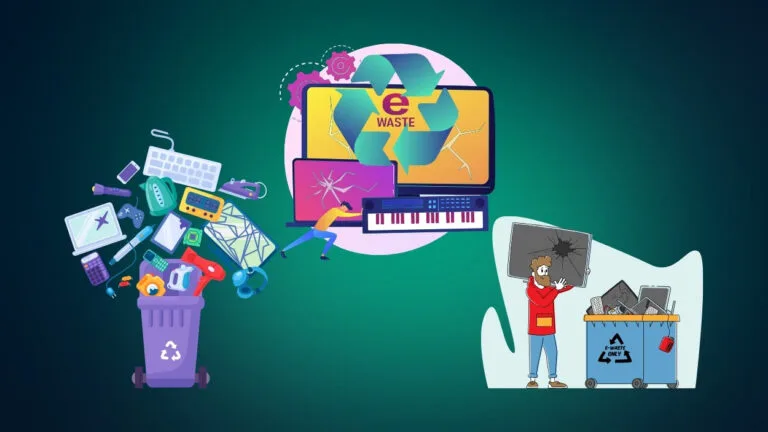

E‑waste, discarded electrical or electronic equipment, is one of the fastest‑growing waste streams worldwide. In 2022 alone, the world generated 62 million tonnes of e‑waste, driven by rapid tech adoption and shorter device lifecycles.
Businesses now rely on circular supply chains to reclaim valuable metals from devices before disposal, while cities invest in formal recycling programs to reduce landfill burden and toxic exposure. These real‑world responses highlight how e‑waste statistics directly shape industry strategies and policy agendas. Explore the data below to understand the magnitude, trends, and implications of global e‑waste generation.
Editor’s Choice
- 62 million tonnes of e‑waste were generated globally in 2022, a record high.
- E‑waste generation has risen 82% since 2010.
- Only 22.3% of e‑waste was formally collected and recycled in 2022.
- Global e‑waste is on track to reach 82 million tonnes by 2030.
- On average, people generate about 7.8 kg of e‑waste per person annually.
- Europe led regions in per capita generation at 17.6 kg per person in 2022.
- E‑waste growth outpaces recycling by nearly 5×.
Recent Developments
- A UN‑backed Global E‑Waste Monitor 2024 report highlights a steep rise in e‑waste production worldwide.
- Annual generation has increased by approximately 2.6 million tonnes per year.
- Despite greater awareness, less than a quarter of e‑waste is formally recycled.
- International E‑Waste Day 2025 raised attention to the loss of $62 billion in recoverable materials annually.
- Ongoing research reveals potential breakthroughs in metal recovery from old devices, boosting circular economy prospects.
- Policy frameworks continue to evolve globally, increasing reporting and collection requirements across jurisdictions.
- Informal recycling challenges are increasingly highlighted in international forums due to associated health risks.
E-Waste Management Market Growth Highlights
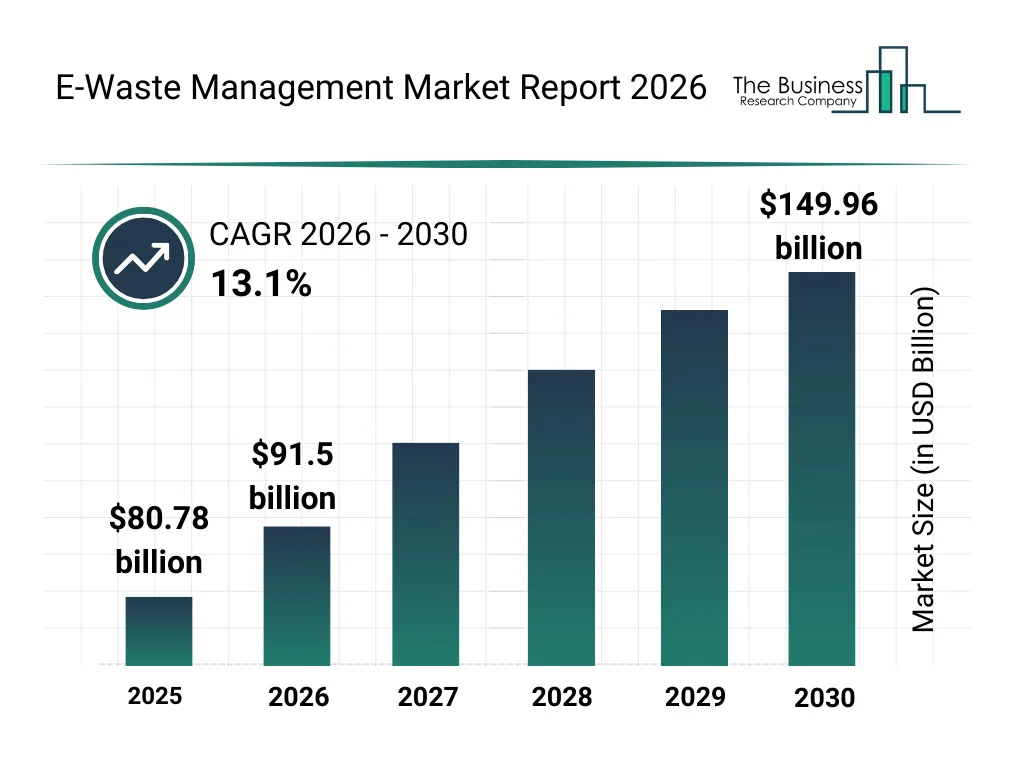
- The global E-Waste Management market was valued at $80.78 billion in 2025, establishing a strong baseline for future expansion.
- In 2026, the market is projected to reach $91.5 billion, reflecting rising adoption of structured e-waste collection and recycling programs.
- By 2027, the market size is expected to surpass $103 billion, driven by increased electronic consumption and regulatory enforcement.
- The market is estimated to grow to approximately $120 billion in 2028, supported by investments in advanced recycling technologies and circular economy models.
- In 2029, the global market value is forecast to approach $135 billion, highlighting sustained demand for responsible e-waste disposal solutions.
- By 2030, the E-Waste Management market is expected to reach $149.96 billion, underscoring the sector’s long-term growth potential.
- The market is projected to expand at a strong CAGR of 13.1% from 2026 to 2030, indicating rapid and consistent industry growth.
Global E‑Waste Generation
- 62 million tonnes of e‑waste were produced globally in 2022.
- Volume has increased 82% since 2010.
- Projections estimate 82 million tonnes by 2030 if trends continue.
- That 2022 figure equates to roughly 1.55 million 40‑tonne trucks of waste.
- Growth is driven by tech consumption, digital transformation, and shorter product lifespans.
- The annual rate of increase remains around 3%–5% per year.
- E‑waste accounts for one of the fastest‑growing segments of global waste streams.
E‑Waste Per Capita
- Global average e‑waste generation was about 7.8 kg per person in 2022.
- Europe topped regional averages at 17.6 kg per person.
- Oceania followed with 16.1 kg per person.
- The Americas recorded about 14.1 kg per person.
- African per capita generation remains the lowest among regions.
- Higher income correlates with greater electronic consumption and more e‑waste.
- Per capita figures fluctuate annually but show sustained growth overall.
Top E‑Waste Producing Countries
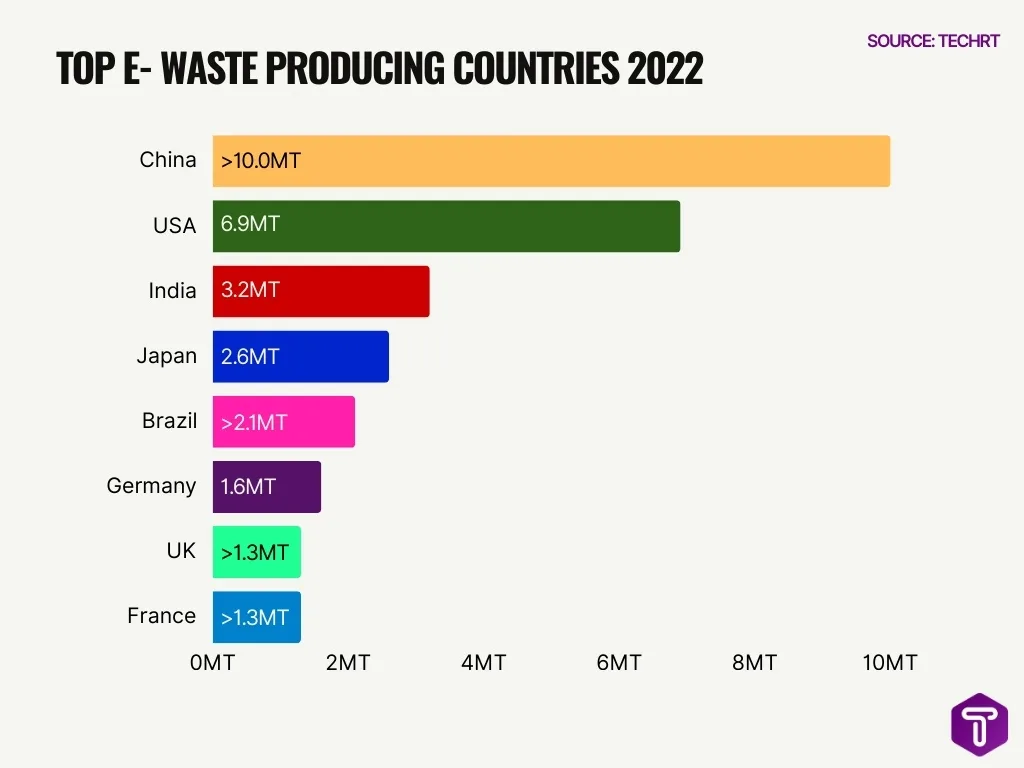
- China produced more than 10 million tonnes of e‑waste.
- The USA followed with about 6.9 million tonnes.
- India contributed approximately 3.2 million tonnes.
- Japan generated around 2.6 million tonnes.
- Brazil added more than 2.1 million tonnes to the global total.
- Germany reported about 1.6 million tonnes, with higher recycling rates.
- The UK and France each produced over 1.3 million tonnes of e‑waste.
E‑Waste by Region
- Asia generated the largest share, with around 30 million tonnes in 2022.
- The Americas followed with about 14.1 million tonnes.
- Europe produced roughly 13.1 million tonnes.
- Africa accounted for smaller volumes, but it is still growing yearly.
- Oceania contributed a minor yet notable portion of global totals.
- Regional recycling rates vary widely, with Europe achieving the highest documented rates.
- Some regions lack formal collection infrastructure, skewing documented figures lower than actual generation.
Historical Trends
- E‑waste generation has climbed sharply since 2010, from about 34 million tonnes to 62 million tonnes by 2022.
- Growth consistently outpaces documented recycling by nearly 5×.
- The pace of growth has accelerated with global tech adoption.
- Per capita waste generation rose as electronics became more ubiquitous worldwide.
- Historical recycling improvements lag behind rising volume.
- E‑waste statistics reporting became more standardised after 2014 with improved global monitoring.
- Trends indicate that without systematic changes, volume will continue climbing through 2030.
Future Projections
- Global e‑waste is projected to climb to 82 million tonnes by 2030 under current trends, roughly a 33% increase from 2022 levels.
- By 2030, documented formal recycling rates are expected to fall from 22.3% to around 20% because recycling infrastructure isn’t keeping pace.
- If formal recycling rises to 60% by 2030, global benefits, including reduced health risks, could exceed US $38 billion.
- Rare earth elements remain largely unrecovered; only about 1% of global demand is met from e‑waste recycling today.
- Forecasts suggest the pace of growth will continue at ~2.6 million tonnes per year through the decade.
- Under an ambitious scenario with improved policies, waste volumes could plateau sooner while boosting recycling uptake.
- Slower‑growth scenarios hinge on stronger product design, repair incentives, and consumer reuse.
Global E-Waste Breakdown by Equipment Type
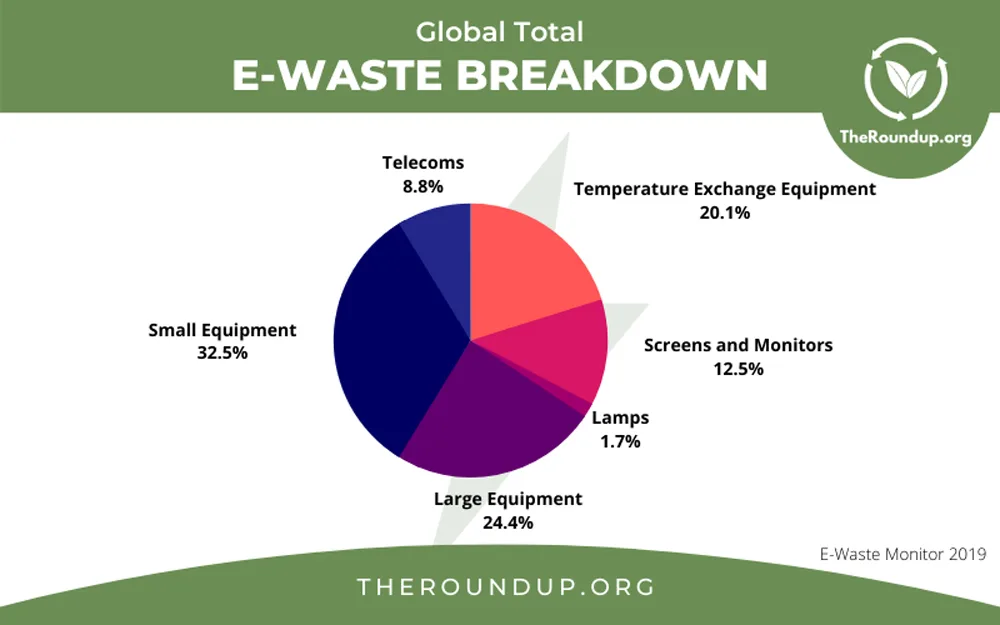
- Small equipment accounts for the largest share at 32.5%, highlighting the growing disposal of items such as toasters, cameras, and small household electronics.
- Large equipment represents 24.4% of total e-waste, driven by discarded washing machines, large printers, and industrial appliances.
- Temperature exchange equipment contributes 20.1%, reflecting significant waste from refrigerators, air conditioners, and cooling systems.
- Screens and monitors make up 12.5% of global e-waste, fueled by frequent upgrades of TVs, laptops, and computer monitors.
- Telecommunications equipment accounts for 8.8%, largely due to the rapid turnover of smartphones, routers, and network devices.
- Lamps contribute the smallest share at 1.7%, yet remain environmentally sensitive due to hazardous materials contained in lighting products.
Valuable Materials Recovered
- In 2022, e‑waste contained roughly $91 billion in recoverable raw materials.
- Only about $28 billion worth of materials was actually reclaimed via recycling.
- Copper accounted for around $19 billion, with gold at approximately $15 billion of that potential value.
- Recovering materials through urban mining avoids the extraction of vast masses of ore.
- Enhanced material recovery could strengthen supply chains for electronics manufacturing.
- Only a tiny fraction of rare earth elements are sourced from recycled e‑waste today.
- Improved recycling technology could increase recovery rates significantly.
Composition of E‑Waste
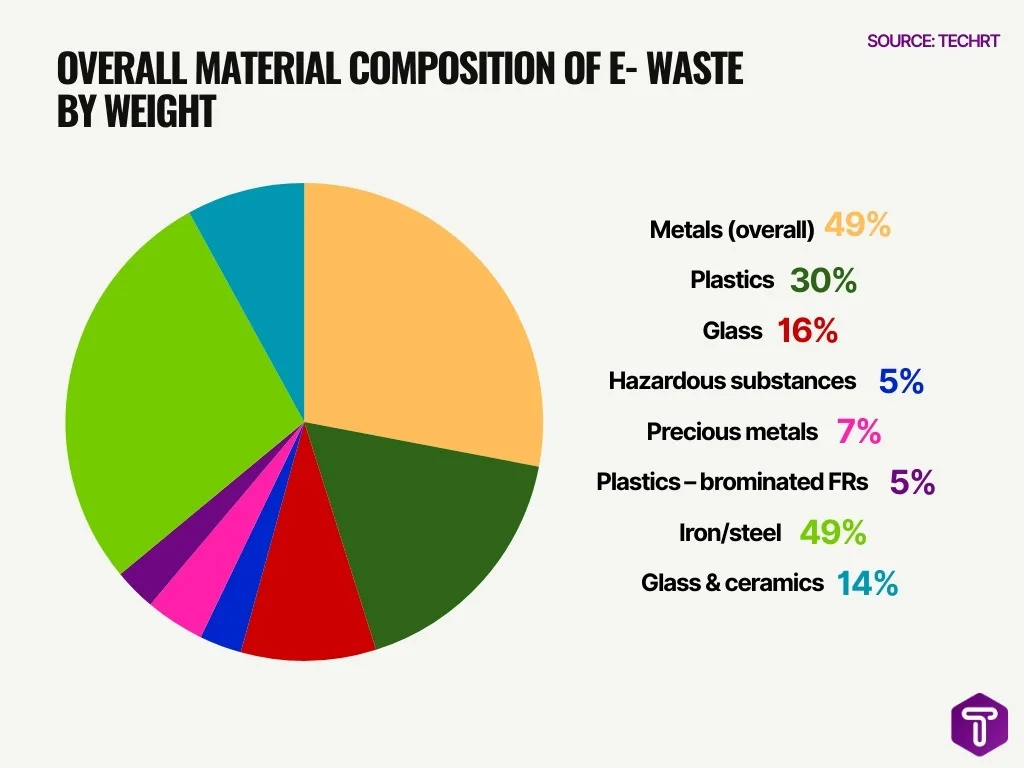
- E-waste contains 49% metals, 30% plastics, 16% glass, and 5% hazardous substances by weight.
- Precious metals like gold, silver, copper, and palladium make up 7% of e-waste value despite low volume.
- A single ton of e-waste yields 100g of gold, 2500g of silver, and 18kg of copper.
- Plastics comprise 21% of e-waste, with 5% being brominated flame retardants.
- Heavy metals include lead (2.9kg/ton), mercury (0.3kg/ton), and cadmium (0.02kg/ton) in circuit boards.
- Iron/steel accounts for 49% of total e-waste mass globally.
- Printed wiring boards hold 28% copper, 16% glass, 10% plastics, and 3% precious metals.
- Only 22% of the 62 million tonnes of 2022 e-waste was formally recycled.
- Critical raw materials recovery rate remains below 1% globally.
- Glass and ceramics constitute 14% of e-waste composition.
Economic Value Lost
- The global loss from inadequate e‑waste management was valued at around $37 billion in 2022.
- Externalised environmental and health costs contribute to this economic impact.
- Material unrecovered from e‑waste represents a missed economic opportunity worth tens of billions annually.
- Countries with stronger recycling systems capture more value domestically.
- Costs are higher in regions relying on informal techniques with low recovery rates.
- Investments in recycling infrastructure tend to yield positive economic returns.
- Circular economy models position e‑waste as a source of strategic critical metals.
Informal vs Formal E‑Waste Handling
- In many developing economies, up to 80–95% of e‑waste is processed informally, outside regulated recycling systems.
- Informal handling often uses primitive and hazardous methods, exposing workers to toxic fumes and chemicals.
- In India alone, an estimated 90 – 95% of e‑waste is managed by the informal sector, including kabadiwalas and informal collectors.
- Formal recycling infrastructure in low‑ and middle‑income countries remains limited, diverting waste to informal channels instead.
- Formal systems, where they exist, offer protective equipment and controlled processing methods, reducing direct exposure to hazardous substances.
- Informal recycling often extracts only high‑value components like copper, leaving hazardous residues untreated.
- Transitions toward formal systems are underway in some regions through policy reforms and extended producer responsibility (EPR) frameworks.
Top Countries by E-Waste Recycling Volume
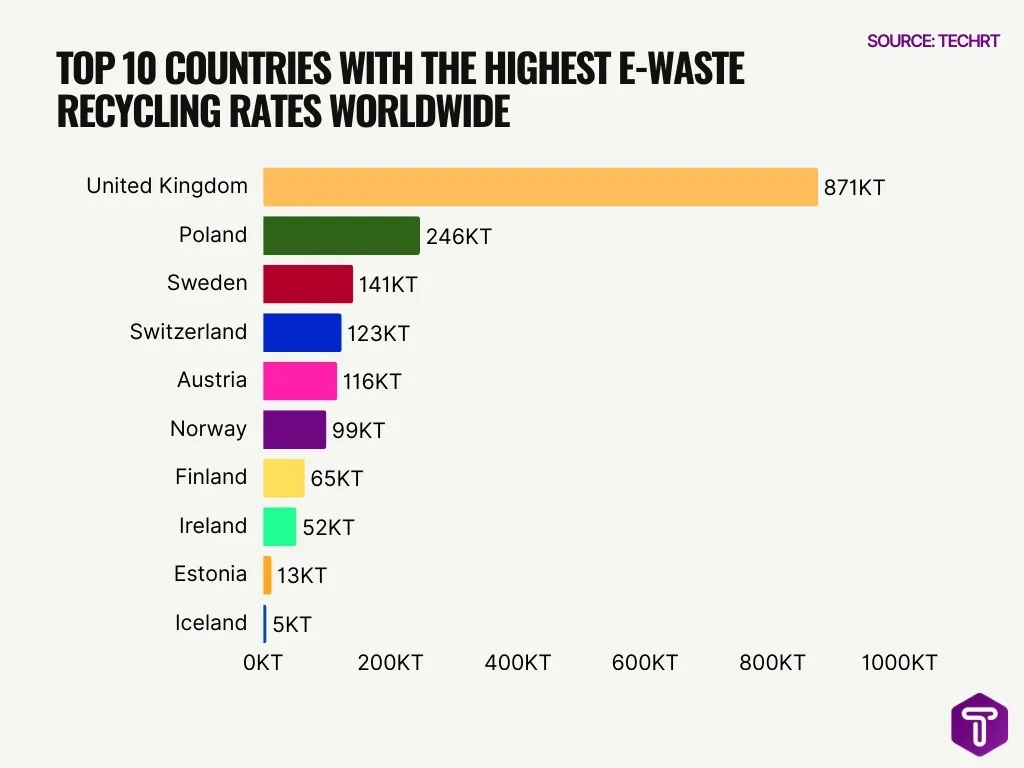
- The United Kingdom dominates e-waste recycling with 871 KT, making it the largest recycler among the top 10 countries.
- Poland secures the second position by recycling 246 KT of electronic waste, indicating a strong national recycling infrastructure.
- Sweden processes 141 KT of e-waste, reflecting its advanced environmental policies and circular economy focus.
- Switzerland recycles 123 KT, highlighting efficient collection and processing systems.
- Austria manages 116 KT of e-waste, positioning it among Europe’s leading recyclers.
- Norway records 99 KT of recycled electronic waste, showcasing consistent regulatory compliance.
- Finland recycles 65 KT, supported by high consumer participation in recycling programs.
- Ireland processes 52 KT of e-waste, showing steady growth in recycling capacity.
- Estonia recycles 13 KT, reflecting smaller-scale but structured e-waste management.
- Iceland reports the lowest volume in the ranking at 5 KT, due to its limited population and market size.
Legislation & Policy Impact on E‑Waste Data
- A formal policy push in India under the E‑Waste (Management) Rules 2022 aims to improve regulated collection and recycling.
- Enforcement of extended producer responsibility (EPR) is shifting recycling costs to manufacturers, encouraging formal processing.
- Government data shows an increase in e‑waste processed by registered recyclers, with collection and recycling percentages rising from ~62% to ~70% year on year in one national dataset.
- New policies are pushing formalisation to reduce informal handling and environmental harm.
- Globally, recycling and reporting standards remain inconsistent, leading to an underestimation of actual volumes.
- Many countries reference the Basel Convention to regulate the cross‑border movement of hazardous waste, including e‑waste.
- Policy gaps in infrastructure and enforcement still allow large volumes of informal recycling to persist.
- Stronger compliance mechanisms and incentives are shown to improve formal recycling participation over time.
Environmental & Health Impacts of E‑Waste
- E‑waste-exposed children have a geometric mean blood lead level of 7.54 μg/dL.
- 95% of studies show e-waste-exposed children with significantly higher blood lead levels than reference groups.
- Every 10 μg/dL increase in blood lead causes a 2–3 IQ point deficit in children.
- E-waste workers experience 33.1% prevalence of respiratory symptoms, vs. 21.6% in the unexposed.
- Chest tightness affects 11.8% of e-waste workers compared to 2.1% in controls.
- Breathlessness was reported in 6.8% of e-waste workers vs. 1.4% unexposed.
- Lead, cadmium, and mercury levels in e-waste sites exceed guidelines by 10–1000 times.
- Formal e-waste recycling avoids 52 million tonnes of CO2-equivalent emissions from mining.
- 93 million tonnes of CO2-equivalent emissions are prevented annually by formal e-waste management.
- E-waste greenhouse gas emissions rose 53% from 2014–2020.
Frequently Asked Questions (FAQs)
How much e‑waste was generated globally in the most recent estimate?
What share of global e‑waste was formally collected and recycled in 2022?
By how much is global e‑waste generation expected to increase by 2030?
What is the average e‑waste generated per person globally?
How much recoverable material value is lost annually due to inadequate e‑waste recycling?
Conclusion
E‑waste continues to grow rapidly, with formal recycling infrastructure lagging behind generation rates worldwide. Informal sectors process much of this waste in unsafe conditions, posing significant risks to human health and the environment while missing opportunities to capture valuable materials. Policy advancements and stronger enforcement have shown promising signs in increasing formal handling and safer recycling, yet gaps remain across regions.
As global electronics consumption climbs, the need for robust data, expanded formal systems, and protective frameworks will be essential to mitigate environmental harm and realise circular economy benefits. Continued monitoring and strategic investment in sustainable practices will shape how societies navigate the mounting challenge of e‑waste in the years ahead.

Leave a comment
Have something to say about this article? Add your comment and start the discussion.