



Android dominates the global mobile landscape, shaping how billions interact with digital services every day. App usage patterns continue to evolve rapidly as users spend more time in apps than ever before and developers push innovations in engagement and retention. This surge impacts e‑commerce, where users complete purchases via mobile apps, and entertainment, where streaming and short‑video apps lead engagement charts. Below, explore key statistics that define Android app usage today and what they mean for developers, marketers, and everyday users looking ahead.
Editor’s Choice
- In 2024, the Google Play Store accounted for 102.4 billion downloads globally, nearly three times the iOS App Store’s volume.
- Mobile apps globally are projected to reach around 299 billion downloads by 2026.
- The average user spends about 4.9 hours per day in mobile apps in 2025.
- The typical smartphone has 80+ apps installed, but users actively engage with only about 9 per day.
- Social media and communication apps dominate global monthly active user rankings.
- Android holds 72% global smartphone market share as of 2025.
- Free Android apps make up 97% of the app ecosystem, paid apps are just 3%.
Recent Developments
- Google plans to tighten app distribution controls by requiring identity verification for developers distributing apps outside the Play Store beginning in late 2026, strengthening platform security.
- The Android Instant Apps feature will be shut down by the end of 2025 due to low usage.
- Cloud security reports show malicious apps on Android have been downloaded over 40 million times in the last year, up 67% YoY, highlighting rising security concerns.
- The Google Play app catalog shrank from 3.4 million to 1.8 million apps, reflecting quality‑driven curation.
- App discovery now increasingly leverages AI‑driven tools over legacy features.
- Android continues to focus on developer safety and verification to curb malicious sideloaded installs.
- Heightened scrutiny of app permissions has accelerated the removal of dangerous apps.
Global Android App Downloads
- In 2024, global app and game downloads hit 137.8 billion, with games making up 46.9 billion of those.
- The Google Play Store alone delivered 102.4 billion downloads in 2024.
- Android accounts for 70% of all mobile app downloads worldwide.
- Downloads are projected to rise to 299 billion by 2026, continuing robust growth.
- Free apps dominate, constituting 97% of all Android apps downloaded.
- Downloads in the U.S. reached 12.6 billion in 2023.
- Emerging markets like India and Brazil show significant share growth in download volume.
- E‑commerce and fintech app downloads are trending upward, reflecting broader digital adoption.
Top Android Apps by Downloads
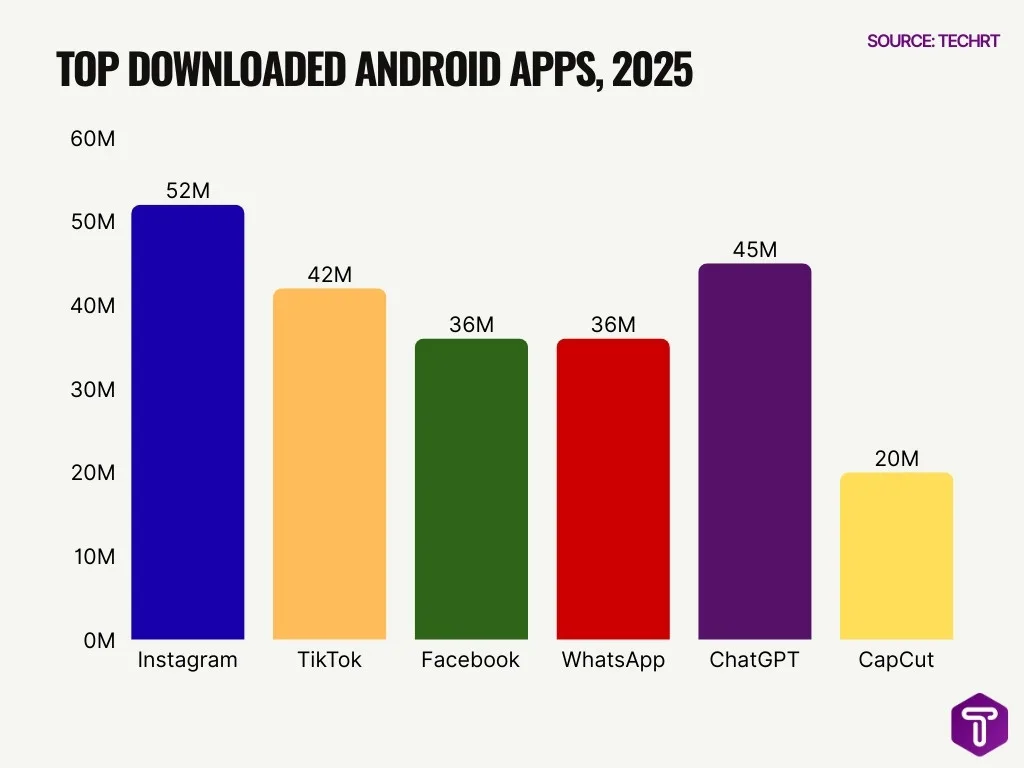
- In October 2025, Instagram led global downloads with 52 million installs.
- TikTok followed with 42 million downloads worldwide.
- Facebook and WhatsApp both registered around 36 million installs globally in the same period.
- ChatGPT ranked as the most downloaded app in some months, with 45 million downloads in September 2025.
- CapCut maintained strong positions with 20 + million installs per month.
- Telegram and Threads remain in the top 10 global download charts consistently.
- Productivity tools and utility apps (PDF readers, etc.) show rising weekly install peaks in various regions.
- Regional preferences influence app rankings, with localized apps performing strongly in specific markets.
Daily App Usage Time
- Average global time spent in mobile apps reached 4.9 hours per day in 2025.
- This marks an increase from 4.1 hours per day in prior years.
- U.S. smartphone users average 4 hours 37 minutes of daily use across apps and phone activity.
- Over 90% of mobile usage time is spent within apps rather than on the mobile web.
- Users check their phones 58 times per day, heavily boosting app engagement.
- App sessions spike during work breaks and evenings, driven by social and entertainment apps.
- Regions like Southeast Asia report even higher per‑capita usage patterns.
- Engagement remains highest in social, communication, and entertainment app categories.
Regional App Usage Statistics
- Asia-Pacific accounts for over 50% of global app downloads, leading with a 45 growth score surpassing the worldwide average of 29.2.
- India tops mobile gaming with 8.45 billion installs in FY 2024-25 and a 49 growth score driven by gaming and entertainment.
- Indonesia records a 43.1 app growth score, fueled by explosive rises in gaming sub-verticals like music (41.2) and card games (35.7).
- The US market sees 10 billion app downloads in 2025, with consumers spending $55.5 billion across apps, including high subscription engagement.
- Latin America boasts 92% smartphone penetration by 2030, with social media reach at 67.8% in Brazil and 41% ATT opt-in rate.
- Europe shows strong finance app adoption, with 85% of investment app installs from non-European providers and neobanks doubling traditional bank users in France.
- Emerging markets like India lead Android downloads with 18 billion on Google Play, reflecting affordable devices and broadband growth.
- APAC gaming sessions average 35.65 minutes, exceeding North America‘s lower frequency and indicating habitual weekly use in strong ecosystems.
- North America leads revenue per install at $0.39 after 14 days, favoring subscriptions over Asia‘s in-app purchase dominance (5.9% paying users).
Retail Mobile App Usage Frequency Among US Smartphone Users
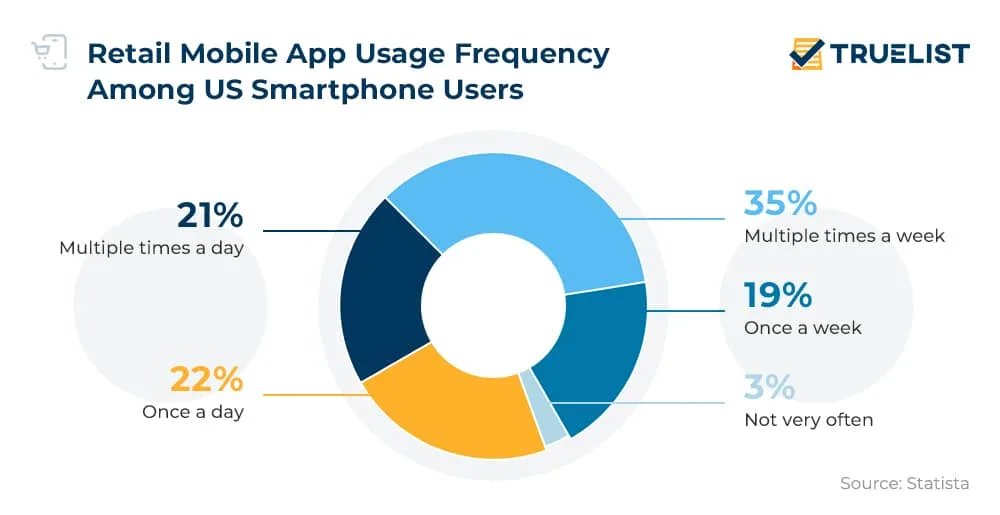
- 35% of US smartphone users access retail mobile apps multiple times a week, making this the most common usage pattern among shoppers.
- 22% of users open retail shopping apps once a day, highlighting strong daily engagement with mobile commerce platforms.
- 21% of consumers use retail mobile apps multiple times a day, indicating a highly active and loyal user segment.
- 19% of users engage with retail apps once a week, reflecting moderate but consistent usage behavior.
- Only 3% of users say they use retail apps not very often, showing minimal disengagement across the user base.
User Demographics and App Engagement
- Gen Z spends 25% of leisure time on gaming, outpacing social media at 18%.
- In India, 53.1% of Android users are aged 18-24, with 32.6% in the 25-34 bracket.
- 49% of people open apps 11+ times daily, reflecting high engagement.
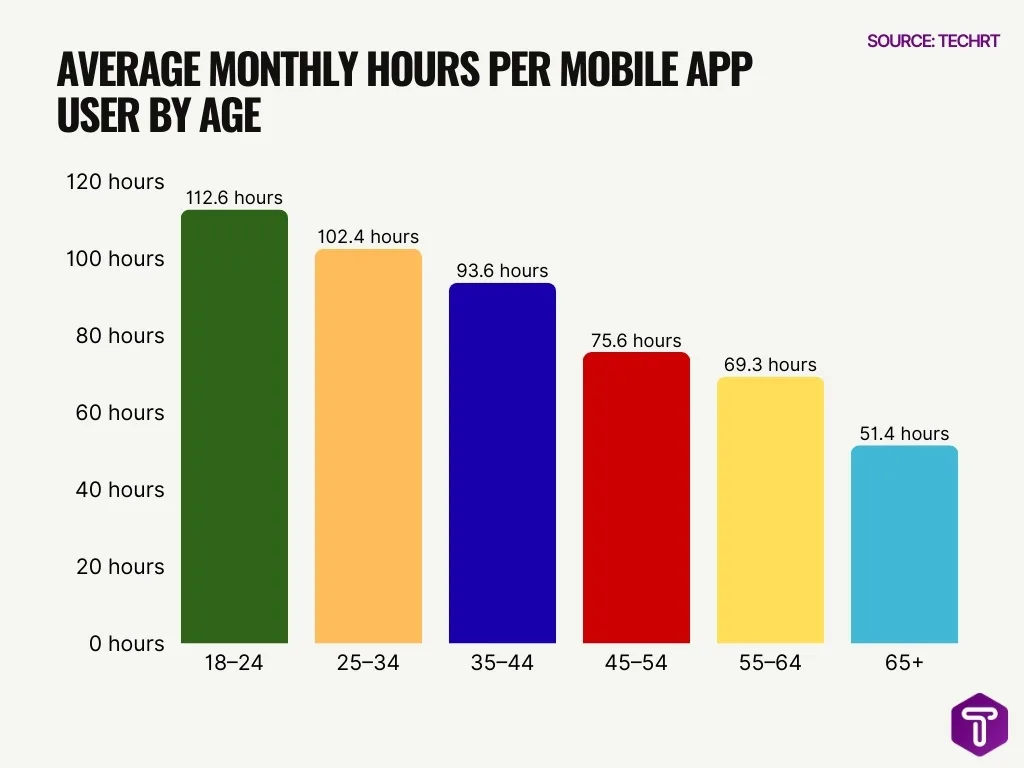
- 18-24-year-olds average 112.6 hours monthly on apps, the highest among demographics.
- College students access their primary app 11 times daily on average.
- Women are 86% more likely to purchase via mobile shopping apps.
- 55% of US consumers prefer mobile banking apps, but only 35% of baby boomers.
- Gen Z users spend 4 hours daily on apps, excluding games.
- 21% of Millennials open apps 50+ times per day.
Active Users Metrics
- Average apps lose 77% of DAU within 3 days post-install.
- Apps lose 90% of DAU within 30 days after installation.
- WhatsApp boasts 2.6 billion DAU and 3 billion MAU in 2025, with 83% DAU/MAU ratio.
- Facebook reaches 2.11 billion DAU and 3.07 billion MAU mid-2025.
- Instagram has over 2 billion MAU worldwide in 2025.
- Amazon Shopping averages 685 million MAU in Q4 2025.
- E-commerce apps average 10% DAU/MAU ratio.
- Fintech apps show 22% DAU/MAU on average.
- Social apps like Facebook exceed 50% DAU/MAU.
- A 20% DAU/MAU ratio signals strong app stickiness.
App Usage by Category
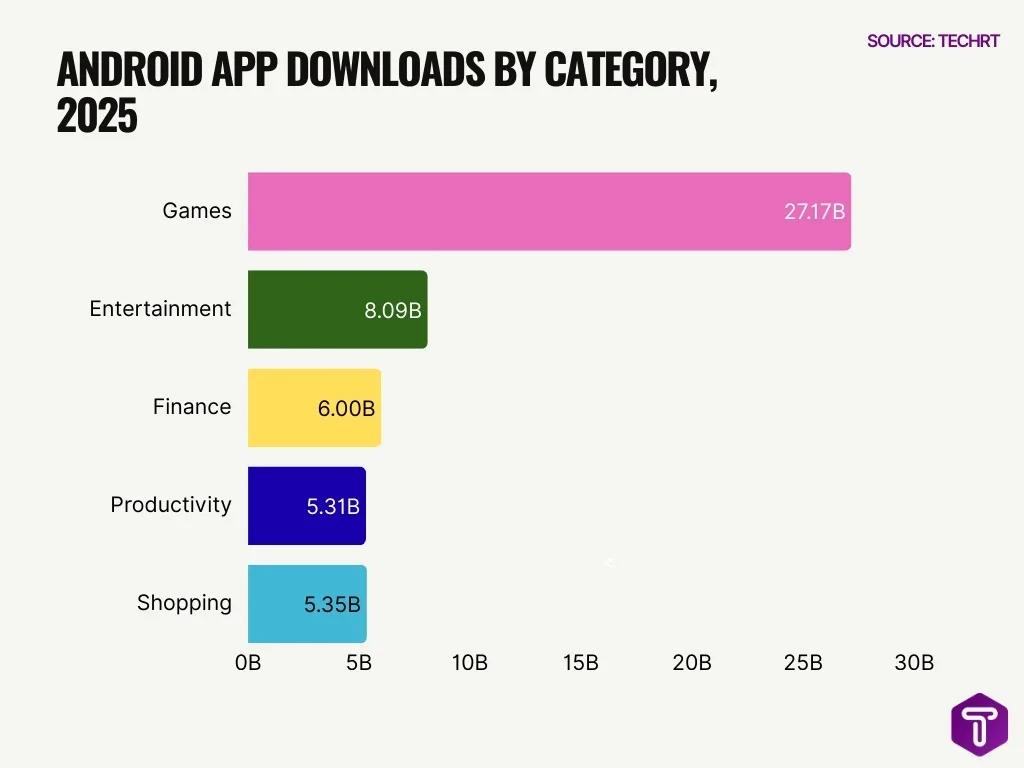
- Games consistently dominate Android usage, with 27.17 billion downloads on Google Play in 2025, far more than any other category.
- Entertainment apps rank second on Android with 8.09 billion downloads in the same period.
- Finance category downloads on Android reached 6 billion, showing strong interest in mobile banking and investment tools.
- Productivity apps logged 5.31 billion installs, reflecting rising use of work and organization tools on mobile devices.
- Shopping apps were downloaded 5.35 billion times, underscoring increasing mobile commerce adoption.
- Social apps also show high engagement, with top Android titles like Facebook and Instagram regularly in most‑used lists.
- Tools and communication categories remain crucial, with thousands of utility apps frequently installed by users.
- Lifestyle and video categories continue to grow, reflecting diverse user preferences beyond core social and recreational apps.
Popular App Categories Breakdown
- Communication apps boast a 99.93% penetration rate among Android users in the U.S.
- Tools & Utilities achieve 99.81% penetration on Android devices.
- YouTube ranks #7 in the U.S. Android top 50 apps as of January 2026.
- Amazon Shopping holds the #12 spot in U.S. Android rankings.
- Cash App secures the #21 position among top U.S. Android apps.
- Productivity apps like Google Calendar rank #30 in U.S. Android usage.
- The entertainment category garners 10.04 billion downloads globally (Nov 2024–Nov 2025).
- Gaming leads with 34.54 billion downloads, 30.82% of the total.
- Finance apps record 6.84 billion downloads worldwide.
Android vs iOS Usage Comparison
- Globally, Android holds roughly 72–75% of the smartphone operating system market share in 2026, with iOS around 25–28%.
- In 2025, Android maintained about 72.55% global mobile OS share with a user base of nearly 3.9 billion.
- In the U.S., iOS leads the market, with roughly 58% share compared to Android’s 42%.
- Over time, iOS has strengthened in the U.S., while Android remains dominant globally, especially in Asia, Africa, and Latin America.
- iOS users historically spend more per app on average, contributing a larger share of consumer revenue despite a smaller market share.
- Android’s affordability and wide range of device options drive broader penetration in emerging markets.
- App marketing spend on iOS grew significantly in 2025, while Android user acquisition spend remained relatively flat.
- Across both platforms combined, app consumer spending exceeded $150 billion in 2024, with iOS responsible for the majority.
Average Monthly Mobile App Usage by Age Group
- Users aged 18–24 spend the highest time on mobile apps, averaging 112.6 hours per month, highlighting extremely high engagement among younger users.
- The 25–34 age group records strong usage with 102.4 monthly hours, reflecting sustained daily reliance on mobile applications.
- Mobile app engagement among users aged 35–44 remains high at 93.6 hours per month, indicating consistent usage across working professionals.
- Users in the 45–54 age bracket spend 75.6 hours monthly, showing a noticeable decline as age increases.
- The 55–64 age group averages 69.3 hours per month, demonstrating moderate but steady mobile app usage.
- Seniors aged 65+ spend the least time on mobile apps, with an average of 51.4 monthly hours, reflecting lower digital adoption compared to younger demographics.
Gaming App Usage Statistics
- Global gaming revenue totaled about $187.7 billion in 2024, with projections reaching $205 billion by 2026.
- Mobile gaming alone accounted for approximately $92 billion in revenue in 2024, nearly half of total gaming revenue.
- There were an estimated 3.2 billion active mobile gamers in 2024, with growth expected through 2025.
- Casual and hyper‑casual games dominate session counts, while core gaming titles drive in‑app spending.
- Android typically leads in total game installs globally, supported by device variety and broad market reach.
- Revenue from in‑app purchases remains a primary earnings source for mobile games.
- Game categories such as puzzles and RPGs maintain high retention rates compared with other genres.
- Emerging regions are increasingly contributing to mobile gaming engagement and spending.
Social Media App Usage
- Social media apps account for 35% of total mobile usage time globally.
- U.S. users averaged 43 hours 53 minutes monthly on TikTok in 2024.
- Instagram led with 52 million global downloads in October 2025.
- TikTok topped Android downloads with nearly 65 million in February 2025.
- Gen Z spends 5.1 hours daily on social media.
- Over 5.24 billion people actively use social media worldwide in 2025.
- Average daily social media time is 2 hours 24 minutes globally.
- 70% of Facebook users engage daily.
- Mobile messaging market projected to reach $595.8 billion by 2035.
- Half of U.S. adults (50%) use Instagram.
Session Length and Frequency
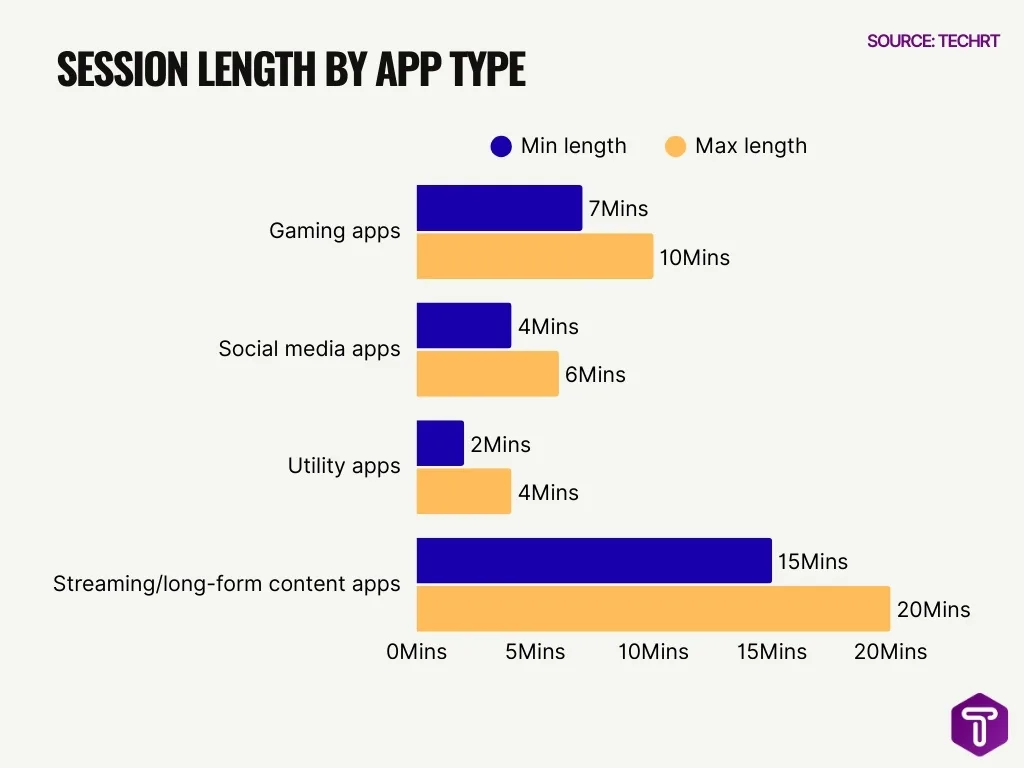
- Session length varies widely by app type, with gaming apps averaging 7–10 minutes per session and social media closer to 4–6 minutes.
- Utility apps like task managers tend to generate shorter sessions of 2–4 minutes.
- Streaming and long‑form content apps can exceed 15–20 minutes per session for engaged users.
- Across mobile users, frequent short bursts of usage are common, with many checking apps multiple times per hour.
- Session frequency is a key engagement metric; nearly half of users interact with their most used apps more than 10 times a day.
- Daily Active Users (DAU) and Monthly Active Users (MAU) ratios help track habit formation and user retention over time.
- High session frequency correlates with higher retention rates and monetization potential, especially in gaming and social categories.
- User engagement analytics emphasize session depth alongside frequency to understand overall value delivered by an app.
Average Apps per User
- On average, smartphone users install 80+ apps on their devices.
- Of those installed, users actively engage with only 9 apps per day on average.
- Utility, social, and messaging categories typically occupy the top spots among daily active apps.
- Productivity and finance apps see regular weekly engagement, especially among professionals.
- Gaming titles also factor into the average app library, though active usage varies by genre.
- Shopping and entertainment apps show increased install frequency during seasonal events.
- App fatigue trends suggest users are selective about long‑term engagement with installed apps.
- Cross‑platform users often install parallel apps across Android and iOS devices, inflating individual app counts in multi‑device households.
App Retention Rates
- Average apps retain 25% of users on day 1, dropping to 12% by day 7 and 5% on day 30.
- Gaming apps achieve 29% day 1 retention but fall to 2.3–2.4% by day 30.
- Social apps show 26.3% day 1 retention, declining to 3.9% at day 30.
- Finance apps maintain 11.6% day 30 retention, outperforming gaming‘s 2.3%.
- Productivity apps hit 4.1% day 30 retention, higher than utilities at 3.4%.
- Annual subscriptions retain 28% of users after one year, vs 11–12% for monthly.
- Push notifications boost retention 3x (nearly 190% higher) for users receiving them.
- Poor onboarding causes 90% user abandonment during the process.
- Personalized in-app messages lift 28-day retention to 61–74%.
Popular App Stores Among Smartphone Users
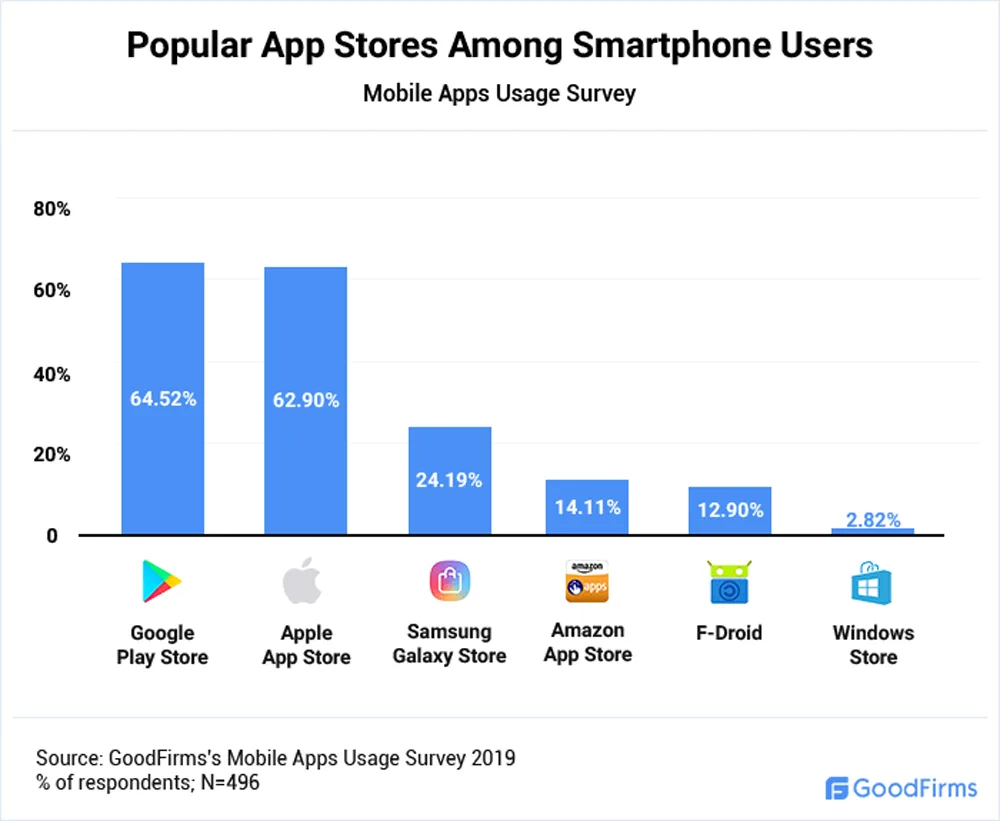
- The Google Play Store dominates the mobile app ecosystem, with 64.52% of smartphone users relying on it as their primary app marketplace.
- The Apple App Store follows closely, recording 62.90% usage, underscoring its strong presence among iOS device owners.
- The Samsung Galaxy Store is used by 24.19% of respondents, reflecting steady adoption within Samsung’s Android user base.
- The Amazon App Store attracts 14.11% of users, indicating secondary usage beyond default app stores.
- F-Droid, an open-source app platform, accounts for 12.90% usage, highlighting interest in privacy-focused and community-driven apps.
- The Windows Store shows minimal traction on smartphones, with only 2.82% of users reporting usage.
Advertising & In‑App Monetization Trends
- Global mobile ad spend reached $390 billion in 2025, reflecting strong investment in in‑app advertising.
- In‑app advertising remains a primary monetization channel for free apps.
- The in‑app advertising market is projected to expand from $182 billion in 2024 to $481 billion by 2033 at a CAGR of 12.1%.
- Mobile ad revenue accounts for a large share of overall mobile ecosystem earnings.
- Subscription models and in‑app purchases continue to grow, especially in service and entertainment categories.
- Advertisers increasingly allocate budgets to personalized and video ad formats.
- Android’s broad user base provides high ad inventory despite iOS often delivering stronger per‑user revenue.
- Social platforms and games capture significant portions of in‑app monetization spend.
Market Forecasts & Future Growth Predictions
- The global mobile app market is expected to exceed $673 billion by 2025, driven by downloads, usage, and commerce.
- Sensor Tower data projects continued growth in app downloads through 2026 and beyond.
- Mobile apps are forecast to reach nearly 300 billion global downloads worldwide.
- Consumer spending on apps is projected to grow as subscription and in‑app purchase models mature.
- Expansion of 5G and mobile internet access will further fuel engagement and monetization opportunities.
- AI integration in app experiences is expected to enhance personalization and retention outcomes.
- Emerging markets will continue contributing the most new downloads and active users.
- Cross‑platform development and cloud services will shape app delivery and scalability.
Frequently Asked Questions (FAQs)
How many global app downloads did Google Play record in 2024?
What percentage of the global smartphone market does Android hold as of 2025?
How many apps were available on the Google Play Store in 2025?
How many apps are projected to be downloaded worldwide by 2026?
What share of Android apps on Google Play are free versus paid?
Conclusion
Android app usage reflects broader trends in mobile engagement, global market share, and monetization strategies. Android remains the dominant global platform, while iOS leads key markets like the U.S. Gaming and social apps continue to shape user behavior, with advertising and in‑app purchases as major revenue drivers. Retention remains essential for long‑term success as average apps per user grow alongside evolving monetization models. Market forecasts point to sustained growth in downloads, revenue, and innovation through and beyond, underscoring mobile apps’ central place in everyday digital life.

Leave a comment
Have something to say about this article? Add your comment and start the discussion.