




Social media is no longer a fringe communication channel; it is woven into daily life around the world. An estimated 5.66 billion people, roughly 69% of the global population, actively use social media each month, up from about 5.24 billion the year before. This growth spans personal entertainment, news consumption, online commerce, and cultural movements that shape how individuals and organizations interact online.
For marketers, social platforms are essential for reaching audiences, while for individuals, they remain primary spaces for connection and expression. In this article, we break down the latest social media usage data and explore what it means for users, businesses, and digital trends and beyond.
Editor’s Choice
- ~5.66 billion people use social media worldwide in 2026.
- Social media now reaches 68.7% of the global population.
- Social media usage grew by roughly 4.8% year over year.
- The average global daily time spent on social media is about 2 hours 20 minutes to 2 hours 41 minutes.
- YouTube and Facebook remain the most used platforms in the U.S., with 84% YouTube and Facebook remain the most used platforms in the U.S., with 84% and 71% adult usage, respectively.71% adult usage, respectively.
- Mobile devices account for ~92% of social media access.
- Users engage with multiple platforms, averaging 6 to 7 platforms per month.
Recent Developments
- Social media usage continues to expand globally, with millions of new user identities added each year.
- Platforms are adapting to shifting user behavior, privacy expectations, and regulatory pressure.
- Fragmentation of platform preferences is increasing, especially in the U.S., as users split attention across video, messaging, and community‑driven platforms.
- AI‑powered recommendation systems increasingly shape how users discover and engage with content.
- Short‑form video remains central to engagement strategies across nearly all major platforms.
- Social commerce features continue to expand, allowing users to browse and purchase without leaving apps.
- Policy changes and safety concerns influence teen usage patterns and parental oversight.
- Cross‑platform integration, such as messaging combined with payments or marketplaces, is becoming more common.
Global Social Media User Growth Trends
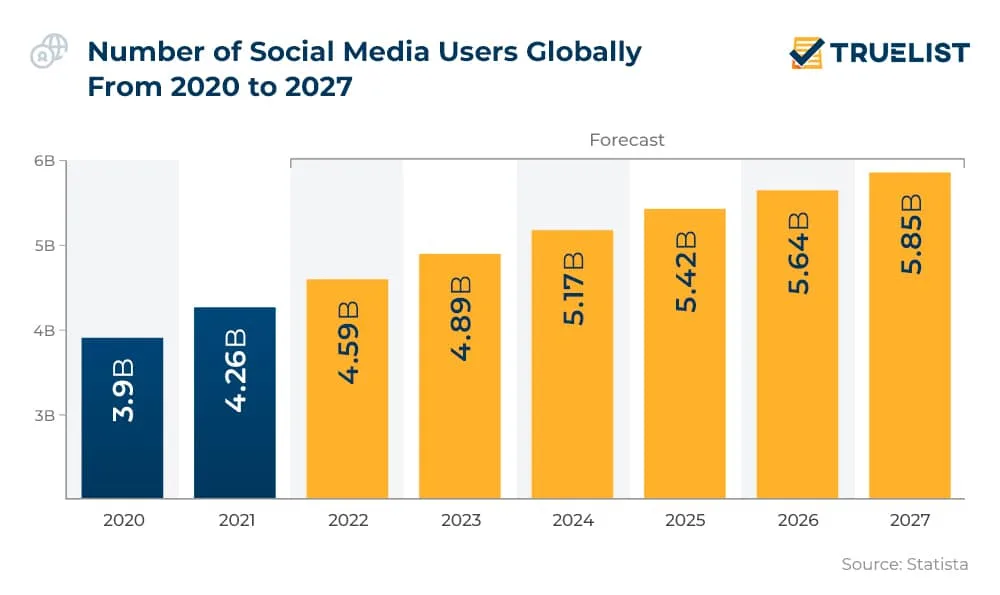
- The global social media user base grew from 3.9 billion users in 2020, reflecting rapid digital adoption worldwide.
- In 2021, total users increased to 4.26 billion, marking a strong year-over-year expansion.
- By 2022, social media platforms reached 4.59 billion users, showing sustained global engagement.
- The number of users climbed to 4.89 billion in 2023, indicating continued mainstream penetration.
- Forecasts show users surpassing 5.17 billion in 2024, crossing a major global milestone.
- In 2025, global social media usage is projected to reach 5.42 billion users, driven by mobile-first markets.
- User growth is expected to rise further to 5.64 billion in 2026, fueled by emerging economies and new platforms.
- By 2027, the worldwide social media audience is forecast to hit 5.85 billion users, highlighting long-term digital connectivity growth.
Social Media Penetration Rate
- Global social media penetration now sits at about 68.7% of the population.
- Penetration among internet users is much higher, exceeding 90% in many regions.
- Some countries report penetration rates above 100%, indicating multi‑account ownership.
- Growth in penetration reflects expanding mobile connectivity in emerging markets.
- Regions with limited internet infrastructure continue to lag in adoption.
- Urban populations consistently show higher penetration than rural populations.
- Platforms localized for language and culture accelerate regional adoption.
- Penetration rate remains a key benchmark for advertisers assessing market maturity.
Platform User Numbers
- Facebook remains one of the largest platforms globally with over 2.9 billion monthly active users.
- TikTok has surpassed 1.2 billion users and continues to grow rapidly.
- Instagram, WhatsApp, and YouTube each exceed one billion users worldwide.
- Over 92% of users access social media primarily via mobile devices.
- Newer and niche platforms continue to gain traction among specific demographics.
- Short‑form video platforms show the fastest growth rates globally.
- Mature platforms still add users but at slower, more stable rates.
- Southeast Asia and Latin America show particularly strong platform adoption momentum.
Top Platforms Worldwide
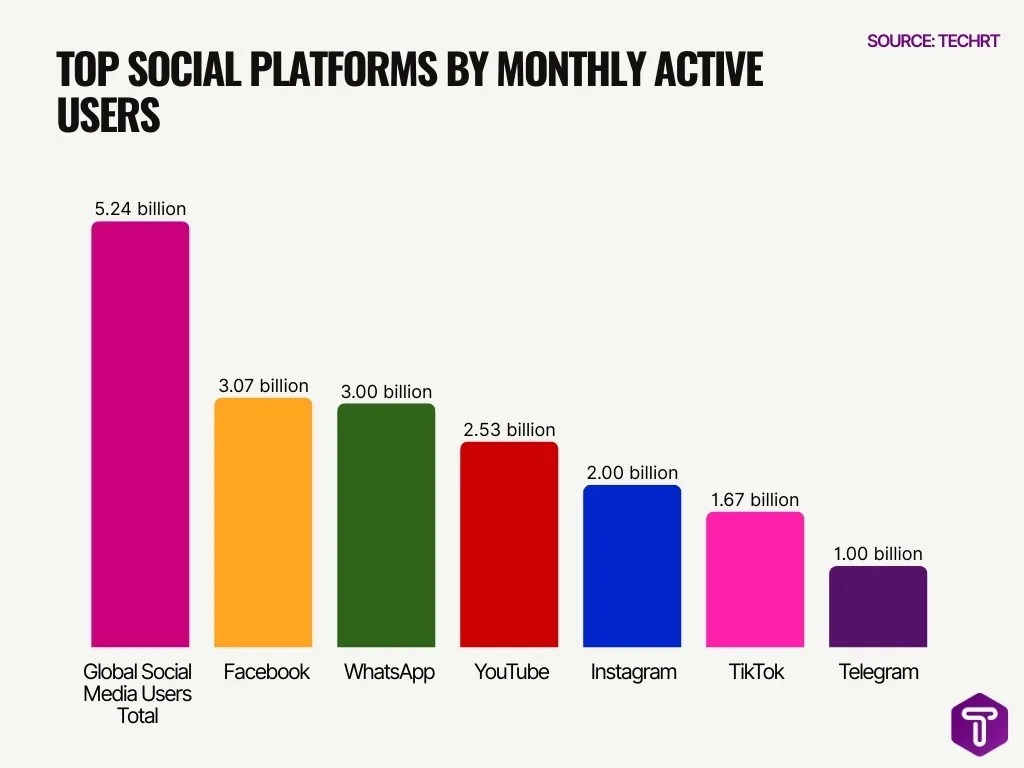
- Facebook boasts 3.07 billion monthly active users worldwide in 2025.
- YouTube has 2.53 billion monthly active users globally as of 2025.
- WhatsApp reached over 3 billion monthly active users in 2025.
- TikTok commands 1.67 billion monthly active users entering 2026.
- Snapchat reports 477 million daily active users in Q3 2025.
- Reddit achieves 116 million daily active users with 19% YoY growth.
- Telegram hits 1 billion monthly active users as of 2025.
- Instagram secures 2 billion monthly active users worldwide.
- Global social media users total 5.24 billion, with Facebook covering over half.
Platforms Per User
- The average person engages with about 6.8 social media platforms per month.
- Multi‑platform usage reflects different needs, including messaging, video, news, and communities.
- Nearly 96% of internet users use at least one social platform monthly.
- Messaging apps such as WhatsApp and Telegram are often counted alongside traditional social networks.
- Many users maintain multiple accounts for personal and professional use.
- Younger adults often use 8 or more platforms, while older users average fewer.
- Most users visit 3 to 5 platforms daily for content discovery.
- Visual and video platforms show the highest repeat engagement.
Average Time Spent Daily
- The global average time spent on social media is about 2 hours and 24 minutes per day.
- This equals roughly 141 minutes daily across platforms.
- Daily usage levels have remained relatively stable year to year.
- Users spend close to 19 hours per week on social media on average.
- Some Latin American and African markets exceed 3 hours per day.
- Short‑form video drives a significant share of total time spent.
- Mobile devices account for the majority of daily social media usage.
- Messaging, browsing, live video, and short clips all contribute to time spent.
Average Daily Time Spent on Social Media by Country
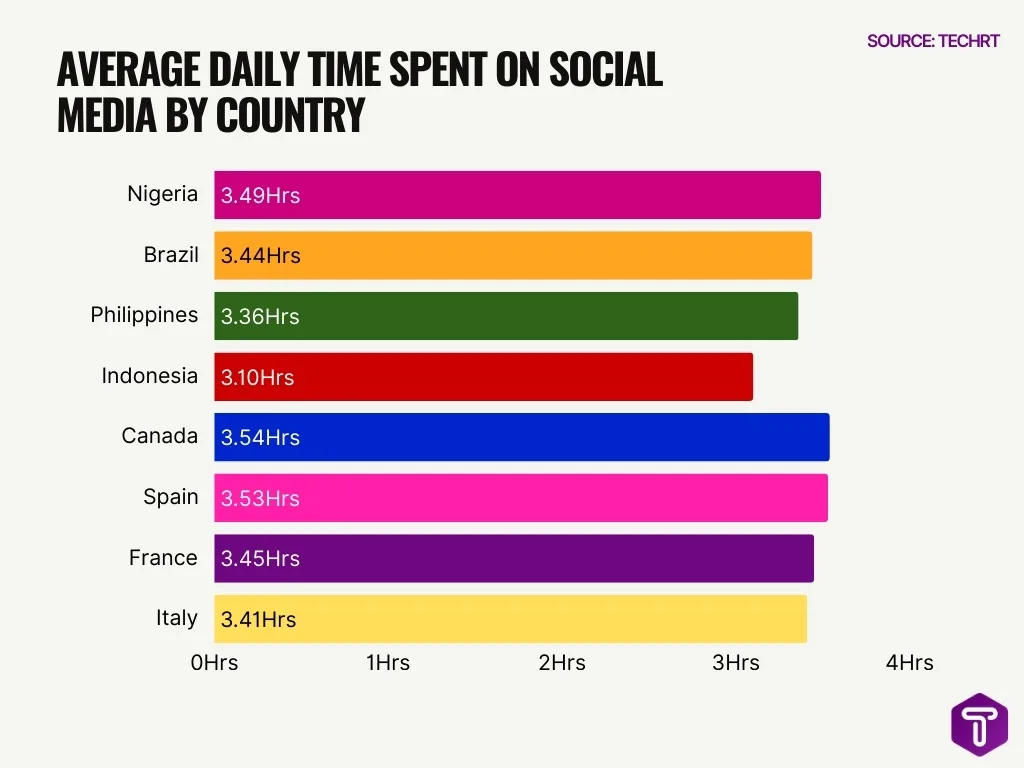
- Canada records the highest social media usage, with users spending 3.54 hours per day on average.
- Spain follows closely, with an average daily social media time of 3.53 hours, highlighting strong engagement levels.
- Nigeria shows high platform adoption, as users spend 3.49 hours daily on social media.
- France maintains steady usage, with an average of 3.45 hours per day spent across social platforms.
- Brazilian users dedicate 3.44 hours daily to social media, reflecting widespread mobile and app usage.
- Italy reports consistent engagement, with users spending 3.41 hours per day on social networks.
- The Philippines sees heavy social media consumption, averaging 3.36 hours daily per user.
- Indonesia ranks lowest among the listed countries, yet it still records a substantial 3.10 hours per day spent on social media.
Usage by Demographics
- Gen Z spends 81% more than 1 hour daily on social media, with 60% exceeding 3 hours.
- 95% of ages 18-29 use YouTube, 80% Instagram, engaging multiple features daily.
- 40% of 30-49-year-olds use social media for news, favoring community platforms.
- 74% of adults 50+ use social media regularly, primarily Facebook for family ties.
- 64% of 65+ use YouTube, 57% Facebook, mainly to stay in touch.
- Urban users show 55% Instagram adoption vs 37% rural.
- Higher SES correlates with more platforms used and higher frequency.
- College graduates use 58% Instagram, 37% LinkedIn, vs 41% TikTok for high school.
- Individualistic cultures show a r=0.450 correlation with higher engagement.
Usage by Gender
- Global usage shows relatively balanced participation between men and women.
- In some datasets, males represent about 53% of total social media user identities.
- Gender differences are more pronounced at the platform level than overall.
- Visual platforms often show higher female engagement in many regions.
- Messaging and gaming‑adjacent networks sometimes skew male.
- Gender gaps have narrowed as platforms diversify content formats.
- Marketers often tailor campaigns to platform‑specific gender patterns.
Social Media Platform Usage by Age Group
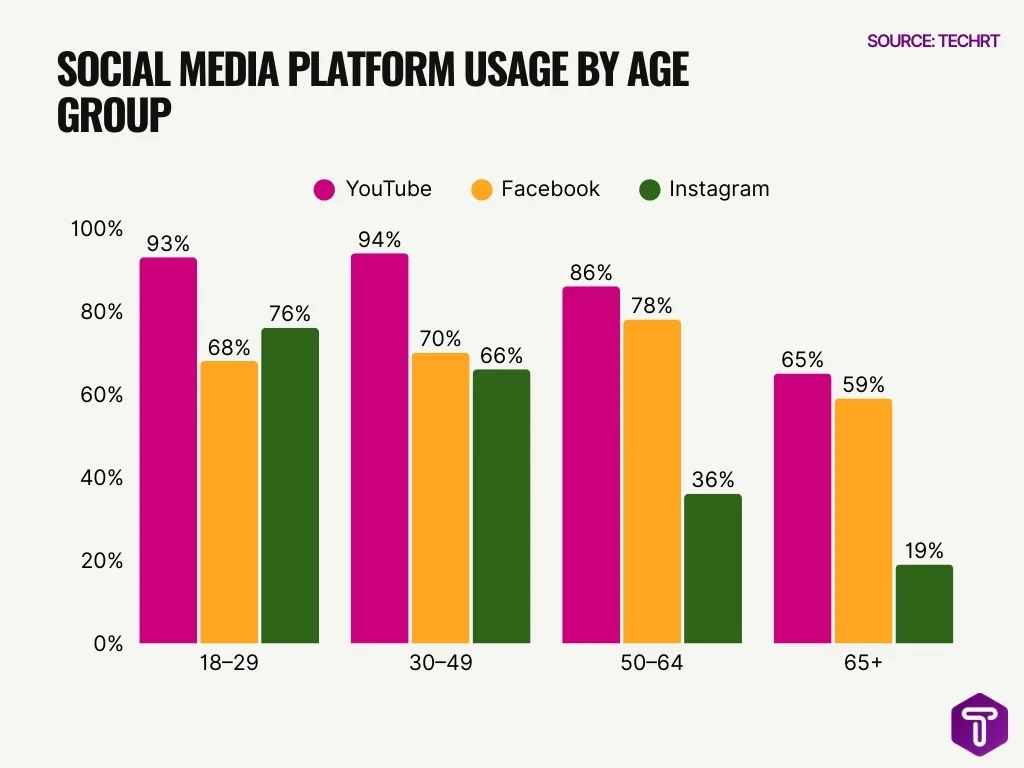
- YouTube dominates across all age groups, reaching 93% of users aged 18–29, peaking at 94% among 30–49, and maintaining strong usage at 86% for 50–64 and 65% for 65+ audiences.
- Instagram is most popular among younger users, with 76% adoption in the 18–29 age group and 66% among 30–49, before dropping sharply to 36% for 50–64 and just 19% for 65+ users.
- Facebook shows a stronger appeal among older demographics, with usage rising to 78% in the 50–64 age group and remaining substantial at 59% among users aged 65+.
- YouTube consistently outperforms Facebook and Instagram in every age category, highlighting its cross-generational reach and content versatility.
- Instagram usage declines significantly with age, falling by 57 percentage points from 18–29 (76%) to 65+ (19%), reflecting its younger audience concentration.
- Facebook maintains relatively stable usage across age groups, ranging from 68% to 78% for users aged 18–64, indicating its broad demographic appeal.
Usage by Region
- North America sees 72.5% social media penetration, with users averaging 2 hours 8 minutes daily.
- Latin America users in Brazil and Colombia exceed global averages at 3h 34m and 3h 22m daily.
- Africa leads with Kenya at 4h 13m daily usage amid 67.1% mobile penetration rising to 78.3% by 2030.
- The Middle East, like Saudi Arabia, averages 3h 10m daily, surpassing global norms.
- Europe boasts 78.7% penetration in Northern regions with 1h 59m average daily usage.
- Asia varies widely: the Philippines is at 3h 33m high, and Japan is low at 46m above sea level.
- Regional content in Hindi drives 65% page views, boosting 47% YoY growth.
- Messaging apps like WhatsApp hold 85% penetration in Brazil, where networks lag.
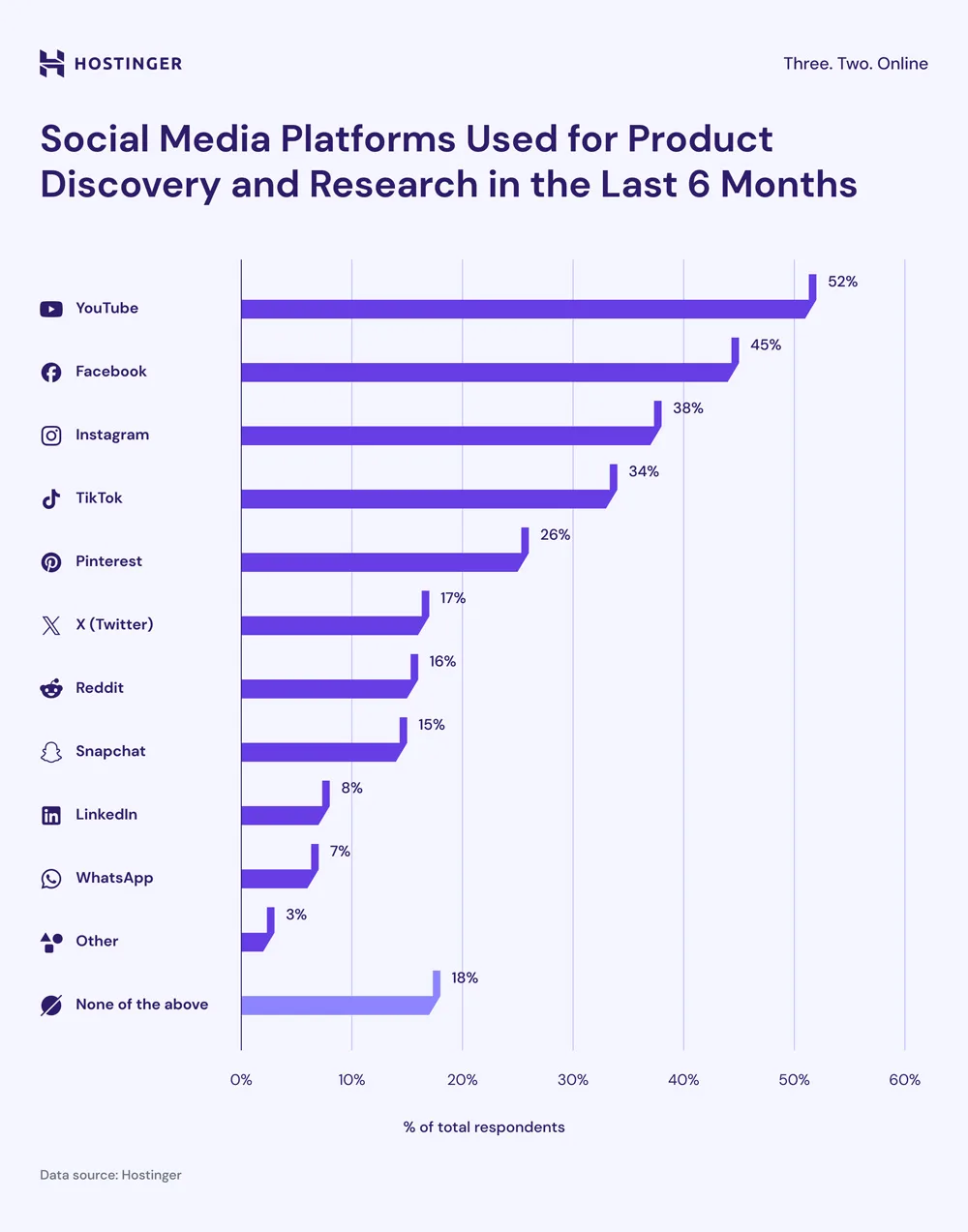
Social Media Platforms Used for Product Discovery and Research
- YouTube leads product discovery, with 52% of respondents using the platform for researching products through reviews, tutorials, and influencer content.
- Facebook remains a strong research channel, as 45% of users rely on it for product recommendations, brand pages, and social proof.
- Instagram plays a major role in visual product discovery, with 38% of respondents using the platform to explore brands and trending products.
- TikTok is rapidly influencing purchase research, with 34% of users turning to short-form videos for authentic product insights.
- Pinterest supports inspiration-led product research, used by 26% of respondents for planning and idea discovery.
- X (Twitter) contributes to real-time product discussions, with 17% of users researching products via trends and conversations.
- Reddit serves as a trusted peer-review platform, with 16% of respondents using community discussions for honest product feedback.
- Snapchat has limited but notable research usage, with 15% of users exploring products through stories and creator content.
- LinkedIn plays a niche role in product research, used by 8% of respondents, mainly for B2B and professional tools.
- WhatsApp is minimally used for product discovery, with only 7% of respondents relying on private group recommendations.
- Alternative platforms contribute marginally, as just 3% of users reported using other social networks for research.
- A significant share avoids social platforms entirely, with 18% of respondents stating they used none of the above for product discovery.
US Social Media Users
- In 2026, the U.S. had about 254 million social media user identities, or roughly 73% of the population.
- 84% of U.S. adults use YouTube, making it the most widely adopted platform.
- 71% of U.S. adults use Facebook, maintaining a strong national reach.
- About 50% of adults use Instagram, driven by visual content consumption.
- 37% of U.S. adults use TikTok, reflecting rapid mainstream adoption.
- 32% use WhatsApp, showing growth in messaging‑based social platforms.
- 26% use Reddit, indicating strong niche engagement.
- 25% use Snapchat, skewing younger.
- 21% use X, primarily for news and commentary.
Social Media Growth Trends
- U.S. adoption remains above global averages, with roughly 73% penetration.
- The total U.S. user base continues to grow steadily year over year.
- Younger demographics drive growth on TikTok, Reddit, and emerging platforms.
- Legacy platforms show slower growth but stable engagement.
- Platform switching behavior is becoming more common among U.S. users.
- Short‑form video and social commerce features fuel engagement growth.
- Smartphone adoption continues to support usage expansion.
- Algorithm‑driven discovery influences retention and growth patterns.
Advertising Reach Stats
- Social media reaches 246 million Americans monthly, 72.5% of the population.
- US digital ad impressions total 16.3 trillion in 2025, up 7% YoY.
- YouTube ads reach 2.53 billion users globally with strong US penetration.
- Meta platforms target 253.5 million US adults for advertising.
- Social media ad spend hits $83.3 billion in the US, 11% growth from 2024.
- Social media captures 50.7% of tracked US digital ad spend in 2025.
- 80% of marketing leaders shift budgets toward social media channels.
- 71% of consumers favor precise targeted ads on social platforms.
- Gen Z encounters gamified ads at 38% exposure, exceeding older cohorts.
- New formats like Reels account for 35% of Instagram time spent.
Social Media Business Statistics Highlights
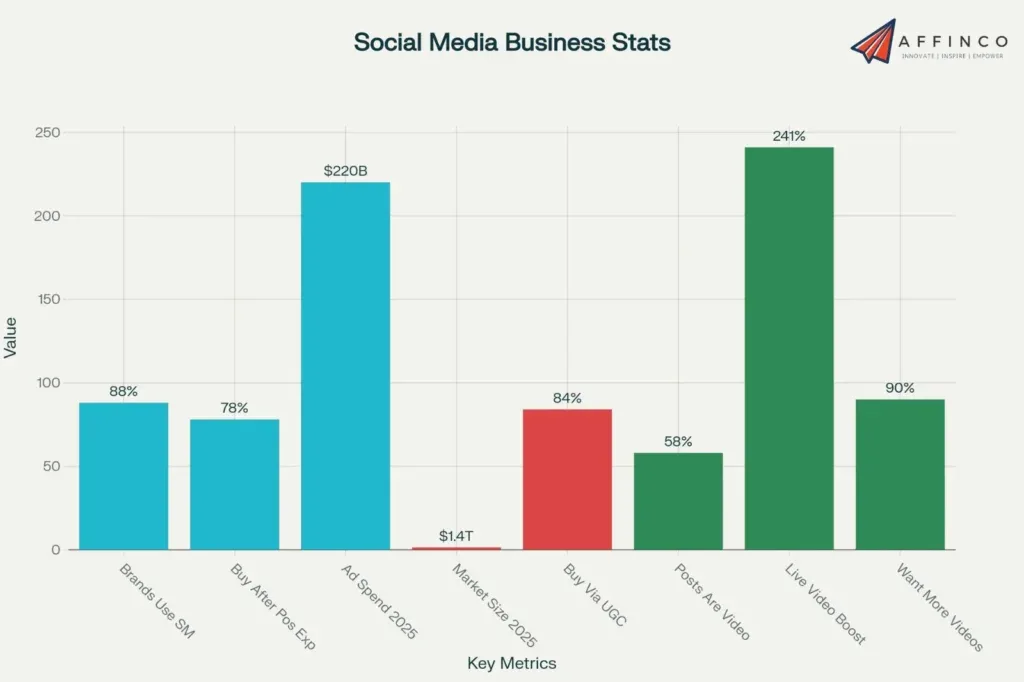
- 88% of brands actively use social media platforms to promote products, engage audiences, and drive business growth.
- 78% of consumers are more likely to buy after a positive social media experience, highlighting the impact of brand interactions.
- Social media ad spending is projected to reach $220 billion by 2025, reflecting aggressive investment in digital marketing.
- The global social media market size is expected to hit $1.4 trillion by 2028, indicating strong long-term industry expansion.
- 84% of buyers say they purchase via user-generated content (UGC), reinforcing trust in authentic peer-driven content.
- 58% of all social media posts are now video-based, confirming video as the dominant content format.
- Live video content delivers a massive 241% boost in engagement, making it one of the most effective formats for brands.
- 90% of users want to see more video content from brands, signaling clear audience demand for visual storytelling.
Influencer Marketing Stats
- U.S. influencer marketing spending reached about $37 billion in 2025.
- Growth continues to outpace many traditional advertising channels.
- Nearly 80% of brands maintained or increased influencer budgets.
- Over 86% of U.S. marketers partner with influencers.
- Mid‑tier influencers are most commonly used in campaigns.
- TikTok Shop and creator‑led commerce drive daily transactions.
- Influencer content plays a major role in purchase decisions.
- Creator economics shape brand storytelling strategies.
Consumer Behavior Trends
- 58% of U.S. shoppers have purchased a product after seeing it on social media.
- The U.S. social commerce market reached about $114.7 billion in 2025.
- Social commerce accounts for roughly 8.8% of U.S. ecommerce sales.
- Consumers show stronger loyalty to brands that respond on social platforms.
- 76% of consumers report higher loyalty to responsive brands.
- 74% of shoppers say influencer content affects purchase decisions.
- Short‑form video and reviews strongly influence buying behavior.
- Peer recommendations often outweigh traditional ads.
Frequently Asked Questions (FAQs)
How many people worldwide use social media as of 2026?
What is the average daily time spent on social media globally?
What percentage of the world’s population uses social media?
What’s the projected value of global social media advertising by the end of 2025?
How many different social platforms does the average user engage with each month?
Conclusion
Social media has matured into a complex, multi‑platform ecosystem connecting billions of people worldwide and hundreds of millions in the United States alone. Global adoption continues to rise, while usage patterns reflect clear differences by age, region, and platform type. Businesses rely heavily on social platforms for marketing, advertising, and customer engagement, and influencer‑driven strategies now command significant budgets.
Consumer behavior increasingly reflects purchase journeys shaped by social discovery, reviews, and creators. As platforms evolve and audiences fragment across formats, social media remains central to how people connect, learn, and shop, with its influence set to continue well beyond.

Leave a comment
Have something to say about this article? Add your comment and start the discussion.