




Generative AI prompt engineering sits at the core of how humans instruct advanced AI systems, such as large language models, to produce meaningful outputs. Prompt engineering has shifted from a niche developer skill to a business-critical function, underpinning everything from automated customer service to content creation tools used across industries. Two real-world scenarios show this clearly: marketing teams now craft prompts that generate high‑conversion copy in minutes, and software engineers use prompts to accelerate code production and debugging workflows. As this article unfolds, you’ll discover the key statistics shaping the prompt engineering landscape, from market size to adoption across sectors.
Editor’s Choice
- North America’s prompt engineering market share exceeded $133 billion in 2024, driving global innovation.
- Demand for prompt engineers spiked +135.8% in 2025, outpacing many tech roles.
- 84% of developers reported using or planning to use AI tools in their workflows by 2025.
- 95% of Fortune 500 companies report integrating AI capabilities in 2025.
- Enterprise AI unit adoption climbed to 78% in 2025, reflecting broad process automation.
- Structured prompt techniques have reduced AI output errors by up to 76% where deployed.
- Prompt engineering use cases now span creative, technical, and enterprise domains, reinforcing its business utility.
Recent Developments
- Gartner predicts 75% of enterprises will use generative AI by 2026, with prompt engineering central to deployment.
- 80% of enterprises plan to use GenAI APIs or models by 2026, weaving prompting into core workflows.
- McKinsey shows 53% of C‑suite leaders now regularly use generative AI at work.
- Prompting for multi‑agent systems is emerging, boosting productivity in software engineering.
- AI adoption rates climbed sharply, with 78% of organizations using AI in at least one workflow function.
- Corporations are embedding prompting skills in non‑technical roles, including marketing and HR.
- New hybrid roles like AI Prompt Strategist are replacing siloed prompt engineer titles.
- Prompt optimization frameworks are now integrated into enterprise AI governance practices.
Global Prompt Engineering Market Growth
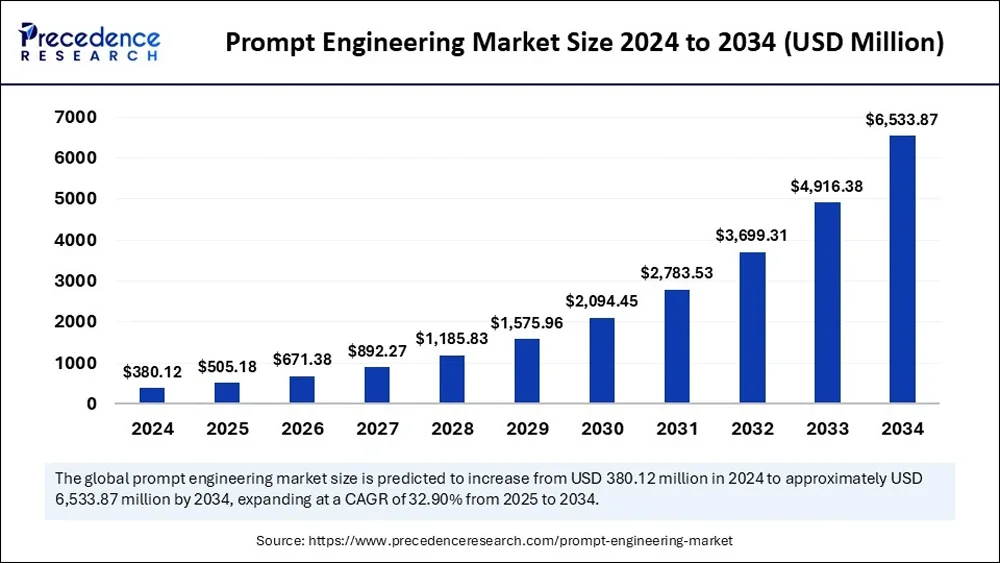
- The global prompt engineering market was valued at $380.12 million in 2024, reflecting the early-stage growth of this emerging AI discipline.
- In 2025, the market is projected to reach $505.18 million, showing strong initial adoption across enterprises.
- By 2026, the market size is expected to grow to $671.38 million, driven by the expanding use of generative AI tools.
- The industry is forecast to cross $892.27 million in 2027, indicating the rapid commercialization of prompt optimization techniques.
- In 2028, revenues are estimated to hit $1,185.83 million, marking the transition into a billion-dollar market.
- The market is projected to reach $1,575.96 million in 2029, supported by growing enterprise AI investments.
- By 2030, the global market size is expected to surpass $2,094.45 million, highlighting mainstream adoption.
- In 2031, revenues are forecast at $2,783.53 million, reflecting increasing demand for specialized AI skills.
- The market is projected to reach $3,699.31 million in 2032, driven by advanced automation and AI integration.
- By 2033, industry value is expected to climb to $4,916.38 million, showing sustained long-term growth momentum.
- In 2034, the global prompt engineering market is forecast to peak at $6,533.87 million, representing massive expansion over the decade.
- Overall, the market is expected to grow at a strong CAGR of 32.90% from 2025 to 2034, underscoring its high-growth potential.
- From 2024 to 2034, the industry is projected to expand by more than 17×, highlighting prompt engineering’s strategic importance in the AI ecosystem.
Regional Market Shares
- North America remains the largest market for generative AI with upwards of 41–43% global share.
- Europe’s share of generative AI markets sits near 26–27% with strong enterprise adoption.
- Asia‑Pacific has recorded rapid growth, often outpacing Western markets in deployment rates.
- Latin America contributed roughly 8% to global adoption figures by 2025.
- India’s generative AI ecosystem saw an adoption surge of >126% YoY in 2025.
- Middle Eastern markets reported ~41% adoption, notably in smart city and enterprise automation.
- Australia/New Zealand adoption rates reached ~58% by 2025.
- Different regions show varied prompting tool preferences, reflecting local enterprise priorities.
Real-Life Use Cases of AI Prompt Engineering
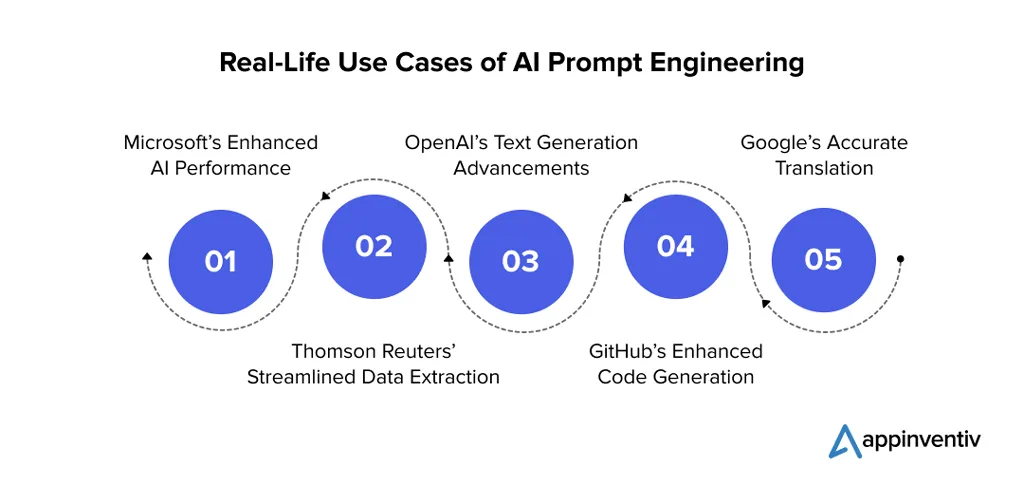
- Microsoft’s Enhanced AI Performance shows how prompt engineering helps optimize AI efficiency, improve response accuracy, and deliver more reliable outputs across enterprise systems.
- Thomson Reuters’ Streamlined Data Extraction demonstrates how advanced prompts enable faster document analysis, automated information retrieval, and high-precision data processing for legal and financial research.
- OpenAI’s Text Generation Advancements highlight the role of prompt engineering in improving natural language understanding, boosting content quality, and supporting large-scale text generation use cases.
- GitHub’s Enhanced Code Generation reflects how optimized prompts power AI-driven programming assistance, reduce development time, and increase coding productivity for software engineers.
- Google’s Accurate Translation illustrates how prompt engineering improves multilingual translation accuracy, enhances context awareness, and enables more natural language conversions across platforms.
Common Techniques Overview
- The prompt engineering market is valued at $505.43 million in 2025, projected to reach $6,703.84 million by 2034 at 33.27% CAGR.
- 68% of companies provide dedicated, prompt engineering training programs for enterprise use.
- n-Shot prompting holds 34% market share among core techniques.
- Generated knowledge prompting dominates with 42% adoption in enterprise AI deployments.
- Chain-of-Thought prompting boosts GSM8K math accuracy from 17.7% to 40.7%.
- Self-consistency with CoT improves GSM8K performance by +17.9%.
- Few-shot prompting increases task accuracy by 15-40% over zero-shot.
- Conversational AI accounts for 38% of prompt engineering applications.
- PaLM 540B with CoT achieves 74% on GSM8K, up 19% from standard.
N‑Shot Prompting Stats
- N‑shot prompting refers to providing the model with n examples to frame the task correctly.
- One‑shot prompting gives a single example, helping models slightly improve precision over zero‑shot.
- Few‑shot prompting, where several examples are shown, significantly improves performance on nuanced tasks.
- Research shows that few‑shot prompting enhances tasks like classification and structured outputs compared with zero‑shot.
- In practice, three to five examples often yield diminishing returns beyond improved context alignment.
- Few‑shot strategies are particularly effective for domain‑specific tasks such as legal or technical summarization.
- N‑shot prompting plays a key role in transfer learning pipelines where model adaptation is needed.
- Enterprises often automate N‑shot example generation to streamline workflows and reduce human overhead.
Zero‑Shot Prompting Data
- Zero‑shot prompting instructs the model to perform a task with no example in the input prompt.
- It relies on pretrained knowledge to interpret tasks, making it efficient for general instructions.
- Common use cases include translation, summarization, or classification without tailored examples.
- Zero‑shot prompting reduces prompt complexity and often yields rapid responses for broad tasks.
- Research shows that adding logical cues like “think step by step” can convert Zero‑shot prompts into better reasoning outputs.
- For very complex reasoning, zero‑shot methods may underperform compared with few‑shot or structured prompts.
- In rapid prototyping environments, zero‑shot techniques are used for exploratory output generation.
- Models such as GPT‑series and others demonstrate baseline competencies in zero‑shot tasks without task‑specific training.
Few‑Shot Prompting Metrics
- Few‑shot prompting uses a handful of examples to illustrate a task before the actual query.
- It generally yields higher accuracy on classification and reasoning tasks compared to zero‑shot.
- In many benchmark datasets, few‑shot prompting improves contextual coherence significantly.
- Examples in prompts offer a conditioning mechanism that steers models to produce expected output formats.
- Few‑shot prompting is key for domain‑adapted applications like legal text interpretation.
- Metrics for assessing few‑shot effectiveness include accuracy, BLEU scores, and task‑specific benchmarks.
- Few‑shot boosts reasoning quality when coupled with structured prompt patterns such as CoT.
- Prompt libraries increasingly include few‑shot templates for common AI workflows.
Chain‑of‑Thought Prompting
- PaLM 540B achieved 58% accuracy on GSM8K with CoT prompting, surpassing fine-tuned GPT-3‘s 55%.
- CoT improved GSM8K accuracy from 55% to 74% on PaLM 540B via self-consistency.
- SVAMP math accuracy rose 24% from 57% to 81% using CoT prompting.
- CommonsenseQA saw 4% gain from 76% to 80% with PaLM 540B CoT.
- Symbolic reasoning boosted ~35% from ~60% to ~95% via CoT.
- CoT benefits emerge at ~100B parameters; smaller models show worse performance.
- PaLM 540B CoT hit 95% on sports understanding, beating human 84%.
- Zero-shot CoT-T5 outperformed Flan-T5 by 4.34% average across 27 datasets.
- Few-shot CoT-T5 gained +2.24% accuracy on domain-specific tasks.
Prompt Engineering Salary Landscape by Country
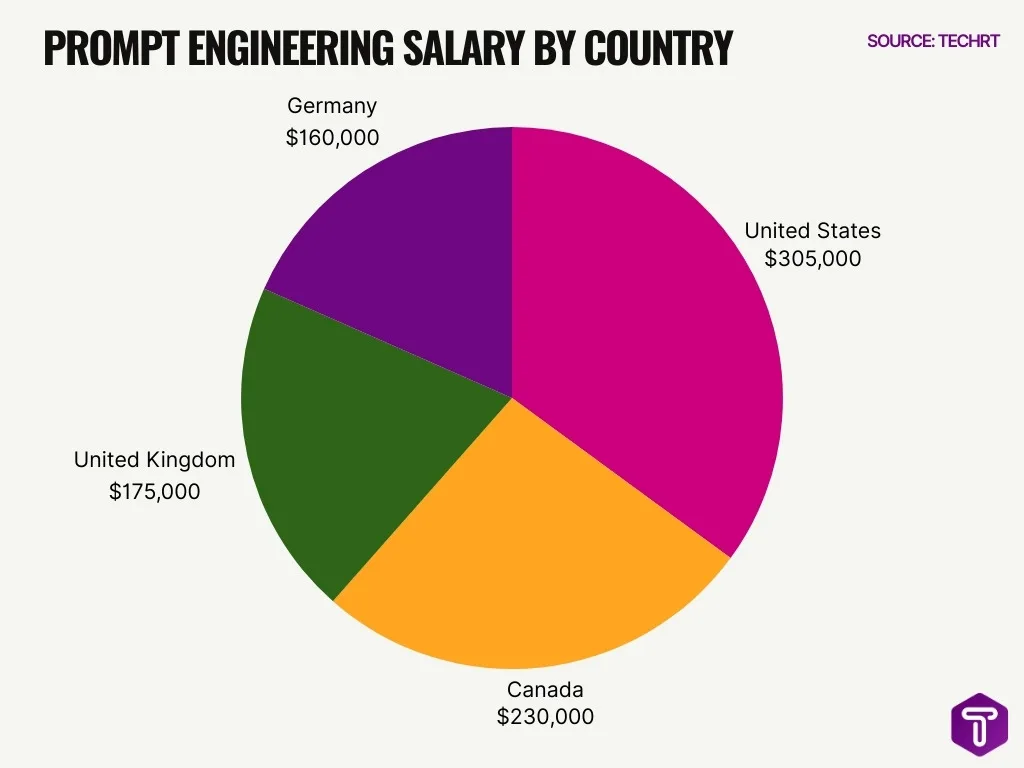
- The United States leads the global market with an average prompt engineering salary of $305,000, making it the highest-paying country for this role.
- Canada follows closely, offering an average annual salary of $230,000, reflecting strong demand for AI and prompt engineering talent.
- The United Kingdom reports an average salary of $175,000, highlighting steady growth in AI-related job opportunities.
- Germany records an average prompt engineering salary of $160,000, remaining competitive within Europe’s tech sector.
- There is a significant salary gap of $145,000 between the highest-paying market (the United States – $305,000) and the lowest among these countries (Germany – $160,000).
- North America dominates the prompt engineering job market, with the US and Canada occupying the top two salary positions.
- Across these major markets, average prompt engineering salaries range from $160,000 to $305,000, showing high earning potential for skilled professionals.
Accuracy and Error Reduction
- Structured prompting techniques like few‑shot and CoT reduce error rates versus simple instructions.
- Zero‑shot prompts with reasoning cues often outperform unstructured zero‑shot approaches in accuracy benchmarks.
- Combining meta prompting and CoT can lower hallucinations in content generation by double‑digit percentages.
- Prompt tuning frameworks cut down iteration time and output errors in long‑form tasks.
- Industry benchmarks now include prompt quality metrics like relevance, coherence, and factuality.
- Large models show improved consistency with hybrid prompting strategies that balance examples and structured logic.
- Accuracy gains typically plateau beyond optimal example count, emphasizing the value of targeted prompting.
- Automated evaluation tools help refine prompts and reduce errors in production systems.
Industry Applications Breakdown
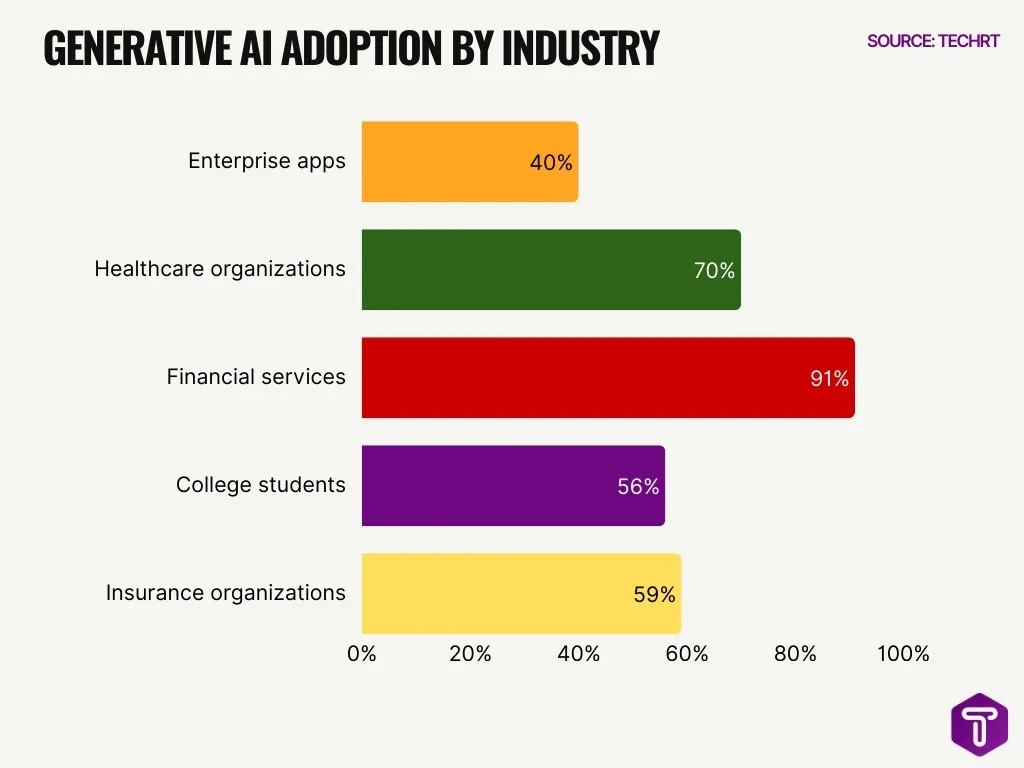
- Around 40% of enterprise applications will include task-specific AI agents by the end of 2026.
- Over 70% of healthcare organizations have implemented or are pursuing generative AI capabilities.
- 91% adoption rate in financial services leads to generative AI enterprise deployment.
- Generative AI in retail is expected to deliver $400–600 billion in industry value.
- The generative AI market in manufacturing is expected to reach $10.5 billion by 2033.
- 56% of college students utilize AI for assignments in education platforms.
- 59% of insurance organizations have implemented generative AI.
- Generative AI in the insurance market is projected to reach $5.7 billion by 2029.
- Generative AI in logistics could lower operational costs by up to 20%.
BFSI Sector Statistics
- The global AI in BFSI market is expected to grow from $101.2 billion in 2025 to $140.54 billion in 2026, reflecting strong AI adoption momentum in banking and financial services.
- The BFSI market is forecast to reach $517.77 billion by 2030, with generative AI and other AI technologies driving transformation.
- Chatbots and conversational AI, heavily reliant on prompt engineering, are projected to expand from $9.9 billion in 2025 to $12.98 billion in 2026.
- AI‑powered risk management tools demonstrate higher fraud detection accuracy and reduce false positives compared with traditional methods.
- By leveraging prompt‑based automation, leading banks report faster loan processing times and improved customer touchpoints.
- Financial institutions also use generative AI to generate personalized financial advice, boosting client engagement.
- Prompt engineering supports real‑time market analytics in investment banking, enhancing algorithmic insights.
- The rise of agentic AI and autonomous workflows is expected to further streamline back‑office operations across BFSI.
Prompt Engineering Job Roles and Salary Trends
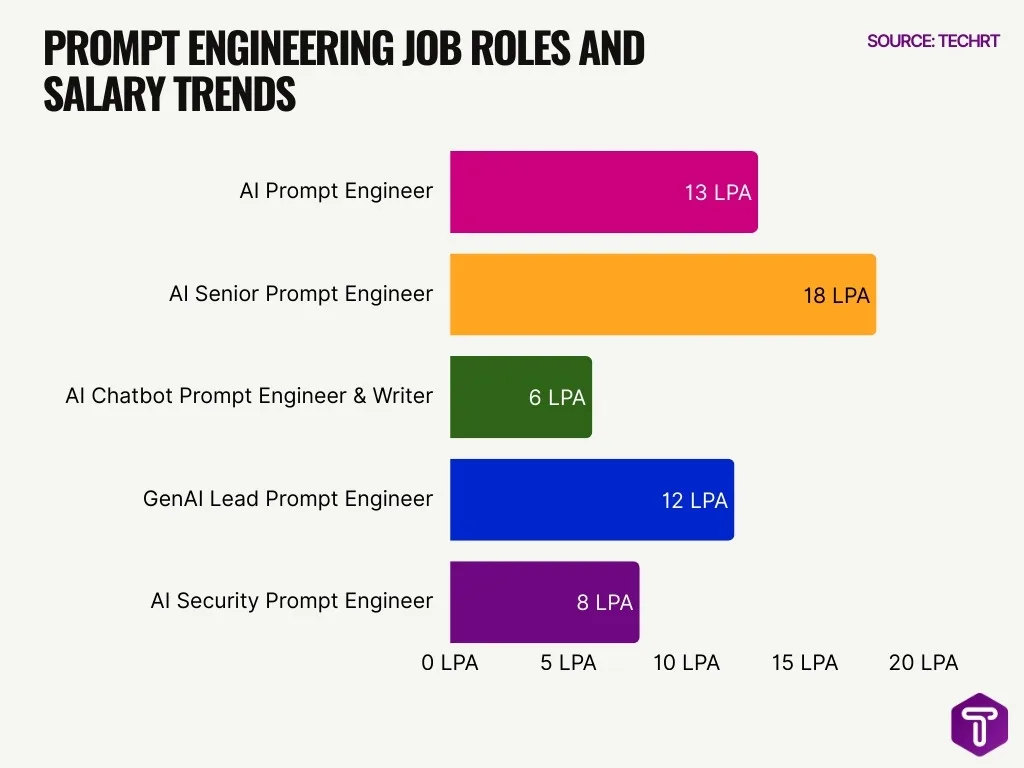
- AI Senior Prompt Engineer earns the highest average salary at 18 LPA, highlighting strong demand for advanced prompt optimization and leadership skills.
- AI Prompt Engineer receives an average salary of 13 LPA, reflecting the growing importance of prompt design in AI-driven applications.
- GenAI Lead Prompt Engineer commands around 12 LPA, showing the value of expertise in managing generative AI systems.
- The AI Security Prompt Engineer earns approximately 8 LPA, emphasizing the rising need for secure and responsible AI prompt development.
- AI Chatbot Prompt Engineer & Writer has the lowest average salary at 6 LPA, indicating entry-level or content-focused specialization.
- The overall salary range for prompt engineering roles spans from 6 LPA to 18 LPA, demonstrating significant variation based on experience and specialization.
- Senior and leadership roles earn up to 3× more than junior or content-oriented prompt engineering positions.
- Technical specialization and experience significantly influence compensation in the prompt engineering job market.
Healthcare Prompt Stats
- 85% of healthcare organizations have adopted or explored generative AI by the end of 2025.
- 68% of physicians use AI more for clinical documentation in 2025.
- 100% of surveyed health systems adopted generative AI for clinical documentation.
- AI clinical documentation saves physicians 1-2 hours daily and improves revenue by 5-10%.
- AI medical scribes achieve 95-98% accuracy in documentation with 22% more relevant findings.
- AI in diagnostic imaging reaches 98.7% accuracy for lung cancer detection.
- TrialGPT improves clinical trial matching performance by 43.8% over baselines.
- AI tools reduce documentation time by 20.4-30% and after-hours work.
- 92% of provider health systems deploy or pilot AI ambient scribes as of 2025.
- AI-powered supply chain achieves 99% accuracy in healthcare inventory tracking.
Content Generation Metrics
- Creative AI generates over 34 million images daily, showcasing massive content automation scale.
- 91% of U.S. ad agencies use or explore generative AI for marketing content.
- 75% of marketers report higher content output speed with generative AI.
- 67% of marketing executives note significant improvements in content processes via AI.
- Prompt engineering reduces time-to-first draft by 70% in workflows.
- AI slashes cost per content piece by 25.6% for digital agencies.
- 86.5% of top-ranking pages leverage AI for SEO alignment.
- Structured prompts enhance brand voice consistency by 62%.
- 71% of marketers use generative AI weekly for content generation.
Prompt Engineering – New Skills Mentions Breakdown
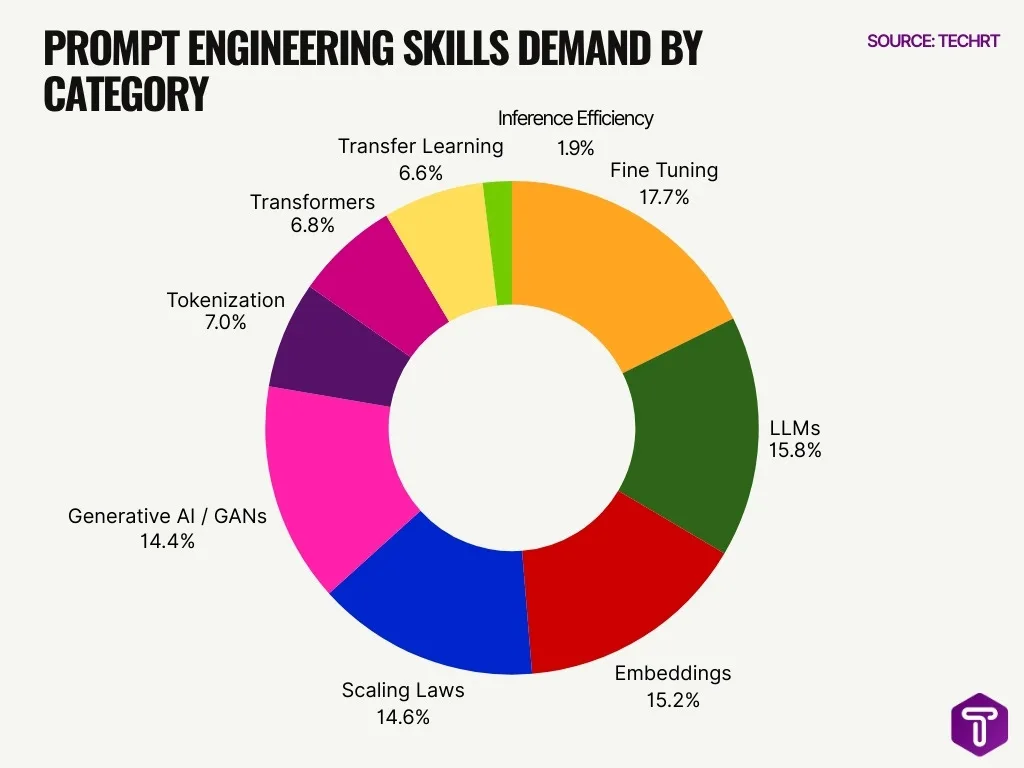
- Fine-tuning leads all skill areas with 17.7%, highlighting its dominant role in improving AI model performance and customization.
- Large Language Models (LLMs) account for 15.8%, showing strong demand for expertise in foundation models and text generation systems.
- Embeddings represent 15.2%, reflecting their growing importance in search, recommendation, and semantic analysis tasks.
- Scaling Laws contribute 14.6%, emphasizing the industry’s focus on model size, compute optimization, and performance scaling.
- Generative AI / GANs hold 14.4%, underlining continued interest in content creation, image synthesis, and synthetic data generation.
- Tokenization stands at 7.0%, indicating steady demand for text preprocessing and input optimization techniques.
- Transformers make up 6.8%, confirming their role as the core architecture behind modern AI systems.
- Transfer Learning accounts for 6.6%, highlighting its value in reducing training costs and accelerating deployment.
- Inference Efficiency remains the smallest segment at 1.9%, suggesting limited but emerging focus on cost control and real-time performance optimization.
Conversational AI Usage
- Conversational AI market valuations are projected to grow from roughly $12.24 billion in 2024 to $61.69 billion by 2032.
- Chatbot markets are expected to expand from $7.01 billion to $20.81 billion by 2029.
- North America leads globally, filing more than 60% of conversational AI patents.
- Prompt engineering plays a key role in tailoring responses for multilingual and context‑aware AI interactions.
- Conversational AI usage in customer support helps decrease average resolution times significantly.
- AI‑driven Q&A systems increasingly handle complex customer inquiries, reducing dependence on human agents.
- Enterprises integrating conversational AI report higher satisfaction scores due to consistent engagement.
- Prompt‑optimized chatbots respond with greater brand‑aligned tone and fewer irrelevant outputs.
Future Trends Overview
- The generative AI market is expected to reach $55.51 billion in 2026, growing at 36.97% CAGR.
- Worldwide AI spending forecast at $2.52 trillion in 2026, up 44% year-over-year.
- 40% of enterprise apps to include task-specific AI agents by the end of 2026.
- The prompt engineering market is growing at 32.8% CAGR from 2024 to 2030.
- The AI governance market is expected to hit $417.8 million in 2026.
- The reinforcement learning market reaches $13.52 billion in 2025, up 28.9%.
- Hybrid human-AI teams outperform autonomous agents by 68.7% in accuracy.
- 85% of AI projects risk bias without ethical fairness controls.
- The personal AI assistants market is expected to grow from $2.23 billion in 2024 to $56.3 billion by 2034.
- Enterprise AI adoption hits an inflection point in 2026 with measurable ROI gains.
Frequently Asked Questions (FAQs)
What was the global prompt engineering market size in 2025, and what is it projected to be by 2034?
What CAGR is the prompt engineering and agent programming tools market expected to grow at from 2025 to 2030?
By what percentage did the demand for “Prompt Engineer” roles grow in 2025?
What share of the prompt engineering and agent programming market did cloud‑based offerings hold in 2024?
What percentage of enterprises are expected to use generative AI by 2026, according to Gartner?
Conclusion
Prompt engineering remains one of the most strategically impactful facets of the generative AI era. Across sectors from BFSI to healthcare, and in content, conversational interfaces, and future workflows, prompt statistics reveal both adoption depth and growth potential. As the prompt landscape evolves, with agentic workflows, improved accuracy measures, and global implementation, organizations that refine their prompting strategies will unlock richer insights, faster automation, and clearer business value. These trends suggest a future where prompt engineering not only fuels AI output quality but also reshapes how industries innovate and deliver value with intelligence.

Leave a comment
Have something to say about this article? Add your comment and start the discussion.