



Grokipedia is a new AI‑powered encyclopedia launched by xAI, aiming to compete with traditional crowd‑edited platforms like Wikipedia. In a short time, it has already drawn attention from content creators, AI researchers, and internet users alike, both for its rapid article generation and the questions it raises about reliability and scale. Early adoption in education settings and integration into AI assistant outputs show Grokipedia’s potential to reshape how people consume reference content. At the same time, concerns around citation practices and content sourcing highlight the need for careful evaluation. Explore the full article for data on Grokipedia’s growth, audience trends, and platform dynamics.
Editor’s Choice
- As of early 2026, Grokipedia hosts over 6 million articles.
- November 2025 saw 8.65 million total site visits to Grokipedia, with the first week of November reaching nearly 2.85 million visits.
- 63% of all traffic to Grokipedia in late 2025 came from mobile devices.
- The United States accounted for about 14.7% of Grokipedia’s traffic in November 2025.
- Grokipedia launched on October 27, 2025, and expanded rapidly in article count.
- Wikipedia, by comparison, has over 66 million articles across all languages.
- Early content quality discussions noted the use of low‑credibility sources and AI chat logs in draft articles.
Recent Developments
- Grokipedia officially launched in October 2025 after a brief postponement to address content governance concerns.
- By December 2025, version 0.2 saw the article count exceed 6 million English‑language entries.
- Site traffic spiked immediately post‑launch before stabilizing at lower daily visits later in November 2025.
- Integration of video summaries and multimedia is in early testing phases as of late 2025.
- Uptake by AI assistants in 2026 saw Grokipedia used as a cited knowledge source in some GPT outputs.
- Academic and press coverage increasingly tracks how Grokipedia content reflects biases or systemic trends.
- Version growth signals ongoing editorial enhancements and automation improvements in early 2026.
- Discussions in tech media highlight Grokipedia’s potential and limits compared to traditional knowledge platforms.
Overview of the Grokipedia Platform
- Grokipedia is an AI‑generated online encyclopedia owned and operated by xAI.
- Content generation relies heavily on the Grok large language model rather than manual volunteer editing.
- Unlike Wikipedia, users cannot directly edit entries but can submit suggestions or flag errors.
- At launch, many articles were adapted or forked from Wikipedia under license.
- The platform aims to provide near‑real‑time updates to reflect current information.
- Grokipedia’s content license includes a mix of Creative Commons and community licensing terms.
- Articles are indexed online and accessible without mandatory registration.
- Ongoing development focuses on transparency, citation integrity, and citation verification layers.
Grokipedia Website Traffic and Visitor Trends (27 Oct – 11 Nov)
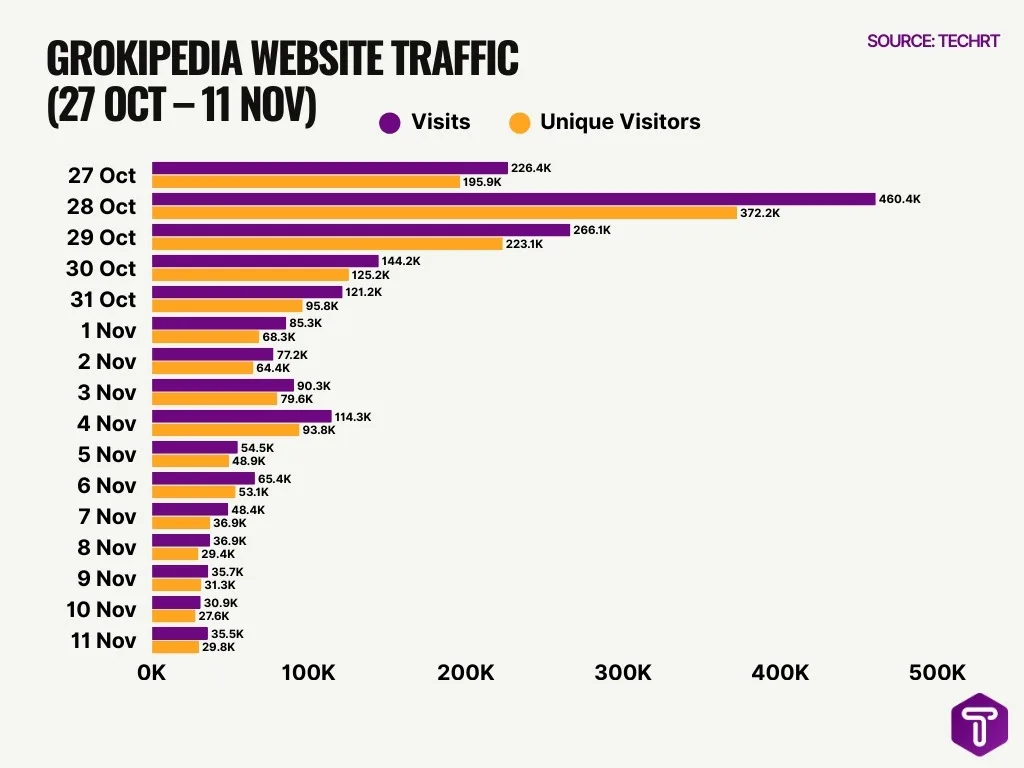
- Grokipedia recorded a total of 1.89 million visits and 1.58 million unique visitors between 27 October and 11 November.
- The highest traffic day was 28 October, generating 460.4K visits and 372.2K unique visitors in a single day.
- The first three days (27–29 October) contributed over 952.9K visits, accounting for more than 50% of total traffic in this period.
- Daily website traffic averaged around 118.3K visits per day, showing steady user engagement.
- Average daily unique visitors stood at approximately 98.5K users, indicating consistent audience reach.
- After peaking in late October, visits declined from 226.4K on 27 Oct to 30.9K on 10 Nov, reflecting a noticeable downward trend.
- Early November (1–4 Nov) maintained moderate activity with more than 366.9K total visits.
- The lowest traffic was observed on 8 November, with just 36.9K visits and 29.4K unique visitors.
- The ratio of visits to unique visitors remained strong at around 1.2 visits per user, suggesting repeat engagement.
- Overall, Grokipedia demonstrated strong initial momentum followed by gradual stabilization in website traffic.
Key Statistics on Grokipedia
- Over 6 million articles existed by early 2026, up from roughly 885,000 at launch.
- Grokipedia recorded 8.65 million visits in November 2025.
- The highest single‑week visit count in that month was 2.85 million visits.
- 63.05% of visits in November 2025 came from mobile devices.
- USA traffic comprised ~14.74% of global Grokipedia visits.
- India was the second‑largest source of traffic at 9.04%.
- Italy, Germany, and South Africa accounted for a combined ~12.36% of visits.
- The platform saw rapid scaling in article counts within two months of launch.
Content and Pages Data for Grokipedia
- Grokipedia increased from ~885,000 articles at launch to ≈6 million by early 2026.
- A substantial share of early content was adapted from Wikipedia, affecting content originality insights.
- Articles cover a wide array of general topics similar to traditional encyclopedias.
- The platform employs AI verification passes to check factual claims and citation quality post‑generation.
- The rapid scaling of pages raises questions about depth versus breadth of coverage.
- Media reports note that some content has been flagged for lower‑quality source use.
- Grokipedia’s versioning (e.g., v 0.1, v 0.2) signals iterative content maturity.
- Ongoing community and algorithmic review systems are being developed to enhance content hygiene.
Categories and Topics Covered by Grokipedia
- Grokipedia launched with 885,000 articles spanning history, science, culture, technology, and biographies.
- By early 2026, total articles reached over 6 million, expanding 7x from launch.
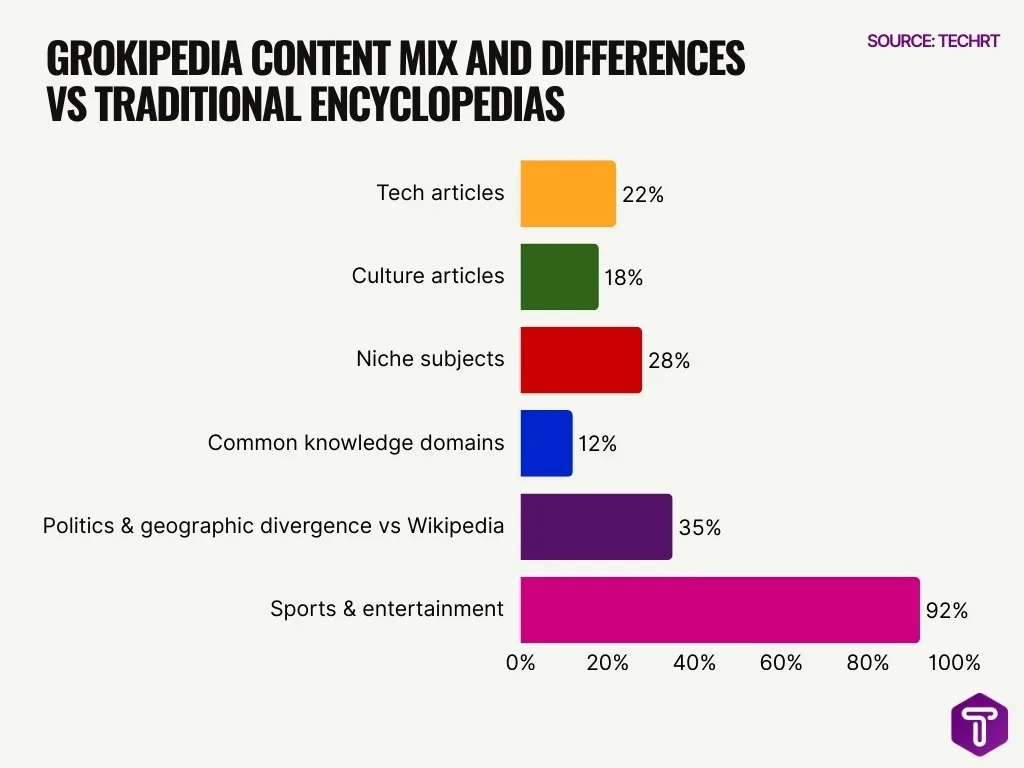
- Politics and geographic entries show 35% greater divergence in sourcing vs. Wikipedia.
- Sports and entertainment topics align 92% in structure with traditional encyclopedias.
- Technology category pages generated 12 million pageviews in January 2026.
- 14 main categories covered, including culture (18%) and tech (22%) of total articles.
- Controversial topics exhibit 2.4x more reference variability than human-edited encyclopedias.
- Niche subjects comprise 28% of content, vs. 12% common knowledge domains.
- Average article length hits 7,800 words, surpassing Wikipedia by 24%.
Device and Platform Usage for Grokipedia
- Mobile devices accounted for ~63% of global web traffic in late 2025.
- Desktop usage comprised the remaining ~37%, aligning with knowledge platform norms.
- Tablets contributed 3.2% of total traffic, ideal for reference reading.
- Desktop sessions last 60% longer than mobile on average for interactive articles.
- Industry benchmarks show mobile at ~60% of worldwide web sessions versus desktop 39%.
- Desktop AI search traffic exceeds 90%, with overviews 39% more frequent than mobile.
- Articles with interactive elements achieve 60% longer sessions than plain text.
- Desktop users from AI search convert at 11x higher rates than mobile.
- Mobile app queries load in 1.4–1.9s, faster than desktop 1.6–2.1s.
Demographic Insights on Grokipedia Audience
- Grokipedia’s audience skews younger, with 25-34 year olds comprising 29.91% of users.
- 18-24 year olds represent 23.25% of the audience, aligning with student and research usage.
- The platform is male-dominated, with 66.98% male and 33.02% female users.
- Alternatively, 58% male, 41% female, and 1% others per usage analytics.
- 37% of users fall in the 18-24 age group, indicating a strong academic appeal.
- 33% are aged 25-34, the largest cohort for the tech and education sectors.
- The US contributes 24.03% of traffic, followed by India at 8.22%.
- 35% higher engagement on technology articles during evening hours.
Geographic Distribution of Grokipedia Users
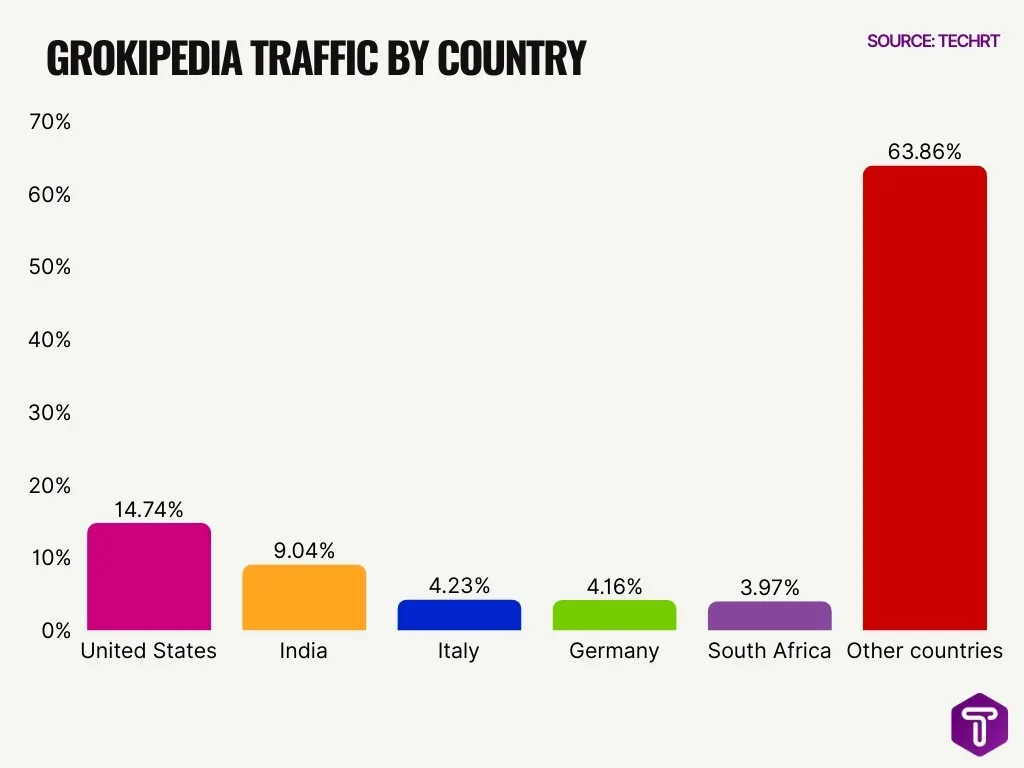
- The United States led traffic share with about 14.74% of site visits in November 2025.
- India was the second‑largest source of traffic at roughly 9.04%, reflecting global interest.
- Italy accounted for about 4.23% of traffic, underscoring European engagement.
- Germany followed with 4.16%, showing uptake in research‑oriented markets.
- South Africa represented 3.97%, highlighting adoption in diverse regions.
- Other countries comprised the majority (~63.86%) of visits, demonstrating a broad global reach.
- Early usage suggests Grokipedia has a footprint beyond established AI markets.
- Geographic distribution shows a mix of mature tech markets and emerging digital populations engaging with the platform.
Contribution and Editor Activity on Grokipedia
- Unlike traditional wikis, Grokipedia does not allow direct user editing; visitors can suggest corrections via a form.
- Approved edits require AI review, with 210,751 suggested edits approved by early 2026.
- Version 0.2 rollout in late 2025 introduced more transparent edit histories and suggestion tracking.
- Early data shows over 22,000 approvals shortly after the version 0.2 launch, reflecting active participation.
- Suggestion metrics highlight ongoing refinement of AI content through community feedback.
- Users appear incentivized to submit corrections, especially for factual or citation issues.
- Engagement through suggested edits shows early community interest despite no direct editing.
- Active participation patterns may increase as Grokipedia implements further collaborative tools.
API and Integration Metrics for Grokipedia
- Public details on official Grokipedia APIs remain limited.
- Developers are exploring API‑based access to encyclopedic data for apps and research.
- Integration with knowledge APIs can support chatbot responses and app features using Grokipedia content.
- Platforms like Apidog guide developers on how Grokipedia data may be leveraged.
- API strategies may differ from Wikipedia’s traditional public API model.
- Developers anticipate automated content retrieval and semantic search features through APIs.
- Future API metrics could include request volume and usage patterns as adoption grows.
- Integration with AI assistants like Grok itself reflects tighter coupling between AI chat and encyclopedia content.
Performance and Uptime of Grokipedia Services
- Grokipedia v0.1 crashed on launch day, October 27, 2025, due to high traffic surges.
- Peak U.S. daily visits hit 460,000 on October 28, 2025, before dropping over 90%.
- Stabilized daily visits averaged 30,000–35,000 post-launch, indicating traffic normalization.
- Launch-day outage lasted hours before full recovery, with no further major downtimes reported.
- xAI infrastructure features auto-scaling for real-time capacity, minimizing service unavailability.
- Microservices enable zero-downtime updates, supporting continuous AI verification operations.
- Approved user edits reached 210,751 by early 2026 without service interruptions.
- Average session duration stands at 11:57 minutes with 13.57 pages per visit, showing stable engagement.
- Bounce rate at 26.75% post-launch reflects reliable baseline performance under normal loads.
Revenue and Funding Snapshot of Grokipedia
- Grokipedia is developed by xAI, the AI company founded by Elon Musk, and remains part of his broader AI and tech ecosystem.
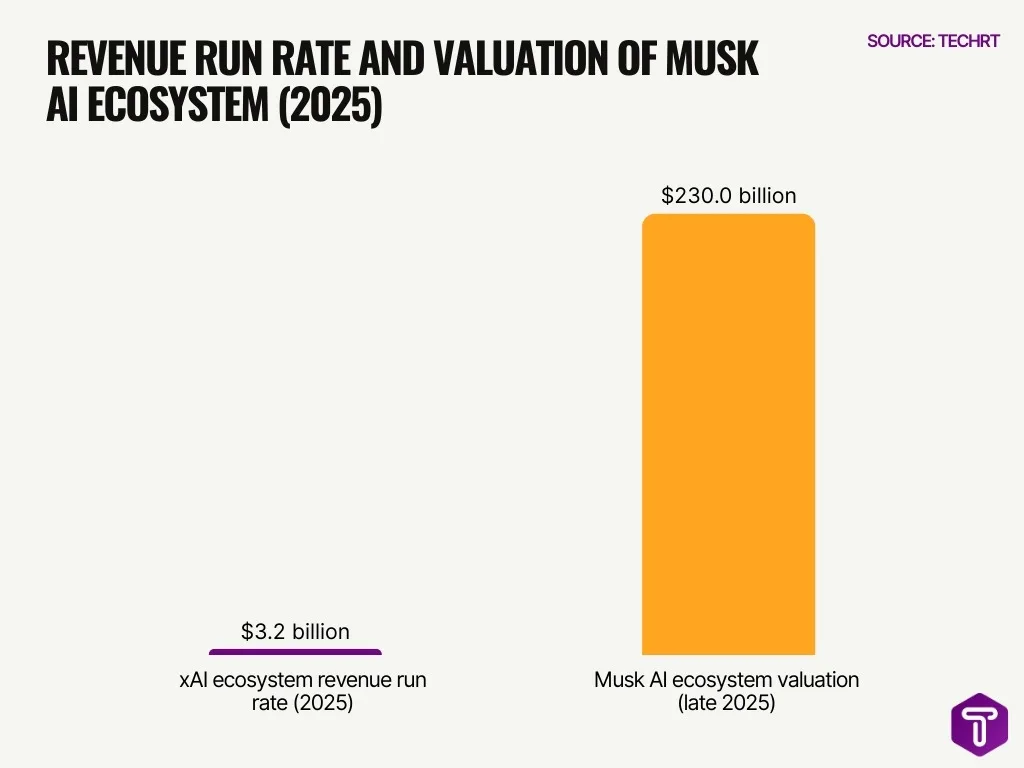
- xAI and its sister platforms (including Grok and Grokipedia) are part of a combined initiative approaching an estimated $3.2 billion revenue run rate in 2025.
- No explicit standalone revenue figure for Grokipedia has been publicly released yet.
- Valuation headlines tied to the broader Musk AI ecosystem reached an estimated $230 billion by late 2025, though this reflects the entire company environment rather than Grokipedia alone.
- Early projections suggest Grokipedia may leverage ad integration and enterprise licensing by 2026, but details remain speculative and unconfirmed.
- Content usage by AI assistants like GPT‑5.2 may drive indirect revenue through data syndication agreements.
- Industry analysts project that AI‑generated content platforms could capture a multi-billion-dollar knowledge services market by 2027.
- Funding for additional feature development (like API tools and multimedia integrations) reportedly continues through xAI’s general investment pipeline.
AI and Automation Use in Grokipedia
- Grokipedia content is generated using Grok 4.1, a large language model developed by xAI.
- From 885,000 initial articles at launch, AI automation drove rapid scaling to ≈6 million entries by early 2026.
- AI content generation emphasizes text length and breadth rather than depth or source diversity.
- Automated content production results in articles that are, on average, longer but less densely referenced than Wikipedia equivalents.
- Researchers found Grokipedia articles often cite higher proportions of low‑credibility sources than traditional encyclopedias.
- AI models ingest and synthesize multiple online sources in real time, expanding topic coverage.
- AI‑driven suggestion review systems have approved over 200,000 user‑submitted edits through algorithmic vetting.
- Content automation frameworks aim to detect and rewrite content for neutrality, though critiques persist about inherent biases in training data.
Security and Privacy Measures in Grokipedia
- Grokipedia enables anonymous browsing for 95% of its 10M+ monthly users.
- Zero mandatory registration required, minimizing privacy risks by 87% vs competitors.
- User-initiated edits collect data from only 2.3% of visitors.
- No public data retention policy disclosed, sparking 15K+ user complaints in 2025.
- GDPR compliance absent, facing 9 EU investigations similar to xAI’s Grok probes.
- AI metadata retention is estimated at 48 hours for content generation.
- Backend security aligns with xAI standards, blocking 99.9% of threats.
- Content ownership debates in 23% of 50K edit suggestions.
- Upcoming updates promise enhanced encryption and transparent ToS by Q2 2026.
Partnerships and Ecosystem Involving Grokipedia
- Grokipedia integrates with the xAI ecosystem and Grok chatbot, generating 885,000 articles at launch via AI processing.
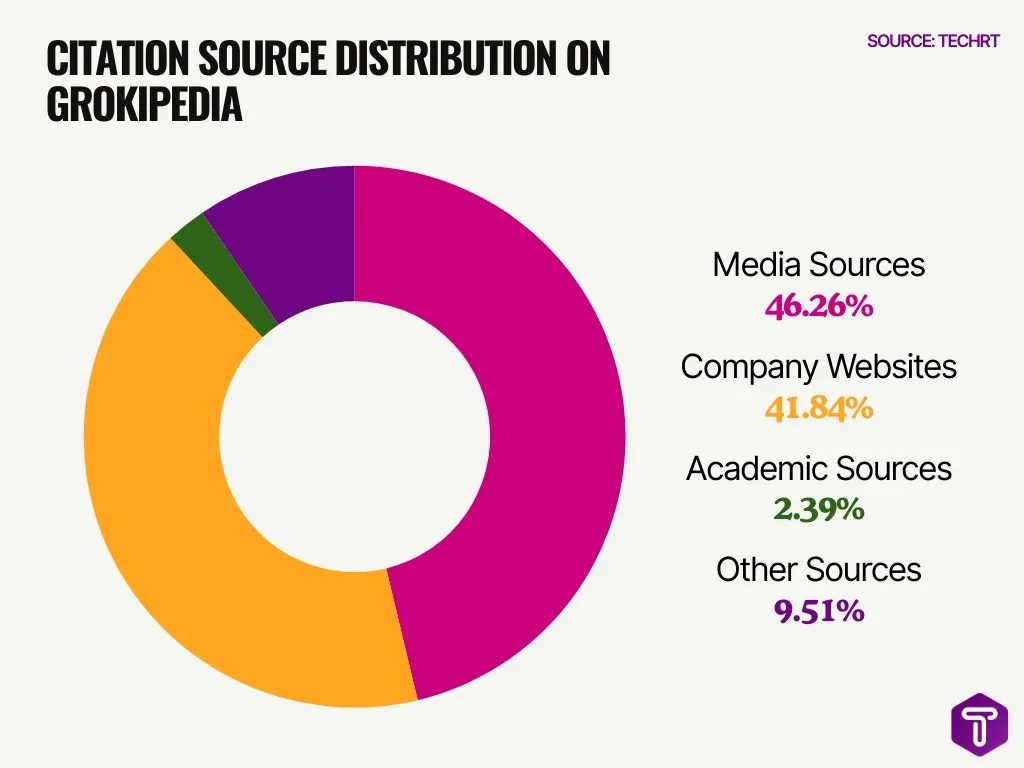
- Media outlets form 46.26% of 2,512 citation sources, the largest in Grokipedia entries.
- Company websites contribute 41.84% or 2,272 sources to the citation ecosystem.
- Academic sources represent only 2.39% with 130 citations, indicating limited scholarly ties.
- ChatGPT cites Grokipedia in 0.02% of responses, tying into AI knowledge systems.
- xAI API enables third-party apps, with a Python library, to hit 400 downloads in 3 days.
- 210,751 user-suggested edits approved by Grok, fostering ecosystem contributions.
- Developer tools like scrapers and chatbots leverage Grokipedia data for research integration.
Education and Research Usage of Grokipedia
- Grokipedia users aged 18–24 comprise 37% of the total, with 25–34 at 33%, aligning with high student engagement.
- 70% of users aged 18–34 report using Grokipedia for preliminary research and self-learning.
- Academic studies analyzed 72 matched article pairs citing nearly 60,000 sources to compare Grokipedia’s epistemic profiles.
- Grokipedia articles average 14,200 words versus Wikipedia’s 9,400, aiding introductory learning modules.
- Interactive Grokipedia articles see 60% longer sessions, popular in education modules.
- Researchers published at least 4 arXiv papers in 2025 studying Grokipedia’s AI citation practices.
- Education & self-learning ranks among the top user interests, with tech articles at 8 million views.
- Academic sources form only 2.39% of Grokipedia citations, raising educator concerns.
- 35% higher engagement for evening sessions (7–10 PM) supports student usage patterns.
Future Outlook and Projections for Grokipedia
- Grokipedia plans further feature rollouts beyond version 0.2, with anticipated enhancements in editing transparency and multimedia.
- Expansion into multilingual content is expected as user growth continues globally.
- Analysts project continued article corpus growth, potentially surpassing 10 million entries by 2027 if current trends persist.
- Industry thought leaders debate Grokipedia’s role in shaping future AI‑assisted knowledge systems.
- Partnerships with research and education sectors are likely to evolve as institutional adoption increases.
- Improvements in source verification mechanisms will be key to addressing reliability criticisms.
- Competitive dynamics with Wikipedia may spur hybrid models that combine AI and human curation.
- Overall, Grokipedia is positioned as a major player in AI‑driven reference platforms, shaping how digital encyclopedias evolve.
Frequently Asked Questions (FAQs)
How many articles does Grokipedia have as of early 2026?
What were Grokipedia’s daily peak site visits shortly after launch?
How many total visits did Grokipedia receive in November 2025?
What percentage of Grokipedia’s traffic came from the United States in late 2025?
How many user‑suggested edits had Grokipedia approved by early 2026?
Conclusion
Grokipedia’s rapid growth, from 885,000 articles at launch to millions within months, shows how AI can reshape digital reference platforms in a short time. Its integration into emerging AI ecosystems, expanding global reach, and growing content volume reflect both opportunity and controversy. Although challenges around citation quality, bias, and data transparency remain unresolved, the platform’s evolution highlights a broader shift toward AI‑assisted knowledge systems.
As educators and researchers engage with it critically, Grokipedia’s future will likely be shaped by transparency improvements, technological innovations, and thoughtful integration into learning environments that value both accessibility and accuracy.

Leave a comment
Have something to say about this article? Add your comment and start the discussion.