



Internet outages continue to shape how individuals, organizations, and entire economies behave online. From global cloud service disruptions to regional blackouts, the frequency and severity of connectivity interruptions remain a trending risk for businesses, governments, and everyday users. In the U.S., millions of users have faced major network and service interruptions in the past year, and critical industries such as finance, streaming, and cloud operations feel the impact most. Across sectors, outages are more than a minor inconvenience; they can halt operations, impede communication, and degrade customer trust. Let’s explore the latest data and trends that define internet outage patterns and beyond.
Editor’s Choice
- In 2025, over 180 significant internet outages were recorded worldwide from diverse causes such as cable damage and power failures.
- Global internet outages surged 178% from November to December 2025.
- ISP outage frequency in early 2026 saw a sizeable uptick across multiple regions.
- A major cloud outage in October 2025 affected millions of users globally, leading to widespread service disruption.
- Government-directed shutdowns have caused millions of cumulative hours of lost internet access globally.
- In 2026, Iran experienced a sustained national internet blackout tied to civil unrest and protests.
- Multiple Cloudflare outages in late 2025 disrupted trading platforms and communication services.
Recent Developments
- A significant global outage hit X.com (formerly Twitter) on February 16, 2026, with over 41,000 user reports at peak before service stabilized.
- Cloudflare reported its own bot management configuration failure in November 2025, leading to wide-reaching connectivity issues.
- Reports from network intelligence firms indicate 263 outage events globally during mid-January 2026.
- Collaboration app network outages have increased in early 2026 despite ISP outages decreasing week-over-week in certain snapshots.
- Multiple cloud service outages disrupted connectivity for web applications and backend services in early 2026.
- Multiple ISP outage frequencies show variable week-over-week shifts, highlighting unstable service environments.
- Strategic analysis suggests internet resilience will remain a focus for businesses and infrastructure providers in 2026.
- Cloud service trend reports show that public cloud network outages are increasing in certain regions.
Global Internet Outage Statistics Overview
- In Q4 2025, more than 180 connectivity disruptions were observed across global internet infrastructure.
- Internet outage events increased 178% between November and December 2025 on a global scale.
- Global ISP outages are down in some reports but spike in others, reflecting market volatility for providers.
- Cloud service outages have shown a 3% uptick worldwide, particularly in public cloud environments.
- Real-time outage monitors show an average of thousands of website outages per hour worldwide.
- Some regions report zero collaboration app network outages in certain weekly windows.
- Regional data tracks show U.S. outage events climbing by 10% week-over-week in January 2026.
- Undersea cable issues and terrestrial infrastructure damage remain persistent outage triggers.
Key Insights: Network Outage Events (Global vs. U.S.)
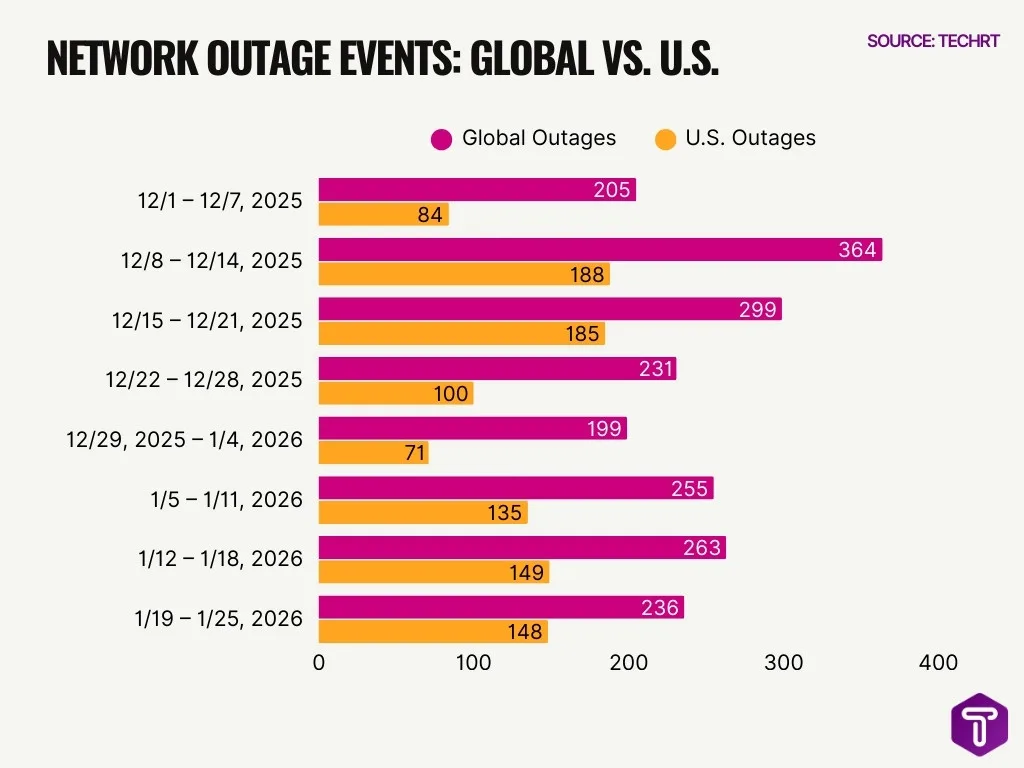
- Global network outages peaked at 364 incidents during Dec 8–Dec 14, 2025, marking the highest weekly disruption level in the observed period.
- The U.S. also saw its highest outage count in the same week, reporting 188 outages, indicating a parallel surge with global trends.
- After mid-December, global outages declined sharply, falling from 299 events (Dec 15–21) to 231 events (Dec 22–28), showing a temporary stabilization.
- The lowest outage levels occurred during Dec 29, 2025–Jan 4, 2026, with only 199 global outages and 71 U.S. outages, representing the calmest week in the dataset.
- Early January 2026 experienced a renewed increase in disruptions, as global outages rose to 255 events (Jan 5–11) and further to 263 events (Jan 12–18).
- U.S. outage volumes mirrored global recovery trends, climbing from 71 outages in early January to 149 outages by Jan 12–18, 2026.
- Despite week-to-week fluctuations, global outages consistently remained higher than U.S. outages, underscoring the broader scale of worldwide network instability.
- By Jan 19–25, 2026, outage levels moderated slightly, with 236 global outages and 148 U.S. outages, suggesting partial recovery but continued volatility.
Key Internet Outage Statistics (Quick Facts)
- 17 million user reports tracked during the largest AWS outage of 2025.
- 1.4 million users reported issues accessing Google Cloud and Cloudflare in 2025.
- Around 3 million users reported YouTube disruptions during the 2025 outage waves.
- Over 2 million complaints were filed for a major social network outage in 2025.
- Cloudflare’s November outage potentially impacted one in five webpages globally.
- Real-time outage dashboards log >7,000 ISP and website outages per hour.
- Weekly outage analytics show 263 global network outages during early 2026.
- ISP outage fluctuations represent double-digit percent changes week-over-week in early 2026.
Internet Outage Duration and Severity Statistics
- The October 2025 AWS outage lasted over 15 hours, generating 17 million user reports worldwide.
- Cloudflare’s November 2025 outage persisted for 6 hours, affecting 28% of global HTTP traffic.
- The PlayStation Network outage in February 2025 lasted over 24 hours, with 3.9 million reports.
- The Azure October 2025 outage lasted 8-10 hours, disrupting Microsoft 365 and Xbox Live globally.
- Starlink July 2025 outage continued for 2.5 hours, impacting users across all service regions.
- Average IT downtime cost in 2025 reached $9,000 per minute or $540,000 per hour for businesses.
- Regional internet disruptions in 2025, like Tonga’s, spanned multiple days, including 26 hours initially.
- Iraq government shutdowns in 2025 lasted up to 2 weeks during exam periods.
- Collaboration network outages in early 2026 averaged 1 hour 5 minutes in duration.
- 45% of 2025 internet outages stemmed from power failures, the leading cause.
Global Internet Outage Frequency and Volume
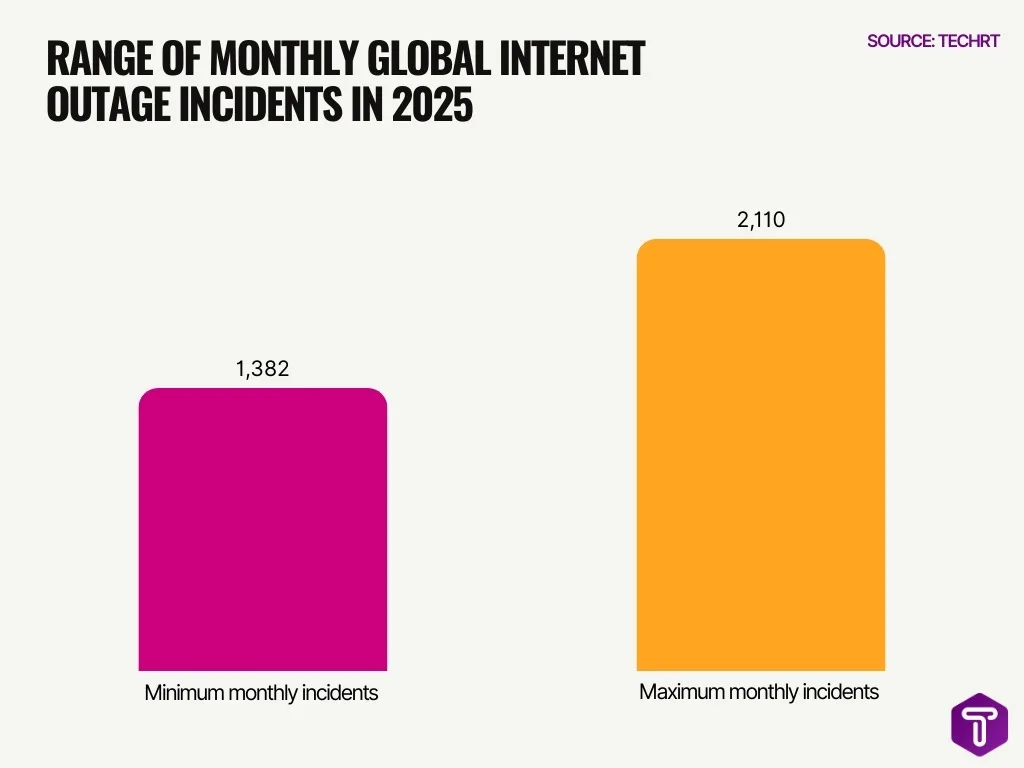
- Monthly outage tracking in 2025 showed fluctuations from 1,382 incidents to over 2,110, reflecting sharp increases and declines across months.
- Outages climbed consecutively in several months of 2025, signaling rising instability.
- ISP outages increased 40% week-over-week in parts of 2025.
- Cloud network outages globally rose by ~3% in recent weeks.
- Collaboration application network outages shifted from zero to non-zero counts at times.
- 263 global outage events were counted during a mid-January 2026 snapshot.
- U.S. outage events saw a 10% week-over-week increase in the same period.
- Public cloud provider issues contribute to overall outage volumes.
Regional Internet Outage Statistics
- Between Dec 29, 2025, and Jan 4, 2026, 199 global outages were recorded across ISPs, cloud networks, and services, down 14% from the previous week.
- In the same snapshot, U.S. outages dropped from 100 to 71, marking a 29% reduction.
- Globally, ISP outages fell from 136 to 105, 23% in that period.
- However, public cloud network outages climbed globally from 47 to 59, a 26% rise, and climbed 68% in the U.S. during the same timeframe.
- Collaboration platform outages remained stable at zero across both global and U.S. regions.
- Some reports show diverse regional trends, where ISP outages sometimes spike in certain areas but drop in others.
- Regional internet infrastructure remains vulnerable to undersea cable failures and power-related disruptions, particularly in coastal and island regions.
- Cloud service instability shows regional variance, with some markets seeing greater occurrences than others.
- Localized outages due to maintenance and configuration errors are frequent in urban centers across Europe and Asia.
Country-Level Internet Outage Statistics
- The U.S. has experienced multiple ISP outage shifts in 2026, with weekly fluctuations noted in early January.
- In Iran, a nationwide internet blackout began Jan 8, 2026, affecting most domestic web access and mobile services amid social unrest.
- During the blackout, internal networks were also inaccessible, showing complete disconnection.
- In the UK, Vodafone and major mobile carriers experienced periodic service lapses in 2025, generating up to 877,000 user reports during peak outages.
- YouTube reported ~3 million outage reports from users globally during the peak 2025 disruptions.
- Google Cloud and Cloudflare outages impacted the U.S., generating approximately 1.4 million user reports.
- In some smaller countries, internet disruptions tied to infrastructure damage or maintenance account for a significant percentage of connectivity losses.
- Outage incident volume in developed economies has been notable despite stronger infrastructure, often tied to cloud and configuration events.
AWS Outage Reports by Country
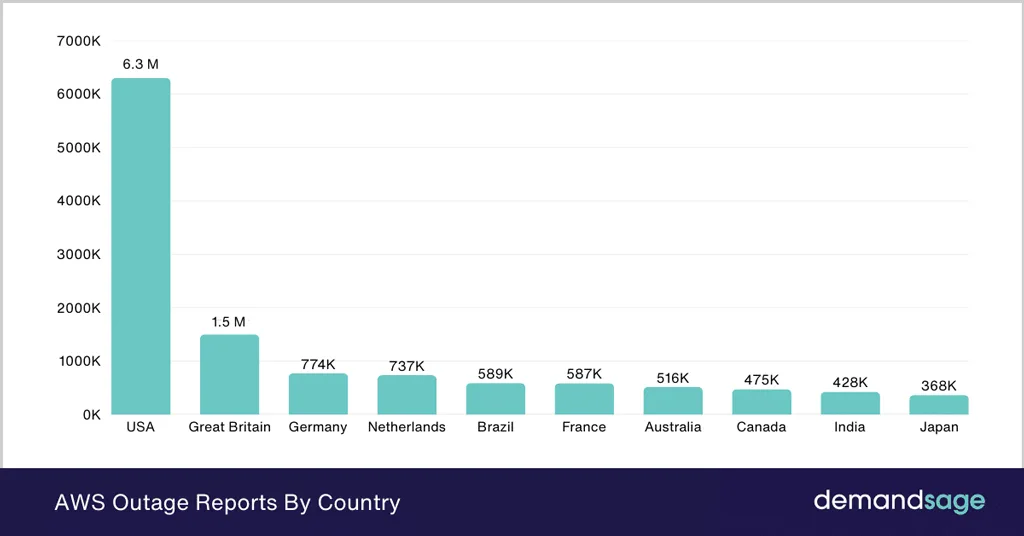
- The United States leads globally with 6.3 million AWS outage reports, highlighting its massive cloud infrastructure footprint and heavy enterprise reliance.
- Great Britain ranks second with 1.5 million reports, reflecting strong AWS adoption across finance, government, and digital services.
- Germany recorded 774,000 outage reports, indicating significant cloud usage within Europe’s largest economy.
- The Netherlands follows closely with 737,000 reports, driven by its role as a major European data center hub.
- Brazil experienced 589,000 AWS outages, underscoring rapid cloud expansion across Latin America.
- France reported 587,000 outages, showing comparable cloud dependency to Brazil despite a smaller market scale.
- Australia logged 516,000 outage reports, reflecting high cloud penetration across enterprises and public services.
- Canada registered 475,000 reports, consistent with steady AWS usage in North American markets.
- India saw 428,000 AWS outage reports, highlighting growing cloud adoption alongside expanding digital infrastructure.
- Japan reported the lowest among the top countries with 368,000 outages, indicating comparatively lower AWS disruption volumes.
ISP and Fixed Broadband Outage Statistics
- ISP outages have shown mixed trends; they sometimes double week-over-week, for example, from 86 to 175 events.
- In the U.S., ISP outages climbed from 44 to 78, a 77% rise.
- Week-over-week data from another snapshot shows ISP outages declining from 115 to 113.
- Yet another period saw global ISP outages drop by 23% while cloud outages rose sharply.
- Monthly tracking in 2025 showed continuous ISP outage events influencing connectivity performance.
- Daily reports often track hundreds of ISP outage incidents originating from routing or maintenance failures.
- ISP outages remain one of the largest contributors to overall internet disruptions worldwide.
- Fixed broadband outages often spike during extreme weather events or infrastructure upgrades.
Mobile, 4G, and 5G Network Outage Statistics
- A major mobile network outage, more than 100,000 Verizon users faced service loss for 10 hours in January 2026.
- Reports suggest that even 180,000 U.S. users experienced outages during the same Verizon incident.
- Nationwide 4G outages persist in small markets tied to routing errors and tower maintenance.
- 5G network outages occur less frequently, but when they happen, they impact emergency communications systems.
- Satellite internet systems like Starlink experienced notable outages in 2025, with 61,000 user reports over 2.5 hours.
- Outage tracking sites report thousands of mobile connection loss reports weekly across platforms.
- Mobile network outages often show peaks during infrastructure upgrades or failed configuration rollouts.
- Legacy mobile systems occasionally act as backup during modern 4G and 5G disruptions.
Key Insights on Internet Shutdown Causes
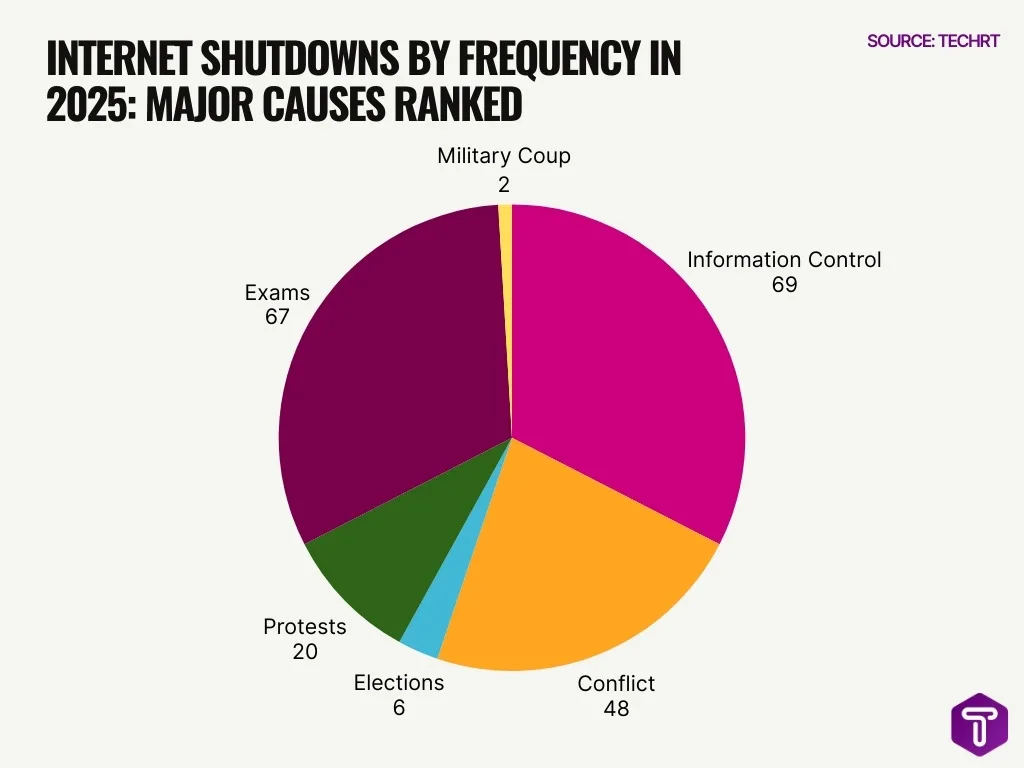
- Information Control was the dominant reason, causing 69 shutdowns, resulting in $14.91 billion in losses and 68,259 hours of disruption worldwide.
- Conflict-related shutdowns accounted for 48 incidents, leading to $3.06 billion in economic damage and 29,198 hours of internet downtime.
- Elections triggered only 6 shutdowns, but still caused significant losses of $1.26 billion and disrupted connectivity for 4,762 hours.
- Protest-related restrictions led to 20 shutdowns, generating losses of $272.7 million and affecting services for 15,776 hours.
- Exams-related shutdowns were frequent, with 67 incidents, yet had a relatively low financial impact at $140.6 million and lasted just 118 hours in total.
- Military coups resulted in the fewest shutdowns at 2 cases, causing $67.4 million in losses and 1,982 hours of internet disruption.
- Overall, government-led information control and conflict situations were responsible for the largest share of shutdowns and economic damage in 2025, highlighting their severe impact on digital access and business continuity.
Cloud Service and Data Center Outage Statistics
- AWS and major cloud providers had several large outages in 2025, including a 15-hour AWS event affecting 3,500+ companies.
- That AWS outage generated ~6.3 million outage reports from U.S. users alone.
- Cloud and CDN outages were among the most disruptive tech incidents in 2025.
- Cloudflare, which supports roughly 20% of global internet traffic, suffered multiple outages in 2025.
- Cloudflare’s November 18 outage was triggered by a software configuration issue.
- Predictions suggest at least two major multiday cloud outages in 2026 tied to AI data center upgrades.
- Public cloud outages climbed in some reporting periods; for example, U.S. cloud outages jumped from 22 to 37 in a week.
- Cloud infrastructure issues often cascade into platform-level outages, expanding overall disruption.
Platform and Service-Specific Outage Statistics
- Popular internet services experienced massive outage spikes in 2025, with AWS disruptions alone generating over 17 million user reports worldwide.
- Snapchat outages peaked at 944,675 reports during the October AWS incident.
- Spotify saw over 31,200 US reports during its major December outage.
- YouTube disruptions logged 1.5 million reports in October 2025.
- X (Twitter) outages spiked to 645,395 reports in March 2025.
- PlayStation Network generated 3.9 million reports during its 24-hour February outage.
- Cloudflare outage in November 2025 disrupted X and ChatGPT.
- Zoom peaked at 59,000 user reports during its April global outage.
- Asana received over 3,900 reports amid AWS-linked disruptions.
- Microsoft Teams faced widespread performance issues in December 2025.
Impact of Global Internet Outages on User Reports by Industry
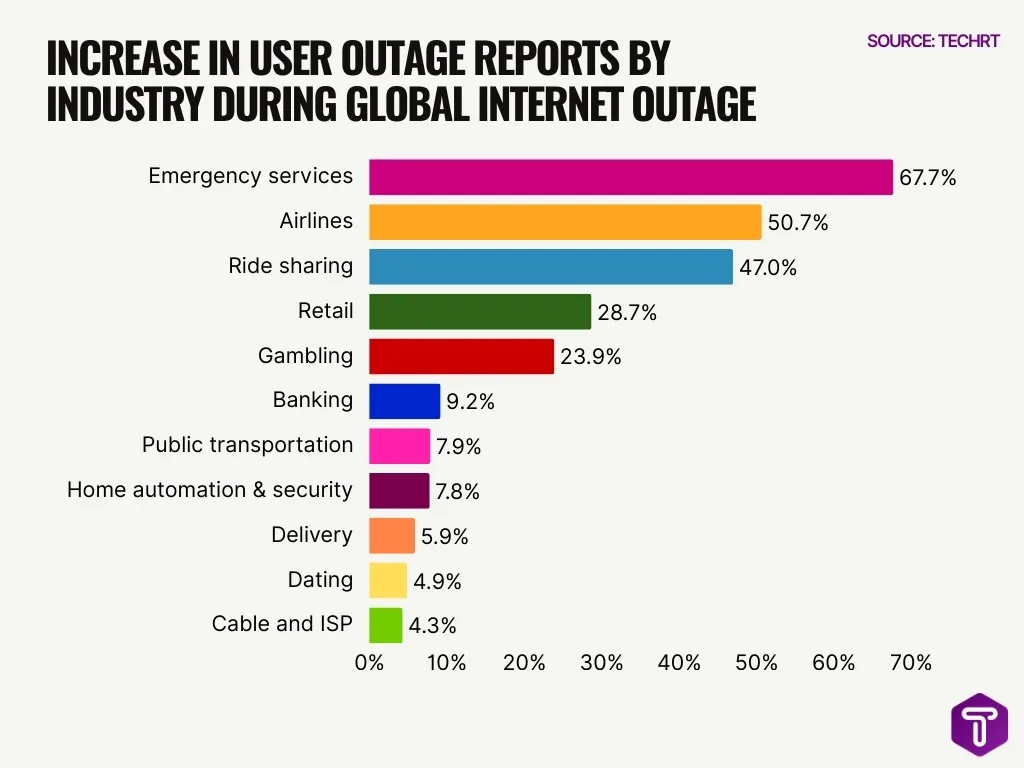
- Emergency services experienced the highest surge, with user reports increasing by 67.7%, highlighting severe risks to public safety during outages.
- Airlines saw a major disruption, recording a 50.7% increase in outage complaints, affecting bookings, check-ins, and flight operations.
- Ride-sharing platforms faced strong user impact, with reports rising by 47.0%, disrupting real-time mobility and on-demand services.
- Retail services reported a notable 28.7% jump in complaints, reflecting interruptions in online shopping and digital payments.
- Gambling platforms experienced a 23.9% increase in user reports, showing high dependency on continuous connectivity.
- Banking services recorded a relatively lower but critical rise of 9.2%, impacting digital transactions and mobile banking access.
- Public transportation systems saw reports grow by 7.9%, affecting ticketing apps and real-time transit updates.
- Home automation and security services registered a 7.8% increase, raising concerns over smart home reliability and safety.
- Delivery platforms experienced a 5.9% rise in outage complaints, slowing logistics tracking and order fulfillment.
- Dating apps and platforms reported a 4.9% increase, showing moderate user disruption in social connectivity.
- Cable and ISP services recorded the smallest rise at 4.3%, indicating comparatively faster recovery or better infrastructure resilience.
Economic and Business Impact of Internet Outages
- The average cost of a data center outage reached $9,000 per minute in 2025.
- 40% of enterprises report that a single hour of downtime costs $1M–$5M.
- Global internet shutdowns cost the economy $19.7 billion in 2025.
- 56% of businesses experienced significant revenue loss from technology downtime.
- The Cloudflare outage in 2025 caused a $1.58 billion loss in financial trading volume.
- 90% of enterprises face downtime costs of over $300,000 per hour.
- Indian businesses lost $76 million annually from high-impact IT outages.
- Downtime costs per hour in automotive rose 113% over five years.
- 31% of firms call 8 hours of cloud downtime catastrophic for business.
- 93% of enterprises report downtime exceeding $300,000 hourly.
User-Reported Internet Outage Statistics
- Downdetector tracked millions of outage reports in 2025, with single incidents generating over 3 million complaints globally.
- During a major AWS disruption, U.S. user reports exceeded 6 million within hours.
- Verizon’s January 2026 outage saw more than 100,000 user reports within the first few hours.
- YouTube and Spotify outages in 2025 triggered a combined 4+ million user complaints.
- Real-time tracking platforms log thousands of outage reports per minute during peak incidents.
- Consumer frustration trends show that users typically report outages within 10 to 20 minutes of disruption onset.
- Survey data shows that over 65% of consumers consider internet access essential for daily activities.
- In the U.S., broadband complaints to regulators spike during multi-state outage events.
Notable Global Internet Outages and Large-Scale Incidents
- The October 2025 AWS outage lasted roughly 15 hours, disrupting thousands of companies globally.
- A Starlink global outage in 2025 lasted approximately 2.5 hours, affecting 60,000+ users.
- Cloudflare’s November 2025 outage temporarily disrupted services for sites representing ~20% of web traffic.
- The 2026 Iran blackout disconnected most national internet traffic for days.
- Large-scale DNS outages in 2025 affected payment processors and government portals.
- Major social media platforms experienced repeated short-term outages tied to cloud provider failures.
- Hurricane-related outages in the southeastern U.S. disrupted broadband access for hundreds of thousands of households.
- Multiple collaboration app disruptions occurred globally in early 2026 due to backend infrastructure instability.
Internet Outage Trends Over Time
- Cloudflare observed over 180 global internet disruptions in 2025.
- Global outage incidents reached 180+ in 2025, up significantly from prior years.
- ISP outages dropped 24% week-over-week globally in early 2026.
- Cloudflare’s November-December 2025 outages affected 28% of global HTTP traffic.
- Government shutdowns totaled 101 incidents since February 2025 across 13 countries.
- AWS October 2025 outage generated over 17 million user reports worldwide.
- PlayStation Network outage on February 7, 2025, logged 3.9 million reports.
- 5G median download speeds hit 388 Mbps in the U.S. Q4 2024, aiding latency reduction.
- Cloud outages ranked second highest category after cybersecurity in 2025.
Frequently Asked Questions (FAQs)
What percentage increase did global internet outages see from November to December 2025?
How many outage reports did the biggest AWS outage in 2025 generate from U.S. users alone?
By what percentage did global network outages increase between January and May 2025?
What proportion of IT decision makers have experienced at least one outage in the past three years?
What percentage of companies estimate losing more than $1 million monthly due to internet outages or degradations?
Conclusion
Internet outages reflect a complex mix of infrastructure strain, cloud dependency, human error, and cybersecurity risks. While some outage categories show short-term declines, cloud and data center instability continue to influence global connectivity patterns. For U.S. businesses, especially, the financial stakes are rising as digital transformation deepens reliance on uninterrupted access.
At the same time, user awareness and reporting have never been higher, making outages more visible and reputationally costly. As enterprises expand AI workloads, adopt multi-cloud strategies, and deploy 5G infrastructure, resilience planning becomes essential rather than optional.
Ultimately, the data shows that outages are not isolated events; they are systemic risks tied to how the modern internet operates. Organizations that invest in redundancy, monitoring, and proactive risk management will be best positioned to navigate the connectivity challenges ahead.

Leave a comment
Have something to say about this article? Add your comment and start the discussion.