




Zoom remains one of the most widely used video communications platforms worldwide, powering meetings, webinars, and collaboration across industries. Zoom still plays a critical role in hybrid work, distance learning, healthcare consultations, and customer support channels, reflecting its deep integration into how organizations operate and connect. Remote teams, global businesses, and educators leverage Zoom daily to break down geographical barriers, while service providers use its tools for customer engagement and real-time assistance. These statistics offer a clear lens into Zoom’s current scale, usage patterns, and business performance. Read on for the detailed data driving its impact.
Editor’s Choice
- Zoom hosts over 300 million daily active users participating in meetings across the globe.
- The platform’s annual revenue for fiscal 2026 is reported at roughly $4.67 billion.
- Zoom holds approximately 55.9% of the global video conferencing market share.
- Users spend more than 3.3 trillion minutes in meetings annually.
- Zoom Phone surpassed 10 million paid seats, marking strong growth outside core meetings.
- The company serves around 192,600 enterprise customers worldwide.
- Zoom’s AI Companion advancements are a key growth driver in 2025–26.
Recent Developments
- In 2025, Zoom raised its FY2026 revenue outlook to approximately $4.83 billion due to increased AI and hybrid work adoption.
- Zoom introduced AI Companion 3.0, enabling enhanced AI note-taking, task automation, and cross-platform interoperability with Teams and Google Meet.
- Realistic AI-generated avatars and improved video performance (60 fps) are planned to boost user experience.
- CEO Eric Yuan highlighted AI-driven features as central to the long-term growth strategy.
- Expanded Zoom Phone and Contact Center features reflect an enterprise-oriented product shift.
- Zoom maintains a transparency report covering user data requests for the latter half of 2024.
- Ongoing enhancements improve accessibility and language translation capabilities within meetings.
- Zoom continues to optimize hybrid work communications with broader integrations across productivity tools.
Zoom Key Statistics Overview
- Zoom supports an estimated 300+ million daily active users in meetings in 2025–26.
- The platform’s market share in video conferencing sits near 55.9%.
- Users worldwide spend more than 3.3 trillion minutes in Zoom meetings annually.
- Zoom’s fiscal year 2026 revenue reached ~$4.67 billion.
- Zoom Phone licenses surpassed 10 million paid seats, reflecting broader communication service adoption.
- The platform serves nearly 470,000 paying business customers.
- Average meeting length remains consistent with multi-participant engagement trends.
- Zoom’s AI transcription performance outpaced several competitors in recent evaluations.
Zoom Revenue Growth Trends
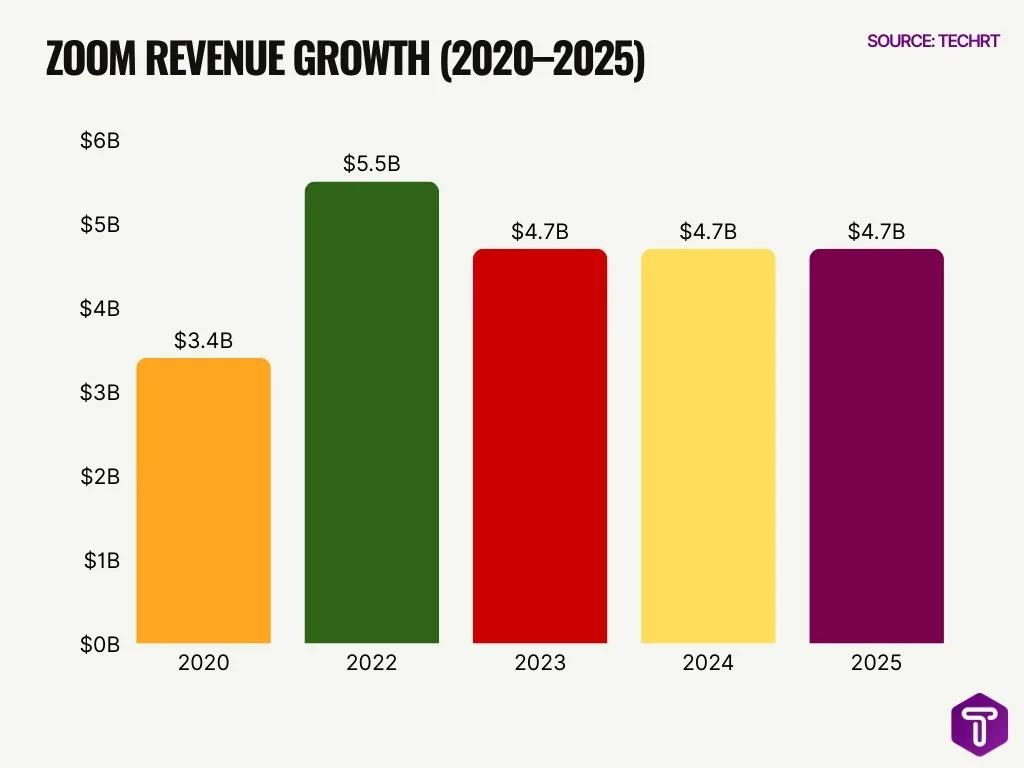
- Zoom’s revenue surged to $3.4 billion in 2020, marking the beginning of its rapid expansion phase driven by global remote work adoption.
- The company reached its peak revenue of $5.5 billion in 2022, reflecting a massive pandemic-era growth spike and heightened demand for video conferencing solutions.
- After the 2022 high, revenue declined to $4.7 billion in 2023, signaling a post-pandemic normalization in usage and enterprise spending.
- Revenue remained stable at approximately $4.7 billion in 2024, indicating a plateau phase following earlier hypergrowth.
- Forecast data for 2025 also projects revenue at around $4.7 billion, suggesting continued stabilization rather than aggressive expansion.
- Overall, Zoom experienced a strong 61% growth from 2020 to its 2022 peak, followed by a ~15% decline as market conditions normalized.
Zoom User Growth Over Time
- Zoom grew from 10 million daily users in 2019 to over 300 million by mid-2020, a nearly 2,900% increase.
- This exponential user growth occurred within less than two years during the pandemic surge.
- By 2025, Zoom will continue to expand its user base across both free and paid tiers.
- Enterprise customer growth reflects expanded business adoption since 2020.
- Zoom’s expansion includes added features like phone, contact center, and AI tools, which attract new segments.
- The platform’s shift to a workplace ecosystem helps sustain monthly active user momentum globally.
- By 2026, Zoom’s headline user metrics will remain elevated compared to legacy levels from 2021–23.
- Growth persists despite competitive pressures from platforms like Microsoft Teams.
Daily Active Users and Meeting Participants
- Zoom’s daily active user count is consistently above 300 million in 2025–26.
- This figure includes both free users and paid subscribers worldwide.
- Daily usage patterns show Tuesday as the most active day for meetings.
- Daily engagement far exceeds pre-pandemic participation figures.
- Zoom’s platform remains central to virtual meeting adoption across sectors.
- Average engagement metrics suggest stable daily usage throughout the business week.
- Competition from Microsoft Teams and other tools remains strong, but doesn’t drastically dent Zoom’s DAU totals.
Monthly Active Users and Registered Accounts
- Zoom surpassed 800 million+ total downloads globally across iOS and Android combined, reflecting long-term adoption beyond pandemic peaks.
- The platform maintains an estimated 300 million daily meeting participants, which translates into hundreds of millions of recurring monthly users.
- Zoom reported approximately 219,700 enterprise customers in FY2025, signaling stable registered business account growth year over year.
- More than 3.3 trillion annual meeting minutes imply sustained monthly engagement levels across global user bases.
- Zoom’s paid business customer base exceeded 192,000+ customers, contributing over $100,000 in trailing 12-month revenue, highlighting strong account retention.
- Over 50% of revenue now comes from enterprise accounts rather than small teams or individuals.
- The U.S. accounts for roughly 50% of Zoom’s total revenue, showing concentrated registered usage in North America.
- Zoom continues expanding registered users via education, healthcare, and public sector contracts, which add recurring monthly seats.
Zoom Clients With 10+ Employees: Explosive Growth
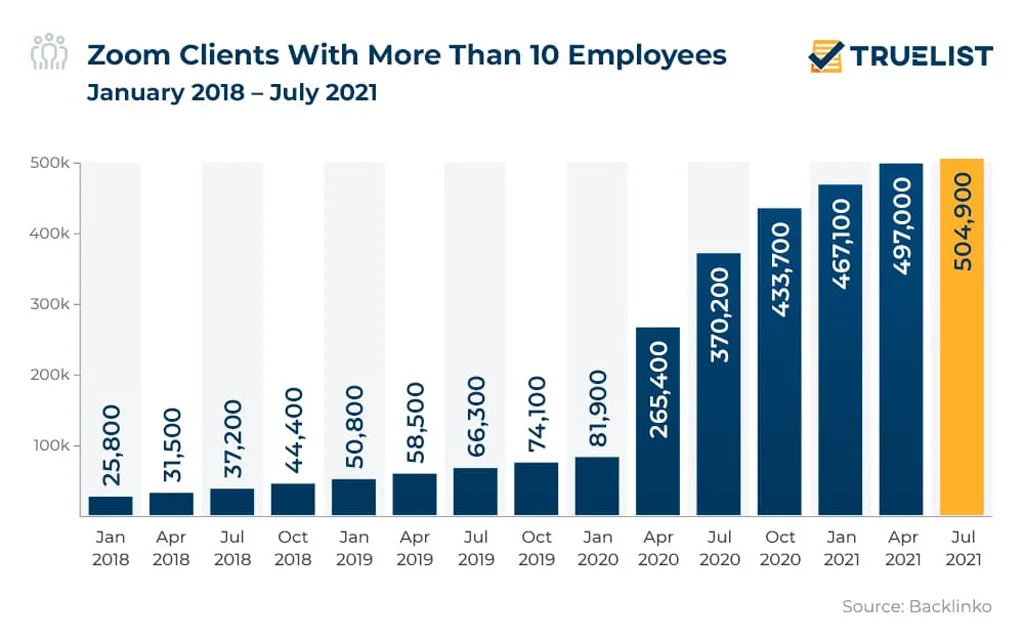
- Zoom served 25,800 business clients (10+ employees) in January 2018, marking the early stage of its enterprise expansion.
- By January 2019, the client base had nearly doubled to 50,800, reflecting steady pre-pandemic adoption.
- In January 2020, Zoom had 81,900 enterprise clients, showing consistent year-over-year growth before COVID-19.
- Between January 2020 (81,900) and April 2020 (265,400), Zoom added over 183,500 new business clients in just one quarter, a 224% surge.
- By July 2020, the number climbed further to 370,200, adding more than 100,000 clients in three months.
- In October 2020, enterprise clients reached 433,700, crossing the 400K milestone.
- Zoom entered 2021 with 467,100 business customers, indicating sustained demand even after the initial pandemic spike.
- By April 2021, the figure rose to 497,000, approaching the half-million mark.
- In July 2021, Zoom surpassed 500,000 enterprise clients, reaching 504,900 companies globally.
- Overall, Zoom’s 10+ employee client base grew from 25,800 (Jan 2018) to 504,900 (July 2021), an increase of nearly 19.5× in just 3.5 years.
Zoom Usage by Device and Platform
- Approximately 65%+ of Zoom users access meetings via desktop or laptop devices, especially in enterprise settings.
- Mobile devices account for nearly 30%–35% of Zoom meeting joins, driven by iOS and Android adoption.
- Zoom’s iOS app consistently ranks among the top 10 business apps in the U.S. App Store.
- Android installs surpassed 500 million downloads on Google Play, underscoring global mobile penetration.
- Zoom Rooms hardware adoption expanded across enterprises, with thousands of companies deploying dedicated room systems for hybrid collaboration.
- Browser-based participation via Chrome and Edge has grown as organizations limit software downloads.
- Mac and Windows platforms remain dominant among corporate users, with Windows accounting for the majority of enterprise device usage.
- Zoom supports cross-platform compatibility across Windows, macOS, Linux, iOS, Android, and web browsers, maintaining accessibility across ecosystems.
Zoom Demographics by Age and Gender
- Adults aged 25–34 represent 29.71% of Zoom users, the largest age segment.
- Adults aged 35–44 comprise 21.46% of Zoom users.
- Gender split is 50.1% female and 49.9% male among Zoom users.
- Over 70% of Fortune 100 companies utilize Zoom services.
- Over 125,000 educational institutions have adopted Zoom for virtual learning.
- 87% of government employees rate Zoom positively for collaboration.
- 80% of government workers use Zoom to connect with colleagues.
- Enterprise customers generate 58% of Zoom’s fiscal 2024 revenue.
Zoom Traffic Distribution by Country
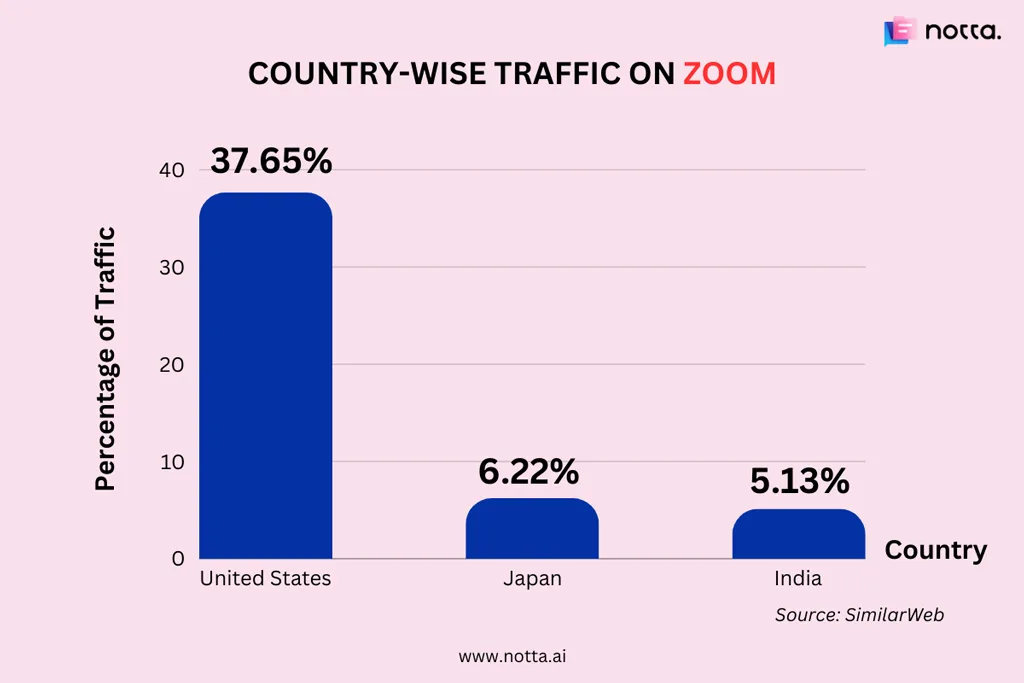
- The United States dominates Zoom traffic with a substantial 37.65% share, making it the platform’s largest traffic contributor by a wide margin.
- Japan ranks second among the listed countries, contributing 6.22% of total Zoom traffic, significantly lower than the U.S. but ahead of India.
- India accounts for 5.13% of Zoom’s overall traffic, positioning it as the third-largest contributor among the highlighted countries.
- The traffic gap between the United States (37.65%) and Japan (6.22%) is over 31 percentage points, indicating a highly concentrated user base in the U.S.
- Combined, Japan and India contribute 11.35%, which is still far below the U.S. share alone, underscoring the platform’s strong North American dominance.
Zoom Usage by Industry and Business Size
- Over 55% of Zoom revenue derives from enterprise clients with more than 10 employees.
- Zoom serves over 504,900 business customers globally, including enterprise accounts.
- Enterprise customers account for 58% of Zoom’s fiscal 2024 revenue, totaling $4.5 billion.
- Customers with more than 10 employees represent 64% of Zoom’s total revenue.
- 70% of Fortune 100 companies and over half of Fortune 500 use Zoom.
- Over 125,000 educational institutions leverage Zoom for virtual learning.
- 40% of U.S. hospitals use Zoom for patient consultations and telehealth.
- 192,600 enterprise customers actively deploy Zoom as of the recent fiscal reports.
- 4,468 high-value customers contribute over $100,000 annually, 33% of revenue.
- SMBs and companies under 500 employees form a large share of paying Zoom accounts.
Free vs Paid Zoom Users
- Zoom continues operating a freemium model, with free accounts limited to 40-minute meetings for group sessions.
- Paid plans start at approximately $14–$15 per user per month for Pro subscriptions in the U.S. market.
- Enterprise plans offer advanced security, analytics, and admin controls, driving higher ARPU.
- More than 470,000 businesses use Zoom in a paid or licensed capacity.
- Customers contributing over $100,000 in annual revenue represent Zoom’s fastest-growing high-value segment.
- Zoom Phone and Contact Center subscriptions contribute incremental revenue beyond core meeting licenses.
- Paid users generate the majority of Zoom’s $4.6+ billion annual revenue.
- Free users remain critical to funnel growth, often converting into paid accounts for webinars, team collaboration, and extended meeting durations.
Zoom Website Traffic Breakdown by Source
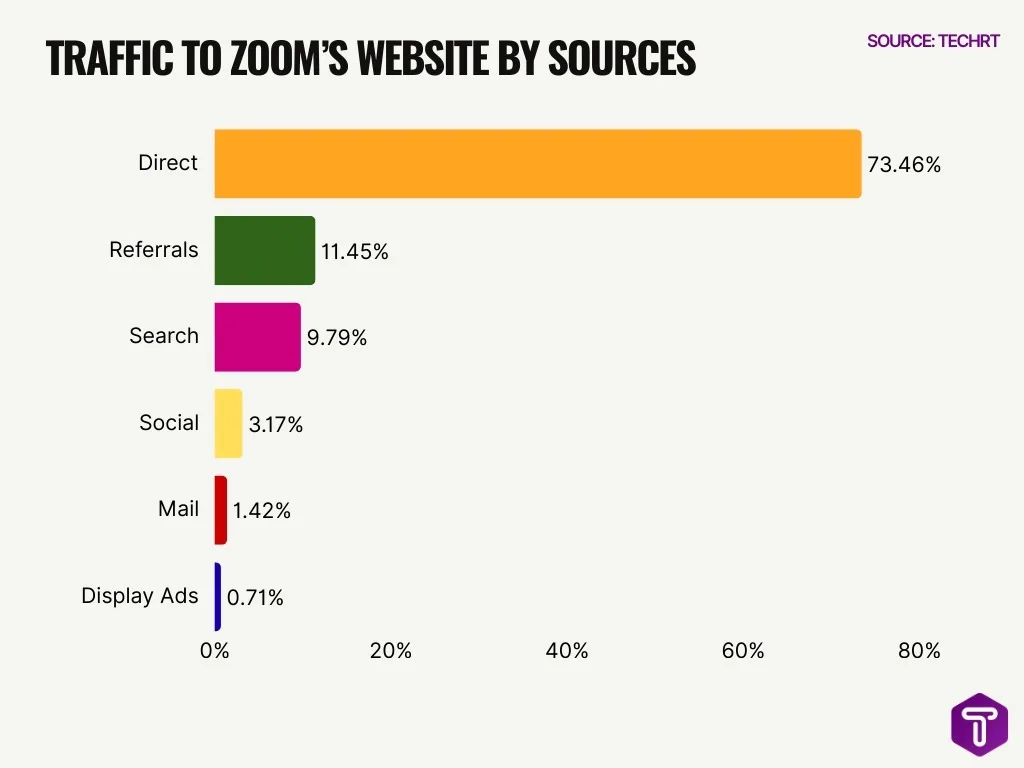
- Combined, Search, Social, Mail, and Display Ads contribute only 15.09%, reinforcing that Zoom’s traffic is overwhelmingly brand- and direct-driven rather than performance-marketing-led.
- Direct traffic dominates Zoom’s website visits, accounting for 73.46% of total traffic, indicating strong brand recognition and repeat usage.
- Referral traffic contributes 11.45%, showing that partnerships, backlinks, and third-party platforms play a meaningful role in driving users.
- Organic and paid search combined account for 9.79%, highlighting moderate reliance on search engines compared to brand-driven access.
- Social media drives only 3.17% of total traffic, suggesting that Zoom’s acquisition strategy is not heavily dependent on social platforms.
- Email (Mail) traffic represents 1.42%, indicating a limited contribution from email marketing campaigns.
- Display ads generate just 0.71%, making paid display advertising the smallest traffic channel.
Zoom Enterprise and Business Customers
- Zoom reported approximately 219,700 enterprise customers in FY2025, reflecting continued large-account stability.
- Customers contributing more than $100,000 in trailing 12-month revenue exceeded 3,800, a key indicator of enterprise stickiness.
- Enterprise revenue represents over 55% of total company revenue, highlighting Zoom’s shift away from small-team dependency.
- Zoom Phone surpassed 10 million paid seats globally, strengthening its enterprise communications footprint.
- Fortune 500 companies widely deploy Zoom across distributed teams and hybrid offices.
- Zoom Contact Center continues expanding within large organizations seeking integrated support solutions.
- The company maintains a net dollar expansion rate above 100%, meaning existing enterprise customers continue increasing spend.
- Government and public sector contracts contribute recurring multi-year revenue streams.
Zoom Profitability, Valuation, and Market Cap
- Zoom reported GAAP net income exceeding $600 million in FY2024, signaling sustained profitability.
- The company maintains operating margins above 20% on a non-GAAP basis, reflecting cost controls.
- As of early 2026, Zoom’s market capitalization fluctuates around $20–$25 billion, depending on market conditions.
- Zoom went public in 2019 at an IPO price of $36 per share on the Nasdaq under the ticker ZM.
- During its 2020–2021 peak, Zoom’s valuation exceeded $100 billion, before normalizing post-pandemic.
- The company holds billions in cash and short-term investments, strengthening balance sheet stability.
- Free cash flow remains strong, exceeding $1 billion annually in recent fiscal years.
- Zoom continues to share repurchase programs to return capital to shareholders.
Zoom Market Share in Video Conferencing
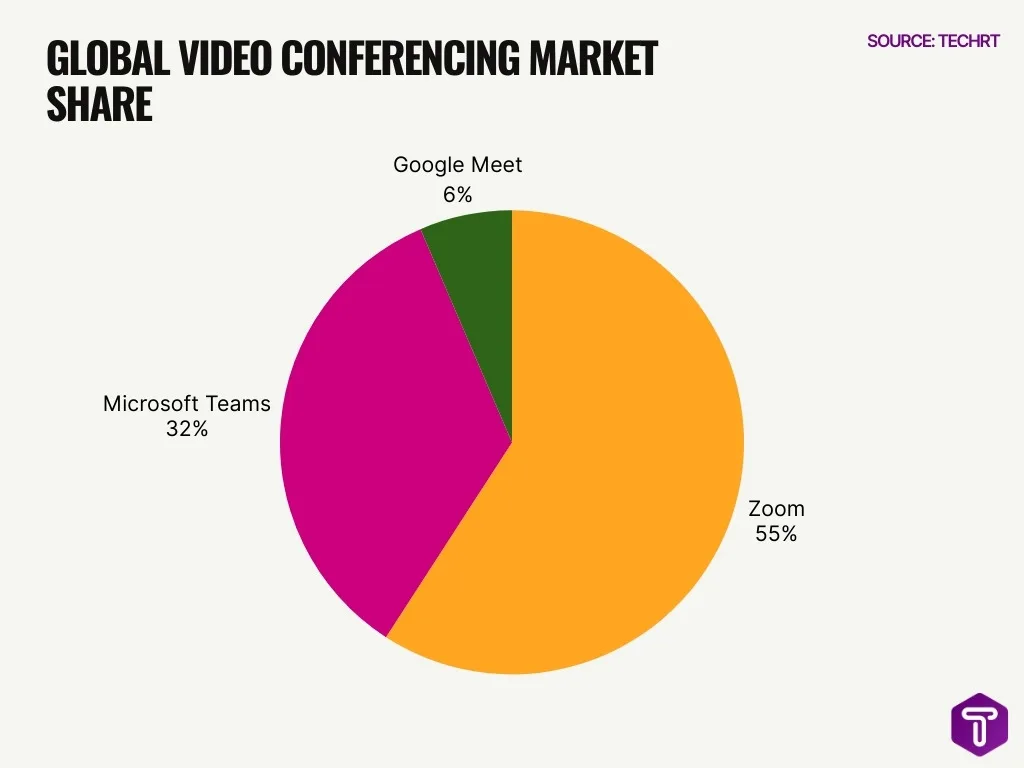
- Zoom commands a leading 55% share of the global video conferencing market.
- Microsoft Teams holds approximately 32% of the video conferencing market.
- Google Meet secures around 6% global market share in video conferencing.
- Zoom averages over 300 million daily meeting participants worldwide.
- Zoom supports more than 500,000 business customers globally.
- Microsoft Teams boasts 320 million monthly active users.
- In education, Zoom leads with adoption by 3,293 institutions.
- Zoom reported $4.66 billion in revenue for fiscal year 2025.
- Zoom’s brand enjoys over 80% awareness among U.S. remote workers.
Zoom Meetings: Volume and Duration Statistics
- Zoom supports 300+ million daily meeting participants worldwide.
- Users collectively log more than 3.3 trillion meeting minutes annually.
- Tuesday and Wednesday rank as the busiest meeting days globally.
- The average meeting duration typically ranges between 30 to 60 minutes in business settings.
- Enterprise accounts frequently host meetings exceeding 100 participants, especially for webinars and town halls.
- Zoom Webinar supports up to 10,000 interactive attendees, depending on plan tier.
- Virtual events and hybrid conferences continue driving higher participant volumes year over year.
- Meeting recording and cloud storage features remain heavily utilized by enterprise users.
Where Do Zoom Users Prefer to Hold Meetings?
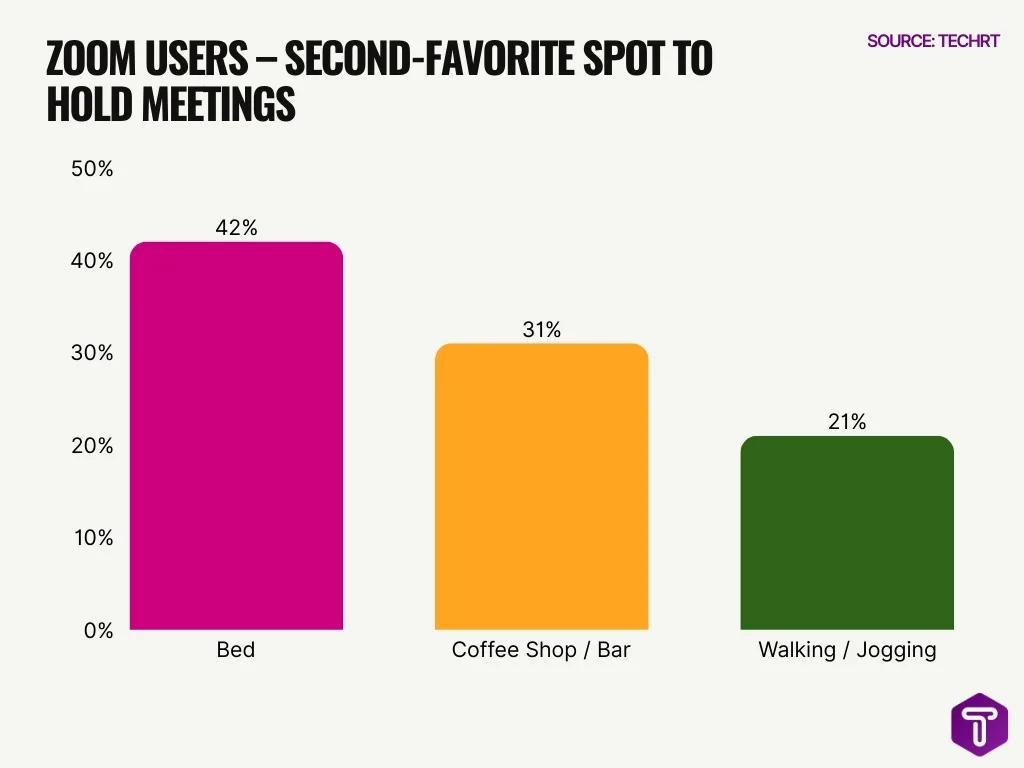
- 42% of Zoom users say their second-favorite spot to hold meetings is their bed, making it the top informal meeting location.
- 31% of users prefer attending Zoom meetings from a coffee shop or bar, highlighting the rise of hybrid work and location flexibility.
- 21% of users take meetings while walking or jogging, reflecting increased adoption of mobile devices and on-the-go productivity.
- The data shows that over 9 in 10 users (94%) are comfortable joining Zoom meetings from non-traditional workspaces, reinforcing the shift toward a remote and flexible work culture.
- The significant gap between bed (42%) and walking/jogging (21%) suggests that users prioritize comfort over mobility when choosing informal meeting environments.
Zoom Phone, Contact Center, and AI Features Usage
- Zoom Phone reached over 10 million paid seats globally by October 2025.
- Zoom Contact Center serves 1,250 customers, up 82% year-over-year.
- Zoom enterprise customers total 192,400 accounts.
- AI Companion generated over 1 million meeting summaries shortly after launch.
- Contact Center clients over $100K ARR surged 94% YoY to 229.
- Zoom Phone ARR grows in the mid-teens annually.
- Enterprise revenue from these features hit 60% of total Zoom revenue.
- Contact Center AI achieved 30% deflection rates, saving 1,000+ agent hours monthly.
- Customers over $100K ARR number 4,363, up 9% YoY.
Zoom Customers by Products and Services: Sector-Wise Breakdown
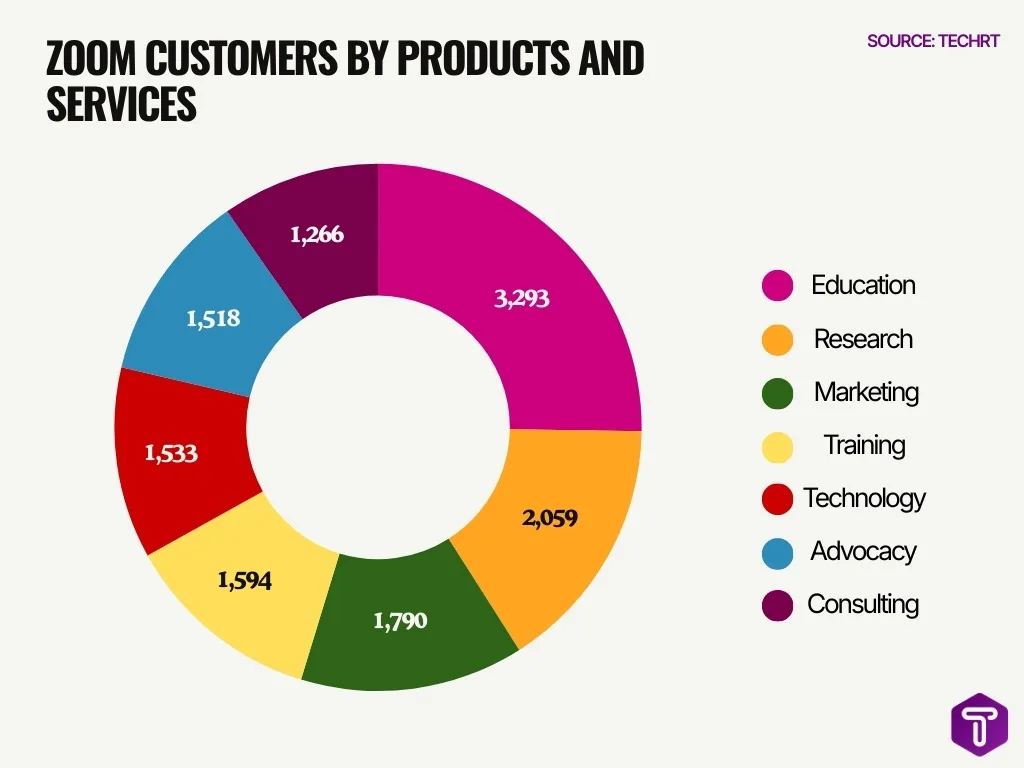
- Education leads significantly with 3,293 customers, making it the largest segment for Zoom’s product and service adoption.
- Research ranks second with 2,059 customers, highlighting strong demand from academic and institutional research organizations.
- Marketing follows at 1,790 customers, reflecting growing reliance on virtual meetings, webinars, and collaboration tools in digital campaigns.
- Training accounts for 1,594 customers, indicating substantial usage for employee onboarding, skill development, and corporate learning programs.
- Technology sector adoption stands at 1,533 customers, showing consistent demand from tech companies leveraging Zoom for remote collaboration.
- Advocacy organizations represent 1,518 customers, demonstrating steady utilization for community engagement and stakeholder communication.
- Consulting records the lowest among the listed segments with 1,266 customers, though it remains a notable contributor to Zoom’s professional services user base.
- The gap between the top (Education – 3,293) and the lowest (Consulting – 1,266) segment is 2,027 customers, underscoring education’s dominant position in Zoom’s ecosystem.
Customer Satisfaction and NPS for Zoom
- Zoom maintains a 4.7/5 rating on G2 from over 55,000 reviews, topping video conferencing satisfaction.
- Gartner Peer Insights names Zoom Customers’ Choice for exceeding the market average in overall experience and adoption.
- Zoom’s NPS score stands at 72, far above the SaaS average of 36.
- Net dollar retention rate at 98% in FY2026 Q4, with historical highs over 130%.
- Comparably CSAT survey shows 90% satisfaction among users, with 63% promoters.
- 56% of healthcare professionals report being satisfied or very satisfied with Zoom telehealth reliability.
- Zoom earns top G2 scores in all categories, a leader in 11,000+ customer reviews.
- Post-2020 security enhancements boosted trust, earning repeated Gartner awards.
Frequently Asked Questions (FAQs)
How many daily active Zoom participants are there as of 2026?
What revenue did Zoom report in its first quarter of fiscal 2025 and in fiscal 2024?
What market share does Zoom hold in the global video conferencing industry?
How many enterprise customers did Zoom have as of October 2025?
By what percentage did Zoom’s daily meeting participants grow from December 2019 to April 2020?
Conclusion
Zoom has evolved from a pandemic-era video tool into a diversified communications platform powering hybrid work, enterprise collaboration, telehealth, and virtual events. With $4.6+ billion in annual revenue, 300+ million daily participants, and millions of paid enterprise seats, the company maintains a leadership position in global video conferencing despite intensifying competition. Its expansion into Phone, Contact Center, and AI-driven features demonstrates a clear shift toward becoming a full workplace communications ecosystem rather than a standalone meetings app.
For U.S. businesses, educators, and global enterprises alike, Zoom remains a foundational collaboration tool. As AI integration deepens and hybrid work models persist, Zoom’s long-term growth will likely depend on enterprise retention, product bundling, and continued innovation in intelligent automation.

Leave a comment
Have something to say about this article? Add your comment and start the discussion.