




Amazon continues to shape global commerce, cloud computing, and digital services. From powering millions of online stores to running mission-critical infrastructure through Amazon Web Services (AWS), the company influences industries ranging from retail and logistics to entertainment and artificial intelligence. For example, businesses rely on Amazon’s marketplace to reach customers globally, while enterprises use AWS to run cloud applications and AI workloads. The following statistics highlight Amazon’s growth, market position, and evolving ecosystem.
Editor’s Choice
- Amazon generated about $716.9 billion in net sales in 2025, reflecting a 12% year-over-year increase from $638.0 billion in 2024.
- Amazon recorded $630 billion in total revenue in 2024, maintaining its position as one of the largest companies by revenue worldwide.
- Amazon’s net income reached $77.7 billion in 2025, up from $59.2 billion in 2024.
- The company had around 250 million Amazon Prime subscribers globally in 2025, making it one of the largest subscription programs in the world.
- Amazon controls roughly 37%–40% of the U.S. e-commerce market, far ahead of any competitor.
- AWS generated about $128.7 billion in revenue in 2025, accounting for a significant share of Amazon’s operating income.
- As of 2026, Amazon’s market capitalization is about $2.36 trillion, placing it among the most valuable companies globally.
- Amazon reported $213.4 billion in sales during Q4 2025, the company’s strongest quarterly performance to date.
- North America accounts for roughly 59% of Amazon’s total revenue, showing the continued dominance of the U.S. market.
Recent Developments
- In 2026, Amazon announced plans to invest nearly $200 billion in AI, robotics, satellites, and infrastructure expansion.
- Amazon Web Services partnered in a $110 billion funding round supporting OpenAI, strengthening its position in enterprise AI infrastructure.
- AWS consulting services are shifting toward AI-driven automation and outcome-based pricing models, with some tasks expected to be 90% automated by software agents.
- Amazon’s cloud division recorded over 20% annual growth in 2025, driven largely by enterprise demand for AI infrastructure.
- Amazon reported $180.2 billion in revenue during Q3 2025, up 12% year-over-year.
- The company’s advertising business grew more than 22% in 2025, making it one of Amazon’s fastest-growing segments.
- Amazon’s cloud infrastructure business expanded as companies increased spending on generative AI applications.
- Prime Video’s ad-supported model reached over 130 million monthly U.S. viewers, reflecting the platform’s expanding advertising reach.
- Amazon continues to scale AI chip development, including Trainium processors, to reduce AI computing costs across AWS.
Overview of Amazon Statistics
- Amazon was founded in 1994 and is headquartered in Seattle, Washington, evolving from an online bookstore into a global technology ecosystem.
- The company now operates across multiple sectors, including e-commerce, cloud computing, advertising, streaming, and logistics.
- In 2024, Amazon’s revenue averaged roughly $1.75 billion per day based on annual sales of around $638 billion.
- Amazon’s business segments include online stores, third-party seller services, AWS, advertising, subscriptions, and physical stores.
- Online store sales accounted for about 38.7% of Amazon’s revenue in 2024, the largest individual segment.
- Third-party seller services contributed about $156 billion in revenue, representing roughly 24.5% of Amazon’s total revenue.
- Advertising revenue reached more than $56 billion in 2024, making Amazon one of the top global digital advertising platforms.
- Subscription services such as Prime generated about $44 billion in revenue in 2024.
- Amazon operates marketplaces across dozens of global regions, enabling millions of sellers to reach international buyers.
Amazon Revenue Growth: The Road to $1 Trillion
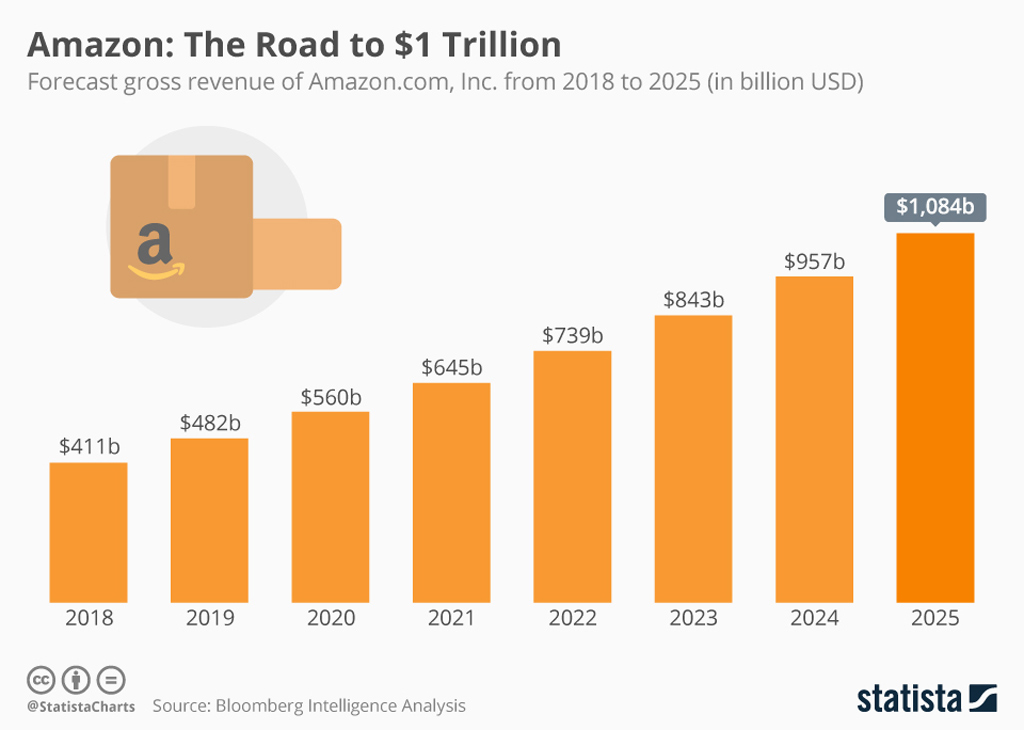
- Amazon’s gross revenue shows consistent and rapid growth, increasing from $411 billion in 2018 to a projected $1.084 trillion by 2025.
- Between 2018 and 2019, Amazon’s revenue grew from $411 billion to $482 billion, marking an increase of $71 billion in just one year.
- In 2020, Amazon’s revenue reached $560 billion, reflecting strong growth driven by the global surge in e-commerce demand.
- By 2021, revenue climbed further to $645 billion, adding another $85 billion year-over-year.
- Amazon continued its upward momentum in 2022, generating $739 billion, highlighting the platform’s expanding global marketplace and cloud services.
- In 2023, revenue is estimated to hit $843 billion, crossing the $800 billion milestone for the first time.
- The growth trajectory continues in 2024, with revenue projected at $957 billion, bringing Amazon close to the $1 trillion revenue mark.
- By 2025, Amazon is expected to reach approximately $1.084 trillion in revenue, officially surpassing the $1 trillion annual revenue milestone.
- Overall, Amazon’s revenue is projected to grow by over $673 billion between 2018 and 2025, demonstrating the company’s massive expansion in e-commerce, cloud computing, and digital services.
Profit and Valuation Statistics of Amazon
- Amazon posted $77.7 billion in net income in 2025, compared with $59.2 billion in 2024.
- Operating income rose to $80 billion in 2025, up from $68.6 billion in 2024.
- AWS generated $45.6 billion in operating income in 2025, accounting for more than half of Amazon’s operating profits.
- The North America segment recorded $29.6 billion in operating income in 2025, increasing 18.4% from 2024.
- Amazon’s international segment delivered $4.7 billion in operating income in 2025, up from $3.8 billion in 2024.
- Amazon’s market capitalization reached roughly $2.36 trillion in 2026, ranking it among the top global tech companies.
- AWS generated about 15% of Amazon’s total revenue but a much larger share of operating profit, highlighting its importance to overall profitability.
- Amazon’s earnings per share increased from $5.53 in 2024 to $7.17 in 2025, reflecting improved margins and cloud growth.
- Cloud computing, advertising, and subscription services continue to drive Amazon’s higher-margin revenue streams, improving long-term profitability.
Market Share Statistics of Amazon
- Amazon controls approximately 37%–40% of the U.S. e-commerce market, making it the dominant online retailer in the country.
- The company processes billions of transactions annually across its marketplace, supporting millions of third-party sellers globally.
- Amazon Web Services holds about 30% share of the global cloud infrastructure market, ahead of Microsoft Azure and Google Cloud.
- Microsoft Azure holds roughly 21% market share in the cloud market, while Google Cloud accounts for around 12%, illustrating AWS’s leadership.
- Amazon is one of the largest digital advertising platforms globally, competing with Google and Meta in retail media.
- The Amazon marketplace hosts millions of active sellers, many of whom rely on the platform for the majority of their online revenue.
- Amazon’s dominance in U.S. e-commerce is several times larger than its closest online competitor.
- AWS remains the largest public cloud provider globally, supporting startups, enterprises, and government workloads.
- Retail media advertising on Amazon continues to grow rapidly as brands allocate more budget to marketplace-based advertising channels.
Category and Product Statistics on Amazon
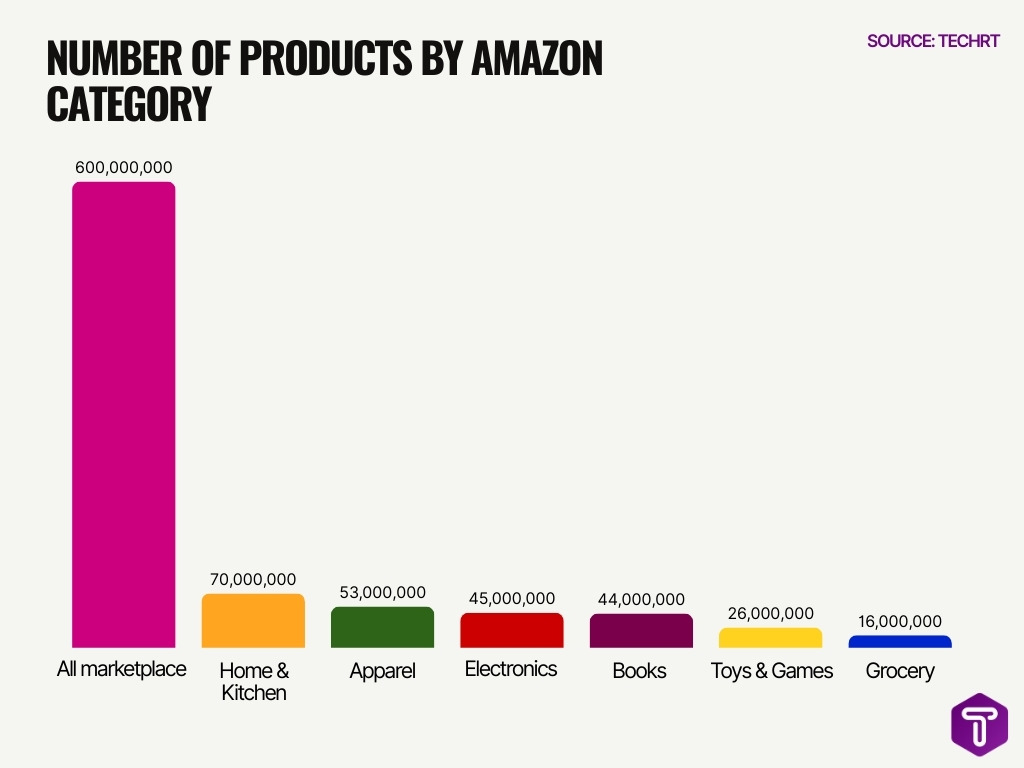
- Amazon’s marketplace lists over 600 million products globally across all categories.
- The electronics category features 45 million products, including smartphones and smart devices.
- Home & Kitchen leads with 70 million products, the largest category by listings.
- Amazon operates over 400 private label brands, including Amazon Basics and Solimo.
- Books category offers over 44 million titles worldwide.
- Amazon Basics provides over 105,000 electronics products alone.
- The apparel category holds 53 million products in clothing, shoes, and jewelry.
- The grocery category includes 16 million products via Amazon Fresh integrations.
- The Toys & Games category has 26 million products, spiking during Prime Day.
- Electronics sales surged 95% during Prime Day 2025 events.
Customer and Usage Statistics of Amazon
- Amazon had more than 310 million active customers worldwide in 2025, reflecting the platform’s massive global reach.
- In the United States alone, Amazon recorded over 230 million unique monthly shoppers in 2025, making it the country’s most visited online retailer.
- Around 80% of U.S. households use Amazon at least once per month, demonstrating deep market penetration in the American retail landscape.
- Nearly 66% of U.S. consumers start their product searches on Amazon rather than on traditional search engines or retailer sites.
- Amazon reported more than 2 billion monthly visits globally from logged-in shoppers, reflecting the platform’s heavy daily usage.
- Approximately 74% of U.S. adults purchase from Amazon at least once a month, highlighting the platform’s repeat purchase behavior.
- Surveys show that more than 90% of Prime members shop on Amazon at least monthly, indicating strong loyalty within the subscription ecosystem.
- Amazon’s marketplace now hosts over 9.7 million sellers worldwide, with millions of active buyers interacting with sellers daily.
- The platform processes millions of product reviews every day, helping consumers make purchasing decisions through peer feedback.
Website Traffic and Engagement Statistics of Amazon
- Amazon.com recorded over 2.7 billion monthly visits globally in 2025, ranking among the most visited websites worldwide.
- The United States accounts for roughly 42% of Amazon’s website traffic, followed by India, Japan, and the United Kingdom.
- Amazon’s average website session duration is approximately 7 minutes per visit, reflecting strong user engagement.
- The site receives over 600 million monthly visits from mobile devices in the U.S. alone, illustrating the dominance of mobile commerce.
- Amazon consistently ranks among the top 5 most visited websites globally, alongside platforms like Google and YouTube.
- Approximately 55% to 60% of Amazon traffic comes from direct visits, indicating strong brand recognition and customer loyalty.
- Organic search contributes roughly 25% of Amazon’s website traffic, driven by product-related queries.
- Amazon users typically view 8 to 10 pages per visit, reflecting browsing across product categories and listings.
- The platform’s bounce rate remains around 30% to 35%, significantly lower than many retail websites due to strong product discovery features.
Amazon Purchase Frequency Among Americans (Prime vs Non-Prime Members)
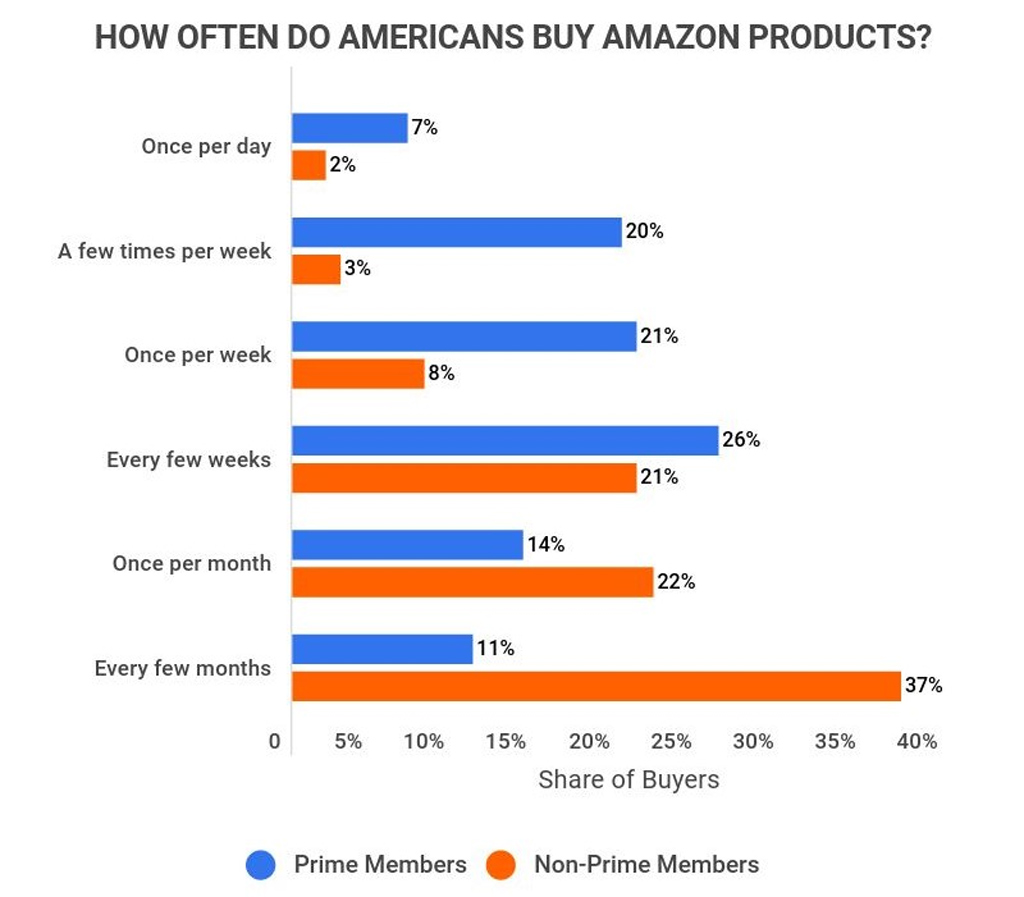
- Prime members purchase significantly more frequently on Amazon compared to non-Prime users. Around 7% of Prime members buy products daily, while only 2% of non-Prime members shop at this frequency.
- Frequent weekly shopping is also dominated by Prime users. About 20% of Prime members buy a few times per week, compared with just 3% of non-Prime members.
- Similarly, 21% of Prime members shop once per week, which is more than double the 8% of non-Prime members who shop weekly.
- The most common purchase frequency for Prime members is “every few weeks” (26%), indicating that many subscribers use Amazon regularly for ongoing purchases.
- Non-Prime users tend to shop less frequently. About 22% of non-Prime members purchase once per month, compared to 14% of Prime members.
- Infrequent purchasing is especially common among non-Prime users, with 37% buying only every few months, while only 11% of Prime members fall into this category.
- Overall, the data highlights how Amazon Prime membership drives higher purchase frequency, with subscribers far more likely to shop weekly or multiple times per week compared to non-Prime customers.
Sales and GMV Statistics of Amazon
- Amazon’s gross merchandise volume (GMV) surpassed $760 billion in 2025, reflecting the scale of transactions across its marketplace.
- In 2024, Amazon’s GMV was estimated at around $690 billion, demonstrating continued growth in marketplace activity.
- Third-party sellers account for roughly 60% of total units sold on Amazon, up from about 30% in 2007.
- Amazon shipped more than 9 billion items globally with same-day or next-day delivery in 2024, highlighting logistics expansion.
- During major shopping seasons, Amazon processes thousands of orders per minute worldwide.
- Amazon’s online store segment alone generated over $250 billion in revenue in 2024, making it the largest retail segment within the company.
- Third-party seller services produced over $156 billion in revenue in 2024, including commissions, fulfillment fees, and advertising.
- Marketplace sales accounted for over half of total units sold globally, confirming Amazon’s shift toward platform-based commerce.
- The United States remains Amazon’s largest sales market, generating more than $400 billion annually in gross sales.
Global Marketplace and Country Statistics of Amazon
- Amazon operates in over 20 global marketplaces as of 2025.
- The United States generated $489.7 billion in net sales in 2025, its largest market.
- Germany ranked second with $45.9 billion in net sales in 2025.
- Amazon’s international segment produced $161.9 billion in revenue in 2025.
- The UK marketplace (amazon.co.uk) received 368 million visits in January 2026.
- Japan contributed $27.4 billion in net sales in 2024, a key Asian market.
- Amazon India enabled $20 billion in cumulative exports by 2025 via Global Selling.
- 9.7 million sellers operate across Amazon’s 20+ marketplaces worldwide in Q1 2025.
- Brazil’s Amazon saw $2.5 billion in sales in 2023 with 214 million monthly visits.
- Germany attracts over 500 million monthly visitors to Amazon.de.

Mobile Commerce Statistics on Amazon
- Mobile devices account for more than 60% of Amazon’s global website traffic, reflecting the dominance of smartphone shopping.
- The Amazon mobile app ranks among the top shopping apps in the United States by downloads and usage.
- In the U.S., over 150 million consumers use the Amazon mobile app each month.
- Mobile users generate more than half of Amazon’s e-commerce transactions globally.
- Amazon’s app features, such as one-click purchasing and voice shopping via Alexa, contribute to faster mobile conversions.
- Mobile shopping peaks during major retail events such as Prime Day and Black Friday, when millions of users shop through the app.
- Push notifications and personalized recommendations drive significant repeat purchases via the Amazon mobile app.
- Mobile shoppers tend to browse more product pages per session compared with desktop users, increasing engagement and product discovery.
- Amazon continuously improves its mobile UX with AI-powered search and personalized shopping feeds.
Prime Membership Statistics of Amazon
- Amazon Prime had around 250 million global subscribers in 2025, making it one of the largest subscription programs worldwide.
- In the United States alone, over 180 million people have a Prime membership, representing a majority of American households.
- More than 80% of U.S. households subscribe to Amazon Prime, highlighting strong market penetration.
- Prime members spend about twice as much annually on Amazon compared with non-Prime customers.
- Prime membership costs $139 per year or $14.99 per month in the United States as of 2026.
- Benefits include fast shipping, Prime Video, Prime Music, Prime Reading, and exclusive deals.
- Prime members are more likely to purchase during major retail events such as Prime Day and Black Friday.
- Amazon continues to expand Prime benefits with gaming content, grocery delivery perks, and streaming services.
- Surveys indicate that over 90% of Prime members renew their subscription annually, showing high retention rates.
Where Consumers Begin Searching for New Products?
- Amazon dominates product discovery, with 66% of consumers starting their search directly on the platform, making it the most preferred destination for product research.
- Search engines are the second-largest starting point, with 20% of consumers beginning their product discovery journey on platforms like Google or Bing.
- Only 4% of consumers start their search on brand websites, indicating that most buyers prefer marketplaces or search engines rather than visiting brand sites directly.
- Similarly, retailer websites account for 4% of product search starting points, showing that individual store sites play a smaller role compared to large marketplaces.
- Other marketplaces contribute 3%, reflecting a modest share of consumers who explore alternative e-commerce platforms outside major ones like Amazon.
- Social media platforms influence only 1% of product searches, suggesting that while social platforms impact awareness, they are not the primary starting point for discovery.
- A small 1% of consumers start product searches through other channels, highlighting the overwhelming dominance of Amazon and search engines, which together account for 86% of product discovery starting points.

Prime Day and Seasonal Sales Statistics of Amazon
- Amazon Prime Day generated over $14.2 billion in U.S. online sales in 2024, making it one of the biggest retail events of the year.
- Globally, Prime Day 2024 became Amazon’s largest Prime Day event ever, with customers purchasing more than 375 million items worldwide.
- Independent sellers sold over 200 million items during Prime Day 2024, highlighting the role of third-party sellers in the event.
- U.S. consumers spent approximately $12.7 billion online during Prime Day 2023, according to Adobe Analytics.
- Prime Day sales growth exceeded 6% year over year in 2024, showing continued consumer demand despite economic pressures.
- Electronics, apparel, and home appliances consistently rank among the top-selling categories during Prime Day events.
- Amazon’s holiday season remains the company’s busiest period, with billions of items shipped globally during the Q4 shopping season each year.
- Black Friday and Cyber Monday events also generate billions of dollars in Amazon sales annually, driven by heavy discounts and promotional campaigns.
- Prime members typically purchase significantly more products during Prime Day compared with non-members, reflecting the value of the subscription ecosystem.
Advertising and Retail Media Statistics of Amazon
- Amazon generated over $56 billion in advertising revenue in 2024, making it the third-largest digital advertising platform globally.
- Amazon’s advertising business grew around 22% year over year in 2025, outpacing many traditional digital ad platforms.
- Advertising now accounts for nearly 9% of Amazon’s total revenue, reflecting the rapid growth of retail media networks.
- Amazon Ads reaches over 200 million monthly U.S. consumers through ad-supported Prime Video and other services.
- Sponsored product listings represent one of the most common advertising formats on Amazon’s marketplace.
- Retail media spending on Amazon continues to rise as brands allocate larger budgets toward marketplace-based advertising channels.
- Amazon’s advertising ecosystem includes Sponsored Products, Sponsored Brands, Sponsored Display, and video ads.
- The platform’s retail media network allows advertisers to reach shoppers at the point of purchase, which often leads to higher conversion rates than traditional ads.
- Amazon’s ad-supported Prime Video launched in 2024 and quickly became a major new revenue channel within Amazon Ads.
Key Reasons Why People Use Amazon
- Fast and free shipping is the top reason people choose Amazon, with 80% of users citing delivery speed and free shipping as the primary factor.
- A broad collection of items is another major attraction, as 69% of shoppers use Amazon because it offers a wide variety of products across multiple categories.
- Amazon Prime membership benefits strongly influence purchasing behavior, with 65.7% of users saying Prime perks such as faster delivery, exclusive deals, and streaming services encourage them to shop on the platform.
- Nearly 49.2% of users prefer Amazon due to its competitive pricing, making it one of the most popular destinations for finding deals and affordable products online.
- The platform’s easy returns process also boosts customer trust, with 43.7% of shoppers valuing Amazon’s hassle-free return and refund system when making purchases.

AWS (Amazon Web Services) Statistics
- AWS generated about $128.7 billion in revenue in 2025, making it Amazon’s most profitable business segment.
- The cloud platform holds roughly 30% of the global cloud infrastructure market, maintaining its leadership position.
- AWS serves millions of active customers across more than 190 countries.
- Major companies such as Netflix, Airbnb, and NASA rely on AWS cloud infrastructure to run critical applications.
- AWS operates over 100 availability zones across dozens of global regions, enabling reliable cloud infrastructure worldwide.
- The cloud division recorded over 20% annual growth in 2025, driven by demand for AI and machine learning services.
- AWS offers more than 200 cloud services, including computing, storage, analytics, and artificial intelligence tools.
- Amazon continues investing heavily in AI infrastructure with custom chips such as Trainium and Inferentia.
- AWS contributes more than half of Amazon’s total operating income, despite representing a smaller share of overall revenue.
Logistics, Delivery, and Fulfillment Statistics of Amazon
- Amazon operates over 1,100 fulfillment centers and logistics facilities worldwide.
- The company delivered more than 9 billion items globally with same-day or next-day shipping in 2024.
- Amazon’s logistics network includes hundreds of sortation centers, delivery stations, and air cargo hubs.
- The company runs Amazon Air with more than 110 cargo aircraft, enabling faster deliveries across major regions.
- Amazon employs hundreds of thousands of warehouse workers globally to manage fulfillment operations.
- Robotics technology plays a key role, with over 750,000 warehouse robots deployed across Amazon facilities.
- Amazon’s last-mile delivery network includes over 200,000 delivery drivers worldwide.
- Same-day delivery services are now available in dozens of major cities across the United States and Europe.
- Amazon continues investing in logistics automation and robotics to reduce delivery times and operational costs.
Amazon Shipping Volume: Orders Processed Daily, Monthly, and Yearly
- Amazon ships approximately 1.6 million packages every day, highlighting the company’s massive global logistics and fulfillment network.
- On a monthly basis, Amazon processes around 48 million orders, demonstrating the platform’s consistent and high-volume consumer demand.
- Over the course of a year, Amazon handles an estimated 584 million orders, reflecting the enormous scale of its e-commerce operations.
- The progression from 1.6 million daily orders to 48 million monthly and 584 million yearly shipments illustrates how Amazon maintains a steady flow of purchases throughout the year.
- These figures emphasize Amazon’s ability to manage millions of deliveries daily, supported by its advanced fulfillment centers, warehouses, and delivery infrastructure worldwide.

Third-Party Seller Statistics on Amazon
- Amazon hosts over 9.7 million sellers globally, making it the largest online marketplace for independent merchants.
- More than 2 million sellers are actively selling on the platform, contributing significantly to total sales.
- Third-party sellers account for about 60% of all units sold on Amazon.
- Independent sellers generated over $140 billion in annual sales through Amazon’s marketplace.
- Amazon’s Fulfillment by Amazon (FBA) service helps sellers store, pack, and ship products through Amazon’s logistics network.
- Thousands of entrepreneurs launch new brands on Amazon every year through the marketplace ecosystem.
- Small and medium-sized businesses account for more than half of the products sold on Amazon globally.
- Amazon invests billions annually in tools, logistics services, and advertising platforms to support third-party sellers.
- Many sellers rely heavily on Amazon advertising and FBA services to scale global e-commerce operations.
Frequently Asked Questions (FAQs)
How much revenue does Amazon generate annually?
How many Amazon Prime members are there worldwide?
What share of the U.S. e-commerce market does Amazon control?
How many active customers and sellers does Amazon have?
How much revenue does Amazon Web Services generate?
Conclusion
Amazon remains one of the most influential technology and commerce companies in the world. Its ecosystem spans e-commerce, cloud computing, advertising, logistics, and digital media, creating multiple revenue streams and reinforcing its market leadership. With continued investments in AI infrastructure, cloud services, and global logistics, Amazon is expanding far beyond traditional retail. These statistics illustrate how Amazon’s scale, innovation, and marketplace model continue to reshape global commerce and digital infrastructure.

Leave a comment
Have something to say about this article? Add your comment and start the discussion.