




Search engines remain the gateway to the internet, shaping how people discover information, products, and services. While Google dominates the search landscape, Microsoft Bing plays a strategic role in advertising, enterprise search, and AI-powered discovery. For example, marketers rely on Bing Ads (now Microsoft Advertising) to reach high-intent desktop audiences, while businesses use Bing-powered results in tools like Windows search and AI assistants. Understanding Bing’s growth, user base, and market dynamics helps marketers, analysts, and tech leaders navigate the evolving search ecosystem. Let’s explore the latest Bing statistics.
Editor’s Choice
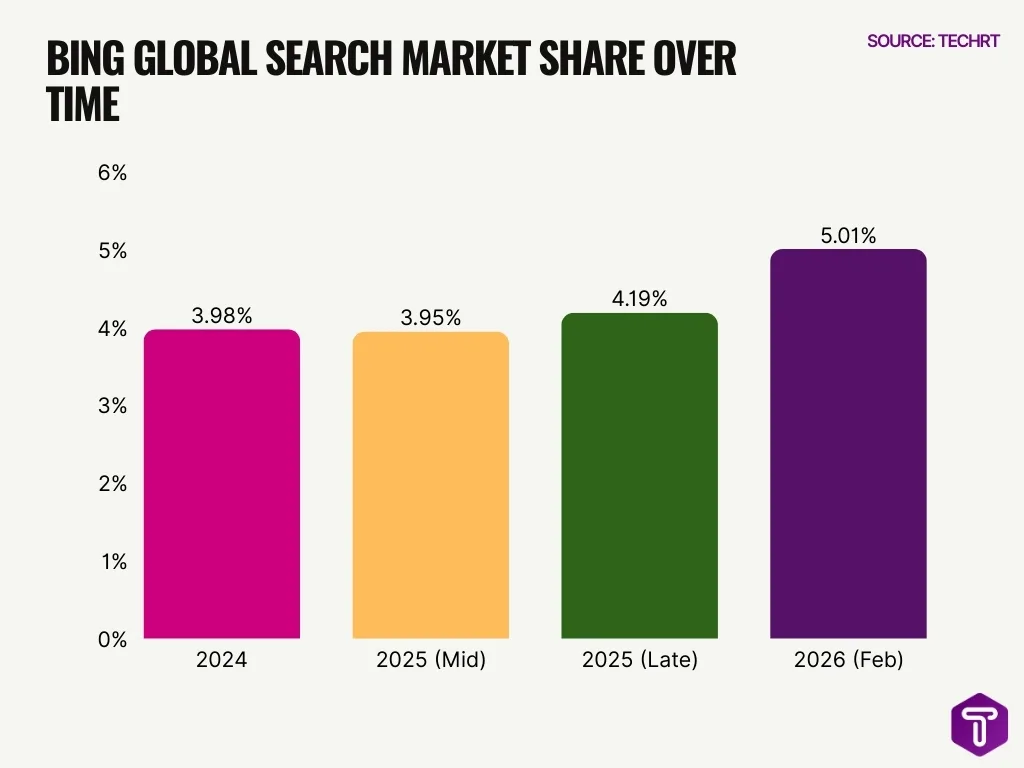
- Bing holds about 5.01% of the global search engine market share as of February 2026, making it the second-largest search engine worldwide.
- The search engine receives over 500 million monthly unique visitors globally.
- Around 100 million users search on Bing daily, reflecting strong daily engagement.
- Bing processes over 900 million searches per day across its network.
- Microsoft’s search platform generated $12.2 billion in revenue in 2023, primarily from advertising.
- In the United States, Bing holds around 7.5% market share across devices.
- Bing’s desktop strength is notable, with about 12% share of global desktop searches.
Recent Developments
- Bing crossed 100 million daily active users, highlighting strong adoption following AI integrations.
- Microsoft’s AI-powered search update, originally launched as Bing Chat, accelerated search adoption and user engagement.
- Bing’s global search share rose from around 2.97% in 2023 to nearly 3.96% in 2025, reflecting steady growth.
- The platform’s search and news advertising revenue increased by $1.6 billion year over year, showing strong monetization.
- Bing’s desktop search share in the U.S. climbed to about 29% of desktop queries, boosted by Windows integration.
- The platform now integrates deeply with AI tools like Microsoft Copilot, enhancing conversational search experiences.
- Microsoft ended public access to certain Bing Search APIs in 2025, shifting focus toward AI-powered search infrastructure.
- AI search competition has intensified, with AI-based search accounting for 5.6% of U.S. desktop search traffic in 2025.
- Bing continues to power multiple platforms, including DuckDuckGo search results in many regions.
Overview and Key Facts of Bing
- Microsoft launched Bing in June 2009, replacing its earlier search engine, Live Search.
- Bing currently ranks as the second-largest search engine worldwide, behind Google.
- The platform handles hundreds of millions of daily search queries, reflecting strong usage outside Google.
- Bing’s ecosystem includes search, news, maps, shopping, and AI-powered tools integrated into Microsoft products.
- Approximately 3.357 billion people visit Bing each month globally, including searches through partner sites.
- Bing powers results for platforms such as Yahoo! Search and DuckDuckGo in certain cases, extending its reach.
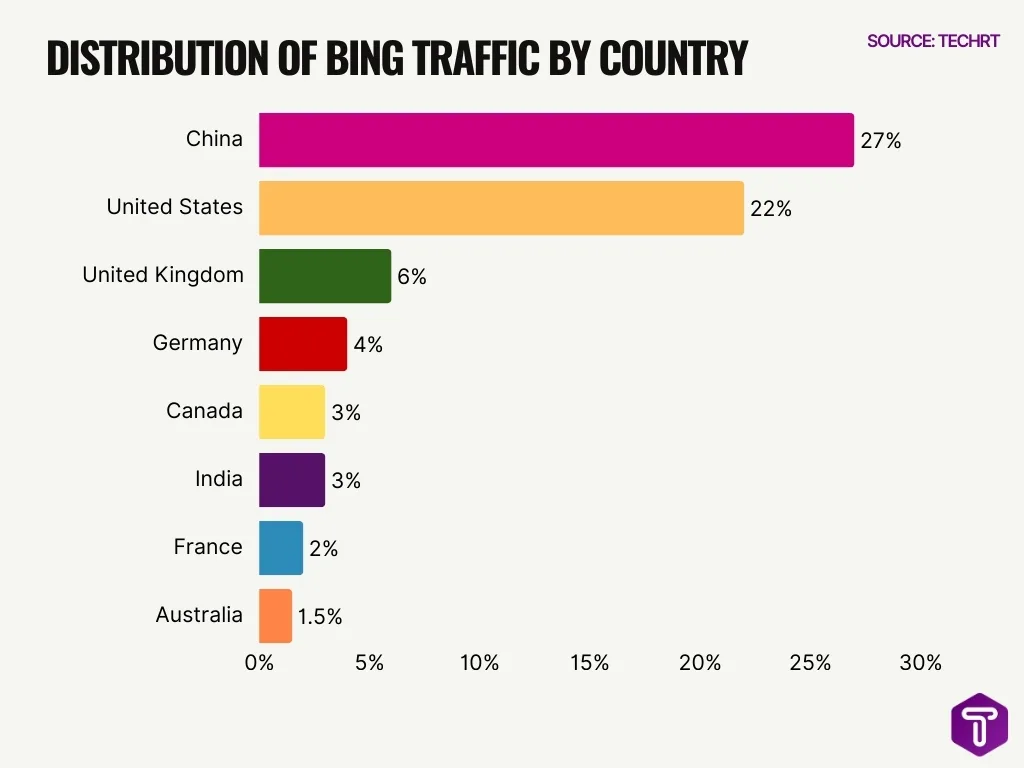
- China contributes over 27% of Bing’s global traffic, while the U.S. accounts for about 22%.
- Enterprise environments rely on Bing because Windows and Microsoft Edge often set it as the default search engine.
- Around 18% of enterprise users use Bing as their default search engine, highlighting its corporate footprint.
Global Market Share of Bing
- As of February 2026, Bing holds approximately 5.01% of the global search market.
- In 2025, Bing’s global market share averaged around 3.9% to 4.0%, depending on the dataset.
- Google continues to dominate with around 89% to 90% global share, leaving Bing as the primary competitor.
- Bing’s share rose slightly from 3.98% in 2024 to around 4.19% in late 2025.
- Across desktop devices, Bing’s share can exceed 11% globally, significantly higher than on mobile.
- Bing consistently ranks second globally, ahead of Yahoo!, DuckDuckGo, and Baidu.
- The platform’s share typically fluctuates between 3.7% and 4.3% worldwide, depending on the measurement period.
- Despite a smaller share, Bing remains a critical advertising channel for marketers targeting desktop and enterprise users.
Regional Market Share of Bing
- In the United States, Bing holds around 7.5% search market share across devices.
- Some datasets estimate Bing’s U.S. share slightly higher, reaching around 8% in 2025.
- The United Kingdom saw Bing’s share grow from 5.06% in 2024 to about 6.22% in 2025.
- Europe overall records roughly 3.9% Bing search share, reflecting modest adoption.
- In China, Bing has historically achieved over 19% search share, though usage fluctuates due to market restrictions.
- China contributes more than 25% of Bing’s global traffic, making it the largest regional source.
- The United States generates about 22% of Bing’s global traffic, the second-largest contributor.
- In Germany and France, Bing accounts for around 3% to 4% of search usage, reflecting similar patterns across Western Europe.
Users and Audience Size of Bing
- Bing attracts over 500 million monthly unique visitors worldwide.
- The platform supports around 100 million daily active search users.
- Bing processes over 900 million search queries per day across its ecosystem.
- Globally, 3.3 billion people visit Bing each month, including partner search traffic.
- More than 900 million users interact with Bing every month through search or integrated services.
- Enterprise adoption remains strong, with 18% of enterprise users choosing Bing as their default search engine.
- Bing usage tends to rise during working hours, with about 15% higher search activity during business hours.
- The platform’s user base continues to grow through integration with Windows, Microsoft Edge, and AI-powered Copilot tools.
Traffic and Monthly Visits of Bing
- Bing receives over 1.2 billion monthly visits to bing.com globally, making it one of the most visited websites worldwide.
- The United States contributes roughly 22% of Bing’s total website traffic, making it the largest traffic source.
- China accounts for about 27% of Bing’s traffic, reflecting strong usage due to limited access to Google services.
- Approximately 65% of Bing’s traffic comes from desktop devices, highlighting its strong position in workplace environments.
- Bing ranks among the top 30 most visited websites globally based on traffic volume.
- Direct traffic accounts for over 70% of visits to bing.com, indicating strong brand recognition and default search usage.
- Organic search drives around 16% of Bing’s own traffic, mainly from queries about the search engine itself.
- The average Bing visitor views around 4.1 pages per session, showing moderate engagement with search results and services.
- Users spend roughly 6 minutes per visit on Bing, interacting with search results, images, news, and maps.
Usage of Bing by Country
- The United States generates about 22% of Bing’s global traffic, making it the largest user base.
- China contributes more than 27% of Bing’s traffic, partly due to restrictions on other search engines.
- The United Kingdom accounts for roughly 6% of Bing’s global search traffic.
- Germany contributes around 4% of Bing usage, reflecting steady European adoption.
- Canada represents about 3% of global Bing traffic, benefiting from strong Microsoft ecosystem adoption.
- India generates approximately 3% of Bing’s global search traffic, with gradual growth driven by Windows devices.
- France contributes around 2% of global Bing usage, reflecting moderate adoption across Europe.
- Australia accounts for roughly 1.5% of Bing’s global traffic.
Daily, Monthly, and Annual Searches on Bing
- Bing processes over 900 million search queries daily across its search network.
- This translates to approximately 27 billion searches per month on Bing.
- Every year, Bing handles roughly 330 billion search queries worldwide.
- In the United States alone, Bing generates more than 7 billion monthly searches.
- The search engine powers results for platforms like Yahoo Search and DuckDuckGo in some regions, increasing its effective query volume.
- Bing’s search index contains over 8 billion web pages, allowing it to deliver diverse search results.
- The search engine also processes millions of image searches daily, with Bing Images among the largest visual search platforms.
- Bing Maps handles millions of location-based queries each day, supporting navigation and local business searches.
- Voice search through Bing-powered assistants and Windows devices accounts for a growing share of search queries, particularly in enterprise environments.
User Demographics of Bing
- Around 63% of Bing users are male, while about 37% are female, indicating a notably male-skewed audience.
- Roughly 50–51% of Bing users are aged 25–44, making this working-age segment the platform’s largest demographic group.
- About 50% of Bing users belong to the top 25% of household income earners, reflecting a relatively affluent audience with strong purchasing power.
- Approximately 41% of Bing users in the U.S. earn more than $100,000 per year, highlighting a high-income user base in key markets.
- Around 34% of Bing users hold a college degree, suggesting a comparatively educated search audience.
- Over 50% of Bing users are married, with some studies reporting about 54% married and 59% having children at home.
- Microsoft data indicates that about 73–74% of Bing users are under 45, even though separate research notes that Bing users tend to have an older median age than Google users.
- Bing’s single largest age group is 25–34 years, accounting for roughly 25–26% of total users, followed closely by the 35–44 segment at around 22–24%.
- Bing users are more likely to be active online shoppers, with about 32% spending more online than the average internet user and 54% using Bing specifically for product research.
Key Insights on Bing Users by Education Level
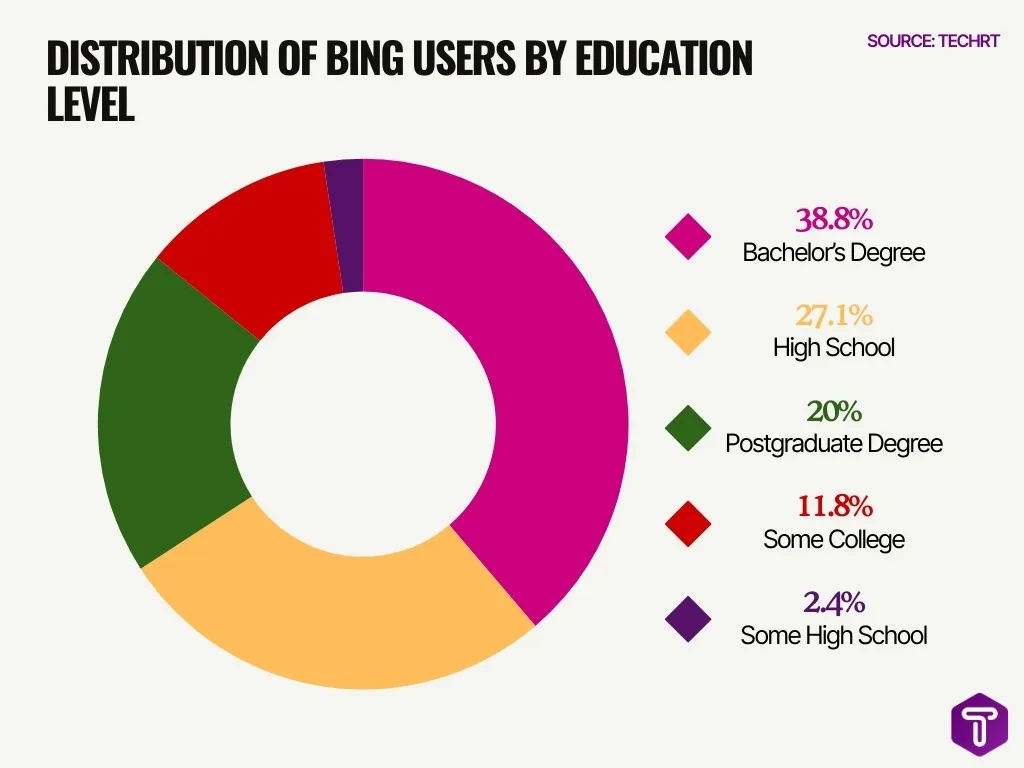
- The largest share of Bing users holds a Bachelor’s degree (38.8%), making it the most common education level among the platform’s audience.
- Users with a High school education account for 27.1% of Bing’s user base, representing the second-largest group of users.
- Around 20% of Bing users have a Postgraduate degree, indicating that one in five users has advanced academic qualifications.
- A smaller segment of the audience, 11.8%, consists of users with some college education but no completed degree.
- Only 2.4% of Bing users have some high school education, making it the smallest education segment among Bing’s users.
- Overall, the data suggests that Bing’s user base skews toward higher education levels, with 58.8% of users holding at least a Bachelor’s or Postgraduate degree.
Desktop vs Mobile Usage of Bing
- Bing performs strongest on desktop devices, with over 11% global desktop market share.
- On mobile devices, Bing’s market share drops to around 1% globally, largely due to Google’s dominance on smartphones.
- Desktop accounts for roughly 65% of Bing’s traffic, while mobile contributes about 35%.
- Bing holds over 30% of the desktop search market share in the United States when including Yahoo and partner searches.
- Windows PCs ship with Microsoft Edge and Bing as the default search, boosting desktop usage.
- Many enterprise networks use Bing as the default workplace search engine, reinforcing desktop dominance.
- Mobile usage has increased with AI-powered search features integrated into the Bing mobile app.
- Bing’s mobile search experience now includes visual search, AI chat, and voice queries, encouraging smartphone usage.
User Behavior and Engagement on Bing
- Bing’s average bounce rate is 38-42%, indicating moderate user retention on search pages.
- Users average 2.6 queries per session, especially for research and product comparisons.
- Desktop Bing users achieve 21% higher e-commerce conversion rates than other search engines.
- Bing peaks with 15% usage surge during weekday work hours (9 AM-5 PM).
- Bing queries average 3x longer than Google for technical topics.
- Shopping searches on Bing yield 12% higher average order values than competitors.
- Bing Image Creator generates 750+ million images monthly for visual searches.
- News searches spike 40% during major events, integrated with Microsoft News.
- Bing session duration averages 7.24 minutes, showing strong engagement.
- Over 900 million daily searches drive Bing’s robust user activity.
Bing Revenue Growth Statistics
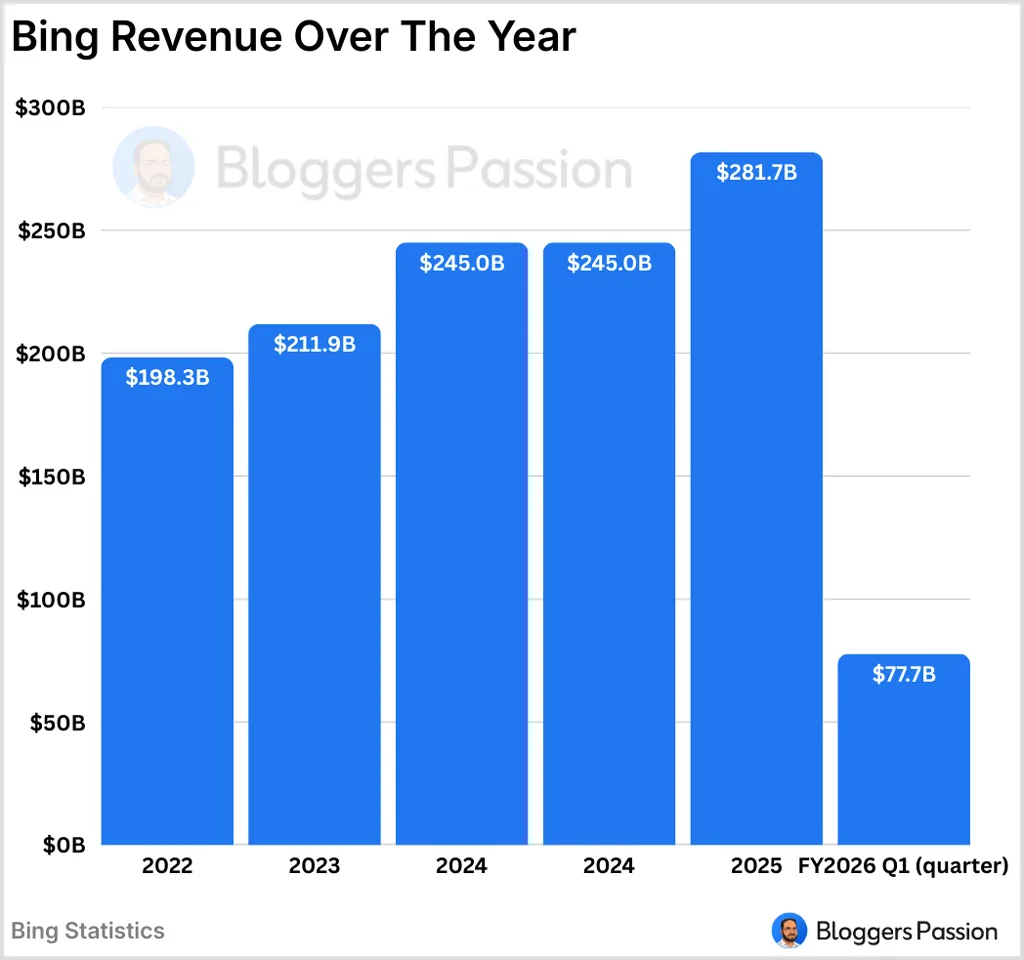
- Bing revenue reached $198.3 billion in 2022, marking the starting point of strong growth driven by expanding search and advertising demand.
- In 2023, Bing revenue increased to $211.9 billion, reflecting a year-over-year growth of about 6.9% compared to 2022.
- Revenue continued to rise in 2024, reaching $245.0 billion, representing a significant increase of roughly 15.6% from the previous year.
- The $245.0 billion revenue figure in 2024 highlights Bing’s accelerating monetization through search ads, Microsoft ecosystem integrations, and AI-driven features.
- By 2025, Bing revenue climbed to $281.7 billion, the highest annual figure recorded, showing continued expansion in the search advertising market.
- In the first quarter of FY2026 alone, Bing generated $77.7 billion, indicating strong early-year momentum and sustained demand for search and digital advertising.
- Overall, Bing revenue grew from $198.3 billion in 2022 to $281.7 billion in 2025, representing an increase of $83.4 billion over three years.
Advertising Performance Statistics of Bing
- Microsoft Advertising, formerly Bing Ads, reaches more than 900 million unique searchers worldwide, offering brands significant exposure.
- Bing’s search network, including partner sites like Yahoo, reaches over 63 million searchers in the United States who are not reached by Google Ads.
- Advertisers using Microsoft Advertising can access approximately 44 million U.S. desktop searchers with household incomes above $100,000.
- Bing Ads campaigns often achieve higher average click-through rates in certain industries, particularly finance and technology sectors.
- Microsoft Advertising accounts for roughly 6% to 7% of the global search advertising market, making it the second-largest platform after Google Ads.
- In the United States, Bing-powered search networks generate over 30% of desktop search ad clicks.
- Retail advertisers report up to 30% lower competition on Bing Ads compared with Google Ads, improving campaign visibility.
- Bing Ads often deliver higher average order values from search traffic, especially in e-commerce and B2B industries.
- Microsoft Advertising campaigns can deliver conversion rates up to 20% higher in some B2B segments compared with other search platforms.
Ads Cost CPC and ROI on Bing
- The average cost per click on Bing Ads ranges between $1.54 and $1.70 across industries.
- In comparison, Google Ads’ average CPC across industries often exceeds $2.60, making Bing Ads relatively cost-efficient.
- Bing Ads CPC is typically 20% to 35% lower than Google Ads, depending on the industry.
- Some industries, such as finance and insurance, can see average Bing CPC exceeding $3.00, reflecting competitive keywords.
- Microsoft Advertising campaigns often produce ROI improvements of 20% or more when combined with Google Ads campaigns.
- Retail advertisers report average conversion rates between 2.94% and 3.50% on Bing Ads.
- The average cost per acquisition on Bing Ads is roughly 30% lower than on Google Ads for similar campaigns.
- Bing Ads can increase reach by extending campaign visibility to 15% to 25% additional search users beyond Google Ads alone.
- Businesses using Microsoft Advertising often see higher engagement from desktop users, contributing to improved ROI.
Google vs Bing Ads Performance Statistics
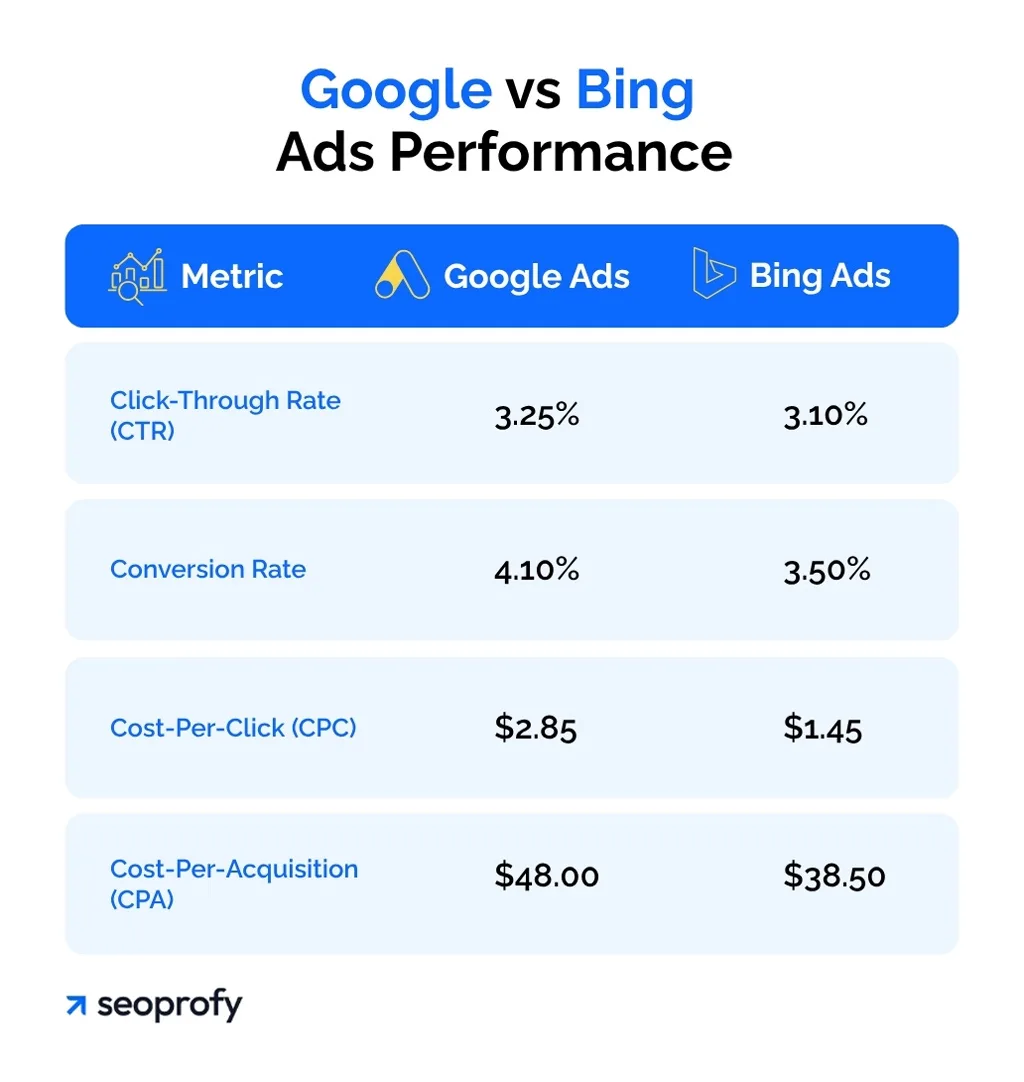
- Google Ads records a slightly higher Click-Through Rate (CTR) of 3.25%, compared to 3.10% on Bing Ads, indicating marginally stronger engagement with search ads on Google.
- Conversion rates are also higher on Google Ads at 4.10%, while Bing Ads achieves a 3.50% conversion rate, suggesting Google generates slightly more conversions from ad clicks.
- Bing Ads offers significantly lower Cost-Per-Click (CPC) at $1.45, nearly 49% cheaper than Google Ads’ $2.85 CPC, making Bing a more cost-efficient option for advertisers seeking lower click costs.
- Cost-Per-Acquisition (CPA) is also lower on Bing Ads at $38.50, compared to $48.00 on Google Ads, meaning advertisers typically spend about $9.50 less per acquisition on Bing.
- Overall, Google Ads leads in engagement and conversion performance, while Bing Ads stands out for lower advertising costs, making each platform attractive depending on whether the priority is performance or budget efficiency.
AI and Copilot Statistics in Bing
- AI-powered Bing hit over 100 million daily active users shortly after its February 2023 launch.
- Roughly one-third of new Bing preview users were new to Bing.
- Users conducted over 45 million total chats in the first month of Bing AI preview.
- Bing and Edge users held more than 10 billion Copilot chats by late 2024.
- Bing Image Creator generated over 750 million AI images as of early 2024.
- Average sessions featured about 3 chats with Bing AI during early preview.
- Bing’s desktop market share rose to 11–12% post-AI Copilot integration by early 2025.
- Younger users aged 25–34 form the largest Bing demographic segment.
- Over 50% of Bing users are under 34 years old.
Integration of Bing with the Microsoft Ecosystem
- Bing is the default search engine in Microsoft Edge, which is used by nearly 300 million people monthly worldwide.
- Windows runs on 1.4 billion+ active devices globally, giving Bing integrated access to over 1.4 billion potential users through built‑in search.
- Microsoft 365, with more than 400 million paid seats, increasingly routes work and web queries through Bing‑powered Copilot and search experiences.
- Bing processes around 1.2 billion searches every day, translating to over 430 billion queries a year across Windows, Edge, and other Microsoft entry points.
- Daily active users of Bing exceed 140 million, heavily driven by its integration into Edge, Windows taskbar search, and Copilot surfaces.
- Microsoft reports over 100 million monthly active Copilot users across Bing, Edge, MSN, Windows, and Xbox, all grounded in Bing search and index data.
- MSN and Microsoft Start help drive over 800 million article views per day, with content discovery underpinned by the Bing search index.
- The Bing platform reaches more than 100 million daily active users while supporting thousands of developers via its API for search, ads, and intelligence features.
- Bing commands about 11.96% of global desktop search share, making its tight integration into Windows and Edge a major driver of engagement in the Microsoft ecosystem.
- Integration across Bing, Edge, MSN, Windows, Xbox, and Copilot helped push Microsoft search advertising revenue to nearly $12.2 billion by 2023.
Frequently Asked Questions (FAQs)
What is Bing’s global search engine market share in 2026?
How many searches are conducted on Bing each day?
How many people visit Bing each month globally?
What is Bing’s market share in the United States?
How much revenue does Bing generate from search advertising?
Conclusion
Bing remains a significant player in the search ecosystem despite Google’s dominance. Its strength lies in desktop usage, enterprise integration, and the Microsoft ecosystem, which includes Windows, Edge, and Microsoft 365. Additionally, Microsoft Advertising provides a cost-efficient alternative for marketers, often delivering lower CPC and strong conversion rates. The integration of AI features such as Copilot and conversational search has further expanded Bing’s capabilities and attracted new users. As AI-driven search evolves and Microsoft continues integrating Bing across its products, the platform will likely remain a key channel for search, advertising, and AI-powered information discovery.

Leave a comment
Have something to say about this article? Add your comment and start the discussion.