




Screen time has become a defining feature of modern life. From remote work and online learning to streaming entertainment and social media engagement, people now spend a significant portion of their day interacting with digital screens. Businesses rely on screen-based platforms for communication and marketing, while consumers increasingly manage shopping, banking, and entertainment through smartphones and connected devices. Understanding the latest screen time statistics helps reveal how digital habits evolve across countries, devices, and demographics. Let’s explore the data behind this global trend.
Editor’s Choice
- The average global screen time reached 6 hours and 38 minutes per day in 2024–2025, equivalent to over 46 hours per week spent online across devices.
- Globally, people spend roughly 6 hours and 40 minutes daily on screens, reflecting steady growth over the past decade.
- Smartphones account for about 53% of total screen time worldwide, making them the dominant device category.
- The average American adult spends around 7 hours and 3 minutes per day using screens, exceeding the global average.
- Globally, users spend about 2 hours and 21 minutes per day on social media alone.
- Mobile phone usage averages around 4 hours and 37 minutes daily worldwide, accounting for the majority of digital interactions.
- Some countries exceed 9 hours of daily screen time, highlighting large regional differences in digital consumption.
Recent Developments
- Global average screen time declined slightly by around 20 minutes compared with 2021 levels, suggesting stabilization after pandemic peaks.
- Smartphone usage has risen dramatically, with mobile screen time nearing 4 hours per day in 2023, up from less than 2 hours in 2013.
- Social media continues to dominate digital behavior, with users spending over 140 minutes daily across platforms globally.
- Surveys show the average American checks their device about 58 times per day, reflecting frequent microinteractions with screens.
- Streaming video remains a major driver of digital consumption, with over half of U.S. households using connected TV platforms daily.
- Countries with emerging digital economies have seen rapid growth in mobile-first internet usage, particularly in Southeast Asia and Latin America.
- Global internet users collectively spend billions of days annually interacting with screens, reflecting the scale of digital adoption.
- Governments and health agencies increasingly discuss screen time limits and digital well-being initiatives, especially for younger populations.
Global Screen Time Statistics
- The average global internet user spends 6 hours and 38 minutes per day on digital screens across devices.
- That daily figure equals roughly 46 hours and 26 minutes of screen exposure per week.
- Global daily screen time has increased by about 17 minutes since 2015, reflecting expanding digital services.
- The global average remains close to seven hours per day in 2025, despite modest declines since the pandemic period.
- Smartphones alone account for over half of total digital screen activity globally.
- Users spend over three hours daily on mobile devices, primarily for messaging, browsing, and video streaming.
- Streaming audio, podcasts, and music contribute more than 1 hour of screen-related media consumption per day.
- Younger users typically exceed the average, with people aged 16–24 logging over 7 hours of daily screen exposure.
Average Daily Screen Time Worldwide Over Time
- Global screen time averaged about 6 hours and 36 minutes per day in 2024, marking long-term growth in digital engagement.
- In 2013, the average mobile screen time was around 1 hour and 38 minutes per day, far lower than today.
- By 2023, global mobile screen time increased to nearly 4 hours daily, highlighting the rise of smartphone-first digital behavior.
- Over the last decade, global daily screen exposure increased by roughly 50 minutes per person.
- Pandemic-era remote work and online education temporarily pushed some adults’ screen time above 10 hours per day.
- After 2021, global screen usage stabilized as offices reopened and digital fatigue increased.
- Despite stabilization, digital entertainment and streaming keep overall usage consistently near seven hours per day worldwide.
- Mobile apps, social media platforms, and online gaming remain the main contributors to ongoing screen time growth.
Screen Time by Country
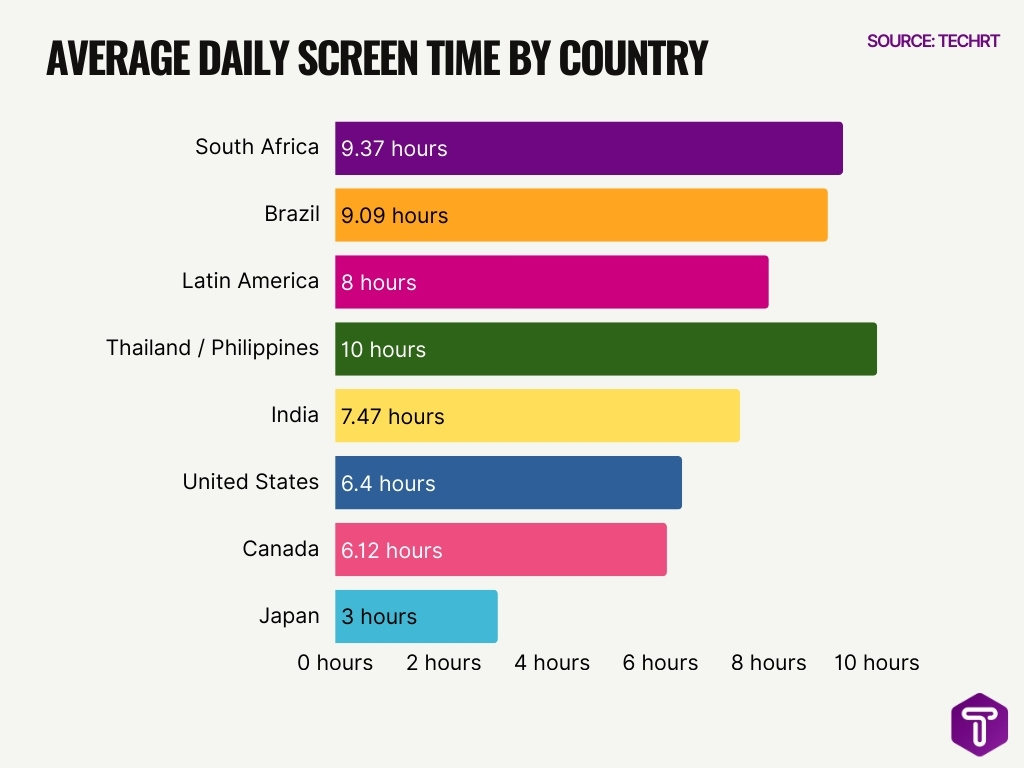
- South Africa records the highest daily screen time, averaging about 9 hours and 37 minutes per day.
- Brazil follows closely with around 9 hours and 9 minutes of daily screen use.
- Several Latin American countries, including Chile and Colombia, exceed 8 hours of average daily screen time.
- Thailand and the Philippines rank among the most digitally engaged nations, with around 9–10 hours of daily screen exposure.
- India averages roughly 7 hours and 47 minutes of screen time daily, driven by mobile internet use.
- The United States logs around 6 hours and 40 minutes of daily internet usage, slightly above the global average.
- Canada averages about 6 hours and 12 minutes of daily screen time, slightly below the U.S. level.
- Japan reports one of the lowest averages among major economies, at around 3 hours of smartphone usage daily.
Screen Time in the United States
- The average U.S. adult spends about 7 hours and 3 minutes daily on screens, higher than the global average.
- Americans spend around 5 hours and 16 minutes per day on smartphones alone, among the highest in developed markets.
- Nationwide, Americans average 6 hours and 35 minutes of daily screen exposure, depending on measurement methodology.
- The typical U.S. consumer checks their phone nearly 60 times per day, often within minutes of the previous interaction.
- Children aged 8–18 in the United States spend about 7.5 hours per day using entertainment media.
- Teenagers increasingly exceed 8 hours of daily screen exposure, largely through gaming and social media.
- Online shopping, digital banking, and remote work contribute significantly to daily screen engagement among American adults.
- U.S. internet users collectively spend thousands of hours annually interacting with digital platforms, highlighting the scale of the digital economy.
Screen Time in India
- The average internet user in India spends about 6 hours and 36 minutes per day online, placing the country close to the global average.
- Smartphone users in India average around 4.9 hours of daily mobile screen time, driven by messaging, video apps, and mobile gaming.
- India has more than 750 million internet users, with most accessing the internet primarily through smartphones.
- Roughly 97% of Indian internet users access the web via mobile devices, reflecting a strong mobile-first digital ecosystem.
- Indian users spend about 2 hours and 28 minutes daily on social media, slightly above the global average.
- Online video streaming accounts for over 70% of mobile data traffic in India, significantly influencing screen time patterns.
- India ranks among the top five countries globally for total screen time hours, due to its large digital population.
- Surveys show that Indian teenagers average over 7 hours of daily screen exposure, including school, gaming, and social media.
Users’ Opinions on How Screen Time Influences Behavior
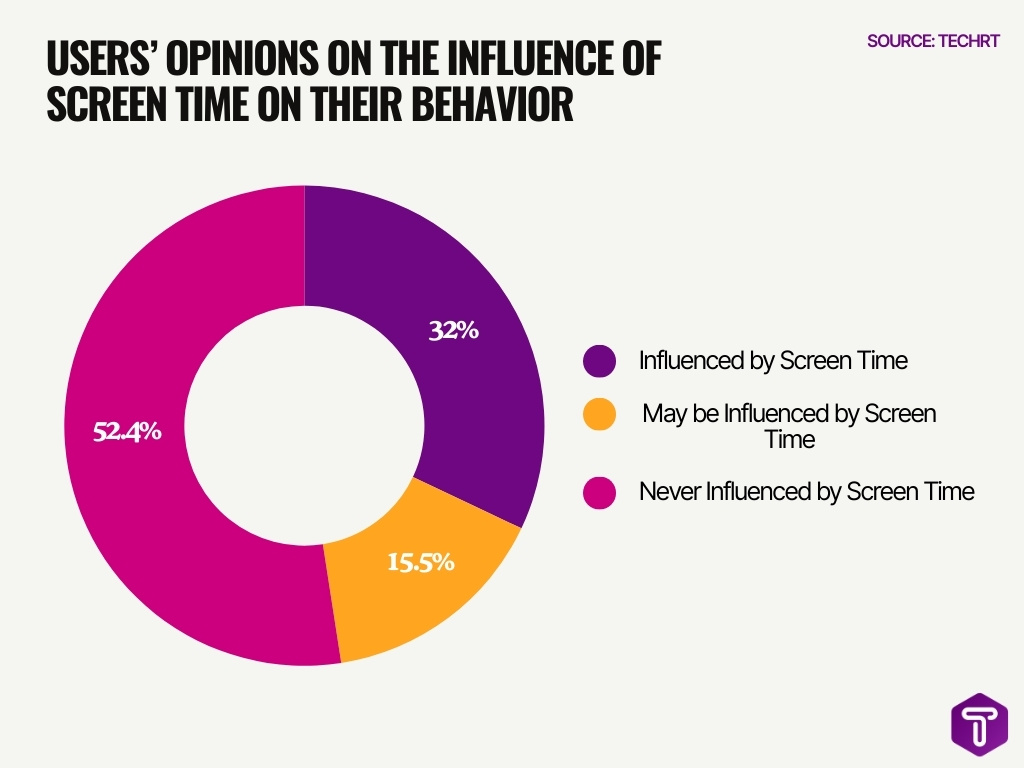
- More than half of respondents (52.4%) believe they are never influenced by screen time, indicating that many users perceive their digital habits as having no direct impact on their behavior.
- Around 32% of users report that their behavior is influenced by screen time, suggesting that nearly one in three people recognize a noticeable effect of prolonged device usage on their daily actions and habits.
- An additional 15.5% of respondents say they may be influenced by screen time, highlighting a group that is uncertain but aware of potential behavioral changes linked to digital exposure.
- Combining these segments shows that 47.5% of users either acknowledge or suspect behavioral influence from screen time, indicating that almost half of the population perceives some level of impact.
- The data suggests a divided perception among users, where a majority deny behavioral influence, while a significant minority recognizes or suspects it, reflecting ongoing debates about the psychological and behavioral effects of digital consumption.
Screen Time by Device Type (Mobile, Desktop, Tablet, TV)
- Mobile phones account for about 53% of total global screen time, making them the most dominant device category.
- Desktop and laptop devices represent roughly 31% of total digital screen time worldwide.
- Television and connected TV screens contribute around 13% of daily digital screen usage globally.
- Tablets account for approximately 3–4% of global screen time, mainly used for entertainment and reading.
- In the United States, adults spend over 3 hours per day watching TV or streaming services on large screens.
- Smartphones dominate casual activities such as messaging, social media browsing, and quick searches.
- Desktop devices remain popular for work, education, and productivity tasks, particularly in professional environments.
- Connected TV adoption continues to grow, with over 80% of U.S. households owning at least one smart TV device.
Mobile Phone Screen Time Statistics
- The average smartphone user spends around 4 hours and 37 minutes daily on their phone worldwide.
- Americans spend approximately 5 hours and 16 minutes per day using mobile phones, among the highest in developed markets.
- Global smartphone users collectively spend over 3.8 trillion hours annually on mobile devices.
- Around 88% of total mobile time is spent inside apps rather than web browsers.
- Messaging apps, social media, and video platforms account for the majority of mobile screen interactions.
- The average smartphone user checks their device between 50 and 60 times per day.
- Teenagers often exceed 7 hours of daily smartphone usage, significantly above adult averages.
- Mobile gaming alone accounts for more than 40% of total global gaming time.
Teen Social Media Usage: Daily Screen Time by Platform
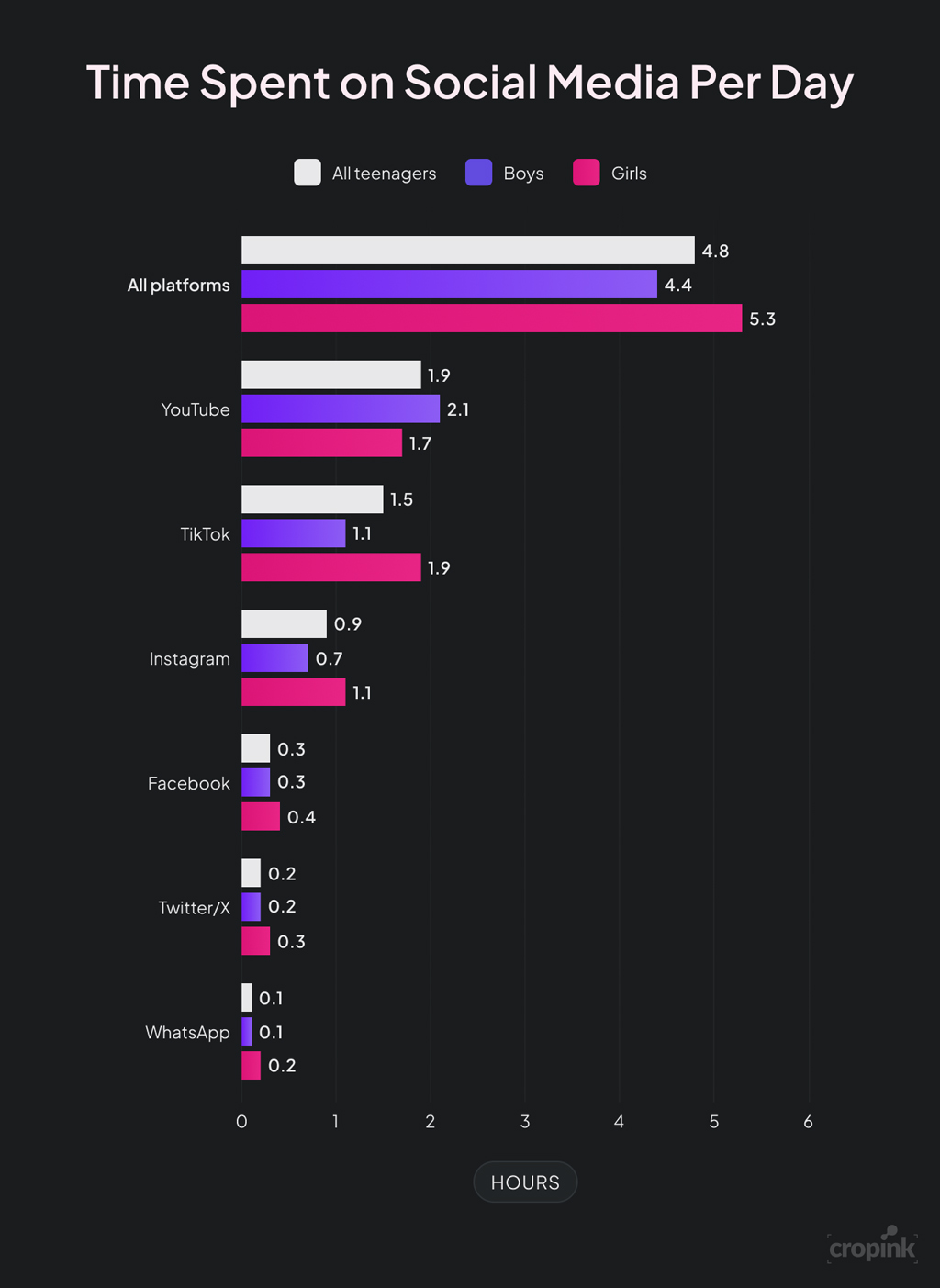
- Teenagers spend an average of 4.8 hours per day on social media platforms, highlighting how central these platforms are in their daily digital habits.
- Girls spend more time on social media than boys, averaging 5.3 hours per day, compared to 4.4 hours for boys.
- YouTube is the most-used individual platform, where teens spend about 1.9 hours daily on average.
- Boys spend slightly more time on YouTube, averaging 2.1 hours per day, compared to 1.7 hours for girls.
- TikTok ranks as the second most time-consuming platform, with teens spending about 1.5 hours per day.
- Girls dominate TikTok usage, spending 1.9 hours daily, significantly higher than 1.1 hours among boys.
- Instagram usage averages 0.9 hours per day among teenagers, showing moderate engagement compared to video platforms.
- Girls again spend more time on Instagram, averaging 1.1 hours daily, compared to 0.7 hours for boys.
- Facebook usage among teens remains relatively low, with an average of 0.3 hours per day.
- Twitter/X engagement is minimal, with teenagers spending only 0.2 hours daily on average.
- WhatsApp has the lowest daily usage among the listed platforms, with teens spending about 0.1 hours per day on average.
- Across most platforms, girls consistently record higher usage time, except on YouTube, where boys lead in daily watch time.
Online Video and Streaming Screen Time Statistics
- The average internet user spends about 3 hours and 6 minutes per day watching online video content.
- Over 85% of internet users watch online video monthly, making it one of the most consumed digital formats.
- Streaming services account for over 38% of total TV viewing time in the United States.
- Americans spend approximately 1 hour and 49 minutes daily streaming digital video.
- The global streaming market surpassed 1.8 billion subscription video accounts in 2024.
- Short-form video consumption has increased significantly, especially on mobile platforms.
- Online video traffic represents over 80% of total internet traffic globally.
- Younger viewers spend more time on streaming platforms than on traditional television.
Gaming Screen Time Statistics
- The global gaming community includes over 3.3 billion gamers worldwide.
- Gamers spend an average of 8 to 12 hours per week playing video games.
- Mobile gaming accounts for roughly 50% of global gaming revenue, reflecting strong smartphone engagement.
- In the United States, about 65% of adults play video games regularly.
- The average gamer spends around 1 hour per day gaming across devices.
- Younger players aged 18–34 represent the largest share of global gaming screen time.
- Esports and online multiplayer games have expanded viewing and playing hours significantly.
- Streaming platforms like Twitch and YouTube Gaming contribute additional hours of gaming-related screen time.
Average Daily Screen Time by Age Group
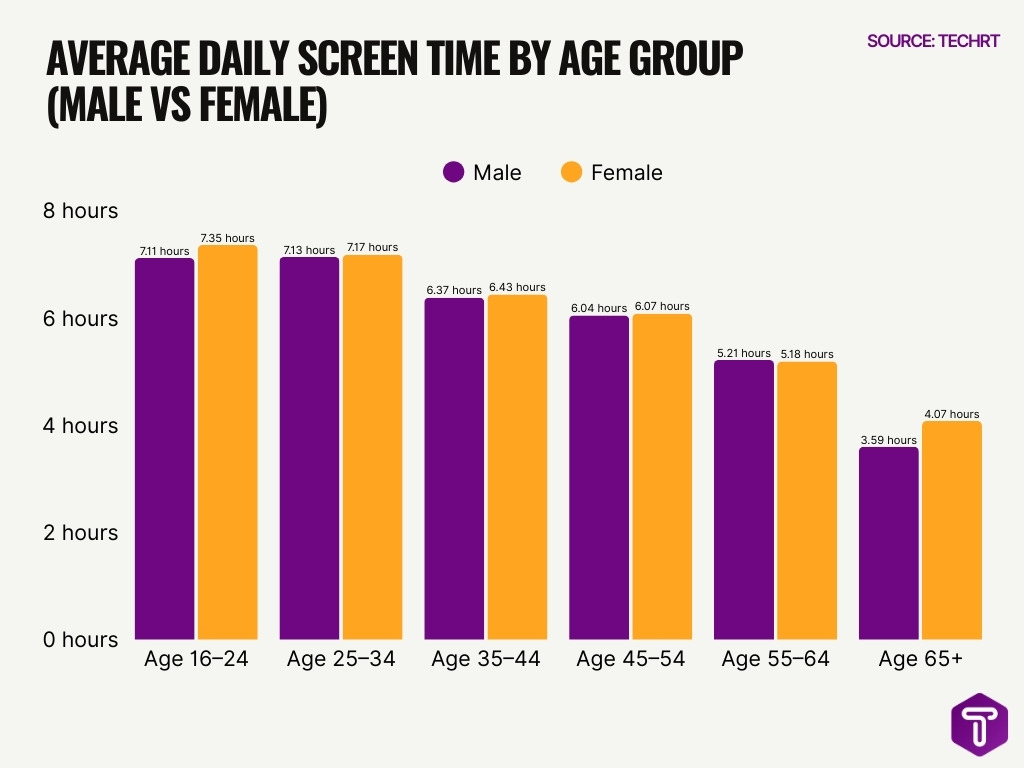
- Young adults aged 16–24 spend the most time online, with 7 hours 11 minutes for males and 7 hours 35 minutes for females per day, the highest screen time across all age groups.
- Among ages 25–34, daily internet usage remains very high, reaching 7 hours 13 minutes for men and 7 hours 17 minutes for women, showing that heavy digital engagement continues into early adulthood.
- People aged 35–44 spend around 6 hours 37 minutes (male) and 6 hours 43 minutes (female) online daily, indicating a moderate decline in screen time compared to younger users.
- For the 45–54 age group, the average daily internet usage drops to 6 hours 4 minutes for men and 6 hours 7 minutes for women.
- Adults aged 55–64 spend about 5 hours 21 minutes (male) and 5 hours 18 minutes (female) online per day, showing a continued reduction in internet use with age.
- Seniors aged 65+ record the lowest internet usage, with 3 hours 59 minutes for men and 4 hours 7 minutes for women per day.
- Across most age groups, females spend slightly more time online than males, particularly in ages 16–24 and 65+.
- Overall, the data shows a clear downward trend in internet usage as age increases, dropping from over 7 hours daily among young adults to around 4 hours among seniors.
Screen Time for Children
- Children aged 8–12 spend an average of about 5 hours per day on screens for entertainment purposes alone.
- Nearly 42% of children under age 8 own their own tablet device.
- About 68% of children watch online videos daily, primarily through platforms such as YouTube.
- In the United States, children aged 0–8 average roughly 2 hours and 27 minutes of daily screen time.
- Educational apps and digital learning platforms account for about 20% of children’s screen use during school periods.
- Approximately 71% of parents report concern about excessive screen time for their children.
- Pediatric guidelines recommend limiting recreational screen time to under 2 hours daily for school-age children.
- The share of children owning smartphones has grown rapidly, reaching over 50% by age 11.
Screen Time for Teenagers and Young Adults
- Teenagers aged 13–18 spend about 7 hours and 22 minutes per day on entertainment screen media, excluding schoolwork.
- More than 95% of teenagers have access to a smartphone, making mobile devices their primary screen.
- Approximately 46% of teens say they are online almost constantly.
- Social media accounts for roughly 3 hours of daily screen time among teens.
- Young adults aged 18–24 average more than 7 hours of daily internet use, among the highest of any age group.
- Around 60% of teenagers say they spend too much time on their phones.
- Video streaming platforms represent the largest share of teen screen time, followed by social media and gaming.
- Surveys show that over 70% of teens use screens within 30 minutes of waking up.
Screen Time by Generation (Gen Z, Millennials, Gen X, Boomers)
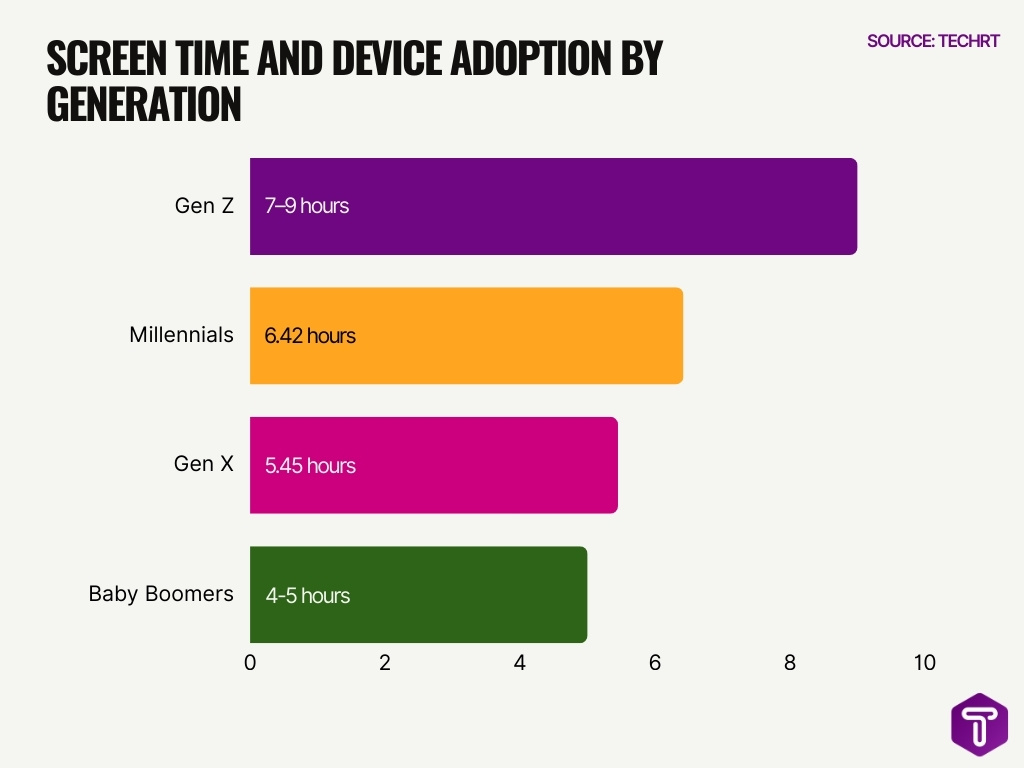
- Gen Z users (ages roughly 12–27) spend an average of 7 to 9 hours per day on screens, making them the most digitally engaged generation.
- Around 95% of Gen Z owns a smartphone, which heavily influences their daily screen usage.
- Millennials spend approximately 6 hours and 42 minutes daily on digital screens, combining work and entertainment usage.
- About 86% of Millennials use social media daily, contributing significantly to total screen exposure.
- Gen X users average roughly 5 hours and 45 minutes of screen time per day, often driven by work-related device usage.
- Baby Boomers typically log 4 hours to 5 hours of screen time daily, mostly for news, communication, and streaming.
- Nearly 70% of Boomers own smartphones, reflecting increased digital adoption among older adults.
- Across all generations, streaming video and social media remain the largest contributors to total screen time.
Screen Time and Mental Health Statistics
- Teens with 4+ hours daily screen time show 25.9% depression symptoms vs. 9.5% for those with less.
- Adolescents exceeding 5 hours of screen time are 70% more likely to have depressive symptoms.
- About 45% of teens feel they spend too much time on social media.
- Teens with high screen time have 27.1% anxiety symptoms vs. 12.3% for low.
- More than 11% of adolescents exhibit problematic social media behavior.
- Social media use links to a −3.32-unit drop in self-esteem per extra hour.
- Around 38% of teens feel overwhelmed by social media drama.
- U.S. teens average 4.8 hours daily on major social media apps.
- Each extra screen hour reduces attention span score by 3.2 points.
Screen Time and Physical Health (Sleep, Obesity, Eye Strain)
- About 70% of adults report using screens within one hour before bedtime, which can disrupt sleep cycles.
- Blue light from screens suppresses melatonin production, potentially delaying sleep onset by up to 60 minutes.
- Research shows children with more than 4 hours of daily screen time have a higher risk of obesity.
- Prolonged screen exposure contributes to digital eye strain, affecting more than 50% of computer users.
- Common symptoms include dry eyes, headaches, blurred vision, and neck pain.
- Experts recommend the 20-20-20 rule, looking at something 20 feet away for 20 seconds every 20 minutes, to reduce eye strain.
- Excessive screen time is associated with lower physical activity levels among both adults and children.
- Health guidelines encourage regular screen breaks and outdoor activity to maintain physical well-being.
Key Health and Behavioral Impacts of Excessive Screen Time
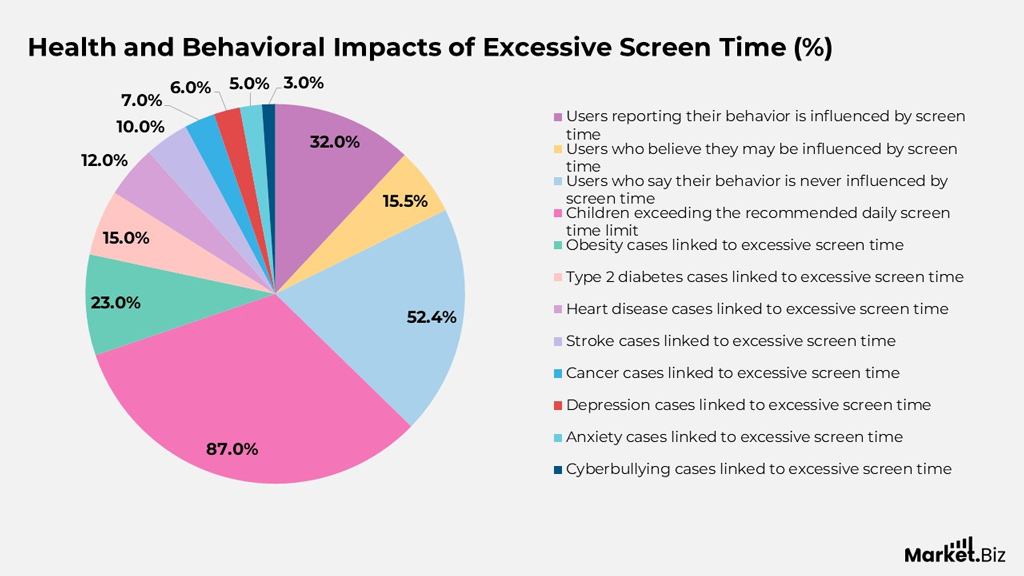
- A significant 32% of users report that their behavior is influenced by screen time, indicating that digital exposure can directly affect habits, productivity, and daily routines.
- Around 15.5% of respondents believe their behavior may be influenced by screen time, suggesting that nearly half of users acknowledge at least some level of behavioral impact from prolonged device usage.
- Meanwhile, 52.4% of users say their behavior is never influenced by screen time, showing that more than half of respondents perceive no direct behavioral effect from their screen usage.
- A striking 87% of children exceed the recommended daily screen time limit, highlighting widespread overexposure to digital devices among younger age groups.
- Excessive screen time is associated with several physical health risks, including 23% of obesity cases being linked to prolonged screen exposure.
- Studies also connect excessive screen time with 15% of Type 2 diabetes cases, suggesting potential metabolic health consequences.
- Cardiovascular risks are also present, with 12% of heart disease cases and 10% of stroke cases linked to excessive screen time.
- Screen overuse is further associated with serious illnesses, including 7% of cancer cases connected to prolonged sedentary digital behavior.
- Mental health impacts are also notable, with 6% of depression cases and 5% of anxiety cases linked to excessive screen time.
- Additionally, 3% of cyberbullying cases are associated with excessive screen exposure, highlighting the social and psychological risks of extended time spent online.
Future Outlook: Screen Time Projections and Emerging Trends
- Global digital screen time is expected to remain close to 7 hours daily through 2030, driven by mobile and streaming services.
- The number of global internet users could reach over 6 billion by 2030, increasing total screen hours worldwide.
- Short-form video platforms are projected to account for more than half of social media screen time by the late 2020s.
- Augmented reality and virtual reality technologies are expected to introduce new immersive screen experiences.
- Remote work and digital collaboration tools may keep daily workplace screen time above pre-pandemic levels.
- Smart TVs and connected devices will likely increase household streaming hours worldwide.
- AI-powered recommendation algorithms will continue shaping how users discover and consume digital content.
- Governments and organizations are expected to expand digital well-being initiatives to manage excessive screen exposure.
Frequently Asked Questions (FAQs)
What is the average daily screen time worldwide?
The average global screen time is about 6 hours and 38 minutes per day, equivalent to roughly 46 hours and 26 minutes per week for internet users.
How many hours do people spend on social media each day globally?
Internet users spend an average of 2 hours and 21 minutes per day on social media, representing a major share of total screen time.
How much screen time do U.S. adults have per day on average?
Adults in the United States spend approximately 7 hours and 2–3 minutes per day using screens, slightly above the global average.
Which country has the highest average screen time per day?
South Africa ranks among the highest, with about 9 hours and 24 minutes of daily screen time per person.
How many hours per day does Gen Z spend on screens?
Gen Z users average 9+ hours of daily screen time, significantly higher than older generations.
Conclusion
Screen time continues to shape how people work, communicate, and consume entertainment worldwide. From smartphones and social media to streaming and gaming, digital screens now occupy a large portion of daily life across all age groups. While global averages hover around 6 to 7 hours per day, younger generations often exceed this level due to heavy mobile and social media use. At the same time, research highlights the importance of balancing digital engagement with physical activity, sleep, and offline interaction. As technology evolves and new platforms emerge, monitoring screen time trends will remain essential for understanding the future of digital behavior.

Leave a comment
Have something to say about this article? Add your comment and start the discussion.