




Steam continues to shape the global PC gaming ecosystem, powering everything from indie game launches to billion-dollar franchises. Game studios rely on Steam for distribution, monetization, and global reach, while players use it as a centralized hub for multiplayer gaming, digital libraries, modding, and community interaction. Its influence extends beyond gaming into areas like esports, digital commerce, and even hardware innovation with devices like the Steam Deck. From blockbuster titles like Counter-Strike 2 to breakout indie successes, Steam’s scale directly impacts how games are developed, marketed, and consumed worldwide.
As the platform grows in users, revenue, and technological capabilities, understanding its data becomes essential for developers, marketers, and gamers alike. Let’s explore the latest Steam statistics to understand how the platform is evolving.
Editor’s Choice
- Steam reached 147 million monthly active users (MAU) in 2025, reflecting steady platform growth.
- The platform recorded 69 million daily active users (DAU) in 2025, showing strong engagement levels.
- Steam hit a record 42.04 million concurrent users in January 2026.
- Steam generated over $16.2 billion in revenue in 2025, marking a significant year-over-year increase.
- The platform holds roughly 74–75% market share in PC game distribution globally.
- More than 52% of monthly users log in daily, indicating high retention.
- Steam hosted 117,000+ games in 2025, with thousands of new releases added annually.
Recent Developments
- Steam surpassed 42 million concurrent users in early 2026, setting a new platform record.
- The platform crossed the 40 million concurrent user milestone for the first time in March 2025.
- Steam’s concurrent user base grew by around 17% year-over-year in 2025.
- Steam revenue reached $16.2 billion in the first 11 months of 2025, surpassing 2024 totals early.
- December 2025 alone generated $1.6 billion in revenue, the highest in Steam’s history.
- Over 5,800 games earned $100K+ revenue in 2025, highlighting developer success on the platform.
- Steam user downloads exceeded 100 exabytes of data in 2025, showing massive content consumption.
- Asia-Pacific accounts for 42% of Steam’s user base, signaling regional growth trends.
Steam Overview
- Steam was launched in 2003 by Valve as a digital distribution platform for PC games.
- The platform now supports over 117,000 games, including indie and AAA titles.
- Steam recorded 147 million MAUs in 2025, up from 132 million in 2024.
- Daily active users increased to 69 million in 2025, from 62.6 million previously.
- Steam reached 41.6 million concurrent users in October 2025, a record at the time.
- The platform’s revenue hit $10.8 billion in 2024, before rising sharply in 2025.
- Steam’s ecosystem includes cloud saves, multiplayer services, and mod support, enhancing user retention.
- The platform operates globally, with a strong presence in North America, Europe, and the Asia-Pacific.
Key Steam Statistics
- Steam reached 42 million+ concurrent users in 2026, doubling from 2020 levels.
- The platform added over 16,700 new games in 2025 alone.
- Steam controls around 75% of the PC gaming distribution market.
- Monthly active users grew by 11.4% year-over-year from 2024 to 2025.
- Daily engagement remains strong with 52% DAU-to-MAU ratio.
- Steam’s total revenue exceeded $16 billion in 2025, up from ~$15 billion in 2024.
- Peak in-game players reached 13.39 million simultaneously in 2026.
- Steam’s user base doubled from ~24 million concurrent users in 2020 to 42 million in 2026.
Steam Concurrent Player Growth Trends
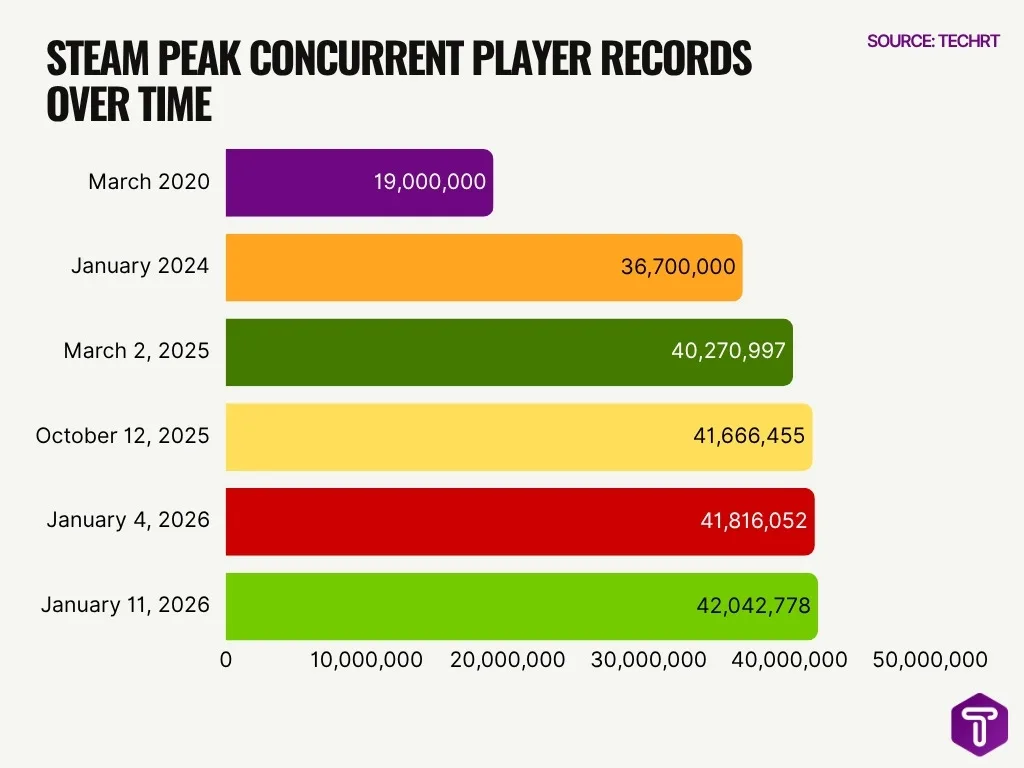
- Steam’s peak concurrent users surged from 19 million in March 2020 to 42.04 million by January 2026, marking a massive 121%+ overall growth.
- The biggest jump occurred between 2020 and January 2024, where users nearly doubled to 36.7 million, reflecting a +93.2% increase.
- Steam crossed a major milestone on March 2, 2025, reaching 40.27 million users, the first time exceeding 40 million concurrent players.
- Growth continued steadily through 2025, with a new peak of 41.66 million in October 2025, representing a +3.5% increase from the previous record.
- Early 2026 showed incremental but consistent gains, rising from 41.81 million (Jan 4) to 42.04 million (Jan 11), adding over 225,000 users in just one week.
- The recent growth trend indicates market saturation with slower gains, as increases dropped to +0.4% and +0.5%, compared to earlier explosive growth phases.
- Overall, Steam demonstrates a strong, sustained upward trajectory, solidifying its position as the leading PC gaming platform globally.
Steam User Growth Over Time
- Steam MAUs increased from 132 million in 2024 to 147 million in 2025.
- Daily active users rose from 62.6 million to 69 million year-over-year.
- Concurrent users climbed from 39.2 million in 2024 to 41.6 million in 2025.
- Steam crossed 40 million concurrent users for the first time in 2025.
- By early 2026, concurrency hit 42 million+, marking continued acceleration.
- The platform’s user base has nearly doubled since the 2020 pandemic levels.
- Average weekly playtime increased from 6.3 hours (2024) to 7.1 hours (2025).
- Growth remains steady due to global PC gaming expansion and digital adoption trends.
Monthly Active Users (MAU)
- Steam reported 147 million MAUs in 2025, its highest ever.
- MAUs increased by 11.4% from 2024 (132 million).
- Over 52% of MAUs log in daily, indicating strong engagement.
- Steam maintains one of the highest retention rates in digital entertainment platforms.
- MAU growth accelerated during 2020–2025 due to pandemic-driven gaming adoption.
- Steam consistently adds millions of new users annually, driven by global reach.
- The platform supports a diverse global audience across multiple regions and languages.
- MAU growth correlates with new game releases, seasonal sales, and platform updates.
Steam User Demographics by Age Group
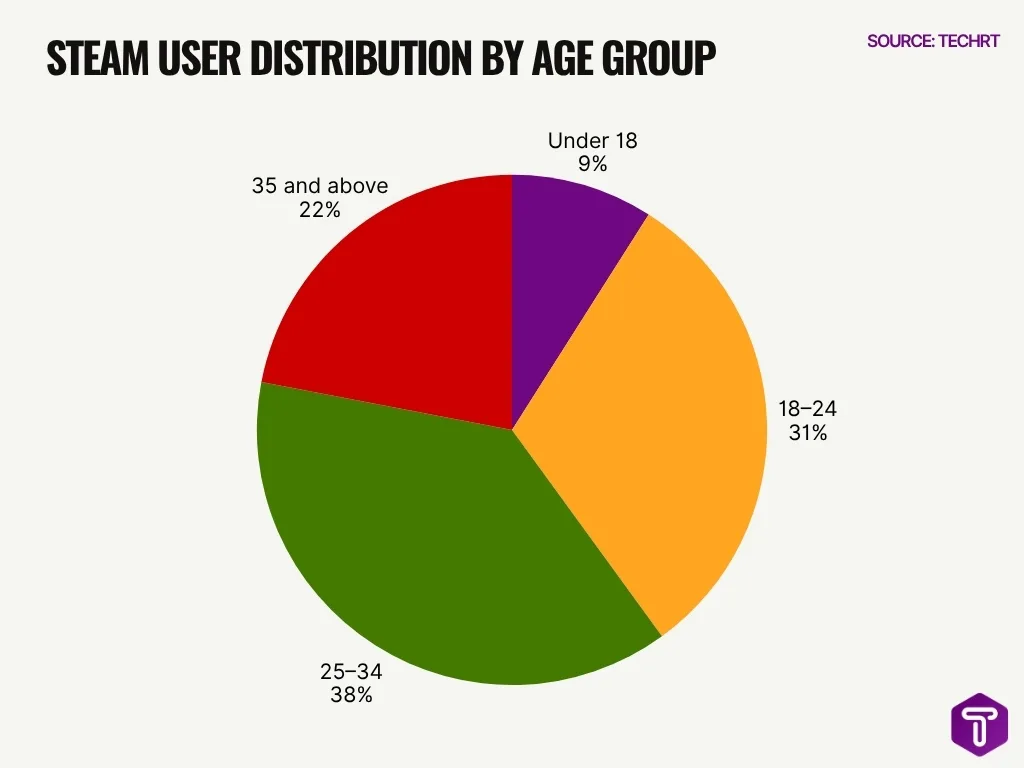
- The 25–34 age group dominates Steam, accounting for the largest share at 38%, highlighting the platform’s strong appeal among young working professionals.
- Users aged 18–24 make up 31% of the audience, indicating that nearly one-third of Steam users are young adults and students.
- Combined, the 18–34 segment represents a massive 69% of total users, showing that Steam is heavily concentrated among younger demographics.
- The 35 and above group holds a notable 22% share, reflecting a growing presence of older and more mature gamers on the platform.
- The under 18 segment is the smallest at 9%, suggesting that Steam has relatively lower penetration among teenage users compared to older age groups.
- Overall, the data indicates that Steam’s core audience is primarily between 18 and 34 years old, making it a highly attractive platform for targeting young adult gamers and digital consumers.
Steam Market Share in PC Gaming
- Steam holds approximately 74–75% of the global PC game distribution market.
- Competitors like Epic Games Store and GOG collectively account for less than 25% market share.
- Steam generated over $16 billion in revenue in 2025, reinforcing its dominant position.
- Valve’s revenue share model (typically 30% cut) remains the industry standard.
- Steam’s catalog includes 117,000+ titles, far exceeding most competitors.
- The platform accounts for over 50% of all PC gaming playtime globally.
- Steam’s early market entry (since 2003) helped it build a strong network effect and developer ecosystem.
- Over 5,800 games generated $100K+ revenue in 2025, showcasing monetization strength.
Time Spent on Steam and Playtime
- Average Steam users spend 7.1 hours per week gaming in 2025, up from 6.3 hours in 2024.
- Heavy users (top 10%) log 20+ hours per week on the platform.
- Multiplayer games account for over 60% of total playtime on Steam.
- Free-to-play titles contribute to over 50% of total playtime hours.
- Weekend playtime increases by 25–30% compared to weekdays.
- Seasonal events and game launches drive short-term spikes in average playtime by up to 40%.
- Single-player games account for around 35–40% of total gameplay hours.
- The average session length ranges from 1.8 to 2.5 hours.
Geographic Distribution of Steam Users
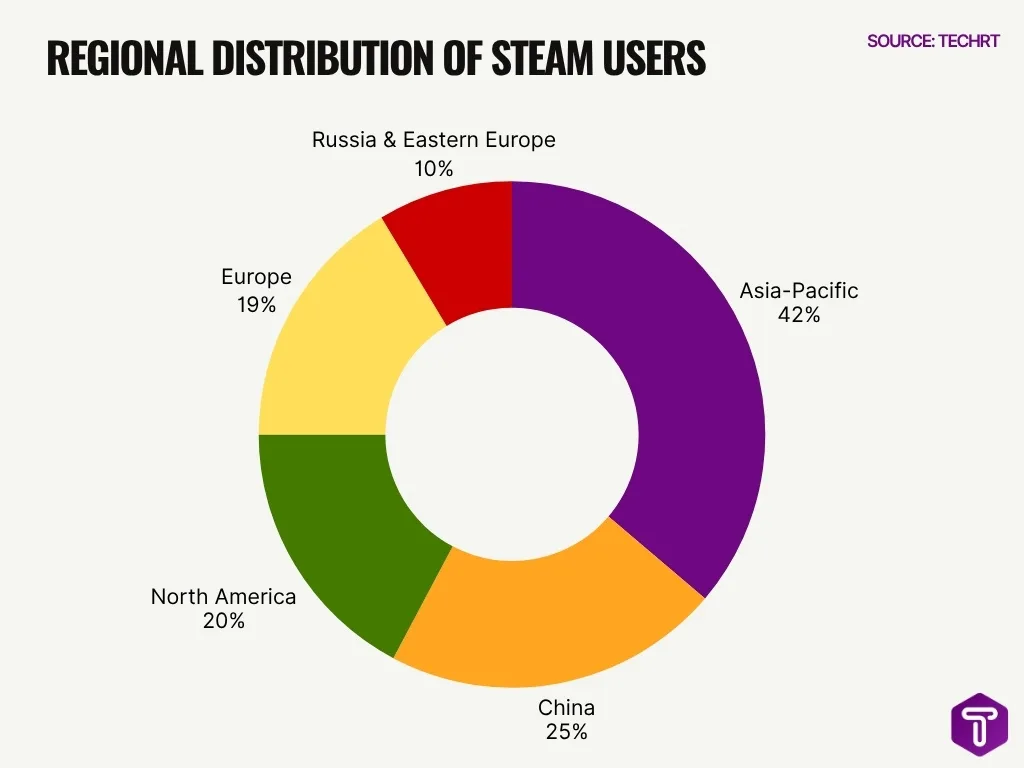
- Asia-Pacific accounts for approximately 42% of Steam’s global user base.
- China represents the largest single country market, contributing over 25% of total users.
- North America holds around 20% of Steam users, driven by high spending power.
- Europe contributes roughly 18–20% of the user base, with strong adoption in Germany and the UK.
- Emerging markets like India and Brazil are seeing double-digit growth in Steam adoption annually.
- Russia and Eastern Europe collectively account for 10%+ of Steam users, supported by PC gaming culture.
- Steam supports 28+ languages, enabling global accessibility.
- Regional pricing strategies have increased adoption in low-income markets by over 15%.
Steam Revenue and Business Performance
- Steam generated over $16.2 billion in revenue in 2025, up from ~$15 billion in 2024.
- December 2025 alone brought in $1.6 billion, the highest monthly revenue on record.
- Valve earns a standard 30% revenue share on most game sales.
- Over 5,800 games generated $100K+ revenue in 2025, highlighting platform profitability.
- Indie games account for 30–40% of total Steam revenue, showing strong developer diversity.
- Microtransactions and DLC contribute to over 25% of platform revenue.
- Steam’s annual revenue grew by ~8–10% year-over-year from 2024 to 2025.
- Digital distribution ensures high profit margins compared to physical game sales.
Top Grossing Games on Steam
- Counter-Strike 2 generated over $1 billion in revenue for Valve in 2025 from 400 million weapon cases opened.
- Dota 2 ranked in Steam’s Platinum top-grossing tier for 2025 alongside other leaders.
- PUBG: Battlegrounds achieved Platinum status in Steam’s 2025 best-sellers by revenue.
- Baldur’s Gate 3 holds the top 20 position in current Steam grossing charts with strong sales.
- Call of Duty (Warzone integration) hit 114,000 peak concurrent players on Steam in 2025.
- Free-to-play games account for 22% of Steam’s total revenue, with premium at 78%.
- Steam’s total revenue reached $17.7 billion in 2025, up 15% from 2024.
- CS2 leads weekly top sellers, driving consistent top-grossing performance into 2026.
- Top F2P titles like CS2, Dota 2, and PUBG dominate Platinum revenue tiers.
- Esports events boost game revenues, with tournament sales at $420 million in 2025.
Top 10 Most Played Games on Steam by Peak Players
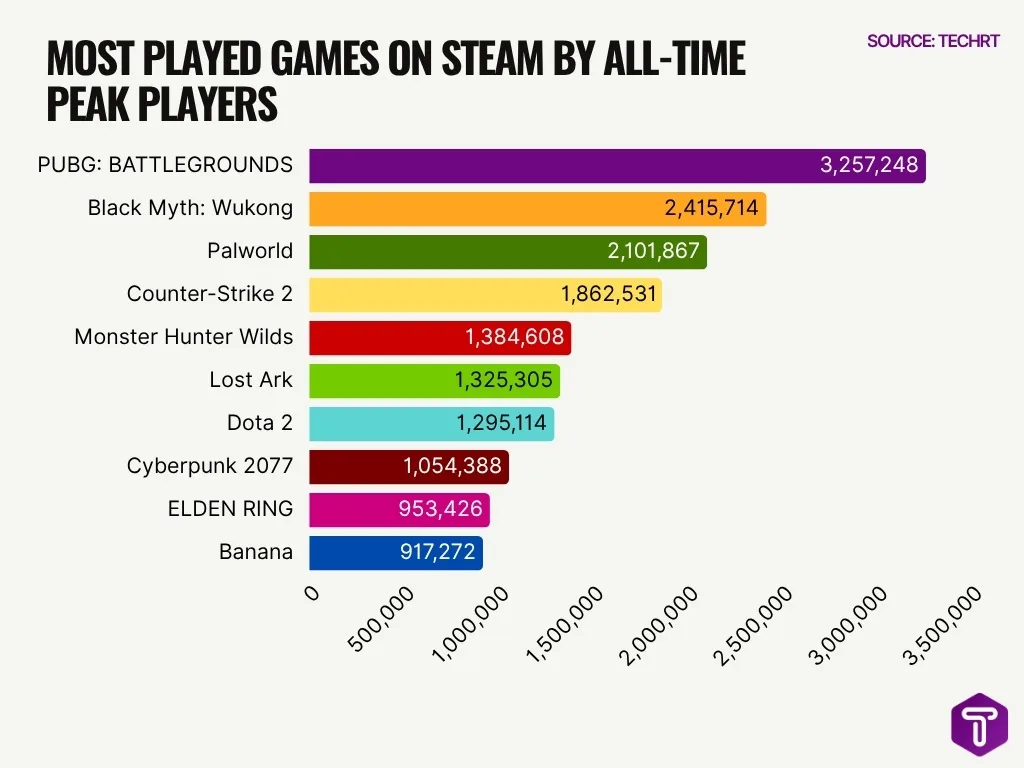
- PUBG: BATTLEGROUNDS dominates the chart with an all-time peak of 3,257,248 players, making it the most-played game in Steam history.
- Black Myth: Wukong ranks second with 2,415,714 players, showcasing massive hype and strong launch performance.
- Palworld secured the third spot with 2,101,867 peak players, highlighting the growing popularity of hybrid survival and creature-collection games.
- Counter-Strike 2, a flagship competitive title, reached 1,862,531 players, reinforcing the strength of FPS esports titles on Steam.
- Monster Hunter Wilds achieved 1,384,608 peak players, indicating strong demand for action RPG franchises.
- Lost Ark recorded 1,325,305 players, reflecting the continued appeal of MMORPGs in global markets.
- Dota 2 peaked at 1,295,114 players, maintaining its position as one of the top MOBA games on the platform.
- Cyberpunk 2077 saw a resurgence with 1,054,388 players, driven by updates and renewed player interest.
- ELDEN RING reached 953,426 players, proving the success of soulslike RPGs in attracting large audiences.
- Banana rounds out the list with 917,272 peak players, demonstrating that even indie or viral titles can achieve massive scale on Steam.
- Notably, only 3 games surpassed the 2 million peak player mark, highlighting how rare such blockbuster-level engagement is on Steam.
- The top 7 out of 10 games exceeded 1 million players, underlining the platform’s ability to support massive concurrent user spikes.
Free-to-Play vs Paid Game Usage
- Free‑to‑play games account for over 50% of total playtime on Steam, dwarfing the engagement share of paid titles.
- F2P titles occupy roughly 7 out of the top 10 most‑played games on Steam at any given time.
- Paid games generate about 65–70% of upfront revenue per sale, especially AAA titles priced between $40–$70.
- Microtransactions now drive over 25% of Steam’s total revenue, with the vast majority coming from F2P games.
- Premium game sales spike dramatically during seasonal sales, often increasing unit sales by 200–300% versus regular‑price periods.
- Subscription‑style monetization (battle passes, DLCs, and seasons) contributes more than 30% of ongoing revenue for major live‑service titles.
- Indie paid games typically price between $10–$25, capturing around 15–20% of indie‑game revenue on Steam.
- Hybrid monetization models (free‑to‑play base with paid content) are growing at 10%+ annually in downloads and active players.
- Paid games account for roughly 60% of all Steam revenue, while F2P games dominate with over 70% of total concurrent players.
- Around 35% of all Steam players regularly switch between free‑to‑play and paid games, using both models nearly equally by sessions per week.
Steam Deck Adoption Statistics
- Steam Deck surpassed 4 million units sold globally by early 2026.
- Valve shipped approximately 1.6 million units in 2023, with growth continuing into 2025.
- Steam Deck usage increased by over 30% year-over-year in 2025.
- Over 12,000 games are now verified or playable on Steam Deck.
- Linux-based SteamOS adoption has grown due to the Steam Deck, reaching 2%+ of Steam users.
- The device contributes to portable PC gaming growth, expected to exceed $14 billion globally by 2027.
- Steam Deck users spend 20–25% more time gaming on average compared to desktop-only users.
- Valve continues to expand compatibility, adding hundreds of verified titles monthly.
Steam Language Distribution Insights
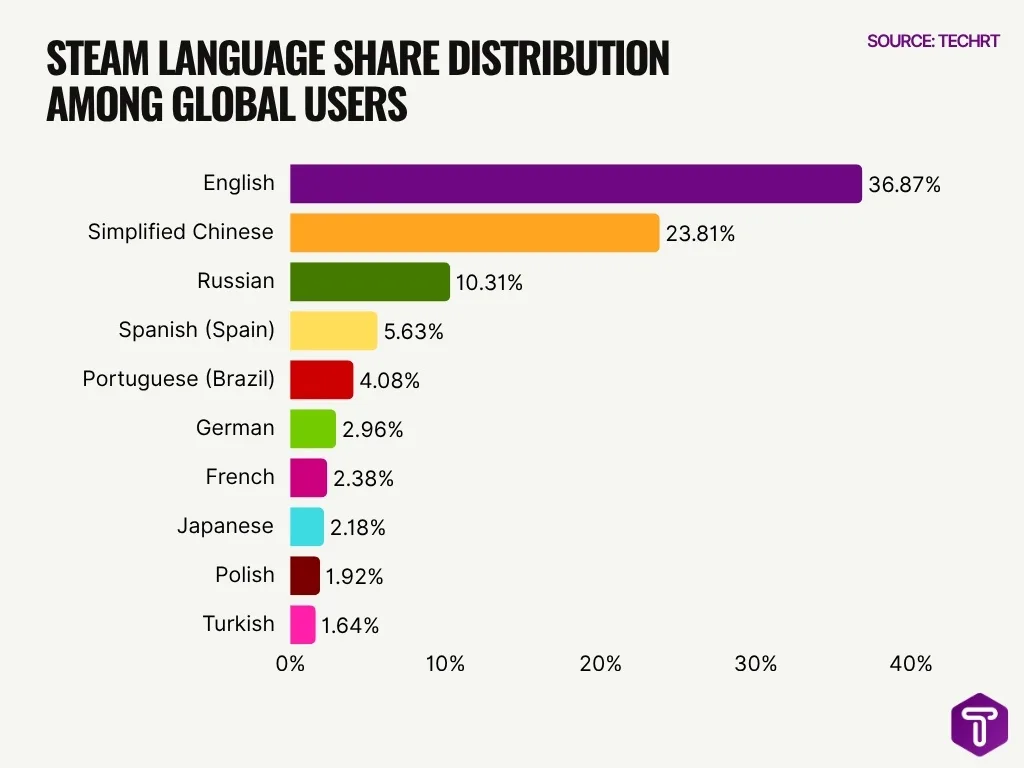
- English dominates Steam with a 36.87% share, making it the primary language across the platform.
- Simplified Chinese ranks second at 23.81%, highlighting Steam’s massive penetration in the Chinese gaming market.
- There is a significant gap between the top two and others, with Russian at 10.31%, making it the third-largest language segment.
- Spanish (Spain) accounts for 5.63%, indicating strong adoption across Spanish-speaking gamers.
- Portuguese (Brazil) contributes 4.08%, reflecting Brazil’s growing gaming ecosystem.
- Among European languages, German (2.96%) and French (2.38%) maintain moderate shares.
- Asian language presence beyond Chinese includes Japanese at 2.18%, showing steady but smaller market representation.
- Polish (1.92%) and Turkish (1.64%) represent emerging but niche player bases on Steam.
- The top 3 languages (English, Chinese, and Russian) together account for over 71% of Steam users, indicating strong concentration.
- Overall, Steam’s language distribution shows a global but highly concentrated user base, dominated by a few key regions.
Steam Hardware Survey Overview
- Windows dominates with over 95% OS share among Steam users in 2026.
- Windows 11 accounts for over 50% of users, surpassing Windows 10 adoption.
- NVIDIA GPUs lead with over 75% market share among Steam gamers.
- The most common GPU remains the NVIDIA GeForce RTX 3060.
- 16 GB RAM is the standard, used by over 50% of Steam users.
- 1080p resolution dominates, with over 60% of gamers using Full HD displays.
- SSD adoption exceeds 70% of users, improving load times and performance.
- VR headset usage remains niche at under 2% of Steam users.
Steam Community and Social Features
- Steam hosts over 1 billion registered community accounts, with 132 million monthly active users.
- Over 30 million users engage via Steam chat features monthly, fostering social bonds.
- Steam Workshop features nearly 15 million user-generated items and mods across thousands of games.
- User reviews on Steam total around 100 million, significantly shaping buyer choices.
- Steam Community Market sees up to 58 million transactions monthly, worth $38.9 million in volume.
- Users leveraging social features show 25% higher daily retention rates compared to non-active peers.
- Millions of Steam groups exist, with top ones boasting over 4.9 million members each.
- Steam forums and groups sustain millions of discussions monthly among engaged communities.
- Livestreaming on Steam draws millions of weekly viewers, boosting game discovery.
Steam Revenue Growth Trends
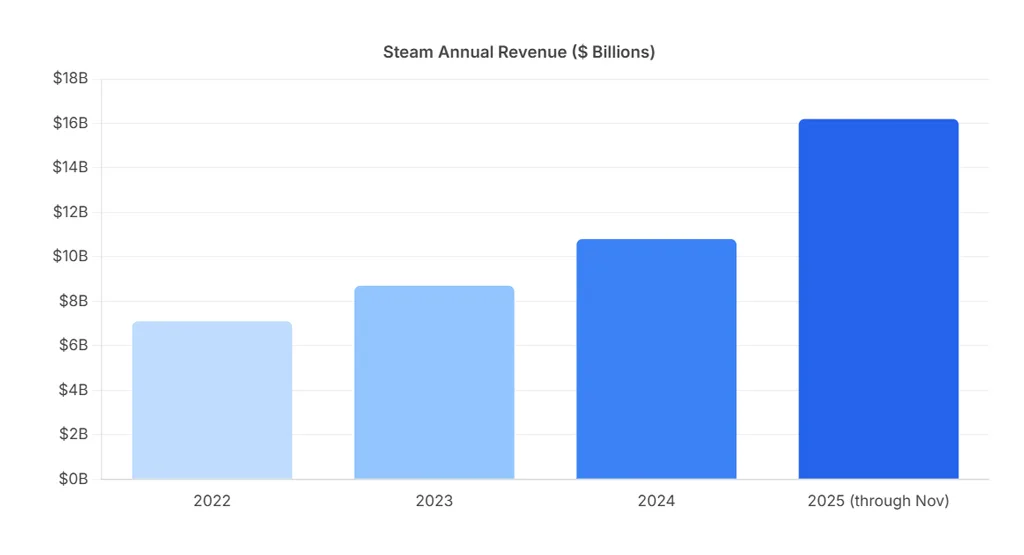
- Steam’s revenue has grown significantly from ~$7.1 billion in 2022 to $16.2 billion in 2025 (through November), showing a strong upward trajectory.
- In 2023, revenue reached $8.7 billion, marking a +22.5% year-over-year growth, signaling post-pandemic market stabilization and continued platform expansion.
- The growth momentum accelerated in 2024, with revenue climbing to $10.8 billion, reflecting a +24.1% YoY increase driven by rising game sales and in-platform spending.
- 2025 is a breakout year, with revenue already hitting $16.2 billion (through November)—representing an impressive 50%+ annualized growth, the highest in the period.
- Over just three years (2022–2025), Steam’s revenue has more than doubled, highlighting its dominance in the PC gaming distribution market.
- The sharp spike in 2025 suggests strong contributions from AAA game launches, live-service models, and increased digital purchases.
- Overall, Steam demonstrates a consistent high-growth pattern, with accelerating YoY gains and expanding monetization opportunities across its ecosystem.
Account Security and Anti-Cheat Statistics
- Steam Guard protects 90%+ of active accounts with 2FA, making it one of the strongest built-in defenses on Steam.
- VAC has blocked 600,000+ accounts in a single month, showing how large-scale cheating enforcement can be.
- Valve has reported about 77,000 Steam accounts hacked every month, which helped drive stronger account protection measures.
- Steam’s security changes cut fraud tied to account theft by 20% after the 2024–2025 updates.
- Steam’s recovery system handles millions of account-help requests each year, reflecting the platform’s huge user base.
- VAC supports 100+ multiplayer games, including major competitive and esports titles.
- Community reporting helps speed up cheat detection, improving enforcement beyond automated bans alone.
- Security upgrades have reduced account-hacking incidents by 15% year over year.
Frequently Asked Questions (FAQs)
How many concurrent users does Steam have in 2026?
How many monthly active users does Steam have?
What is Steam’s annual revenue?
What share of the PC gaming market does Steam hold?
How many daily active users are on Steam?
Conclusion
Steam continues to dominate the PC gaming landscape with sustained growth in users, revenue, and engagement across global markets. Its ability to balance blockbuster franchises, indie innovation, and robust community features makes it a central pillar of the gaming industry. Moreover, its expansion into hardware, evolving monetization models, and strong developer ecosystem position it well for long-term growth.
As trends like portable gaming, live-service models, and global market expansion accelerate, Steam is likely to remain at the forefront of digital game distribution. These statistics not only highlight current performance but also reveal how Steam continues to influence player behavior, developer strategies, and the broader future of gaming.

Leave a comment
Have something to say about this article? Add your comment and start the discussion.