



Chatbots have rapidly evolved from simple scripted responders into intelligent digital assistants that power real-time conversations across websites, apps, and messaging platforms. Today, businesses rely on chatbots to streamline customer support, automate repetitive tasks, and deliver personalized experiences at scale. For example, ecommerce brands use chatbots to guide shoppers, recommend products, and recover abandoned carts, while banks deploy them to handle balance inquiries, fraud alerts, and transaction support without human intervention.
At the same time, advancements in generative AI have significantly improved chatbot accuracy, contextual understanding, and conversational depth. This shift has transformed chatbots into strategic assets rather than just support tools. As adoption accelerates across industries and user expectations continue to rise, understanding the latest data becomes critical. Let’s explore the most important chatbot statistics shaping and beyond.
Editor’s Choice
- The global chatbot market reached approximately $11 billion in 2026, reflecting strong year-over-year growth.
- The market is projected to grow from $11.45 billion in 2026 to $32.45 billion by 2031 at a 23% CAGR.
- Over 987 million people worldwide use AI chatbots, showing near-billion-scale adoption.
- Chatbots can handle up to 80% of routine customer inquiries, reducing human workload significantly.
- Around 91% of businesses with 50+ employees use chatbots in their workflows.
- Businesses report earning $8 for every $1 invested in chatbots, highlighting strong ROI.
- Approximately 49% of customer interactions on websites are now handled by chatbots.
Recent Developments
- Chatbot adoption has grown 4.7× between 2020 and 2025, marking one of the fastest enterprise tech shifts.
- By 2026, nearly 80% of companies will be using or planning to adopt AI chatbots for customer service.
- AI chatbots are expected to handle 80% of routine interactions in 2026, up sharply from previous years.
- The number of businesses using chatbots increased by 34% in 2025 alone.
- Around 69% of service professionals report using AI tools, including chatbots, in their workflows.
- Generative AI adoption reached roughly 1 in 6 people globally by late 2025, influencing chatbot usage growth.
- ChatGPT alone processes over 2.5 billion messages daily, showing massive real-world usage.
- AI chatbot ecosystems are becoming competitive, with platforms like Gemini and Copilot gaining share from early leaders.
Global AI Chatbot Market Growth Insights
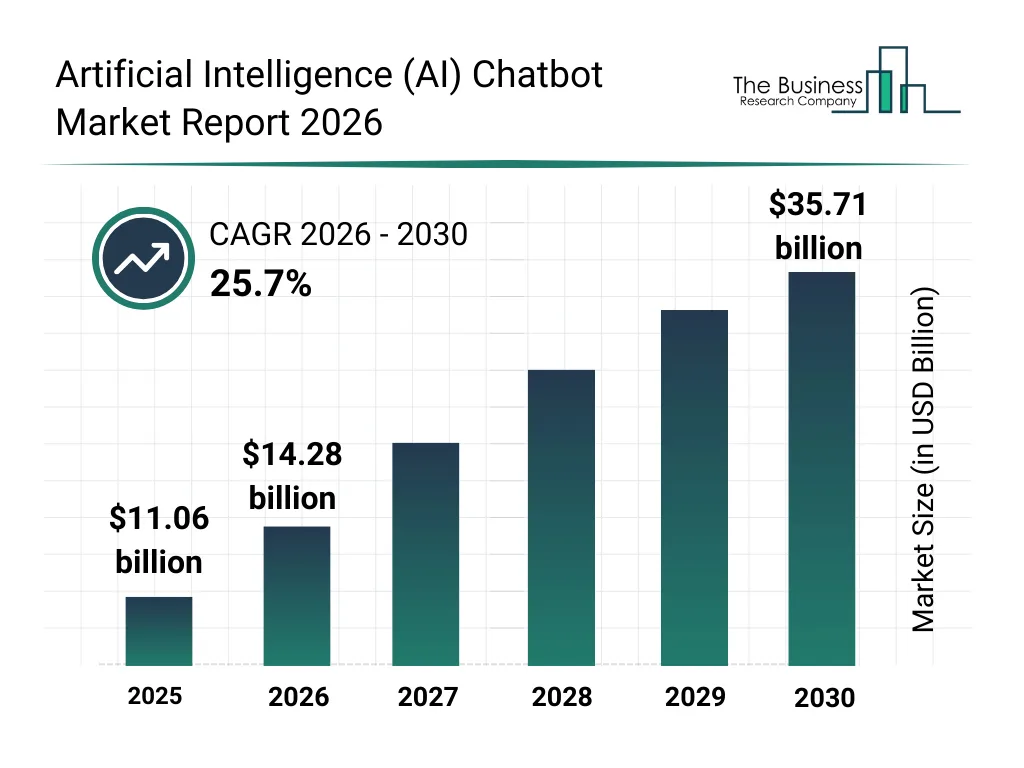
- The global AI chatbot market is projected to grow from $11.06 billion in 2025 to $35.71 billion by 2030, showing massive expansion.
- The market is expected to grow at a strong CAGR of 25.7% between 2026 and 2030, highlighting rapid adoption across industries.
- In 2026, the market is estimated to reach $14.28 billion, marking a significant year-over-year increase.
- By 2027, the market size is expected to cross approximately $18 billion, driven by rising enterprise AI integration.
- The growth accelerates further in 2028, reaching around $23 billion, fueled by advancements in generative AI.
- By 2029, the market is projected to hit nearly $29 billion, reflecting widespread adoption in customer service and automation.
- The market is set to surpass $35 billion by 2030, indicating a more than 3x increase compared to 2025 levels.
- This consistent upward trend highlights how AI chatbots are becoming a core component of digital transformation strategies globally.
Chatbot Growth and Future Projections
- The chatbot market is forecast to reach $32.45 billion by 2031.
- Some projections estimate $27.29 billion by 2030 as a conservative scenario.
- Growth rates remain strong at 23%–55% CAGR depending on segment and region.
- Over 1 billion users are expected to interact with chatbots globally, indicating mass adoption.
- Chatbots could power up to 95% of customer interactions by 2025–2027, especially in digital channels.
- Around 72% of businesses expect AI to enable proactive customer service, shifting from reactive models.
- ROI benchmarks show chatbot deployments achieving 148%–200% returns in advanced implementations.
- The U.S. alone could save $23 billion annually through chatbot automation.
AI vs Traditional Chatbot Adoption
- AI-powered chatbots now dominate, with over 80% of customer service teams using AI-based solutions.
- Traditional rule-based bots are declining as LLM-powered bots deliver more accurate responses.
- Around 60% of B2B companies use chatbots, compared to 42% of B2C firms.
- AI chatbots can automate 30% of contact center tasks, outperforming rule-based systems.
- Businesses report significant ROI within the first year from AI chatbot adoption.
- AI chatbots resolve 30% of customer service cases independently, reducing human intervention.
- Legacy chatbots struggle with context, while AI models improve intent recognition and personalization.
- Enterprises increasingly replace legacy bots as 78% now use AI chatbots for internal workflows.
Key Insights on What Customers Expect from Chatbots
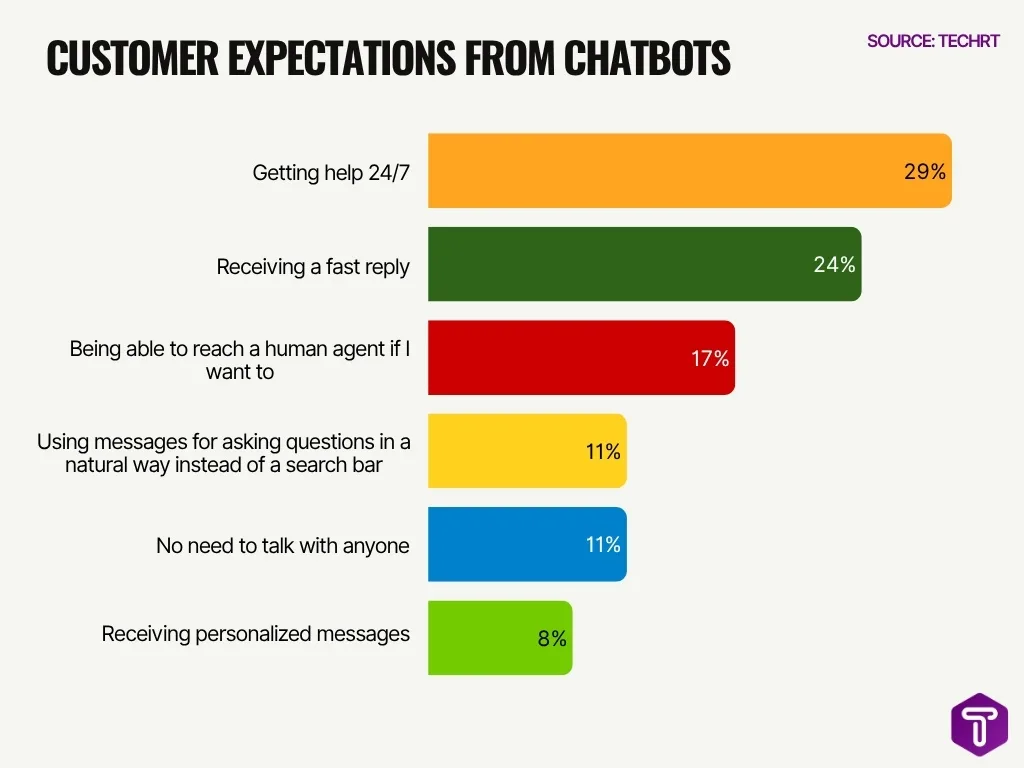
- The most important expectation is 24/7 availability, with 29% of users wanting instant access to help at any time, highlighting the demand for always-on customer support.
- Speed is critical, as 24% of customers expect fast replies, making response time one of the top performance metrics for chatbot effectiveness.
- A significant 17% of users still value human fallback options, indicating that hybrid support (chatbot + human agent) remains essential for trust and complex queries.
- Around 11% of users prefer natural, conversational interactions instead of traditional search methods, emphasizing the shift toward AI-driven conversational UX.
- Interestingly, another 11% of customers prefer fully automated interactions with no human involvement, showing a growing comfort with self-service experiences.
- Only 8% of users prioritize personalized messaging, suggesting that while personalization is valuable, it is less critical than speed and availability in chatbot interactions.
- Overall, the data shows that efficiency (speed + availability) outweighs advanced features (like personalization) in shaping customer expectations from chatbots.
Generative AI Chatbot Statistics
- The global generative AI chatbot market was valued at $9.9 billion in 2025.
- It is projected to grow to $12.98 billion in 2026, reflecting rapid expansion.
- By 2034, the market could reach around $113.35 billion, driven by enterprise adoption.
- Approximately 16.3% of the global population used generative AI tools in 2025, accelerating chatbot usage.
- ChatGPT accounts for roughly 80% of the generative AI chatbot market share in early 2026.
- Gemini and Copilot together captured over 25% of global AI chatbot traffic share in 2026, intensifying competition.
- Generative AI chatbots handle over 1 billion daily queries worldwide, reshaping digital communication.
- Around 68% of AI chatbot traffic is dominated by the top two platforms, indicating high market concentration.
- North America holds about 28–38% of the generative AI chatbot market, the largest regional share.
- Over 700 million weekly active users now interact with major generative AI chatbots, showcasing mass adoption.
Chatbot User Base and Penetration Rates
- More than 987 million people globally use chatbots, reflecting near mass-market adoption.
- Over 88% of users have interacted with a chatbot at least once in the past year.
- Around 65% of users engage with chatbots weekly or daily, indicating habitual usage.
- Approximately 27% of users interact with chatbots every day.
- About 67% of consumers globally used a chatbot for customer support in the past year.
- ChatGPT alone is projected to surpass 1 billion users globally, accelerating chatbot penetration.
- Roughly 10% of the world’s adult population uses ChatGPT, showing rapid mainstream adoption.
- Nearly 49% of website interactions are handled by chatbots, highlighting strong digital penetration.
- Chatbots now serve as a default touchpoint in customer journeys across ecommerce, SaaS, and banking platforms.
Demographic Statistics of Chatbot Users
- Around 64% of U.S. teens use chatbots, with higher rates among 15-17 year olds at 68%.
- About 30% of U.S. teens use AI chatbots daily, including 16% several times a day or almost constantly.
- Users aged 18–34 comprise 56.6% of global ChatGPT users, dominating younger demographics.
- Female ChatGPT users rose to 52% by mid-2025, shifting from early male dominance.
- Teens from households earning over $75k show 66% ChatGPT adoption vs. 56% under $30k.
- Black and Hispanic teens report 68% chatbot usage, higher than White teens at 58%.
- 40% of millennials engage with chatbots daily, a key user segment worldwide.
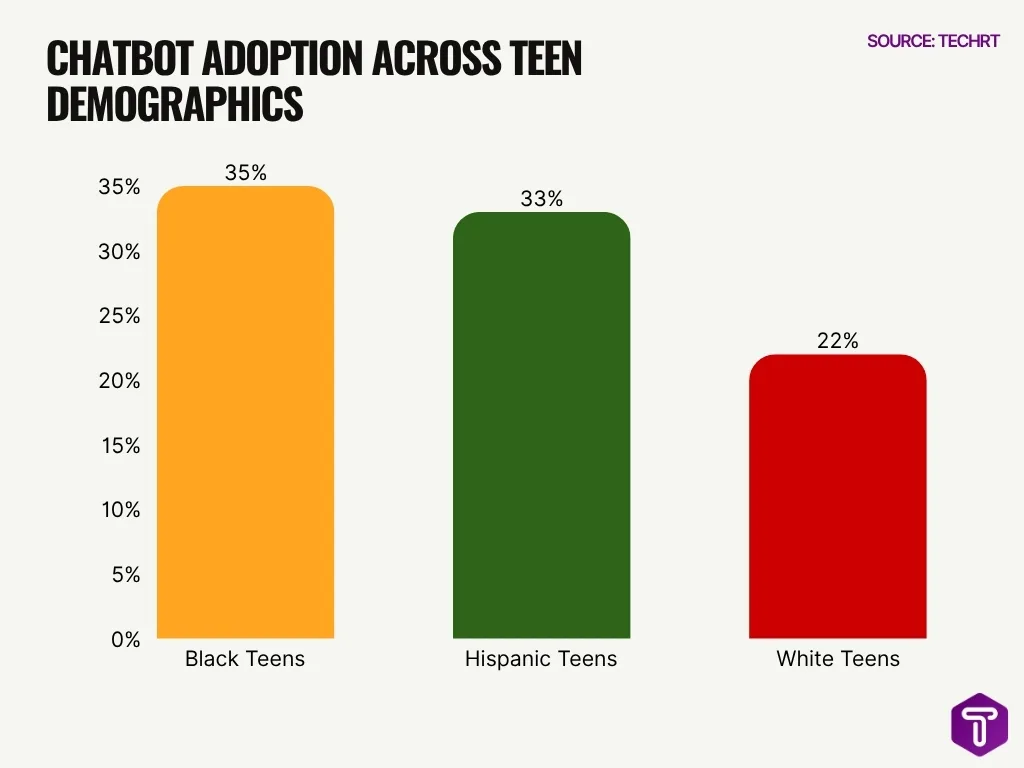
- 35% of Black teens and 33% of Hispanic teens use chatbots daily, vs. 22% White teens.
- Nearly 60% of Black and Hispanic teens use chatbots for schoolwork, exceeding White peers.
- Tech and media sectors lead with 69% chatbot adoption among professionals.
Consumer Preferences for Chatbots vs Human Agents
- About 62% of customers prefer chatbots over waiting for human agents.
- Around 74% of users prefer chatbots for simple queries, such as FAQs.
- Nearly 73% of users expect websites to include chatbot functionality.
- Around 56% of consumers prefer messaging businesses over calling support.
- Chatbots respond 3× faster than human agents, improving response expectations.
- Approximately 59% of customers expect responses within 5 seconds, favoring automation.
- Around 33% of users want chatbots for transactions like bookings and orders.
- Only 9% of consumers oppose chatbot usage, indicating broad acceptance.
- Consumers increasingly prefer chatbots for 24/7 availability and instant resolution.
Consumer Trust and Satisfaction with Chatbots
- Around 80% of customers report positive chatbot experiences.
- Nearly 90% of businesses report faster complaint resolution with chatbots, improving satisfaction.
- About 59% of consumers believe AI will significantly change customer interactions.
- Approximately 82% of users consider chatbot conversations sensitive, reflecting trust concerns.
- Around 50% of users admit to sharing personal or health-related information with chatbots.
- About 27% of users feel chatbot services are confusing or unclear, impacting trust levels.
- Privacy concerns remain, with 76% lacking a full understanding of chatbot data risks.
- Despite concerns, users continue to engage due to speed and convenience advantages.
- Businesses report improved satisfaction due to instant responses and reduced wait times.
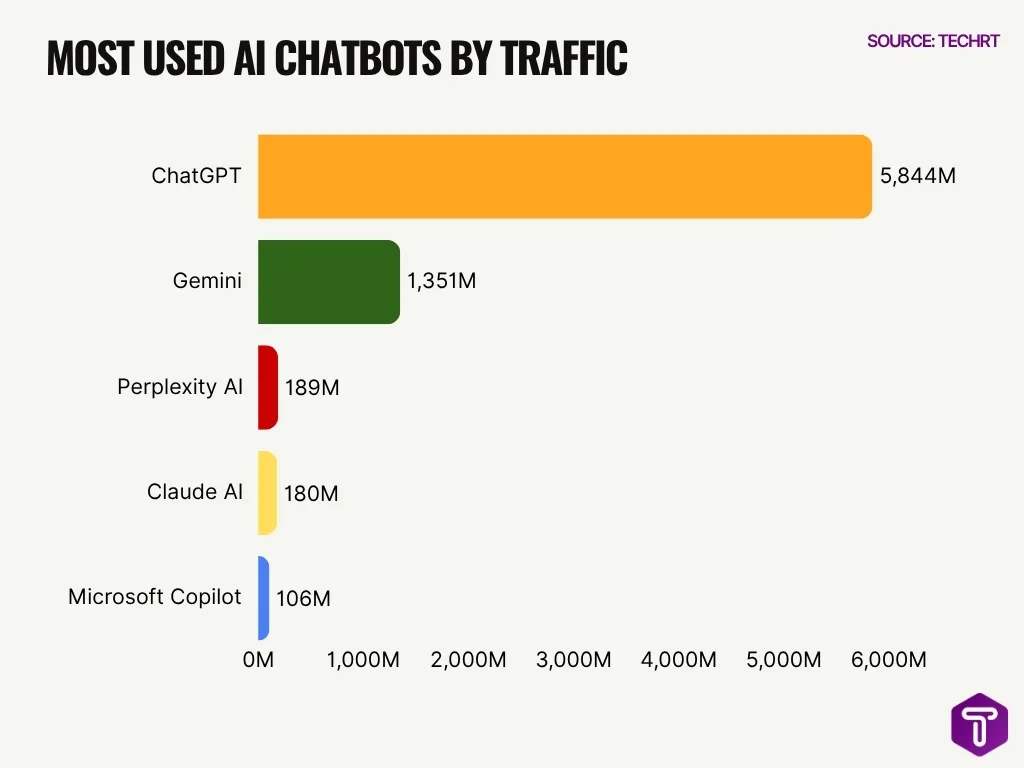
Most Used AI Chatbots by Traffic
- ChatGPT dominates the market with a massive 5,844 million visits, making it the clear leader in AI chatbot traffic.
- Gemini ranks second with 1,351 million visits, but still trails far behind ChatGPT by a significant margin.
- The traffic gap between ChatGPT and Gemini exceeds 4,400 million visits, highlighting a strong market concentration.
- Perplexity AI records 189 million visits, positioning itself as a growing but much smaller competitor.
- Claude AI follows closely with 180 million visits, showing similar traction to Perplexity in the mid-tier segment.
- Microsoft Copilot has the lowest traffic among the listed tools, with 106 million visits.
- There is a steep drop-off after the top two players, indicating a duopoly-like dominance by ChatGPT and Gemini.
- The combined traffic of Perplexity AI, Claude AI, and Microsoft Copilot (~475 million) is still less than half of Gemini’s traffic alone.
- The data suggests that user adoption is heavily concentrated, with most users preferring established platforms over emerging alternatives.
AI Chatbot Market Share by Platform
- ChatGPT holds approximately 80%+ market share among AI chatbot platforms.
- Microsoft Copilot has grown to around 4–5% share, driven by Office integration.
- Perplexity AI maintains roughly 8–9% market share, focusing on search-based queries.
- Google Gemini holds between 2–3% share, with steady growth.
- Emerging platforms like DeepSeek capture ~2–3% share, reflecting new entrants.
- Anthropic’s Claude accounts for under 2% of the market, but continues expanding.
- Regional platforms like Ernie Bot dominate local markets despite a lower global share.
- Market concentration remains high, with the top 3 platforms controlling the majority share.
Website and App Chatbot Adoption Rates
- Around 37% of businesses use chatbots for customer support interactions.
- Approximately 80% of companies plan to adopt AI chatbots for customer service.
- Nearly 85% of customer service leaders are exploring generative AI chatbots.
- Chatbots now handle up to 49% of website interactions, reducing manual support needs.
- Businesses report 30–40% cost reductions in customer service after chatbot implementation.
- Around 90% of companies report faster issue resolution with chatbot integration.
- Chatbots are increasingly embedded in mobile apps, especially in fintech and ecommerce platforms.
- SaaS companies widely adopt chatbots for onboarding, support, and lead generation workflows.
- Enterprises deploy chatbots internally for HR, IT support, and knowledge management tasks.
Chatbot Adoption Trends Across Industries
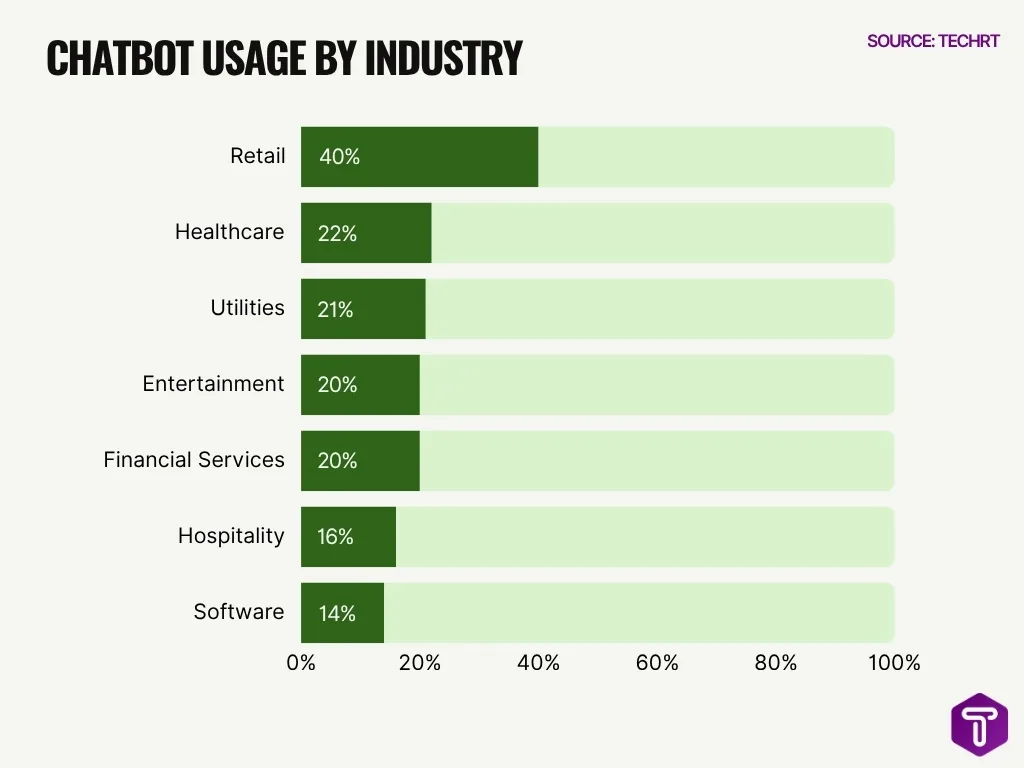
- Retail leads chatbot adoption with a dominant 40% usage, highlighting its strong focus on customer support, sales automation, and personalized shopping experiences.
- Healthcare ranks second at 22%, showing rapid adoption for patient support, appointment scheduling, and virtual assistance.
- Utilities follow closely with 21%, leveraging chatbots for billing inquiries, service requests, and outage updates.
- Entertainment and Financial Services are tied at 20%, indicating growing reliance on chatbots for user engagement, recommendations, and customer service automation.
- Hospitality stands at 16%, using chatbots primarily for booking assistance, customer queries, and guest support.
- The software industry records the lowest adoption at 14%, suggesting either greater reliance on human support or more complex customer interactions.
- The data shows a clear trend: customer-facing industries dominate chatbot usage, especially where real-time interaction and scalability are critical.
- There is a noticeable gap of 26 percentage points between Retail (40%) and Software (14%), emphasizing uneven adoption across sectors.
- Overall, chatbot usage is strongly aligned with industries that prioritize high-volume customer interactions and automation efficiency.
Ecommerce Chatbot Statistics
- Around 70% of ecommerce businesses use chatbots to assist customers during purchases.
- Chatbots can increase ecommerce sales by up to 67% through personalized recommendations.
- Approximately 35% of consumers use chatbots to resolve complaints in ecommerce settings.
- Chatbots reduce cart abandonment rates by up to 30% through proactive engagement.
- Around 53% of shoppers prefer messaging brands before making a purchase.
- Ecommerce chatbots handle over 80% of repetitive customer queries, freeing human agents.
- Businesses report up to 25% increase in conversion rates after chatbot integration.
- Chatbots enable 24/7 product discovery and support, improving customer experience.
- Mobile commerce platforms rely heavily on chatbots for real-time order tracking and support.
Banking and Financial Services Chatbot Statistics
- Around 75% of banking interactions are expected to be handled by chatbots by 2026.
- Chatbots could help banks save over $7.3 billion annually in operational costs.
- Over 60% of financial institutions have deployed chatbots for customer service.
- Chatbots reduce customer service costs in banking by up to 30%.
- Around 43% of banking customers prefer chatbots for balance inquiries and transactions.
- Financial chatbots improve response time by up to 90% compared to traditional channels.
- Banks use chatbots for fraud alerts, with real-time monitoring improving security outcomes.
- AI chatbots help reduce call center volume by up to 40% in banking environments.
- Digital banking apps increasingly embed chatbots for personal finance insights and recommendations.
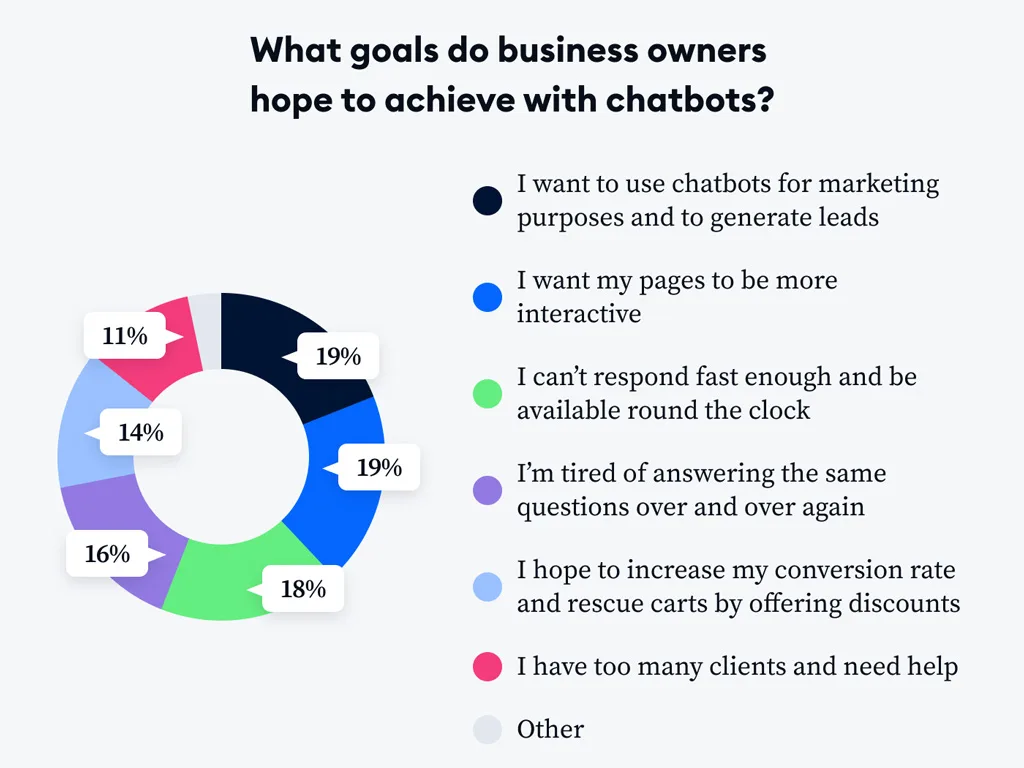
Key Goals Driving Chatbot Adoption Among Businesses
- Lead generation and marketing are the top priorities, with 19% of business owners using chatbots to attract and convert potential customers.
- An equal 19% aim to make their websites more interactive, highlighting the growing focus on enhancing user engagement.
- Around 18% of businesses adopt chatbots to ensure faster responses and 24/7 availability, improving customer experience and support efficiency.
- 16% of business owners use chatbots to handle repetitive queries, reducing manual workload and saving time for teams.
- About 14% focus on boosting conversion rates and recovering abandoned carts through discounts and automated interactions.
- 11% of respondents implement chatbots to manage high client volumes, indicating scalability as a key benefit.
- A small share (3%) falls under other use cases, suggesting niche or emerging applications beyond the main goals.
Healthcare and Telemedicine Chatbot Statistics
- The healthcare chatbot market is projected to reach $543 million by 2026, growing steadily.
- Around 60% of patients are willing to use chatbots for basic healthcare inquiries.
- Chatbots can reduce healthcare administrative costs by up to 30%.
- AI chatbots assist in symptom checking and triage for millions of users globally.
- Around 70% of healthcare organizations are exploring AI chatbot solutions.
- Chatbots reduce patient wait times by up to 40%, improving access to care.
- Telemedicine platforms use chatbots for appointment scheduling and follow-ups, enhancing efficiency.
- Mental health chatbots have seen significant growth post-2023, supporting user engagement.
- Healthcare providers use chatbots for medication reminders and chronic disease management.
Customer Service and Support Chatbot Statistics
- Chatbots can handle up to 80% of routine customer service inquiries, reducing workload.
- Businesses report up to 90% faster response times with chatbot integration.
- Around 69% of customers prefer chatbots for quick communication with brands.
- Chatbots help reduce support costs by 30%–40%, depending on implementation.
- About 64% of businesses say chatbots allow them to deliver more personalized support.
- Chatbots operate 24/7, eliminating downtime in customer service operations.
- Around 50% of companies plan to increase chatbot investments in customer service.
- AI chatbots improve first-response resolution rates significantly, reducing escalations.
- Enterprises use chatbots internally for IT and HR support, improving employee productivity and satisfaction.
Cost Savings from Chatbot Implementations
- Businesses can save up to $11 billion annually through chatbot automation across industries.
- The U.S. market alone could see $23 billion in savings from chatbots, especially in customer service.
- Chatbots reduce customer service costs by 30%–40%, depending on deployment scale.
- Businesses report saving 2.5 billion hours of labor annually using chatbots.
- Companies achieve an ROI as high as 200% within the first year of chatbot implementation.
- Chatbots reduce support staffing needs while maintaining service levels.
- Automation enables companies to scale customer interactions without proportional cost increases.
- Chatbots improve efficiency in lead generation and sales, lowering acquisition costs.
- Enterprises increasingly reinvest chatbot savings into AI and automation initiatives, accelerating digital transformation.
Frequently Asked Questions (FAQs)
What is the global chatbot market size in 2026?
How many people worldwide use chatbots today?
What percentage of businesses use or plan to use chatbots?
What is the average ROI from chatbot investments?
What share of the chatbot market does ChatGPT hold in 2026?
Conclusion
Chatbots have firmly established themselves as a cornerstone of modern digital interaction, reshaping how businesses communicate with customers and manage operations. The statistics clearly show measurable benefits, including faster response times, reduced operational costs, and improved customer satisfaction across industries such as ecommerce, banking, healthcare, and SaaS. As AI capabilities continue to advance, chatbots are no longer limited to handling basic queries but are increasingly capable of managing complex workflows, delivering personalized recommendations, and supporting decision-making processes.
Looking ahead, the role of chatbots will expand even further as generative AI enhances their ability to understand context, emotions, and intent. Businesses that invest in chatbot technology today position themselves to scale efficiently, meet rising customer expectations, and maintain a competitive edge in an increasingly automated digital landscape.

Leave a comment
Have something to say about this article? Add your comment and start the discussion.