



Quick commerce, often called q-commerce, is transforming how consumers access everyday essentials by enabling ultra-fast deliveries, often within minutes. From last-minute grocery needs to urgent medicine purchases, this model supports time-sensitive buying behavior that traditional retail and even standard e-commerce cannot match. Retailers leverage quick commerce to increase order frequency and capture impulse demand, while consumers benefit from convenience, speed, and real-time availability.
As urban lifestyles become busier and digital adoption rises, quick commerce continues to reshape supply chains, logistics infrastructure, and consumer expectations. The growing network of dark stores, advancements in last-mile delivery, and expansion into new product categories further highlight its rapid evolution. Let’s explore the latest quick commerce statistics and uncover the key trends shaping this high-growth industry.
Editor’s Choice
- The global quick commerce market reached $73.93 billion in 2024 and continues to expand rapidly.
- The market is projected to hit $161.93 billion in 2026, growing at a 24.8% CAGR.
- Global revenues climbed from $142.4 billion in 2023 to $170.8 billion in 2024.
- Deliveries typically occur within 10–30 minutes, setting a new retail benchmark.
- Around 77% of consumers expect delivery within two hours, highlighting rising expectations.
- India’s quick commerce market reached roughly $6–7 billion GMV in 2024.
- The industry is projected to grow nearly 7.8x by 2032, reaching over $582 billion globally.
Recent Developments
- India’s quick commerce sector grew to about ₹65,645 crore (~$7.4 billion) by FY2025, a 24x rise since 2022.
- Quick commerce now contributes over two-thirds of all e-grocery orders in India.
- The sector accounts for roughly 10% of total e-retail spending in India.
- Zepto reported ~150% year-over-year revenue growth in FY2025.
- JioMart reached 1.6 million daily orders in 2025, growing over 360% YoY.
- Quick commerce platforms captured 12% of festive online sales in 2025, up from 8% the previous year.
- Blinkit and competitors are expanding aggressively with hundreds of new dark stores annually.
- The sector created over 400,000 jobs in India, driven by delivery and warehouse expansion.
- Platforms now offer 45,000+ SKUs, including electronics and apparel, beyond groceries.
Global Quick Commerce Overview
- The global market was valued at $94.6 billion in 2024, showing strong demand.
- It is expected to exceed $123.8 billion in 2025, driven by urban demand.
- North America held a 33.43% market share in 2025.
- China is projected to generate over $102 billion in revenue by 2026.
- India is among the fastest-growing markets with a 17% growth rate in 2025.
- GCC markets are expanding at 30.2% CAGR between 2025–2033.
- The US market is expected to reach $8.78 billion in 2025.
- Quick commerce penetration continues rising due to smartphone adoption and urban density.
- Average delivery times globally remain under 30 minutes, shaping consumer expectations.
Quick Commerce Market Growth Insights
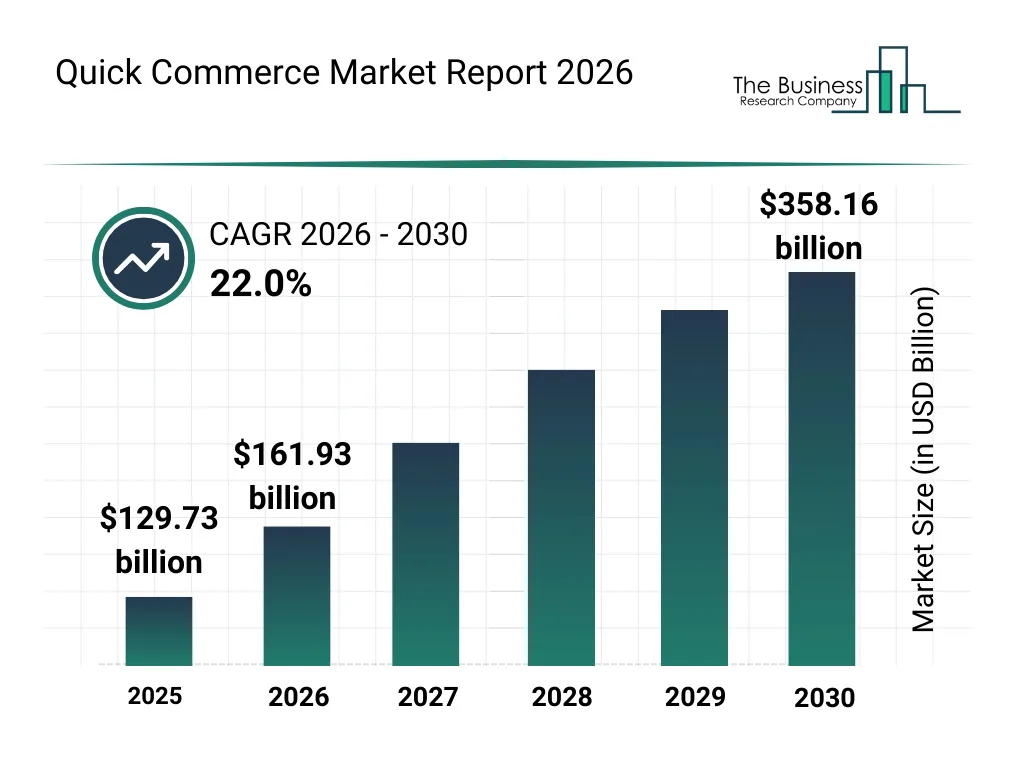
- The global quick commerce market is projected to grow from $129.73 billion in 2025 to $358.16 billion by 2030, highlighting massive expansion.
- The market is expected to register a strong CAGR of 22.0% between 2026 and 2030, indicating rapid industry acceleration.
- In 2026, the market size reaches $161.93 billion, marking a significant year-over-year increase.
- By 2027, the market is estimated to cross approximately $200 billion, signaling strong early-stage growth momentum.
- The market continues its upward trajectory, reaching around $250 billion in 2028, driven by rising demand for instant deliveries.
- In 2029, the market is projected to approach $300 billion, reflecting increased adoption across urban and emerging markets.
- The jump from $129.73 billion (2025) to $358.16 billion (2030) represents nearly a 2.7x growth within five years.
- This sustained growth is fueled by factors such as increasing smartphone penetration, changing consumer behavior, and demand for ultra-fast delivery services.
Quick Commerce vs Traditional E-Commerce
- Quick commerce delivery times average 10–30 minutes, compared to 1–3 days in traditional e-commerce.
- Around 77% of users prefer faster delivery over lower prices.
- Traditional e-commerce growth slowed to 10–12% in 2024, while q-commerce grows faster.
- Quick commerce focuses on high-frequency, low-value orders, unlike bulk purchases in e-commerce.
- Q-commerce contributes 20% of India’s e-commerce sector, indicating rapid adoption.
- Average basket sizes are smaller, but order frequency is significantly higher.
- Traditional models rely on warehouses, while q-commerce uses localized dark stores for speed.
- Customer expectations for immediacy continue to shift retail toward on-demand fulfillment models.
Quick Commerce CAGR and Future Projections
- The global quick commerce market is expected to grow at a 24.8% CAGR between 2024 and 2028.
- Some forecasts estimate a compound annual growth rate above 27% through 2030, reflecting strong investor interest.
- The market could reach over $582 billion by 2032, nearly 7–8x growth from 2024 levels.
- Long-term projections suggest a $1.3 trillion market by 2035, driven by urban expansion.
- Asia-Pacific is forecast to grow at a CAGR exceeding 30%, outpacing global averages.
- The US market is expected to grow at over 19% CAGR through 2030, supported by last-mile innovation.
- India’s quick commerce sector may expand at over 40% CAGR between 2024 and 2028, among the fastest globally.
- By 2030, quick commerce could account for 20–25% of total e-grocery sales globally.
- Investment in automation and AI logistics is projected to increase operational efficiency by 30–40% by 2030.
Quick Commerce Revenue Growth
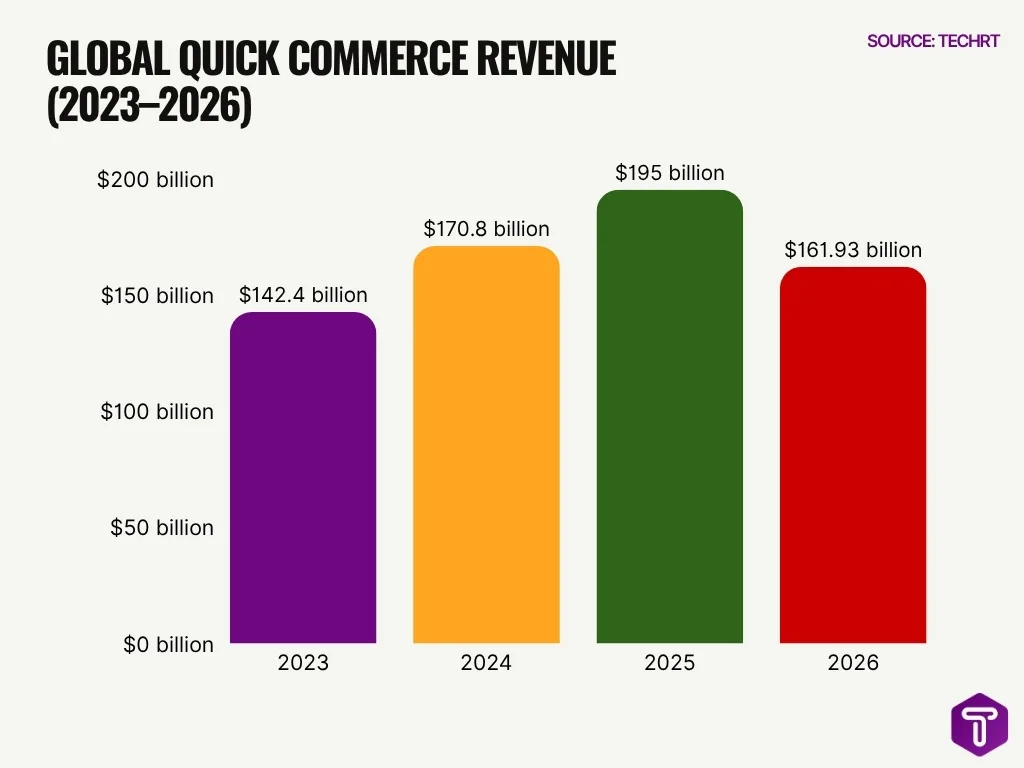
- Global revenue increased from $142.4 billion in 2023 to $170.8 billion in 2024.
- Revenue is expected to reach $195 billion in 2025.
- The market is projected to grow to $161.93 billion in 2026.
- India’s q-commerce gross order value reached ₹64,000 crore in FY2025.
- Instamart recorded 113% YoY revenue growth in FY2025.
- Zepto achieved 150% revenue growth, signaling aggressive expansion.
- The Indian market is projected to triple by 2028, driven by demand.
- Revenue growth is fueled by higher order frequency and expanded product categories.
Regional Quick Commerce Market Breakdown
- North America held approximately 33% of the global market share in 2025.
- Europe accounts for nearly 25% of global quick commerce revenue, led by the UK and Germany.
- Asia-Pacific is the fastest-growing region with over 35% market share by 2026.
- China alone is projected to generate over $100 billion in quick commerce revenue by 2026.
- India contributes roughly 5–7% of the global quick commerce market, but growth remains steep.
- The Middle East quick commerce market is expected to grow at 30%+ CAGR through 2033.
- Latin America is seeing growth rates above 20% annually, especially in Brazil and Mexico.
- Urban penetration in developed markets exceeds 60% of online grocery users, reflecting maturity.
- Regional growth correlates strongly with smartphone penetration above 70%.
Quick Commerce Market Size in India
- India’s quick commerce market reached approximately $6–7 billion in 2024.
- The market is projected to hit $40–45 billion by 2030, showing exponential growth.
- Gross merchandise value (GMV) crossed ₹64,000 crore in FY2025.
- Quick commerce accounts for nearly two-thirds of India’s e-grocery orders in 2025.
- The sector contributes around 20% of India’s total e-commerce market.
- India’s top cities account for over 80% of q-commerce demand, led by metro regions.
- The number of dark stores in India surpassed 3,000 locations in 2025.
- The sector generated 400,000+ jobs, including delivery and logistics roles.
- Tier-2 and Tier-3 cities are expected to contribute 30–35% of growth by 2027.
India Quick Commerce User Growth Insights
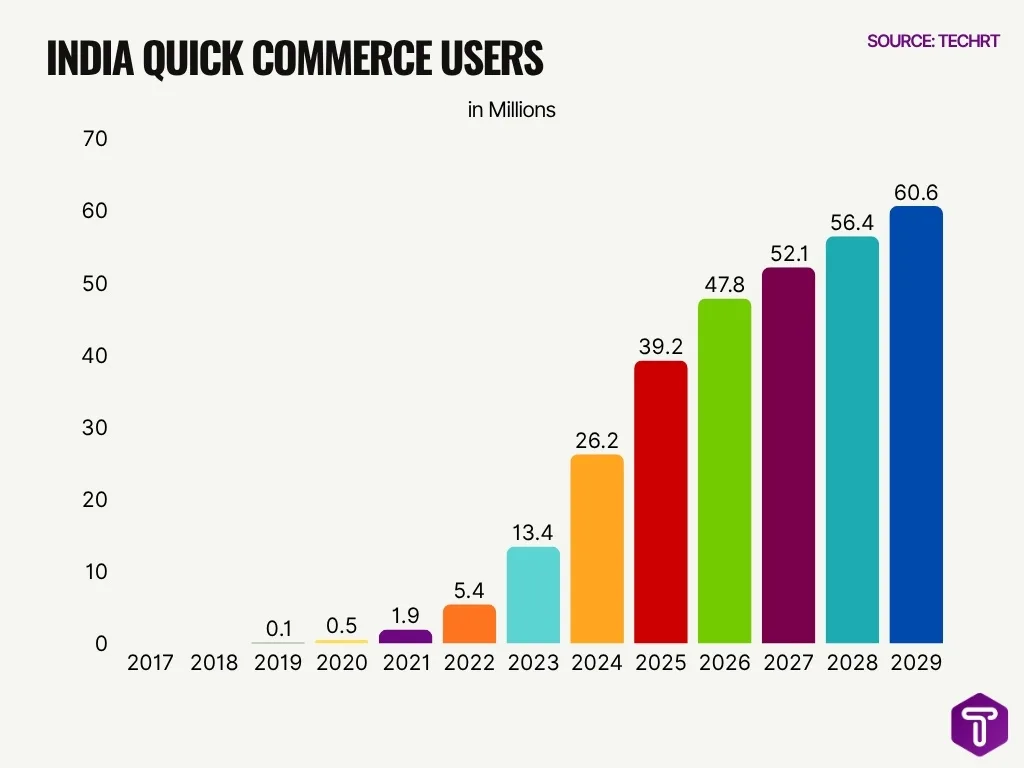
- The number of quick commerce users in India has surged from virtually 0 million in 2017–2018 to an estimated 60.6 million by 2029, reflecting a massive adoption curve.
- Early-stage growth remained minimal, with just 0.1 million users in 2019 and 0.5 million in 2020, indicating the nascent phase of the market.
- A significant breakout began post-2021, as users jumped from 1.9 million (2021) to 5.4 million (2022), marking the start of rapid expansion.
- The market experienced explosive growth between 2022 and 2025, with users increasing from 5.4 million to 39.2 million, a nearly 7x growth in just three years.
- By 2024, the user base reached 26.2 million, highlighting quick commerce’s mainstream penetration in urban India.
- Growth remains strong but starts to moderate after 2025, rising from 39.2 million (2025) to 60.6 million (2029), indicating a shift from hyper-growth to steady scaling.
- The addition of over 21 million new users between 2025 and 2029 shows continued market expansion and deeper adoption.
- The sharp rise reflects increasing consumer demand for instant delivery, driven by convenience, urbanization, and digital adoption.
- Overall, the data highlights India as one of the fastest-growing quick commerce markets globally, with strong long-term growth potential.
Quick Commerce User Statistics Worldwide
- The number of quick commerce users globally exceeded 400 million in 2025.
- User penetration is expected to reach 8–10% of the global population by 2026.
- Around 55% of urban consumers have used a quick commerce platform at least once.
- The US alone is projected to have 70+ million q-commerce users by 2026.
- India’s user base crossed 100 million users in 2025, growing rapidly.
- Over 65% of users are repeat customers, indicating strong retention.
- Mobile apps drive over 90% of quick commerce orders globally.
- Millennials and Gen Z make up over 70% of total users, reflecting digital-first adoption.
- Average user growth rates remain above 20% annually across emerging markets.
Demographics of Quick Commerce Users
- Gen Z and millennials form over 70% of global quick commerce users.
- Around 60% of quick commerce users are aged 18–35, showing strong youth dominance.
- Urban consumers account for over 80% of total q‑commerce users worldwide.
- Dual‑income households are 2x more likely to use quick commerce than single‑income ones.
- Male users represent roughly 55% of total quick commerce users globally.
- Students and young professionals make up over 45% of frequent quick commerce users.
- High‑income households contribute 40%+ of total quick commerce order value.
- Suburban areas have seen 25–30% user growth in quick commerce over the last year.
- Women‑led households show higher grocery order frequency on quick‑commerce platforms.
Quick Commerce Usage Trends by Age & Gender
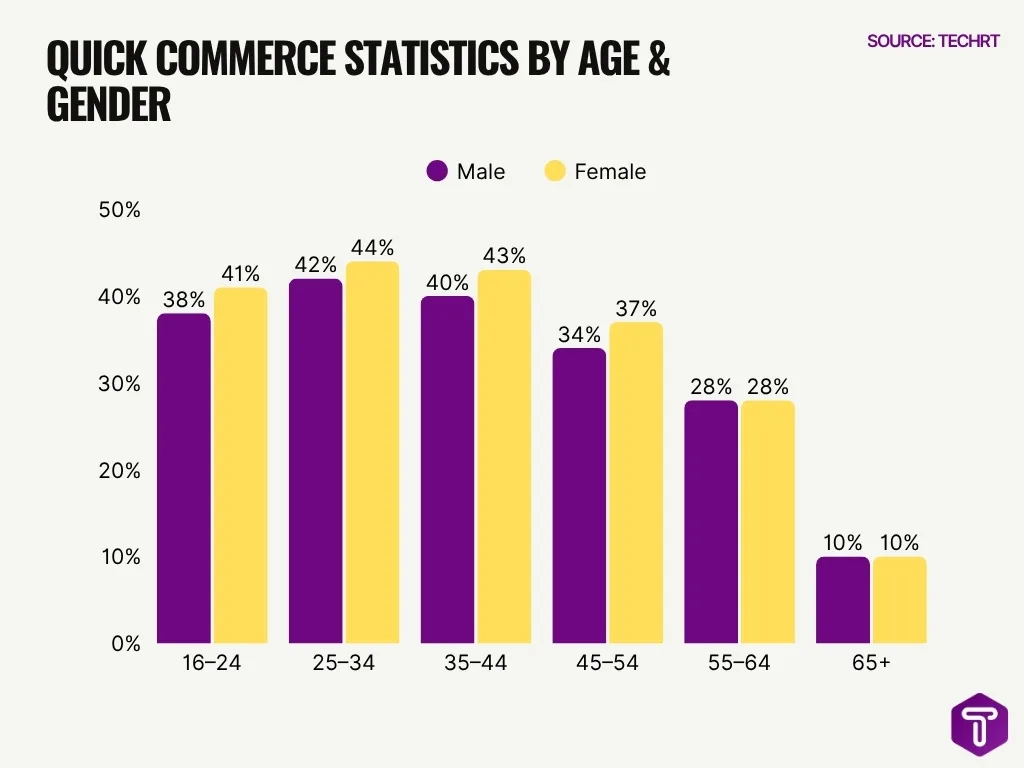
- The highest usage of quick commerce is observed in the 25–34 age group, with 44% of females and 42% of males actively using these services.
- Young adults (16–24) also show strong adoption, with 41% females and 38% males, highlighting early digital adoption trends.
- In the 35–44 segment, usage remains high at 43% for females and 40% for males, indicating sustained engagement among mid-age consumers.
- A gradual decline begins from the 45–54 group, dropping to 37% (female) and 34% (male).
- Usage further decreases in the 55–64 category, where both genders converge at around 28%, showing reduced reliance on quick commerce.
- The lowest adoption is seen among 65+ users, with only ~10% participation from both males and females.
- Across all age groups, female users consistently show slightly higher usage rates than males, indicating stronger engagement.
- The data clearly highlights that quick commerce is predominantly driven by younger demographics, with usage sharply declining as age increases.
Consumer Behavior in Quick Commerce
- Around 77% of consumers prioritize faster delivery over price discounts.
- Over 60% of users place orders for urgent or last-minute needs.
- Impulse purchases account for 30–40% of quick commerce orders.
- Nearly 50% of users shop multiple times per week, indicating high engagement.
- Convenience remains the top factor for over 80% of users.
- Subscription programs increase retention by 20–25%.
- Average browsing-to-purchase conversion rates exceed 10–15%, higher than traditional e-commerce.
- Consumers prefer localized assortments, improving satisfaction and repeat purchases.
- Discounts influence about 35% of purchasing decisions, but speed still dominates.
Order Frequency and Average Order Value
- Average order frequency ranges between 3–5 orders per week per active user.
- The average order value (AOV) globally ranges from $10 to $25, depending on the region.
- In India, AOV typically falls between ₹350–₹550 per order.
- High-frequency users place over 15–20 orders per month.
- Grocery orders account for over 60% of total order volume, influencing AOV.
- Promotional campaigns can increase AOV by 10–20% temporarily.
- Peak ordering times occur during evenings and weekends, accounting for 50%+ of orders.
- Basket sizes remain 30–50% smaller than traditional e-commerce, but frequency compensates.
- Subscription users show higher AOV and frequency by 25%, improving platform economics.
Product Categories Sold via Quick Commerce
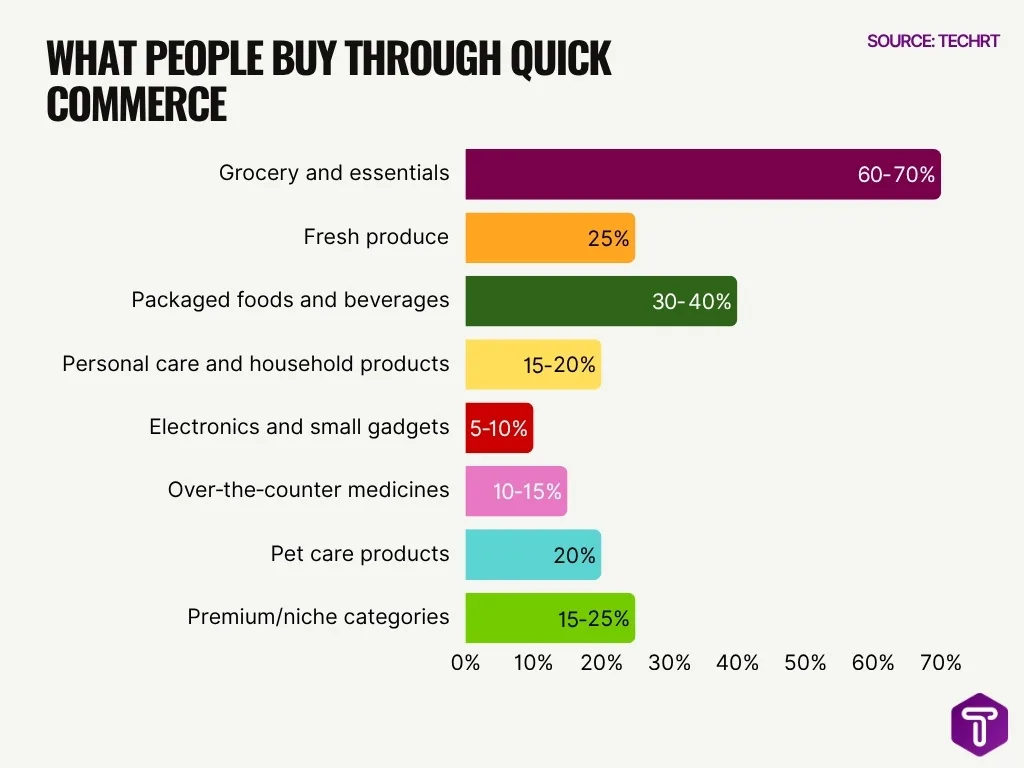
- Grocery and essentials account for over 60–70% of total quick commerce orders globally.
- Fresh produce contributes nearly 25% of grocery orders, driven by daily consumption needs.
- Packaged foods and beverages make up 30–40% of product volume, reflecting impulse buying.
- Personal care and household products represent 15–20% of sales.
- Electronics and small gadgets have grown to 5–10% of catalog share on leading platforms.
- Over-the-counter medicines account for 10–15% of orders in urban markets, especially in emergencies.
- Ready-to-eat meals and snacks drive high-frequency purchases, contributing to repeat orders.
- Pet care products have seen 20%+ annual growth, especially in North America.
- Premium and niche categories, including organic and gourmet foods, are growing at 15–25% annually.
Drivers of Quick Commerce Growth
- Rising urbanization has pushed over 56% of the global population into cities, increasing demand for faster delivery.
- Smartphone penetration exceeded 70% globally, enabling mobile-first ordering.
- Consumers now expect delivery within 1–2 hours or less, accelerating q-commerce adoption.
- Venture capital funding in quick commerce crossed $10 billion globally between 2021–2025.
- Improved last-mile logistics reduced delivery costs by 15–20% over the past three years.
- Dark store networks increased fulfillment efficiency by 30–40%.
- Subscription models improved customer retention by 20–25%.
- Expansion into non-grocery categories boosted average revenue per user by 10–15%.
- Same-day delivery expectations now influence over 65% of online purchase decisions.
Fulfillment and Dark Store Network Statistics
- Quick commerce platforms operate thousands of dark stores globally, with India alone exceeding 3,000 locations.
- Average dark store size ranges between 2,000–5,000 square feet, optimized for speed.
- Delivery radii typically cover 1.5 to 3 miles, enabling faster fulfillment.
- Orders are picked and packed within 2–5 minutes, reducing total delivery time.
- Automation in warehouses improves picking efficiency by 20–30%.
- Dark store density in metro cities has increased by 50%+ between 2023 and 2025.
- Delivery partners complete 20–30 orders per shift on average, depending on location.
- Fulfillment accuracy rates exceed 95%, critical for customer retention.
- Micro-fulfillment centers reduce last-mile delivery costs by up to 25%.
Unit Economics and Profitability Metrics
- Contribution margins remain negative for many players, averaging -5% to -15% per order in early stages.
- Mature markets have improved margins to 2–5% profitability per order.
- Delivery costs account for 40–50% of total operational expenses.
- Customer acquisition costs (CAC) range between $10–$25 per user globally.
- Repeat customers contribute over 65% of total revenue, improving profitability.
- Subscription models reduce CAC by 20–30% over time.
- Average gross margins for grocery items remain low at 10–15%, challenging profitability.
- Advertising and brand partnerships contribute 5–10% of platform revenue.
- Order batching and route optimization can improve margins by 10–15%.
India’s Quick Commerce Market Share
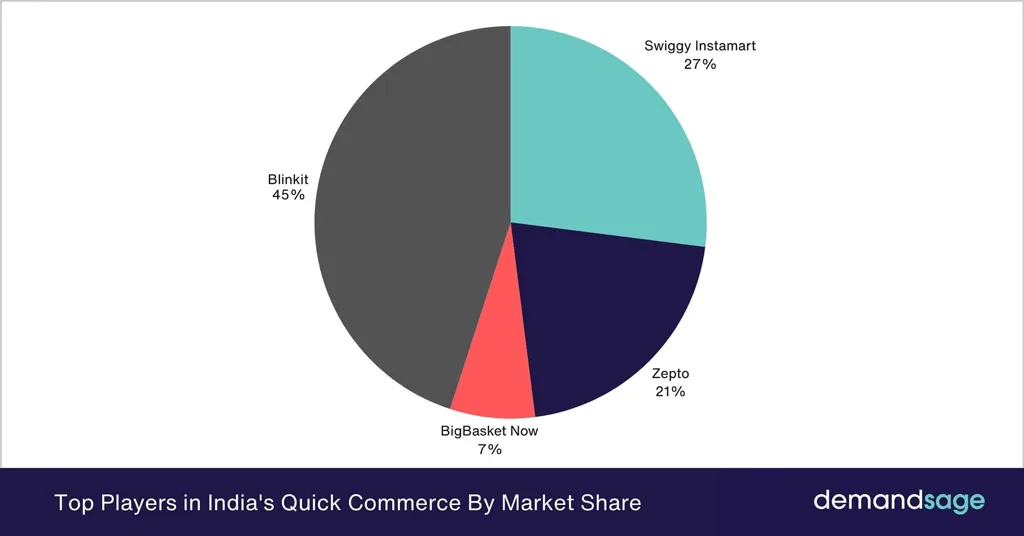
- Blinkit dominates the market with a commanding 45% share, making it the clear market leader in India’s quick commerce space.
- Swiggy Instamart holds the second position with 27% market share, indicating strong competition but still significantly behind Blinkit.
- Zepto captures 21% share, positioning itself as a fast-growing challenger brand in the industry.
- BigBasket lags with just 7% market share, highlighting its relatively smaller presence in the quick commerce segment.
- The top 3 players (Blinkit, Swiggy Instamart, Zepto) collectively control a massive 93% of the market, showing high market concentration.
- There is a sharp gap of 18 percentage points between Blinkit (45%) and Swiggy Instamart (27%), reinforcing Blinkit’s leadership.
- The market shows a duopoly-like competition at the top, with Blinkit and Swiggy Instamart together accounting for 72% share.
- Smaller players like BigBasket face intense competition, with a limited share in a highly consolidated market.
Major Quick Commerce Players and Market Share
- In India, Blinkit, Zepto, and Swiggy Instamart collectively hold over 80% market share.
- Blinkit leads with approximately 40% market share in India.
- Zepto holds around a 25–30% share, growing rapidly in metro cities.
- Swiggy Instamart contributes 20–25% of the Indian market.
- In Europe, Getir and Gorillas dominate with a combined 30%+ market share.
- The US market includes players like Gopuff, which generated over $1 billion in annual revenue.
- DoorDash and Uber Eats are expanding into quick commerce with double-digit growth in convenience deliveries.
- Alibaba and Meituan dominate China, controlling over 60% of the market.
- Global competition continues to intensify, with new entrants launching in emerging markets annually.
Challenges and Future Outlook
- In many e-commerce and quick-commerce models, last-mile delivery accounts for around 50% of total logistics/shipping costs, making it the single largest operational expense driver.
- Average per-order handling and delivery add-ons in Indian quick commerce can reach ₹40–₹50 extra per order, further inflating operational cost structures.
- Quick commerce typically operates with low or negative margins, as high warehousing and manpower costs mean losses are “essentially inherent from the start” in the early years.
- Even large platforms report that heavy subsidies and logistics expenses from quick-commerce are the primary factor squeezing profitability and depressing EBITA in the short term.
- Growing dependence on gig workers comes with rising regulatory and worker-relations risks, with reports noting structural pressure from the model’s reliance on gig labour and limited pricing power.
- Consumers show rising expectations for ultra-fast delivery (10–30 minutes), but meeting these promises requires significantly higher last-mile delivery costs versus next‑day options.
- Misaligned pricing and discounting mean quick commerce sales are often 92–93% cannibalized from existing channels, with just 6–8% truly incremental, intensifying competition and margin pressure.
- In last‑mile operations, 5–10% or more of costs can stem from failed or inefficient deliveries (returns, re‑attempts), aggravating wastage issues in categories like perishables.
- AI-powered logistics and supply-chain optimization can cut operational costs by 25–40% and improve overall efficiency by 35–50%, pointing to substantial automation-led upside over the next decade.
- Route optimization alone can reduce transportation expenses by about 22%, while broader AI and automation in logistics can deliver 40–50% cost savings and faster networks, favouring stronger players by 2030.
Frequently Asked Questions (FAQs)
What is the global quick commerce market size in 2026?
What is the projected CAGR of the quick commerce market through 2035?
How large was the global quick commerce market in 2025?
What share of online grocery orders does quick commerce hold in India?
What is the projected global quick commerce market value by 2032?
Conclusion
Quick commerce has evolved into a critical component of the modern retail ecosystem, driven by the need for speed, convenience, and flexibility. It has redefined how consumers shop for daily essentials, shifting preferences toward smaller, more frequent purchases delivered almost instantly. While the sector continues to face challenges such as high operational costs, profitability pressures, and regulatory complexities, ongoing investments in technology, automation, and logistics are steadily improving efficiency. At the same time, expanding product assortments and deeper penetration into non-metro regions are unlocking new growth opportunities.
As competition intensifies and market consolidation begins, only the most efficient and customer-focused players are likely to succeed. Looking ahead, quick commerce will not just complement traditional e-commerce but may fundamentally reshape consumer expectations around delivery speed and convenience, making immediacy a standard rather than a premium feature.

Leave a comment
Have something to say about this article? Add your comment and start the discussion.