




Mobile commerce has shifted from a secondary channel to the primary way consumers interact with brands and retailers. Today, shoppers rely on smartphones not only to browse products but also to compare prices, read reviews, and complete purchases within seconds. Whether someone orders groceries through a delivery app, books travel on their phone, or buys directly through social media platforms, mobile has become deeply embedded in everyday commerce behavior.
At the same time, businesses across retail, fintech, and digital services have adapted quickly. Companies now design mobile-first websites, invest in app experiences, and streamline checkout with digital wallets and one-click payments. This shift has not only improved convenience but also accelerated purchase decisions and increased customer engagement across multiple touchpoints. As mobile technology continues to evolve with innovations like 5G, AR, and AI-driven personalization, its role in shaping global commerce will only expand.
In this article, we break down the latest mobile commerce statistics for 2026, covering market size, user behavior, technology trends, and regional insights to help you understand where the industry stands today and where it is heading next.
Editor’s Choice
- Global mobile commerce sales reached $2.51 trillion in 2025, up from $2.07 trillion in 2024.
- Mobile commerce is projected to account for ~60% of global ecommerce sales by 2026.
- In the U.S., mobile commerce sales are expected to hit $647.95 billion in 2025, rising from $564 billion in 2024.
- Mobile devices generated 75–78% of ecommerce traffic globally in 2025.
- Around 76% of U.S. adults have purchased via smartphone, showing widespread adoption.
- Mobile commerce accounts for 44.6% of U.S. ecommerce sales in 2024, with continued growth expected.
- Globally, about 1.65 billion people shopped via mobile devices in 2025.
Recent Developments
- Mobile commerce surpassed $2.2 trillion globally in 2023, showing steady year-over-year expansion.
- By 2025, mobile commerce reached $2.51 trillion, reflecting strong post-pandemic growth.
- Global mobile commerce revenue is projected to reach $2.74 trillion in 2026.
- Mobile commerce growth rate rebounded to 21%+ in 2024–2025 after slower growth in 2022.
- Smartphones now drive 69% of global online shopping orders, compared to 30% from desktops.
- Holiday 2025 data shows mobile accounted for 56.4% of total online sales, up from 54.5% in 2024.
- Mobile exceeded 61.6% of sales on Thanksgiving 2025, marking a key milestone.
- Buy Now, Pay Later (BNPL) purchases were 82.2% mobile-driven during the 2025 holiday season.
Global Mobile Commerce Overview
- Mobile commerce accounted for 57% of global ecommerce sales in 2024, rising to ~60% in 2025–2026.
- Global ecommerce sales reached $6.86 trillion in 2025, with mobile contributing a major share.
- Smartphones generate 77% of retail website traffic worldwide, highlighting mobile dominance.
- Mobile commerce has grown more than 4x since 2017, driven by smartphone adoption.
- Asia-Pacific contributes over 55% of global mobile commerce revenue, leading the market.
- Around 30% of the global digital population shops via mobile devices.
- Smartphones account for 68% of retail orders globally, reinforcing mobile-first behavior.
- Mobile commerce has grown 3x faster than desktop ecommerce since 2019.
Global Mobile Commerce Sales Trends and Growth Insights
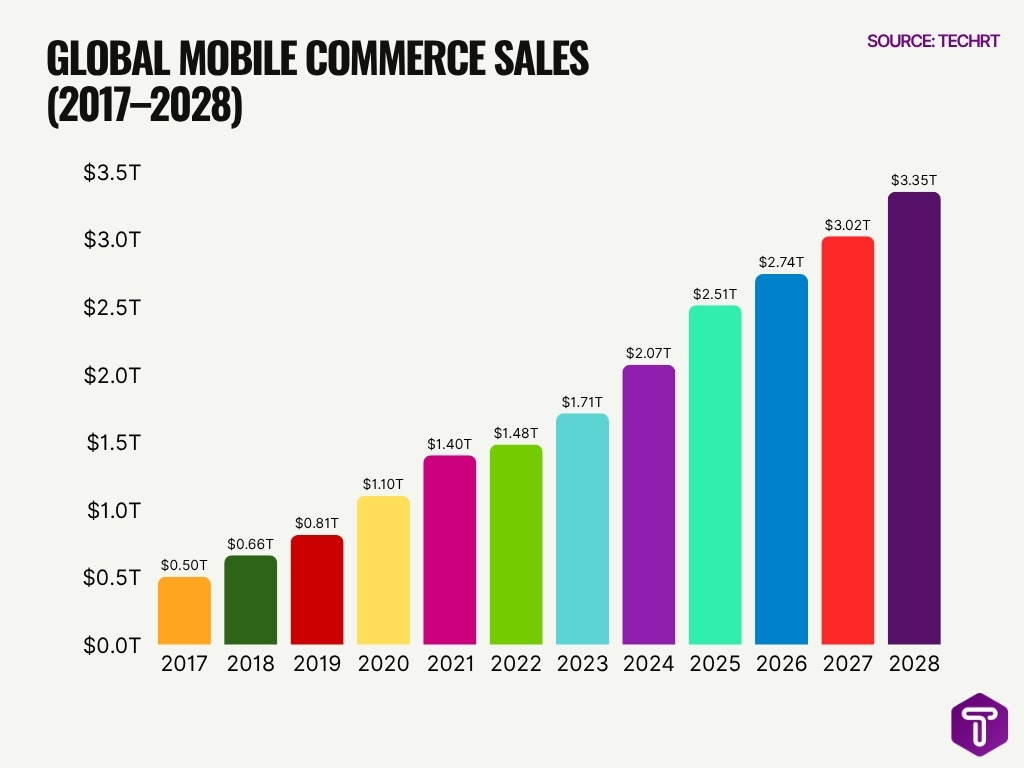
- Global mobile commerce sales surged from $0.50 trillion in 2017 to a projected $3.35 trillion by 2028, reflecting massive long-term expansion.
- The market experienced its fastest early growth in 2020 with +35.8% YoY, driven largely by pandemic-induced digital adoption.
- Strong double-digit growth continued through 2021 (+27.3%), signaling sustained momentum beyond initial spikes.
- Growth slowed significantly in 2022 to just +5.7%, indicating a temporary stabilization phase after rapid expansion.
- The market rebounded in 2023 with +15.5% growth, showing renewed consumer demand and mobile adoption.
- Mobile commerce is expected to cross the $2 trillion mark in 2024, reaching approximately $2.07 trillion.
- Continued acceleration is projected through 2025 ($2.51T, +21.3%), highlighting strong future confidence in mobile shopping.
- Growth is expected to moderate post-2025, with rates stabilizing around 9–11% annually between 2026 and 2028.
- By 2027, global mobile commerce sales are forecast to exceed $3 trillion, a key industry milestone.
- Overall, the data indicate a transition from hyper-growth (2018–2021) to a more mature, stable growth phase (2026 onward).
- The consistent upward trajectory underscores mobile’s dominance as a primary ecommerce channel globally.
Mobile Commerce Growth and Market Size
- The global mobile commerce market was valued at $2.24 trillion in 2025.
- It is expected to reach $2.41 trillion in 2026, showing steady expansion.
- By 2034, the market could exceed $5 trillion, with a CAGR of 9.5%.
- Mobile commerce sales are projected to reach $3.35 trillion by 2028.
- U.S. mobile commerce is expected to grow from $564B in 2024 to $744B by 2026.
- Mobile commerce nearly tripled in the U.S. from $221B in 2019 to $564B in 2024.
- Global mobile commerce grew 16.3% from 2023 to 2025, reflecting strong demand.
- The market continues to expand due to rising smartphone penetration and digital payments adoption.
Mobile Commerce Share of Ecommerce and Retail Sales
- Mobile commerce accounts for 59% of global ecommerce sales in 2025.
- This share is expected to rise to 63% by 2028, indicating continued dominance.
- In 2024, mobile represented 44.6% of U.S. ecommerce sales, up from 42.4% in 2023.
- Mobile commerce contributed 7.4% of total U.S. retail sales in 2024.
- This share is projected to reach 10.4% of total retail sales in 2025.
- Globally, mobile accounts for 57–60% of ecommerce revenue, depending on the region.
- Some estimates suggest mobile drives over 70% of all online sales globally.
- Mobile commerce is expected to account for ~46% of all online sales globally in conservative estimates.
Mobile Commerce Share by Region
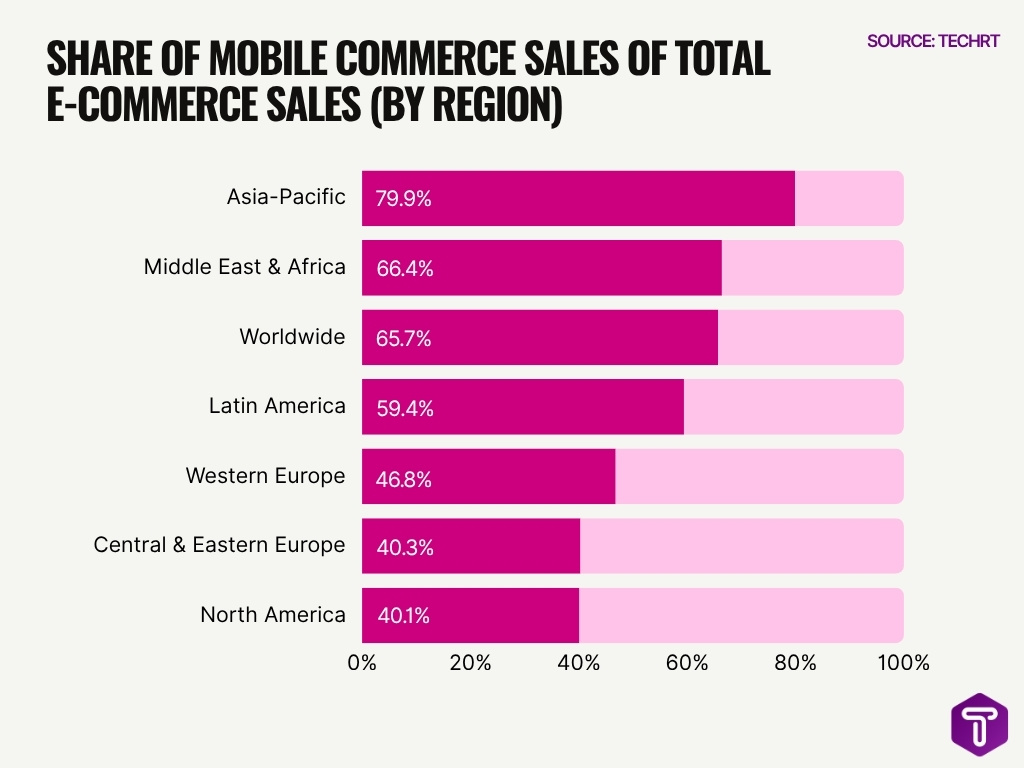
- Asia-Pacific dominates globally with an impressive 79.9% share, making it the most mobile-first e-commerce region.
- The Middle East & Africa reaches 66.4%, reflecting rapid mobile adoption and increasing smartphone penetration.
- The global average stands at 65.7%, meaning nearly two-thirds of all e-commerce sales happen via mobile devices.
- Latin America records 59.4%, highlighting strong growth driven by mobile accessibility and digital payments.
- Western Europe, at 46.8%, shows a more balanced split between mobile and desktop commerce.
- Central & Eastern Europe (40.3%) continues to lag, indicating a slower mobile transition in developing European markets.
- North America has the lowest share at 40.1%, suggesting higher reliance on desktop and multi-device shopping behavior.
- The gap between Asia-Pacific (79.9%) and North America (40.1%) exceeds 39 percentage points, showcasing major regional disparities.
- Regions with emerging economies tend to be more mobile-first, while developed markets show diversified device usage.
- Overall, mobile commerce is the dominant global channel, but adoption levels vary significantly by region and digital maturity.
Smartphone Adoption and Mobile Internet Usage
- Global smartphone users surpassed 6.9 billion in 2025, up from 6.6 billion in 2024.
- Smartphone penetration reached ~86% of the global population, signaling near saturation in key markets.
- In the U.S., about 91% of adults owned a smartphone in 2025.
- Mobile devices generate over 60% of global internet traffic, compared to ~58% in 2023.
- Users spend an average of 3 hours and 46 minutes daily on smartphones in 2025.
- Mobile internet users globally crossed 5.5 billion people in 2025.
- In emerging markets, over 70% of internet users are mobile-only, with no desktop access.
- 5G connections exceeded 2 billion globally in 2025, improving mobile commerce speed and reliability.
- Average mobile data consumption reached 21 GB per user per month globally in 2025.
Voice Search and Voice Commerce Statistics
- Over 50% of smartphone users use voice search daily in 2025.
- Voice commerce sales are projected to reach $80 billion globally by 2026.
- Around 30% of mobile users have made purchases using voice assistants.
- Smart speakers are present in over 35% of U.S. households, supporting voice shopping.
- Voice search influences ~20% of mobile purchase journeys.
- Consumers use voice primarily for product research, price comparisons, and reordering items.
- Voice-enabled shopping is growing fastest in grocery and household product categories.
- Accuracy improvements in voice recognition now exceed 95%, boosting user trust.
- Younger users (18–34) are 2x more likely to adopt voice commerce than older demographics.
Mobile Commerce Traffic & Order Share Insights
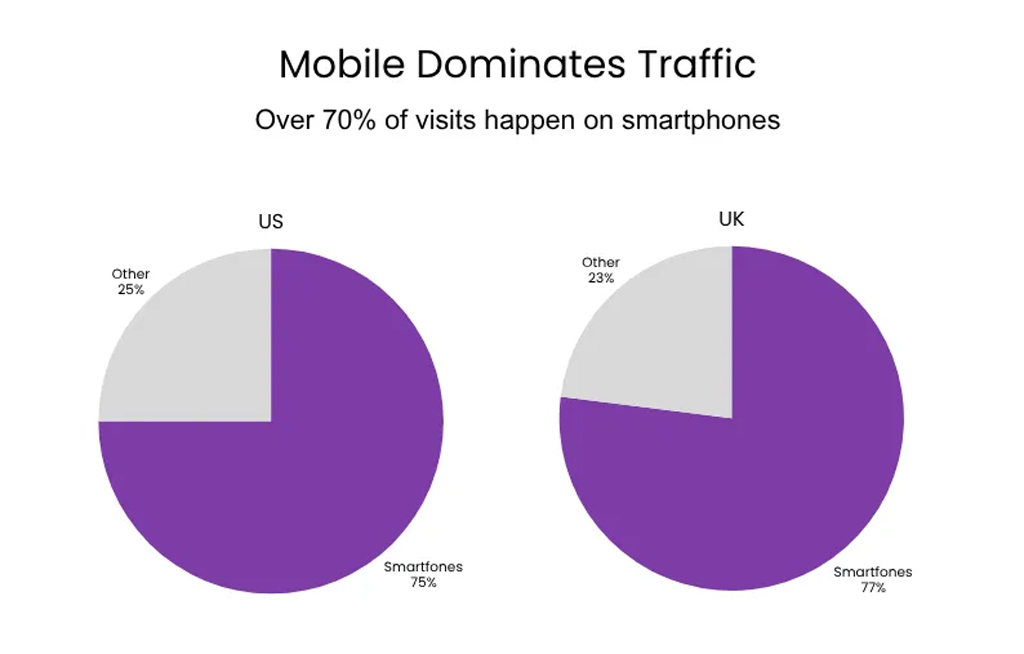
- Smartphones drive 78% of global retail site traffic, highlighting their dominance as the primary browsing device for shoppers.
- Despite higher traffic, smartphones account for 70% of online shopping orders, indicating a gap between browsing and conversion.
- The 8 percentage point difference between traffic (78%) and orders (70%) suggests potential friction in mobile checkout experiences.
- Mobile users are highly active in product discovery and research, contributing heavily to traffic volume.
- A significant portion of users still switch to desktop for completing purchases, impacting mobile conversion rates.
- Optimizing mobile UX, speed, and checkout flow can help bridge the conversion gap and increase order share.
- The data reinforces that mobile-first strategies are critical for ecommerce businesses aiming to maximize both traffic and revenue.
Mobile Commerce User Adoption and Demographics
- Around 76% of U.S. adults shop on smartphones, with higher adoption among younger users.
- Millennials and Gen Z drive over 60% of global mobile commerce transactions.
- Gen Z shoppers are 2x more likely to prefer mobile-first shopping experiences than older generations.
- About 85% of consumers aged 18–34 made at least one mobile purchase in the past year.
- Women account for ~60% of mobile shopping activity, especially in fashion and beauty categories.
- High-income households show 25–30% higher mobile spending per user, though usage rates are similar to those of other groups.
- Urban consumers are 30–40% more likely to shop via mobile than rural users.
- Mobile commerce adoption among seniors (55+) reached ~45% in 2025, up from ~30% in 2020.
- Globally, over 1.65 billion people now shop via mobile devices.
- Asia-Pacific leads mobile commerce growth, accounting for over 55% of global m-commerce sales.
In-Store and Omnichannel Mobile Shopping Behavior
- About 73% of shoppers use smartphones in-store to compare prices, read reviews, or find product details.
- Nearly 60% of consumers check their phones while shopping in physical stores.
- Mobile influences over 70% of in-store purchases, even when transactions happen offline.
- Around 46% of shoppers use retailer apps inside stores for deals and navigation.
- Click-and-collect (BOPIS) orders grew by over 20% year-over-year in 2025, driven largely by mobile usage.
- Approximately 50% of omnichannel shoppers use mobile to check product availability before visiting stores.
- Mobile coupons influence over 45% of in-store purchase decisions.
- Retailers that integrate mobile into omnichannel strategies see 30% higher customer lifetime value.
- About 35% of shoppers use mobile payments in-store, a number rising with NFC adoption.
How Mobile Shoppers Use Their Smartphones
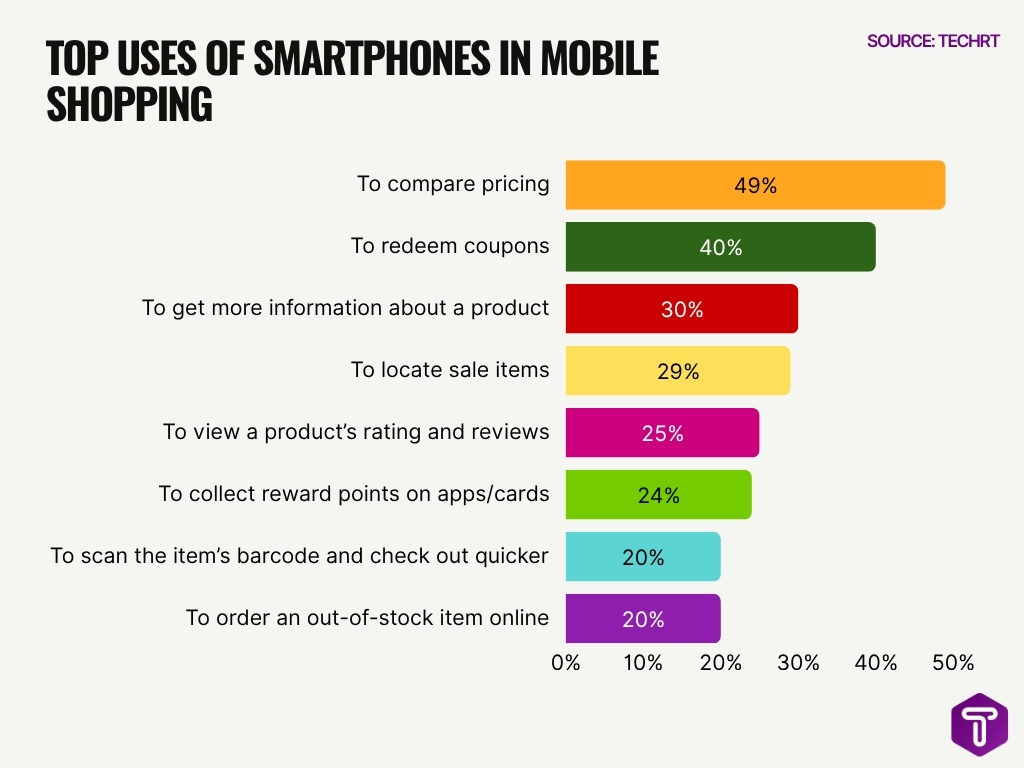
- Price comparison dominates, with 49% of mobile shoppers using their smartphones to check and compare prices before making a purchase decision.
- Coupon usage is highly prevalent, as 40% of users actively redeem discounts and promotional offers on their devices.
- Product research remains a core behavior, with 30% of shoppers seeking additional information about products while browsing.
- Deal hunting is common, with 29% of users using smartphones to locate sale items and special offers.
- Social proof influences decisions, as 25% of shoppers check ratings and reviews before buying.
- Loyalty engagement is growing, with 24% of users collecting reward points via apps or cards.
- In-store convenience features are emerging, with 20% scanning barcodes for faster checkout.
- Omnichannel shopping behavior is evident, as 20% of shoppers use smartphones to order out-of-stock items online.
Social Commerce and Mobile-Driven Purchases
- Global social commerce sales exceeded $700 billion in 2024, projected to surpass $1 trillion by 2026.
- Over 80% of social media users access platforms via mobile devices, making mobile central to social commerce.
- Platforms like Instagram and TikTok drive over 40% of mobile product discovery among Gen Z.
- Around 55% of consumers have purchased directly through social media apps.
- Mobile-driven social commerce conversion rates are 2–3x higher than traditional display ads.
- Influencer-driven purchases account for ~30% of mobile ecommerce transactions among younger audiences.
- Live shopping events on mobile platforms generate conversion rates up to 10x higher than standard ecommerce.
- Facebook and Instagram together account for over 60% of social commerce revenue globally.
- Nearly 70% of mobile shoppers say social media influences their buying decisions.
Mobile Wallets, Digital Payments, and One-Click Checkout
- Digital wallets accounted for 52.5% of global ecommerce transaction value in 2025.
- Apple Pay and Google Pay together processed around $13.9 trillion globally in 2025.
- In the U.S., 34% of consumers actively use Apple Pay, with 31.2% using digital wallets weekly in-store.
- One-click checkout boosts ecommerce conversions by up to 35%, reducing cart abandonment.
- Digital wallets cut checkout time by eliminating manual card entry, speeding transactions significantly.
- Global BNPL payments grew 13.7% to $560.1 billion in 2025, driven by mobile adoption.
- Over 70% of smartphone BNPL market revenue came from mobile devices in 2024-2025.
- Contactless payments, including mobile, are nearly 50% of U.S. in-store transactions, rising globally.
- Biometric authentication in mobile payments is set to secure over $3 trillion by 2025.
Mobile Retail App Usage Frequency Insights
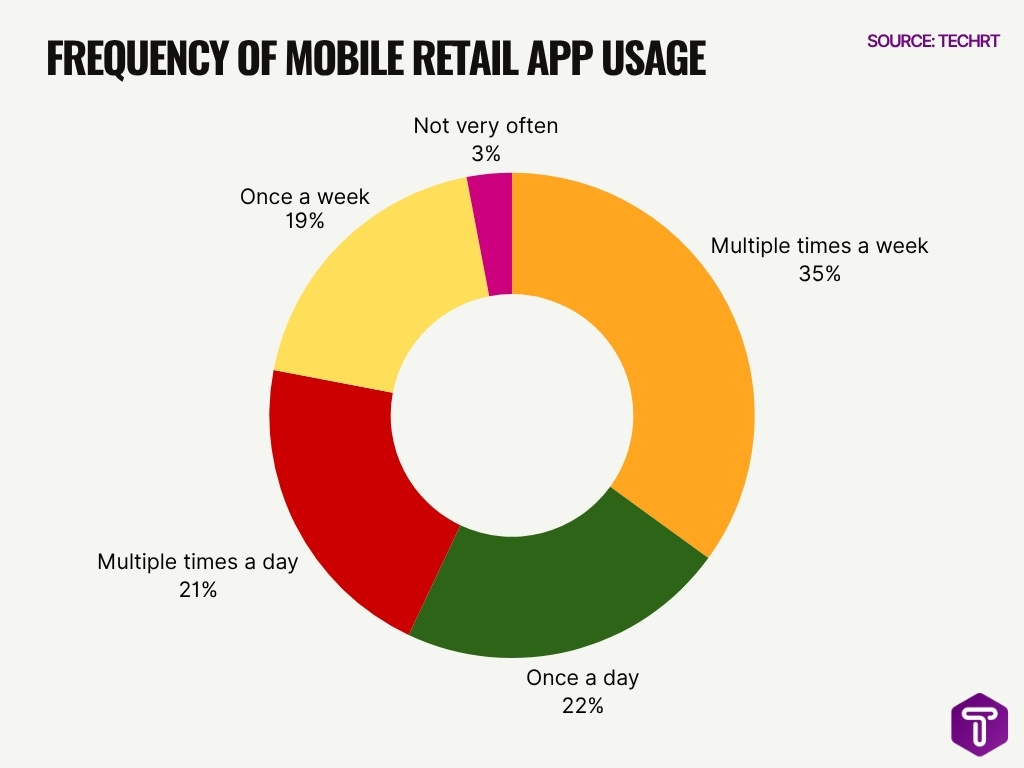
- 35% of users access retail apps multiple times a week, making it the most common usage pattern among consumers.
- A combined 43% of users engage with apps daily (22% once a day and 21% multiple times a day), highlighting strong daily engagement habits.
- 21% of users open retail apps multiple times a day, indicating a high-intent and highly engaged user segment.
- Nearly 1 in 5 users (19%) use retail apps once a week, showing a moderate but consistent interaction level.
- Only 3% of users report using retail apps not very often, suggesting very low disengagement rates overall.
- Overall, 78% of users (35% + 22% + 21%) use retail apps at least weekly or more frequently, reinforcing the dominance of mobile apps in shopping behavior.
- The data clearly indicates that mobile retail apps are deeply integrated into daily and weekly shopping routines, not just occasional tools.
- Businesses can leverage this by focusing on frequent engagement strategies like push notifications, personalized offers, and loyalty programs.
Mobile Commerce UX, Speed, and Cart Abandonment
- The average mobile cart abandonment rate is ~85%, higher than desktop at ~70%.
- 53% of users leave mobile sites that take longer than 3 seconds to load.
- Improving page load time by 1 second can increase conversions by up to 20%.
- Poor UX is responsible for over 70% of mobile cart abandonment cases.
- Simplified checkout flows reduce abandonment by up to 35%.
- Mobile users expect pages to load in under 2 seconds for optimal engagement.
- About 58% of users abandon purchases due to complicated checkout processes.
- Responsive design improvements can increase mobile conversions by 20–30%.
- Autofill and mobile-friendly forms improve checkout completion rates by up to 30%.
Augmented Reality and Other Emerging Tech in Mobile Shopping
- Over 100 million consumers used AR for shopping in 2025.
- AR-powered product visualization increases conversion rates by up to 40%.
- Around 71% of consumers say they would shop more often if AR were available.
- Retailers using AR report 94% higher engagement rates compared to non-AR experiences.
- Virtual try-on features are widely used in fashion, beauty, and furniture categories.
- AI-driven recommendations increase mobile sales by up to 30%.
- Chatbots and conversational commerce tools handle ~70% of customer queries in mobile environments.
- 3D product views improve purchase confidence by over 50%.
- Progressive Web Apps (PWAs) improve mobile engagement and conversions by 20–36%.
Mobile Commerce Completion: Apps vs Browsers Insights
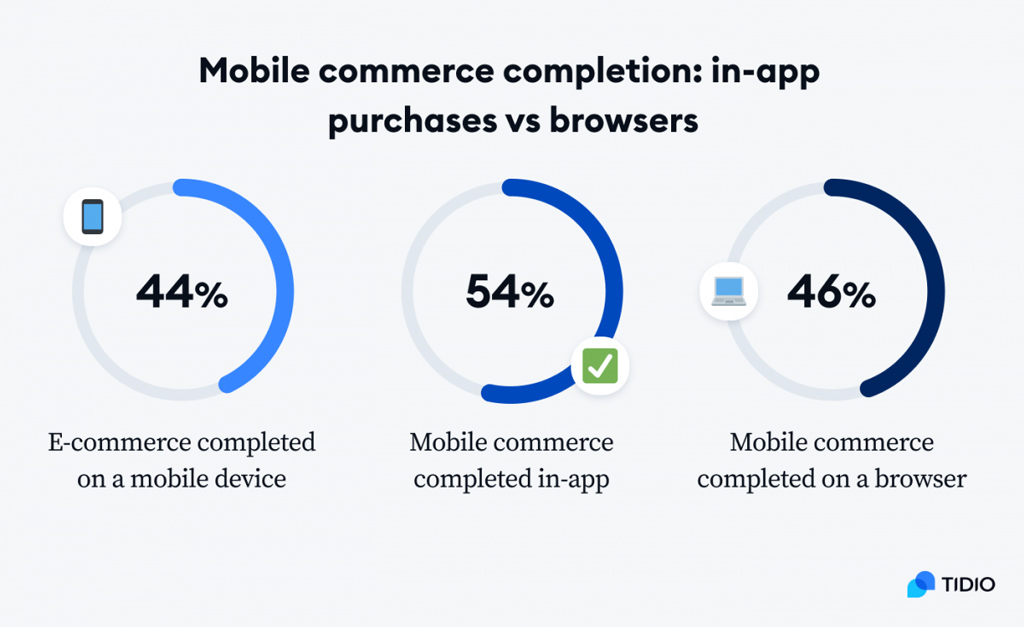
- Over half of mobile purchases (54%) happen in-app, highlighting the strong dominance of mobile apps in driving conversions.
- In comparison, 46% of mobile commerce is completed via browsers, showing that mobile web still plays a significant role but lags behind apps.
- Overall, only 44% of total e-commerce transactions are completed on mobile devices, indicating there is still room for mobile growth compared to other devices.
- The 8 percentage point gap (54% vs 46%) between in-app and browser purchases suggests that apps offer a more optimized and frictionless checkout experience.
- Higher in-app completion rates are often driven by saved payment details, faster navigation, and personalized experiences.
- Despite the rise of apps, the near parity of browser usage (46%) shows that businesses must optimize both mobile web and app experiences.
- The data reinforces the importance of mobile-first strategies, especially focusing on app engagement and retention to boost conversions.
- Brands investing in app UX, push notifications, and seamless checkout flows are more likely to capture the majority share of mobile transactions.
Mobile Commerce by Industry and Product Category
- Fashion and apparel account for ~30% of mobile commerce sales globally.
- Electronics represent ~20% of mobile purchases, especially in high-income markets.
- Grocery mobile commerce grew by over 25% annually post-2023, driven by convenience.
- Beauty and personal care see high mobile engagement, with over 60% of purchases via smartphones.
- Travel bookings via mobile account for ~40% of total travel ecommerce sales.
- Digital goods (apps, subscriptions, media) are primarily mobile-driven, exceeding 70% mobile share.
- Food delivery apps generate over 80% of orders via mobile devices.
- Luxury brands report growing mobile sales share, especially among younger buyers.
- Health and wellness ecommerce via mobile has grown over 18% annually since 2022.
Frequently Asked Questions (FAQs)
What is the global mobile commerce market size in 2025?
What percentage of ecommerce sales come from mobile devices?
How many people shop via mobile globally?
What share of ecommerce traffic comes from mobile devices?
How much of U.S. ecommerce sales come from mobile?
Conclusion
Mobile commerce continues to reshape how consumers discover, evaluate, and purchase products. From in-store smartphone usage to social commerce and digital wallets, mobile now drives both online and offline retail experiences. Businesses that prioritize fast mobile UX, seamless payments, and personalized experiences stand to gain the most as adoption grows.
Looking ahead, technologies like AR, voice commerce, and AI-driven personalization will further strengthen mobile’s role in the buying journey. As mobile devices become the primary gateway to commerce worldwide, brands that invest in mobile-first strategies will stay competitive in an increasingly digital retail landscape.

Leave a comment
Have something to say about this article? Add your comment and start the discussion.