




Predictive AI has rapidly evolved from a niche analytical tool into a core pillar of modern business strategy. Organizations across industries now rely on predictive models to anticipate outcomes, reduce uncertainty, and make faster, data-driven decisions. For example, healthcare providers use predictive AI to identify high-risk patients and prevent hospital readmissions, while ecommerce companies leverage it to forecast demand, personalize recommendations, and optimize inventory in real time.
Moreover, the growing availability of big data, combined with advances in machine learning and cloud computing, has made predictive AI more accessible to businesses of all sizes. As competition intensifies, companies that harness predictive insights gain a measurable advantage in efficiency, customer experience, and profitability. This article breaks down the latest Predictive AI statistics, helping you understand where the market stands today and where it is headed next.
Editor’s Choice
- The global predictive analytics market reached $22.22 billion in 2025 and is projected to hit $27.56 billion in 2026.
- Market forecasts estimate it will grow to $116.65 billion by 2034, showing strong long-term demand.
- Predictive analytics adoption has surged, with nearly 95% of businesses using it for customer insights.
- The market recorded a CAGR of up to 28.3% between 2025 and 2030 in some projections.
- North America accounted for over 38% of the global market share in 2025, leading adoption.
- Cloud-based predictive AI solutions generated over $15.5 billion in 2025, outpacing on-premises deployments.
- Retail demand forecasting improved by 21% using predictive AI models, showing measurable ROI.
Recent Developments
- In 2026, predictive AI models will increasingly integrate real-time decision-making workflows, rather than static reporting.
- AI-driven predictive systems now deliver up to 95% fraud detection accuracy in financial services.
- Manufacturing firms report 50% reduction in unplanned downtime using predictive maintenance models.
- Predictive AI helped SaaS companies generate $100 million in churn retention value.
- Healthcare predictive models reduced hospital readmissions by up to 39%.
- Supply chain AI models prevented $80 million in disruption losses in logistics operations.
- Explainable AI and MLOps have become standard, improving trust and scalability in enterprise deployments.
- Agentic AI systems now automate decisions without human input in select workflows, accelerating adoption.
Overview of Predictive AI Concepts and Applications
- Predictive AI uses historical data, machine learning, and statistical models to forecast outcomes.
- Around 95% of organizations leverage predictive analytics for marketing and customer behavior analysis.
- Retail companies use predictive AI for SKU-level demand forecasting, improving inventory precision.
- Financial institutions rely on predictive models for fraud detection and credit risk assessment.
- Healthcare systems apply predictive analytics to patient outcome prediction and resource allocation.
- Manufacturing uses predictive AI to predict equipment failures and schedule maintenance.
- Marketing teams use predictive insights to segment customers and personalize campaigns.
- AI-powered predictive systems increasingly operate in real-time environments, enhancing responsiveness.
Key Market Size Statistics for Predictive AI
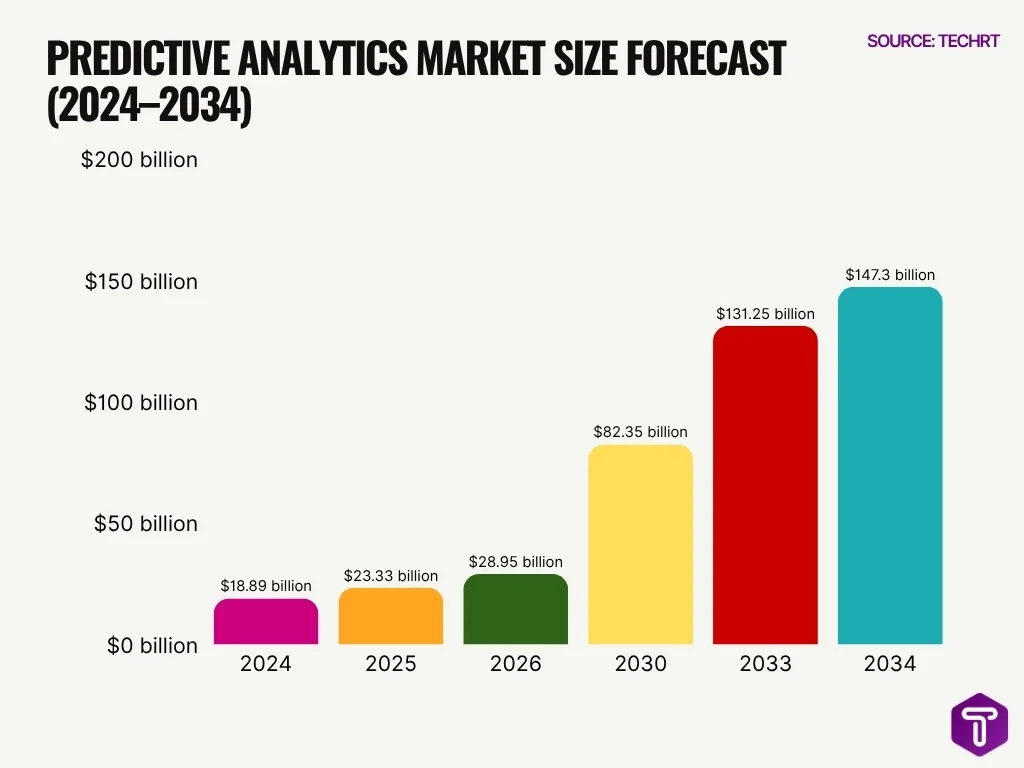
- The predictive analytics market was valued at $18.89 billion in 2024.
- It grew to approximately $22.22–$23.33 billion in 2025, depending on estimates.
- The market is expected to reach $27.56–$28.95 billion in 2026.
- Forecasts show growth to $82.35 billion by 2030.
- Another estimate projects $131.25 billion by 2033, indicating strong expansion.
- Long-term projections suggest $147.3 billion by 2034.
- The U.S. predictive analytics market alone is expected to reach $5.63 billion by 2025.
- Europe generated $6.85 billion in 2025, showing a strong regional contribution.
- Asia-Pacific remains the fastest-growing region, driven by digital transformation.
Global Adoption and Usage Rates of Predictive AI
- Nearly 95% of businesses globally use predictive AI for customer analysis and marketing.
- About 44% of companies have fully integrated predictive AI tools into operations.
- Large enterprises accounted for 59% of predictive analytics adoption in 2024.
- Small and mid-sized businesses represent 41% of adoption, showing growing democratization.
- North America leads with over one-third of global adoption share.
- Asia-Pacific shows the fastest adoption growth due to IoT and big data expansion.
- Around 51% of marketers rely on predictive models for customer behavior forecasting.
- Predictive AI adoption continues to rise as organizations shift toward data-driven decision-making strategies.
Growth and CAGR Trends in Predictive AI Market
- The predictive analytics market is expected to grow at a CAGR of 19.8% from 2026 to 2034.
- Some projections estimate a higher CAGR of 28.3% between 2025 and 2030.
- Other reports show 24.1% CAGR from 2026 to 2033, reflecting consistent expansion.
- The market may grow at up to 33.6% CAGR in short-term forecasts (2025–2030).
- The U.S. predictive analytics market is projected to grow at over 21% annually through 2034.
- Europe shows steady growth with consistent annual increases in market revenue.
- Cloud adoption is a key driver, accelerating growth across industries.
- Rising data volumes from IoT and digital platforms significantly fuel market expansion rates globally.
How Companies Adopt Predictive AI in Marketing
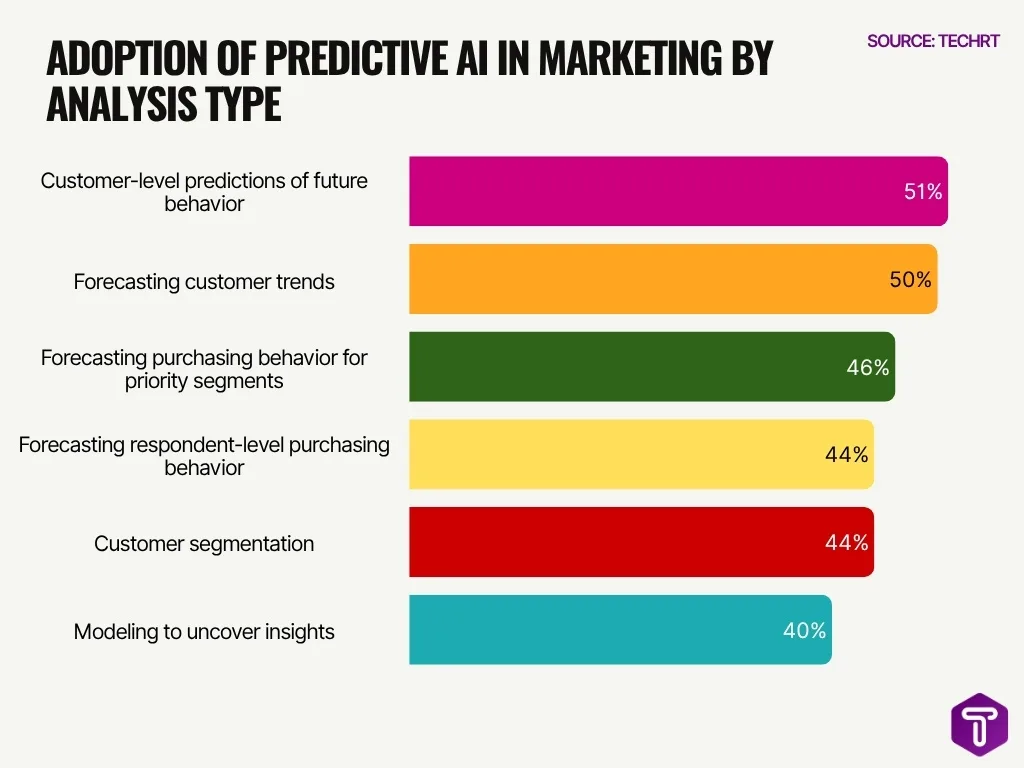
- Customer-level predictions of future behavior are the most common use case, with 51% of companies using predictive AI for this purpose. This shows that businesses are heavily focused on anticipating individual customer actions.
- Forecasting customer trends is a close second at 50%, highlighting that half of the companies use predictive AI to identify broader market and customer movement patterns.
- Forecasting purchasing behavior for priority segments is adopted by 46% of companies, indicating a strong interest in predicting how high-value customer groups are likely to buy.
- Forecasting respondent-level purchasing behavior stands at 44%, showing that many companies apply predictive AI to estimate purchase intent at the individual response level.
- Customer segmentation is also used by 44% of companies, reflecting how predictive AI helps marketers divide audiences into more targeted and actionable groups.
- Modeling to uncover insights is adopted by 40% of companies, making it the least common use case in this dataset, though it still represents a significant share of businesses using AI for deeper analytical discovery.
- The data suggests that companies prioritize predictive AI more for forecasting and behavior prediction than for general insight modeling.
- Overall, adoption rates range from 40% to 51%, which indicates that predictive AI has become a widely used marketing capability across several core functions.
Investment and Spending Patterns in Predictive AI
- Global enterprise spending on AI, including predictive AI, surpassed $154 billion in 2025, up from $118 billion in 2024.
- U.S. businesses alone accounted for over $50 billion in AI investments in 2025, reflecting strong domestic demand.
- Around 63% of organizations increased AI budgets in 2025, prioritizing predictive analytics capabilities.
- Predictive AI solutions receive 30–40% of total AI budgets in data-driven enterprises.
- Cloud-based predictive AI spending grew by over 27% year-over-year in 2025.
- Financial services firms allocate up to 45% of analytics budgets to predictive modeling tools.
- Startups in predictive AI attracted $18 billion in venture funding in 2025, up from $12 billion in 2024.
- Over 70% of enterprises plan to increase predictive AI investments by 2027, signaling sustained growth.
- Mid-sized businesses increased predictive analytics spending by 22% in 2025, driven by SaaS adoption.
ROI and Business Impact of Predictive AI
- Companies using predictive AI report average ROI improvements of 20–30% across operations.
- Predictive maintenance reduces operational costs by up to 25% in manufacturing environments.
- Businesses leveraging predictive analytics improve sales conversion rates by 15–20%.
- Fraud detection systems powered by predictive AI reduce financial losses by over 40%.
- Customer churn prediction models improve retention by 10–25%.
- Retailers using predictive AI report inventory cost reductions of 10–15%.
- Healthcare providers achieve cost savings of up to $150 billion annually through predictive analytics adoption.
- Logistics companies reduce delivery delays by up to 30% using predictive optimization.
- Marketing teams see ROI increases of 25% when using predictive targeting.
Industry-Wise Adoption of Predictive AI
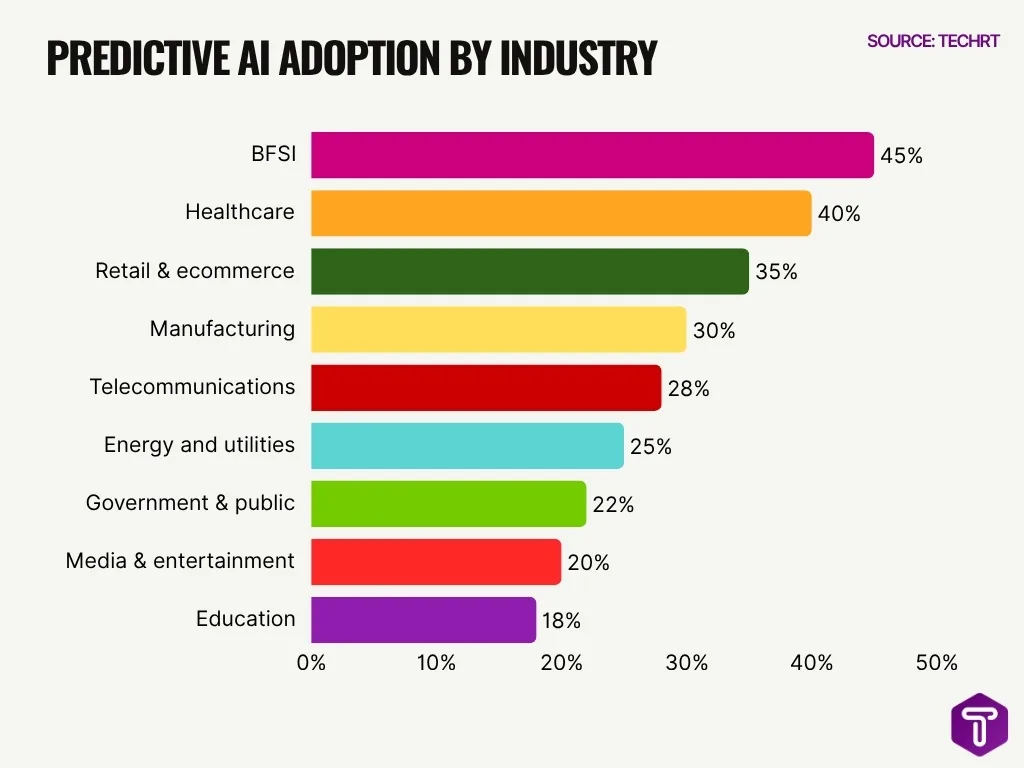
- The BFSI sector leads with over 45% adoption of predictive AI tools globally.
- Healthcare follows with nearly 40% adoption in clinical and operational use cases.
- Retail and ecommerce industries report 35% adoption of predictive analytics platforms.
- Manufacturing adoption reached over 30% in 2025, driven by Industry 4.0 initiatives.
- Telecommunications companies show 28% adoption, focusing on network optimization.
- Energy and utilities adoption stands at 25%, mainly for demand forecasting.
- Government and public sector usage reached 22%, focusing on predictive planning.
- Education sector adoption remains lower at 18%, but is growing steadily.
- Media and entertainment adoption reached 20%, focusing on audience prediction.
Healthcare Applications of Predictive AI Statistics
- Predictive AI reduces hospital readmissions by up to 39%.
- Around 90% of hospitals use predictive analytics for patient care optimization.
- AI-driven diagnostics improve disease detection accuracy by 20–30%.
- Predictive models help reduce emergency room wait times by 15–20%.
- Healthcare AI could generate $150 billion in annual savings in the U.S. by 2026.
- Predictive tools reduce patient no-show rates by up to 30%.
- Chronic disease prediction models improve early diagnosis rates by 25%.
- AI-assisted imaging increases diagnostic efficiency by 40%.
- Predictive analytics reduces hospital operational costs by 15%.
Finance and Banking Use of Predictive AI
- Banks using predictive AI detect fraud with up to 95% accuracy.
- Predictive analytics reduces credit default risk by 20–25%.
- Financial institutions using AI report 30% faster decision-making processes.
- Around 80% of banks use predictive models for customer segmentation.
- AI-driven trading systems contribute to over 60% of equity trades in the U.S.
- Fraud losses reduced by 40–50% in organizations using predictive AI.
- Loan approval processes improved by 35% efficiency gains using predictive analytics.
- Predictive AI enhances customer retention in banking by up to 25%.
- Risk management accuracy improved by over 30% using AI-driven models.
Retail and Ecommerce Trends in Predictive AI
- Retailers using predictive AI increase revenue by 10–20% through personalization.
- Demand forecasting accuracy improves by up to 21%.
- Predictive analytics reduces stockouts by 30–50%.
- Ecommerce platforms using predictive AI see conversion rate increases of 15%.
- Customer lifetime value improves by 25% with predictive targeting.
- Retail AI adoption increased by over 30% between 2024 and 2025.
- Personalized recommendation engines drive 35% of Amazon’s revenue.
- Predictive pricing strategies improve profit margins by 5–10%.
- Supply chain forecasting reduces logistics costs by 15%.
Manufacturing and Supply Chain Insights Using Predictive AI
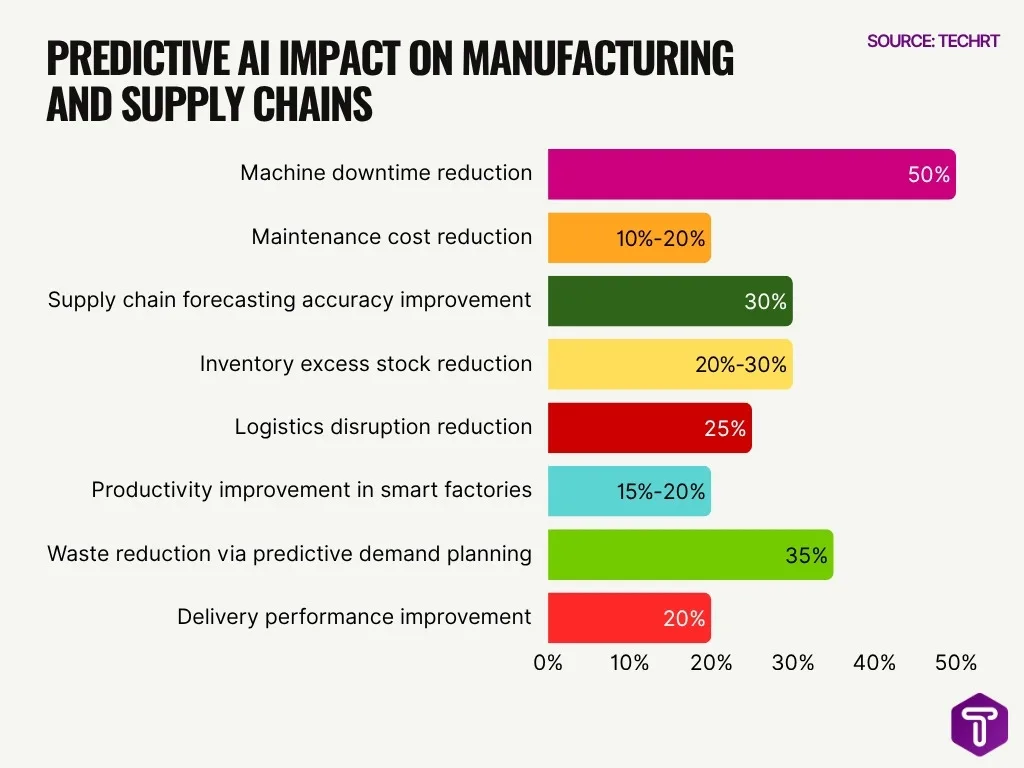
- Predictive maintenance reduces machine downtime by up to 50%.
- Manufacturing firms reduce maintenance costs by 10–20% using predictive AI.
- Supply chain forecasting improves accuracy by up to 30%.
- Inventory optimization reduces excess stock by 20–30%.
- Predictive AI reduces logistics disruptions by 25%.
- Smart factories using AI improve productivity by 15–20%.
- Predictive demand planning reduces waste by up to 35%.
- AI-enabled supply chains improve delivery performance by 20%.
- Manufacturing AI adoption grew by over 25% year-over-year in 2025.
Model Accuracy and Performance Metrics in Predictive AI
- Advanced predictive models now achieve accuracy rates exceeding 90% in structured data environments.
- Fraud detection models reach up to 95% precision rates in financial systems.
- Predictive maintenance models improve fault detection accuracy by 20–40%.
- Healthcare diagnostic models improve prediction accuracy by up to 30%.
- Model performance improves by 15–25% with better feature engineering techniques.
- AI models trained on high-quality datasets show up to 50% fewer prediction errors.
- Ensemble learning techniques increase predictive performance by 10–20%.
- Real-time model deployment improves decision latency by up to 40%.
- Continuous model retraining improves long-term accuracy by over 25%.
Data Volume and Data Quality in Predictive AI Systems
- Global data creation is expected to exceed 181 zettabytes by 2025, fueling predictive AI systems.
- Poor data quality costs organizations an average of $12.9 million annually.
- Around 80% of AI project time is spent on data preparation.
- High-quality data improves model performance by up to 35%.
- Organizations using structured data pipelines reduce errors by 20–30%.
- Real-time data processing adoption grew by over 25% in 2025, enabling faster predictions.
- Data governance initiatives increased by 40% across enterprises to support AI reliability.
- Around 60% of organizations cite data quality as the biggest barrier to predictive AI success.
- Data integration tools improve predictive model efficiency by up to 30%.
Cloud vs On-Premises Deployment of Predictive AI
- Cloud-based predictive AI accounts for over 65% of deployments in 2025.
- On-premises solutions still hold around 35% share, mainly in regulated industries.
- Cloud AI spending grew by over 27% year-over-year in 2025.
- Organizations report 30% lower infrastructure costs when using cloud-based predictive AI.
- Hybrid deployment models increased adoption by 20% in 2025, combining flexibility and control.
- Cloud platforms enable up to 40% faster deployment times for predictive models.
- Data security concerns keep 45% of enterprises using on-prem systems for sensitive workloads.
- Multi-cloud strategies grew by over 35% adoption, improving scalability.
- SaaS-based predictive analytics tools saw 25% growth in adoption in 2025.
Key Insights on Tasks Easily Automated by Machines
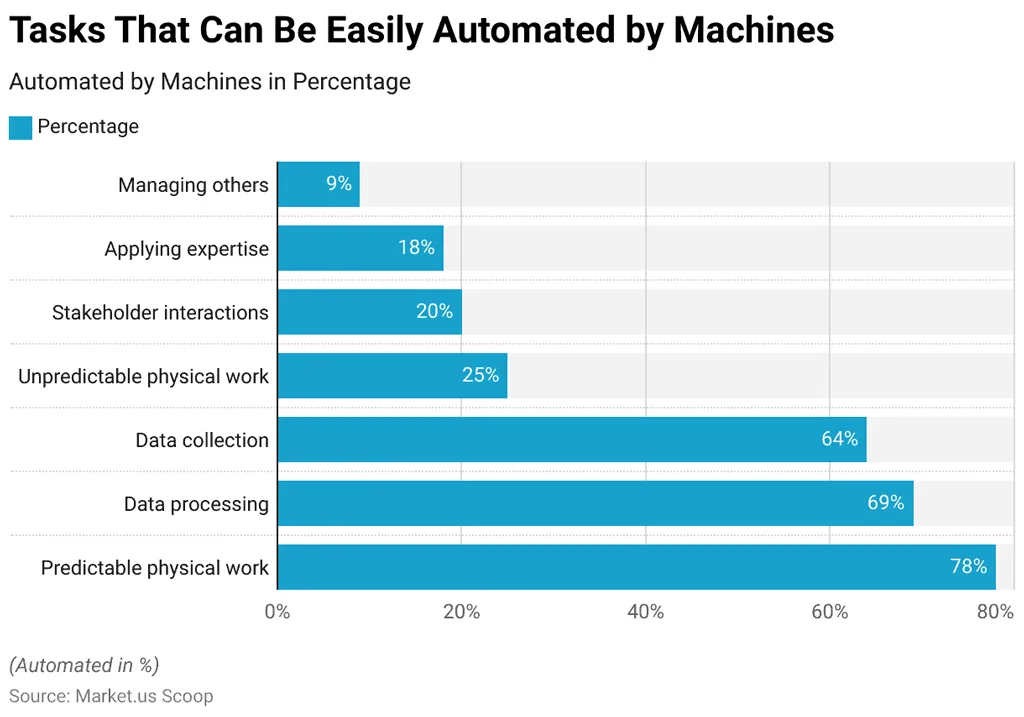
- Routine and structured tasks dominate automation, with Predictable physical work leading at 78%, making it the most automatable category.
- Data-related functions are highly automated, with Data processing at 69% and Data collection at 64%, highlighting how machines excel at handling large volumes of information efficiently.
- Physical tasks with variability are less automated, as Unpredictable physical work stands at 25%, showing limitations where adaptability and real-time decision-making are required.
- Human-centric roles remain difficult to automate, with Stakeholder interactions (20%), applying expertise (18%), and managing others (9%) ranking the lowest.
- Leadership and management tasks are the least automatable, with just 9% automation, emphasizing the continued importance of emotional intelligence, judgment, and interpersonal skills.
- The data clearly shows a shift toward automating repetitive and data-driven processes, while creative, strategic, and people-oriented roles remain largely human-driven.
Benefits and Efficiency Gains from Predictive AI
- Predictive AI improves operational efficiency by 20–30% across industries.
- Businesses reduce costs by 10–25% using predictive analytics tools.
- Predictive AI reduces downtime by up to 50% in manufacturing.
- Customer satisfaction improves by up to 20% through predictive personalization.
- Logistics efficiency improves by 15–20% with predictive routing systems.
- Predictive analytics reduces fraud losses by over 40%.
- Healthcare systems achieve significant cost savings, up to $150 billion annually in the U.S.
- Workforce productivity improves by up to 25% through AI-driven insights.
- Predictive AI enables faster decision-making, reducing response times by 30–40%.
Key Challenges in Adopting Predictive AI
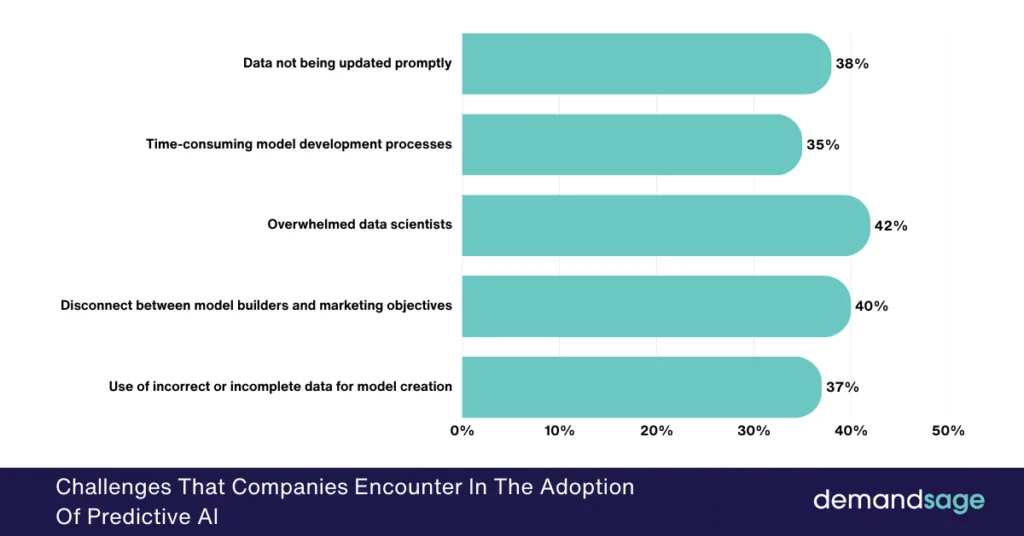
- The biggest challenge companies face is overwhelmed data scientists (42%), highlighting a significant talent capacity gap in managing predictive AI workloads.
- A close second is the disconnect between model builders and marketing objectives (40%), indicating a critical alignment issue between technical teams and business goals.
- Data quality and availability issues remain prominent, with 38% of companies reporting that data is not updated promptly, impacting the accuracy and timeliness of predictions.
- Additionally, 37% of organizations struggle with the use of incorrect or incomplete data, reinforcing that poor data governance directly undermines AI performance.
- 35% of respondents cite time-consuming model development processes as a barrier, showing that operational inefficiencies slow down AI deployment and scalability.
- Overall, the data suggests that organizational and data-related challenges outweigh purely technical limitations, emphasizing the need for better workflows, collaboration, and data management strategies in predictive AI adoption.
Future Trends and Forecast for Predictive AI
- The predictive AI market is expected to exceed $116 billion by 2034, showing strong long-term growth.
- AI adoption will reach over 80% of enterprises globally by 2030.
- Generative AI integration with predictive systems is expected to grow by 35% annually.
- Real-time predictive analytics adoption will increase by over 40% by 2028.
- Edge AI combined with predictive analytics will grow at a CAGR above 20%.
- Autonomous decision-making systems will expand across industries, reducing manual intervention.
- AI-driven personalization will influence over 70% of customer interactions.
- Data-centric AI approaches will improve model reliability by over 30%.
- Predictive AI will play a critical role in sustainability, optimizing energy and resource usage globally.
Frequently Asked Questions (FAQs)
What is the market size of predictive AI in 2025?
What is the projected CAGR of predictive AI market growth?
What percentage of companies use predictive AI in marketing?
What share of supply chains will use predictive AI by 2026?
What is the expected market size of predictive AI by 2033?
Conclusion
Predictive AI continues to shift from a specialized capability to a mainstream business necessity. Across industries, organizations now rely on predictive models to anticipate demand, reduce risk, and optimize operations. As investments grow and model accuracy improves, the gap between data-rich and data-poor organizations will widen. Companies that prioritize data quality, scalable infrastructure, and real-time analytics will gain a measurable edge. Moving forward, predictive AI will not just support decisions, it will increasingly drive them autonomously, reshaping how businesses operate at every level.

Leave a comment
Have something to say about this article? Add your comment and start the discussion.