




Uber Technologies, Inc. continues to redefine how people move, order food, and access logistics services across the globe. From daily commuting in cities like New York and Los Angeles to enabling restaurants to scale delivery operations without building their own fleets, Uber has become deeply embedded in modern urban life. Its platform connects millions of riders, drivers, couriers, and merchants in real time, creating a dynamic, on-demand ecosystem.
As mobility demand rebounds and delivery services mature, Uber’s financials and usage data highlight important shifts in pricing strategies, profitability, and multi-service adoption. At the same time, competition from companies like DoorDash and Lyft, along with changing rider behavior, continues to shape the company’s growth trajectory. This article breaks down the latest Uber statistics, offering a clear view of its performance, market position, and evolving business model.
Editor’s Choice
- Uber generated $52.0 billion in revenue in 2025, marking an 18.3% year-over-year increase.
- The company reported $43.9 billion in revenue in 2024, up 18% YoY from 2023.
- Uber reached over 200 million monthly active users by late 2025, reflecting strong platform growth.
- The platform facilitates around 42 million trips and deliveries daily globally.
- Uber recorded $14.4 billion in quarterly revenue in Q4 2025, a 20% YoY increase.
- Annual net income reached $10.05 billion in 2025, slightly up from 2024.
- Gross bookings hit $54.1 billion in Q4 2025 alone, growing 22% YoY.
Recent Developments
- Uber’s revenue grew 20% year-over-year in Q4 2025, driven by demand across rides and delivery.
- Monthly active users surpassed 200 million globally, reflecting 18% YoY growth.
- Uber completed 3.8 billion trips in Q4 2025, up 22% YoY.
- The company reported $1.8 billion in operating income in Q4 2025, a 130% increase YoY.
- Uber’s autonomous vehicle partnerships expanded with firms like Waymo and Baidu.
- The company announced a $20 billion stock buyback program in 2025, signaling confidence in long-term growth.
- Average ride costs increased by 9.6% in 2025, influencing user behavior.
- Around 60.4% of riders reduced usage due to higher prices, showing sensitivity to fare changes.
Uber Overview and Key Facts
- Uber operates in 70 countries and 15,000+ cities worldwide.
- The platform has over 10 million drivers and couriers globally.
- Uber has completed more than 72 billion lifetime trips and deliveries.
- Monthly active platform consumers exceeded 202 million in 2025.
- Mobility services account for 57% of total revenue, while delivery contributes 31%.
- Uber’s largest market is the U.S. and Canada, contributing over 53% of revenue.
- The company maintains an average take rate of 29.9% for mobility services.
- Uber supports multi-modal transport, including bikes, scooters, and transit integrations.
Uber Revenue Growth Trends and YoY Performance Insights
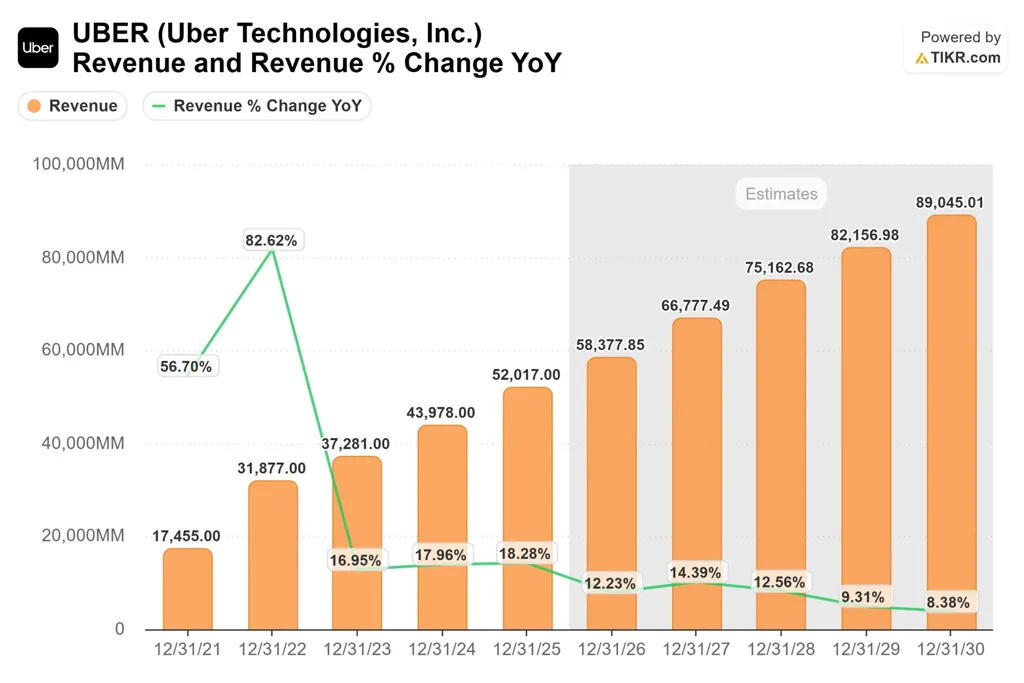
- Uber’s revenue surged from $17.46 billion in 2021 to $89.05 billion by 2030, representing a 5x growth over the decade, highlighting strong long-term expansion.
- The company experienced its fastest growth in 2022, with a remarkable 82.62% YoY increase, driven by post-pandemic recovery and demand rebound.
- In 2021, Uber already showed strong momentum with a 56.70% YoY growth, signaling the beginning of a rapid scaling phase.
- Growth normalized after 2022, dropping to 16.95% in 2023, indicating a transition from hyper-growth to steady expansion.
- Between 2023 and 2025, Uber maintained consistent mid-teen growth rates (17%–18%), showing operational stability and predictable scaling.
- Revenue is projected to cross $50 billion in 2025, reaching $52.02 billion, a key milestone for the company.
- From 2026 onwards, growth moderates further, staying in the 12%–14% range, reflecting market maturity and larger revenue base effects.
- By 2027, Uber’s revenue is expected to reach $66.78 billion, reinforcing its dominant position in the mobility and delivery ecosystem.
- Growth continues to gradually decline toward single digits, with 9.31% in 2029 and 8.38% in 2030, a typical trend for large, mature companies.
- Despite slowing percentages, absolute revenue gains remain significant, adding billions each year due to Uber’s expanding scale.
- The data shows a clear shift from high-growth startup phase → stable scaling → mature enterprise growth, making Uber a long-term compounding business.
Uber Financial Performance Overview
- Uber reported $20.67 billion gross profit in 2025, up from $17.33 billion in 2024.
- Cost of revenue reached $31.33 billion in 2025, reflecting scale expansion.
- Operating income hit $1.8 billion in Q4 2025, marking strong margin improvement.
- Adjusted EBITDA grew by 30%+ in 2025, indicating improved operational efficiency.
- Operating expenses remained high at $15.1 billion in 2025.
- Uber generated $2.3 billion in operating cash flow in Q3 2025.
- Free cash flow continued to grow, supporting share buybacks and investments.
- Uber’s liquidity exceeded $9 billion in 2025, strengthening its balance sheet.
Uber Profit, Loss, and Margins
- Uber recorded $10.05 billion in net income in 2025, a 2% increase YoY.
- Net income in 2024 stood at $9.86 billion, reflecting a major rebound from prior losses.
- Q4 2025 net income was impacted by a $1.6 billion investment-related headwind.
- Operating income rose 130% YoY in Q4 2025, showing improved margins.
- Uber’s take rate reached 29.9% for mobility services, reflecting strong monetization.
- Delivery segment margins remain lower at 19.2% take rate, highlighting cost pressures.
- Profitability improved significantly compared to pre-2022 loss-making years, marking a structural shift.
- Uber’s EPS reached $0.71 in Q4 2025, though slightly below expectations.
Uber User Age Demographics
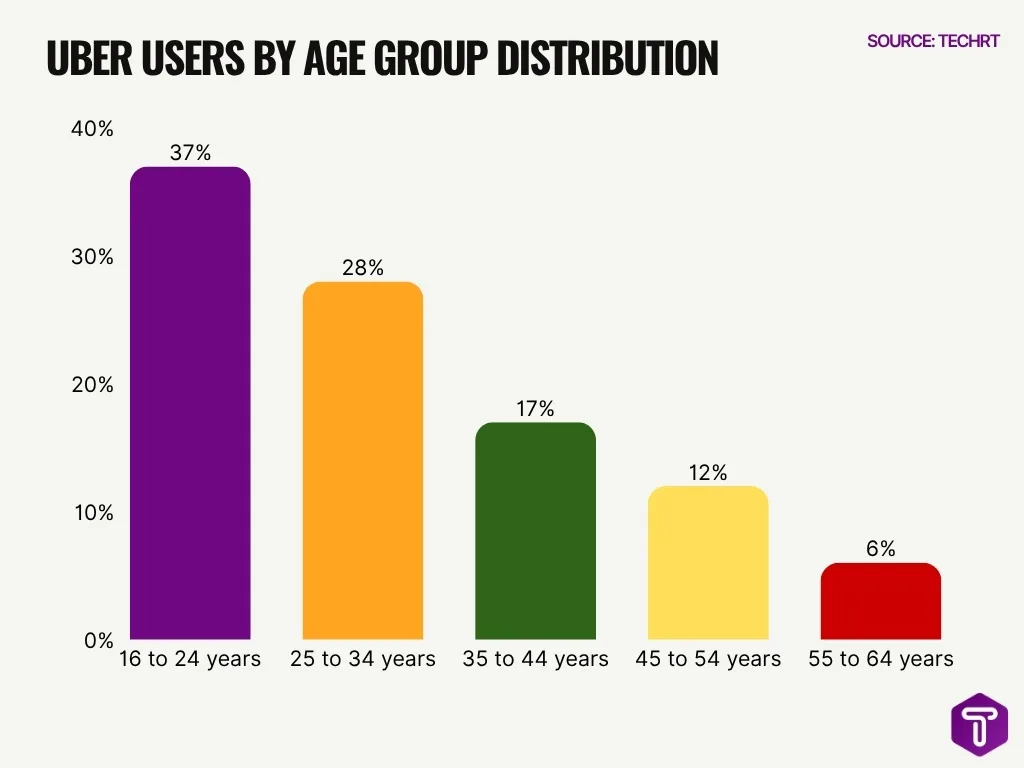
- The largest share of Uber users comes from the 16 to 24-year age group, accounting for 37%, highlighting strong adoption among younger users.
- The 25 to 34 years segment follows closely with 28%, making it the second-largest user base and a key demographic for ride-hailing demand.
- Users aged 35 to 44 years represent 17%, showing a moderate but steady presence in mid-career professionals.
- The 45 to 54 years group contributes 12%, indicating lower engagement compared to younger cohorts.
- The smallest segment is 55 to 64 years, with just 6%, suggesting limited adoption among older users.
- Overall, a combined 65% of Uber users are under 35, demonstrating that the platform is heavily dominated by younger demographics.
- There is a clear decline in usage with increasing age, reflecting differences in technology adoption, mobility needs, and digital comfort levels.
Uber Gross Bookings Statistics
- Uber reported $137.6 billion in gross bookings in 2025, reflecting 20% YoY growth.
- Gross bookings in 2024 reached $113.9 billion, up from $103.6 billion in 2023.
- In Q4 2025 alone, gross bookings totaled $54.1 billion, marking a 22% YoY increase.
- Mobility gross bookings grew 19% year over year in 2025, driven by higher ride demand.
- Delivery gross bookings increased 18% YoY, supported by order frequency and basket size growth.
- Uber Freight contributed $20 billion in annual gross bookings, though growth remained slower.
- Gross bookings per user rose to $680+ annually in 2025, indicating stronger monetization.
- The U.S. and Canada accounted for over 50% of total gross bookings, maintaining Uber’s largest regional share.
Uber User Growth Statistics
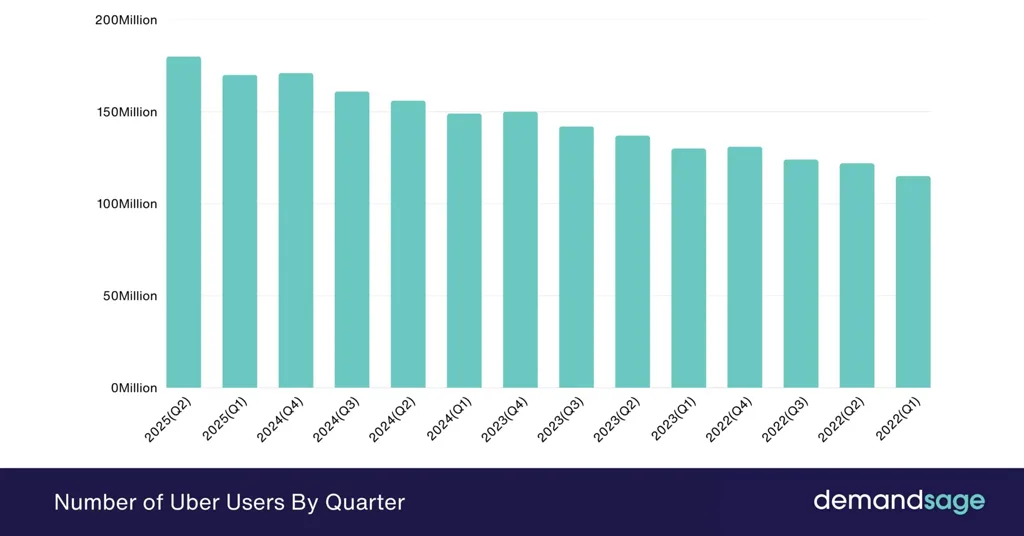
- Uber’s monthly active users reached a peak of 180 million in Q2 2025, marking the highest recorded figure in the dataset.
- The platform saw a strong year-over-year growth, increasing from 115 million in Q1 2022 to 180 million in Q2 2025, reflecting a ~56% growth over the period.
- 2025 shows accelerated momentum, with users rising from 170 million in Q1 to 180 million in Q2, indicating rapid quarterly expansion.
- Throughout 2024, Uber maintained steady growth, moving from 149 million in Q1 to 171 million in Q4, showing consistent demand recovery and expansion.
- There was a minor dip between Q4 2024 (171M) and Q1 2025 (170M), but this was quickly offset by a sharp rebound in Q2 2025.
- In 2023, Uber crossed the 150 million milestone, growing from 130 million in Q1 to 150 million in Q4, signaling a strong post-pandemic recovery.
- The fastest growth phase occurred between 2022 and 2023, where users jumped from 115 million to 150 million, an increase of 35 million users in just one year.
- Quarterly growth remains relatively stable, with most increases ranging between 5–10 million users per quarter, indicating predictable scaling.
- User growth slowed slightly in mid-2024, with smaller increments compared to earlier quarters, suggesting a maturing market phase.
- Despite minor fluctuations, the overall trend is strongly upward, demonstrating Uber’s sustained global adoption and expanding user base.
Uber Rider Demographics and Behavior
- Around 52% of Uber riders are aged 18–34, making younger adults the dominant group.
- Approximately 60% of riders live in urban areas, where ride-hailing demand is highest.
- Male users account for 56% of Uber riders, while female users represent 44%.
- About 70% of riders use Uber at least once per month, indicating high engagement.
- Roughly 25% of riders use Uber weekly, especially in major U.S. cities.
- Business-related travel accounts for 18% of total rides, showing strong corporate usage.
- Riders spend an average of $20–$25 per trip in the U.S., depending on city and demand.
- Around 60.4% of riders reduced usage in 2025 due to higher fares, signaling price sensitivity.
Uber Driver and Courier Statistics
- Uber has over 10 million drivers and couriers globally, supporting its marketplace.
- The U.S. alone has 1.5 million active drivers, making it the largest driver market.
- About 70% of drivers work fewer than 10 hours per week, highlighting part-time flexibility.
- Over 25% of drivers also work for competing platforms like Lyft or DoorDash.
- The average driver tenure is less than one year, reflecting high churn.
- Uber added millions of new drivers post-2023 to meet rising demand.
- Approximately 80% of drivers cite flexibility as the main reason for joining.
- Delivery couriers now make up over 40% of Uber’s active workforce, driven by Eats growth.
Uber Driver Earnings Statistics
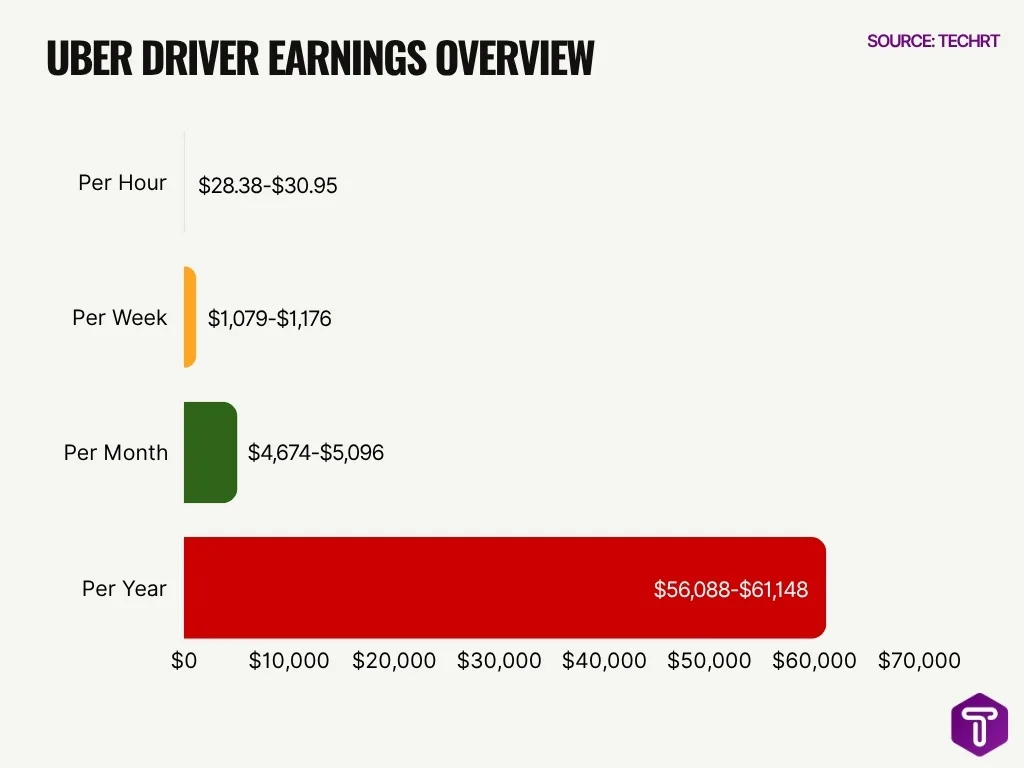
- The average hourly earnings of an Uber driver range between $28.38 and $30.95, indicating strong short-term earning potential.
- On a weekly basis, drivers typically earn between $1,079 and $1,176, depending on location, demand, and working hours.
- The monthly income for Uber drivers falls in the range of $4,674 to $5,096, making it a viable full-time income source in many regions.
- Annually, Uber drivers can generate approximately $56,088 to $61,148, showcasing competitive earnings compared to many traditional jobs.
- The earnings structure highlights that consistent working hours and peak-time driving significantly impact overall income potential.
- These figures suggest that Uber driving can be a flexible yet financially rewarding gig, especially in high-demand urban markets.
Uber Trip and Ride Volume Statistics
- Uber completed 9.4 billion trips in 2025, up from 8.8 billion in 2024.
- Q4 2025 saw 3.8 billion trips, marking a 22% YoY increase.
- Daily trips and deliveries average 42 million globally.
- Mobility trips grew 20% YoY in 2025, reflecting travel recovery.
- Uber Eats deliveries account for over 45% of total transactions.
- The average trip distance in the U.S. is 6–7 miles per ride.
- Airport trips represent 15% of total ride volume, a key revenue segment.
- Peak-hour trips contribute over 35% of total rides, driven by commuting patterns.
Uber Usage by Time and Day
- Uber usage peaks between 7–9 AM and 5–8 PM, aligning with commuting hours.
- Friday and Saturday nights generate the highest ride demand globally.
- Weekend rides account for 40% of total weekly trips.
- Late-night rides (10 PM–3 AM) make up 20% of total rides, driven by nightlife demand.
- Uber Eats orders peak during lunch (12–2 PM) and dinner (6–9 PM) hours.
- Holiday periods see 20%–30% spikes in ride demand, especially in the U.S.
- Rainy weather increases ride demand by 10%–15%, affecting surge pricing.
- Business travel rides peak midweek, especially Tuesday through Thursday mornings.
Uber Market Share and Competitors
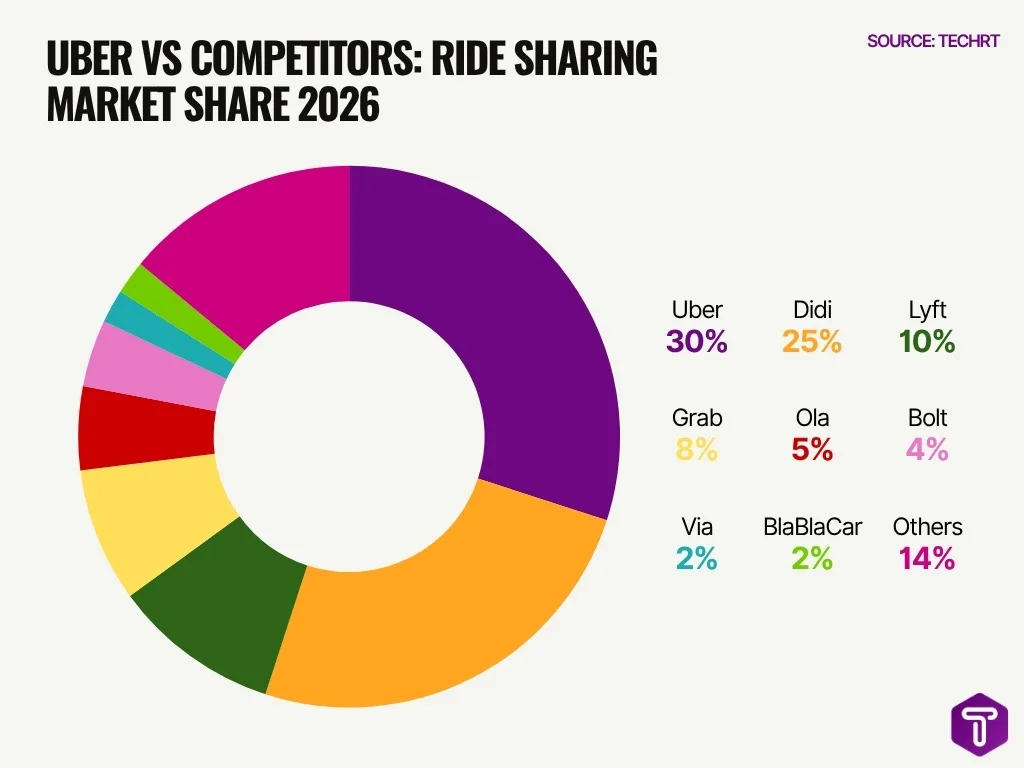
- Uber leads the global market with a dominant 30% market share, maintaining its position as the industry leader.
- Didi follows closely with 25%, making it the second-largest player and a strong competitor in key regions.
- Lyft holds 10%, positioning itself as a significant but distant third in the market.
- Grab captures 8%, highlighting its strong presence in Southeast Asia.
- Ola accounts for 5%, indicating a moderate share with regional dominance in India.
- Bolt secures 4%, showing steady growth in European markets.
- Via and BlaBlaCar each hold 2%, reflecting their niche positioning and smaller global footprint.
- The “Others” category makes up 14%, suggesting a fragmented market with multiple smaller competitors.
- The top two players (Uber + Didi) together control a massive 55% of the market, indicating high market concentration.
- The top five companies collectively hold 78%, showing that the industry is largely dominated by a few major players.
Uber Eats and Delivery Statistics
- Uber Eats generated over $12 billion in revenue in 2025, up from $10 billion in 2024.
- The platform processed billions of orders annually, contributing nearly 45% of total Uber transactions.
- Uber Eats operates in 6,000+ cities worldwide, expanding its delivery footprint.
- Average order value increased to $30+ in the U.S., reflecting inflation and larger basket sizes.
- Uber Eats holds 23% U.S. market share, ranking second behind DoorDash.
- Subscription service Uber One exceeded 25 million members globally, boosting order frequency.
- Grocery and convenience delivery grew 30%+ YoY, becoming a key growth area.
- Delivery demand peaks during evenings, with 60% of orders placed between 5 PM and 9 PM.
Uber Freight Statistics
- Uber Freight generated $7–8 billion in revenue in 2025, slightly down from 2024.
- The segment connects hundreds of thousands of carriers and shippers across North America and Europe.
- Freight gross bookings exceeded $20 billion annually, though margins remain tight.
- The logistics downturn led to a 1% decline in freight revenue in 2025.
- Uber Freight expanded into Europe after acquiring Transplace, strengthening its global reach.
- Digital freight platforms now account for 20% of U.S. brokerage transactions, with Uber Freight as a key player.
- Average shipment costs declined in 2025 due to lower freight demand and excess capacity.
- AI-powered pricing and route optimization improved efficiency by 10%–15% in freight operations.
Uber Segment Breakdown (Rides, Eats, Freight)
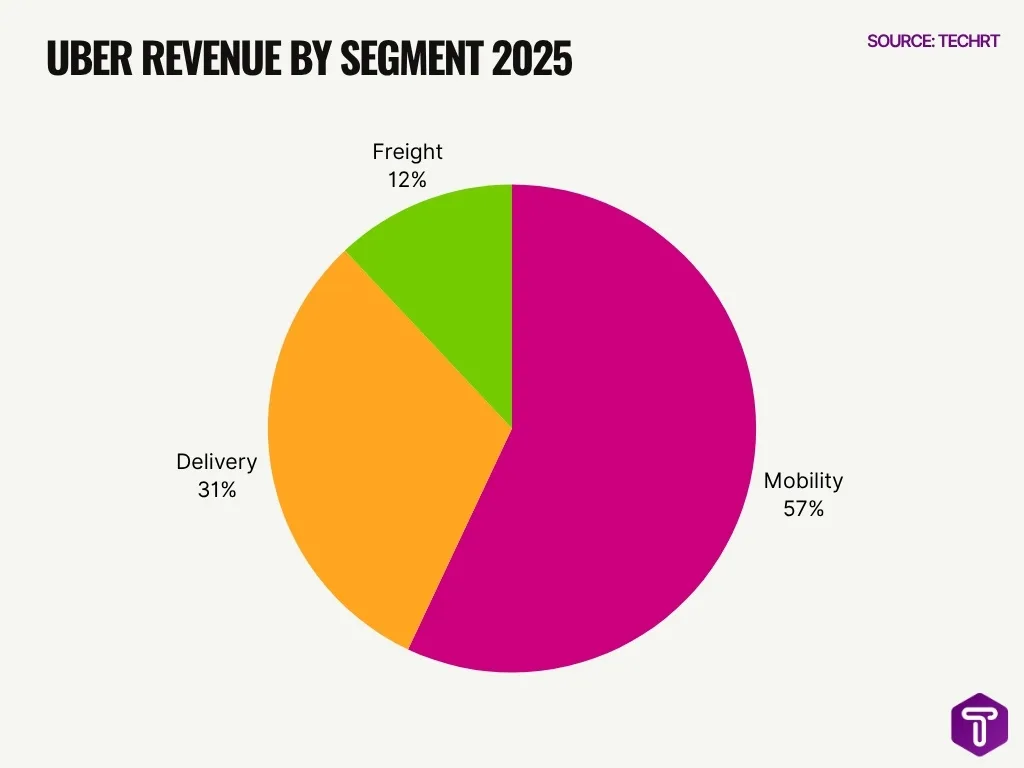
- Mobility (rides) contributed 57% of total revenue in 2025, remaining Uber’s largest segment.
- Delivery (Uber Eats) accounted for 31% of total revenue, showing strong diversification.
- Freight contributed 12% of revenue, though growth remained slower.
- Mobility revenue grew 18% YoY in 2025, fueled by higher trip volumes.
- Delivery revenue increased 25% YoY, driven by order frequency and subscriptions.
- Freight revenue declined 1% YoY, reflecting industry-wide logistics slowdown.
- Uber One subscriptions boosted cross-segment usage, with multi-service users increasing retention rates by 15%+.
- Over 70% of users now engage with more than one Uber service, strengthening ecosystem stickiness.
Uber App Downloads and Usage
- Uber’s main app has surpassed 1 billion downloads globally across iOS and Android.
- Uber Eats has over 500 million downloads worldwide, reflecting strong delivery adoption.
- In 2025, Uber averaged 15 million monthly app downloads globally.
- The U.S. accounts for 25% of total app downloads, followed by India and Brazil.
- Uber ranks consistently among the top travel apps in the U.S. App Store and Google Play.
- Average session duration on the Uber app is 5–7 minutes, driven by ride tracking and ordering behavior.
- Push notifications increase user engagement by 20%+, especially for promotions and ride updates.
- Over 70% of bookings are made via mobile apps, with web usage remaining minimal.
Frequently Asked Questions (FAQs)
How much revenue did Uber generate in 2025?
How many users and daily trips does Uber have globally?
What is Uber’s gross bookings value in recent data?
What share of the U.S. ride-hailing market does Uber control?
How many drivers and couriers work on Uber’s platform?
Conclusion
Uber’s data shows a company that has moved beyond growth-at-all-costs into a more disciplined, profitable phase. Revenue continues to climb at double-digit rates, while gross bookings and user engagement highlight sustained demand across mobility and delivery. At the same time, rising prices and competitive pressure from players like DoorDash and Lyft shape user behavior and market dynamics.
Looking ahead, Uber’s ability to balance pricing, driver incentives, and multi-service adoption will define its trajectory. With expanding segments like grocery delivery and freight digitization, the company remains a central force in how people move and receive goods globally.

Leave a comment
Have something to say about this article? Add your comment and start the discussion.