




Virtual reality (VR) has evolved from a niche entertainment technology into a practical tool that drives real-world impact across multiple industries. Today, healthcare providers use VR to manage pain, treat mental health conditions, and train surgeons in risk-free environments. At the same time, businesses rely on immersive simulations to onboard employees, improve safety training, and streamline complex workflows.
As hardware becomes more affordable and software ecosystems mature, VR adoption continues to accelerate across both consumer and enterprise segments. In this article, we break down the latest statistics, trends, and insights shaping the global VR market.
Editor’s Choice
- The global VR market reached $20.83 billion in 2025 and is projected to hit $26.71 billion in 2026.
- VR market value could grow to $171.33 billion by 2034, reflecting strong long-term expansion.
- Around 171 million people worldwide actively use VR technology today.
- The number of VR hardware users is expected to surpass 130 million by 2027.
- In the U.S., about 53 million adults own a VR system, with demand still increasing.
- North America held a 35.6% market share in 2025, making it the leading region.
- The VR industry is forecast to grow at a CAGR of over 26% through the next decade.
Recent Developments
- VR adoption is expected to reach 30% global penetration by 2025, driven by enterprise use cases.
- Standalone and wireless VR headsets are accelerating user adoption due to improved accessibility.
- The VR segment grew from $16.32 billion in 2024 to $20.83 billion in 2025, showing strong year-over-year growth.
- Fully immersive VR systems are projected to grow at a 23.12% CAGR, especially in healthcare and industrial sectors.
- Hospitals using VR therapy report double-digit reductions in opioid use during treatment.
- Enterprise adoption is expanding due to demand for remote collaboration and simulation training tools.
- VR hardware innovation focuses on lighter headsets and better motion tracking, improving usability.
- The XR ecosystem (VR + AR) is expected to support 2.3 million jobs by 2030, up from 80,000 today.
Virtual Reality Market Size and Value
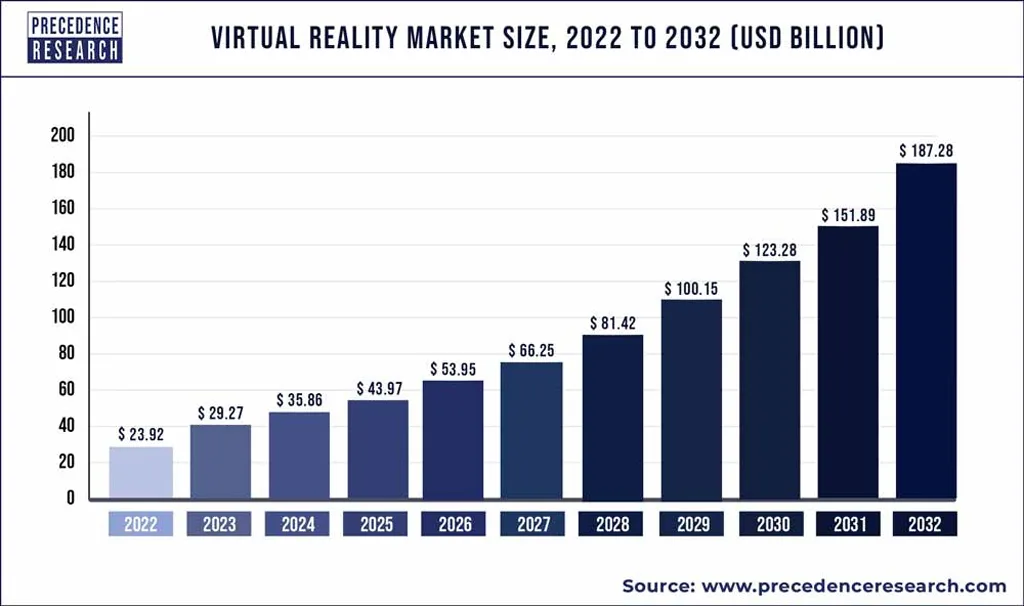
- The global virtual reality market is projected to grow from $23.92 billion in 2022 to $187.28 billion by 2032, reflecting massive long-term expansion.
- The market is expected to increase by nearly 7.8x over the 10-year period, highlighting strong industry momentum and adoption.
- Between 2022 and 2025, the market grows steadily from $23.92B to $43.97B, indicating early-stage acceleration.
- A significant growth phase begins after 2026, with the market reaching $66.25 billion in 2027 and crossing $100.15 billion by 2029.
- The industry surpasses the $100 billion milestone in 2029, marking a major inflection point for mainstream adoption.
- From 2029 to 2032, the market expands rapidly from $100.15B to $187.28B, adding over $87 billion in just three years.
- The highest annual gains occur in the later years, especially between 2030 ($123.28B) and 2032 ($187.28B), showing accelerating demand.
- The market grows by approximately $163.36 billion in absolute terms over the forecast period.
- The consistent upward trajectory suggests a strong compound annual growth rate (CAGR) of around 23–25%, signaling a high-growth technology sector.
- This rapid expansion is driven by increasing adoption across gaming, enterprise, healthcare, and education sectors, fueling sustained demand.
Global Virtual Reality Revenue Trends
- Global VR revenue grew from $16.32 billion in 2024 to $20.83 billion in 2025, a significant annual increase.
- The VR market is expected to maintain a ~28.9% CAGR through 2030.
- Revenue is projected to exceed $171 billion by 2034, driven by enterprise demand.
- The AR/VR combined market may reach $138.60 billion by 2032.
- VR gaming alone could generate $92.31 billion by 2027.
- Asia-Pacific continues to lead growth, with increasing investments and consumer demand.
- The U.S. remains a key revenue driver due to high adoption and enterprise spending.
- Global AR/VR revenue is expected to surpass $200 billion by 2030.
- Software is projected to dominate revenue share with nearly 60% contribution in 2025.
Virtual Reality Market Growth Rate and Forecast
- The VR market is forecast to grow at a 26.2% CAGR from 2026 to 2034.
- Some projections estimate a higher 44.3% CAGR between 2021 and 2027.
- The AR/VR market is expected to grow at a 34.69% CAGR through 2034.
- Another forecast shows a 27.5% CAGR from 2023 to 2030, highlighting consistent expansion.
- The extended reality (XR) market is expected to grow at 25.5% CAGR through 2034.
- Europe’s VR market is projected to grow at 26.72% CAGR from 2026 to 2034.
- India’s VR market is expected to expand at a 35.5% CAGR, one of the fastest globally.
- Fully immersive VR systems are expected to grow faster than semi-immersive systems.
- VR adoption growth is fueled by lower hardware costs and improved content ecosystems.
Growth of VR Users in the United States
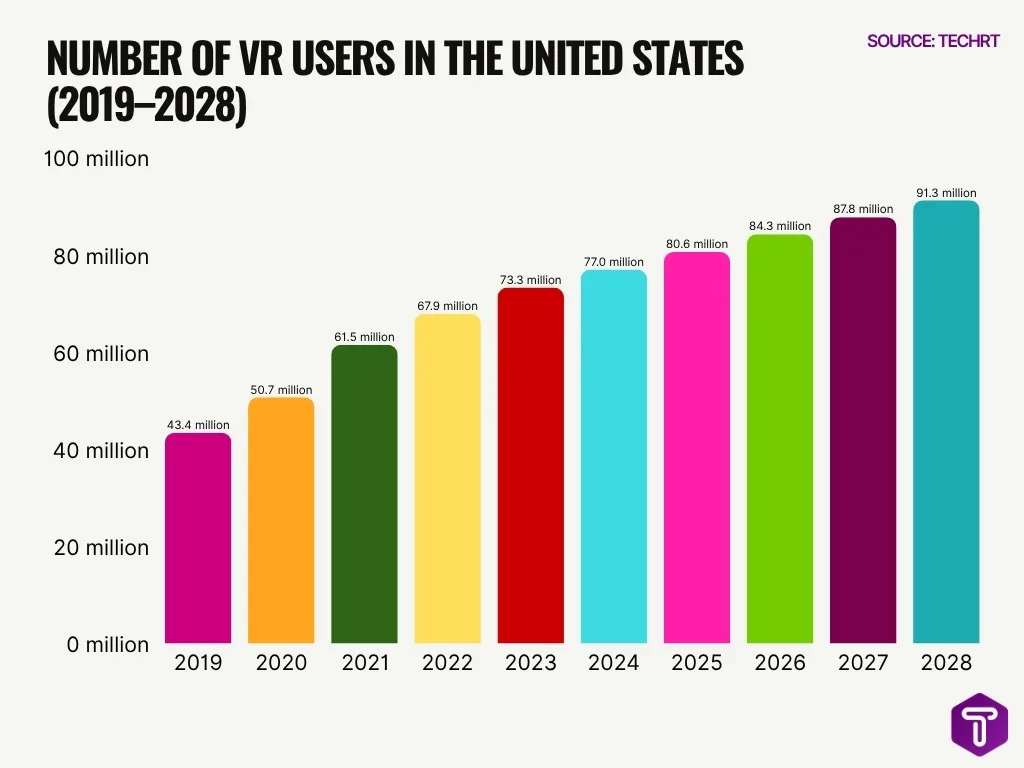
- The number of VR users in the U.S. has grown significantly from 43.4 million in 2019 to a projected 91.3 million by 2028, reflecting a more than 2x increase over the period.
- Between 2019 and 2021, adoption surged rapidly, jumping from 43.4 million to 61.5 million, highlighting an early acceleration phase in VR adoption.
- Growth remained strong but began to stabilize after 2021, with users rising from 61.5 million (2021) to 73.3 million (2023), indicating a shift toward steady mainstream adoption.
- In 2024, the user base is expected to reach 77.0 million, showing continued expansion despite a slightly slower growth rate compared to earlier years.
- Future projections suggest consistent increases, with VR users expected to hit 80.6 million in 2025 and 84.3 million in 2026, reinforcing long-term market confidence.
- By 2027 and 2028, the market is forecasted to reach 87.8 million and 91.3 million users, respectively, signaling near mass-market penetration.
- Overall, the data reflects a clear transition from early adoption (2019–2021) to mature growth (2022–2028) in the VR ecosystem.
- The steady upward trend suggests increasing use cases across gaming, enterprise, education, and healthcare, contributing to sustained user growth.
Virtual Reality Hardware Market Statistics
- The VR headset market is expected to grow from $14.85 billion in 2025 to $43.72 billion by 2032.
- VR hardware users grew from 30 million in 2020 to 97.7 million in 2023, a 225% increase.
- The number of VR hardware users is projected to exceed 130 million by 2027.
- Approximately 13% of U.S. households own a VR headset.
- Head-mounted displays (HMDs) dominate the hardware segment globally.
- Semi-immersive systems accounted for 42.56% of VR revenue in 2025.
- Fully immersive hardware is gaining traction in healthcare and industrial training.
- Hardware innovation focuses on standalone devices without external sensors, improving convenience.
- Motion tracking and haptic feedback technologies are becoming standard features in newer devices.
Virtual Reality Software and Content Market
- The VR software market is projected to account for nearly 60% of total VR revenue in 2025, driven by content demand.
- Global VR content revenue is expected to exceed $41 billion by 2027, fueled by gaming and enterprise applications.
- Enterprise VR software spending grew by over 35% year-over-year in 2025, especially in training simulations.
- Subscription-based VR content platforms are increasing, with over 25% of users paying for premium VR experiences.
- The VR gaming content segment alone contributes over 50% of total VR software revenue.
- Education-focused VR software is expected to grow at a CAGR of 28% through 2030.
- Healthcare VR software adoption increased by over 30% in 2024, particularly in therapy and rehabilitation.
- The rise of social VR platforms has led to millions of monthly active users engaging in virtual environments.
- Cloud-based VR content delivery is expanding rapidly, reducing dependency on high-end local hardware.
Virtual Reality Engagement by Age Group
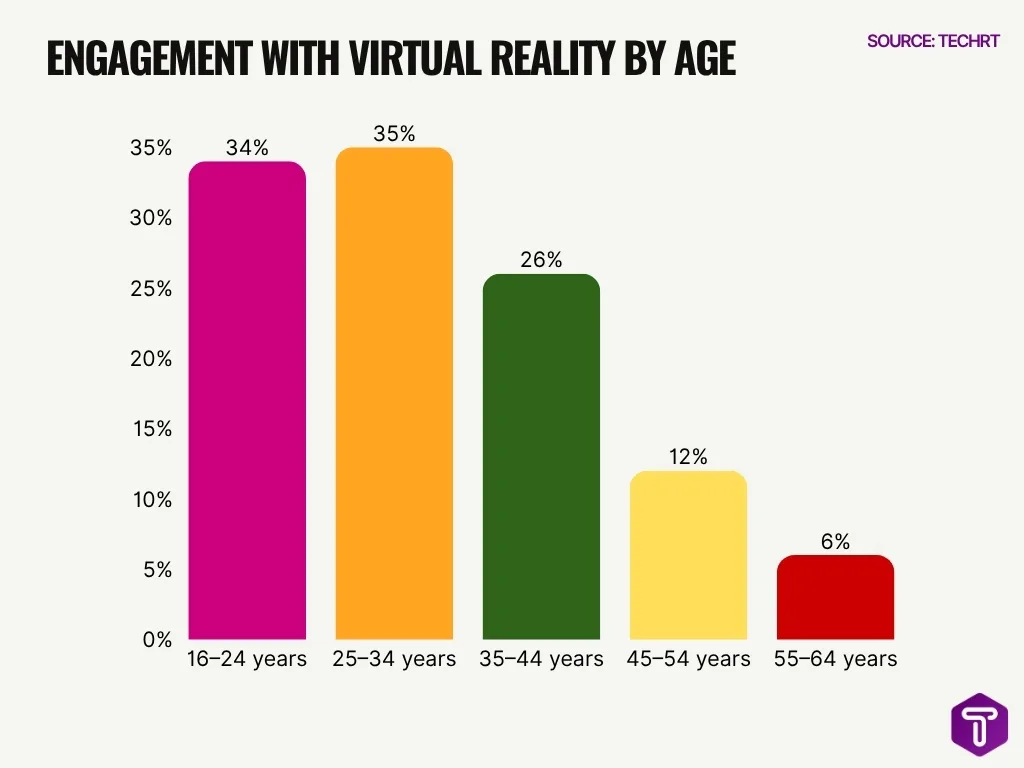
- The highest engagement is seen in the 25–34 age group at 35%, making them the most active VR users.
- Close behind, 16–24-year-olds account for 34%, highlighting strong adoption among younger audiences.
- Engagement drops noticeably to 26% in the 35–44 age group, indicating a mid-career usage decline.
- A sharp decline occurs among older users, with only 12% engagement in the 45–54 segment.
- The lowest participation is observed in the 55–64 age group at just 6%, showing minimal adoption.
- Overall, VR engagement shows a clear negative correlation with age, decreasing steadily as age increases.
- Nearly 70% of engagement comes from users under 35, emphasizing VR’s dominance among younger demographics.
- The data suggests that younger users are the primary drivers of VR growth, while older segments remain largely untapped.
Virtual Reality User Base and Adoption
- The global VR user base reached approximately 171 million users in 2025, with steady growth expected.
- VR adoption in the U.S. surpassed 53 million users, representing a significant consumer base.
- Around 25% of adults in the U.S. have tried VR at least once, indicating rising awareness.
- The number of VR users worldwide is projected to exceed 200 million by 2027.
- Consumer adoption continues to grow due to falling headset prices and improved accessibility.
- Enterprise adoption of VR solutions increased by over 40% between 2023 and 2025.
- Nearly 60% of companies using VR report improved training efficiency.
- Emerging markets are seeing faster adoption rates, with Asia-Pacific leading user growth.
- About 1 in 5 internet users globally has experienced VR content, showing broad exposure.
Virtual Reality Usage Frequency and Behavior
- Around 28% of VR users engage with VR at least once a week, indicating regular usage patterns.
- Approximately 16% of users use VR daily, primarily for gaming and social interaction.
- The average VR session lasts 20 to 40 minutes, depending on the application.
- Gaming accounts for over 70% of total VR usage time globally.
- Social VR platforms saw a 25% increase in engagement time in 2025.
- Fitness and wellness VR apps have grown, with over 15% of users using VR for exercise.
- VR training simulations result in up to 4x faster learning compared to traditional methods.
- About 35% of users report using VR for educational or learning purposes.
- Multi-user VR experiences are becoming popular, with collaborative sessions increasing by over 30% annually.
Regional Virtual Reality Market Breakdown
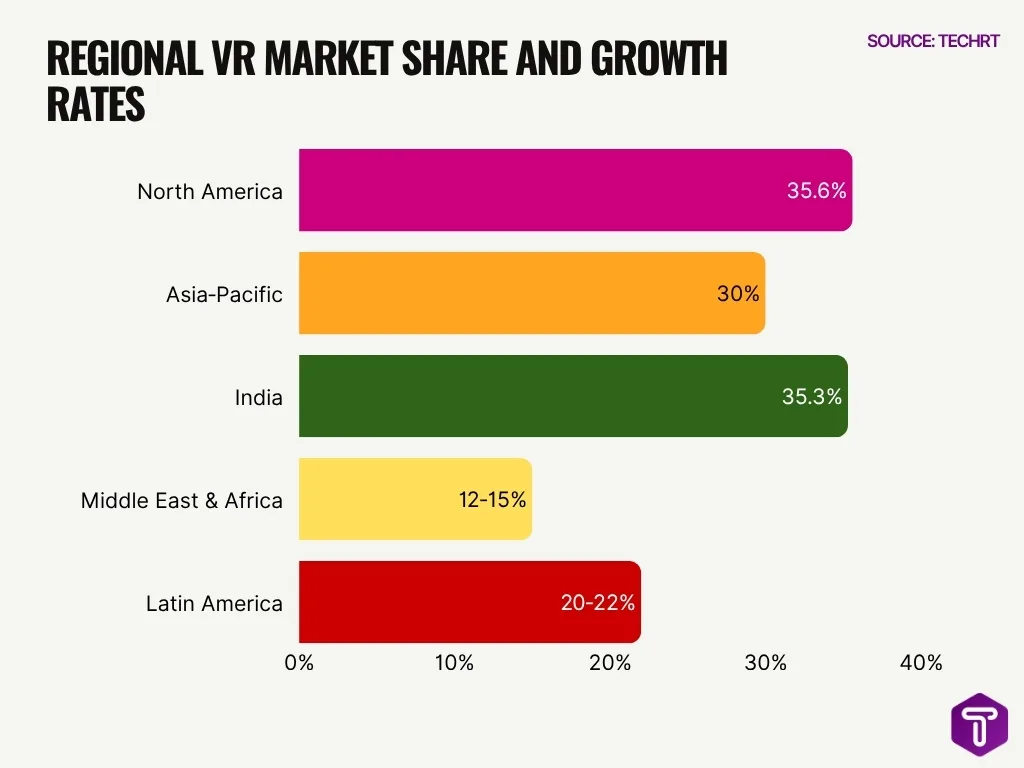
- North America accounts for 35.6% of the global virtual reality market in 2025.
- The global VR market was valued at $20.83 billion in 2025, with North America leading by share.
- The U.S. VR market alone was valued at $4.32 billion in 2025, making it the largest single-country contributor.
- The Asia‑Pacific VR market is projected to grow at a CAGR exceeding 30%, making it the fastest‑growing region.
- China contributes over one‑third of global VR hardware production and is a top consumer market for VR headsets.
- The European VR market is expected to reach $47.61 billion by 2026, driven by enterprise and gaming adoption.
- India’s VR market is projected to grow at a CAGR of 35.3% through the forecast period, one of the highest in Asia.
- Japan and South Korea together account for over 40% of Asia‑Pacific VR gaming revenue in 2025.
- The Middle East and Africa VR market is expected to grow at a double‑digit CAGR of 12–15% through 2030.
- Latin America’s VR adoption is expanding at a CAGR of 20–22%, led by education and corporate training applications.
Virtual Reality for Education and Training
- VR-based training improves learning retention by up to 75% compared to traditional methods.
- Students trained with VR are 4 times faster to train than classroom learners.
- Around 30% of educational institutions in the U.S. have adopted VR tools.
- The global VR education market is expected to grow at a 28% CAGR through 2030.
- VR simulations are widely used in medical and aviation training programs.
- Over 50% of enterprises use VR for employee training and onboarding.
- VR reduces training costs by up to 40% in large organizations.
- Schools using VR report higher student engagement and improved test scores.
- Remote learning platforms increasingly integrate VR for immersive experiences.
Virtual Reality in Gaming and Entertainment
- VR gaming revenue is projected to reach $92.31 billion by 2027.
- Gaming accounts for over 40% of total VR market revenue.
- Over 60% of VR users primarily use the technology for gaming.
- Popular VR games drive hardware sales, contributing significantly to market growth.
- The number of VR gamers worldwide is expected to exceed 100 million by 2026.
- Live VR events and concerts have grown, with millions attending virtual experiences annually.
- VR arcades and location-based entertainment are rebounding post-pandemic.
- Streaming platforms are integrating VR, offering immersive viewing experiences.
- Esports is exploring VR formats, with early adoption in competitive gaming leagues.
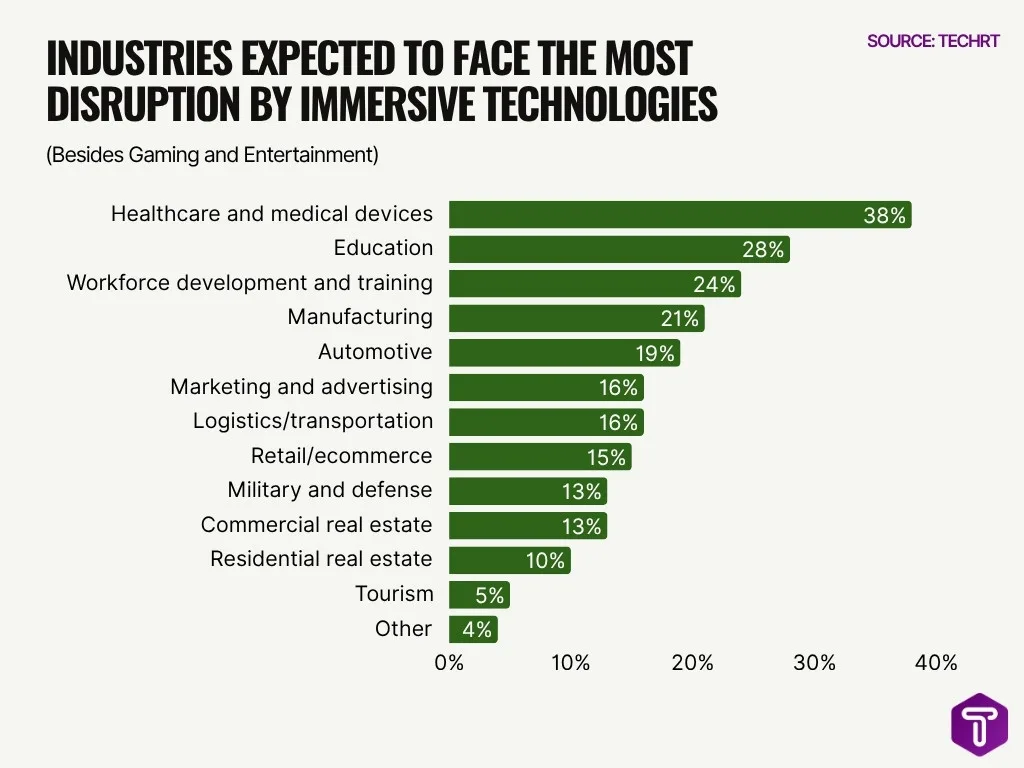
Immersive Technologies Disruption Across Industries
- Healthcare and medical devices lead at 38%, making it the most impacted sector, highlighting strong adoption of VR/AR in surgery, diagnostics, and patient care.
- Education ranks second with 28%, indicating rapid integration of immersive tools for interactive learning and virtual classrooms.
- Workforce development and training (24%) shows growing reliance on VR for skill-building, simulations, and corporate training programs.
- Manufacturing (21%) is increasingly leveraging immersive tech for process optimization, safety training, and prototyping.
- The automotive industry (19%) is adopting VR/AR for design, testing, and driver training simulations.
- Marketing and advertising (16%) and logistics/transportation (16%) are equally impacted, using immersive tech for customer engagement and operational efficiency.
- Retail/ecommerce (15%) is transforming through virtual shopping experiences and product visualization.
- Military and defense (13%) and commercial real estate (13%) are utilizing immersive technologies for training simulations and virtual property tours.
- Residential real estate (10%) is moderately impacted, driven by virtual home walkthroughs and remote buying experiences.
- Tourism (5%) shows limited but emerging use cases like virtual travel experiences and destination previews.
- The “Other” category (4%) indicates minimal disruption across smaller or less tech-dependent industries.
- Overall, industries focused on training, simulation, and visualization are experiencing the highest levels of disruption, emphasizing the core strengths of immersive technologies.
Virtual Reality in Healthcare Applications
- VR in healthcare is projected to reach $14.06 billion by 2030, driven by therapy and surgical training.
- Hospitals using VR for pain management report up to 24% reduction in pain levels among patients.
- VR therapy has helped reduce opioid usage by over 20% in some clinical trials.
- Around 65% of healthcare professionals believe VR improves patient outcomes.
- VR-based surgical training improves accuracy by up to 230% compared to traditional methods.
- Mental health applications of VR, including PTSD treatment, have shown success rates above 60%.
- Over 30% of medical schools in the U.S. now incorporate VR training modules.
- VR rehabilitation programs help stroke patients recover mobility up to 30% faster.
- Remote VR consultations are growing, especially in rural healthcare settings.
Virtual Reality in Business and Enterprise
- Over 75% of Fortune 500 companies using VR for training report it as a valuable resource.
- VR training reduces training time by up to 75% compared to traditional methods.
- Employees trained with VR are 275% more confident in applying skills learned.
- VR onboarding boosts employee retention by 40%.
- VR learners are 3.75x more emotionally connected to training content than classroom learners.
- Shoppers using 3D/VR models are 40% more likely to complete purchases.
- VR tours reduce property selling time by 28–49%.
- UK manufacturing sees 50–70% fewer workplace accidents with VR safety training.
- Over 40% of enterprise VR deployments focus on remote collaboration in 2025.
- By 2030, enterprise users will account for over 60% of VR revenue.
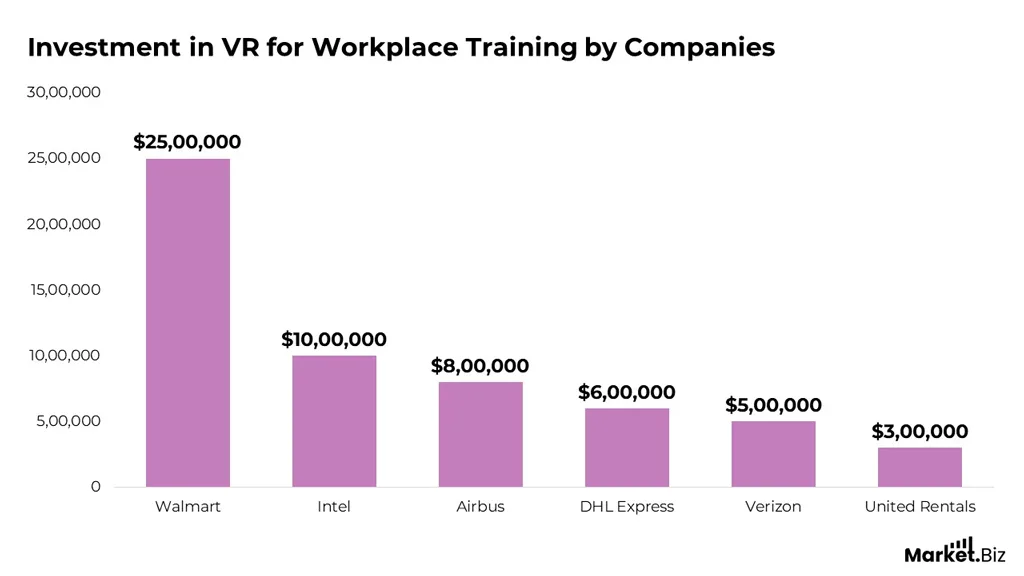
VR Investment in Workplace Training
- Walmart leads significantly with an investment of $2.5 million, making it the largest investor among the listed companies.
- Intel follows with $1 million, investing less than half of Walmart’s total, indicating a notable gap between the top two.
- Airbus allocated $800,000, positioning itself as the third-highest investor in VR-based training.
- DHL Express invested $600,000, showing a moderate commitment toward immersive training technologies.
- Verizon contributed $500,000, staying close to DHL but still 20% lower in investment.
- United Rentals has the lowest investment at $300,000, which is over 8x smaller than Walmart’s spending.
- The top three companies (Walmart, Intel, Airbus) together account for a major share of total investments, highlighting concentration among leading enterprises.
- There is a clear downward trend in investment from $2.5 million to $300,000, suggesting varying levels of VR adoption maturity across industries.
- The data reflect that large-scale enterprises are more aggressive adopters of VR training compared to smaller or less tech-focused firms.
- Overall, the investment range ($300K to $2.5M) shows that VR training budgets vary widely, depending on company size, industry, and digital transformation priorities.
Virtual Reality Startups and Investment Trends
- Global investment in VR startups exceeded $4.1 billion in 2025, reflecting strong investor confidence.
- Venture capital funding in XR (VR + AR) has grown at a 20% annual rate since 2020.
- The number of VR startups globally surpassed 3,500 companies in 2025.
- The U.S. leads VR startup funding, accounting for over 40% of total global investment.
- Enterprise-focused VR startups attract over 60% of total funding, especially in training and simulation.
- Early-stage VR startups saw an average deal size increase of 15% year-over-year.
- Asia-Pacific is emerging as a startup hub, particularly in China and South Korea.
- Corporate investments from tech giants continue to accelerate VR innovation.
- Government funding programs are supporting VR startups in the education and healthcare sectors.
Virtual Reality Headset Market Share
- Meta dominates the VR headset market with over 50% global market share in 2025.
- Sony holds approximately 20% market share, driven by PlayStation VR devices.
- Apple entered the market with premium devices, capturing early adopters in 2025.
- The global VR headset market shipped over 10 million units in 2024 alone.
- Standalone headsets account for over 70% of total shipments, replacing tethered systems.
- The average selling price of VR headsets dropped by 15% between 2023 and 2025.
- Enterprise-grade headsets are growing faster than consumer devices.
- Asia-Pacific leads manufacturing, producing over 60% of global VR hardware.
- New entrants are focusing on lightweight and mixed-reality capabilities.
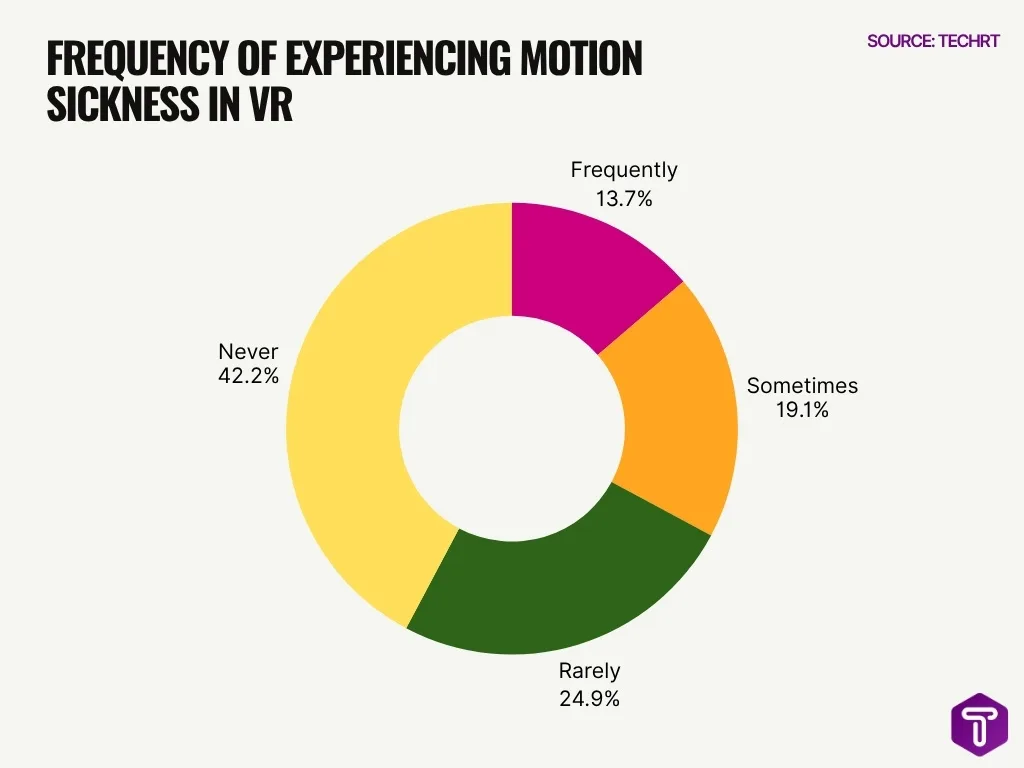
Key Insights on Motion Sickness in Virtual Reality
- A significant 42.2% of users report never experiencing motion sickness, indicating that VR is comfortable for a large portion of users.
- Around 24.9% of users rarely experience motion sickness, suggesting occasional discomfort but generally manageable experiences.
- Approximately 19.1% of users experience motion sickness sometimes, highlighting a moderate segment affected intermittently.
- Only 13.7% of users experience motion sickness frequently, showing that severe or consistent discomfort is relatively limited.
- Overall, nearly 67.1% of users (rarely + never) experience little to no motion sickness, reinforcing improved VR technology and user adaptation.
- However, about 32.8% of users (frequently + sometimes) still face noticeable motion sickness, indicating room for further optimization in VR design and hardware.
- The data reflects a declining barrier to VR adoption, as the majority of users report minimal discomfort during usage.
Barriers to Virtual Reality Adoption
- High hardware costs deter roughly 65% of non‑users from adopting VR due to expensive headsets and PCs.
- Motion sickness affects an estimated 40–70% of users within 15 minutes of VR use, limiting sustained sessions.
- Over 30% of non‑users report that lack of compelling content is a primary reason they avoid VR.
- About 25% of AR/VR app users never return after the first day, highlighting strong early‑use attrition.
- Limited battery life and hardware discomfort cut typical VR sessions short, with many users stopping after 20–30 minutes.
- Roughly half of U.S. residents say they will wait for cheaper VR hardware before entering the metaverse or using VR regularly.
- Limited computing power excludes many users in developing regions, where only about 30% of households can run modern VR experiences.
- Social acceptance remains low, with only 12% of global consumers viewing VR as “essential” compared with smartphones or social media.
- Content fragmentation across platforms means that fewer than 20% of VR titles are available on all major headsets, hurting ecosystem growth.
- Enterprise users increasingly cite privacy and data security concerns, with over 40% of business leaders delaying VR pilots over data‑handling risks.
Virtual Reality Trends and Future Outlook
- Global VR market to reach $435 billion by 2030, growing at a CAGR of 27.5%.
- AI in the VR market is projected to be $198.5 billion by 2033 with a 25% CAGR.
- The mixed reality market is expected to hit $27.5 billion by 2033 from $2.16 billion in 2024.
- Enterprise applications to grow fastest at 22.5% CAGR in the VR market.
- VR in the healthcare market to surge with 50.22% CAGR through 2028.
- VR education market to expand to $9.8 billion by 2032 at 26.2% CAGR.
- 5G in the VR market is valued at $50 billion in 2024, reaching $210 billion by 2033.
- Metaverse market to exceed $1,303 billion by 2030 at 48% CAGR.
- Global VR users are currently at 171 million, and penetration is rising to 55.9% by 2028.
Frequently Asked Questions (FAQs)
What is the global virtual reality market size in 2026?
How many people use virtual reality worldwide in 2025–2026?
What is the expected CAGR of the VR market over the next decade?
What percentage of businesses are adopting VR technology?
How large is the VR gaming market expected to become?
Conclusion
Virtual reality is no longer limited to gaming; it now plays a critical role in transforming how industries operate and how people interact with digital environments. From improving patient outcomes in healthcare to enabling faster, more effective employee training in enterprises, VR delivers measurable value across use cases. Additionally, falling device costs, improved accessibility, and stronger content ecosystems are lowering the barriers to entry for both individuals and organizations.
Looking ahead, the data points to sustained growth fueled by innovation in hardware, integration with AI, and expansion into areas like education, remote collaboration, and virtual commerce. As adoption scales globally, VR is set to reshape learning, productivity, and digital experiences at a fundamental level. Understanding these trends and statistics provides a clear view of where the technology stands today and where it is heading in the years to come.

Leave a comment
Have something to say about this article? Add your comment and start the discussion.