


Google’s Gemini has rapidly evolved from an experimental AI assistant into a foundational layer across search, mobile ecosystems, and enterprise software. Today, companies use Gemini to streamline customer support, generate marketing content, and automate data-heavy workflows, while developers integrate it into applications through APIs and cloud tools. Its deep integration with Google Search and Android gives it an unmatched distribution advantage, influencing how billions of users interact with information daily.
As AI adoption accelerates across industries such as e-commerce, SaaS, and digital marketing, Gemini’s growth metrics offer valuable insight into where the broader AI landscape is heading. Understanding these trends helps businesses, marketers, and developers make informed decisions about adopting and scaling AI solutions. Let’s explore the latest data shaping Gemini’s rise.
Editor’s Choice
- Google Gemini crossed 750 million monthly active users (MAUs) in early 2026, reflecting rapid adoption.
- The platform grew from ~450 million MAUs in early 2025 to 750 million+ by Q4 2025.
- Gemini reached 650 million users by late 2025, before accelerating further in 2026.
- Daily active users surpassed 35 million in 2025, indicating strong engagement.
- Gemini recorded over 1.2 billion monthly visits at its peak in October 2025.
- The AI assistant is integrated across 1–5 billion devices globally, giving it massive distribution.
- AI Overviews powered by Gemini now reach 2 billion monthly users via search.
Recent Developments
- Google launched Gemini 3 Pro in November 2025, marking a major leap in reasoning capabilities.
- The rollout of Gemini 3 contributed to a 100 million user increase within a quarter.
- Gemini’s MAU growth surged 30% between August and November 2025, outpacing competitors.
- Google expanded Gemini integration into Android, Wear OS, and smart home devices.
- Gemini APIs now process over 10 billion tokens per minute, showing enterprise-scale usage.
- Google made premium features like Gemini 2.5 Pro free, boosting adoption rates.
- Over 70% of Google Cloud customers now use Gemini-powered AI tools.
- More than 1.5 million developers actively use Gemini APIs, reflecting ecosystem growth.
- Gemini adoption expanded across 230+ countries, highlighting global reach.
Google Gemini Monthly Active Users
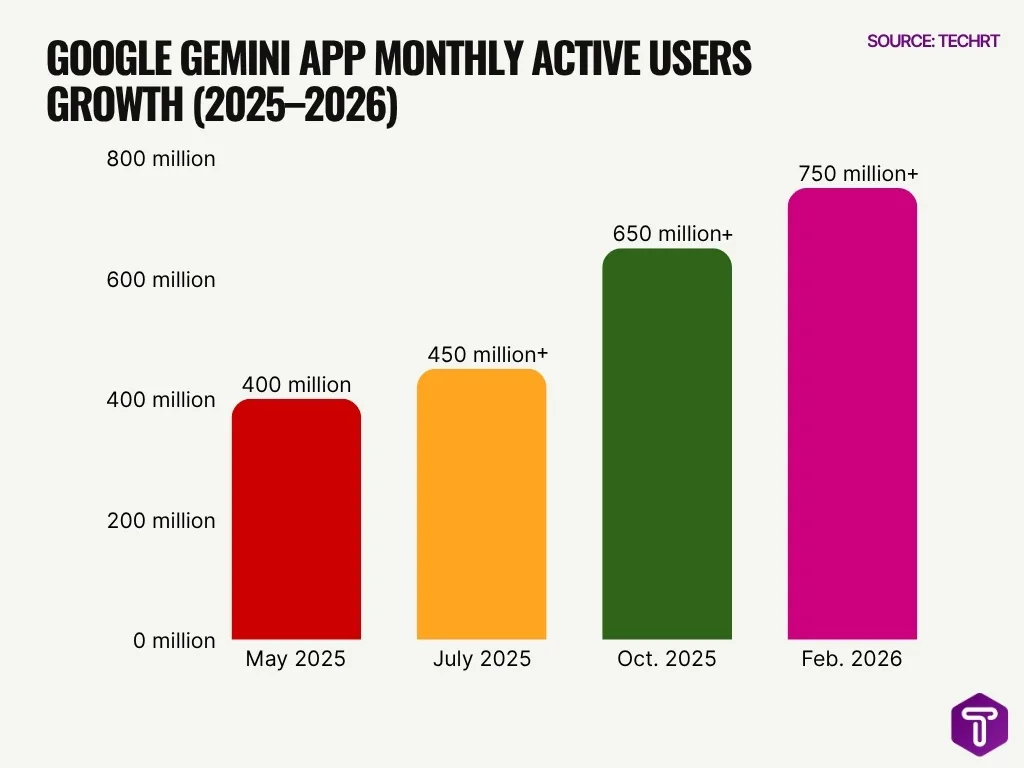
- The data highlights a consistent upward trajectory, with each period showing higher absolute user gains than the previous phase.
- The Gemini app experienced rapid user growth, increasing from 400 million MAUs in May 2025 to 750 million+ by February 2026.
- Within just 9 months, the platform added 350 million+ users, reflecting explosive adoption in the AI tools market.
- Between May and July 2025, users grew from 400 million to 450 million+, marking an early growth phase of roughly 12.5% increase.
- The most significant jump occurred between July and October 2025, where users surged from 450 million+ to 650 million+, adding 200 million+ users in just 3 months.
- Growth continued steadily into early 2026, reaching 750 million+ users by February, indicating sustained momentum rather than short-term spikes.
- Overall, Gemini’s user base grew by approximately 87.5% from May 2025 to February 2026, showcasing strong market penetration and user retention.
Google Gemini Daily Active Users
- Gemini recorded over 35 million daily active users (DAUs) in 2025.
- Daily usage increased by 50% quarter-over-quarter in 2025.
- DAUs grew alongside MAUs, maintaining a strong engagement ratio above 7%.
- Weekly activity increased by 52% during the late 2025 growth surge.
- Daily engagement rose significantly after Gemini 3, and new features were launched.
- AI-powered search interactions contributed to billions of daily queries via Gemini integrations.
- Increased mobile integration drove higher daily retention rates across Android devices.
- Viral features like image generation tools boosted daily session frequency among younger users.
Google Gemini App Downloads
- Gemini recorded 75 million downloads in 2024, making it one of the fastest-growing AI apps.
- The app surpassed 10 million downloads on Google Play in 2025.
- Download growth accelerated after the rebrand from Bard to Gemini in 2024.
- Global downloads surged alongside AI adoption trends across mobile ecosystems.
- Countries like Vietnam and Mexico contributed ~4% of global downloads each.
- Integration with Android helped Gemini achieve mass distribution without relying solely on app installs.
- App installs increased sharply after Gemini Pro features became widely accessible.
- The app is now available across iOS, Android, and web platforms, expanding its install base.
Google Gemini Most Used Features
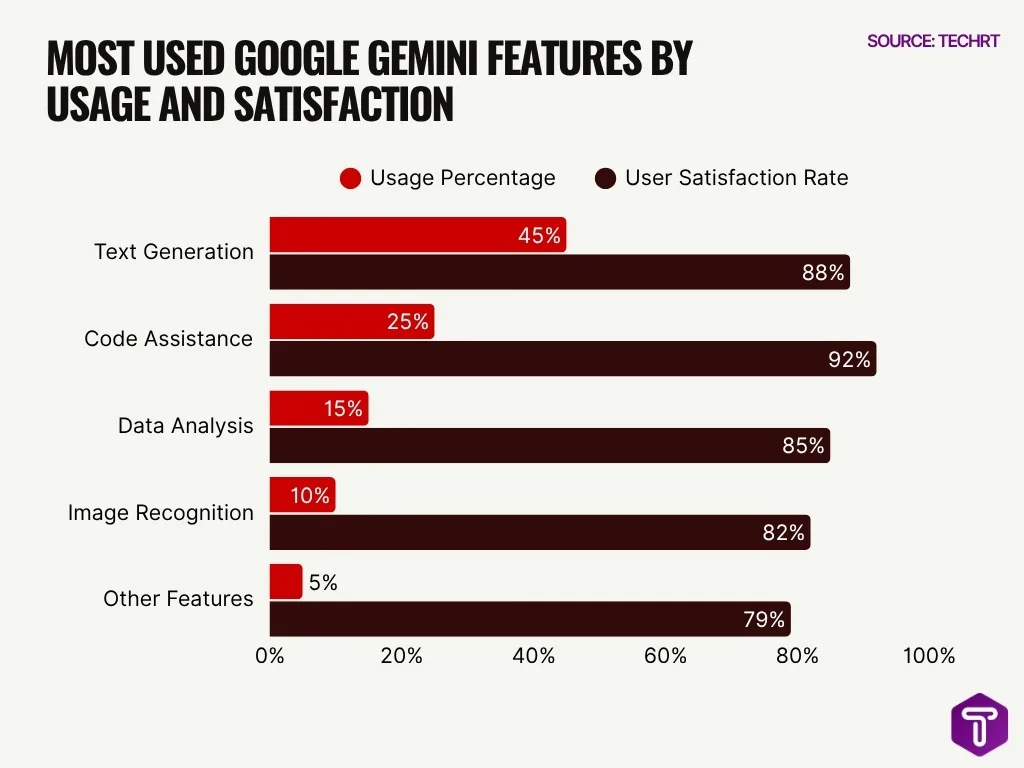
- Text Generation dominates usage, accounting for 45% of total usage, making it the most widely used feature in Google Gemini.
- Despite being the most used, Text Generation has a strong satisfaction rate of 88%, indicating high user trust and reliability.
- Code Assistance stands out with the highest satisfaction, achieving an impressive 92% user satisfaction rate, even though it represents only 25% of usage.
- This suggests that developers and technical users find Code Assistance highly effective and valuable.
- Data Analysis is moderately used, contributing 15% of usage, with a solid 85% satisfaction rate, highlighting its growing importance for business and analytical tasks.
- Image Recognition sees lower adoption, with just 10% usage, and a slightly lower 82% satisfaction rate, indicating room for improvement in visual AI capabilities.
- Other Features collectively account for only 5% usage, and have the lowest satisfaction rate at 79%, suggesting these features are either niche or under-optimized.
- Overall, there is a clear trend: core functionalities (text and code) drive the majority of usage and satisfaction, while specialized features lag behind in both adoption and performance.
Google Gemini Web Traffic and Visits
- Gemini recorded over 1.2 billion monthly web visits at its peak in late 2025.
- The platform averaged 900 million+ monthly visits throughout 2025, showing consistent demand.
- Traffic grew by over 60% year-over-year from 2024 to 2025, driven by AI search integration.
- The U.S. contributed roughly 18% of total web traffic, making it the largest single market.
- India accounted for nearly 9% of Gemini traffic, reflecting strong mobile adoption.
- Average visit duration exceeded 6 minutes per session, indicating deep engagement.
- Users viewed 4–6 pages per visit on average, highlighting multi-step interactions.
- Bounce rates remained around 35%–40%, lower than many AI tools due to ecosystem integration.
- Traffic spikes aligned with product launches, especially after the Gemini 3 rollout in Q4 2025.
Google Gemini Growth by Quarter or Year
- Gemini’s user base expanded from ~350 million in early 2025 to 750 million+ by early 2026.
- Q4 2025 alone saw a 100 million+ user increase, one of the fastest growth periods.
- Quarterly growth averaged 20%–30% throughout 2025, driven by feature releases.
- The rebranding from Bard to Gemini triggered a significant adoption spike in 2024.
- Gemini adoption grew 5× faster than earlier Google AI tools during its first year.
- Enterprise usage increased by over 40% year-over-year entering 2026.
- Mobile usage doubled between mid-2024 and late-2025, fueled by Android integration.
- Growth in emerging markets outpaced developed regions by ~25%.
- Analysts estimate Gemini could cross 1 billion users before 2027.
Google Gemini Market Share Among AI Chatbots
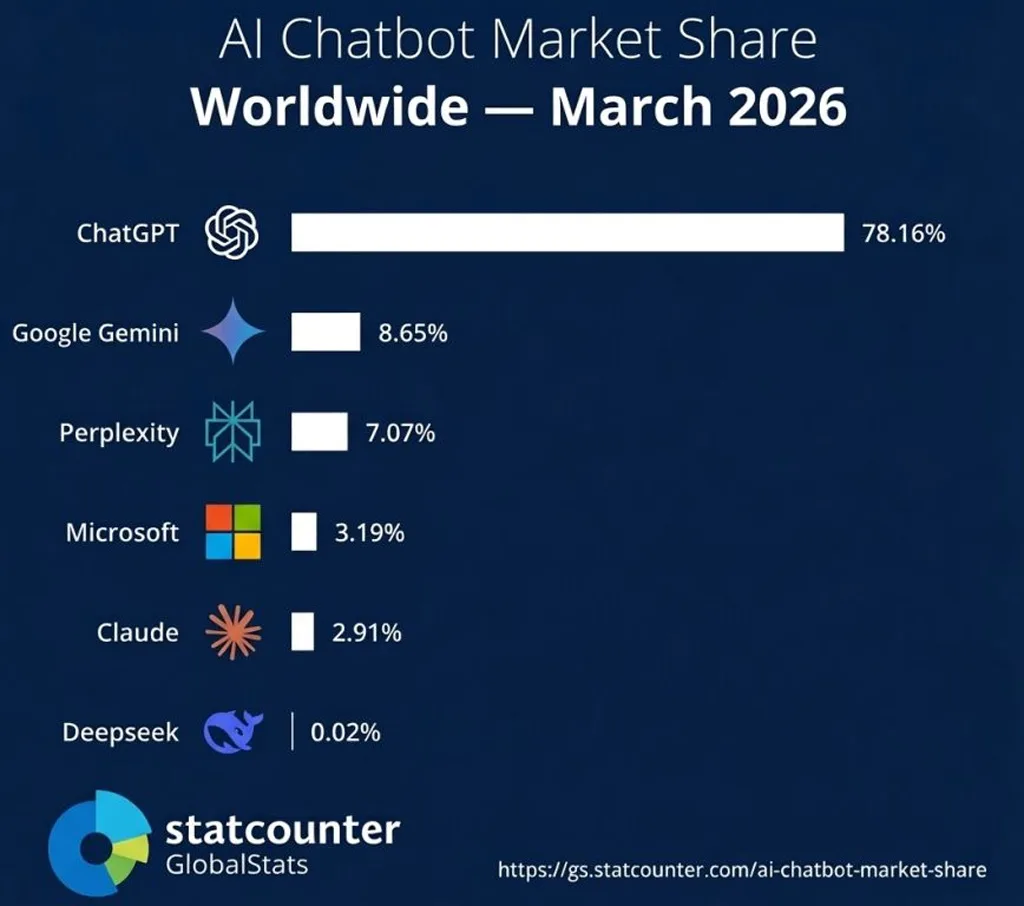
- ChatGPT dominates the market with a massive 78.16% share, making it the clear leader by a wide margin.
- Google Gemini ranks second at 8.65%, but trails far behind ChatGPT by nearly 70 percentage points.
- Perplexity holds a notable position with 7.07%, closely competing with Google Gemini for the second spot.
- Microsoft accounts for 3.19%, indicating a relatively smaller presence despite strong ecosystem integration.
- Claude captures 2.91%, showing moderate adoption but still under 3% market share.
- DeepSeek has a negligible share of just 0.02%, highlighting minimal market penetration.
- The top three players (ChatGPT, Gemini, Perplexity) collectively control over 93% of the market, indicating strong market concentration.
- There is a significant drop-off after the top player, with no other chatbot exceeding 10% share.
- The market shows a clear dominance pattern, where one leader vastly outperforms all competitors.
Google Gemini User Demographics
- Approximately 58% of Gemini users are male, with females making up about 42% of the user base.
- Users aged 18–34 represent roughly 51% of the total user base, highlighting heavy Gen Z and millennial adoption.
- The 25–34 age group alone accounts for nearly 30% of users, the largest single demographic segment.
- The United States generates about 14% of Gemini traffic, the highest share among countries as of late 2025.
- India contributes around 11% of Gemini traffic, reflecting strong adoption in emerging digital‑growth markets.
- Over 70% of active users have at least some college education, underscoring its appeal to knowledge‑driven professionals.
- Developers and marketers together form roughly 25% of power users, driving intensive usage across workflows.
- Enterprise professionals represent about 20% of active users, boosted by deep integration with Google Workspace tools.
- Emerging markets drive over 35% of new user growth, signaling rapid expansion beyond Western tech hubs.
- Students and early‑career professionals make up roughly 30% of the user base, fueling AI‑assisted learning and experimentation.
Google Gemini Usage by Device (Desktop vs Mobile)
- Mobile accounts for ~65% of total Gemini usage, reflecting Android integration.
- Desktop usage contributes around 35% of total interactions, mainly for productivity tasks.
- Mobile usage grew by over 80% between 2024 and 2025.
- Android devices drive the majority of mobile usage, given pre-installed integrations.
- iOS adoption increased steadily, contributing ~20% of mobile usage share.
- Desktop users tend to have longer session durations (8+ minutes).
- Mobile users generate higher daily session frequency, averaging multiple sessions per day.
- Voice-based interactions are more common on mobile, especially through smart assistants.
- Tablet and wearable usage remains niche but growing, contributing under 5% of usage.
Google Gemini Traffic Sources Breakdown
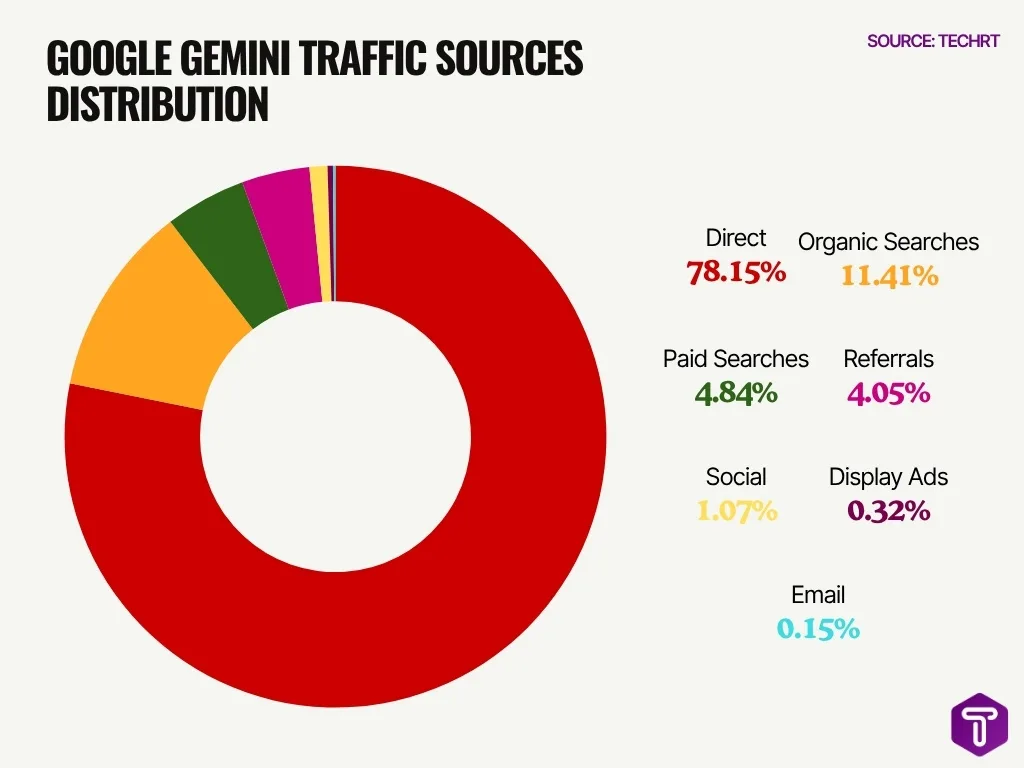
- Direct traffic dominates with a massive 78.15% share, indicating strong brand recognition and high repeat user engagement.
- Organic search contributes 11.41%, showing that SEO still plays a key role in user acquisition, but is secondary to direct visits.
- Paid search drives 4.84% of traffic, suggesting moderate reliance on paid acquisition channels like search ads.
- Referral traffic accounts for 4.05%, highlighting the importance of third-party websites, partnerships, and backlinks.
- Social media generates only 1.07%, indicating that social platforms are a minor traffic driver for Gemini compared to other channels.
- Display advertising contributes just 0.32%, showing a limited impact of banner/display campaigns on overall traffic.
- Email traffic is minimal at 0.15%, suggesting low dependency on email marketing for user visits.
- Overall, the data reveals a heavily skewed traffic distribution, where over 3/4th of users come directly, emphasizing strong ecosystem integration and user loyalty.
Google Gemini AI Overviews Usage
- AI Overviews powered by Gemini now reach 2 billion monthly users via Google Search.
- Over 60% of search queries in the U.S. show AI-generated summaries.
- AI Overviews increased click-through rates for informational queries by up to 25%.
- The feature reduced zero-click searches by ~10% in some verticals, changing SEO dynamics.
- Mobile searches account for over 70% of AI Overview impressions.
- Gemini-powered summaries process billions of queries daily.
- Publishers report mixed impact, with traffic changes ranging from -20% to +15% depending on niche.
- AI Overviews are now available in 120+ countries, expanding global reach.
- Adoption continues to grow as Google integrates AI deeper into core search experiences.
Google Gemini AI Mode Usage
- Google introduced AI Mode in Search, powered by Gemini, reaching hundreds of millions of users by 2026.
- AI Mode is now active in over 120 countries, expanding rapidly beyond the U.S.
- More than 65% of experimental users opted into AI Mode features during testing phases.
- AI Mode interactions increased average query length by 2× compared to traditional search.
- Users spend 30% more time per session when AI Mode is enabled.
- AI Mode contributes to billions of AI-assisted search responses daily.
- Early adoption is highest among Gen Z and millennial users, especially in the U.S.
- Enterprise users increasingly rely on AI Mode for research, summarization, and decision-making workflows.
- AI Mode usage continues to grow as Google expands multimodal capabilities across search.
Google Gemini Adoption Across Industries
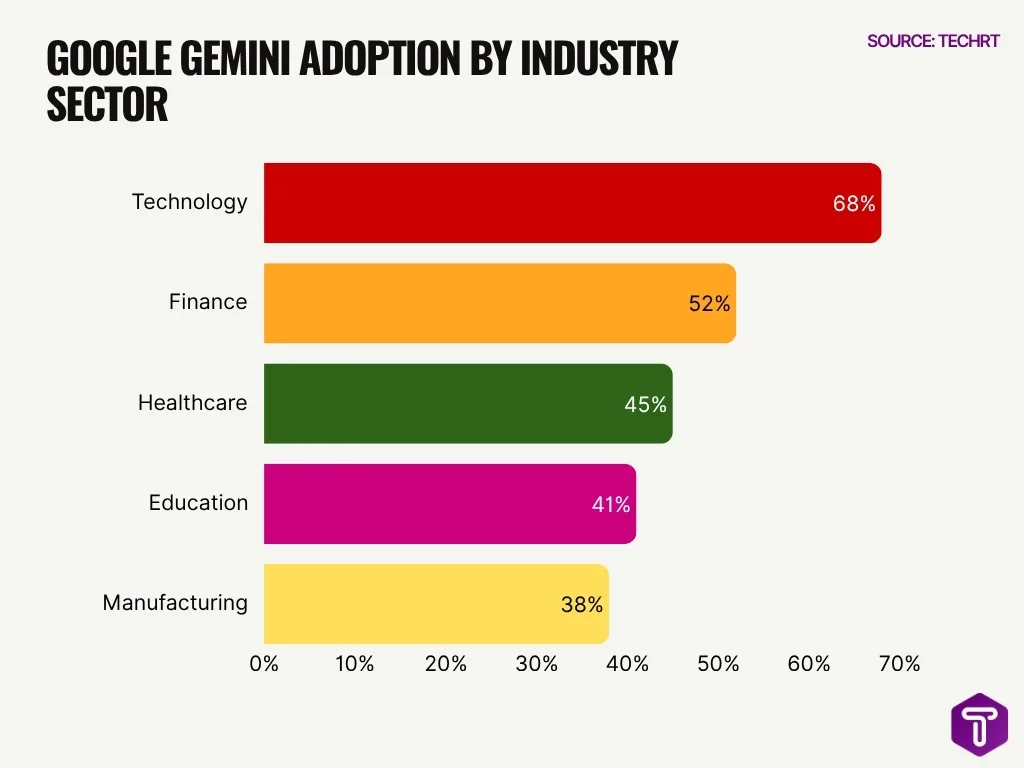
- The Technology sector leads adoption at 68%, making it the most active industry leveraging Google Gemini for code development and programming tasks.
- The Finance industry follows with 52% adoption, primarily using Gemini for data analysis, highlighting its role in decision-making and financial insights.
- Healthcare shows a 45% adoption rate, where Gemini is widely used for research assistance, supporting medical studies, and data interpretation.
- In the Education sector, 41% adoption indicates strong usage for content creation, including study materials, lesson plans, and academic support.
- The Manufacturing industry records 38% adoption, utilizing Gemini for process optimization, improving efficiency, and operational workflows.
- There is a clear trend where knowledge-intensive industries (Technology, Finance, Healthcare) show higher adoption rates above 45%, compared to more operations-driven sectors.
- The gap between the highest (68%) and the lowest (38%) adoption is 30 percentage points, indicating uneven AI adoption maturity across industries.
- Overall, Gemini’s usage is highly use-case driven, with each industry adopting it for specialized, domain-specific applications rather than general use.
Google Gemini Engagement Metrics
- Average session duration ranges from 6 to 8 minutes per visit, depending on use case.
- Users interact with 4–6 prompts per session on average.
- Daily retention rates exceed 35% for active users, indicating strong stickiness.
- Weekly retention improved by 50% during 2025 feature rollouts.
- Power users generate 10+ queries per day, especially in enterprise environments.
- Engagement increased significantly after multimodal features (image, voice) were introduced.
- Bounce rates remain relatively low at under 40%, compared to standalone AI tools.
- Users in the U.S. show higher engagement depth, with longer sessions and more queries.
- Educational use cases contribute to high repeat usage among students.
Google Gemini Model Usage and Popularity
- Gemini 3 Pro leads with 750 million monthly active users in 2026, driving widespread adoption.
- Over 70% of Google Cloud customers use Gemini models for enterprise AI.
- Gemini Nano powers AI on over 3 billion Android devices worldwide.
- Multimodal capabilities score 84% on the MMMU benchmark, boosting adoption.
- Gemini Ultra serves 8 million enterprise seats across 2,800+ companies.
- Developers generate 310 million API requests daily with Gemini models.
- Multimodal queries account for nearly 17% of AI Mode interactions.
- Gemini integrations save 105 minutes weekly per Workspace user.
- Hallucination rates dropped over 50% in Gemini 3.1 Pro vs prior models.
- 13 million developers actively build with Gemini generative models.
Programming Language Support in Google Gemini
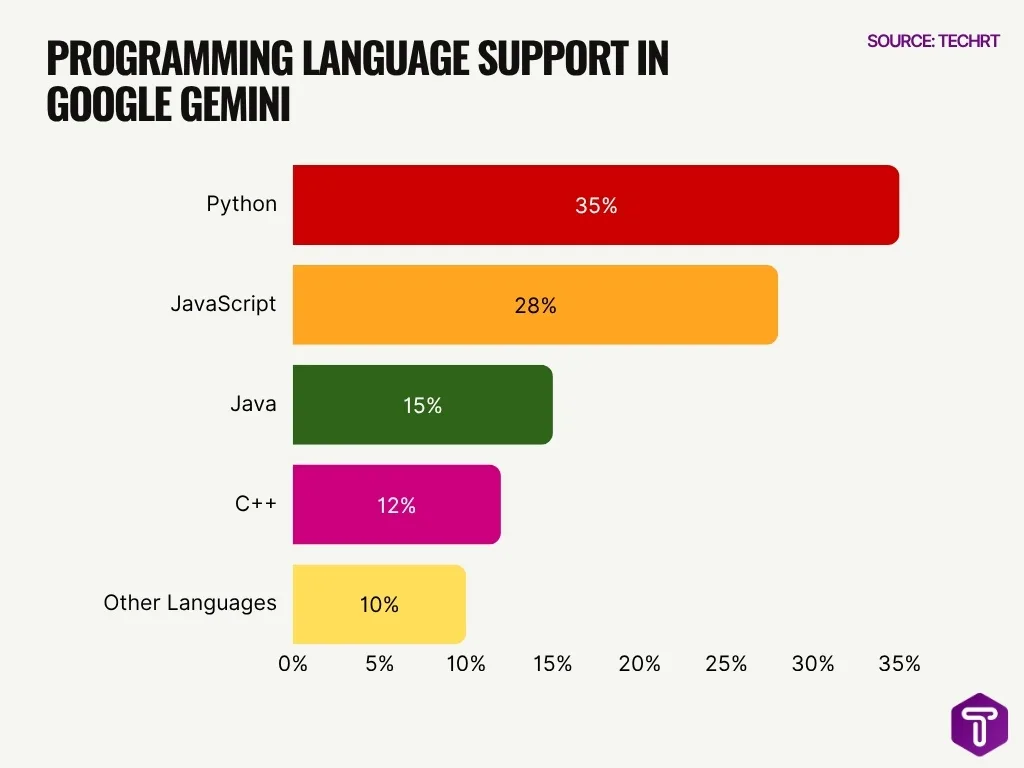
- Python leads with 35% usage, making it the most supported and preferred language, likely due to its dominance in AI, machine learning, and data science workflows.
- JavaScript holds a strong 28% share, highlighting its importance in web development, frontend-backend integration, and full-stack applications.
- Java accounts for 15%, indicating steady adoption in enterprise environments, backend systems, and large-scale applications.
- C++ contributes 12%, reflecting its role in performance-critical tasks, system-level programming, and high-efficiency computing.
- Other languages collectively make up 10%, showing diversity in support, but with significantly lower adoption compared to the top languages.
- The top two languages (Python + JavaScript) together dominate with 63% combined usage, emphasizing a strong tilt toward modern, developer-friendly ecosystems.
- There is a clear trend toward high-level and versatile languages, suggesting that Google Gemini is optimized for productivity, rapid development, and AI-driven use cases.
Google Gemini Enterprise Adoption
- Over 70% of Google Cloud customers use Gemini-powered features in 2026.
- Gemini adoption in enterprises grew by 40% year-over-year from 2025 to 2026.
- Fortune 500 companies increasingly deploy Gemini for automation and data analysis workflows.
- More than 1.5 million developers and businesses use Gemini APIs globally.
- Enterprise AI spending involving Gemini tools increased by over 35% in 2025.
- Gemini integration in Google Workspace drives adoption across Gmail, Docs, and Sheets users.
- Industries such as healthcare, finance, and retail lead the adoption of Gemini-based AI tools.
- Enterprises report productivity gains of 20%–30% after deploying Gemini solutions.
- AI copilots powered by Gemini are now standard in many enterprise SaaS environments.
Google Gemini Enterprise Paid Seats and Customers
- Google Workspace AI (Gemini) reached over 10 million paid enterprise seats by 2026.
- Paid adoption grew by 3× year-over-year between 2024 and 2026.
- Thousands of enterprises upgraded to Gemini Advanced plans within the first year.
- Large enterprises account for over 60% of paid Gemini subscriptions.
- Small and mid-sized businesses represent a growing segment, contributing ~25% of paid users.
- Subscription-based revenue models drive recurring income streams for Google AI services.
- Paid Gemini features include advanced reasoning, longer context windows, and priority access.
- Enterprise customers report improved ROI within 6–12 months of adoption.
- Demand for paid AI seats continues to rise alongside enterprise digital transformation initiatives.
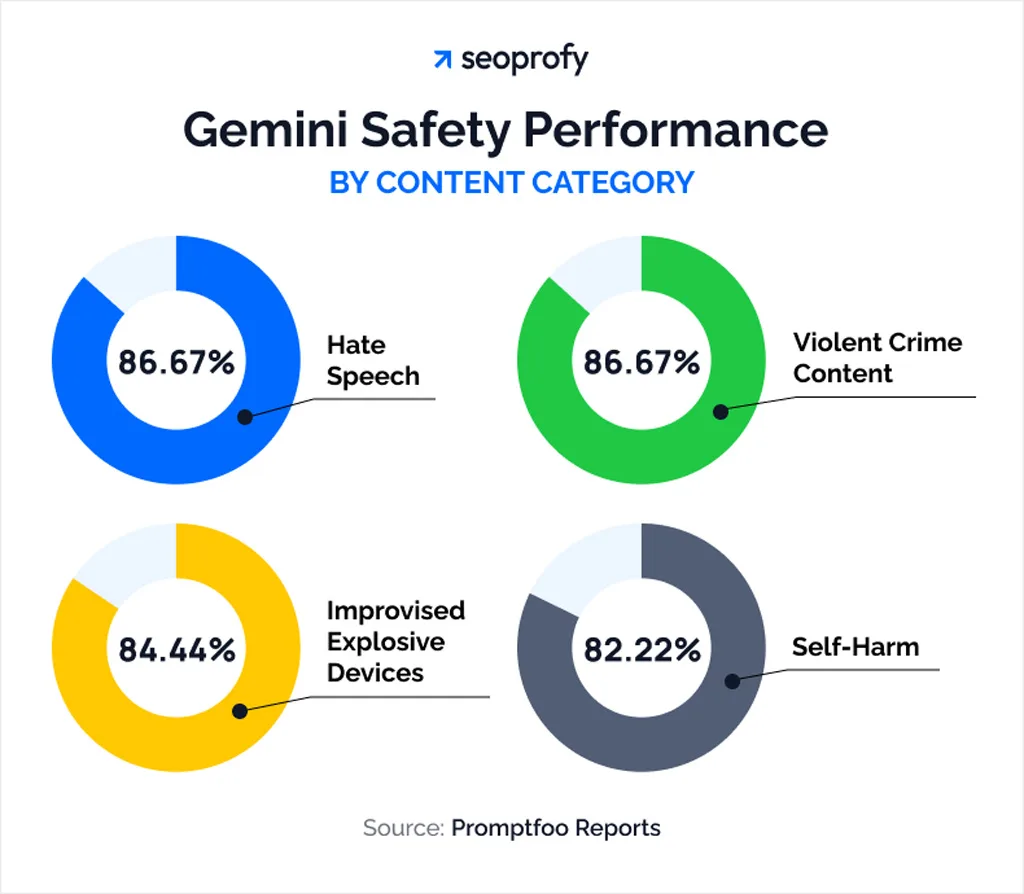
Gemini Safety Performance by Content Category
- Top-performing categories include Hate Speech and Violent Crime Content, both achieving a high safety score of 86.67%, indicating strong moderation capabilities in these areas.
- Improvised Explosive Devices (IED) content follows closely with a safety performance of 84.44%, showing relatively robust but slightly lower control compared to the top categories.
- Self-Harm content has the lowest safety performance at 82.22%, highlighting a potential gap in handling sensitive and high-risk content.
- The overall performance range is relatively narrow, between 82.22% and 86.67%, suggesting consistent but not perfect safety enforcement across categories.
- There is a 4.45 percentage point gap between the highest and lowest categories, indicating room for improvement in more complex or nuanced content areas like self-harm.
- With all categories scoring above 80%, the data reflects a generally strong safety baseline, but emphasizes the need for continued optimization in critical risk domains.
Google Gemini API Usage and Token Volume
- Gemini APIs process over 10 billion tokens per minute across applications.
- Developers generate trillions of tokens monthly through Gemini integrations.
- API usage grew by over 150% year-over-year in 2025.
- More than 1.5 million developers actively use Gemini APIs.
- Enterprise applications account for over 60% of total API token consumption.
- Real-time applications such as chatbots and copilots drive high-frequency API calls.
- Gemini APIs support multimodal inputs, increasing token complexity and volume.
- API pricing models are based on token usage tiers, enabling scalable adoption.
- Startups increasingly rely on Gemini APIs for AI-native product development.
Google Gemini Revenue and Monetization
- Google Cloud revenue hit an annual run rate above $70 billion in 2025, driven largely by AI products like Gemini.
- Gemini app reached 750 million monthly active users by Q4 2025.
- Over 8 million paid seats sold for Gemini Enterprise across 2,800+ companies as of early 2026.
- Gemini models process over 10 billion tokens per minute via direct API usage.
- Revenue from products built on Google’s generative AI models grew over 200% year-over-year.
- Gemini Advanced subscription priced at $19.99/month for premium AI access.
- Google plans $175-185 billion in AI infrastructure CapEx for 2026.
- Gemini API calls surged from 35 billion to 85 billion between March and August 2025.
- Pro subscription base for Gemini grew nearly 300% year-over-year in 2025.
Frequently Asked Questions (FAQs)
How many monthly active users does Google Gemini have in 2026?
How many daily active users does Gemini record?
What is Google Gemini’s market share among AI chatbots?
How many enterprises are using Google Gemini?
How many tokens does Gemini process through its APIs?
Conclusion
Google Gemini has firmly positioned itself as a central player in the global AI ecosystem, combining massive consumer reach with enterprise-grade capabilities. Its integration across Search, Google Workspace, and Cloud services allows it to influence everything from everyday queries to complex business workflows. As adoption continues to grow, Gemini is not only reshaping how users access information but also how organizations operate, innovate, and compete.
The platform’s expanding user base, increasing engagement levels, and strong monetization signals suggest that it will remain a key driver of AI transformation in the coming years. For businesses and professionals alike, keeping a close eye on Gemini’s trajectory is essential to staying ahead in an AI-first digital environment.

Leave a comment
Have something to say about this article? Add your comment and start the discussion.