




Webinars have become a cornerstone of modern digital communication, helping businesses connect with audiences at scale while maintaining a personalized experience. Companies now rely on webinars for lead generation, product demonstrations, employee training, and customer onboarding, making them one of the most versatile marketing and education tools available. In industries like SaaS and professional services, webinars often replace traditional sales meetings, while in education and HR, they streamline knowledge sharing across distributed teams.
As remote work continues to shape how organizations operate, webinars offer a cost-effective way to engage global audiences without logistical barriers. They also provide measurable insights, from attendance behavior to conversion data, allowing marketers to refine strategies in real time. With the rise of AI, automation, and hybrid event models, webinars are no longer just virtual presentations; they are performance-driven assets that influence revenue and customer relationships. Let’s explore the latest webinar statistics and uncover what truly drives performance.
Editor’s Choice
- 95% of marketers say webinars are essential to their marketing strategy.
- Webinar conversion rates average 61.7% across industries.
- The typical webinar attendance rate ranges between 35% and 45%.
- 92% of marketers consider webinars the best way to engage remote audiences.
- Around 57% of registrations convert into attendees in B2B webinars.
- Webinars generate up to 2.5x higher ROI compared to in-person events.
- 85% of businesses consider webinars critical to their marketing efforts.
Recent Developments
- Webinar adoption grew by nearly 20% between 2024 and 2025.
- 42.6% of organizations increased webinar frequency year over year.
- The global webinar market reached $1.3 billion in 2025 and continues to expand.
- The webinar software market is projected to hit $29.39 billion by 2034.
- 98% of marketers plan to integrate AI into webinars soon.
- Average webinar attendees increased by 7% year over year.
- 47% of webinar views now occur after the live session.
- Hybrid events combining webinars and live formats are now used by over 60% of companies.
Key Webinar Statistics Overview
- Average webinar attendance sits around 40% to 50% of registrants.
- The average show-up rate in 2025 dropped slightly to 47.7%.
- High-performing webinars attract 375 registrants and 214 attendees on average.
- 73% of B2B attendees convert into leads.
- Around 89% of attendees take post-webinar action, such as visiting a website.
- The average webinar lasts 30 to 45 minutes for optimal engagement.
- Engagement duration averages 51 minutes per session.
- About 75% of webinars have fewer than 50 live attendees, showing niche targeting.
Live Webinar Software Market Growth Insights
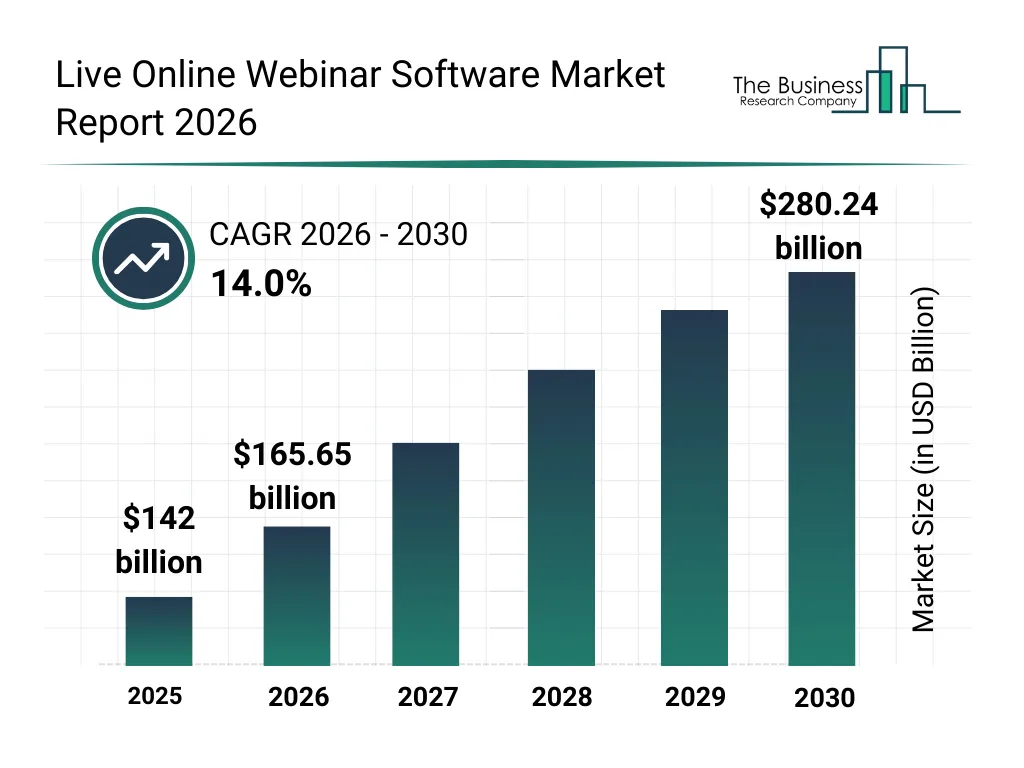
- The global live webinar software market is projected to grow from $142 billion in 2025 to $280.24 billion by 2030, indicating strong long-term expansion.
- The market is expected to register a robust 14.0% CAGR between 2026 and 2030, highlighting accelerating adoption across industries.
- In 2026, the market reaches $165.65 billion, reflecting a significant year-over-year increase from 2025.
- The upward trajectory continues steadily, with the market surpassing approximately $200 billion by 2028, signaling rapid scaling.
- By 2029, the market size will approach nearly $245 billion, driven by increased enterprise usage and digital engagement strategies.
- The consistent year-over-year growth demonstrates strong demand for virtual events, online learning, and remote communication tools.
- The nearly 2x growth from $142 billion (2025) to $280.24 billion (2030) underscores the market’s high growth potential and investment attractiveness.
Webinar Adoption and Usage Trends
- 62% of companies consider webinars a key part of their digital strategy.
- 85% of businesses actively use webinars in marketing campaigns.
- 75% of marketers prefer live webinars for real-time engagement.
- 44% of webinars are episodic, showing a shift toward series-based content.
- 23.5% of webinars are recurring, reinforcing long-term engagement strategies.
- 49% of marketers use engagement analytics to optimize webinars.
- 31% of marketers cite engagement as their biggest webinar challenge.
- More than 50% of content marketers say webinars deliver the best results.
Webinar Audience and Demographics
- Webinar audiences typically feature professionals aged 25-45, who dominate attendance due to their tech-savvy nature and interest in industry insights.
- 71% of B2B webinar attendees join via desktop, favoring larger screens for professional content consumption.
- 57% of registrations originate from email marketing, making it the top channel over social media or ads.
- Average webinars draw 322 registrants, with B2B benchmarks showing steady growth year-over-year.
- The 40-50% attendance rate is standard for registrants, while B2B formats often hit higher with engaged professionals.
- 73% of B2B marketers report webinars as their top source for high-quality leads from attendees.
- 22% of registrations occur via mobile devices, lower than general web traffic due to professional preferences.
- 57% of attendees stay until the webinar ends, with Q&A sessions boosting retention by 32%.
- Tuesdays, Wednesdays, and Thursdays account for 63% of registrations, optimal days for professional audiences.
- 91% of B2B professionals prefer webinars as their top content format for learning and decision-making.
Webinar Attendance and Registration Trends by Day
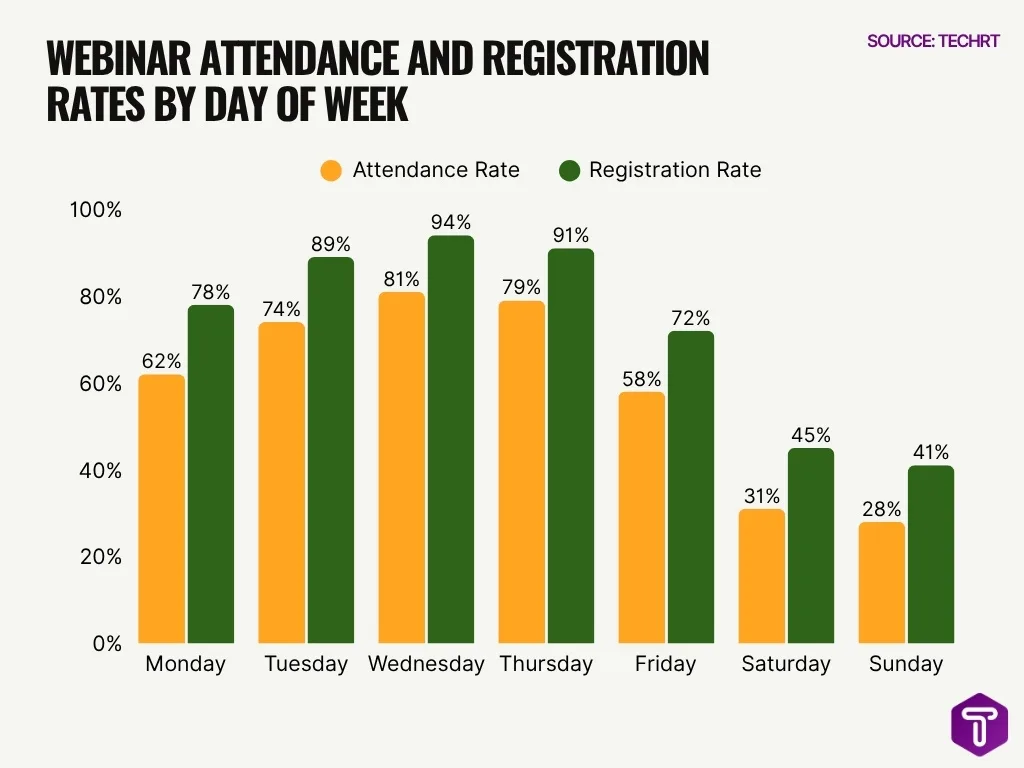
- Midweek dominates performance, with Wednesday recording the highest attendance rate (81%) and registration rate (94%), making it the most effective day for webinars.
- Tuesday and Thursday also perform strongly, with attendance rates of 74% and 79%, and registration rates of 89% and 91%, respectively.
- Monday shows moderate engagement, achieving 62% attendance and 78% registrations, indicating a decent start to the week.
- Friday sees a noticeable drop, with attendance falling to 58% and registration to 72%, suggesting reduced audience availability.
- Weekend performance is significantly lower, with Saturday at 31% attendance and 45% registration, and Sunday at just 28% attendance and 41% registration.
- The gap between weekdays and weekends is substantial, with attendance dropping by over 50 percentage points from Wednesday (81%) to Sunday (28%).
- Registration rates consistently exceed attendance rates across all days, with a typical gap of 10–15 percentage points, indicating common no-show behavior.
- Best scheduling window: Hosting webinars between Tuesday and Thursday maximizes both registrations and live attendance rates.
Webinar Registration Rate Statistics
- Average webinar registration pages convert at 20% to 30%, depending on industry and traffic source.
- Adding a clear value proposition can increase registration rates by up to 35%.
- Webinars promoted via email see 2x higher registration rates than social media campaigns.
- Landing pages with video previews improve sign-ups by up to 80%.
- 59% of registrations happen within 7 days of the event announcement.
- Reminder emails boost registrations by up to 20% when sent 24–48 hours before the event.
- Shorter registration forms (3–5 fields) increase conversions by up to 26%.
- Webinars with guest speakers attract 20% more registrations on average.
- Paid ads contribute to 18%–25% of total webinar registrations for B2B campaigns.
Live vs On-Demand Webinar Statistics
- 47% of total webinar views now come from on-demand replays.
- On-demand webinars generate 20% more total views over time than live-only sessions.
- Live webinars achieve higher engagement rates (up to 30% more interactions).
- On-demand viewers typically watch 25%–40% of total content length.
- 60% of marketers use a hybrid model combining live and on-demand formats.
- Live webinars convert better, with conversion rates up to 2x higher than recorded sessions.
- On-demand content extends lead generation cycles by up to 90 days post-event.
- 70% of webinar content is repurposed into on-demand assets.
- Evergreen webinars contribute to 30% of total webinar leads annually.
Webinar Engagement and Interaction Metrics
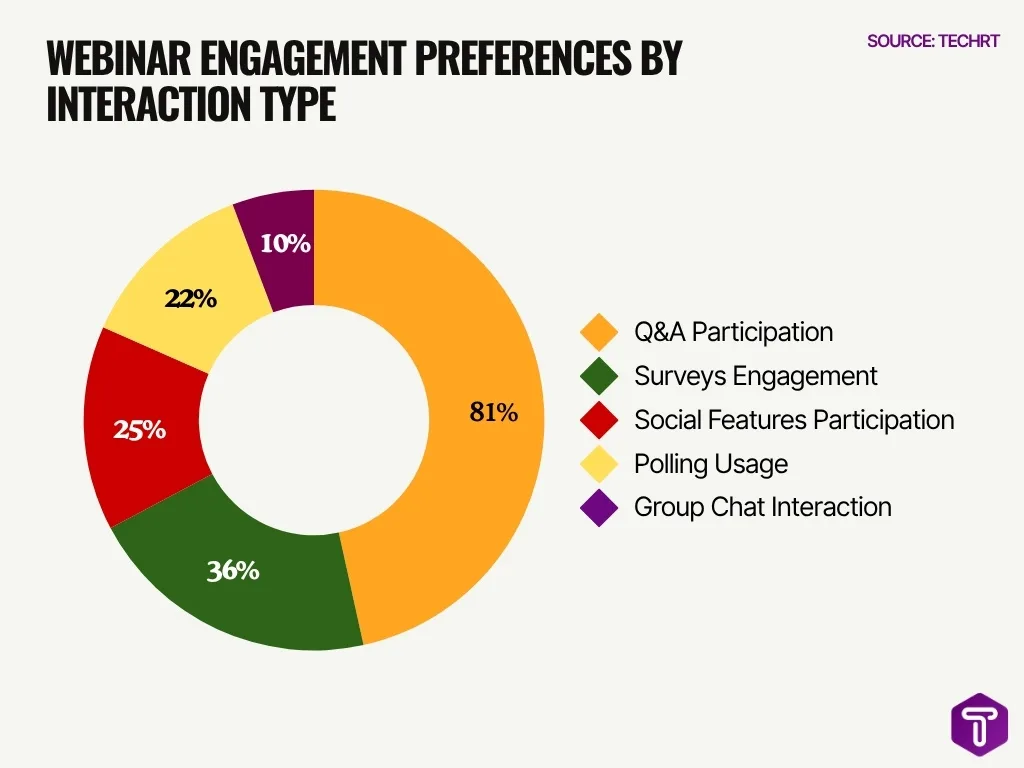
- Q&A dominates engagement, with 81% of attendees preferring it, making it the most effective interaction format in webinars.
- Surveys drive strong participation, engaging 36% of users, indicating audiences are willing to share feedback during sessions.
- Social features see moderate adoption, with 25% participation, suggesting room for improvement in community-driven engagement tools.
- Polling remains underutilized, used by only 22% of attendees, despite its potential for real-time interaction.
- Group chat has the lowest engagement, at just 10%, highlighting limited interest in open discussion formats during webinars.
- The data shows a clear preference for structured and purposeful interactions (like Q&A and surveys) over casual or open-ended communication (like group chat).
- Webinar organizers should prioritize interactive segments like Q&A and surveys to maximize engagement and audience retention.
- There is an opportunity to optimize polling and social features through better timing, relevance, and integration into the webinar flow.
Webinar Conversion and Lead Generation Statistics
- Webinar conversion rates average 55% to 65% for qualified leads.
- 73% of B2B marketers say webinars generate high-quality leads.
- Attendees are 4x more likely to convert compared to non-attendees.
- Webinars contribute to 20%–40% of total B2B pipeline revenue.
- Follow-up emails increase conversion rates by 22% on average.
- 67% of marketers use webinars for lead nurturing campaigns.
- Gated webinar content converts 2x better than ungated content.
- Product demo webinars show conversion rates above 30%.
- A multi-session webinar series improves lead quality by up to 25%.
Webinar Revenue and ROI Statistics
- Webinars deliver 2x to 3x higher ROI than traditional in-person events.
- The average cost per lead from webinars is 30% lower than paid advertising.
- Businesses report up to 500% ROI on well-optimized webinar funnels.
- 73% of marketers say webinars are the best channel for high-quality ROI.
- Webinar-generated leads close faster, reducing sales cycles by up to 23%.
- Training webinars reduce onboarding costs by up to 40%.
- Companies hosting monthly webinars see higher annual revenue growth.
- Automated webinars generate passive revenue streams with minimal incremental cost.
- Upsell webinars increase customer lifetime value by 15%–25%.
Webinar Registration Trends by Marketing Channel
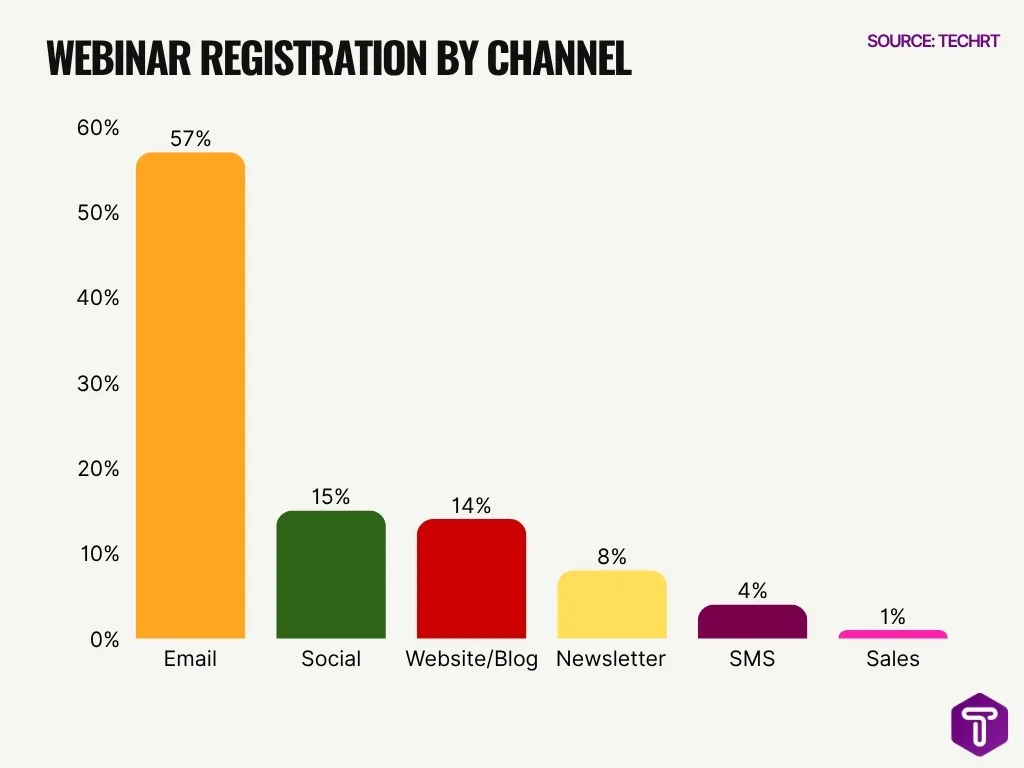
- Email dominates registrations, accounting for a massive 57%, making it the most effective channel by a wide margin.
- Social media contributes 15%, positioning it as the second-largest driver of webinar sign-ups.
- Website and blog traffic generate 14%, showing the importance of owned content platforms in attracting registrations.
- Newsletters account for 8%, indicating a moderate but consistent impact from subscriber-based outreach.
- SMS delivers only 4%, suggesting limited effectiveness compared to digital channels like email and social.
- Sales-driven registrations are minimal at 1%, highlighting that direct sales efforts play a negligible role in webinar sign-ups.
- The top three channels (Email, Social, Website/Blog) together contribute 86% of total registrations, emphasizing the need to prioritize digital marketing channels.
- There is a sharp drop-off after email, with the remaining channels individually contributing less than 20%, indicating a high dependency on email marketing.
Webinar Content and Topic Performance Statistics
- Educational webinars generate 2x higher engagement rates than purely promotional sessions.
- Product demo webinars achieve conversion rates above 30%, making them top-performing formats.
- Webinars focused on industry trends and insights attract 40% more registrants.
- Case study-based webinars improve audience trust, increasing conversions by up to 25%.
- Short-form webinars (under 45 minutes) deliver higher completion rates above 60%.
- Interactive workshop-style webinars boost engagement by up to 50% compared to lecture-style formats.
- Technical webinars attract higher retention rates (above 55%) among B2B audiences.
- Webinars with actionable takeaways increase post-event actions by up to 35%.
- Niche topic webinars (small audience segments) often achieve higher attendance rates (50%+).
Webinar Technology and Platform Statistics
- Zoom, Microsoft Teams, and Webex dominate over 70% of webinar platform usage globally.
- 67% of marketers prioritize platform reliability as the most critical feature.
- Platforms with built-in analytics improve campaign performance by up to 30%.
- 58% of companies integrate webinar platforms with CRM systems like Salesforce.
- Mobile-friendly platforms increase attendance rates by up to 25%.
- Cloud-based webinar tools account for over 80% of deployments in 2025.
- Automated webinar tools reduce operational workload by up to 40%.
- Platforms with AI-driven insights improve engagement tracking accuracy by 35%.
- Webinar software adoption among small businesses grew by 18% year over year.
Webinar Features Driving Platform Demand
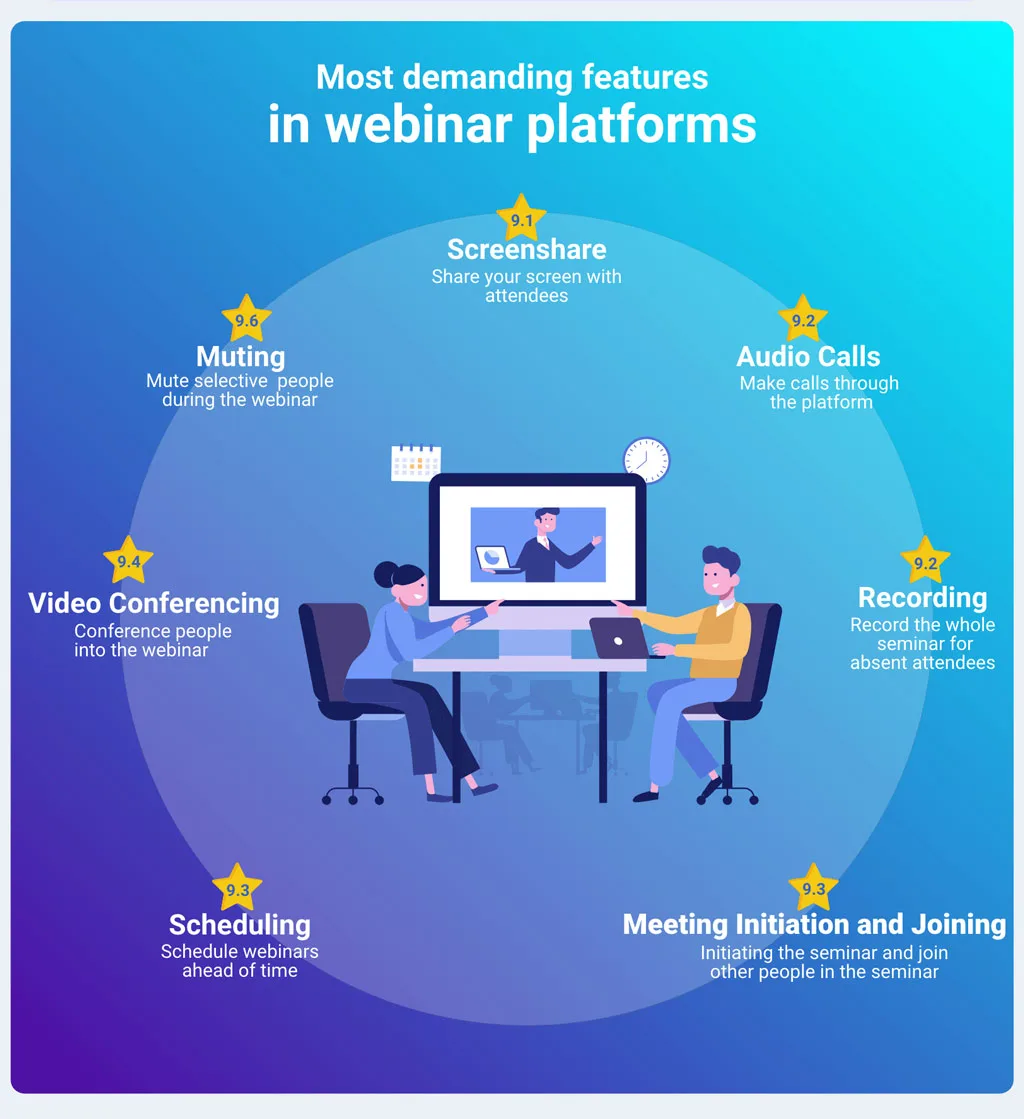
- Muting emerges as the top priority, with a score of 9.6, highlighting the critical need for noise control and better audience management during webinars.
- Video conferencing ranks second at 9.4, emphasizing that high-quality face-to-face interaction remains a core expectation for modern webinar platforms.
- Scheduling and meeting initiation/joining both score 9.3, showing strong demand for seamless planning and easy access, which directly impacts attendance rates.
- Recording and audio calls each receive a score of 9.2, indicating that users value content accessibility and clear communication even after live sessions end.
- Screensharing, with a score of 9.1, remains a must-have feature, enabling effective presentations, demos, and collaborative discussions.
- Overall, all features score above 9.0, signaling that users expect comprehensive, high-performance functionality rather than basic webinar capabilities.
AI and Automation in Webinar Statistics
- 78% of marketers use AI tools to optimize webinar promotions and targeting.
- AI-powered chatbots handle up to 60% of attendee queries during webinars.
- Automated webinar funnels increase conversion rates by up to 25%.
- 65% of companies use AI to personalize webinar content and recommendations.
- AI-driven analytics improve audience segmentation accuracy by 40%.
- Predictive analytics help increase attendance rates by 15%–20%.
- AI-generated summaries reduce post-event processing time by 50%.
- Marketing teams using automation save 30%–40% of campaign time.
- AI-assisted webinar scheduling tools improve global attendance by optimizing time zones.
Webinar Adoption Across Industries
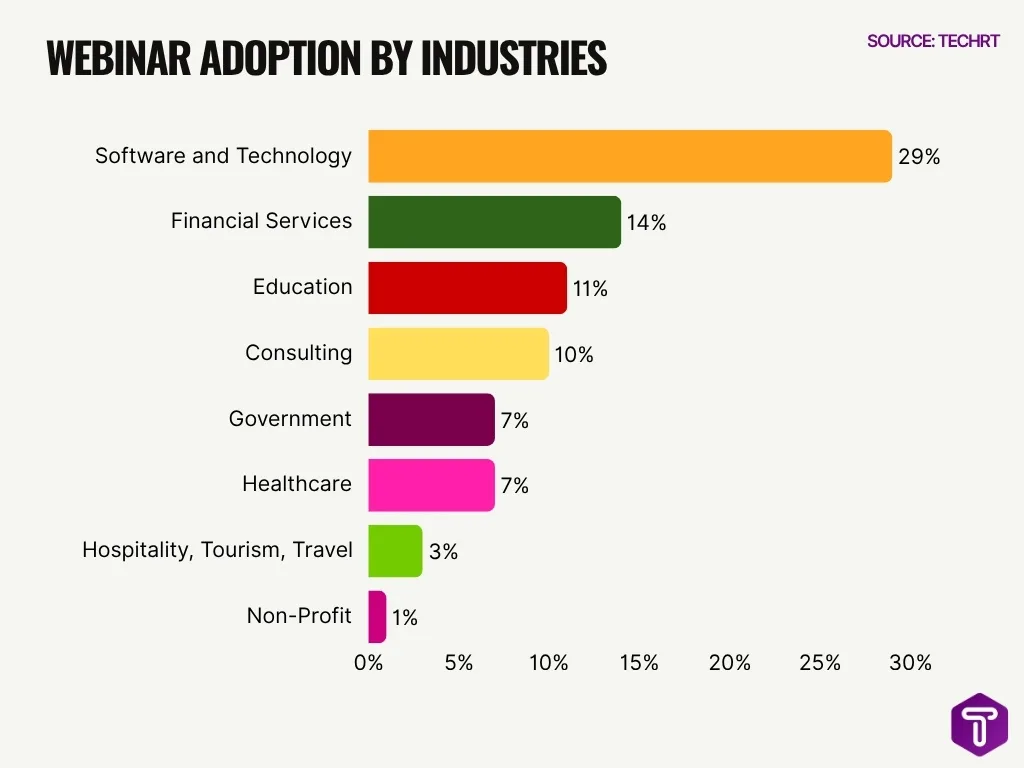
- The Software and Technology sector dominates webinar adoption with a leading 29% share, making it the most active industry by a significant margin.
- Financial Services ranks second at 14%, showing strong reliance on webinars for client education, product demos, and lead generation.
- The Education industry accounts for 11%, highlighting the growing importance of webinars in online learning and virtual training environments.
- Consulting firms contribute 10%, indicating steady use of webinars for thought leadership, client engagement, and knowledge sharing.
- Both the government and Healthcare sectors stand at 7% each, reflecting moderate adoption driven by public communication and professional training needs.
- The Hospitality, Tourism, and Travel industry lags at just 3%, suggesting limited reliance on webinars compared to other digital marketing channels.
- Non-Profit organizations show the lowest adoption at only 1%, indicating potential untapped opportunities for fundraising, awareness campaigns, and outreach.
- There is a clear concentration of webinar usage in tech-driven and knowledge-based industries, while service and traditional sectors show slower adoption rates.
Future Webinar Trends and Predictions
- $31.05 billion projected global webinar software market size by 2033.
- 80% of marketers plan to increase webinar investment over the next two years.
- 80% of marketers expect hybrid in-person/virtual events to coexist.
- AI personalization drives engagement, boosting it up to 135%.
- 61% of marketers plan to increase investment in content creators.
- 53% of video content is watched in under 90 seconds.
- 78% of corporate companies use video calling software for team meetings.
- 37 additional attendees from AI voice outreach per 838 contacts.
- 65% of organizations will be fully data-driven by 2026.
Frequently Asked Questions (FAQs)
What is the average webinar attendance rate?
What percentage of webinar registrations convert into attendees?
What is the average webinar conversion rate for leads?
How much engagement time do webinars typically achieve?
What percentage of webinar views come from on-demand content?
Conclusion
Webinars have evolved far beyond simple online presentations, becoming a data-driven engine for marketing, sales, and education. Organizations now use webinars to attract qualified leads, nurture prospects through the funnel, and deliver ongoing value to customers and employees. Their ability to combine scalability with personalization makes them especially effective in today’s digital-first environment.
Looking ahead, the integration of AI, automation, and advanced analytics will continue to reshape how webinars are planned and executed. Businesses that focus on interactive formats, targeted content, and seamless user experiences will stand out in an increasingly competitive landscape. At the same time, hybrid and on-demand models will extend the lifespan of webinar content, turning single events into long-term growth assets. Companies that invest strategically in webinars will not only improve engagement but also drive consistent, measurable business outcomes.

Leave a comment
Have something to say about this article? Add your comment and start the discussion.