



Tesla continues to shape the global electric vehicle (EV) market with aggressive innovation in battery technology, autonomous driving, and clean energy solutions. Its influence now extends far beyond cars, impacting industries such as automotive manufacturing, renewable energy, AI-driven mobility, and grid-scale energy storage. From powering homes with solar and battery systems to advancing self-driving capabilities that could redefine transportation, Tesla plays a central role in the transition toward a low-carbon economy.
At the same time, shifting consumer demand, pricing pressures, and rising competition from companies like BYD and legacy automakers are reshaping its growth trajectory. As Tesla navigates this evolving landscape, its latest data offers critical insights into performance, strategy, and future direction, so let’s explore the numbers that define Tesla.
Editor’s Choice
- Tesla generated approximately $97.7 billion in revenue in 2024, reflecting modest year-over-year growth.
- The company’s revenue declined slightly to about $94.8 billion in 2025, marking a 2.9% drop.
- Tesla delivered 1.79 million vehicles in 2024, its first annual decline in over a decade.
- Global deliveries further dropped to 1.63 million units in 2025, down 8.6% year-over-year.
- In Q1 2026, Tesla delivered 358,023 vehicles, reflecting a 6% annual increase but missing expectations.
- Tesla produced over 434,000 vehicles in Q4 2025, showing strong quarterly output.
- The company operates over 7,100 Supercharger stations globally as of early 2025.
Recent Developments
- Tesla delivered 358,023 EVs in Q1 2026, below analyst expectations of ~368,900 units.
- The company reported a 6% year-over-year increase in Q1 2026 deliveries, signaling a partial recovery.
- Production in Q1 2026 reached over 408,000 vehicles, creating a gap between production and deliveries.
- Tesla produced roughly 50,000 more vehicles than it delivered, raising inventory concerns.
- Energy storage deployments fell to 8.8 GWh in Q1 2026, below expectations.
- EVs still account for about 75% of Tesla’s revenue in 2025, despite diversification efforts.
- Tesla is shifting focus toward robotaxis and humanoid robots, signaling a strategic pivot.
- The company plans to phase out legacy models like Model S and Model X, affecting the product mix.
- Global EV demand softened, with U.S. EV sales dropping 28% in 2026, impacting Tesla’s performance.
Key Tesla Statistics Overview
- Tesla has sold over 7.2 million vehicles cumulatively since inception.
- The company employed around 125,000+ people globally as of 2025.
- Tesla’s market capitalization exceeded $920 billion in 2025, keeping it among the top automakers.
- Tesla maintained a 17.6% global EV market share in 2024, leading the segment.
- The company produced over 1.77 million vehicles in 2024, slightly down from 2023.
- Tesla’s lifetime Model 3 sales exceeded 1 million units, making it a milestone EV.
- The Model Y recorded around 1.2 million annual sales in 2024, one of the best-selling EVs globally.
- Tesla operates in over 50+ countries, expanding its global footprint.
Tesla Sales by Year and Growth Rates
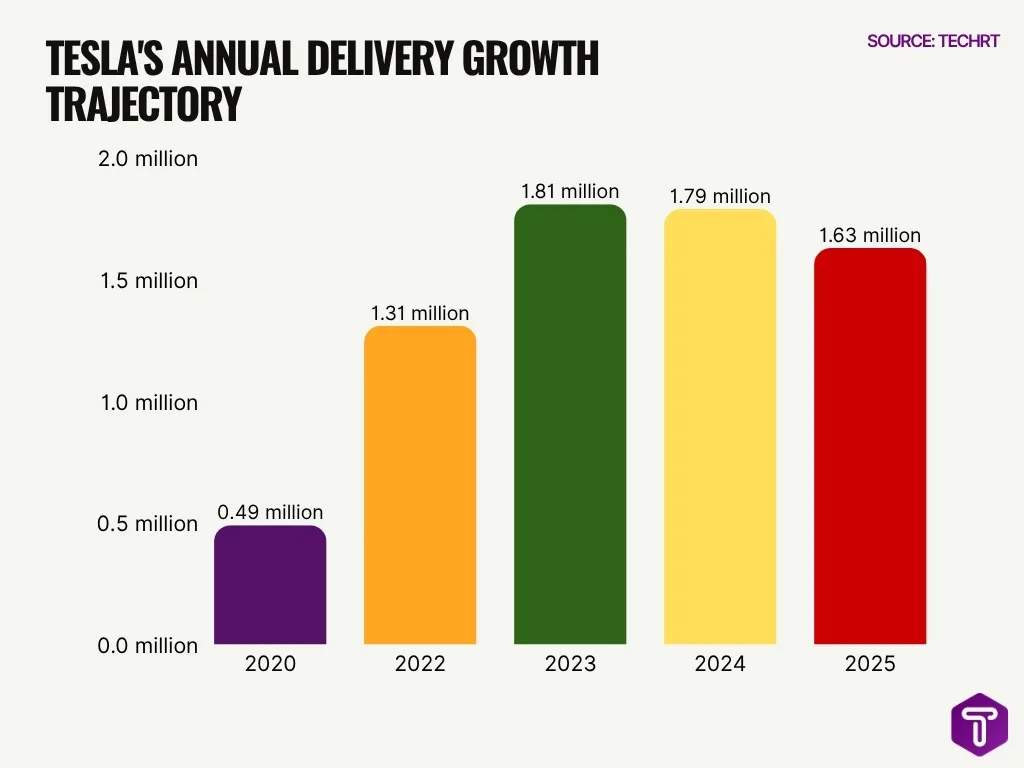
- Tesla’s vehicle sales grew from 499,550 units in 2020 to over 1.31 million in 2022, reflecting rapid scaling.
- In 2023, Tesla achieved a record 1.81 million deliveries, up 38% year-over-year.
- Sales declined slightly to 1.79 million in 2024, marking a plateau in growth.
- Tesla experienced an 8.6% decline in 2025 deliveries, signaling demand normalization.
- Between 2015 and 2023, Tesla’s CAGR exceeded 40% annually, one of the fastest in the auto sector.
- Tesla’s growth slowed significantly in 2024 and 2025, dropping to single-digit or negative growth rates.
- In Q1 2026, Tesla reported a 6% year-over-year increase, showing partial recovery.
- The company aims to return to 20–30% annual growth, though market conditions remain uncertain.
- Tesla’s growth trajectory remains tied to pricing strategies and global EV demand trends.
Tesla History and Milestones Timeline
- Tesla launched its first vehicle, the Roadster, in 2008, marking its entry into EVs.
- The Model S debuted in 2012, winning Motor Trend Car of the Year.
- Tesla introduced the Model X in 2015, expanding into SUVs.
- The Model 3 launched in 2017, becoming Tesla’s mass-market breakthrough.
- Tesla reached 1 million vehicle deliveries in 2020, scaling production globally.
- The company produced its 6 millionth car in 2024, highlighting rapid growth.
- Tesla launched the Cybertruck in 2024, entering the electric pickup market.
- By 2026, Tesla is shifting toward AI-driven mobility and robotics, marking a new phase.
Tesla Sales by Model
- Tesla delivered a total of 1,789,226 vehicles globally in 2024, with Model 3/Y accounting for 1,704,093 units or about 95% of sales.
- Model Y sales reached approximately 1.22 million units in 2024, representing over 68% of Tesla’s total deliveries.
- Model 3 contributed around 476,626 to 482,000 units in 2024, making up roughly 27% of overall sales.
- Model S and Model X combined delivered 85,133 units in 2024, less than 5% of Tesla’s total volume.
- Cybertruck achieved 37,165 to 38,965 deliveries in 2024, marking its launch year ramp-up.
- In 2025, Tesla’s total deliveries fell to 1,636,129 units, with Model 3/Y at 1,585,279 or 97% share.
- Other models, including Cybertruck, Model S, and X, totaled just 50,850 deliveries in 2025, down 40% year-over-year.
- Cybertruck sales dropped to 20,237 units in 2025, a 48% decline from 2024 amid market challenges.
- Model Y cumulative sales hit 4 million units by end-2025, solidifying its status as a global bestseller.
Tesla Production vs Deliveries Gap
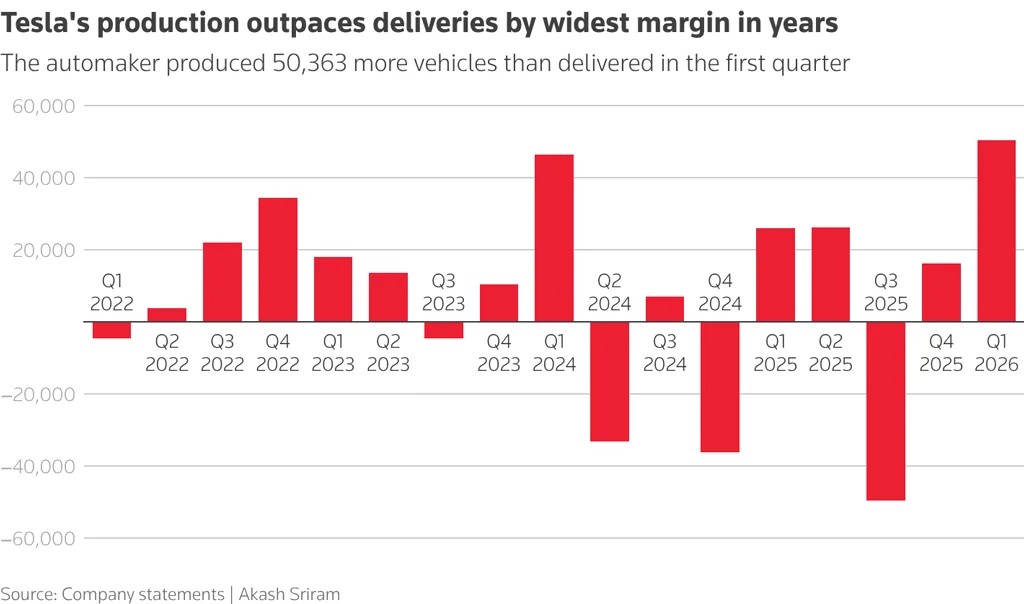
- Tesla recorded its widest production–delivery gap ever in Q1 2026, with over 50,000 excess vehicles produced, signaling significant inventory buildup.
- In 2024, volatility peaked with sharp swings. Q1 2024 saw a surplus of ~47,000 vehicles, followed by a deficit of ~34,000 in Q2 2024, highlighting a demand–supply imbalance.
- Q3 2025 marked the largest delivery outperformance, with a gap of around -50,000 vehicles, indicating Tesla delivered far more than it produced during that quarter.
- Throughout 2022, Tesla consistently overproduced, especially in Q4 2022 (~35,000 surplus), reflecting strong production scaling post-pandemic.
- In 2023, the gap narrowed, with moderate surpluses like ~18,000 in Q1 and ~13,000 in Q2, but turned negative in Q3 2023 (~-10,000).
- Tesla experienced alternating cycles in 2024, switching between surplus and deficit quarters, indicating unstable demand patterns and logistics adjustments.
- During 2025, Tesla maintained consistent surpluses in Q1 and Q2 (~26,000 each), before a sharp reversal in Q3.
- The data reveals a cyclical production strategy, where Tesla alternates between inventory buildup and drawdown phases to manage demand fluctuations.
- Over the full period, the production gap ranged from +50,000 to -50,000 vehicles, showcasing extreme operational variability.
- Overall, Tesla’s widening gaps in recent quarters suggest increasing pressure on demand, logistics efficiency, or global market conditions.
Tesla Market Share in the Global EV Industry
- Tesla held approximately 17.6% global EV market share in 2024, maintaining leadership.
- The company’s share declined from over 20% in 2022, reflecting rising competition.
- Tesla remains the largest EV manufacturer in the U.S., with over 50% domestic market share.
- In China, Tesla’s market share dropped below 10%, pressured by local brands.
- BYD surpassed Tesla in total EV sales volume in late 2023, shifting global rankings.
- Tesla still leads in battery-electric vehicles (BEVs), excluding plug-in hybrids.
- Europe’s EV market share for Tesla declined due to increased competition from Volkswagen Group and others.
- Tesla’s market share is expected to stabilize between 12% and 15% globally by 2026.
Tesla vs BYD Sales and Market Share Comparison
- BYD sold over 3 million electrified vehicles in 2024, surpassing Tesla’s volume.
- Tesla delivered 1.79 million EVs in 2024, focusing exclusively on BEVs.
- BYD leads in total EV (including hybrids) market share, especially in China.
- Tesla maintains a lead in pure battery-electric vehicle (BEV) sales globally.
- BYD’s cost advantage allows it to offer lower-priced models, gaining market share.
- Tesla maintains higher average selling prices (ASPs) compared to BYD.
- In China, BYD commands over 30% EV market share, far ahead of Tesla.
- Tesla’s global brand strength and software ecosystem remain key competitive advantages.
- The competition between Tesla and BYD is shaping global EV pricing and innovation trends.
Tesla Vehicle Sales by Country
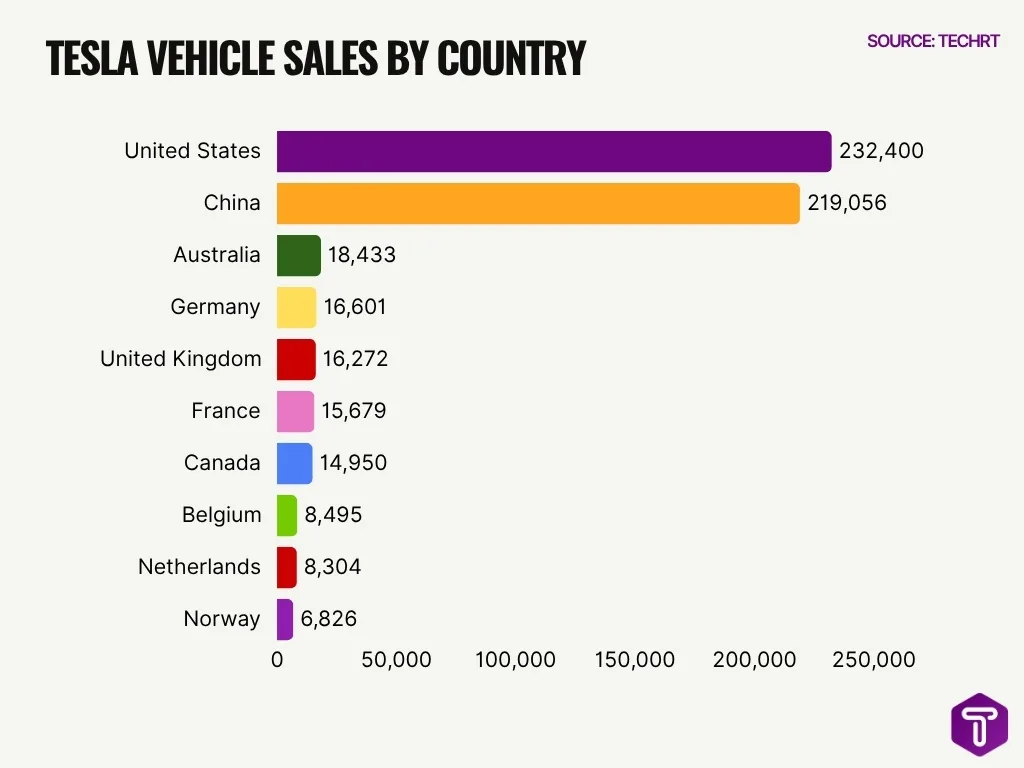
- The Tesla market is heavily dominated by the United States, with 232,400 vehicles sold, making it the largest single-country market.
- China follows closely with 219,056 units sold, highlighting its role as a critical growth driver and one of Tesla’s most strategic international markets.
- There is a significant drop-off after the top two countries, with Australia ranking third at just 18,433 sales, indicating a high concentration of sales in the top markets.
- European countries collectively contribute a substantial share, with Germany (16,601), the United Kingdom (16,272), and France (15,679) forming the leading European markets.
- Canada recorded 14,950 sales, showing strong adoption in North America outside the U.S., but still far behind the U.S. total.
- Mid-tier European markets like Belgium (8,495) and the Netherlands (8,304) demonstrate steady but moderate demand for Tesla vehicles.
- Norway, often considered a leader in EV adoption, recorded 6,826 sales, reflecting a smaller population but a high EV penetration rate.
- The combined sales of the top two countries (U.S. + China = 451,456 units) account for the vast majority of Tesla’s global sales in this dataset.
- The data clearly indicates a geographic concentration, where Tesla’s performance is strongest in large, economically powerful markets with established EV infrastructure.
- Overall, Tesla’s global sales distribution shows a dual-market dominance strategy, relying primarily on the U.S. and China, while maintaining consistent but smaller volumes across Europe and other regions.
Tesla Annual Revenue and Profit Statistics
- Tesla generated $97.7 billion in revenue in 2024, reflecting steady performance.
- Revenue declined slightly to around $94.8 billion in 2025, marking a rare contraction.
- Tesla’s net income reached approximately $15 billion in 2023, its peak profitability year.
- Net income declined in 2024 and 2025 due to price cuts and margin compression.
- Automotive revenue accounts for about 75% of total company revenue.
- Tesla’s gross margin dropped from over 25% in 2022 to below 20% in 2025.
- The company maintains strong cash reserves, exceeding $25 billion in liquidity.
- Tesla remains one of the most profitable EV manufacturers globally, despite margin pressure.
- Revenue growth slowed significantly compared to earlier years of 50%+ annual growth.
Tesla Research and Development Spending Statistics
- Tesla spent approximately $3.97 billion on R&D in 2024, reflecting continued innovation investment.
- R&D spending increased from $3.1 billion in 2023, showing a steady upward trend.
- Tesla allocates about 4–5% of its total revenue to R&D, lower than some traditional automakers.
- The company focuses heavily on AI, autonomous driving, and robotics research.
- Tesla’s investment in Dojo supercomputing aims to accelerate self-driving software training.
- Battery technology research remains a core focus, including 4680 battery cell development.
- Tesla maintains a lean R&D structure compared to competitors, prioritizing vertical integration and efficiency.
- Spending is expected to exceed $4 billion annually by 2026, driven by AI and robotics initiatives.
Norway Car Registrations
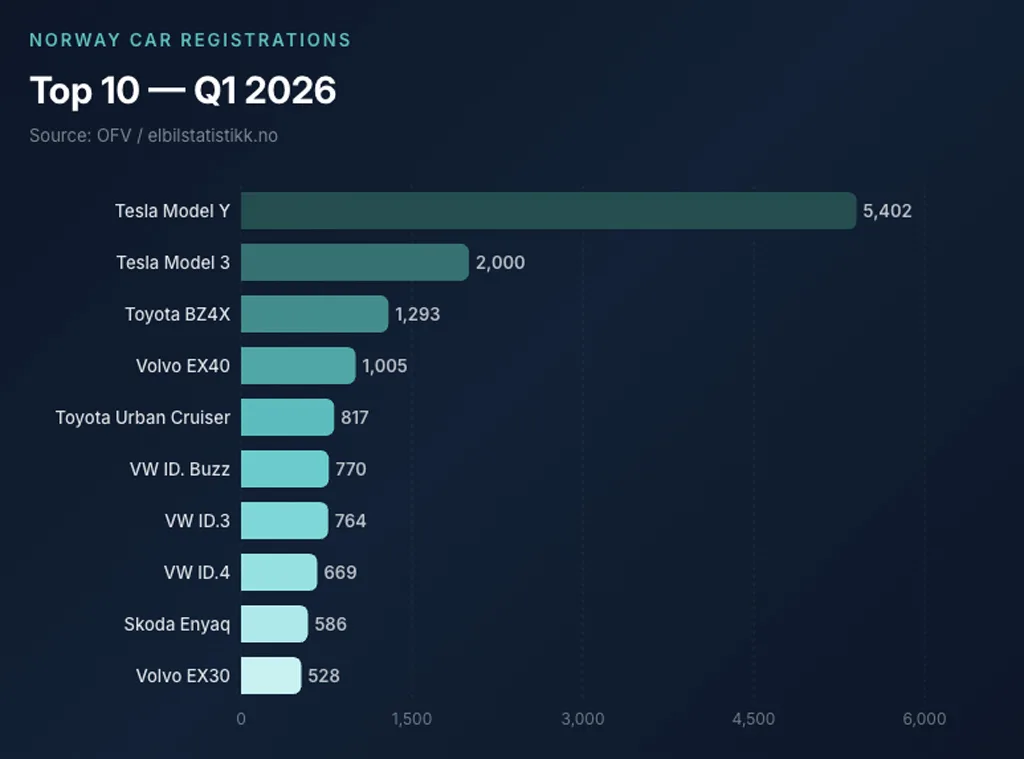
- Tesla dominates the Norwegian EV market, with the Tesla Model Y leading at 5,402 registrations, significantly outperforming all competitors.
- The Tesla Model 3 ranks second with 2,000 registrations, meaning Tesla holds the top two positions, reinforcing its strong market leadership.
- There is a sharp drop after the top two models, with the Toyota BZ4X at 1,293 units, indicating a clear gap between Tesla and other brands.
- Volvo secures two spots in the top 10, with the EX40 (1,005) and EX30 (528), showing growing traction in the EV segment.
- Toyota appears twice, with the BZ4X (1,293) and Urban Cruiser (817), highlighting its expanding presence in electric mobility.
- Volkswagen has the highest representation, with three models (ID. Buzz – 770, ID.3 – 764, ID.4 – 669), indicating a broad but evenly distributed portfolio.
- The mid-tier competition (positions 5–8) is tightly packed, with registrations ranging between 817 and 669, suggesting intense competition among non-Tesla brands.
- The Skoda Enyaq (586) and Volvo EX30 (528) round out the list, showing that even lower-ranked models maintain solid adoption levels.
- Overall, the data highlights a Tesla-led market with fragmented competition, where no single competitor comes close to Tesla’s scale in Norway.
- The Norwegian EV market continues to show strong adoption across multiple brands, but clear dominance by Tesla in early 2026.
Tesla Energy Generation and Storage Statistics
- Tesla deployed 14.7 GWh of energy storage in 2024, a record high.
- Energy storage deployments dropped to 8.8 GWh in Q1 2026, below expectations.
- The energy business grew over 125% year-over-year in 2024, one of Tesla’s fastest-growing segments.
- Tesla’s Megapack installations support grid-scale energy storage projects worldwide.
- Solar deployments reached approximately 223 MW in 2024, stabilizing after prior declines.
- Energy revenue exceeded $6 billion in 2024, highlighting strong segment growth.
- Tesla aims to scale energy storage to 100 GWh annually in the long term.
- Megapack factory expansion in California supports increasing global demand for energy storage.
- The energy segment plays a key role in renewable energy grid stability and peak load management.
Tesla Supercharger Network Overview
- Tesla operates over 7,100 Supercharger stations globally as of 2025.
- The network includes more than 65,000 charging connectors worldwide.
- Tesla added over 1,500 new stations in 2024 alone, rapidly expanding its infrastructure.
- The U.S. accounts for approximately 40% of Tesla’s Supercharger network.
- Tesla opened its charging network to non-Tesla EVs in multiple regions, increasing utilization.
- Europe hosts over 1,000 Supercharger stations, driven by strong EV adoption.
- Tesla’s V4 Superchargers support faster charging speeds and larger vehicles.
- Supercharging contributes to Tesla’s services revenue segment, generating recurring income.
- Tesla continues expanding infrastructure to support long-distance EV travel and adoption.
Tesla Revenue by Segment
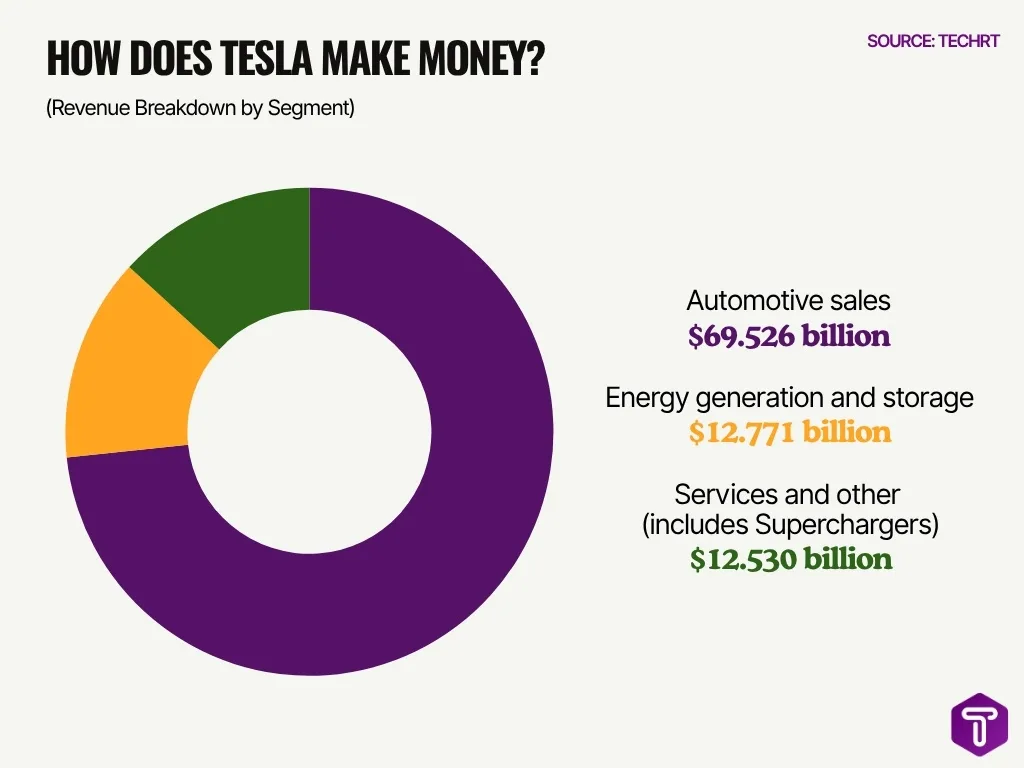
- Automotive sales dominate Tesla’s revenue, contributing 73.3% of total income, with approximately $69.526 billion USD, making it the company’s primary revenue driver.
- Energy generation and storage is a growing segment, generating $12.771 billion USD, accounting for 13.5% of total revenue, reflecting Tesla’s expansion into renewable energy solutions.
- Services and other revenue streams, including Supercharger networks and maintenance services, brought in $12.530 billion USD, representing 13.2% of total revenue.
- The combined non-automotive segments (energy + services) contribute 26.7% of Tesla’s revenue, showing increasing diversification beyond vehicle sales.
- Despite diversification, Tesla remains heavily reliant on vehicle sales, with nearly three-quarters of its total revenue coming from the automotive segment.
- The relatively close share between energy (13.5%) and services (13.2%) indicates balanced growth in Tesla’s secondary business lines.
- Tesla’s revenue model highlights a dual strategy: strong dominance in electric vehicle sales while steadily scaling energy infrastructure and service ecosystems.
Tesla Autopilot, FSD, and Safety Statistics
- Tesla vehicles have driven over 10 billion miles globally using Autopilot.
- Tesla reports one accident per 6.26 million miles with Autopilot engaged, compared to U.S. averages.
- Without Autopilot, Tesla vehicles record one accident every 1.5 million miles, still better than industry averages.
- Tesla continues expanding its Full Self-Driving (FSD) beta program across North America.
- FSD adoption rates are estimated at 15–20% of Tesla owners in 2025.
- Tesla invests heavily in AI neural networks and real-world driving data to improve autonomy.
- The company processes billions of miles of driving data annually to refine self-driving algorithms.
- Regulatory scrutiny continues, with multiple investigations into Autopilot safety performance.
- Tesla positions FSD as a future high-margin software subscription product.
Tesla Future Outlook, Projections, and Forecast Statistics
- Tesla aims to reach 20 million vehicles annually by 2030, a long-term production target.
- Analysts project Tesla deliveries to grow to 2–2.5 million vehicles annually by 2027.
- Tesla’s energy business could generate over $20 billion annually by 2030, driven by storage demand.
- Autonomous driving and robotaxis could contribute significant new revenue streams by the late 2020s.
- Tesla plans to introduce a next-generation affordable EV platform, targeting mass adoption.
- The company’s AI and robotics initiatives, including Optimus humanoid robots, may reshape future revenue.
- Tesla’s global EV market share is expected to stabilize around 12% and 15% by 2026.
- Battery cost reductions are projected to lower EV prices by 20% and 30% over the next decade.
- Tesla’s valuation remains tied to its ability to execute on AI, autonomy, and energy expansion.
Frequently Asked Questions (FAQs)
How many vehicles did Tesla deliver in 2025?
What was Tesla’s total revenue in 2024?
How many vehicles did Tesla deliver in Q1 2026?
What is Tesla’s market share in the U.S. EV market?
How much did Tesla’s vehicle deliveries decline in 2025?
Conclusion
Tesla stands at a pivotal moment as growth stabilizes and competition intensifies across global EV markets. While vehicle deliveries and revenue growth have slowed compared to earlier years, the company continues to invest heavily in AI, energy storage, autonomous driving, and next-generation vehicle platforms. These investments signal a clear shift from being purely an automaker to becoming a broader technology and energy ecosystem player. Moreover, Tesla’s expanding energy business and software-driven revenue streams, such as Full Self-Driving, could play a larger role in long-term profitability.
However, challenges remain. Pricing pressure, increasing global competition, and fluctuating EV demand continue to test Tesla’s market dominance. At the same time, opportunities in robotics, robotaxis, and large-scale energy infrastructure could unlock entirely new revenue streams over the next decade. Ultimately, Tesla’s success will depend on its ability to execute at scale, maintain innovation leadership, and adapt to a rapidly evolving global market.

Leave a comment
Have something to say about this article? Add your comment and start the discussion.