



The Internet of Things (IoT) continues to reshape how businesses and consumers interact with technology at scale. From predictive maintenance in manufacturing, where sensors prevent costly downtime, to remote patient monitoring in healthcare, where connected devices track vital signs in real time, IoT delivers actionable data that drives faster and smarter decisions. Moreover, industries such as logistics, retail, and energy now rely on IoT to improve efficiency, reduce operational costs, and enhance customer experiences.
As connected ecosystems expand and billions of devices communicate seamlessly, understanding the latest IoT statistics becomes essential for leaders, investors, and innovators looking to stay competitive in a data-driven world. With that in mind, let’s explore the most important IoT trends and numbers.
Editor’s Choice
- The global IoT market is expected to reach $1.24 trillion in 2025, up from $1.0 trillion in 2024.
- The IoT market size could exceed $6.7 trillion by 2033, growing at a CAGR of 23.6%.
- There will be around 21.1 billion connected IoT devices in 2025, a 14% YoY increase.
- IoT connections reached 18.6 billion devices in 2024, up from 11.3 billion in 2020.
- The IoT industry could reach $1.3 trillion in 2026 based on long-term projections.
- Cellular IoT connections are forecast to hit 4.5 billion by 2025.
- The IoT sensors market alone is projected to reach $99.2 billion by 2030.
Recent Developments
- IoT device growth accelerated to 14% in 2025, reflecting renewed enterprise investments.
- AI integration is now a primary growth driver for IoT deployments across industries.
- Predictive maintenance using IoT sensors reduces equipment downtime by analyzing real-time data trends.
- Edge AI combined with IoT enables faster decision-making without cloud latency.
- Computer vision in IoT improves workplace safety monitoring, detecting PPE compliance automatically.
- LoRaWAN and low-power networks are gaining traction for long-range IoT deployments in smart cities.
- The IoT node and gateway market is growing rapidly, reaching $27.7 billion in 2026.
- Retail IoT adoption is expanding, with the market size projected to hit $119.9 billion in 2026.
Global Overview of Internet of Things Statistics
- IoT ecosystems now span healthcare, manufacturing, retail, and transportation sectors globally.
- The global IoT market surpassed a $1 trillion valuation in 2024.
- IoT contributes to automation, cost efficiency, and real-time analytics across enterprises.
- Demand for IoT is driven by cloud computing and big data integration.
- North America currently leads in IoT adoption due to its advanced digital infrastructure.
- Asia-Pacific is the fastest-growing region, fueled by smart city and industrial projects.
- IoT adoption surged post-pandemic due to remote monitoring and automation needs.
- Enterprises increasingly use IoT to improve customer experience and operational visibility.
Global IoT Market Size and Growth
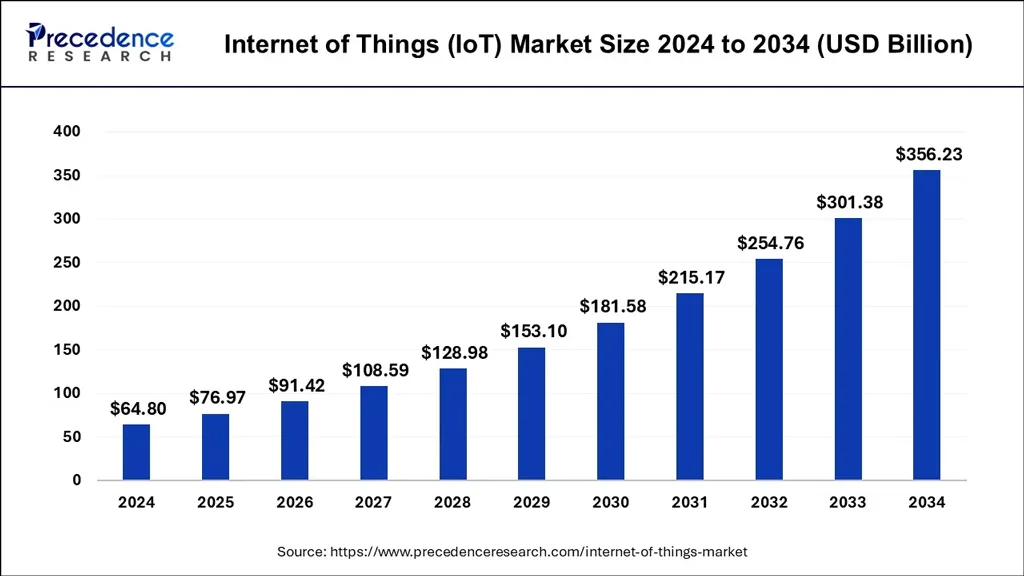
- The global IoT market is projected to grow from $64.80 billion in 2024 to $356.23 billion by 2034, indicating massive long-term expansion.
- This reflects an overall increase of over 5.5× in market size within a decade.
- The market crosses the $100 billion mark by 2027 ($108.59 billion), signaling rapid early-stage acceleration.
- By 2030, the market is expected to reach $181.58 billion, nearly tripling from 2024 levels.
- The industry surpasses $200 billion in 2031 ($215.17 billion), highlighting strong mid-term adoption.
- Significant late-decade growth is evident, with the market jumping from $254.76 billion in 2032 to $356.23 billion in 2034.
- The largest absolute yearly increase occurs between 2033 and 2034, adding nearly $55 billion in value.
- Consistent year-over-year growth is observed with no declines, indicating a stable upward trajectory.
- The market adds approximately $291 billion in total value over the forecast period.
- The steady rise suggests strong demand driven by smart devices, industrial IoT (IIoT), and connected infrastructure adoption.
Number of Connected IoT Devices Worldwide
- There were 18.5 billion IoT devices in 2024, growing steadily year over year.
- The number is expected to reach 21.1 billion devices in 2025.
- IoT connections increased by 64.6% between 2020 and 2024.
- Forecasts suggest 39 billion devices by 2030.
- Some projections estimate 50+ billion devices by 2035.
- Cellular IoT connections alone will approach 8 billion by 2031.
- Earlier forecasts estimated 67.7 billion IoT devices by 2025, showing variation across models.
- IoT devices already outnumber humans by more than 2:1 globally.
Consumer vs. Industrial IoT Statistics
- The global IoT market is projected to reach $2.72 trillion by 2030, expanding from $1.35 trillion in 2025 at a 15.04% CAGR.
- Industrial IoT devices are expected to reach 152 million by 2025, with the global industrial IoT market valued at $194.4 billion in 2024 and forecasted to reach $286.3 billion by 2029.
- The global smart home market (a key consumer IoT segment) reached $147.52 billion in 2025 and is projected to grow to $848.47 billion by 2034 at a 21.40% CAGR.
- The consumer IoT market is valued at $249.82 billion in 2026 and projected to reach $447.06 billion by 2030, growing at a 15.7% CAGR.
- 21.1 billion connected IoT devices exist globally in 2025, with estimates to reach 39 billion by 2030 at a 13.2% CAGR.
- The global enterprise IoT market is projected to expand from $292.77 billion in 2025 to $674.73 billion by 2031, achieving a 14.93% CAGR.
- Industrial IoT holds 32% of the market share as the largest segment, while healthcare IoT accounts for 24%, serving medical devices and patient monitoring systems.
- Consumer revenue from IoT devices surpassed $65 billion in 2023 and is projected to reach $180 billion by 2030.
- Smart home households are expected to reach 93.59 million with a household penetration rate of 68.6% by 2027.
- The global wireless industrial IoT sensor market is expected to reach $16.1 billion by 2032, growing at a 12.3% CAGR compared to 2023.
Global IoT Adoption Rates
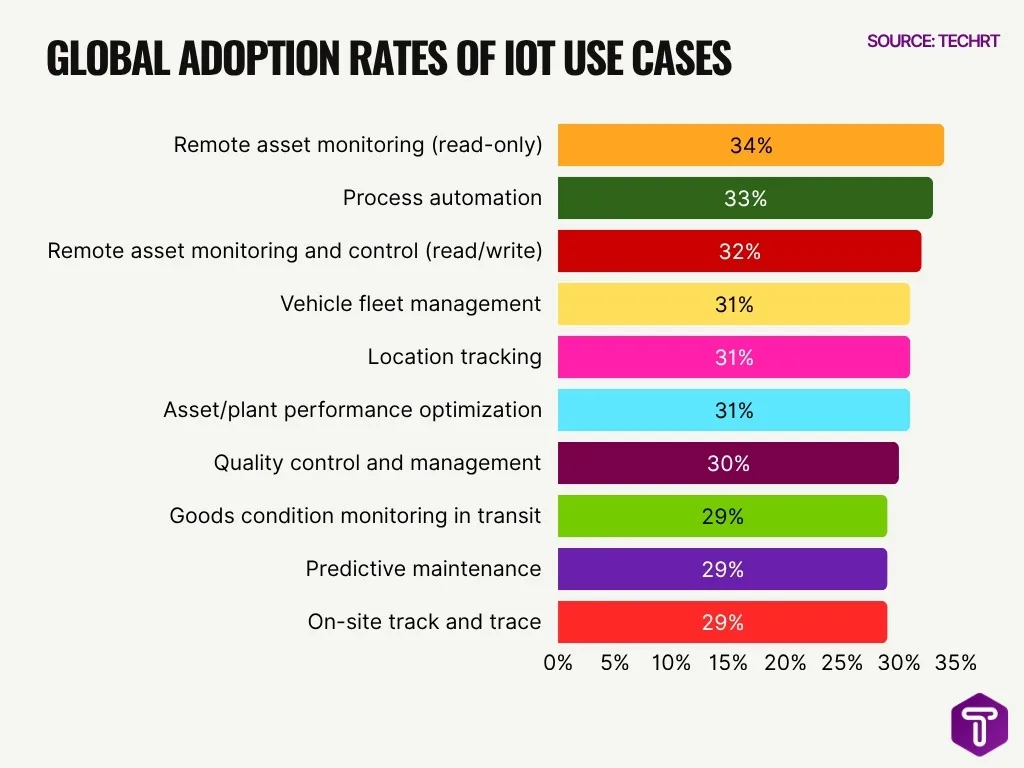
- Remote asset monitoring (read-only) leads IoT adoption with 34%, highlighting its role as the most widely implemented and low-complexity use case.
- Process automation follows closely at 33%, showing strong demand for efficiency, cost reduction, and operational scalability across industries.
- Remote asset monitoring and control (read/write) stands at 32%, indicating growing adoption of real-time control systems beyond passive monitoring.
- A cluster of use cases, vehicle fleet management, location tracking, and asset/plant performance optimization, each hold 31% adoption, reflecting the importance of logistics visibility and operational optimization.
- Quality control and management is adopted by 30%, emphasizing IoT’s role in maintaining product standards and reducing defects.
- Three use cases, goods condition monitoring in transit, predictive maintenance, and on-site track and trace, are tied at 29%, showing increasing focus on supply chain transparency and proactive maintenance strategies.
- The adoption gap between the highest (34%) and lowest (29%) is just 5 percentage points, indicating a fairly balanced and mature IoT adoption landscape across different applications.
- Overall, the data suggests that monitoring, automation, and tracking solutions dominate IoT deployments, while advanced use cases like predictive maintenance are steadily gaining traction.
Industrial IoT (IIoT) Statistics
- The Industrial IoT market is projected to reach $1.6 trillion by 2028.
- IIoT contributes to 30% reduction in maintenance costs in manufacturing environments.
- Smart factories using IIoT improve productivity by up to 25%.
- Around 80% of manufacturers have implemented or plan to implement IIoT solutions by 2026.
- IIoT reduces equipment downtime by up to 50% via predictive maintenance.
- Connected factories generate massive real-time data streams, enabling automation at scale.
- Energy savings from IIoT can reach 10 to 20% in industrial operations.
- IIoT investments in North America represent over 35% of global spending.
Healthcare IoT (IoMT) Statistics
- The IoT in healthcare market is expected to reach $289 billion by 2028.
- Remote patient monitoring can reduce hospital readmissions by up to 38%.
- Over 60% of healthcare organizations now use IoT-enabled medical devices.
- Wearable health device shipments surpassed 500 million units annually.
- IoMT adoption improves chronic disease management by enabling continuous monitoring.
- Smart medical devices reduce emergency response times by 20 to 30%.
- Hospitals using IoT see up to 15% cost savings in operations.
- The U.S. leads IoMT adoption due to its advanced digital health infrastructure.
IoT Adoption by Industry
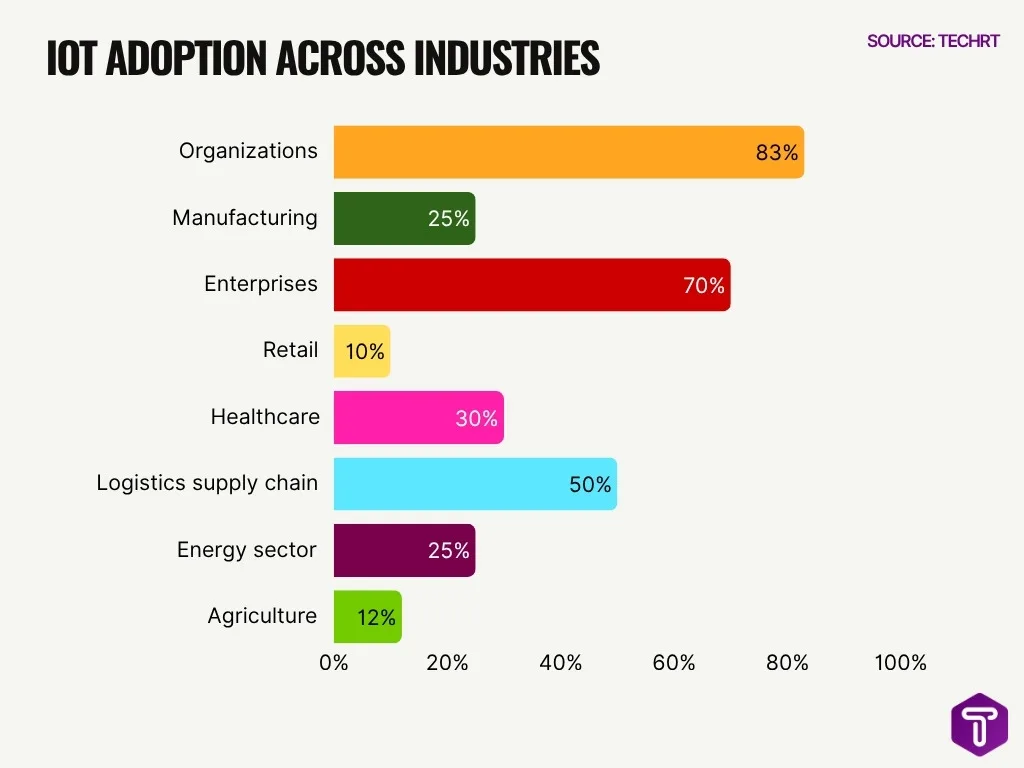
- 83% of organizations report improved efficiency after adopting IoT solutions.
- Manufacturing leads IoT adoption, accounting for over 25% of global IoT usage.
- Around 70% of enterprises worldwide are actively investing in IoT initiatives as of 2025.
- Retail companies using IoT report up to 10% reduction in operational costs.
- Healthcare IoT adoption increased by over 30% between 2022 and 2025.
- Logistics firms leveraging IoT improve supply chain visibility by 50% or more.
- Energy sector IoT adoption helps reduce downtime by 20 to 30% through predictive analytics.
- Agriculture IoT adoption, smart farming, is growing at over 12% CAGR globally.
Smart Home and Consumer IoT Statistics
- The global smart home market is projected to reach $231 billion by 2028.
- Over 69% of U.S. households are expected to use at least one smart device by 2025.
- Smart speaker adoption exceeds 35% of U.S. households.
- Consumers own an average of 8 to 10 connected devices per household globally.
- Smart thermostats can reduce energy usage by 10 to 15% annually.
- Home security IoT devices account for over 25% of smart home spending.
- Wearables and fitness trackers continue to grow at double-digit annual rates.
- Voice assistants drive IoT engagement, with billions of interactions daily.
Smart City IoT Statistics
- Global smart city spending is expected to reach $327 billion by 2025.
- IoT-enabled traffic systems can reduce congestion by up to 30%.
- Smart lighting solutions cut energy costs by 50 to 70% in urban areas.
- Over 1,000 smart city projects are active worldwide.
- Waste management IoT systems improve efficiency by 20 to 40%.
- Public safety systems using IoT reduce emergency response times by 20%.
- Asia-Pacific leads smart city investments due to rapid urbanization.
- Smart parking systems can reduce search time by up to 43%.
IoT Spend in the Logistics Market
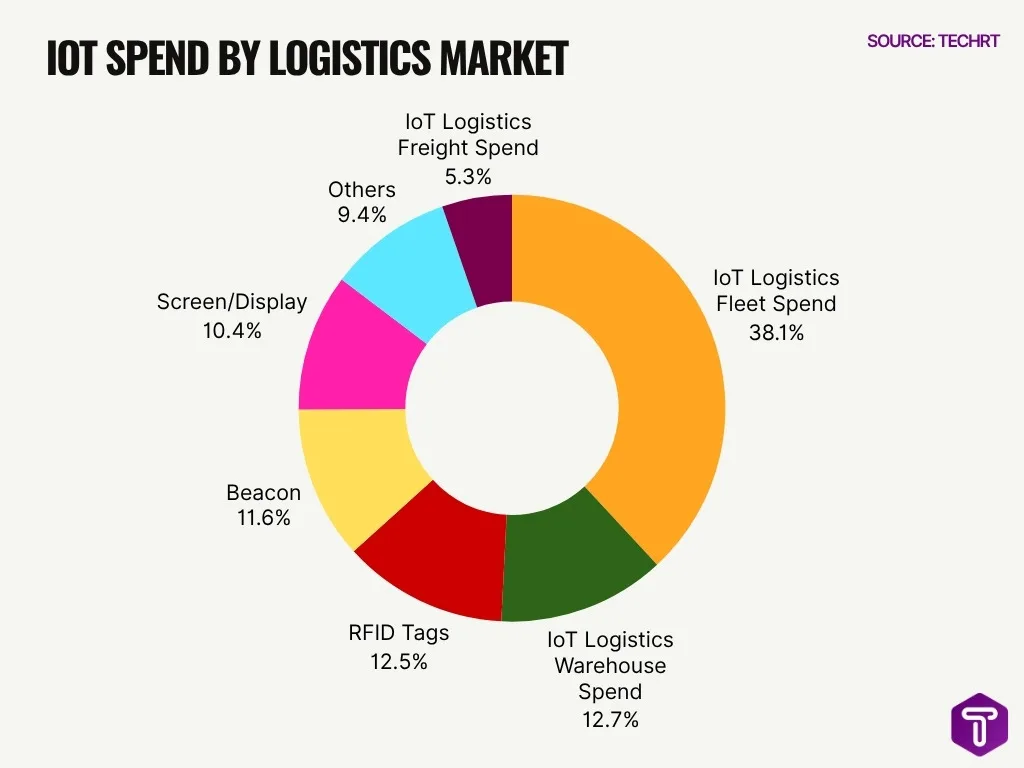
- The largest share of IoT spending in logistics is dominated by IoT Logistics Fleet Spend at 38.1%, highlighting the strong focus on fleet management, tracking, and optimization.
- IoT Logistics Warehouse Spend accounts for 12.7%, indicating significant investment in automation, inventory management, and smart warehousing solutions.
- RFID Tags contribute 12.5% of total spending, showing their critical role in real-time tracking, asset visibility, and supply chain efficiency.
- Beacon technology holds 11.6%, reflecting growing adoption for proximity tracking, navigation, and location-based services in logistics environments.
- Screen/Display solutions make up 10.4%, emphasizing the importance of real-time monitoring dashboards and operational visibility tools.
- A notable 9.4% falls under “Others”, suggesting a diverse range of emerging IoT applications and niche technologies in the logistics sector.
- The smallest segment is IoT Logistics Freight Spend at 5.3%, indicating comparatively lower but still important investment in freight-specific IoT solutions.
- Overall, the data highlights a clear trend toward operational efficiency, real-time tracking, and automation, with the majority of investments concentrated in fleet and warehouse optimization technologies.
Automotive and Connected Vehicle IoT Statistics
- The connected car market is projected to reach $166 billion by 2025.
- Over 400 million connected cars are expected on the road by 2025.
- Connected vehicles can reduce accidents by up to 30% through real-time data sharing.
- Automotive IoT enables predictive maintenance, reducing repair costs by 20%.
- EVs and connected vehicles rely on IoT for battery monitoring and optimization.
- Telematics adoption in commercial fleets exceeds 60% globally.
- Vehicle-to-everything (V2X) communication is expanding rapidly with 5G integration.
- Autonomous vehicles depend on IoT ecosystems for real-time navigation and safety systems.
Regional IoT Market and Adoption Statistics
- North America accounts for over 35% of global IoT revenue, driven by strong enterprise adoption.
- The U.S. leads IoT innovation with widespread use across healthcare, manufacturing, and logistics.
- Asia-Pacific is the fastest-growing region, with IoT CAGR exceeding 20% through 2030.
- China alone contributes significantly to IoT expansion due to massive smart city investments.
- Europe holds a strong share, supported by Industry 4.0 initiatives and regulatory frameworks.
- India’s IoT market is projected to grow at over 25% CAGR, driven by digital transformation.
- Latin America shows rising IoT adoption in the agriculture and logistics sectors.
- Middle East investments in smart cities like NEOM are accelerating IoT deployments.
IoT Connectivity Protocol Adoption
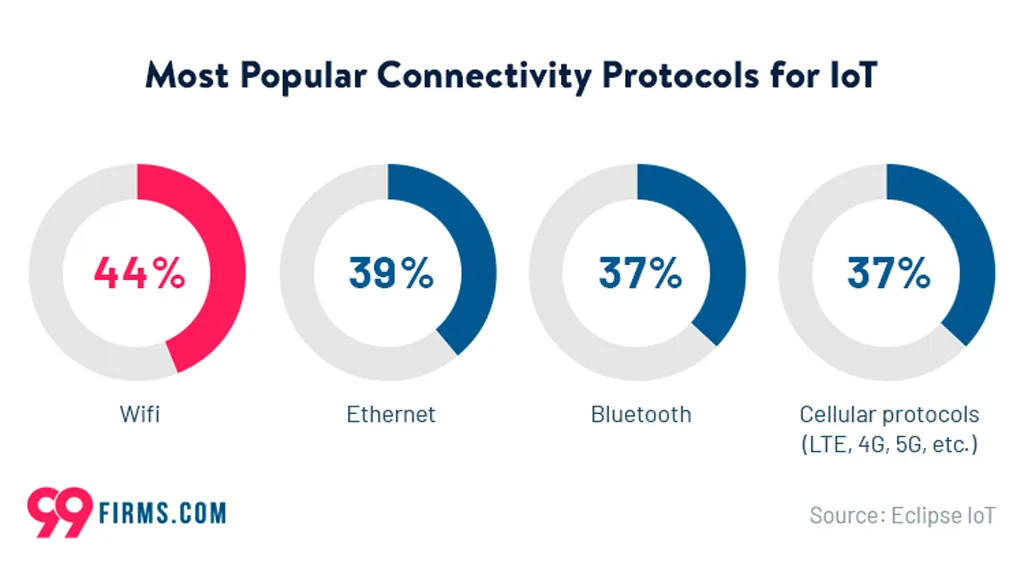
- WiFi leads the IoT connectivity landscape with a dominant 44% usage, making it the most widely adopted protocol for connected devices.
- Ethernet remains highly relevant, accounting for 39%, highlighting its continued importance in stable and high-speed wired connections.
- Bluetooth is used by 37% of IoT devices, emphasizing its strong role in short-range and low-power communication, especially in wearables and smart home devices.
- Cellular protocols (LTE, 4G, 5G) also hold a 37% share, showing their growing significance in remote, mobile, and large-scale IoT deployments.
- The relatively close percentages (37%–44% range) indicate a diverse connectivity ecosystem, where multiple protocols coexist based on specific use cases.
- Wireless technologies dominate overall, with WiFi, Bluetooth, and cellular collectively representing the majority of IoT connectivity solutions.
- The data suggests that no single protocol is sufficient, and hybrid connectivity strategies are increasingly common in IoT implementations.
IoT Security, Privacy, and Cyberattack Statistics
- IoT cyberattacks increased by over 77% in 2024, highlighting security concerns.
- Around 60% of IoT devices are vulnerable to medium or high-severity attacks.
- The average IoT data breach cost exceeds $4.5 million globally.
- Over 70% of enterprises cite security as a major barrier to IoT adoption.
- Botnet attacks often exploit unsecured IoT devices like cameras and routers.
- IoT security spending is projected to reach $6 billion by 2027.
- Firmware vulnerabilities remain a key issue in legacy IoT devices.
- Zero-trust architecture adoption is rising to protect IoT ecosystems.
IoT Data Generation, Traffic, and Network Usage Statistics
- 41.6 billion IoT devices are projected to generate 79.4 zettabytes of data annually by 2025, representing a 28.7% compound annual growth rate.
- Video surveillance applications dominate IoT bandwidth consumption, with a single internet-connected security camera generating up to 300 GB of data monthly.
- 5G IoT deployments account for 62% of all new industrial installations, enabling ultra-low latency connectivity for real-time applications.
- Edge processing reduces cloud data transmission by up to 70%, with hybrid edge-cloud architectures achieving 70% latency reduction compared to cloud-only models.
- Smart factories generate upwards of 5 petabytes (PB) of data per week through connected sensors, machines, and devices monitoring real-time operations.
- Connected vehicles produce approximately 25 GB of data per hour on average, with data collected from over 100 different datapoints, including geolocation, biometrics, and diagnostics.
- 32% of all IoT connections globally rely on Wi-Fi, with three-quarters of Wi-Fi-enabled devices shipped in 2023 using the latest Wi-Fi 6 and Wi-Fi 6E technologies.
- 21.1 billion connected IoT devices are projected worldwide by the end of 2025, growing at a 14% year-over-year rate.
IoT Revenue Growth Trends
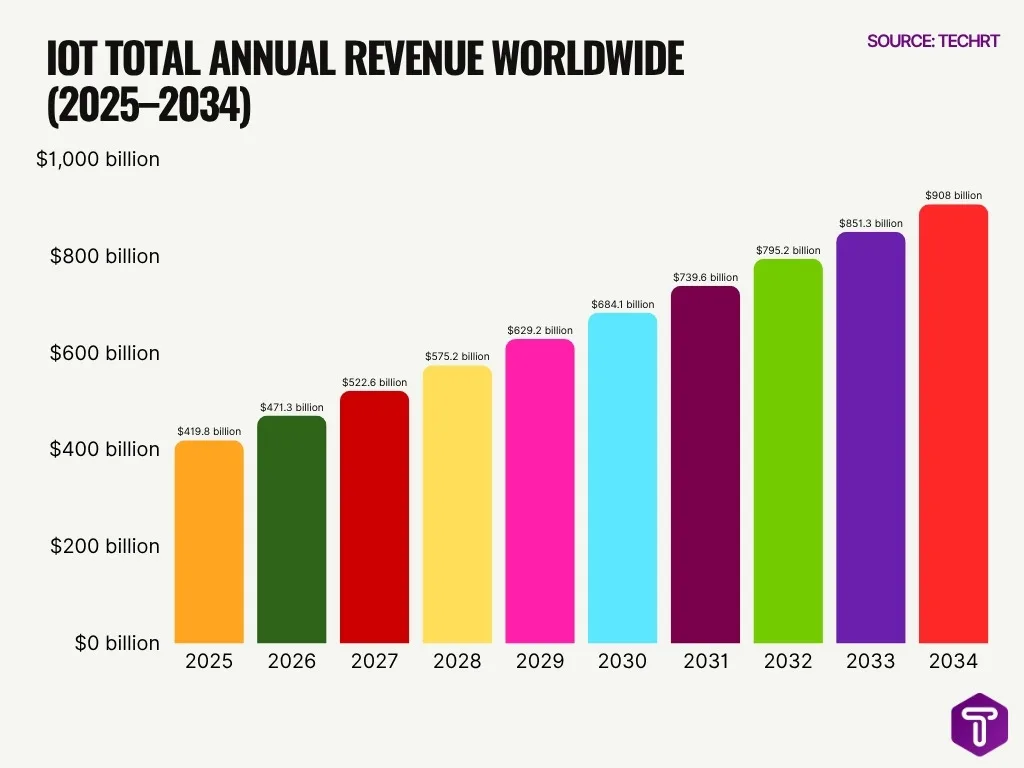
- The global Internet of Things (IoT) market is projected to grow from $419.8 billion in 2025 to $908 billion by 2034, more than doubling in size over the period.
- This represents an overall increase of $488.2 billion, highlighting the massive expansion of IoT across industries.
- The market shows consistent year-over-year growth, with annual revenue increasing steadily by roughly $50–60 billion each year.
- By 2030, IoT revenue is expected to reach $684.1 billion, crossing the $600 billion milestone just one year earlier in 2029 ($629.2 billion).
- The industry is forecast to surpass the $700 billion mark in 2031 ($739.6 billion), indicating strong mid-term growth momentum.
- In the later years, growth remains robust, with revenue hitting $795.2 billion in 2032 and $851.3 billion in 2033.
- The final projection of $908 billion in 2034 signals that IoT is approaching the $1 trillion threshold, a major milestone for the sector.
- Overall, the data reflects a stable and predictable growth curve, driven by increasing adoption in smart devices, industrial automation, healthcare, and smart cities.
- The steady rise suggests a strong compound annual growth trajectory (CAGR), making IoT one of the fastest-growing technology markets globally.
Economic Impact and ROI of IoT
- IoT could generate $5.5 trillion to $12.6 trillion in economic value annually by 2030.
- Businesses adopting IoT report 10 to 30% cost savings through automation.
- Predictive maintenance reduces maintenance costs by up to 40%.
- IoT improves asset utilization by 15 to 25% across industries.
- Smart energy systems cut energy costs by 20% or more.
- Retail IoT increases sales through personalized experiences and inventory optimization.
- Logistics IoT improves delivery efficiency and reduces losses.
- ROI timelines for IoT projects typically range between 6 to 24 months.
Future IoT Trends, Forecasts, and Growth Projections
- IoT devices are forecasted to reach 40 billion globally by 2030, growing at a 13.2% CAGR from current levels.
- The IoT market will expand from $25.44 billion in 2025 to $81.04 billion by 2030 at a 26.1% CAGR.
- The 5G IoT market is projected to grow from $5.67 billion in 2025 to $68.42 billion by 2031 with a 51.45% CAGR.
- Digital twins in the manufacturing market will surge to $131.6 billion by 2033 at a 36.2% CAGR from $8.9 billion in 2024.
- The blockchain IoT market is expected to rise from $2 billion in 2023 to $20 billion by 2032 at a 28% CAGR.
- Sustainability-focused IoT solutions could reduce global carbon emissions by 15% by 2030, aiding net-zero goals.
- The edge AI market, key for IoT low-latency, will reach $170.56 billion by 2035 from $24.97 billion in 2025.
- Smart infrastructure investments are set to grow from $923 billion in 2024 to $2,109.5 billion by 2029 at 18% CAGR.
- Global IoT connections will hit 38.7 billion by 2030 at an 8% CAGR, with enterprise leading at 63% share.
Frequently Asked Questions (FAQs)
How many IoT devices are there globally in 2025?
What is the projected CAGR of IoT devices through 2030?
What is the global IoT market size forecast for 2030?
What is the expected growth rate of the IoT market in the next decade?
How fast has the IoT market grown annually in recent years?
Conclusion
IoT has moved beyond early experimentation and now powers large-scale, real-world applications across nearly every major industry. Businesses are using IoT to unlock measurable efficiency gains, reduce operational risks, and create new revenue opportunities through data-driven insights. For example, connected healthcare systems are improving patient outcomes through continuous monitoring, while smart logistics networks are optimizing global supply chains with real-time tracking and predictive analytics. At the same time, advancements in AI, 5G, and edge computing are accelerating IoT capabilities, enabling faster processing, better automation, and more intelligent decision-making at scale.
Looking ahead, IoT will play a central role in digital transformation strategies, especially as organizations focus on sustainability, automation, and customer-centric innovation. However, challenges such as security, data management, and integration remain critical considerations. Companies that invest strategically in IoT infrastructure, while addressing these risks, will be better positioned to capture long-term value. Ultimately, the data shows that IoT is not just growing; it is becoming a foundational layer of modern technology ecosystems, making it essential for businesses to stay informed, adapt quickly, and act with clarity.

Leave a comment
Have something to say about this article? Add your comment and start the discussion.