




eCommerce fraud continues to surge as online shopping, digital wallets, and cross-border transactions scale rapidly across global markets. Businesses now face a wide range of threats, from card-not-present fraud at checkout to account takeovers in subscription and fintech platforms, each impacting revenue, customer trust, and operational efficiency. Moreover, the rise of mobile commerce, buy now, pay later services, and real-time payments has expanded both opportunity and risk.
Retailers, marketplaces, and payment providers must now balance seamless user experiences with increasingly complex fraud prevention strategies. In this article, we break down the latest eCommerce fraud statistics to help you understand key trends, risks, and opportunities shaping the industry.
Editor’s Choice
- Global eCommerce fraud losses reached $48 billion in 2025, reflecting a sharp year-over-year increase.
- Fraud losses are projected to exceed $107 billion by 2029, driven by automation and AI-based attacks.
- Merchants lose an average of $4.61 for every $1 of fraud, including operational and recovery costs.
- Online payment fraud is expected to cost businesses $206 billion globally by 2025.
- 59% of eCommerce companies reported an increase in fraud attempts in 2025.
- Fraud-related losses between 2023–2027 are projected to total $343 billion globally.
- Nearly 60% of U.S. businesses experienced higher fraud losses in 2025.
Recent Developments
- AI-driven fraud tactics have accelerated, with fraud losses increasing 16% year-over-year from 2024 to 2025.
- Global payment fraud attack rates remained at 3.3% in 2024, signaling sustained high activity.
- 75% of eCommerce companies plan to increase fraud prevention budgets.
- Real-time payment fraud now affects 45% of global retailers, reflecting new vulnerabilities.
- Fraudsters increasingly use synthetic identities and AI-generated data, making detection harder.
- First-party fraud impacts 33–34% of merchants, driven by refund abuse and chargebacks.
- Cross-border fraud continues to rise due to global payment expansion and weak regional controls.
- Payment fraud ecosystems now include “fraud-as-a-service” networks, lowering entry barriers for attackers.
What Is eCommerce Fraud?
- eCommerce fraud refers to unauthorized or deceptive transactions conducted online to gain financial benefit.
- Fraud includes payment fraud, identity theft, account takeover, and policy abuse.
- Nearly 60% of businesses reported rising fraud losses, highlighting its growing scale.
- Only 13% of consumers feel fully secure opening new online accounts.
- Fraud often targets card-not-present (CNP) transactions, where physical verification is absent.
- It also includes friendly fraud, where customers dispute legitimate transactions.
- Fraud affects both merchants (revenue loss) and consumers (identity theft risks).
- Modern fraud increasingly involves automation, bots, and machine learning tools.
Key eCommerce Fraud Statistics (Overview)
- Global eCommerce fraud losses hit $44.3 billion in 2024 and surged further in 2025.
- Fraud losses are expected to grow at a 141% rate between 2024 and 2029.
- Online payment fraud losses may exceed $521 billion cumulatively by 2029.
- North America accounts for over 42% of global eCommerce fraud value.
- Fraud costs increased from $97 to $102 per incident in 2024, showing rising severity.
- Fraud rates in transactions remain around 3.3% globally, indicating persistent risk.
- 20% of eCommerce revenue in Latin America is lost to fraud.
- Fraud now represents a core operational risk for nearly all online retailers.
eCommerce Fraud Losses by Region
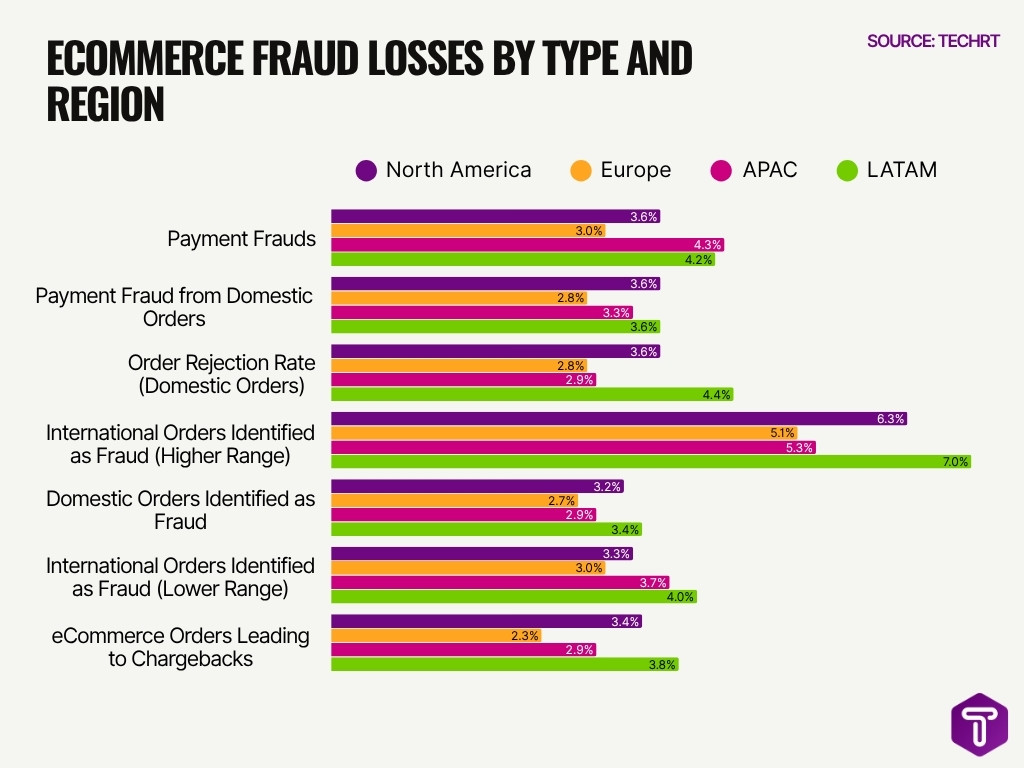
- LATAM records the highest fraud exposure, with up to 7.0% of international orders identified as fraudulent, making it the most vulnerable region globally.
- APAC leads in payment fraud rates, reaching 4.3%, significantly higher than North America (3.6%) and Europe (3.0%).
- North America shows consistently high fraud pressure, with 3.6% across multiple metrics, including payment fraud, domestic fraud, and order rejection rates.
- Europe maintains the lowest fraud rates overall, with figures as low as 2.3% for chargebacks and 2.7% for domestic fraud, indicating stronger fraud prevention systems.
- International transactions are far riskier than domestic ones, with fraud rates peaking at 6.3% (North America) and 7.0% (LATAM) compared to domestic fraud levels of 2.7%–3.4%.
- Chargebacks remain a significant revenue drain, especially in LATAM (3.8%) and North America (3.4%), directly impacting merchant profitability.
- Order rejection rates are notably high, reaching 4.4% in LATAM, suggesting potential revenue loss due to overly strict fraud filters or false declines.
- Domestic payment fraud is still substantial, with North America and LATAM both at 3.6%, proving that fraud is not limited to cross-border transactions.
- APAC shows moderate but rising fraud risk, with 3.7% international fraud (lower range) and 3.3% domestic payment fraud, indicating growing exposure in emerging markets.
- The data highlights a clear trend: cross-border eCommerce transactions carry 1.5x–2x higher fraud risk than domestic orders across all regions.
Global Online Payment Fraud Growth and Projections
- Online payment fraud losses are projected to exceed $362 billion globally over five years.
- Total eCommerce fraud value is estimated at $56.1 billion in 2025.
- Fraud losses could reach $131 billion by 2030, showing long-term growth.
- The market is expected to grow by 133% between 2025 and 2030.
- Payment card fraud losses may reach $400 billion over the next decade.
- Authorized push payment fraud is growing at an 11% CAGR from 2023–2027.
- Merchants are already facing annual fraud losses of ~$48 billion, indicating sustained pressure.
- Growth is fueled by digital wallets, BNPL services, and cross-border payments.
eCommerce Fraud by Industry and Vertical
- The retail sector accounts for over 30% of total eCommerce fraud cases, making it the most targeted industry.
- Digital goods and gaming face fraud rates 2–3x higher than physical retail, due to instant delivery and resale value.
- Travel and ticketing industries report fraud rates as high as 5% of total transactions.
- The fashion and apparel sector sees elevated return fraud, contributing to up to 12% of losses.
- Subscription-based businesses report 20–25% of fraud tied to account takeovers (ATO).
- Electronics retailers face higher fraud severity, with average order values 2x higher in fraudulent purchases.
- Food delivery platforms report refund abuse in nearly 15% of disputed orders.
- Luxury goods see fraud rates exceeding 3.5%, driven by resale demand and cross-border transactions.
Most Popular Types of eCommerce Fraud
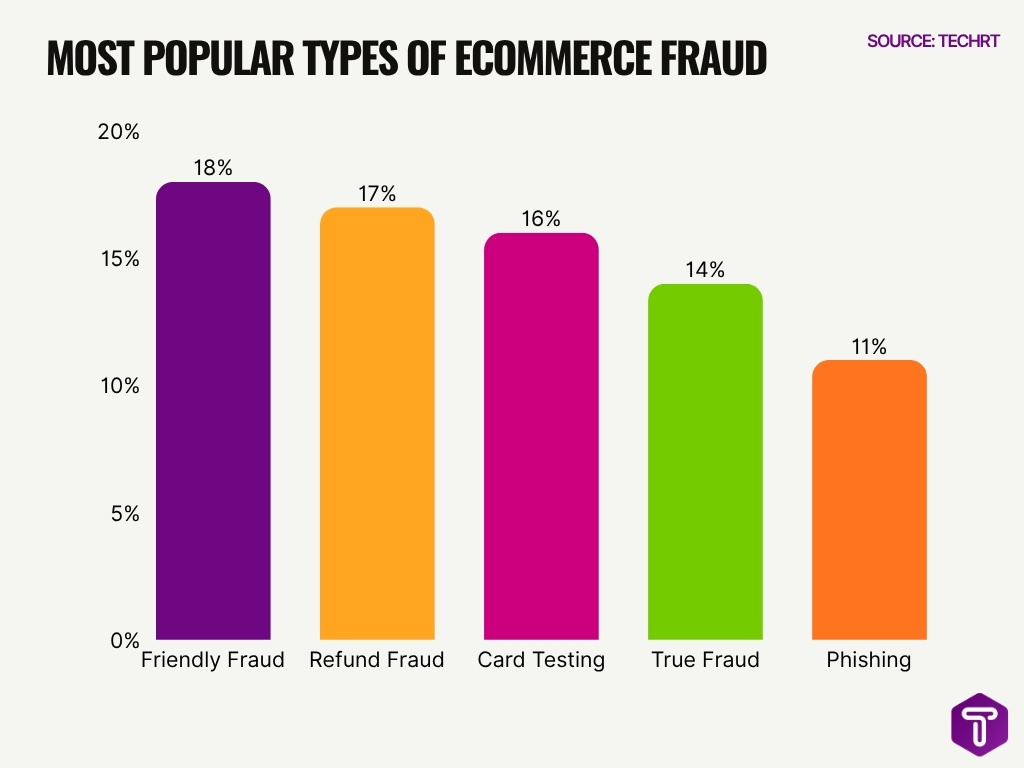
- Friendly fraud is the leading type, accounting for 18% of all eCommerce fraud cases, highlighting the growing issue of chargebacks initiated by legitimate customers.
- Refund fraud closely follows at 17%, indicating significant abuse of return and refund policies by consumers.
- Card testing fraud makes up 16%, showing how fraudsters use small transactions to validate stolen card details before larger purchases.
- True fraud represents 14%, reflecting traditional unauthorized transactions using stolen payment information.
- Phishing attacks contribute 11%, emphasizing the continued risk of consumers being tricked into sharing sensitive data.
- The top three fraud types (Friendly Fraud, Refund Fraud, Card Testing) together account for a dominant 51% share, indicating where merchants face the highest risk concentration.
- Overall, consumer-driven and payment-related frauds dominate the landscape, signaling a need for stronger fraud detection systems and policy controls for online businesses.
Chargeback and Friendly Fraud Statistics
- Friendly fraud accounts for 60–80% of all chargebacks globally.
- Merchants lose an average of $3.75 per chargeback dollar, including fees and operational costs.
- U.S. merchants reported chargeback increases of 19% in 2025.
- Nearly 45% of consumers admitted to filing illegitimate chargebacks.
- Subscription services face higher exposure, with up to 35% of disputes tied to recurring billing confusion.
- The average chargeback rate across industries is 0.47% of transactions, nearing critical thresholds.
- Retailers spend over 25% of fraud management budgets on chargeback handling.
- Digital services see faster dispute cycles, often within 24–48 hours of the transaction.
Account Takeover (ATO) and Identity Theft Statistics
- Account takeover fraud increased by 307% in recent years, driven by credential stuffing.
- 1 in 5 consumers has experienced account takeover at least once.
- Credential stuffing attacks account for over 80% of login fraud attempts.
- ATO attacks cost businesses over $13 billion annually.
- Nearly 64% of consumers reuse passwords, increasing vulnerability.
- Fraudsters can monetize compromised accounts within hours of breach detection.
- Financial services and eCommerce platforms are the top targets for ATO attacks.
- Identity theft cases in the U.S. exceeded 1.1 million reports in 2024.
Card Fraud Breakdown in SEPA
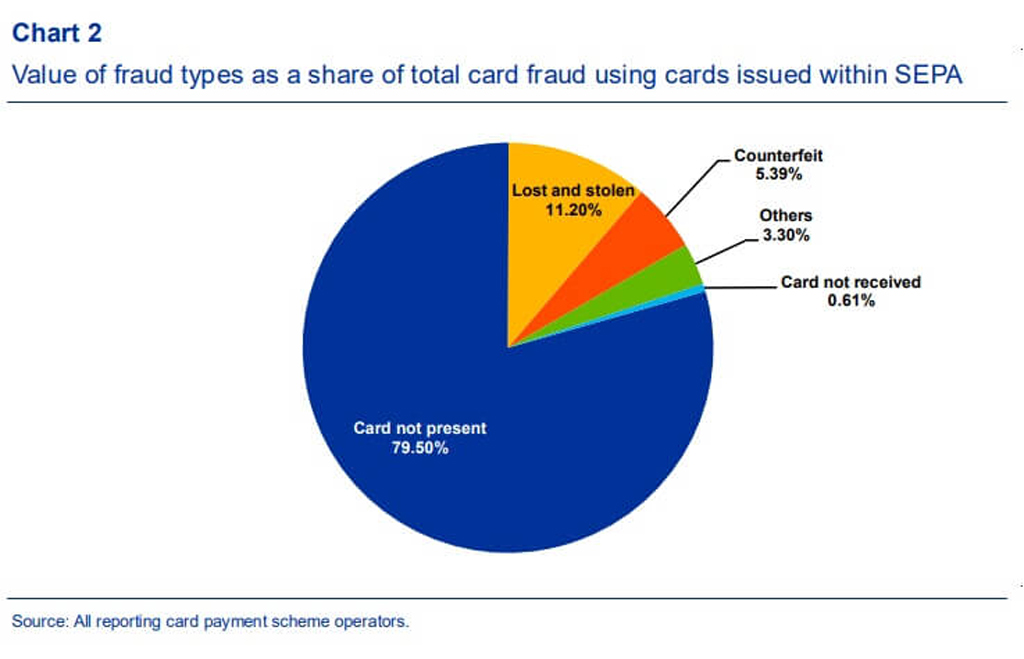
- Card-not-present (CNP) fraud dominates, accounting for a massive 79.50% of total card fraud, highlighting the growing risk in online and remote transactions.
- Lost and stolen card fraud is the second-largest category at 11.20%, showing that physical card security remains a significant concern.
- Counterfeit fraud contributes 5.39%, indicating that while reduced due to EMV chip technology, it persists in certain regions and channels.
- Other fraud types make up 3.30%, reflecting a mix of emerging and less common fraud tactics in the payments ecosystem.
- Card-not-received fraud is minimal at just 0.61%, suggesting improvements in delivery security and tracking systems.
- The data clearly shows a shift toward digital fraud, with nearly 4 out of 5 fraud cases occurring without physical card presence.
- Businesses and payment providers should prioritize fraud prevention strategies for eCommerce and online payments, where the majority of fraud risk is concentrated.
- Overall, the fraud landscape is increasingly digital-first, requiring advanced authentication, AI-driven detection, and real-time monitoring systems.
Mobile, App, and Digital Wallet Fraud Statistics
- Mobile commerce accounts for over 60% of global eCommerce sales, increasing fraud exposure.
- Fraud rates on mobile apps are 2x higher than on desktop platforms.
- Digital wallet fraud grew by 15% year-over-year in 2025.
- In-app purchase fraud affects over 12% of gaming transactions.
- Biometric authentication adoption reduced mobile fraud by up to 30%.
- Over 40% of mobile fraud involves account takeover attacks.
- Push payment scams via mobile banking apps increased by 20% globally.
- Fraudsters increasingly exploit mobile device spoofing and emulator tools.
Refund, Return, and Wardrobing Fraud Statistics
- Return fraud and abuse cost U.S. retailers $101 billion in 2024.
- Wardrobing (using and returning items) accounts for over 10% of returns in fashion retail.
- 16.5% of all retail returns are fraudulent or abusive.
- Refund abuse increased by 21% year-over-year in 2025.
- Merchants lose $166 million per $1 billion in sales due to returns fraud.
- Online orders have return rates 2–3x higher than in-store purchases, increasing fraud exposure.
- Serial returners represent 11% of customers but drive 40% of return fraud losses.
- The electronics and apparel sectors face the highest refund fraud rates globally.
Online Retail Fraud Trends (YoY Change)
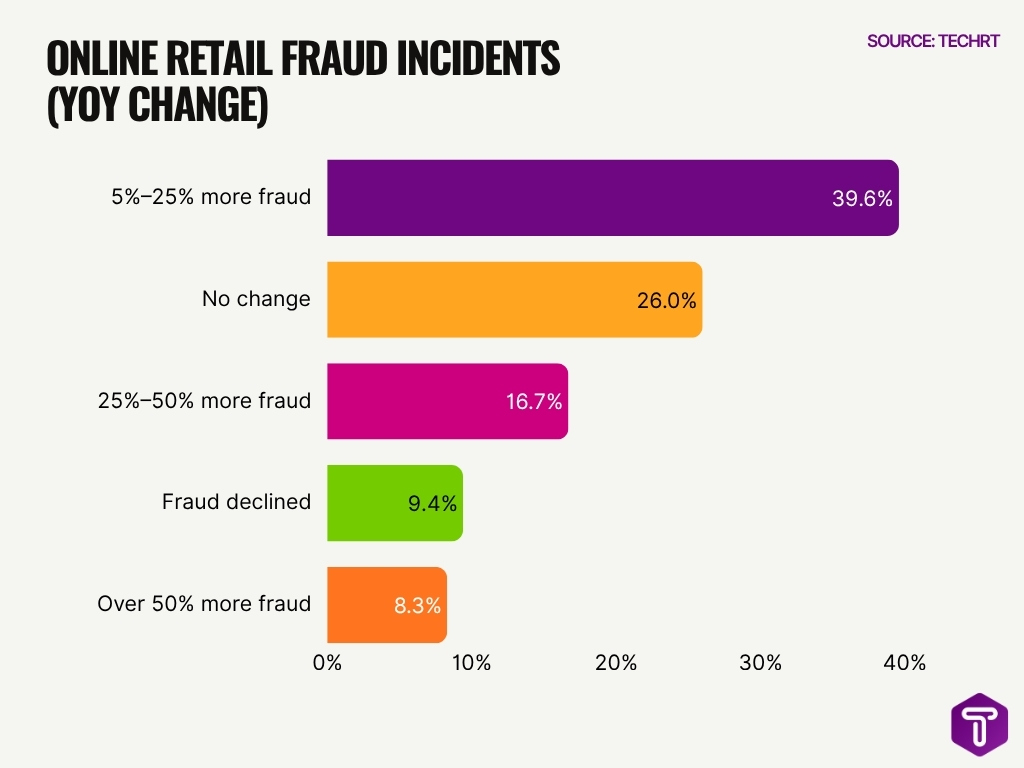
- A significant 39.6% of retailers reported a 5%–25% increase in fraud, making it the most common trend, indicating a widespread moderate rise in fraud incidents.
- Around 26.0% of retailers experienced no change in fraud levels, suggesting that over a quarter of businesses maintained stable fraud exposure year-over-year.
- Nearly 16.7% of retailers saw a 25%–50% surge in fraud, highlighting a substantial escalation for a notable segment of the market.
- Only 9.4% of retailers reported that fraud declined, showing that fraud reduction remains relatively rare across the industry.
- A concerning 8.3% of retailers faced over 50% increase in fraud, representing the most severely impacted group despite being the smallest share.
- Overall, more than 64% of retailers experienced an increase in fraud, reinforcing the growing threat of eCommerce fraud globally.
- The data clearly indicates a skew toward rising fraud incidents, with higher percentages clustered in growth categories rather than decline or stability.
Marketplace and Third-Party Seller Fraud Statistics
- Online marketplaces account for over 50% of global eCommerce sales, increasing fraud exposure.
- Third-party seller fraud contributes to 35% of marketplace-related fraud incidents.
- Fake seller accounts increased by 27% in 2025.
- Product listing scams impact 1 in 4 marketplace buyers.
- Refund abuse and counterfeit goods remain key issues, accounting for over 20% of disputes.
- Marketplace fraud losses are expected to exceed $20 billion annually by 2027.
- Social commerce fraud increased by 25% year-over-year, especially on emerging platforms.
- Platforms using AI moderation reduced fraudulent listings by up to 50%.
Promo Abuse, Coupon Abuse, and Policy Abuse Statistics
- Promo abuse accounts for 8–10% of total eCommerce revenue leakage annually.
- Nearly 40% of merchants report increased coupon abuse in 2025.
- Referral fraud campaigns increased by 30% year-over-year, driven by multi-account creation.
- Fraudsters can generate hundreds of fake accounts per hour using automation tools.
- Coupon stacking abuse leads to losses of up to 15% per promotional campaign.
- Over 25% of new customer promotions are exploited by repeat fraudsters.
- Abuse of free trial policies increased by 18% in subscription-based services.
- Merchants using rule-based controls alone fail to detect over 35% of promo abuse cases.
How Fraud Costs Impact Businesses
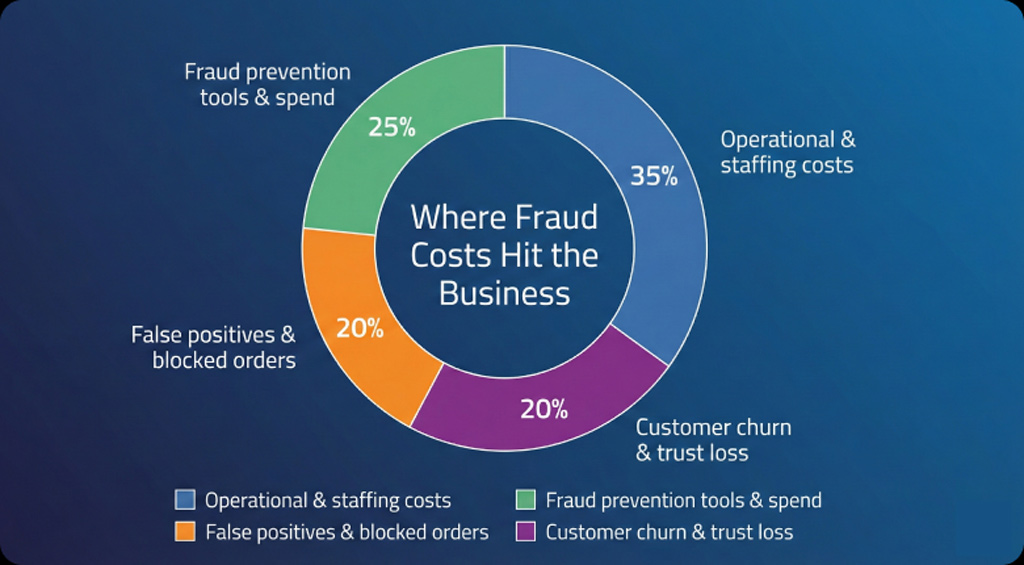
- Operational & staffing costs dominate fraud expenses, accounting for the largest share at 35%, highlighting the heavy burden of manual reviews, investigations, and workforce requirements.
- Fraud prevention tools and technology spending make up 25%, showing that businesses are investing significantly in software, AI tools, and security infrastructure to mitigate risks.
- Customer churn & trust loss contribute 20%, indicating that fraud not only causes direct financial damage but also leads to long-term revenue loss through declining customer loyalty.
- False positives & blocked orders also represent 20%, emphasizing that overly strict fraud detection systems can reject legitimate transactions, negatively impacting sales and customer experience.
- Combined, indirect costs (churn + false positives) total 40%, nearly rivaling operational expenses, proving that customer experience and trust are critical hidden costs of fraud.
- Overall, the data reveals that fraud is not just a financial or technical issue, but a multi-dimensional business challenge affecting operations, technology investment, and customer retention.
Bot Attacks, Credential Stuffing, and Automated Fraud Statistics
- Bots account for over 47% of all internet traffic, with malicious bots making up a large share.
- Credential stuffing attacks increased by 67% between 2023 and 2025.
- Automated attacks target login endpoints in over 90% of large eCommerce platforms.
- Fraud bots can test thousands of stolen credentials per minute.
- Bot-driven inventory hoarding (scalping) increased by 35% in 2025.
- Nearly 80% of account takeover attacks involve automated bot activity.
- Retailers report that bots contribute to over 20% of checkout fraud attempts.
- Advanced bots now mimic human behavior, reducing detection accuracy by up to 25%.
Adoption of Fraud Detection Tools and Technologies
- 78% of eCommerce businesses use automated fraud detection tools in 2025.
- Adoption of real-time fraud monitoring increased by 22% year-over-year.
- Merchants using layered fraud prevention strategies reduced fraud losses by up to 50%.
- Rule-based systems alone detect only 60–70% of fraud cases, highlighting limitations.
- 65% of businesses now integrate fraud detection with payment gateways.
- Behavioral analytics adoption grew by 18% in 2025, improving detection accuracy.
- Companies using device fingerprinting saw 30% fewer fraud attempts.
- Small businesses lag, with only 42% adopting advanced fraud tools.
eCommerce Fraud Impact by Age Group
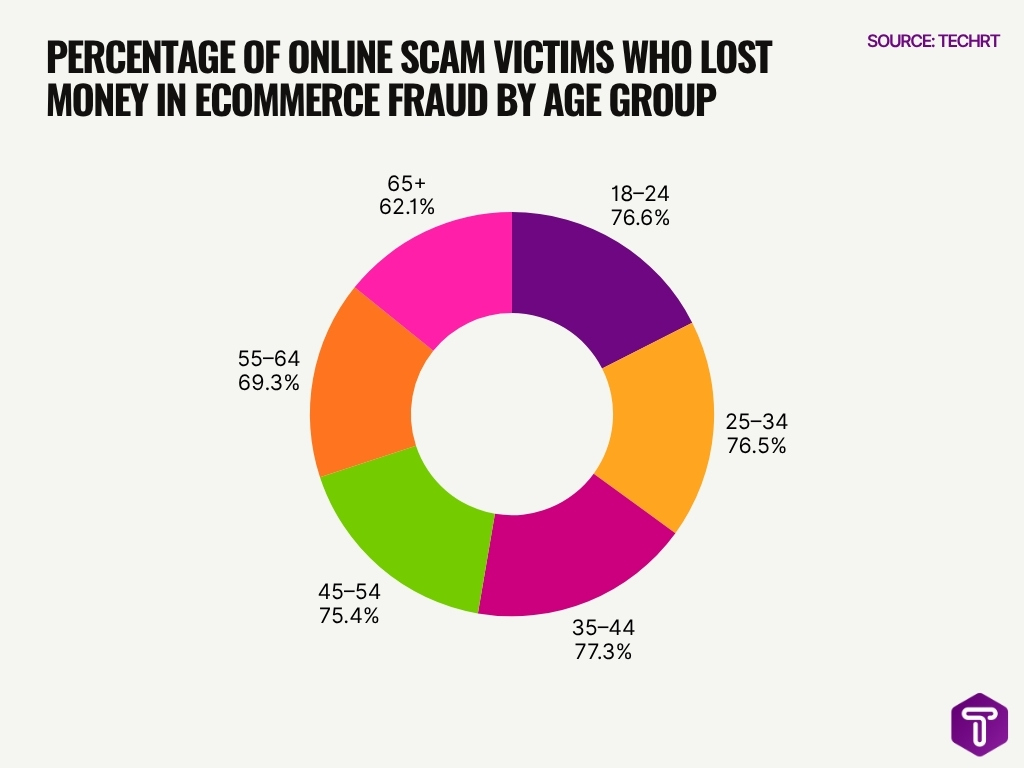
- The highest financial loss rate is observed among the 35–44 age group, with 77.3% of scam victims reporting a loss.
- Young adults aged 18–24 (76.6%) and 25–34 (76.5%) show nearly identical vulnerability, indicating high exposure to online scams among digital-native users.
- The 45–54 age group follows closely, with 75.4% of victims experiencing financial losses, suggesting consistent risk across mid-age segments.
- A noticeable decline begins with the 55–64 age group, where 69.3% of victims lost money, still significant but comparatively lower.
- Seniors aged 65+ report the lowest loss rate at 62.1%, indicating either more cautious behavior or lower engagement in risky online transactions.
- Overall, younger and middle-aged users (18–44) face the highest risk, with loss rates consistently above 76%, making them the primary target demographic for eCommerce fraudsters.
- The data highlights a clear age-based gradient, where financial loss susceptibility decreases with age, especially after 55 years.
Use of AI, Machine Learning, and Biometrics in Fraud Prevention
- 70% of enterprises now use AI or machine learning for fraud detection.
- AI-based fraud detection systems improve accuracy by up to 90% compared to manual review.
- False positives decreased by up to 50% with machine learning models.
- Biometric authentication adoption increased by 26% in 2025, especially in mobile commerce.
- Facial recognition and fingerprint scanning reduce fraud risk by over 30%.
- AI-driven fraud systems analyze thousands of data points per transaction in real time.
- Fraud detection platforms using AI reduced chargebacks by 20–40%.
- Generative AI is also used by attackers, increasing the sophistication of fraud in over 60% of cases.
Future eCommerce Fraud Trends and Predictions
- Global eCommerce fraud losses are projected to exceed $107 billion by 2029.
- Fraud-as-a-service marketplaces are expected to grow by over 20% annually.
- Deepfake and AI-generated identity fraud will rise, impacting over 15% of verification processes by 2027.
- Real-time payment fraud is forecast to increase by 11% CAGR through 2028.
- Cross-border fraud will account for over 50% of total eCommerce fraud losses.
- Biometric authentication adoption is expected to exceed 80% of mobile transactions by 2030.
- Fraud detection spending will surpass $20 billion globally by 2027.
- Retailers investing in AI-driven fraud prevention will see ROI improvements of up to 3x.
Frequently Asked Questions (FAQs)
How much did global eCommerce fraud losses reach recently?
Global eCommerce fraud losses reached $48 billion in a single year.
What is the projected value of eCommerce fraud by 2030?
eCommerce fraud is expected to reach $131 billion by 2030, growing at 133% CAGR (2025–2030).
What percentage of revenue do merchants lose to eCommerce fraud?
Merchants lose an average of around 3% of total eCommerce revenue to fraud.
Which region accounts for the largest share of eCommerce fraud globally?
North America accounts for about 42% of the total global eCommerce fraud value.
How much will cumulative online payment fraud cost merchants between 2023 and 2027?
Online payment fraud losses are projected to total $343 billion globally between 2023 and 2027.
Conclusion
eCommerce fraud is no longer a secondary concern; it has become a core business risk that directly affects profitability, customer retention, and brand reputation. As digital commerce expands, fraud tactics continue to evolve, ranging from automated bot attacks and credential stuffing to policy abuse and sophisticated AI-driven scams. At the same time, the financial impact goes beyond direct losses, including chargebacks, operational costs, and lost legitimate transactions due to false declines.
However, businesses are not standing still. The adoption of AI-powered fraud detection, behavioral analytics, and biometric authentication is helping companies detect threats earlier and respond more effectively. Organizations that invest in layered, data-driven fraud prevention strategies are better positioned to reduce losses while maintaining a smooth customer experience.
Looking ahead, fraud will grow in both scale and sophistication, especially with the rise of generative AI and cross-border commerce. Companies that stay informed, adapt quickly, and prioritize proactive fraud management will not only mitigate risk but also gain a competitive edge in an increasingly digital marketplace.

Leave a comment
Have something to say about this article? Add your comment and start the discussion.