




Artificial intelligence now drives core ecommerce functions, from personalized product recommendations to automated customer service and dynamic pricing. Retailers use AI to predict demand, optimize inventory, and streamline supply chains, while shoppers benefit from faster search results, smarter suggestions, and frictionless checkout experiences. For example, AI-powered recommendation engines help platforms like Shopify increase conversion rates by surfacing relevant products, while conversational AI tools manage thousands of customer queries in real time, reducing wait times and operational costs.
As AI adoption accelerates across the US and global markets, it is reshaping how businesses attract, convert, and retain customers. At the same time, consumers increasingly expect seamless, personalized, and instant interactions at every touchpoint. Understanding the latest statistics behind these trends helps businesses make informed decisions, allocate budgets effectively, and stay competitive in a rapidly evolving landscape. Let’s explore the key data shaping AI in ecommerce.
Editor’s Choice
- The AI-enabled ecommerce market reached $8.65 billion in 2025 and continues to expand rapidly.
- The market is projected to hit $22.6 billion by 2032, growing at a CAGR of 14.6%.
- 78% of organizations now use AI in at least one business function, up from 55% in 2023.
- 97% of retailers plan to increase AI spending in the next fiscal cycle.
- AI-driven personalization generates up to 40% more revenue for ecommerce businesses.
- Product recommendations powered by AI can increase revenue by as much as 300%.
- 69% of AI adopters report revenue growth, while 72% see cost reductions.
Recent Developments
- Generative AI traffic to retail websites surged by 4,700% year over year, reshaping product discovery.
- AI-driven referrals to ecommerce sites increased by over 700% in 2025, signaling new shopping behavior.
- AI-assisted shopping influenced $229 billion in global online sales in 2024.
- AI chatbot usage among shoppers increased by 42% year over year during peak retail seasons.
- Around 40% of enterprise applications will include AI agents by 2026, up from under 5% in 2025.
- AI-powered checkout experiences are emerging, allowing purchases directly within chat interfaces.
- Ecommerce markets like India recorded 25% growth in early 2026, partly fueled by AI-driven efficiencies.
- About 34% of consumers are willing to let AI make purchases on their behalf.
AI in Ecommerce Market Size and Growth
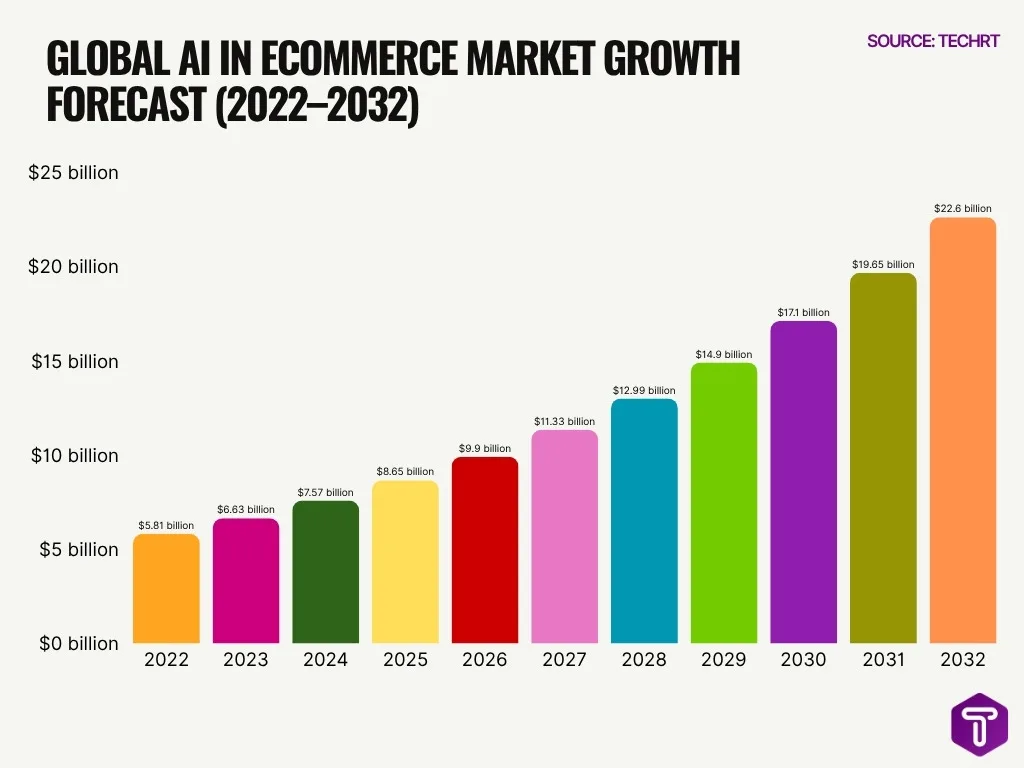
- The global AI-enabled eCommerce market is projected to grow from $5.81 billion in 2022 to $22.6 billion by 2032, showing massive long-term expansion.
- The market nearly quadruples in value over the 10-year period, highlighting strong adoption of AI technologies in online retail.
- In 2023, the market reached $6.63 billion, reflecting steady early-stage growth momentum.
- By 2024, it increased to $7.57 billion, indicating rising investment in AI-driven personalization and automation.
- The market is expected to cross $8.65 billion in 2025, marking a key milestone toward double-digit billion growth.
- In 2026, it is projected to hit $9.9 billion, nearing the $10 billion threshold.
- The industry is forecast to surpass $11.33 billion in 2027, driven by increased adoption of AI in customer experience and logistics.
- By 2028, the market size is expected to reach $12.99 billion, reflecting accelerating enterprise AI integration.
- The market will grow to $14.9 billion in 2029, showing consistent year-over-year expansion.
- In 2030, it is projected to exceed $17.1 billion, signaling a strong mid-term growth trajectory.
- By 2031, the market is expected to reach $19.65 billion, approaching the $20 billion mark.
- Finally, in 2032, the market is forecast to hit $22.6 billion, demonstrating the long-term scalability and dominance of AI in eCommerce.
AI in Ecommerce Revenue and ROI Statistics
- AI personalization increases revenue by up to 40% compared to non-AI approaches.
- AI chat tools deliver 4X higher conversion rates than traditional experiences.
- Businesses report an average 340% ROI from AI chatbot implementations.
- 69% of companies using AI report measurable revenue increases.
- 72% of businesses see cost reductions after adopting AI solutions.
- AI reduces supply chain costs by up to 10%, improving margins.
- AI-driven logistics optimization delivers 5–20% cost savings.
- AI tools help reduce forecasting errors by 30–50%, improving operational efficiency.
AI Personalization in Ecommerce Statistics
- 91% of consumers prefer brands that offer personalized experiences.
- 78% of consumers are more likely to make repeat purchases with personalization.
- Product recommendations can increase revenue by up to 300%.
- AI personalization improves conversion rates by up to 23%.
- 71% of shoppers feel frustrated when experiences are not personalized.
- AI-driven recommendations help shoppers complete purchases 47% faster.
- Personalized ecommerce strategies can increase customer satisfaction by over 25%.
- 38% of consumers value AI for improving personalization in shopping journeys.
AI Adoption Trends in Retail E-commerce
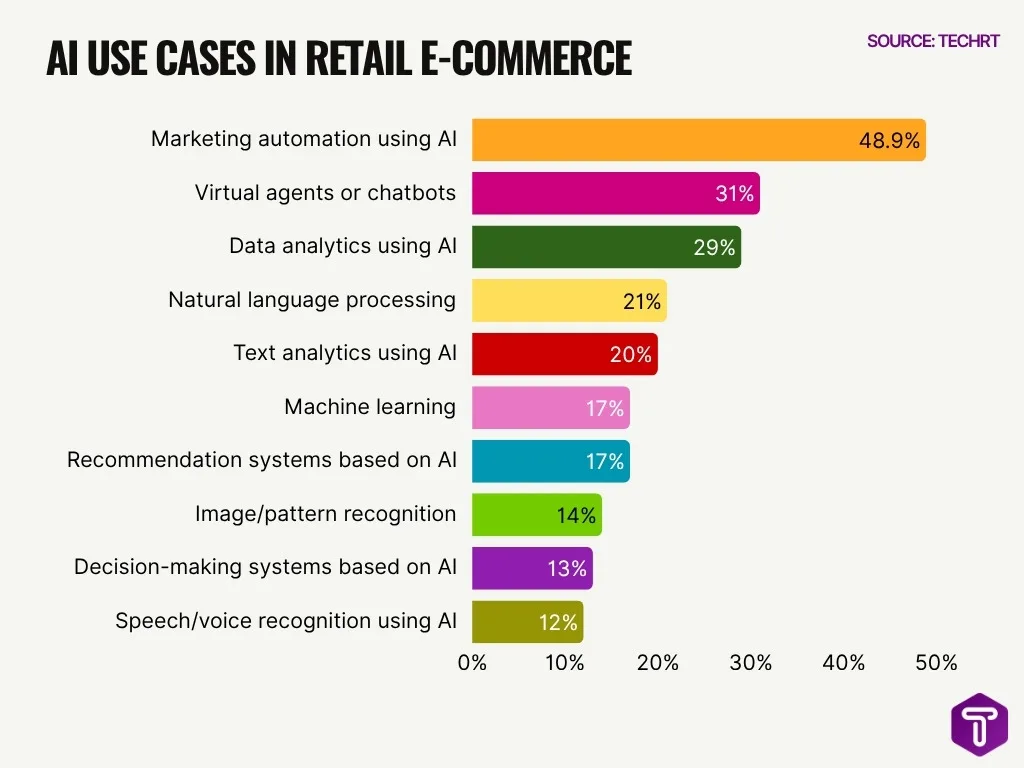
- Marketing automation using AI leads adoption at 48.9%, making it the most widely used AI application in retail, highlighting strong demand for automated campaigns and personalization.
- Virtual agents and chatbots are used by 31% of companies, showing a significant shift toward AI-driven customer support and conversational commerce.
- 29% of businesses leverage AI for data analytics, indicating a growing focus on data-driven decision-making and predictive insights.
- Natural language processing (NLP) is adopted by 21%, enabling retailers to better understand customer queries, sentiment, and search intent.
- Text analytics tools are used by 20% of companies, reflecting increased emphasis on extracting insights from reviews, feedback, and unstructured data.
- Core AI technologies like machine learning (17%) and AI-powered recommendation systems (17%) are equally adopted, playing a key role in personalization and product discovery.
- Image and pattern recognition is used by 14%, supporting use cases such as visual search, inventory tracking, and fraud detection.
- Decision-making systems powered by AI account for 13% adoption, helping businesses automate strategic and operational decisions.
- Speech and voice recognition technologies are used by 12%, indicating early adoption of voice commerce and voice-enabled shopping experiences.
- Overall, the data shows that customer-facing AI applications (marketing, chatbots, personalization) dominate adoption compared to more advanced backend AI systems.
AI in Ecommerce Customer Support Statistics
- AI can automate up to 70% of customer service interactions, reducing response time.
- Businesses using AI support tools see a 25% improvement in customer satisfaction scores.
- AI-driven support reduces average handling time by up to 40%.
- 64% of customers expect real-time assistance regardless of time or channel.
- AI-powered support systems can cut operational costs by 30% or more.
- 73% of customers say experience is a key factor in purchasing decisions.
- AI tools help resolve tickets 52% faster than traditional support systems.
- Chatbots and AI assistants operate 24/7, eliminating downtime in support services.
- AI reduces support ticket volume by up to 35%, freeing human agents for complex issues.
AI-Powered Product Recommendations Statistics
- Product recommendations account for up to 31% of ecommerce revenues.
- AI-based recommendations increase average order value by up to 50%.
- 35% of Amazon’s revenue comes from its recommendation engine.
- Personalized recommendations can boost conversion rates by 150% or more.
- AI recommendations reduce bounce rates by up to 40%.
- Cross-selling and upselling via AI increase revenue by 10–30%.
- 49% of shoppers have purchased items they did not intend to buy due to recommendations.
- Recommendation engines improve customer retention rates by 20%.
- AI personalization engines analyze millions of data points in real time to suggest products.
AI Tools Driving Shopping & Product Discovery
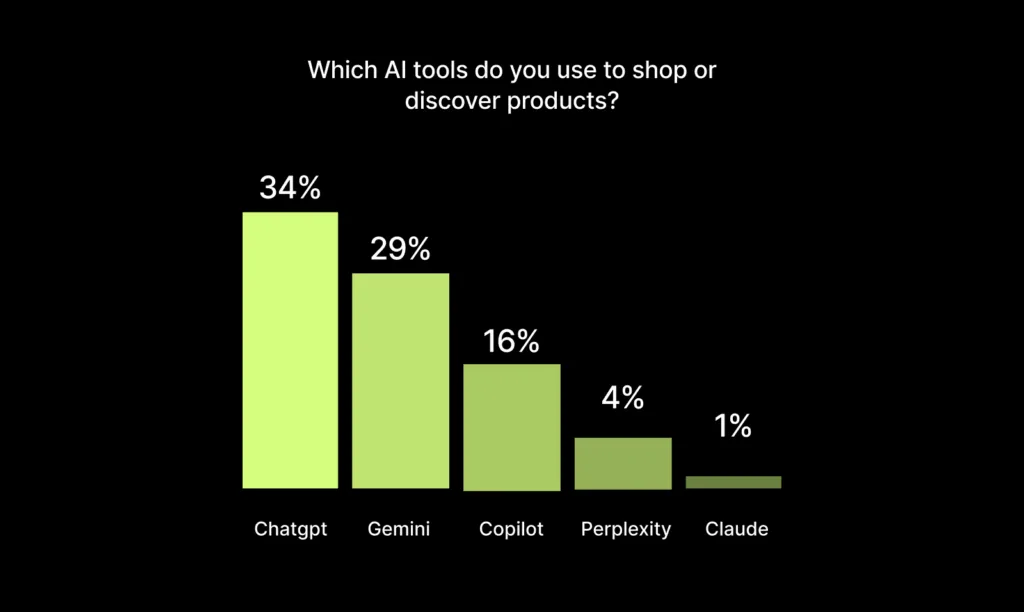
- ChatGPT leads the market, with 34% of users relying on it for shopping and product discovery, making it the most preferred AI tool.
- Gemini ranks second with a strong 29% share, indicating significant adoption among users for discovery use cases.
- Copilot captures 16%, showing moderate traction but still trailing behind the top two AI tools.
- There is a sharp drop after the top three, with Perplexity at just 4%, highlighting limited usage in this category.
- Claude records the lowest adoption, with only 1% of users, indicating minimal penetration in shopping-related use cases.
- The top two tools (ChatGPT + Gemini) dominate with a combined 63% share, reflecting a highly concentrated market.
- The data suggests a winner-takes-most dynamic, where a few leading AI platforms control the majority of user engagement.
- Lower adoption rates for tools like Perplexity and Claude may indicate niche positioning or lower awareness in e-commerce applications.
- Overall, AI-powered shopping is still consolidating, with clear leaders emerging but room for growth among smaller players.
AI in Ecommerce Marketing and Advertising Statistics
- AI-driven marketing can increase conversion rates by up to 30%.
- 84% of marketing organizations use AI in some form.
- AI helps reduce customer acquisition costs by up to 50%.
- Programmatic advertising powered by AI accounts for over 90% of digital display ad spend in the US.
- AI improves email marketing open rates by 20–25% through personalization.
- Predictive analytics increases marketing ROI by 15–20%.
- AI tools can segment audiences up to 100 times faster than manual processes.
- Businesses using AI-driven ads report higher click-through rates by 2X.
- 63% of marketers plan to increase AI budgets in the next year.
AI in Ecommerce Search Statistics (Visual and Voice Search)
- 62% of millennials prefer visual search over traditional search methods.
- Visual search can increase conversion rates by up to 48%.
- Voice commerce is expected to reach $40 billion in the US by 2026.
- 71% of consumers prefer voice search over typing queries.
- Retailers implementing visual search report 30% higher engagement rates.
- Voice assistants are used by over 50% of US households.
- Visual AI tools reduce search friction, leading to faster purchase decisions.
- AI search engines improve product discovery accuracy by up to 70%.
- 27% of global online shoppers use voice search on mobile devices.
AI-Driven Supply Chain Optimization: Key Processes and Performance Insights
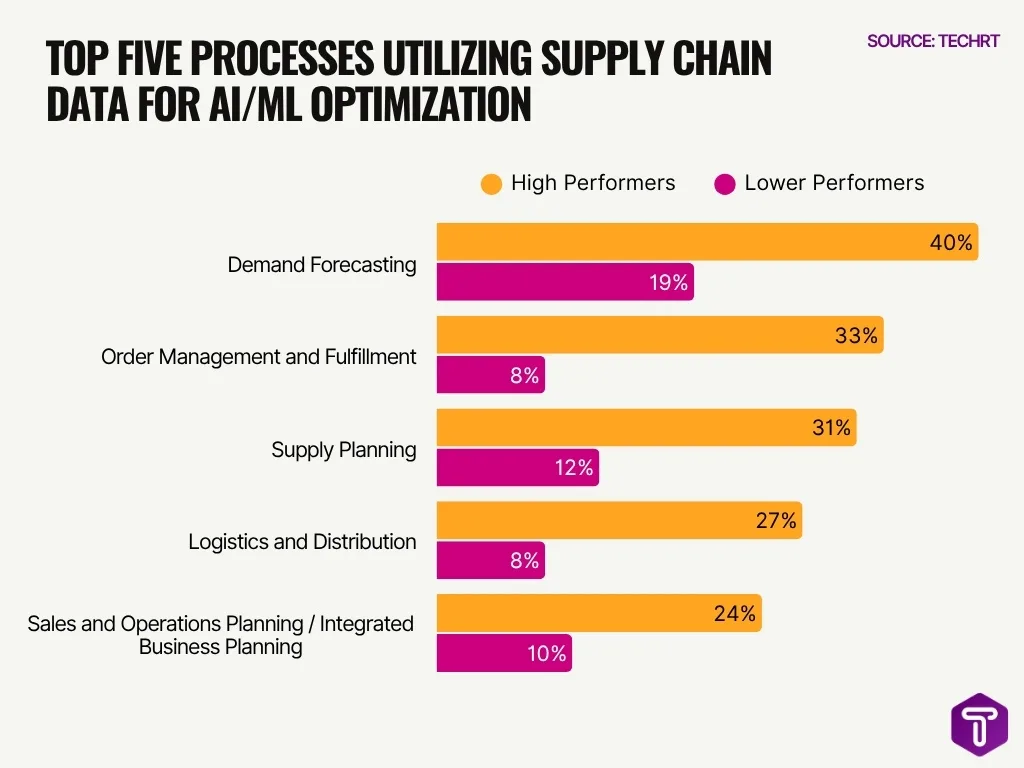
- Demand forecasting leads AI adoption, with 40% of high-performing companies leveraging it, compared to 19% of lower performers, showing a strong competitive edge in predictive analytics.
- Order management and fulfillment is the second most optimized area, used by 33% of high performers, versus just 8% of lower performers, highlighting major efficiency gaps.
- Supply planning is another critical function, with 31% of top performers utilizing AI/ML, more than double the 12% among lower performers.
- In logistics and distribution, 27% of high performers apply AI-driven optimization, compared to only 8% of lower performers, indicating significant room for improvement.
- Sales and operations planning (S&OP) or integrated business planning sees adoption by 24% of high performers, while just 10% of lower performers utilize it.
- Across all five processes, high performers consistently outperform lower performers by 2x to 4x, emphasizing the strategic importance of AI/ML in supply chain decision-making.
- The largest adoption gap (25 percentage points) is observed in demand forecasting (40% vs. 19%), making it the most impactful area for AI-driven transformation.
- Execution-focused processes like order fulfillment and logistics show some of the widest performance disparities, suggesting AI significantly improves operational efficiency.
- Overall, companies leveraging AI in multiple supply chain functions demonstrate stronger operational agility, forecasting accuracy, and decision-making capabilities.
AI in Ecommerce Fraud Prevention Statistics
- AI systems can detect fraud with up to 95% accuracy.
- Ecommerce fraud losses are expected to exceed $48 billion globally by 2025.
- AI reduces false positives in fraud detection by up to 60%.
- Machine learning models can analyze transactions in milliseconds to flag suspicious activity.
- Businesses using AI fraud detection tools report 50% fewer chargebacks.
- AI can identify unusual buying patterns across millions of transactions in real time.
- Fraud detection AI reduces manual review time by 70%.
- 68% of businesses consider AI essential for fraud prevention strategies.
- AI helps ecommerce companies save billions annually by preventing fraudulent transactions.
AI in Ecommerce Customer Sentiment and Shopping Behavior Statistics
- 73% of consumers say customer experience is a key factor in their purchasing decisions.
- 86% of buyers are willing to pay more for a better customer experience driven by AI personalization.
- Around 56% of consumers expect brands to understand their needs using AI insights.
- 52% of shoppers are more likely to switch brands if experiences are not personalized.
- AI-driven insights improve customer retention rates by up to 25%.
- 64% of customers prefer buying from companies that tailor experiences in real time.
- AI-powered sentiment analysis tools can process millions of reviews instantly, helping brands adjust strategies quickly.
- 48% of consumers trust AI recommendations when shopping online.
- AI reduces cart abandonment rates by up to 18% through personalization and predictive nudges.
Top Use Cases of Generative AI in Ecommerce
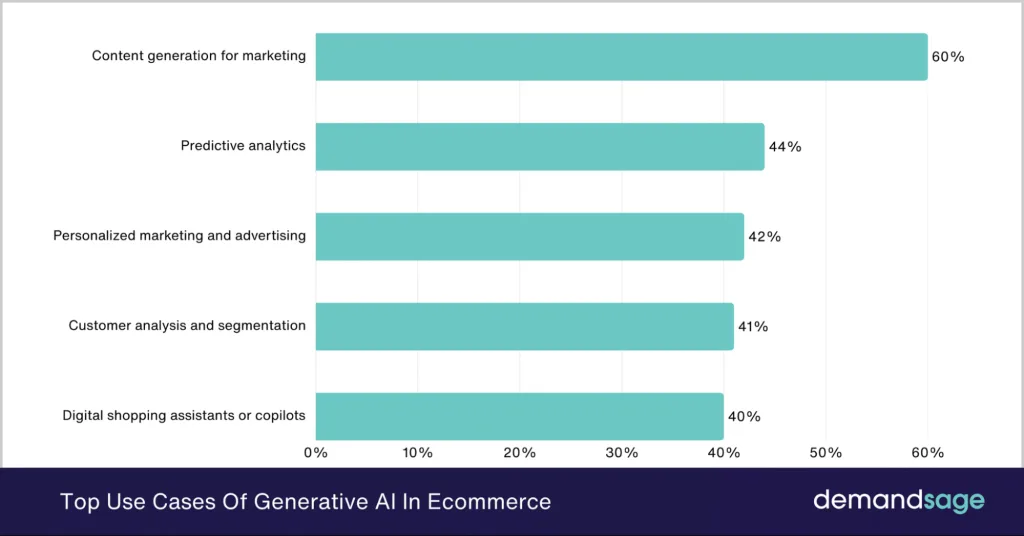
- Content generation for marketing dominates with a 60% adoption rate, making it the most widely used generative AI application in ecommerce.
- Predictive analytics ranks second at 44%, highlighting how businesses are leveraging AI to forecast demand, optimize pricing, and improve decision-making.
- Personalized marketing and advertising accounts for 42%, showing strong adoption of AI to deliver tailored customer experiences and targeted campaigns.
- Customer analysis and segmentation stand at 41%, indicating that AI is heavily used to understand customer behavior and refine audience targeting.
- Digital shopping assistants or copilots are used by 40% of companies, reflecting the growing role of AI in enhancing customer support and guided shopping experiences.
- The data shows a clear trend toward marketing-focused applications, with 3 out of the top 5 use cases directly tied to marketing and personalization.
- Adoption rates are relatively close (40%–60%), suggesting that generative AI use in ecommerce is broadly distributed across multiple functions, not limited to a single area.
- Overall, generative AI is transforming both customer-facing and backend operations, from content creation to data-driven insights and automation.
AI Investment in Ecommerce Statistics
- Global AI investment reached over $200 billion in 2025, with retail as a major contributor.
- 97% of retailers plan to increase AI investments in the next 1–2 years.
- US companies account for nearly 40% of global AI investment spending.
- Venture capital funding for AI startups exceeded $50 billion in 2024.
- Retail AI spending is expected to grow at a CAGR of over 20% through 2030.
- 63% of organizations increased their AI budgets in 2025.
- Companies investing in AI see 2–3X faster decision-making compared to traditional analytics.
- AI infrastructure spending (cloud + compute) accounts for over 60% of enterprise AI budgets.
- Ecommerce brands allocate 15–20% of tech budgets to AI-driven tools.
AI in Ecommerce by Demographics Statistics
- 71% of Gen Z consumers prefer shopping experiences powered by AI recommendations.
- Millennials are 2X more likely to engage with AI-powered shopping assistants than older generations.
- 67% of Gen Z shoppers use AI tools like chatbots during online purchases.
- Only 35% of Baby Boomers actively engage with AI-driven ecommerce features.
- Urban consumers adopt AI shopping tools at a rate 30% higher than rural shoppers.
- 58% of US consumers are comfortable with AI making product suggestions.
- Female shoppers show 15% higher engagement with personalized recommendations than male shoppers.
- High-income consumers are 40% more likely to use AI-driven shopping features.
- Mobile-first users account for over 70% of AI-driven ecommerce interactions.
Challenges and Barriers to AI Adoption in Ecommerce
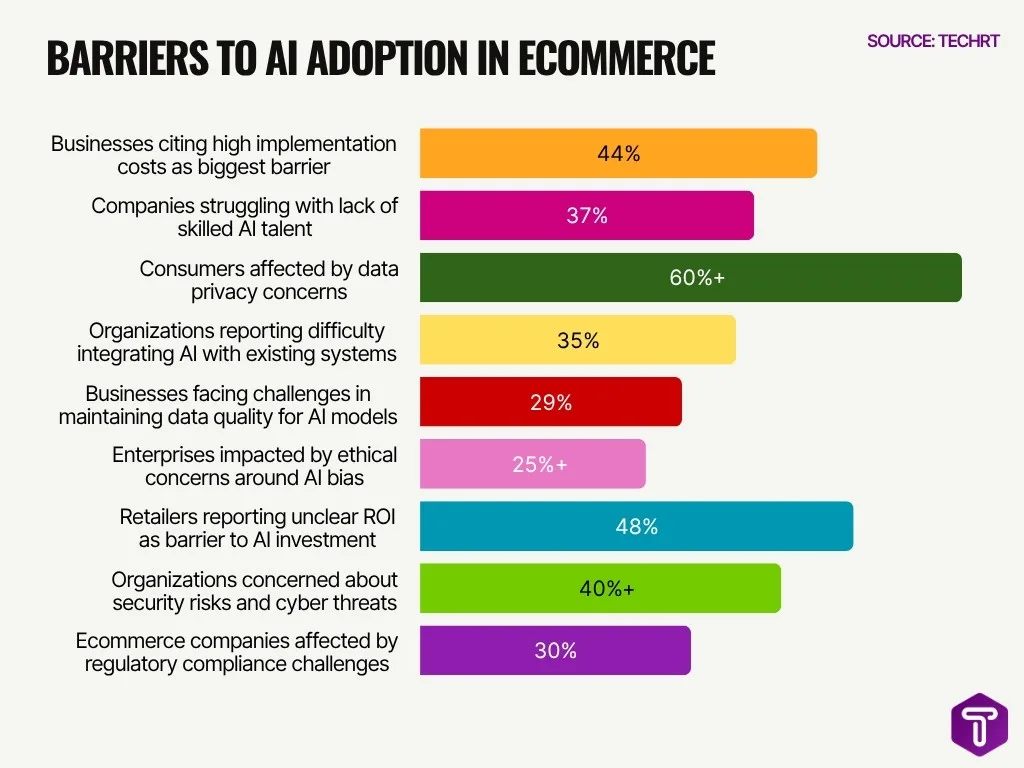
- 44% of businesses cite high implementation costs as the biggest barrier to AI adoption.
- 37% of companies struggle with a lack of skilled AI talent.
- Data privacy concerns affect over 60% of consumers, limiting AI adoption.
- 35% of organizations report difficulty integrating AI with existing systems.
- 29% of businesses face challenges in maintaining data quality for AI models.
- Ethical concerns around AI bias impact over 25% of enterprises.
- 48% of retailers report unclear ROI as a barrier to AI investment.
- Security risks and cyber threats remain a concern for over 40% of organizations.
- Regulatory compliance challenges affect 30% of ecommerce companies implementing AI.
Future of AI in Ecommerce Statistics
- AI is expected to influence over 95% of customer interactions in ecommerce by 2030.
- Autonomous AI agents will manage up to 50% of online transactions by 2030.
- AI-driven personalization could generate $1.7 trillion in value for retail globally.
- Voice and visual commerce combined will account for 30% of all ecommerce searches by 2028.
- AI-powered supply chains will reduce operational costs by up to 30% in the next decade.
- 85% of customer interactions will occur without human involvement by 2027.
- AI adoption in ecommerce is projected to grow at a CAGR of over 15% through 2030.
- Retailers using AI will outperform competitors by 25% in profitability.
- AI-driven dynamic pricing will influence over 40% of online purchases.
Frequently Asked Questions (FAQs)
What is the current market size of AI in ecommerce?
What percentage of ecommerce businesses are using or testing AI?
How much can AI chatbots improve ecommerce conversion rates?
What share of customer interactions can AI handle in ecommerce?
How much ROI do businesses get from AI chatbot investments?
Conclusion
AI continues to reshape ecommerce at every level, from how customers discover products to how businesses manage operations, logistics, and long-term growth strategies. Retailers now rely on AI to deliver real-time personalization, automate customer support, optimize pricing, and forecast demand with greater accuracy. In parallel, consumers benefit from faster, more relevant, and increasingly intuitive shopping experiences that reduce friction and improve satisfaction.
As investment in AI technologies grows and innovations like generative AI mature, the gap between AI-enabled and traditional ecommerce businesses will continue to widen. Companies that integrate AI effectively can unlock higher efficiency, stronger customer loyalty, and improved profitability. Looking ahead, AI will not just support ecommerce operations but define how digital commerce evolves, making it essential for businesses to act now, experiment strategically, and scale what works to remain competitive in the years ahead.

Leave a comment
Have something to say about this article? Add your comment and start the discussion.