



The internet now powers everything from remote work platforms to real-time eCommerce transactions, making it a backbone of modern economies. Businesses rely on it to acquire customers, run targeted marketing campaigns, and manage global supply chains, while governments use it to deliver digital services like online healthcare, education, and public administration. At the same time, individuals depend on the internet for communication, entertainment, and financial transactions, often through mobile-first experiences.
As connectivity expands across both developed and emerging markets, the internet continues to reshape industries such as retail, banking, media, and education. However, challenges like unequal access, cybersecurity risks, and infrastructure gaps still influence how people connect and engage online. Understanding how many people use the internet, where they are located, and how their behavior is evolving is essential for businesses, policymakers, and digital strategists alike. Let’s explore the latest Internet user statistics and uncover the trends shaping the digital world.
Editor’s Choice
- 6 billion people worldwide use the internet in 2025, representing about 74% of the global population.
- Global internet users increased from 5.8 billion in 2024 to 6 billion in 2025, adding over 200 million new users.
- Around 2.2 billion people remain offline, highlighting a persistent digital divide.
- Internet penetration rose to 73–75% globally in 2025, compared to 63% in 2023.
- More than 6.04 billion users were recorded in late 2025, signaling steady adoption heading into 2026.
- Approximately 97 million people came online in 2024 alone, showing continued expansion.
- Countries like China and India together account for over 2.3 billion internet users, dominating global usage.
Recent Developments
- Global internet adoption grew 3.3% year-over-year in 2025, up from 2.9% in 2024.
- Internet traffic increased by 19% in 2025, driven partly by AI and bot activity.
- Over 240 million new users joined the internet in 2025, accelerating global connectivity.
- The global user base crossed the 6 billion milestone for the first time in 2025, a key digital benchmark.
- Internet growth in least developed countries reached 7.4% annually, outpacing global averages.
- 5G coverage expanded to 55% of the global population, improving mobile internet access.
- Mobile data consumption continues to surge, with some regions reporting multi-fold increases over the past decade.
- AI-driven services and tools are increasingly integrated into everyday internet use, reshaping traffic patterns.
Global Internet Users Growth Trends
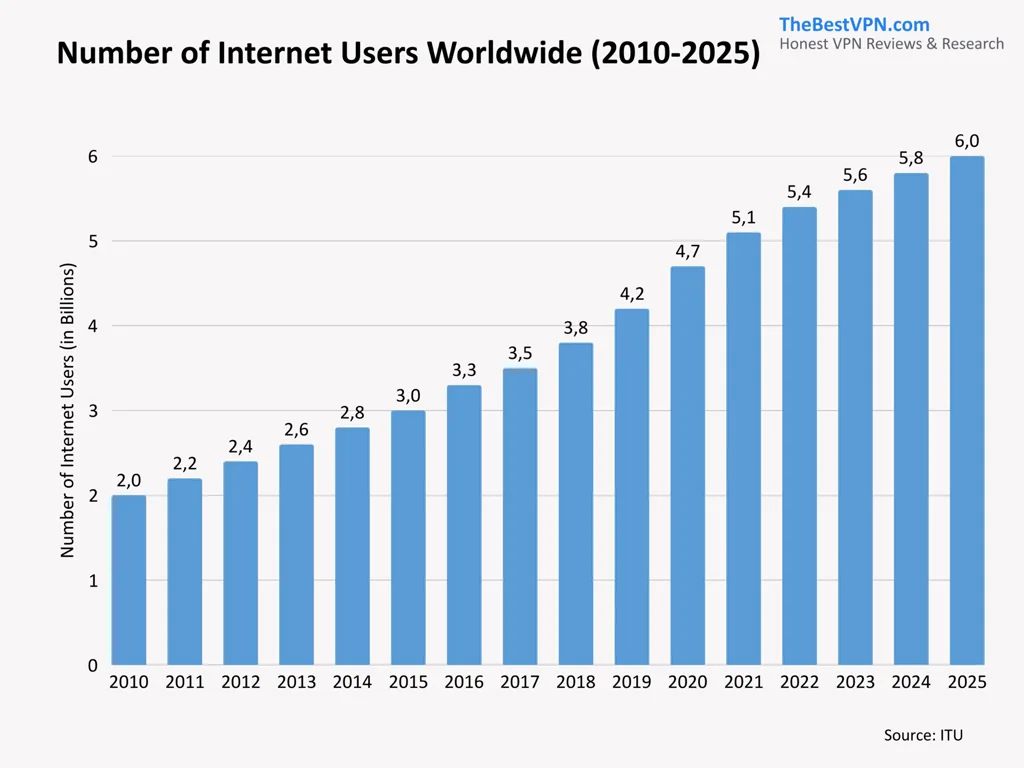
- The number of global internet users grew from 2.0 billion in 2010 to 6.0 billion in 2025, marking a massive +4.0 billion increase over 15 years.
- This represents an approximate 200% growth, meaning the global internet population has tripled since 2010.
- Steady year-on-year growth is evident, with users increasing by roughly 0.2–0.4 billion annually during most of the period.
- A notable acceleration occurred between 2018 (3.8B) and 2021 (5.1B), adding 1.3 billion users in just 3 years.
- The largest single-year jump appears between 2019 (4.2B) and 2020 (4.7B), an increase of +0.5 billion users, likely driven by global digital adoption trends.
- Growth remains strong post-2020, crossing the 5 billion milestone in 2021, a key digital penetration benchmark.
- From 2022 to 2025, growth continues but at a slightly slower pace, increasing from 5.4B to 6.0B, indicating a maturing market.
- Over the last 5 years (2020–2025), internet users increased by +1.3 billion, highlighting continued expansion despite nearing global saturation.
- The data suggests a shift from the rapid adoption phase (2010–2020) to a gradual growth phase (2021–2025).
- Overall, the trend reflects increasing global connectivity, driven by mobile internet expansion, affordable data, and digital infrastructure development.
Internet Penetration Rates
- Global internet penetration reached 74% in 2025, up from 71% in 2024.
- In 2023, only 63% of the population had internet access, showing rapid growth.
- High-income countries report penetration rates of up to 94%, nearing saturation.
- Low-income countries lag significantly, with penetration as low as 23–35%.
- The global average penetration rate was around 67.9% in early 2025, depending on data models.
- Northern Europe leads with penetration above 97%, the highest globally.
- Growth continues strongest in developing economies, narrowing the global gap gradually.
- Penetration trends indicate that global connectivity could approach 80% by the late 2020s if current growth continues.
Internet Usage by Region
- Eastern Asia leads globally with about 1.34 billion internet users.
- Southern Asia follows with over 1.1 billion users, driven by India’s rapid growth.
- Northern Europe has the highest penetration rate at 97.7%, with nearly universal access.
- Internet access in least developed countries averages only 34–35%, far below the global average.
- Small Island Developing States show around 65% penetration, close to global averages.
- Africa remains the fastest-growing region for internet adoption, with growth rates exceeding 5% annually.
- Europe and North America maintain high connectivity levels, often exceeding 85–90% usage rates.
- Regional disparities persist due to differences in infrastructure, affordability, and digital literacy.
Global Leaders in Internet Users
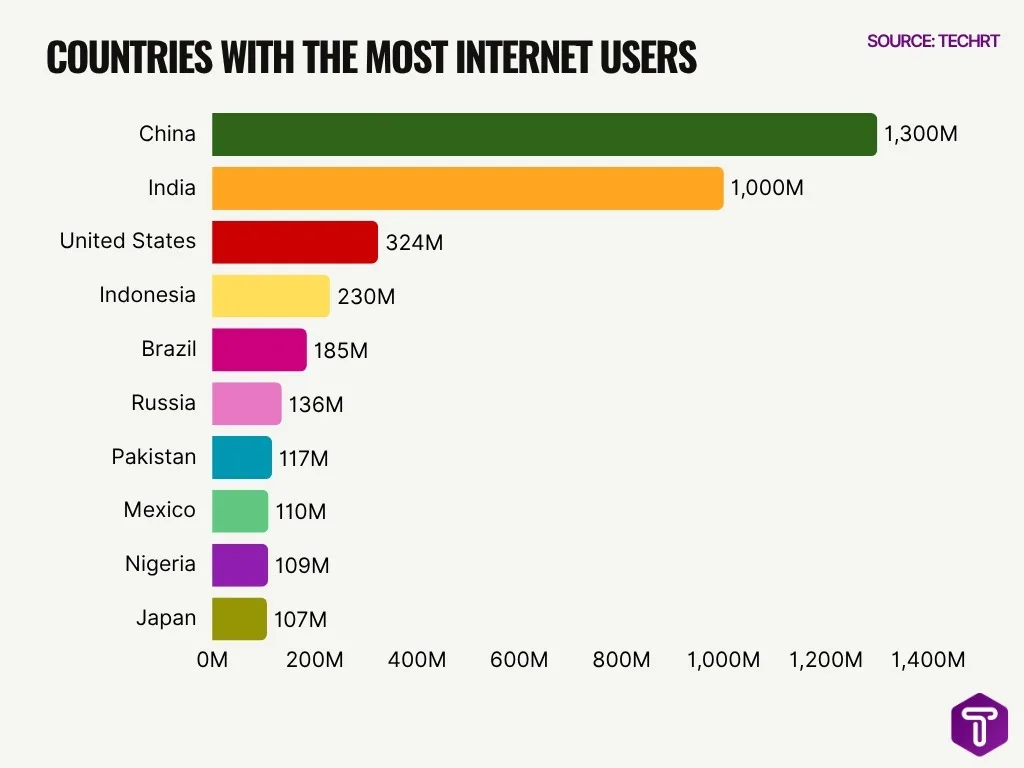
- China dominates globally with 1.3 billion users, making it the largest internet market by a significant margin.
- India ranks second with 1.0 billion users, rapidly closing the gap and highlighting strong digital growth.
- The United States holds third place with 324 million users, far behind the top two but still the largest in the developed world.
- Indonesia (230 million) and Brazil (185 million) show strong internet adoption among emerging economies.
- Russia records 136 million users, maintaining a solid position in the top 10.
- Pakistan reaches 117 million users, reflecting fast-growing connectivity in South Asia.
- Mexico (110 million) and Nigeria (109 million) have nearly identical user bases, showing expanding digital access in both regions.
- Japan rounds out the list with 107 million users, representing high penetration in a mature market.
- The top two countries (China + India) alone account for over 2.3 billion users, a massive share of global internet usage.
- There is a clear trend where developing countries dominate user volume, driven by large populations and increasing mobile internet access.
Internet Connectivity and Access
- Around 95% of the global population now lives within range of a mobile broadband network, yet many remain unconnected.
- Fixed broadband subscriptions reached 1.4 billion globally in 2025, showing steady infrastructure growth.
- Approximately 2.6 billion people still lack meaningful internet access due to affordability or device limitations.
- In low-income countries, only 27% of households have internet access at home.
- Over 70% of internet users in developing regions rely exclusively on mobile connections.
- Public Wi-Fi access points increased by 18% globally between 2024 and 2025, supporting urban connectivity.
- Fiber-optic broadband coverage expanded significantly, reaching over 60% of urban households worldwide.
- Satellite internet services are growing, with coverage expanding to 100+ countries in 2025, improving rural access.
Devices Used to Access the Internet
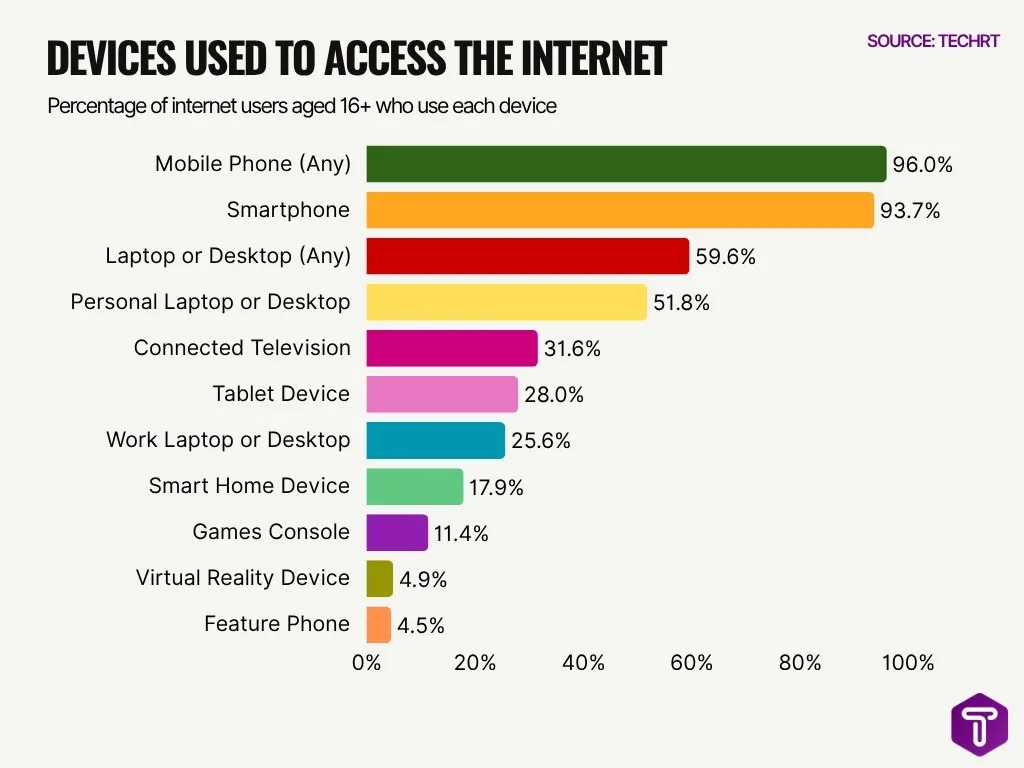
- Mobile dominates internet access globally, with a massive 96.0% of users relying on mobile phones, reinforcing a mobile-first digital ecosystem.
- Smartphones alone account for 93.7% usage, showing they are the primary gateway to the internet, nearly universal among users aged 16+.
- Desktop and laptop usage remains significant, with 59.6% of users accessing the internet via these devices, highlighting continued relevance for work and productivity tasks.
- Personal computers (51.8%) are more commonly used than work devices (25.6%), indicating a strong preference for personal browsing and remote work flexibility.
- Connected TVs are used by 31.6% of users, signaling the rise of big-screen internet consumption, especially for streaming and entertainment.
- Tablet usage stands at 28.0%, showing moderate adoption, often positioned between mobile convenience and desktop functionality.
- Smart home devices (17.9%) are gaining traction, reflecting the growth of the IoT ecosystem and voice-enabled browsing.
- Gaming consoles account for 11.4% usage, indicating a niche but notable segment of users accessing the internet via entertainment platforms.
- Emerging technologies like VR devices are still in early stages, with only 4.9% adoption, suggesting future growth potential but current limitations.
- Feature phones remain marginal at 4.5%, highlighting the ongoing decline of legacy mobile devices in favor of smartphones.
- Overall, the data clearly shows a strong shift toward mobile-centric and multi-device usage behavior, with users increasingly combining smartphones, computers, and smart devices for internet access.
Mobile Internet Usage
- Mobile devices account for over 58% of global web traffic in 2025, up from 55% in 2024.
- There are 5.6 billion unique mobile users worldwide, representing about 70% of the population.
- Around 92% of internet users access the web via mobile devices at least part of the time.
- Average mobile data consumption reached 20 GB per user per month globally in 2025.
- 5G subscriptions surpassed 1.9 billion globally in 2025, nearly doubling from 2023.
- Mobile-first users dominate in regions like Africa and South Asia, where over 75% rely primarily on smartphones.
- In the U.S., mobile internet penetration exceeded 92% of adults in 2025.
- Mobile commerce accounts for over 60% of global eCommerce traffic, reflecting changing consumer behavior.
Internet User Demographics
- Globally, 63% of internet users are aged 18–44, making it the largest active demographic.
- About 48–49% of global internet users are female, showing near gender parity overall.
- In high-income countries, over 95% of people aged 15–24 use the internet.
- Education level strongly influences usage, with over 90% of college-educated individuals online in developed markets.
- Urban populations have significantly higher access, with urban internet usage exceeding rural by 20–30 percentage points globally.
- Income disparities remain evident, as individuals in the top income quartile are twice as likely to be online as those in the lowest quartile.
- In the U.S., 97% of adults aged 18–29 use the internet, compared to 75% of those aged 65+.
- Youth adoption continues to rise, with nearly 80% of children aged 10–14 online globally.
Internet Usage Trends by Income Level
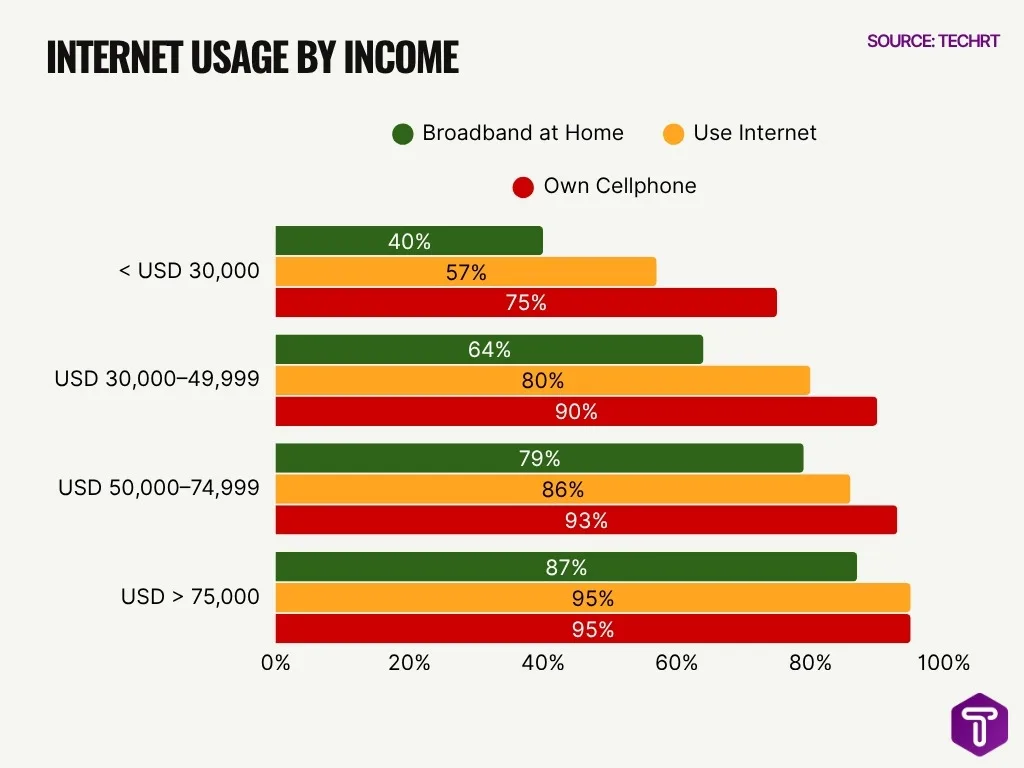
- Clear income-based digital divide: Households earning < $30,000 show significantly lower access, with only 40% broadband penetration and 57% internet usage.
- Strong growth in connectivity with income: Broadband access jumps from 40% to 87% as income increases from the lowest to the highest bracket.
- Internet usage becomes nearly universal at higher incomes: In the >$75,000 group, 95% of people use the internet, indicating near saturation.
- Mobile ownership leads across all income levels: Even in the lowest income group, 75% own cellphones, highlighting mobile as the primary access point.
- Mid-income households show rapid adoption: The $30,000–$49,999 group sees a sharp rise with 80% internet usage and 90% cellphone ownership.
- Diminishing gap at higher income levels: The difference between $50,000–$74,999 (86%) and >$75,000 (95%) internet usage narrows, suggesting maturity in adoption.
- Broadband still lags behind mobile and general usage: Even at the highest income level, broadband (87%) is lower than both internet usage (95%) and cellphone ownership (95%).
- Digital inclusion challenge persists: The 47-point gap in broadband access between the lowest (40%) and highest income groups (87%) highlights ongoing inequality.
Internet Usage Time and Frequency
- The average global user spends 6 hours and 40 minutes online daily in 2025, slightly down from 6 hours and 45 minutes in 2024.
- Users in South Africa and Brazil report some of the highest usage, exceeding 9 hours per day.
- Americans spend an average of 7 hours and 3 minutes online daily, including work and leisure.
- Social media accounts for about 2 hours and 20 minutes of daily internet use globally.
- Over 90% of internet users access the web daily, showing high engagement frequency.
- Video streaming consumes more than 65% of global internet traffic, driven by platforms like Netflix and YouTube.
- Remote work has increased weekday internet usage by 15–20% since 2023.
- Average session durations on mobile apps have grown by 10% year-over-year, reflecting deeper engagement.
Social Media and Internet Users
- There are 5.04 billion social media users globally in 2025, representing over 62% of the population.
- Social media user growth slowed to 1.6% annually in 2025, compared to higher growth in previous years.
- The average user spends 2 hours and 23 minutes per day on social media platforms.
- Over 94% of internet users also use social media, showing a strong overlap.
- Platforms like Facebook, YouTube, and Instagram remain dominant with billions of active users each.
- In the U.S., 72% of adults use at least one social media platform.
- Short-form video content drives engagement, with over 70% of users consuming video-based content weekly.
- Social commerce continues to rise, with over 30% of users purchasing directly through social platforms.
Digital Divide and Offline Population
- Approximately 2.2 billion people remain offline globally in 2025, down from 2.6 billion in 2023.
- Around 96% of the offline population lives in developing countries, highlighting inequality.
- In the least developed countries, nearly 65% of people remain offline.
- Women are 19% less likely to use the internet than men globally, reflecting persistent gender gaps.
- Rural populations are significantly underserved, with connectivity gaps of up to 30% compared to urban areas.
- High device costs and data prices remain major barriers for over 40% of offline individuals.
- Digital literacy challenges affect more than 1 billion people, limiting effective internet use.
- Government initiatives have helped connect hundreds of millions since 2020, but progress remains uneven.
Internet Users in Developed vs Developing Countries
- Internet penetration in developed countries exceeds 90%, compared to about 57% in developing nations.
- Developed regions added only 1–2% new users annually, indicating saturation.
- Developing countries account for over 90% of new internet users globally.
- Average connection speeds in developed countries are 2–3 times faster than in developing regions.
- Fixed broadband adoption is significantly higher in developed economies, exceeding 35 subscriptions per 100 people.
- In contrast, developing regions rely heavily on mobile broadband, with over 75% usage share.
- Affordability remains a key issue, as data costs represent over 5% of monthly income in low-income countries.
- Digital economies in developed countries contribute up to 15% of GDP, compared to less than 5% in developing regions.
Internet Adoption by Age Group
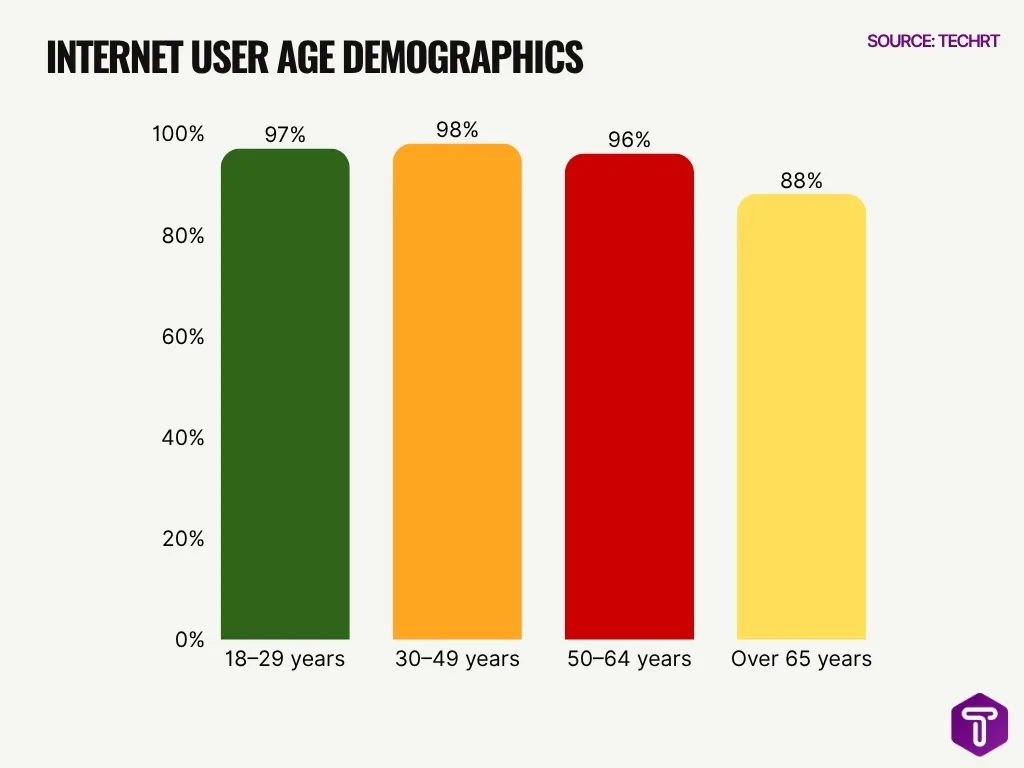
- The 30–49 years age group has the highest internet usage at 98%, indicating near-universal adoption among middle-aged adults.
- Young adults aged 18–29 years also show extremely high penetration at 97%, highlighting strong digital dependency and early adoption trends.
- Internet usage remains consistently high among the 50–64 years group at 96%, reflecting increasing digital inclusion among older working-age populations.
- A noticeable drop appears in the 65+ age group, with 88% usage, though this still represents a significant majority, showing growing tech adoption among seniors.
- The overall trend suggests that internet penetration exceeds 95% across all age groups under 65, demonstrating widespread accessibility and digital integration.
- Despite being the lowest, the 88% usage among seniors indicates a rapidly closing digital divide, driven by smartphones, social media, and communication tools.
- The narrow gap between young adults (97%) and middle-aged users (98%) suggests that internet usage has reached saturation levels in developed digital ecosystems.
Gender Gaps in Internet Usage
- Globally, 63% of men use the internet compared to 57% of women, showing a persistent gap.
- Women in low-income countries are 21% less likely to be online than men.
- The gender gap narrowed slightly from 11% in 2019 to around 6% in 2025, reflecting progress.
- In high-income countries, gender differences are minimal, often below 2–3%.
- South Asia and Sub-Saharan Africa show the widest gaps, exceeding 15–20%.
- Education and income strongly influence gender disparities, with educated women twice as likely to use the internet.
- Mobile access has helped reduce the gap, as over 70% of women online use smartphones as their primary device.
- Closing the gender gap could add hundreds of billions of dollars to global GDP, according to economic estimates.
Cybersecurity and Online Safety
- Cybercrime costs are projected to reach $10.5 trillion annually by 2025, up from $8 trillion in 2023.
- Over 2,200 cyberattacks occur daily, targeting businesses and individuals globally.
- Phishing accounts for over 40% of reported cyber incidents, making it the most common threat.
- The average cost of a data breach reached $4.45 million in 2025, a record high.
- Around 60% of small businesses close within six months of a major cyberattack.
- Ransomware attacks increased by over 13% year-over-year in 2024, continuing into 2025.
- Nearly 95% of cybersecurity breaches involve human error, highlighting training gaps.
- Global spending on cybersecurity is expected to exceed $200 billion annually by 2026.
Sources of Brand Discovery by Age Group
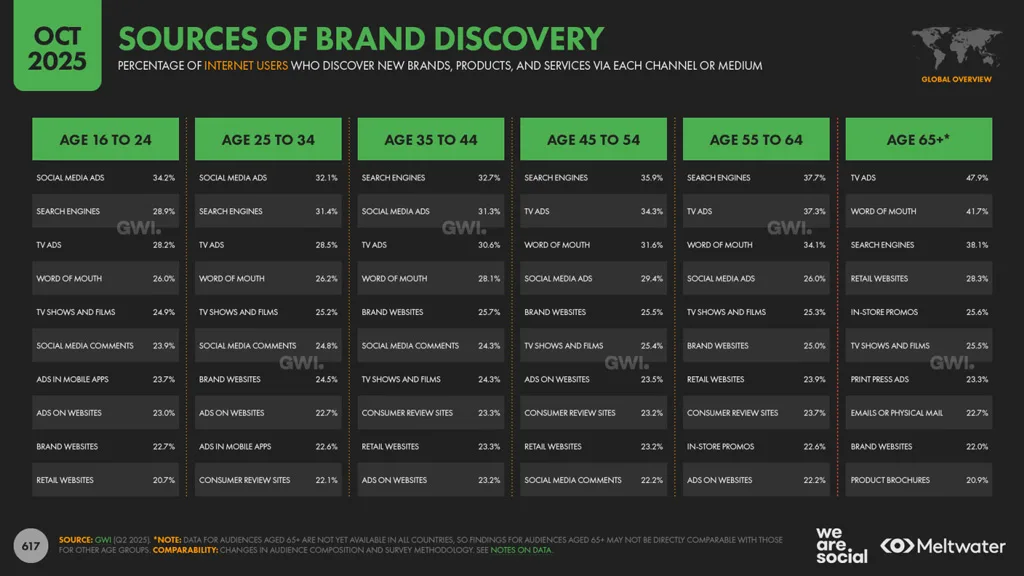
- Social media dominates younger audiences: Among 16–24-year-olds, Social Media Ads (34.2%) are the top discovery channel, significantly higher than any other medium.
- Search engines gain importance with age: Usage rises steadily from 28.9% (16–24) to 37.7% (55–64), showing a clear shift toward intent-driven discovery in older demographics.
- TV advertising becomes dominant for older groups: While TV Ads account for 28.2% (16–24), they surge to 47.9% among 65+, making it the most influential channel for seniors.
- Word of mouth strengthens with age: It increases from 26.0% (16–24) to 41.7% (65+), highlighting growing reliance on trust-based recommendations.
- Social media influence declines with age: From 34.2% (16–24) to just 26.0% (55–64), indicating reduced engagement with paid social channels among older users.
- Balanced channel mix for mid-age groups: Ages 35–54 show a diversified discovery pattern, with Search Engines (32.7%–35.9%), TV Ads (30.6%–34.3%), and Word of Mouth (28.1%–31.6%) all playing strong roles.
- Retail and brand websites remain consistent: Across most age groups, Retail Websites (~20–28%) and Brand Websites (~22–26%) maintain stable influence, supporting consideration-stage research.
- Consumer review sites matter across all ages: Hovering around 22%–23%, these platforms are a consistent trust signal in purchase decisions.
- In-store promotions become relevant later: Not present in younger segments but rise to 22.6% (55–64) and 25.6% (65+), reflecting offline shopping behavior.
- Traditional media still relevant for seniors: Channels like Print Press Ads (23.3%), Emails/Physical Mail (22.7%), and Product Brochures (20.9%) are unique to the 65+ demographic.
- Mobile and website ads are youth-skewed: Ads in Mobile Apps (23.7%) and Ads on Websites (23.0%) are more prominent among younger users, showing a digital-first exposure pattern.
- Entertainment content influences younger users: TV Shows & Films (24.9%) and Social Media Comments (23.9%) are stronger among younger groups, reflecting content-driven discovery behavior.
Broadband Subscriptions
- Global fixed broadband subscriptions reached over 1.4 billion in 2025, up from 1.3 billion in 2024.
- Mobile broadband subscriptions exceeded 8.6 billion worldwide, surpassing the global population due to multiple SIM usage.
- Fiber connections now account for over 50% of fixed broadband subscriptions globally.
- Average global broadband speeds increased by 15% year-over-year in 2025.
- In the U.S., broadband penetration exceeds 90% of households, reflecting mature infrastructure.
- Developing countries continue to rely on mobile broadband, which represents over 75% of total connections.
- Satellite broadband subscriptions grew rapidly, with millions of new users in rural areas.
- Government investments in broadband infrastructure exceeded $150 billion globally in 2025.
eCommerce and Internet Usage
- Global eCommerce sales surpassed $6.3 trillion in 2025, up from $5.8 trillion in 2024.
- Over 2.7 billion people shop online worldwide, representing one-third of the global population.
- Mobile commerce accounts for over 60% of online retail traffic, reflecting mobile-first behavior.
- In the U.S., eCommerce penetration reached over 16% of total retail sales in 2025.
- Asia-Pacific leads global eCommerce, contributing over 50% of total sales.
- Social commerce is growing rapidly, expected to exceed $1 trillion globally by 2026.
- Around 80% of internet users research products online before purchasing, showing the importance of digital touchpoints.
- Cross-border eCommerce continues to expand, with over 30% of shoppers buying internationally.
Frequently Asked Questions (FAQs)
How many people use the internet worldwide in 2025?
What percentage of the world is online today?
How many people remain offline globally?
How much did internet users grow from 2024 to 2025?
Which country has the most internet users and how many?
Conclusion
Internet adoption continues to expand, but the nature of growth is shifting. Instead of rapid user acquisition in already connected regions, progress now depends on closing access gaps in underserved populations and improving the quality of connectivity. While developed regions approach saturation with high penetration and advanced infrastructure, emerging economies continue to drive most of the growth, largely through mobile-first access and affordable data solutions.
At the same time, the digital landscape is becoming more complex. Rising cybersecurity threats, increasing data consumption, and the growing role of AI-driven services are reshaping how users interact with the internet. Businesses must adapt to changing consumer behavior, especially as mobile usage, social commerce, and digital services continue to dominate. For governments and organizations, the focus remains on expanding access, improving digital literacy, and ensuring safe online environments.
Ultimately, these statistics highlight not just how far the internet has come, but also where it is headed. As connectivity becomes more universal and integrated into everyday life, understanding these trends provides a clear foundation for making informed decisions in a rapidly evolving digital ecosystem.

Leave a comment
Have something to say about this article? Add your comment and start the discussion.