



Smartwatches have evolved from simple notification tools into powerful, everyday companions that help users monitor health, stay connected, and manage their daily routines more efficiently. Today, they play a growing role in industries like healthcare, where doctors use wearable data for remote patient monitoring, and in corporate wellness programs, where employers encourage healthier lifestyles through activity tracking. At the same time, consumers rely on smartwatches for everything from fitness insights to contactless payments, making them an integral part of the connected ecosystem.
As innovation continues to accelerate with AI-driven features and advanced sensors, adoption is expanding across age groups and regions. Let’s explore the latest smartwatch statistics to understand how the market is evolving and what trends are shaping its future.
Editor’s Choice
- The global smartwatch market reached $48.4 billion in 2025, with steady expansion expected through the decade.
- The market is projected to hit $51.8 billion in 2026, reflecting consistent year-over-year growth.
- Global smartwatch shipments grew 4% YoY in 2025, reversing the decline seen in 2024.
- Around 562.86 million people used smartwatches in 2025, highlighting rapid adoption.
- The global user base is expected to reach 640 million in 2026, showing continued expansion.
- Smartwatch shipment volume is projected to grow from 230.7 million units in 2025 to 279.3 million in 2026.
- Average smartwatch prices increased by 5% in 2025, signaling a shift toward premium devices.
Recent Developments
- Smartwatch shipments returned to growth in 2025 after five consecutive quarters of decline, marking a market rebound.
- Global shipments increased 4% YoY in 2025, driven by demand for health-focused features.
- The average selling price rose 5% YoY, indicating stronger demand for premium models.
- Devices priced under $200 saw a 9% decline in demand, reinforcing premiumization trends.
- Wearable device shipments reached 611.5 million units in 2025, growing 9.1% YoY.
- Huawei shipped 25.5 million smartwatches in 2025, growing 21.7% YoY.
- Quarterly smartwatch shipments rose 9% YoY in Q3 2025, showing mid-year acceleration.
- India’s smartwatch shipments dropped 17.6% YoY in 2025, reflecting saturation in entry-level segments.
Smartwatch Market Size
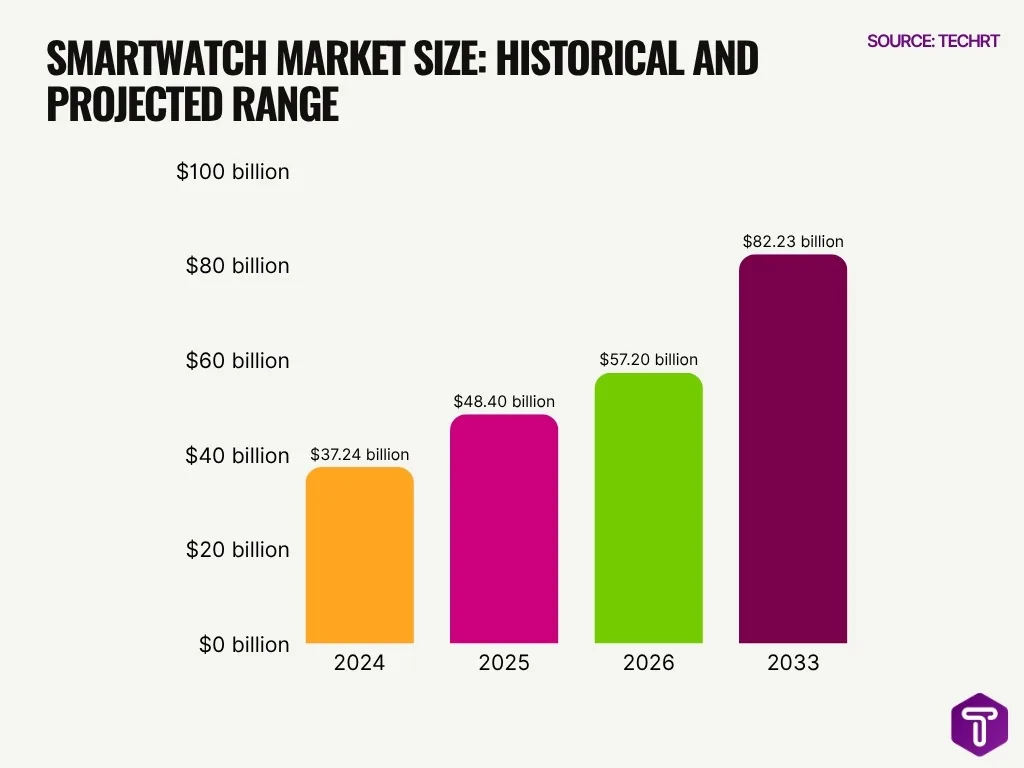
- The global smartwatch market was valued at $37.24 billion in 2024.
- It grew to approximately $40.67 billion in 2025, showing steady expansion.
- Estimates place the 2025 market at $42.6 billion, depending on methodology.
- Another projection shows $48.4 billion in 2025, highlighting varying valuation models.
- The market is expected to reach $44.28 billion in 2026 based on the growth trajectory.
- Some forecasts suggest $57.2 billion by 2026, reflecting aggressive growth scenarios.
- The market is projected to expand to $82.23 billion by 2033, showing long-term potential.
- High-end segments accounted for 45.6% of the total market share in 2025, indicating premium dominance.
Global Market Value and Forecasts
- The smartwatch market is expected to reach $95.2 billion by 2035.
- Another projection estimates growth to $100.9 billion by 2035 at a 9% CAGR.
- High-growth scenarios predict the market could reach $142.04 billion by 2034.
- Some aggressive forecasts suggest $860 billion by 2035, driven by ecosystem integration.
- The industry is expected to grow at a CAGR of 7% to 15.6%, depending on region and segment.
- Forecast growth between 2024 and 2029 is expected to add $46.3 billion in market value.
- The smartwatch market could grow at 9.2% CAGR from 2026 to 2033.
- North America alone accounted for over 41% of global smartwatch revenue in 2025.
Market Growth Projections
- Smartwatch shipment volume is expected to rise to 279.39 million units in 2026.
- By 2031, shipments could reach 726.73 million units, indicating strong scaling.
- The market is forecast to grow at a 21.07% CAGR (2026–2031) in shipment volume.
- Global users are projected to hit 640 million in 2026, up from 562 million in 2025.
- The user base could reach 740 million by 2029, reflecting sustained adoption.
- Wearable markets are expected to grow 8% in 2025 and 9% in 2026, supporting smartwatch demand.
- The smartwatch market is expected to grow from $108.31 billion in 2025 to $121.99 billion in 2026 in broader ecosystem estimates.
- Continued innovation in health sensors and AI is expected to drive double-digit growth across premium segments.
Smartwatch Market Share Insights by Brand
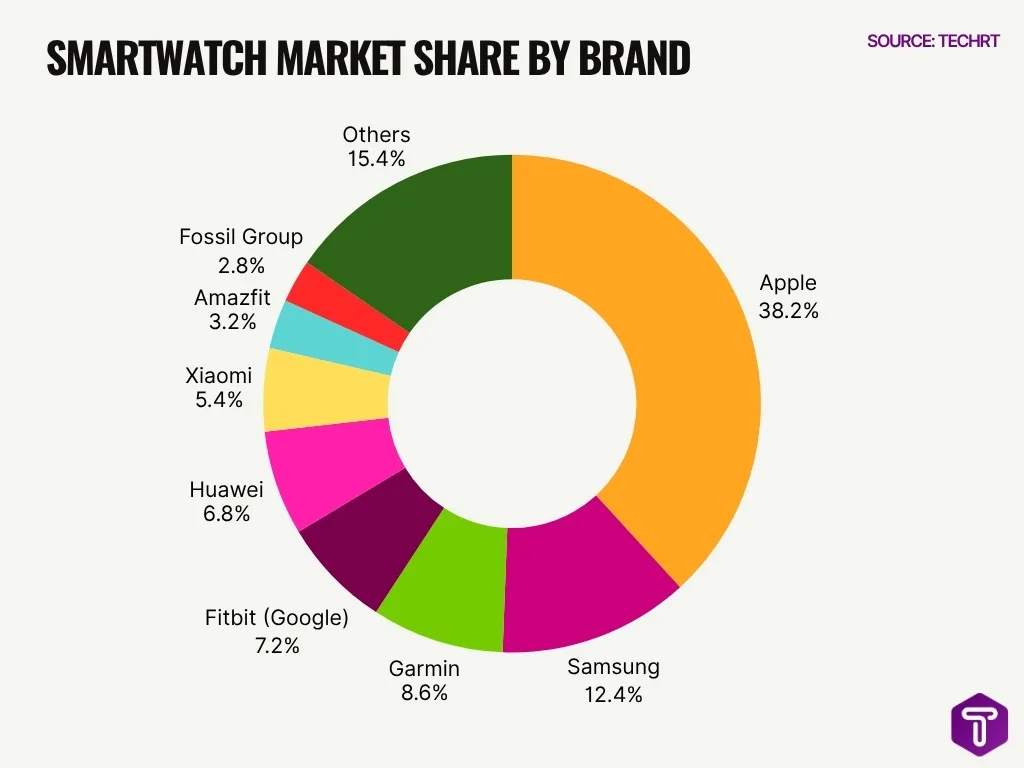
- Apple dominates the global smartwatch market with a commanding 38.2% share, holding more than 3× the market share of its closest competitor.
- Samsung ranks second with 12.4%, but trails significantly behind Apple, highlighting a large competitive gap.
- Garmin secures third place at 8.6%, driven largely by its strength in fitness and outdoor-focused wearables.
- Fitbit (Google) captures 7.2%, showing a steady presence despite increasing competition in the health tracking segment.
- Huawei holds 6.8%, maintaining a solid position, particularly in Asian markets.
- Xiaomi accounts for 5.4%, reflecting its strategy of affordable, feature-rich smartwatches.
- Amazfit (3.2%) and Fossil Group (2.8%) represent smaller but niche-focused players in the market.
- The “Others” category contributes 15.4%, indicating a highly fragmented market with many smaller brands competing collectively.
- The top 3 brands (Apple, Samsung, Garmin) together control nearly 59.2% of the market, showing strong market concentration at the top.
- Overall, the data highlights a leader-dominated market structure, where Apple significantly outpaces all competitors while mid-tier brands compete closely for share.
Wearables Market Performance
- The global wearables market shipped 611.5 million units in 2025, growing 9.1% YoY.
- Smartwatches accounted for roughly 38% of total wearable shipments in 2025, making them the largest segment after earwear.
- The wearable devices market is expected to reach $74.03 billion in 2026, up from $61.3 billion in 2024.
- Earwear still dominates volume, but smartwatches generate higher average revenue per unit, boosting profitability.
- Wearable adoption in the US reached over 35% of adults in 2025, with smartwatches leading usage.
- Health-focused wearables contributed to over 60% of total wearable revenue in 2025.
- Corporate wellness programs increased wearable adoption by 18% YoY in enterprise settings.
- The wearable medical devices segment is projected to grow at a CAGR of 20% through 2030, driven by remote monitoring demand.
Smartwatch Shipments
- Global smartwatch shipments reached 230.7 million units in 2025, reflecting a recovery from the 2024 decline.
- Shipments are projected to grow to 279.3 million units in 2026, marking strong expansion.
- Apple shipped nearly 53 million smartwatches in 2025, maintaining global leadership.
- Huawei recorded 25.5 million shipments in 2025, growing over 20% YoY.
- Samsung shipped approximately 13.6 million units in 2025, maintaining steady growth.
- India contributed over 30 million units in 2025 shipments, despite a YoY decline.
- China became the fastest-growing market with 20% YoY shipment growth in 2025.
- Premium smartwatch shipments (above $300) increased 14% YoY in 2025, outpacing budget devices.
Smartwatch Ownership by Age Group
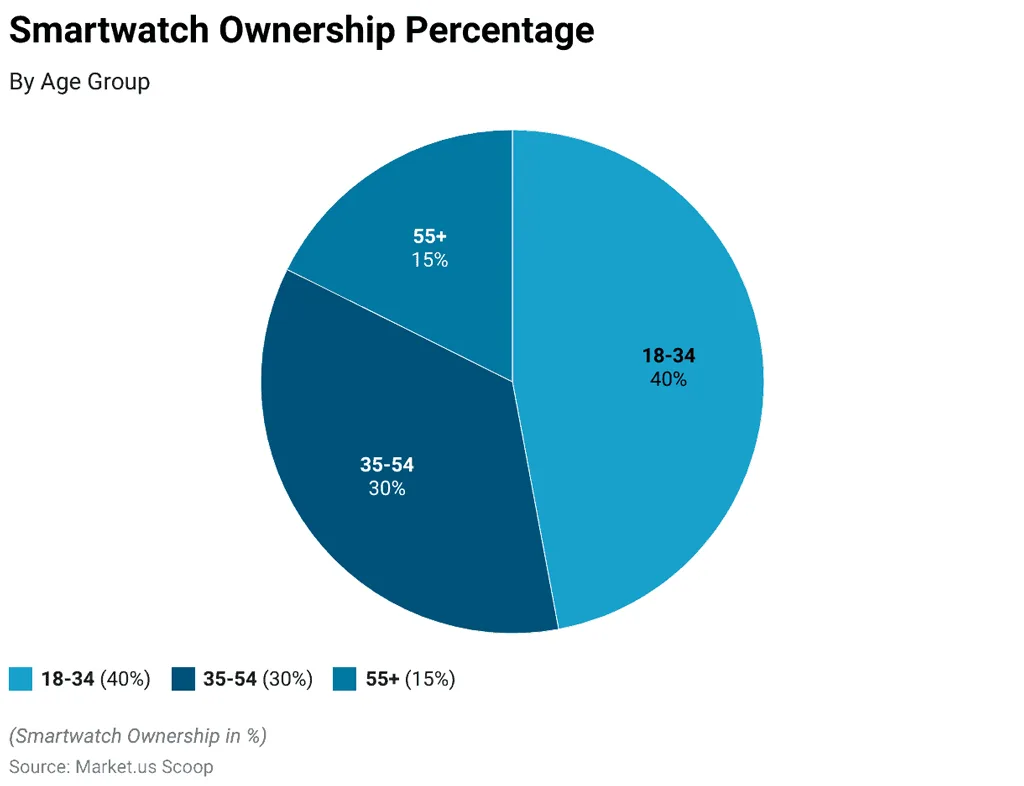
- The 18–34 age group leads smartwatch adoption with a significant 40% ownership share, making them the primary user segment.
- Adults aged 35–54 account for 30% of smartwatch ownership, indicating strong mid-age adoption driven by health and productivity use cases.
- The 55+ age group represents only 15%, showing comparatively lower adoption among older consumers.
- There is a clear age-based adoption gap, with younger users (18–34) owning smartwatches at nearly 2.7× higher rates than those aged 55+.
- Combined, users under 54 years old make up 70% of total smartwatch ownership, highlighting a strong skew toward younger and middle-aged demographics.
- The data suggests that tech-savviness, fitness tracking, and lifestyle integration are key drivers among younger users, while adoption remains limited among older groups.
Operating System Distribution
- Apple’s watchOS powered over 50% of active smartwatches globally in 2025.
- Google’s Wear OS accounted for around 16% market share, growing with Samsung partnerships.
- Proprietary OS platforms (Huawei, Xiaomi) made up over 25% of the market, especially in Asia.
- Fitbit OS usage declined to less than 5% share, following integration into Google’s ecosystem.
- Android-compatible smartwatches accounted for over 40% of total shipments globally.
- Cross-platform compatibility increased adoption by 18% among Android users in 2025.
- Open ecosystem devices saw 12% YoY growth, driven by affordability and customization.
- OS fragmentation remains high, with more than 10 active smartwatch operating systems globally.
User Base Statistics
- The global smartwatch user base reached 562.86 million in 2025, up from 504 million in 2024.
- The number of users is projected to hit 640 million in 2026, reflecting strong adoption.
- The US accounted for over 95 million smartwatch users in 2025, leading global adoption.
- China followed with over 120 million users, driven by domestic brands.
- Smartwatch penetration reached 21% globally in 2025, up from 18% in 2024.
- Nearly 1 in 3 US adults owns a smartwatch or fitness tracker.
- Active smartwatch usage increased by 15% YoY in 2025, driven by health monitoring features.
- Subscription-based smartwatch services (fitness, health insights) grew 22% YoY in 2025.
Smartwatch Market by Region
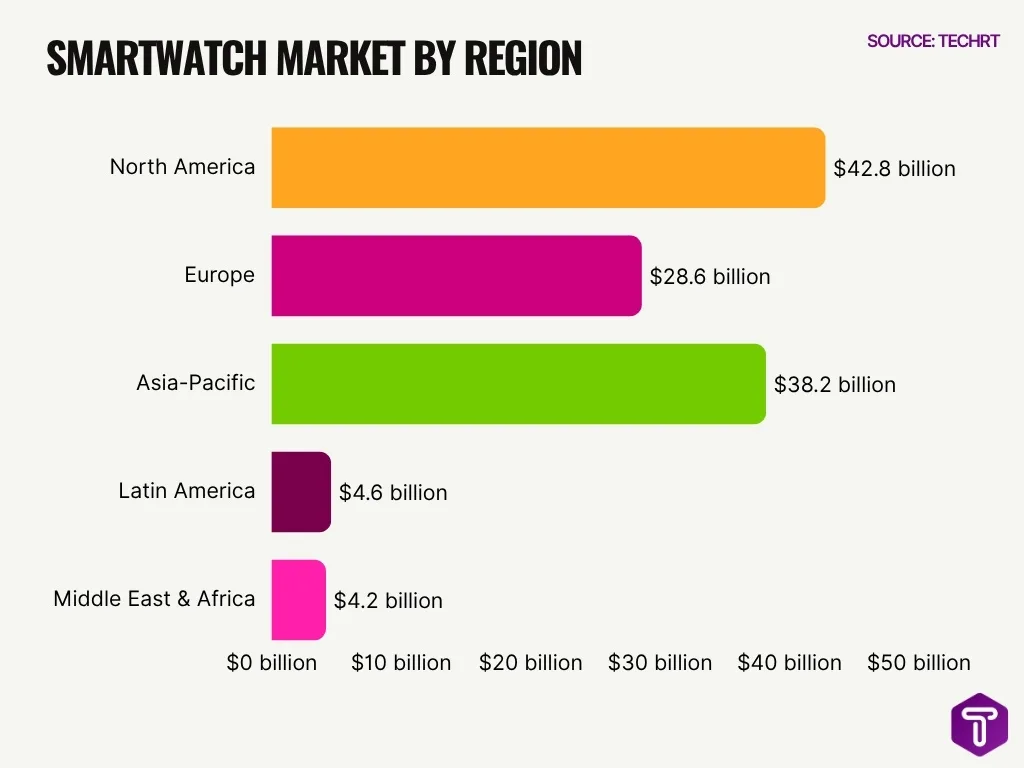
- North America leads the market with a massive $42.8 billion valuation and 124 million users, supported by the highest penetration rate of 33.4%.
- Asia-Pacific dominates in user base, reaching 264 million users, despite a relatively low 6.0% penetration rate, indicating strong untapped potential.
- Europe holds a solid position with a $28.6 billion market size and 86 million users, coupled with a healthy 14.8% YoY growth.
- Emerging markets are growing fastest, with the Middle East & Africa (26.4%) and Latin America (22.6%) showing the highest YoY growth rates.
- Market maturity varies significantly, as developed regions like North America show high penetration but slower growth (12.4%), while developing regions show the opposite trend.
- Asia-Pacific presents the biggest growth opportunity, combining large user volume (264M) with strong growth (18.2%) and low saturation.
- Latin America and the Middle East & Africa remain underpenetrated, with rates as low as 4.3% and 2.1%, signaling future expansion potential for smartwatch brands.
Price Band Analysis
- Premium smartwatches priced above $300 accounted for 45% of total revenue in 2025.
- Budget smartwatches under $100 represented over 35% of unit shipments, highlighting volume-driven demand.
- Mid-range devices ($100–$300) saw 12% YoY growth in 2025, balancing features and affordability.
- The average selling price of smartwatches increased by 5% in 2025, reflecting premiumization trends.
- Entry-level smartwatch demand declined by 9% YoY in 2025, signaling market saturation.
- Luxury smartwatches (above $500) grew by 18% YoY, driven by brand positioning and features.
- Subscription-based features increased the total cost of ownership by 10–15% annually.
- Refurbished smartwatch sales grew 14% YoY in 2025, especially in emerging markets.
Consumer Purchase Factors
- Health tracking features influenced over 62% of smartwatch purchases in 2025.
- Battery life ranked as a top factor for 58% of buyers globally.
- Price sensitivity affected over 55% of consumers, especially in emerging markets.
- Brand reputation influenced 48% of purchasing decisions, particularly in the US.
- Compatibility with smartphones impacted over 50% of buyers, especially Android users.
- Design and aesthetics mattered to 45% of users, reflecting lifestyle positioning.
- Fitness tracking capabilities influenced over 60% of Gen Z buyers in 2025.
- Discounts and promotions drove 20% of smartwatch purchases during peak sales periods.
Smartwatch Features Preferences
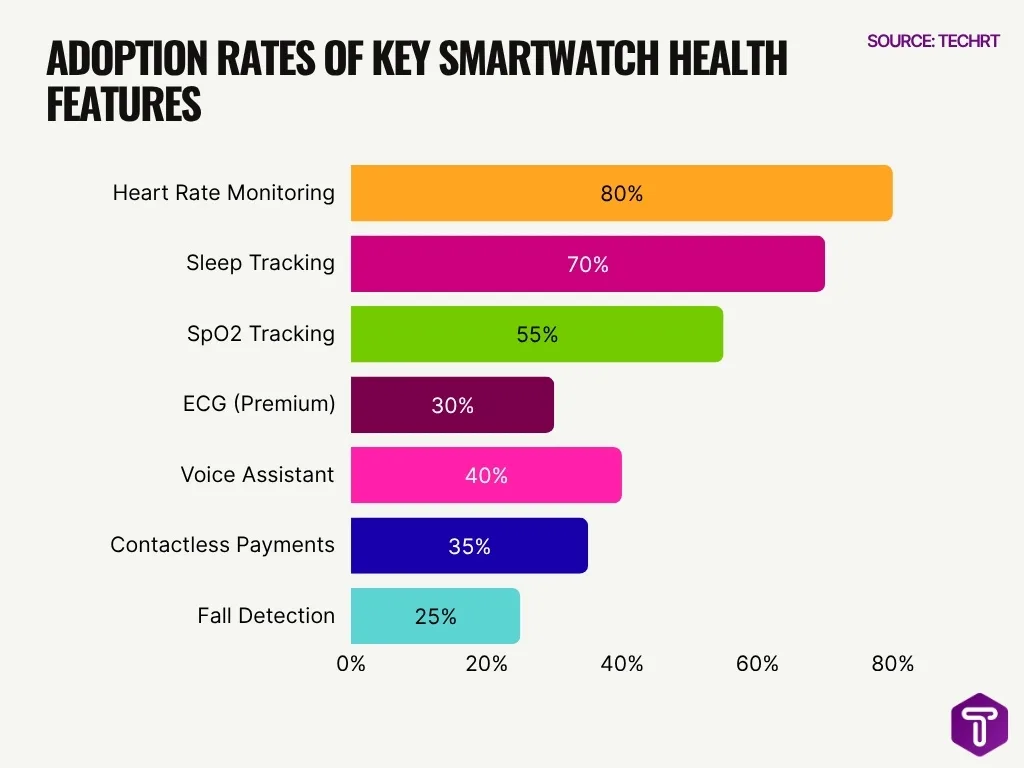
- Heart rate monitoring is used by over 80% of smartwatch users globally.
- Sleep tracking features are utilized by around 70% of users in 2025.
- GPS functionality is preferred by 65% of fitness-focused users.
- Blood oxygen (SpO2) tracking adoption increased to over 55% of devices in 2025.
- ECG functionality is now present in over 30% of premium smartwatches.
- Voice assistant integration is used by 40% of smartwatch users globally.
- Contactless payments are supported by over 35% of smartwatches in 2025.
- Fall detection and emergency features are used by 25% of users, especially older adults.
Health and Fitness Tracking Usage
- Around 78% of smartwatch users actively use health tracking features daily.
- Fitness tracking apps on smartwatches grew 25% YoY in usage during 2025.
- Smartwatches contributed to a 15% increase in daily physical activity among users.
- Over 60% of users track steps and calories regularly, making it the most-used feature.
- Sleep monitoring improved sleep awareness for over 50% of users globally.
- Smartwatches are used in remote patient monitoring for over 20 million users globally.
- Healthcare providers report a 30% improvement in patient engagement when wearables are used.
- Corporate wellness programs using wearables reduced healthcare costs by up to 12% annually.
Data Sharing and Privacy
- 52% of smartwatch users express concerns about data privacy in 2025.
- Around 47% of users are willing to share health data with healthcare providers.
- Only 32% of users trust wearable companies fully with their personal data.
- Data breaches in wearable ecosystems increased by 12% YoY in 2025.
- GDPR and similar regulations impact over 70% of smartwatch users globally, shaping data policies.
- Around 40% of users disable certain features due to privacy concerns.
- Insurance companies increasingly use wearable data, with 25% of users opting into data-sharing programs.
- Biometric data encryption adoption increased by 18% in smartwatch platforms in 2025.
Why People Use Smartwatches
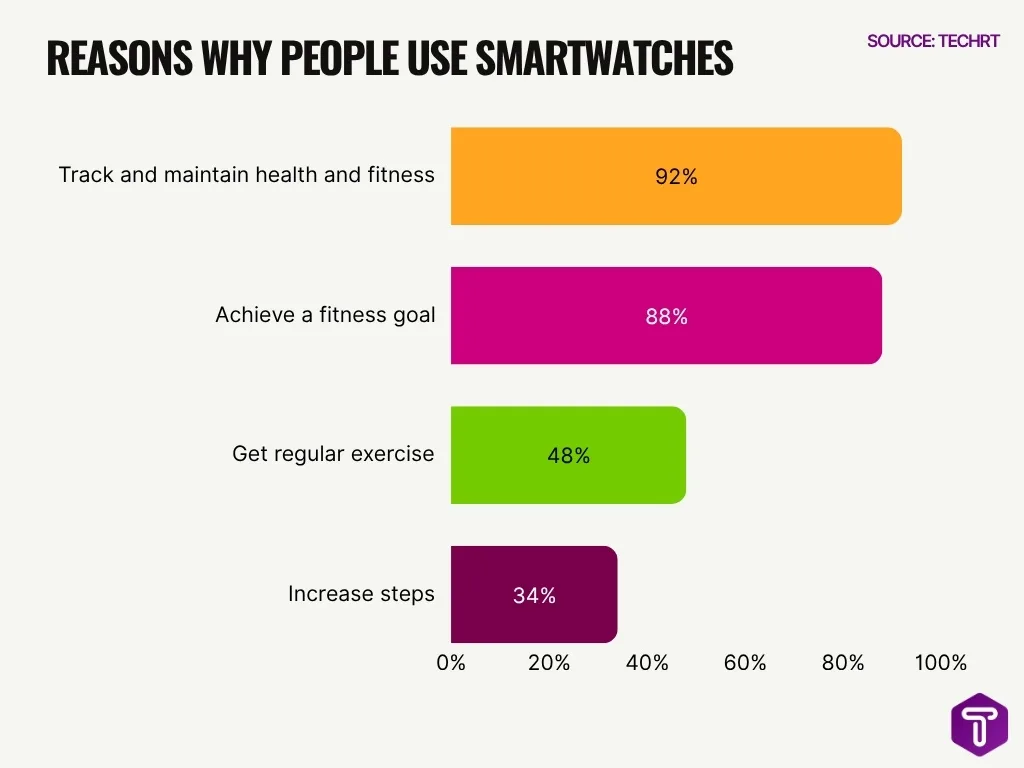
- Health and fitness tracking dominates usage, with a massive 92% of users relying on smartwatches to track and maintain their health.
- A strong 88% of users use smartwatches to achieve specific fitness goals, highlighting goal-oriented behavior.
- Only 48% of users use smartwatches to support regular exercise routines, indicating a gap between tracking and consistent activity.
- Just 34% of users focus on increasing daily steps, making it the least prioritized use case among respondents.
- There is a clear trend toward data-driven health management, with significantly higher percentages for tracking (92%) vs. action-based activities like exercise (48%).
- The data suggests smartwatches are used more as monitoring tools rather than active fitness motivators.
Innovation and Differentiation Trends
- AI-powered health insights are now integrated into over 35% of smartwatches in 2025.
- Battery efficiency improvements extended average usage time by 20% compared to 2023 models.
- Flexible and AMOLED displays are used in over 70% of new smartwatch models.
- Satellite connectivity features are emerging in premium devices, with early adoption in 2025 models.
- Wearables with advanced sensors (ECG, temperature) grew by 28% YoY in 2025.
- Smartwatch integration with smart home ecosystems increased by 22% YoY.
- Voice AI usage in smartwatches rose 30% YoY, driven by assistant improvements.
- Hybrid smartwatches (analog + digital) saw 10% growth, appealing to traditional watch users.
Frequently Asked Questions (FAQs)
What is the projected global smartwatch market size in 2026?
How many smartwatch units are expected to ship worldwide in 2026?
What is the growth rate of global smartwatch shipments in 2025?
What is the expected CAGR of the smartwatch market through 2033?
How much is the smartwatch market expected to grow in value between 2025 and 2026?
Conclusion
Smartwatch adoption continues to accelerate as users demand deeper health insights, seamless connectivity, and longer battery life across devices. The data highlights a clear shift toward premium models, advanced health tracking capabilities, and AI-powered features that deliver more personalized experiences. In markets like the US and China, strong consumer demand and ecosystem integration continue to drive growth, while emerging regions contribute to overall volume expansion. At the same time, concerns around data privacy and pricing remain important factors influencing purchasing decisions and long-term engagement.
Looking ahead, smartwatches are poised to move beyond fitness tracking into comprehensive health management, smart home control, and digital identity functions. As technology advances and use cases expand, smartwatches will remain one of the most dynamic and influential segments in the broader consumer technology landscape.

Leave a comment
Have something to say about this article? Add your comment and start the discussion.