



Search engine optimization continues to shape how businesses attract, engage, and convert online audiences in an increasingly competitive digital landscape. From eCommerce brands driving product discovery through organic listings to SaaS companies capturing high-intent leads via targeted keywords, SEO plays a critical role in revenue generation and customer acquisition. At the same time, rapid changes such as AI-powered search results, zero-click behavior, and evolving Google algorithms are transforming how users interact with search engines.
As businesses shift budgets toward sustainable growth channels, SEO remains one of the most cost-effective and scalable strategies for long-term visibility. However, success now requires a deeper understanding of data, user intent, and search trends. With that in mind, let’s explore the latest SEO statistics and uncover the insights shaping modern search performance.
Editor’s Choice
- Google dominates with about 89–90% of global search traffic, making it the primary platform for SEO strategies.
- 68% of online experiences begin with a search engine, highlighting SEO’s central role in discovery.
- Organic search drives around 53% of total website traffic, outperforming other channels.
- The #1 Google result gets ~39.8% CTR, far ahead of lower positions.
- SEO leads have a 14.6% close rate vs. 1.7% for outbound marketing, showing stronger intent.
- 75% of users never scroll past page one, making rankings critical.
- Organic search accounts for ~90% of clicks vs. 10% for ads, reinforcing its dominance.
Recent Developments
- Organic traffic declined slightly by -2.5% YoY in 2025, showing shifts due to AI and SERP changes.
- Google search traffic still grew +0.8% in 2025, indicating continued demand.
- AI Overviews now appear in 13%+ of searches, doubling within months in 2025.
- AI Overviews prevalence increased to ~30% of SERPs in some datasets.
- AI-generated summaries can reduce CTR by up to 35% when present.
- AI Overviews grew 11.9 percentage points in one quarter (2025), signaling rapid adoption.
- Research shows AI summaries can reduce page traffic by ~15% for some content types.
- 56% of companies already use AI in marketing, influencing SEO workflows.
- 78% of users seek content with identifiable authors, emphasizing trust signals.
Search Engine Market Share
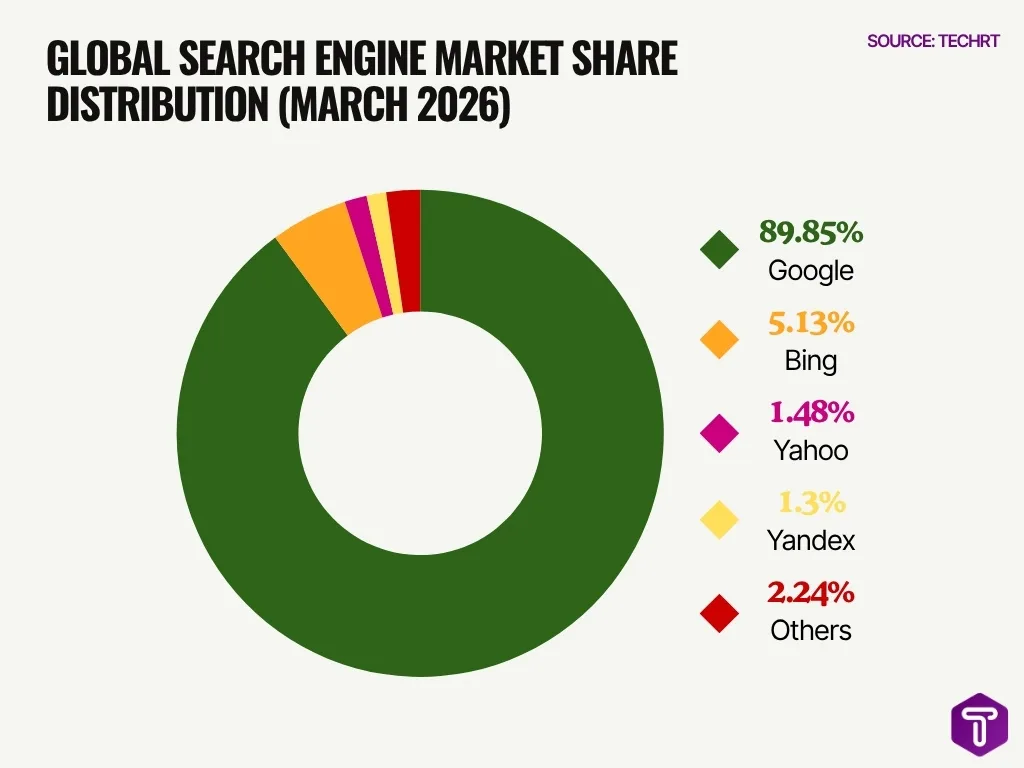
- Google commands a staggering 89.85% global search engine market share as of March 2026.
- Bing secures 5.13%, Yahoo 1.48%, and others like Yandex 1.3% worldwide.
- Over 90% of global searches occur on Google platforms, dwarfing competitors.
- Google processes approximately 16.4 billion searches daily, equating to ~190,000 per second.
- 93% of online experiences begin with a search engine, cementing their dominance.
- Non-Google engines collectively hold under 10% of the global market share.
- YouTube ranks as the second-largest search engine, driving billions in video queries monthly.
- Google’s ecosystem, including Search and YouTube, captures the vast majority of search traffic.
- Mobile searches see Google at 93.89% dominance worldwide.
- In the US, Google leads with ~85%, Bing at ~8-10%.
SEO Market Size and Growth
- SEO generates up to 700% ROI when executed long-term.
- 49% of marketers say SEO delivers the best ROI among channels.
- 60% of marketers report inbound SEO leads are the highest quality.
- SEO conversion rates average ~2.4%, with some industries exceeding 7%.
- Organic search ROI can reach 5.3x ad spend, outperforming paid channels.
- SEO delivers 8x ROI compared to PPC’s 4x in some studies.
- 91% of businesses say SEO improved performance in 2024, rising to 97% for mature programs.
- SEO drives 1000%+ more traffic than social media in some benchmarks.
Daily Search Volume
- Google handles over 16.4 billion searches per day.
- This translates to ~5.9 trillion searches annually.
- Around 190,000 searches occur every second, reflecting constant demand.
- Search traffic overall grew +0.4% in 2025, despite market saturation.
- Large websites saw +1.6% growth in organic traffic, showing scale advantages.
- Search remains the top channel for intent-driven queries, outperforming social.
- 68% of users rely on search engines to start their journey, reinforcing daily usage.
- Search queries continue rising due to AI-assisted discovery tools, increasing total volume.
Key Insights from Traffic Distribution by Channel
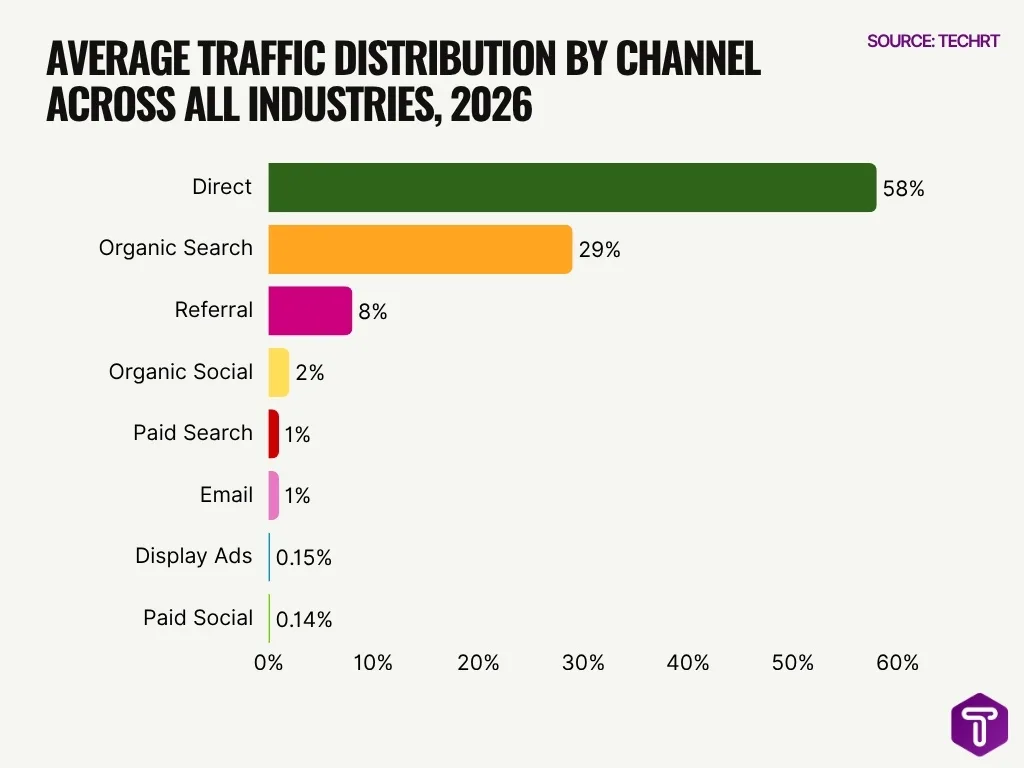
- Direct traffic dominates with a massive 58% share, indicating strong brand awareness and repeat visitors across industries.
- Organic search is the second-largest driver at 29%, highlighting the critical importance of SEO strategies for consistent traffic growth.
- Referral traffic contributes 8%, showing that backlinks and partnerships still play a meaningful role in acquisition.
- Organic social accounts for only 2%, suggesting that while social media is valuable for engagement, it is not a major direct traffic driver.
- Paid search generates just 1%, indicating that many businesses may rely more on organic visibility than paid ads for traffic.
- Email marketing also delivers 1%, reinforcing its role as a retention and nurturing channel rather than a primary acquisition source.
- Display ads contribute only 0.15%, showing extremely low direct traffic impact despite their visibility and branding use.
- Paid social is the lowest at 0.14%, highlighting that social ad campaigns may prioritize conversions or awareness over direct traffic generation.
- The data clearly shows a heavy reliance on owned and organic channels (Direct + Organic Search = 87%), emphasizing the long-term value of brand building and SEO investment.
- Overall, performance marketing channels (paid ads) contribute less than 2% combined, indicating a shift toward sustainable, organic growth strategies.
Google Ranking Factors
- Google uses 200+ ranking factors, though only a subset carries major weight.
- Backlinks remain one of the top 3 ranking factors, alongside content and RankBrain.
- Pages with high-quality backlinks rank significantly higher than those without.
- Content relevance and search intent alignment influence over 70% of ranking success.
- Pages that load in under 2.5 seconds perform better in rankings, tied to Core Web Vitals.
- HTTPS-secured websites are used as a lightweight ranking signal.
- Mobile-friendly pages account for over 60% of top-ranking results, due to mobile-first indexing.
- Longer dwell time correlates with higher rankings in 2025–2026 datasets.
- Domain authority and topical authority strongly impact rankings, especially in competitive niches.
Featured Snippets Impact
- Featured snippets appear in 23.7% of all Google SERPs in 2026, up 23.4% year-over-year.
- Paragraph snippets dominate at 70% of all featured snippet formats.
- AI-hybrid snippets now comprise 14.3% of new snippets with 2.6x higher engagement.
- Voice-assistant queries show a 41.2% featured snippet rate, the highest among search types.
- Featured snippets capture 35.1% of total clicks across studied SERPs.
- Snippet-optimized pages see CTRs up to 5.8%, versus an average of 1.8%.
- Structured headings like H2/H3 boost snippet eligibility by enabling precise content extraction.
- Snippet ownership can drive up to 30% organic traffic growth for targeted keywords.
Google CTR Distribution by Ranking Position
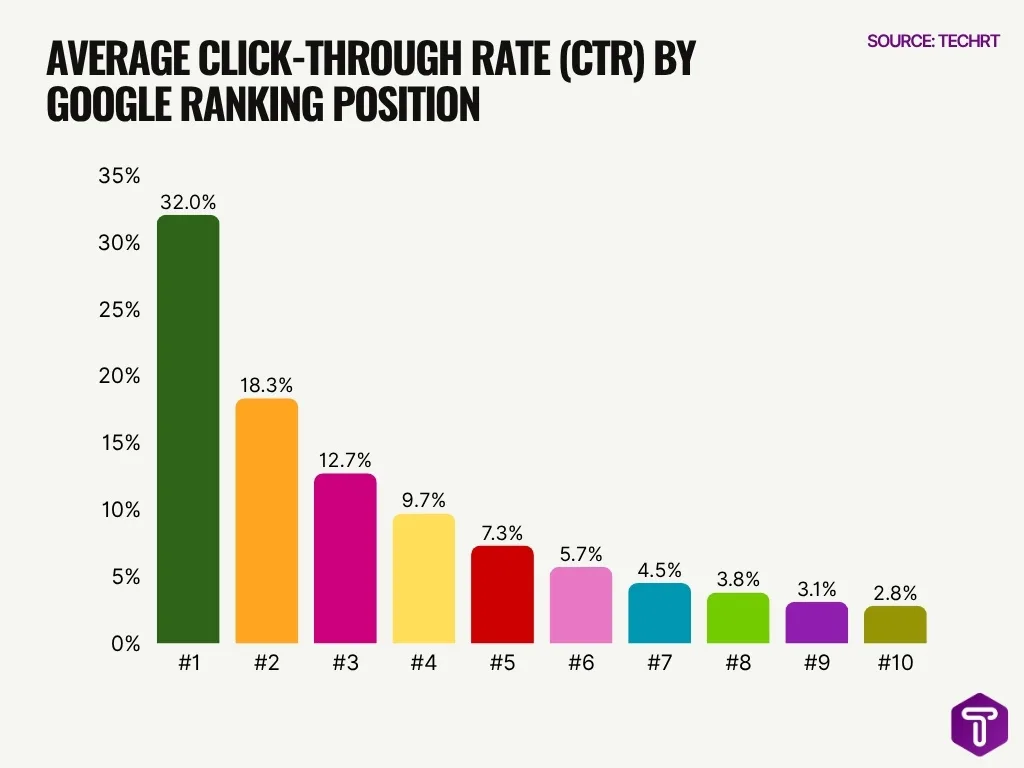
- The #1 position dominates with a massive 32% CTR, capturing nearly one-third of all clicks, making it the most valuable ranking spot.
- There is a sharp drop of ~43% from #1 (32%) to #2 (18.3%), highlighting how critical it is to secure the top position.
- The top 3 results collectively drive ~63% of total clicks (32% + 18.3% + 12.7%), showing that most users rarely go beyond the first three listings.
- CTR steadily declines after position #3, with #4 (9.7%) and #5 (7.3%) still generating moderate traffic but significantly less than top rankings.
- Rankings between #6 and #10 receive under 6% CTR each, with #10 getting only 2.8%, indicating minimal visibility on the lower half of page one.
- The difference between #1 (32%) and #10 (2.8%) is nearly 11x, emphasizing the extreme inequality in click distribution.
- Moving from #2 to #3 results in a noticeable drop (18.3% → 12.7%), but the decline becomes more gradual in lower positions.
- Even small ranking improvements (e.g., #5 to #3) can significantly boost traffic, as CTR jumps from 7.3% to 12.7% (~74% increase).
- The data confirms that SEO efforts should prioritize breaking into the top 3, rather than just appearing on page one.
- Overall, this reflects a winner-takes-most behavior in search results, where higher rankings disproportionately capture user attention and clicks.
Zero-Click Searches Trends
- Over 57% of Google searches result in zero clicks, meaning users don’t visit external sites.
- On mobile, zero-click searches rise to over 60%, due to quick answers.
- Desktop zero-click rates remain around ~50%, slightly lower than mobile.
- SERP features like knowledge panels and snippets drive most zero-click behavior.
- AI Overviews have further increased zero-click rates by 10–15% in 2025.
- Informational queries are most likely to result in zero clicks, especially definitions.
- Branded and transactional queries still generate higher click-through rates.
- Google keeps more users on-platform, reducing outbound traffic for publishers.
AI and SEO Influence
- 56% of marketers use AI tools to enhance SEO workflows.
- AI-generated content adoption grew by +35% YoY in 2025.
- AI tools reduce content production time by 30–50%, improving efficiency.
- Google emphasizes E-E-A-T, making human expertise signals critical despite AI usage.
- AI Overviews impact up to 30% of SERPs, altering SEO strategies.
- Websites using AI-assisted SEO tools report 20–40% productivity gains.
- AI personalization improves search relevance, increasing user satisfaction metrics.
- However, AI content without optimization can lead to ranking volatility and penalties.
Keyword Distribution by Search Intent
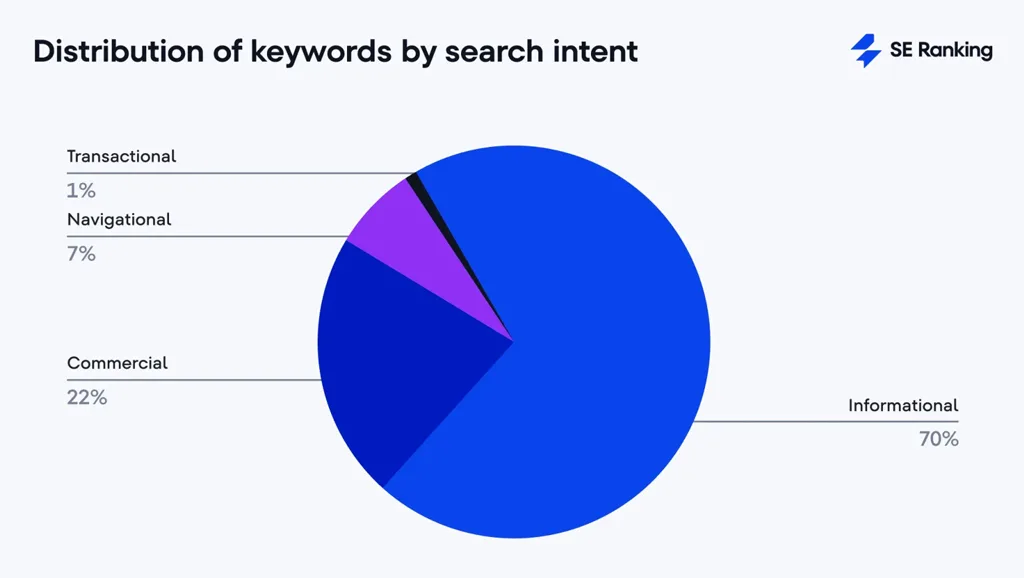
- Informational keywords dominate (70%), showing that the majority of search queries are focused on learning, research, and problem-solving rather than immediate purchases.
- Commercial intent accounts for 22%, indicating a strong segment of users actively comparing products or services before buying.
- Navigational searches make up 7%, reflecting users who already know the brand or website they want to visit.
- Transactional keywords are minimal (1%), highlighting that only a small portion of searches are ready-to-convert or purchase-driven.
- The data suggests a clear top-of-funnel dominance, where users are primarily in the awareness and consideration stages.
- Businesses should prioritize content marketing and SEO strategies targeting informational queries to capture the largest traffic share.
- Optimizing for commercial keywords (22%) can help bridge the gap between traffic and conversions.
- A balanced SEO strategy should still include transactional keywords (1%), as they drive high-intent conversions despite low volume.
Long-Tail Keywords Data
- Long-tail keywords make up over 70% of all search queries, emphasizing niche targeting.
- These keywords have lower competition and higher conversion rates.
- Long-tail queries convert 2.5x better than short-tail keywords.
- Voice search queries tend to be longer and more conversational, increasing long-tail usage.
- Pages targeting long-tail keywords rank faster, often within 3–6 months.
- Niche content targeting long-tail terms drives higher engagement metrics.
- E-commerce sites using long-tail keywords see higher purchase intent traffic.
- Long-tail optimization helps smaller sites compete with larger domains.
Backlinks and Link Building
- Pages ranking #1 on Google have 3.8x more backlinks than positions #2–#10.
- 66.3% of pages have zero backlinks, limiting their ranking potential.
- High-authority backlinks significantly improve rankings, with top pages averaging dozens of referring domains.
- Link building remains one of the top 3 SEO ranking factors.
- Guest posting and outreach remain widely used, with over 60% of SEOs using link-building campaigns.
- Content with backlinks gets 97% more traffic than pages without links.
- Broken link building and digital PR campaigns show higher ROI than directory submissions.
- Links from domains with high authority pass more ranking value than multiple low-quality links.
Top Link Building Channels and Their Performance Breakdown
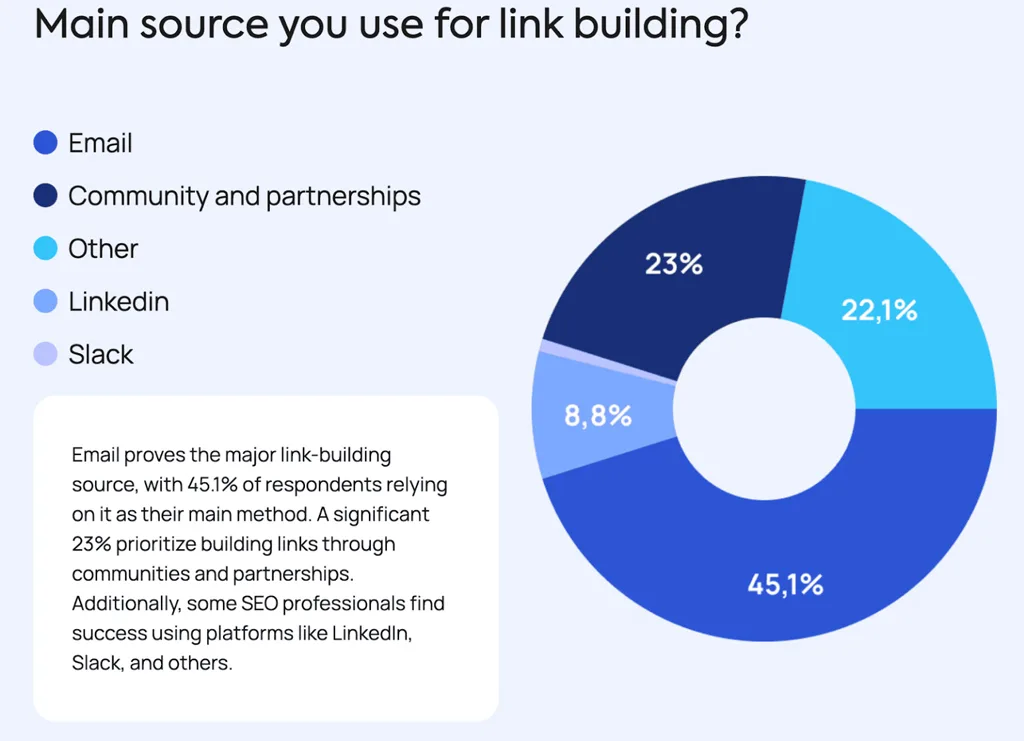
- Email dominates link building, with 45.1% of respondents using it as their primary outreach channel, making it the most effective and widely adopted method.
- Community and partnerships account for 23%, highlighting the growing importance of relationship-driven link-building strategies.
- A notable 22.1% rely on “other” methods, indicating diversification in link-building tactics beyond traditional approaches.
- LinkedIn contributes 8.8%, showing that professional networking platforms still play a supporting but valuable role in outreach.
- Slack has a minimal share (~1%), suggesting that closed communities and niche platforms are used selectively rather than at scale.
- Overall, 67%+ of link building (Email + Partnerships) is driven by direct communication and relationship-based strategies, emphasizing the importance of personalized outreach in SEO.
- The data reflects a clear trend: scalable outreach (Email) combined with trust-based networking (Communities) delivers the strongest link-building results.
Content Length and Performance
- The average first-page result contains ~1,447 words, indicating longer content performs better.
- Long-form content (2000+ words) generates more backlinks and shares than short posts.
- Articles over 3000 words receive 3x more traffic than shorter articles.
- Content updated regularly can increase traffic by up to 106%.
- Visual content (images, videos) increases engagement by ~40%.
- Pages with structured headings (H2, H3) improve readability and ranking potential.
- Evergreen content drives consistent long-term traffic growth compared to trend-based content.
- Content aligned with search intent ranks significantly higher, especially in competitive niches.
Voice Search Growth
- Approximately 20.5% of people globally use voice search regularly, reflecting steady mainstream adoption.
- 8.4 billion voice-enabled devices are in use worldwide, more than double the 4.2 billion devices in 2020.
- 45% year-over-year growth in voice queries demonstrates accelerating consumer adoption trends.
- 149.8 million voice assistant users in the United States represent a 2.5% increase from 2023.
- 32% of global consumers have used a voice assistant in the past week, with 21% using it weekly to find information.
- 50% of global online searches are now conducted via voice assistants, signaling voice’s emergence as the primary search method.
- 71% of consumers prefer using voice search over typing when possible, indicating a strong user preference shift.
- Voice commerce transactions reached $4.6 billion in 2026, representing a 215% increase from the previous year.
- Voice commerce market expected to grow at 23.9% CAGR from 2025 to 2030, adding USD 103.36 billion in market value.
- India’s voice commerce market is projected to reach USD 7.5 billion by 2030, with 32% CAGR indicating regional growth acceleration.
Voice Assistant Usage in the US
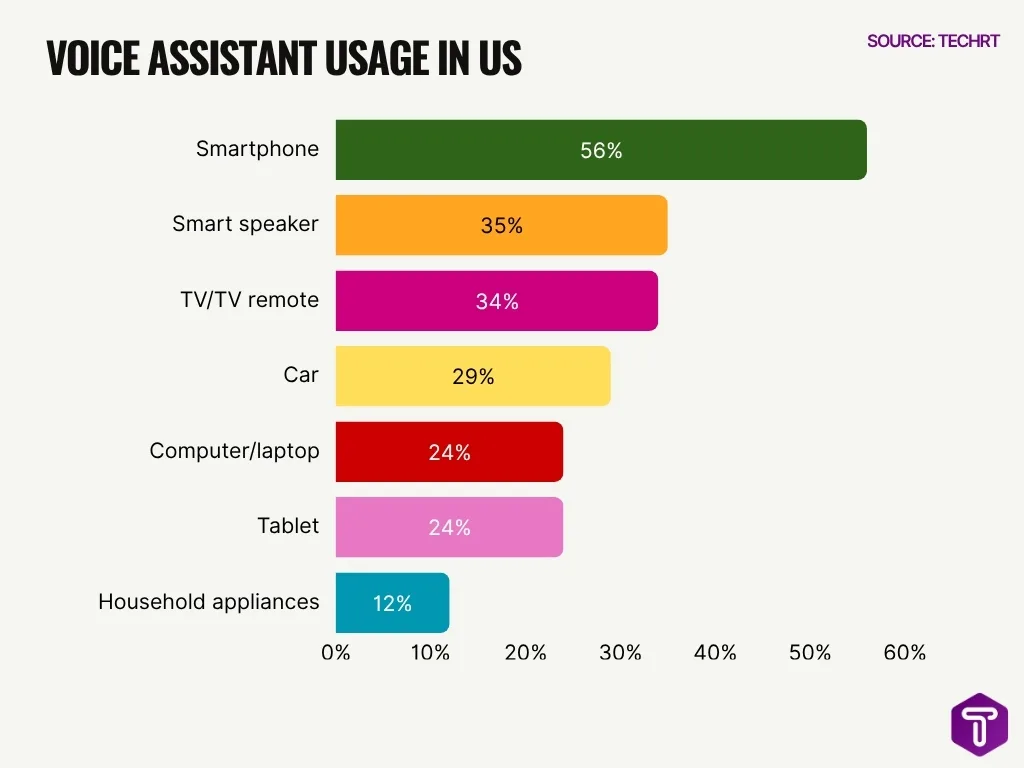
- Smartphones dominate usage, with a leading 56% of users relying on them for voice assistants, making them the primary access point.
- Smart speakers rank second at 35%, highlighting their strong adoption in home environments for hands-free interactions.
- TVs and remotes closely follow with 34% usage, showing that voice technology is becoming a standard feature in entertainment systems.
- In-car voice assistant usage reaches 29%, indicating growing reliance on hands-free, on-the-go interactions for navigation and controls.
- Computers/laptops and tablets are tied at 24% each, suggesting moderate usage in work and casual browsing contexts.
- Household appliances lag significantly at just 12%, reflecting limited integration or lower user adoption in smart home ecosystems.
- There is a 44 percentage point gap between the most-used device (smartphones – 56%) and the least-used (household appliances – 12%), showing a clear usage disparity.
- Overall, mobile and portable devices dominate, while embedded and IoT devices are still emerging in voice assistant adoption.
Mobile Search Dominance
- Mobile devices account for over 60% of global web traffic.
- Google uses mobile-first indexing for 100% of websites, making mobile optimization essential.
- 58% of searches come from mobile devices, surpassing desktop.
- Mobile users are 5x more likely to abandon slow sites, impacting SEO.
- Page speed improvements can boost mobile conversions by up to 27%.
- Local searches on mobile often lead to action, with 76% visiting a business within a day.
- Mobile-friendly websites rank higher due to user experience signals.
- Accelerated Mobile Pages (AMP) can improve load speed and visibility.
Local SEO Statistics
- 46% of all Google searches have local intent.
- 76% of consumers who search “near me” visit a business within 24 hours.
- 80% of local searches result in conversions, with Google Map Pack listings receiving 126% more traffic than positions 4-10.
- Complete Google Business Profile listings generate 7x more clicks than incomplete profiles.
- 75% of consumers read online reviews, with every 10 new reviews increasing conversions by 2.8%.
- 33% of local searches result in an actual purchase, up from 28% in 2025.
- 800 million searches per month contain “near me” variations, with 5.9 million related keywords identified.
- 88% of mobile local search users will call or visit the business within 24 hours.
- 78% of location-based mobile searches result in offline purchases, driving foot traffic to physical locations.
Frequently Asked Questions (FAQs)
What percentage of website traffic comes from organic search?
How many searches does Google process per day?
What is the click-through rate (CTR) for the #1 Google result?
How many SEO ranking factors does Google use?
What percentage of searches result in zero clicks due to AI or SERP features?
Conclusion
SEO reflects a dynamic mix of traditional ranking factors and emerging technologies. While backlinks, content quality, and keyword targeting still drive rankings, AI-powered search features and zero-click behavior continue to reshape traffic patterns. At the same time, mobile and local SEO have become non-negotiable for brands targeting real-world conversions.
For businesses, the takeaway is clear: success now depends on balancing technical SEO, user intent, and AI adaptability. Those who invest in data-driven strategies, authoritative content, and user experience will continue to capture organic visibility in an increasingly competitive search landscape.

Leave a comment
Have something to say about this article? Add your comment and start the discussion.