




Walmart Inc. stands as a defining force in modern retail, shaping how millions of consumers shop both in-store and online. With its vast network of physical stores, advanced supply chain systems, and expanding eCommerce ecosystem, Walmart influences pricing strategies, supplier relationships, and consumer expectations across the globe. Its dominance in essential categories like groceries, combined with rapid investments in digital fulfillment and last-mile delivery, makes it a benchmark for retailers, logistics providers, and investors alike.
As economic conditions shift and consumer behavior evolves, Walmart’s performance offers valuable insight into broader retail and economic trends. Let’s explore the latest Walmart statistics to better understand how the company continues to scale, adapt, and lead in a highly competitive landscape.
Editor’s Choice
- Walmart generated $713.16 billion in total revenue in FY2026, up from $680.99 billion in FY2025.
- The company recorded $706.4 billion in net sales in FY2026, reflecting steady growth.
- Walmart served approximately 270 million customers weekly worldwide in 2025.
- The company operates over 10,822 global stores as of 2025.
- Walmart employs about 2.1 million associates globally, making it the largest private employer.
- Walmart U.S. alone generated $462+ billion in revenue, accounting for nearly 68% of total sales.
- Walmart reached a $1 trillion market valuation in 2026, marking a milestone for traditional retail.
Recent Developments
- Walmart’s total revenue grew 4.7% year-over-year in FY2026, signaling consistent expansion.
- The company reported 5.6% YoY revenue growth in Q4 FY2026, driven by strong consumer demand.
- Walmart’s advertising business generated $6.4 billion in 2025, growing 37% globally.
- Global eCommerce sales increased by roughly 16% in FY2025, reflecting digital acceleration.
- Walmart U.S. retail sales reached $483 billion in 2025, up from $462 billion in 2024.
- The company expanded store modernization, planning upgrades for 650+ locations.
- Walmart introduced AI-driven tools like “Sparky” shopping assistant to improve customer experience.
- Same-store sales in the U.S. grew around 4.5% YoY in 2025, reflecting strong in-store demand.
- Walmart increased grocery price rollbacks across 7,400 products, strengthening price leadership.
Walmart Overview
- Walmart was founded in 1962 in Rogers, Arkansas, and is headquartered in Bentonville, Arkansas.
- The company operates in 19 countries, with a strong presence in North America and emerging markets.
- Walmart is ranked #1 on the Fortune Global 500 by revenue.
- The business is structured into four segments: Walmart U.S., Walmart International, Sam’s Club, and Global eCommerce.
- Around 90% of the U.S. population lives within 10 miles of a Walmart store.
- The Walton family controls roughly 44.8% ownership of the company.
- Walmart maintains a portfolio of over 8,800 patent filings globally, signaling an innovation focus.
- The company’s omnichannel strategy integrates physical stores, mobile apps, and online platforms.
U.S. Retail Market Share: Walmart Leads the Competition
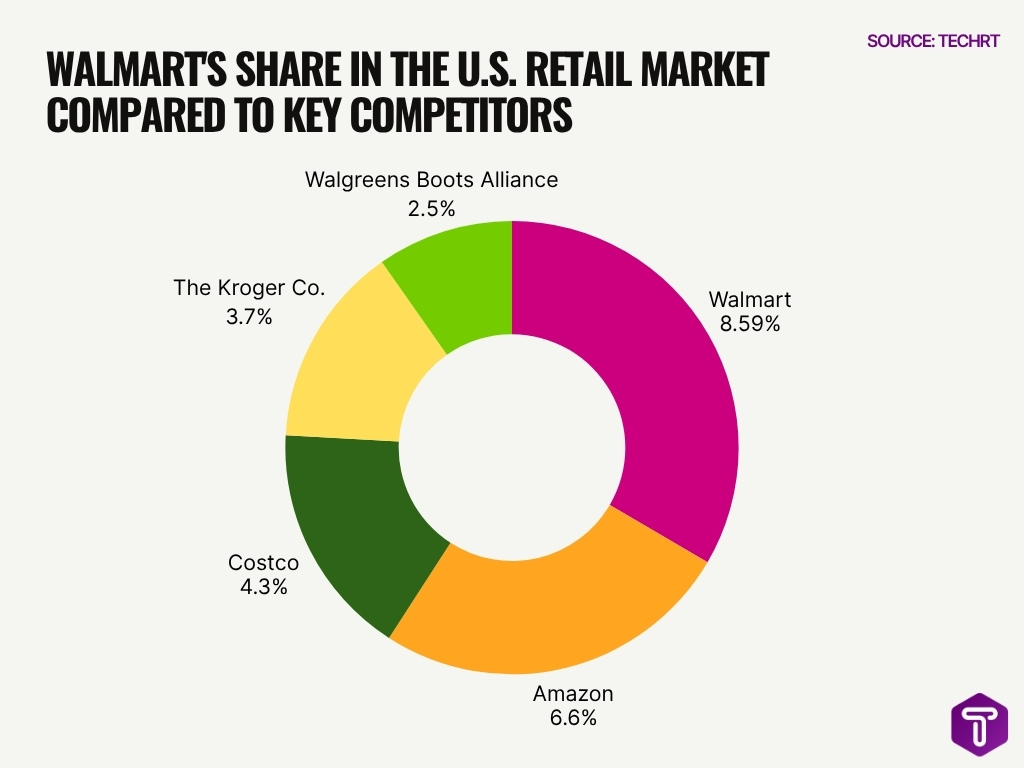
- Walmart dominates the U.S. retail market with a leading share of 8.59%, making it the clear market leader.
- Amazon ranks second with 6.6%, trailing Walmart by nearly 2 percentage points, highlighting strong but still lower dominance.
- Costco holds a solid third position with 4.3%, benefiting from its membership-based retail model.
- The Kroger Co. captures 3.7% of the market, reflecting its strong presence in the grocery segment.
- Walgreens Boots Alliance accounts for 2.5%, showing a smaller but notable share driven by pharmacy and convenience retail.
- The combined market share of these top five players reaches approximately 25.69%, indicating a highly competitive yet concentrated retail landscape.
- Despite strong competition, Walmart maintains a significant lead, reinforcing its position as the largest retailer in the U.S. by market share.
Walmart Revenue Statistics
- Walmart’s total revenue reached $713.16 billion in FY2026, up from $680.99 billion in FY2025.
- Annual revenue grew 4.73% year-over-year in 2026.
- FY2025 revenue stood at $680.99 billion, reflecting a 5.07% increase from 2024.
- FY2024 revenue was $648.13 billion, up 6.03% from 2023.
- Walmart generated $706.4 billion in net sales in FY2026, indicating strong product demand.
- Membership and other income reached $6.75 billion in FY2026.
- Walmart’s 5-year revenue growth rate averaged ~5.39% annually.
- Quarterly revenue hit $190.65 billion in Q4 FY2026, showing consistent scale.
- Walmart U.S. generated over $462 billion in FY2025 revenue, dominating the revenue mix.
Walmart Profit and Income Statistics
- Walmart reported $19.4 billion in net income in FY2025, up from $15.5 billion in 2024.
- Net income increased by roughly 25% year-over-year from 2024 to 2025.
- Operating income continues to scale alongside revenue growth, reflecting improved margins.
- Gross profit margin stood at approximately 24.1% in FY2025.
- Cost of sales reached $535.39 billion in FY2026, highlighting operational scale.
- Walmart has maintained consistent profitability despite inflation and supply chain pressures.
- Quarterly net income exceeded $4.5 billion in Q3 FY2025, beating analyst expectations.
- Profit margins remain relatively thin compared to tech companies, reflecting Walmart’s high-volume, low-margin model.
Walmart Store Count Trends
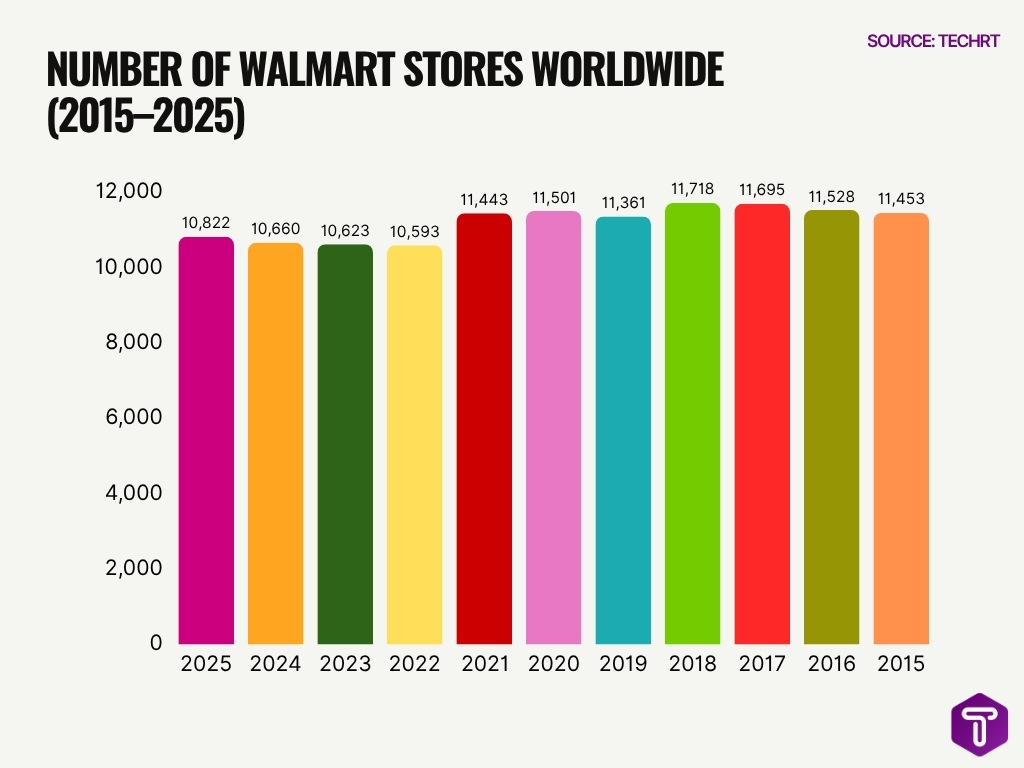
- Walmart operated 10,822 stores in 2025, showing a gradual recovery after earlier declines.
- The company reached its peak store count of 11,718 in 2018, marking the highest expansion phase in the decade.
- From 2020 (11,501 stores) to 2022 (10,593 stores), Walmart saw a notable decline of ~908 stores, reflecting strategic restructuring and optimization.
- Between 2022 and 2025, store numbers stabilized and slightly increased from 10,593 to 10,822, indicating a shift toward sustainable growth.
- Over the full period (2015–2025), Walmart’s store count decreased from 11,453 to 10,822, a net drop of 631 stores (~5.5%).
- The data highlights a transition from aggressive physical expansion (2015–2018) to a more efficiency-driven, omnichannel strategy in recent years.
Walmart U.S. Segment Statistics
- Walmart U.S. generated over $462 billion in revenue in FY2025, making it the largest segment.
- Comparable store sales in the U.S. grew by 4.5% in 2025, driven by grocery demand.
- Grocery accounts for roughly 60% of Walmart U.S. sales, reinforcing its core strength.
- Walmart U.S. eCommerce sales increased by over 20% YoY in 2025.
- The segment operates over 4,600 stores across all 50 states.
- Walmart U.S. saw strong private-label growth, with brands like Great Value gaining traction.
- Same-day delivery now reaches over 80% of the U.S. population, improving fulfillment speed.
- Walmart+ membership continues to grow, with millions of subscribers in the U.S.
- Fuel and pharmacy services contribute additional revenue streams within the U.S. segment.
Walmart International Segment Statistics
- Walmart International generated $121.9 billion in net sales for FY2025, up from $114.6 billion in FY2024.
- Mexico and Central America contributed $51.97 billion in net sales for FY2025, the largest international market.
- China’s net sales reached $19.98 billion in FY2025, with over 50% from online channels.
- Canada generated $23.04 billion in net sales for FY2025 and operates 404 stores.
- The segment operates 5,566 stores across 18 countries as of the FY2025 end.
- ECommerce sales in international markets grew 22% in Q2 FY2026, driven by China and Flipkart.
- International operations account for 18% of Walmart‘s total $681 billion FY2025 revenue.
- Walmart (Mexico) led with 3,316 stores as of January 2026.
- China eCommerce delivered 80% of digital orders in under an hour.
- Membership income in international grew over 20% in Q4 FY2025.
Sam’s Club Store Growth and Stability Trends
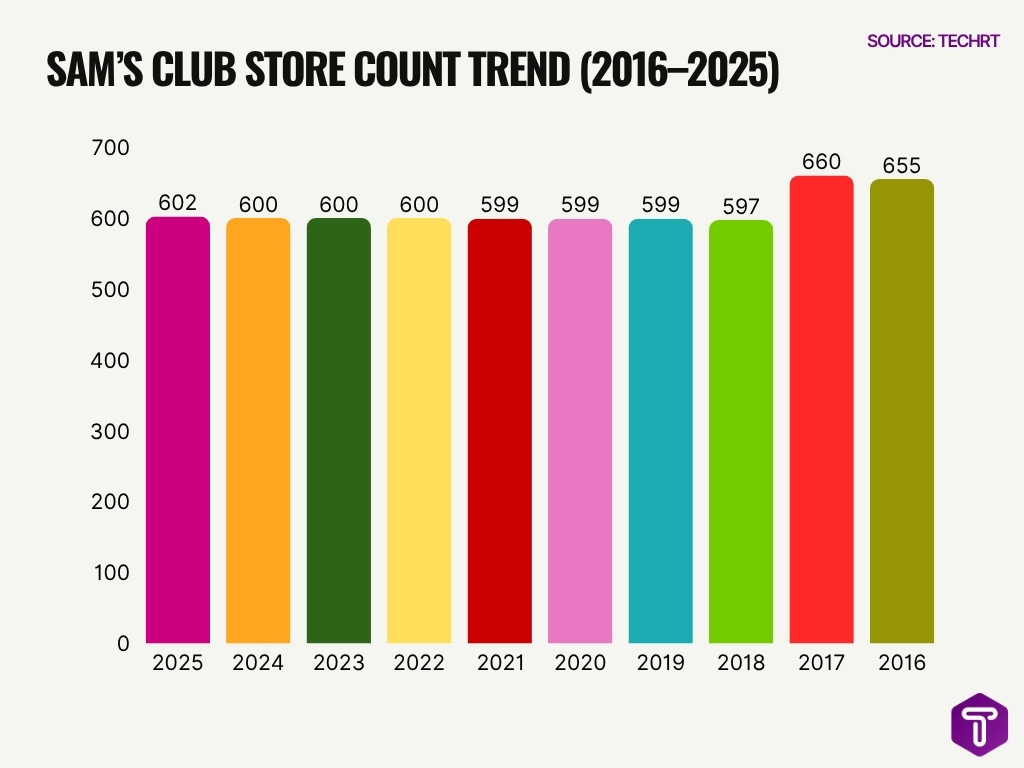
- Sam’s Club store count reached 602 in 2025, marking a slight increase from 600 stores in 2024 and 2023.
- The number of stores remained highly stable between 2019 and 2022, consistently around 599–600 locations.
- A notable peak occurred in 2017 with 660 stores, the highest count in the dataset.
- From 2017 to 2018, the company saw a sharp decline of 63 stores (from 660 to 597), indicating a major restructuring phase.
- After 2018, store numbers stabilized and gradually recovered, maintaining a tight range between 597 and 602 stores.
- Over the 10-year period (2016–2025), Sam’s Club experienced an overall net decline of 53 stores, from 655 to 602, reflecting optimization rather than expansion.
- The data suggests a strategic focus on efficiency and profitability, rather than aggressive physical store growth.
Walmart Ecommerce Statistics
- Walmart’s global eCommerce sales grew by 16% in FY2025, reflecting strong digital demand.
- Walmart U.S. eCommerce growth exceeded 20% YoY in 2025.
- Walmart.com attracts over 400 million monthly visits globally.
- Marketplace sellers exceeded 150,000 active vendors, expanding product assortment.
- Walmart’s eCommerce share of total revenue reached approximately 18% in 2025.
- The company offers same-day delivery to 80%+ of U.S. households.
- Walmart’s mobile app ranks among the top retail apps in the U.S. by downloads.
- Online pickup and delivery services grew significantly post-pandemic and remain a key driver.
- Walmart Fulfillment Services supports third-party sellers with logistics solutions.
Walmart Online Grocery Statistics
- Walmart holds a 31.6% share of the U.S. online grocery market in 2025.
- Online grocery sales reached $127-130 billion in the U.S. in 2025.
- Walmart offered grocery pickup at 4,600 U.S. stores in 2023.
- Store-fulfilled delivery grew 50% in Walmart’s Q2 FY2026.
- Walmart+ membership hit a record 28.4 million in January 2026.
- U.S. e-commerce sales surged 28% in Walmart U.S. Q3 FY2026.
- Pickup baskets average $124.86, higher than in-store $49.70.
- Grocery delivery now reaches 12 million more households via optimized zones.
- Online grocery penetration hit 19% of the U.S. total grocery market in Dec 2025.
Walmart In-Store Traffic Trends Show Strong Momentum into 2026
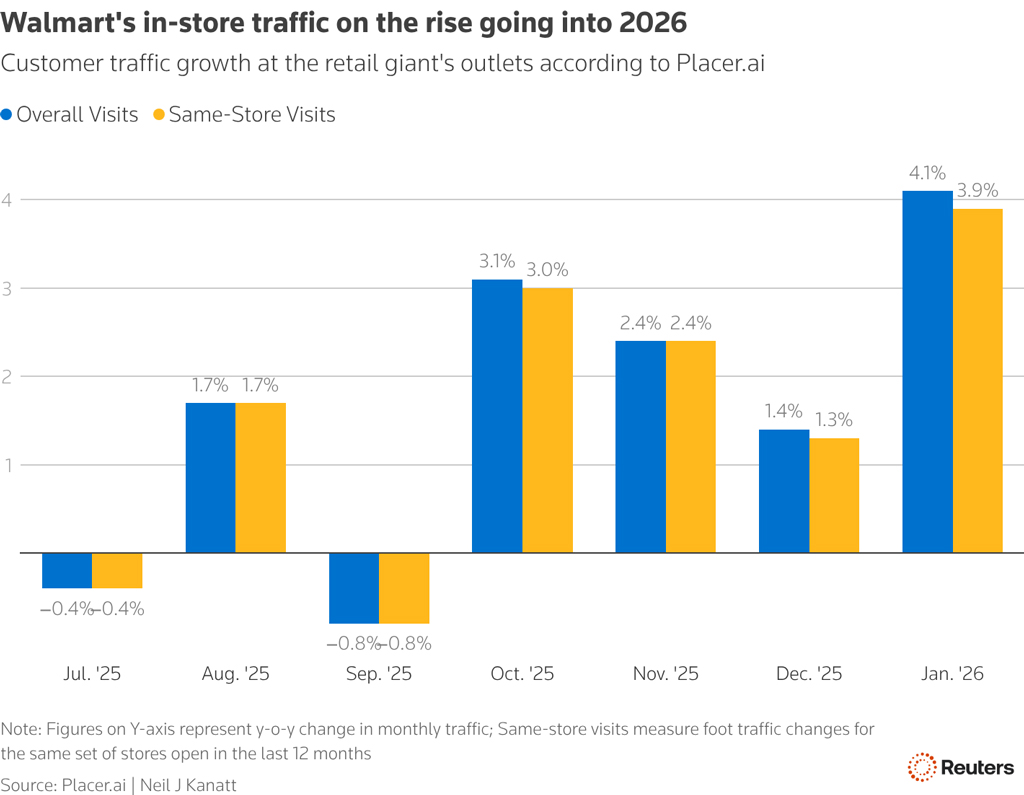
- In-store traffic rebounded strongly, moving from a decline of -0.4% in July 2025 to a peak of 4.1% in January 2026 (overall visits).
- After a dip in September 2025 (-0.8%), Walmart saw a consistent upward trend through the end of the year.
- October 2025 marked a major recovery, with traffic jumping to 3.1% (overall) and 3.0% (same-store).
- Growth remained stable in November 2025 at 2.4%, showing sustained consumer demand across stores.
- Despite a slight slowdown in December 2025 (1.4% overall, 1.3% same-store), traffic stayed firmly positive during the holiday season.
- January 2026 recorded the highest growth, reaching 4.1% overall visits and 3.9% same-store visits, signaling strong start-of-year momentum.
- The gap between overall and same-store visits remained minimal, indicating that growth was organic and not driven by new store openings.
- Across the period, same-store performance closely mirrored overall traffic, reinforcing consistent store-level demand trends.
- Overall, Walmart transitioned from mid-year volatility to strong year-end acceleration, highlighting improving consumer footfall heading into 2026.
Walmart Customer and Footfall Statistics
- Walmart serves approximately 270 million customers weekly worldwide, highlighting its unmatched retail reach.
- In the U.S., Walmart stores receive over 240 million weekly visits, making it one of the most visited retail chains.
- Average monthly footfall across Walmart U.S. stores exceeds 1 billion visits, combining physical and digital interactions.
- Walmart.com attracts over 400 million monthly online visits globally, reflecting strong omnichannel traffic.
- Roughly 90% of Americans shop at Walmart at least once per year.
- Peak shopping seasons like Black Friday drive double-digit increases in store traffic, often exceeding 20% growth.
- Walmart’s grocery segment drives the highest footfall, accounting for over 50% of store visits.
- Mobile app engagement has surged, with millions of daily active users browsing deals and placing orders.
- Online order pickup services contribute significantly to in-store traffic, blending digital and physical experiences.
Walmart Demographic and Shopper Profile Statistics
- Walmart’s core customer base includes households earning under $100,000 annually, representing a majority of shoppers.
- Around 60% of Walmart shoppers are female, reflecting household purchasing patterns.
- Millennials and Gen Z together account for over 45% of Walmart’s customer base, showing generational diversification.
- Walmart attracts a broad demographic, with strong penetration in both urban and rural markets.
- Approximately 70% of U.S. Walmart shoppers prioritize low prices as the primary reason for shopping.
- Walmart+ membership skews toward higher-income households compared to traditional Walmart shoppers.
- Ethnic diversity among Walmart shoppers reflects U.S. demographics, with strong representation across all groups.
- Families with children represent a significant portion of Walmart’s frequent shoppers.
- Digital shoppers tend to spend 20–30% more per transaction compared to in-store-only customers.
Walmart Online Shopping Frequency Insights
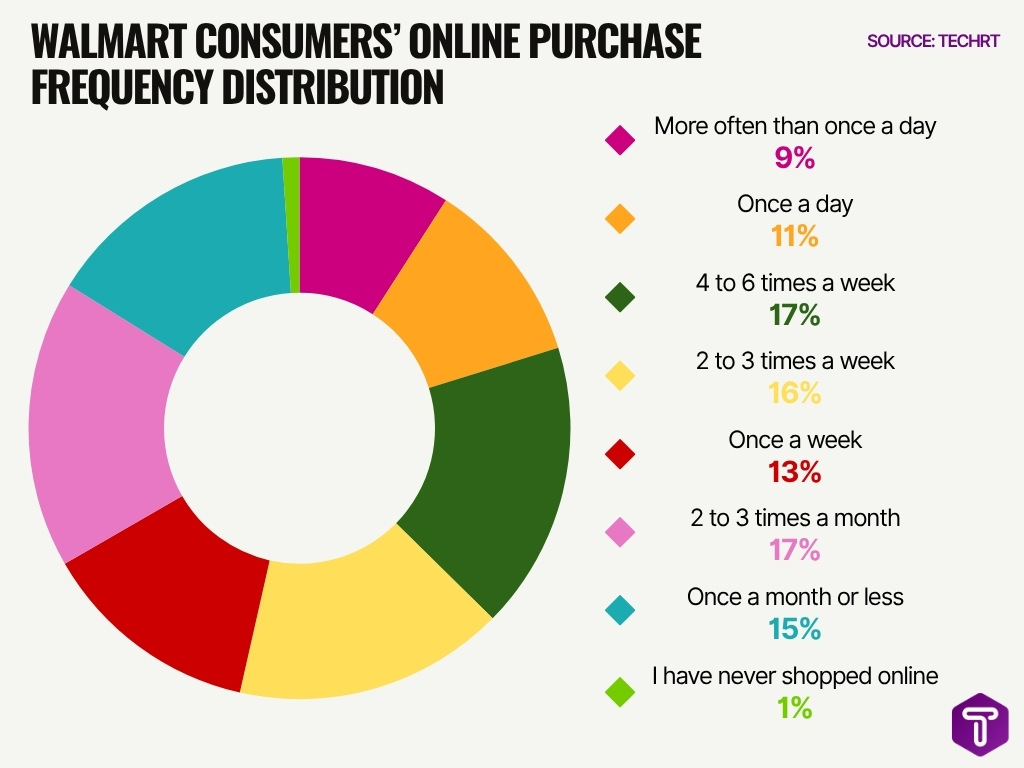
- A significant portion of Walmart consumers shop online multiple times per week, with 17% purchasing 4–6 times weekly and 16% shopping 2–3 times weekly, indicating strong habitual usage.
- Daily engagement is notable, as 20% of respondents shop at least once a day, including 9% purchasing more than once daily and 11% shopping once daily.
- Mid-frequency shoppers also form a large segment, with 17% buying 2–3 times a month and 13% shopping once a week, showing consistent but less intensive usage patterns.
- Occasional shoppers still represent a meaningful share, with 15% purchasing once a month or less, highlighting a segment with lower engagement but potential for growth.
- Only a minimal 1% of respondents have never shopped online, reflecting near-universal adoption of online shopping among Walmart consumers.
- Overall, the data shows that over half of consumers (53%) shop at least weekly, emphasizing Walmart’s strong position in frequent online purchasing behavior.
Walmart Employment and Workforce Statistics
- Walmart employs approximately 2.1 million associates globally, making it the largest private employer.
- Around 1.6 million employees are based in the United States, highlighting domestic workforce concentration.
- Walmart hired over 150,000 seasonal workers in 2025 to support peak demand.
- The average hourly wage for U.S. Walmart employees increased to over $17.50 in 2025.
- Walmart offers education benefits through programs like Live Better U, serving thousands of employees annually.
- Employee turnover remains high in retail, but Walmart has improved retention through wage increases and benefits.
- Women make up more than 50% of Walmart’s workforce globally.
- Walmart invests billions annually in workforce training and development programs.
- The company promotes internal mobility, with 75% of store management roles filled internally.
Walmart Supply Chain and Logistics Statistics
- Walmart operates one of the largest supply chains globally, with over 210 distribution centers worldwide.
- The company manages a private fleet of over 12,000 trucks and 60,000 trailers in the U.S.
- Walmart’s supply chain handles billions of units annually, ensuring product availability across stores.
- The company uses automation and robotics in fulfillment centers to improve efficiency and reduce costs.
- Walmart’s inventory turnover ratio stands at approximately 8–9 times per year, indicating high efficiency.
- Same-day and next-day delivery capabilities cover over 80% of the U.S. population.
- Walmart’s supply chain digitization includes AI-driven demand forecasting and inventory management.
- The company sources products from thousands of global suppliers, maintaining a vast procurement network.
- Walmart’s logistics costs account for a significant portion of operating expenses due to its scale.
Walmart Sales Distribution by Category
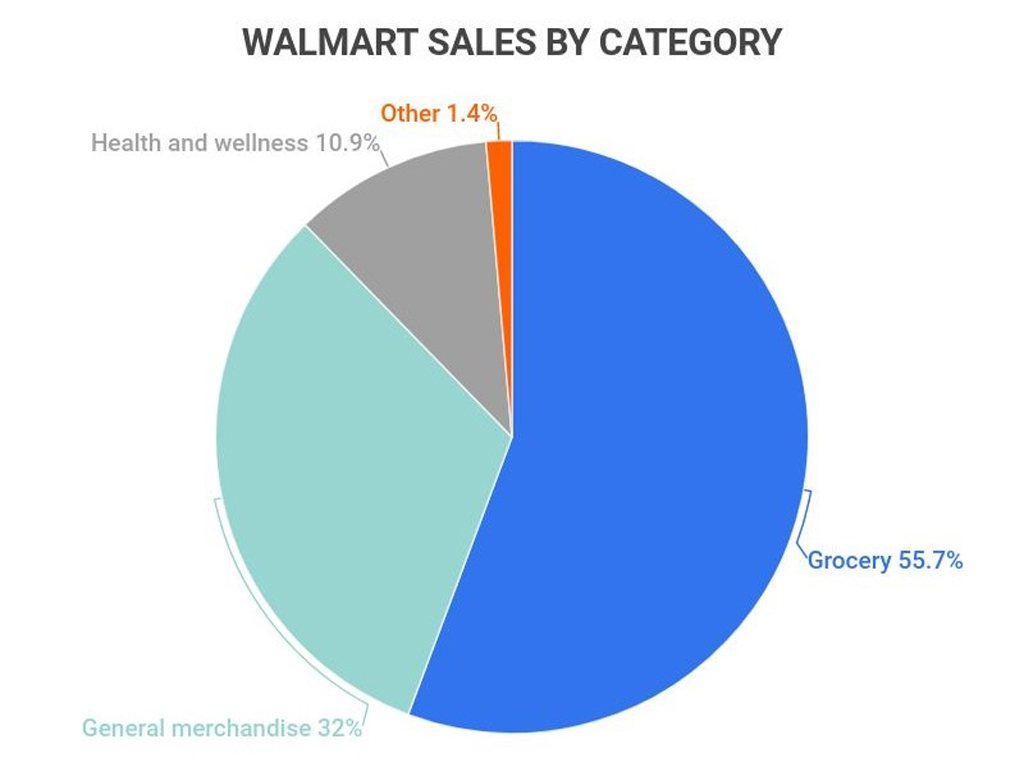
- Grocery dominates Walmart’s sales, accounting for a massive 55.7%, making it the primary revenue driver for the company.
- General Merchandise contributes 32%, highlighting its role as the second-largest segment, but still significantly behind grocery.
- Health and Wellness represents 10.9% of total sales, indicating a growing but smaller category compared to core retail segments.
- The “Other” category accounts for just 1.4%, showing minimal contribution to overall revenue.
- Combined, Grocery and General Merchandise make up 87.7% of total sales, demonstrating Walmart’s heavy reliance on essential and everyday products.
- The data clearly reflects Walmart’s strong positioning as a grocery-first retailer, with over half of its revenue coming from food and consumables.
Walmart Advertising and Media Revenue Statistics
- Walmart’s global advertising revenue reached approximately $6.4 billion in 2025, up about 46% year‑over‑year.
- Walmart Connect in the U.S. grew ad revenue by roughly 41% in the fourth quarter of 2025 alone.
- Walmart’s ad business now accounts for less than 1% of its total company sales of $713 billion, yet it contributes a significant share of profit.
- Around 83% of top Walmart Marketplace sellers advertise via Walmart Connect, highlighting widespread reliance on the platform.
- Walmart’s retail media network ranks as the second‑largest digital retail media network in the U.S., behind only Amazon.
- Advertisers spent about $4.4 billion on Walmart Connect in 2024, up roughly 27% year‑over‑year, signaling strong momentum.
- Over 74% of surveyed U.S. marketers reported using Walmart Connect as their primary retail media network, ahead of rivals like Target Roundel.
- Walmart’s third‑party sellers generate roughly one‑third of online sales, creating a large pool of natural advertisers for Walmart’s ad platform.
- Walmart’s connected TV and Vizio‑driven ad revenue grew at triple‑digit rates, expanding its omnichannel advertising footprint.
- Analysts project Walmart’s retail media revenue to more than double from about $3 billion in 2023 to over $6 billion by 2026, underscoring its multi‑billion‑dollar growth runway.
Walmart Sustainability and ESG Statistics
- Walmart aims to achieve zero emissions across global operations by 2040.
- The company has committed to becoming a regenerative company, focusing on sustainability.
- Walmart reduced operational emissions by approximately 18% since 2015.
- The company sources over 36% of its electricity from renewable energy.
- Walmart’s Project Gigaton aims to eliminate 1 billion metric tons of emissions from its supply chain by 2030.
- The company diverts over 80% of waste from landfills in key markets.
- Walmart invests heavily in sustainable packaging and reducing plastic waste.
- The company supports sustainable sourcing of products like seafood and palm oil.
- Walmart continues to publish annual ESG reports, improving transparency and accountability.
Frequently Asked Questions (FAQs)
What is Walmart’s total revenue in 2026?
How many customers does Walmart serve weekly?
How many employees does Walmart have worldwide?
What is Walmart’s eCommerce share of total revenue?
What market share does Walmart hold in its core retail segment?
Conclusion
Walmart’s performance highlights its ability to balance scale with adaptability in a fast-changing retail environment. The company continues to lead in grocery, strengthens its position in eCommerce, and unlocks new revenue streams through advertising and membership programs. At the same time, its investments in automation, supply chain efficiency, and workforce development ensure it can meet growing demand while controlling costs. Sustainability initiatives and ESG commitments further signal a long-term focus beyond immediate financial performance.
As competition intensifies from both traditional retailers and digital-first players, Walmart’s integrated omnichannel strategy positions it to remain a dominant force in global retail. For businesses, analysts, and consumers alike, Walmart serves as a key indicator of where the retail industry is heading next.

Leave a comment
Have something to say about this article? Add your comment and start the discussion.