



6G networks represent the next leap in wireless connectivity, promising ultra-fast speeds, near-zero latency, and intelligent network automation. Industries such as autonomous transportation and remote healthcare (like telesurgery) already rely on early 6G research to push the limits of real-time communication and precision control. Beyond these, sectors like smart manufacturing, digital twins, and immersive entertainment are preparing for a future where connectivity becomes seamlessly integrated with AI and edge computing. As governments, telecom providers, and technology companies accelerate investments, 6G is quickly moving from theoretical research to practical experimentation.
This evolution will not only enhance network performance but also redefine how devices, systems, and people interact in a hyper-connected ecosystem. Let’s explore the latest statistics driving this transformation.
Editor’s Choice
- 6G networks are expected to deliver peak speeds of up to 1 Tbps, nearly 100x faster than 5G.
- Ultra-low latency of 0.1 milliseconds is projected, enabling real-time applications like remote surgery.
- Device density could reach 10 million devices per km², supporting massive IoT ecosystems.
- Around 60% adoption in autonomous systems is projected by 2026.
- The global sub-terahertz 6G test equipment market is valued at $219 million in 2026.
- 6G could achieve 10x improvement in bandwidth efficiency compared to 5G.
- Early prototypes show speeds exceeding 100 Gbps in lab environments, signaling rapid progress.
Recent Developments
- In 2026, China launched a pre-6G test network in Nanjing, demonstrating real-world capabilities beyond 5G.
- Qualcomm introduced a new 6G-ready modem architecture (X105) to support AI-native networks in 2026.
- Europe deployed its first low-earth orbit 6G satellite to accelerate research and connectivity.
- Samsung successfully completed an early 6G virtualized RAN (vRAN) call in 2026.
- Global 6G research programs are now active across North America, Europe, and Asia.
- Major telecom players like Ericsson, Nokia, and Huawei have launched dedicated 6G R&D initiatives.
- The ITU’s IMT-2030 framework is guiding global 6G standardization efforts.
- 6G research increasingly integrates AI-driven network management and edge computing.
- Early-stage deployments are targeting industrial automation and smart city infrastructure.
Global 6G Overview Statistics
- 6G is expected to become commercially available around 2030, with trials accelerating in 2025–2026.
- The technology builds on 5G but introduces AI-native network architecture.
- Global adoption could reach 80% in advanced industries by 2028.
- 6G networks aim to integrate satellite and terrestrial communication systems seamlessly.
- Expected localization accuracy is below 10 cm, enabling precision tracking.
- 6G will support extended reality (XR), digital twins, and holographic communication.
- AI-driven automation will reduce manual network management by over 70% in advanced deployments.
- Governments worldwide are funding multi-billion-dollar 6G research programs.
6G Market Growth Trends and Forecast Insights
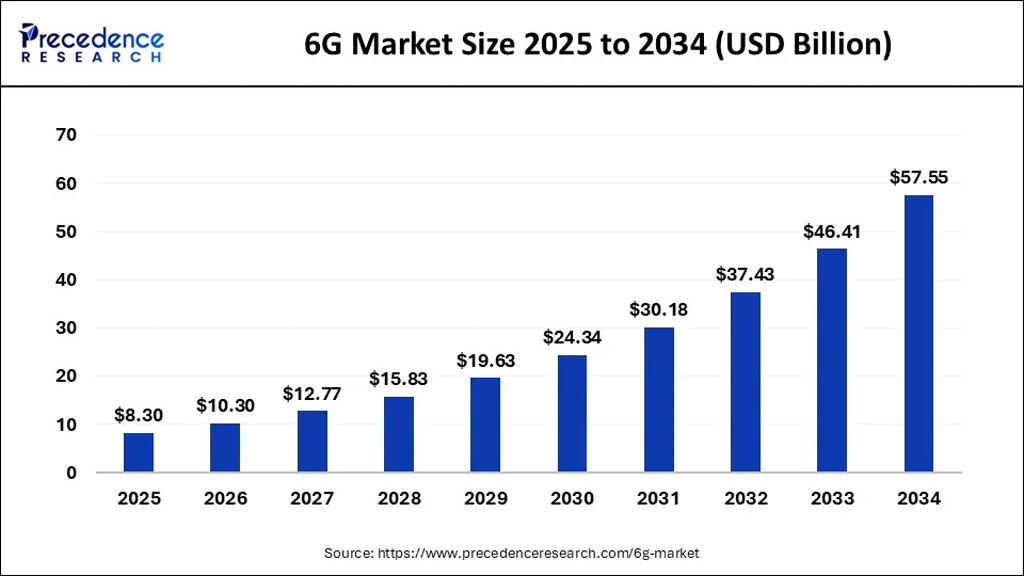
- The global 6G market is projected to grow from $8.30 billion in 2025 to $57.55 billion by 2034, indicating massive long-term expansion.
- The market is expected to increase by nearly 7X (≈593% growth) over the forecast period, highlighting strong industry momentum.
- Between 2025 and 2030, the market rises steadily from $8.30B to $24.34B, adding over $16 billion in value within five years.
- The growth accelerates significantly after 2030, with the market jumping from $24.34B (2030) to $57.55B (2034), an increase of over $33 billion.
- The market crosses the $30 billion milestone in 2031, signaling the beginning of rapid commercialization and deployment phases.
- By 2032, the market will reach $37.43 billion, showing strong adoption across telecom infrastructure and advanced use cases.
- In 2033, the market climbs to $46.41 billion, reflecting increased investment and early mainstream adoption.
- The consistent year-over-year growth suggests a strong compound annual growth trajectory (high double-digit CAGR) throughout the forecast period.
- Early years (2025–2028) show moderate growth, while later years (2030 onward) indicate exponential scaling driven by technological maturity and global rollout.
- The data underscores that 6G will become a multi-billion-dollar ecosystem before 2030, with peak expansion occurring in the early 2030s.
Key 6G Adoption and Usage Statistics
- Industrial automation is expected to account for over 60% of early 6G use cases by 2026.
- Smart cities will leverage 6G for real-time traffic, surveillance, and energy systems.
- Healthcare adoption includes remote diagnostics and robotic surgeries with near-zero latency.
- Autonomous vehicles require sub-millisecond latency for safe navigation systems.
- 6G will enable fully immersive AR/VR experiences with real-time rendering.
- Enterprise adoption is expected to grow with private 6G networks for factories and logistics hubs.
- AI-driven applications will dominate usage, accounting for over 50% of network traffic.
- Rural connectivity could improve significantly with satellite-integrated 6G networks.
6G Market Growth and CAGR Statistics
- The sub-terahertz 6G equipment market is projected to grow at a CAGR of 25% (2026–2036).
- Some regions, like China, are expected to see a CAGR as high as 38% in 6G-related sectors.
- The U.S. market is projected to grow at around 36% CAGR during the same period.
- India’s 6G sector could expand at 34% CAGR, driven by digital infrastructure investments.
- The UK and Japan are forecast to grow at 32% and 30% CAGR, respectively.
- AI integration in telecom is expected to grow at over 40% annually, supporting 6G adoption.
- Global telecom operators are increasing capital expenditure by 10–15% annually toward next-gen networks.
- 6G-related patents and R&D investments are rising at double-digit growth rates globally.
6G Market Forecast by Region (2028)
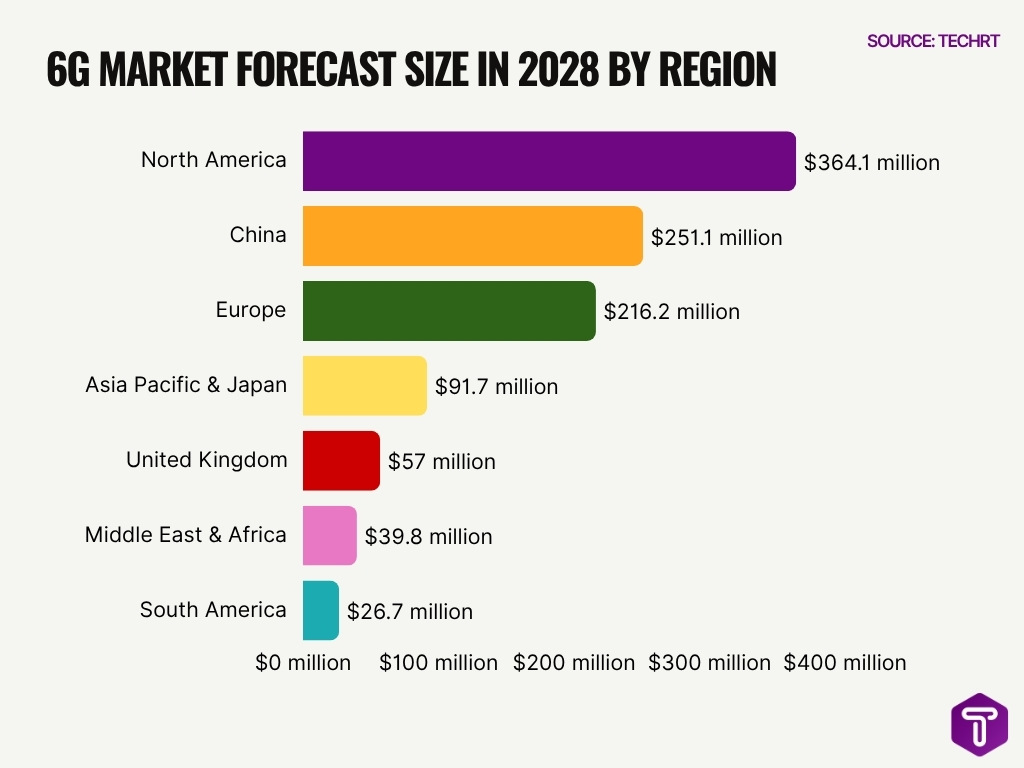
- North America dominates the 6G market with a projected size of $364.1 million, making it the largest regional contributor globally.
- China ranks second, reaching approximately $251.1 million, highlighting its strong investment and rapid technological advancement in next-gen networks.
- Europe holds the third position with a market size of $216.2 million, reflecting steady growth and strategic 6G initiatives across the region.
- Asia Pacific & Japan collectively account for $91.7 million, indicating emerging growth potential but still trailing behind leading regions.
- The United Kingdom contributes $57 million, showing moderate adoption and development within the European landscape.
- The Middle East & Africa record $39.8 million, signaling early-stage adoption and gradual infrastructure expansion.
- South America has the smallest market share at $26.7 million, reflecting limited deployment and slower adoption rates.
- The top three regions (North America, China, and Europe) together contribute over $831 million, accounting for the majority of the global 6G market in 2028.
- There is a significant gap between developed and developing regions, emphasizing uneven global rollout and investment levels in 6G technology.
- Overall, the data highlights a highly concentrated market, where a few regions lead innovation, funding, and deployment of 6G infrastructure.
6G Infrastructure and Deployment Statistics
- Over 70% of telecom operators globally have initiated 6G research or infrastructure planning by 2026.
- 6G infrastructure will rely heavily on terahertz (THz) frequency bands above 100 GHz.
- Small cell deployments are expected to increase by 5x compared to 5G networks.
- Edge computing nodes supporting 6G will grow by 300% between 2024 and 2028.
- Satellite integration will enable global coverage, including remote and oceanic regions.
- AI-native infrastructure is projected to manage over 80% of network operations autonomously.
- Fiber backhaul capacity requirements are expected to increase by 10x to support 6G speeds.
- Energy-efficient infrastructure could reduce network power consumption by up to 30% per bit transmitted.
- Early testbeds show deployment densities of 10–20x more base stations per km² than 5G.
6G Transport Network Investment Statistics
- Global telecom operators are projected to invest over $200 billion annually in next-gen transport networks by 2027.
- Fiber optic investment accounts for over 60% of transport network spending.
- Optical transport capacity is expected to grow by 400% to support 6G data loads.
- Governments worldwide are allocating billions in public funding for 6G backbone infrastructure.
- Private sector contributions make up over 65% of transport network investment globally.
- Submarine cable investments are rising, with over 1.3 million km of cables globally supporting future 6G traffic.
- Network slicing infrastructure spending is expected to grow at over 35% CAGR.
- Data center interconnect (DCI) capacity is projected to increase by 500% by 2030.
- Cloud-native transport networks will handle over 75% of telecom workloads by 2028.
6G Segment Statistics by Component
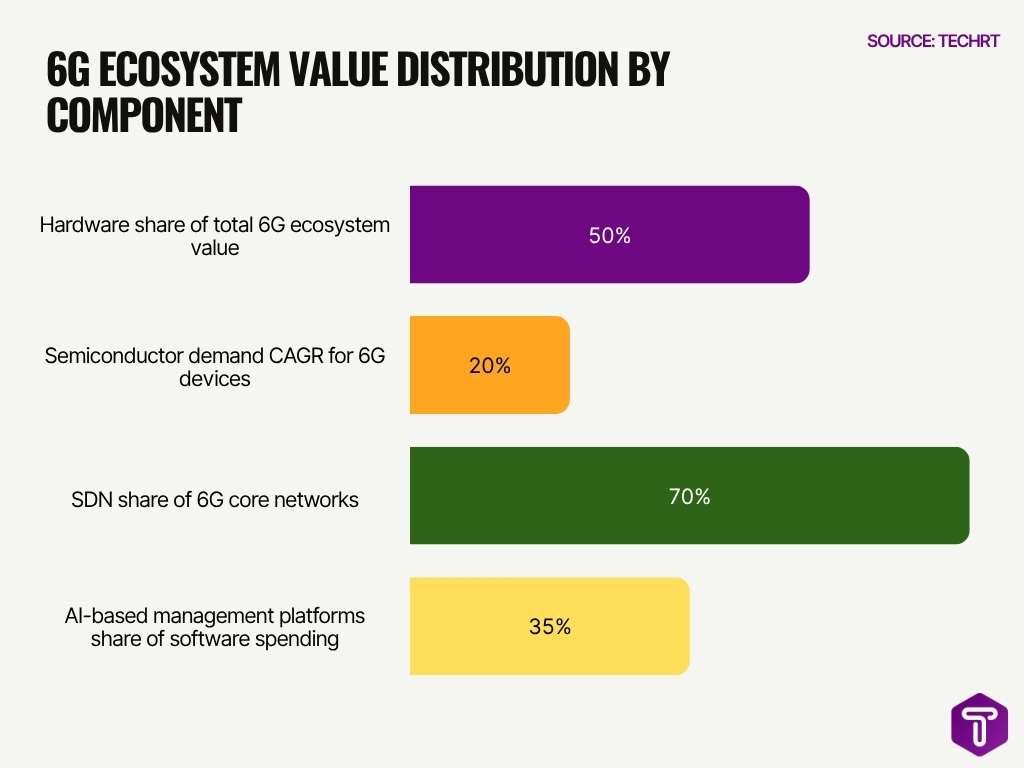
- Hardware components (antennas, chips, sensors) account for over 50% of total 6G ecosystem value.
- Semiconductor demand for 6G devices is expected to grow at over 20% CAGR through 2030.
- Software-defined networking (SDN) will power over 70% of 6G core networks.
- AI-based network management platforms are projected to represent over 35% of software spending.
- Advanced antenna systems (massive MIMO) will see 5x growth compared to 5G deployments.
- Edge devices supporting 6G applications are expected to exceed 15 billion units globally by 2030.
- Optical components demand will rise with a 10x increase in data throughput requirements.
- Quantum communication components are emerging as a niche segment with early-stage investments exceeding $500 million globally.
6G Segment Statistics by Application and Use Case
- Holographic communication requires a network bandwidth of 1 Tbit/s for 70-inch displays.
- Digital twins for 6G networks market valued at $320 million in 2024, growing to $5.7 billion by 2033.
- Autonomous vehicles demand sub-millisecond latency and 1 Tbps peak data rates in 6G.
- Extended reality (XR) applications drive 6G growth with multi-sensory XR as the key segment.
- Smart agriculture in 6G enables 2 million sensors per km² for dense IoT deployments.
- Remote surgery leverages 6G’s URLLC for sub-millisecond latency and high reliability.
- Smart grids use 6G for real-time optimization of energy usage and grid stability.
- Disaster management employs 6G drone networks for ultra-low latency coordination.
- Metaverse market to reach $107.49 billion by 2030, powered by 6G infrastructure.
6G Spectrum and Frequency Band Statistics
- 6G is expected to operate in sub-THz and THz bands ranging from 100 GHz to 1 THz.
- Spectrum above 300 GHz offers bandwidths exceeding 50 GHz, enabling ultra-high data rates.
- Current experimental systems have demonstrated stable communication at 140 GHz and 300 GHz frequencies.
- Spectrum allocation discussions are underway for global harmonization by 2027.
- Higher frequencies enable smaller antennas and denser deployments.
- Signal attenuation challenges at THz frequencies require advanced beamforming and AI optimization.
- Governments are testing spectrum sharing models to improve efficiency and reduce interference.
- Hybrid spectrum strategies combining low, mid, and high bands will ensure coverage and performance balance.
6G Segment Statistics by End-User Industry
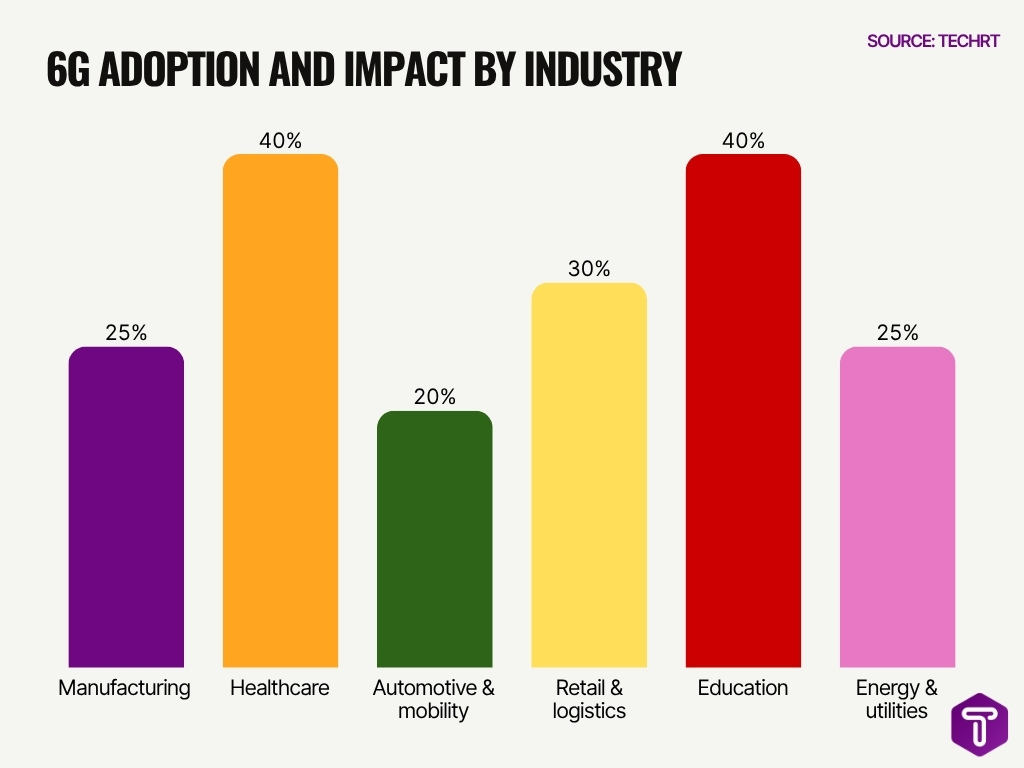
- Manufacturing is projected to capture over 25% of global 6G use cases by 2030, driven by Industry 4.0 automation and AI‑driven robotics.
- Healthcare applications such as telesurgery and remote diagnostics are expected to grow at a CAGR of 40% or higher between 2026 and 2035.
- The automotive and mobility sector will account for roughly 20% of early commercial 6G deployments, led by autonomous vehicles and V2X communication.
- Smart cities will generate more than $1 trillion in 6G‑enabled economic value by 2030 through AI‑powered traffic, surveillance, and utility systems.
- Defense and aerospace are forecast to invest over $10 billion annually globally in secure 6G and AI‑integrated communication and sensing platforms by 2035.
- Retail and logistics will see over 30% of their enterprise networks upgraded to 6G by 2030 for real‑time supply‑chain tracking and warehouse automation.
- Energy and utilities will leverage 6G to cut grid downtime by up to 25% through smart‑grid optimization and predictive maintenance of transmission assets.
- Education will deploy XR‑based classrooms in over 40% of advanced digital‑learning institutions by 2030, powered by ultra‑low‑latency 6G connectivity.
6G Speed and Peak Data Rate Statistics
- 6G is projected to achieve peak data rates of up to 1 Tbps, far exceeding 5G’s 20 Gbps limit.
- Early lab tests have already demonstrated speeds above 100 Gbps using sub-THz frequencies.
- Commercial 6G deployments are expected to deliver average user speeds of 1–10 Gbps.
- Data throughput improvements could reach 100x compared to 5G networks.
- Ultra-high-definition applications like 16K video streaming will require speeds exceeding 1 Gbps per user.
- Wireless backhaul capacity will increase by at least 10x to support 6G speeds.
- AI-driven optimization can boost network throughput efficiency by over 30%.
- Peak spectrum efficiency is expected to reach 100 bps/Hz, compared to ~30 bps/Hz in 5G.
6G Latency and Reliability KPI Statistics
- 6G aims to reduce latency to 0.1 milliseconds, enabling near-instant communication.
- Reliability targets are set at 99.99999% uptime (7 nines reliability).
- End-to-end latency improvements could be 10x better than 5G.
- Mission-critical applications like telesurgery require latency below 1 ms, achievable with 6G.
- AI-based predictive maintenance can reduce network downtime by over 40%.
- Edge computing integration will reduce data travel time by up to 60%.
- Ultra-reliable low-latency communication (URLLC) performance will improve significantly for industrial automation systems.
- Packet loss rates in 6G are expected to drop below 10⁻⁹, ensuring highly stable connections.
Telecom Sector Readiness for 6G
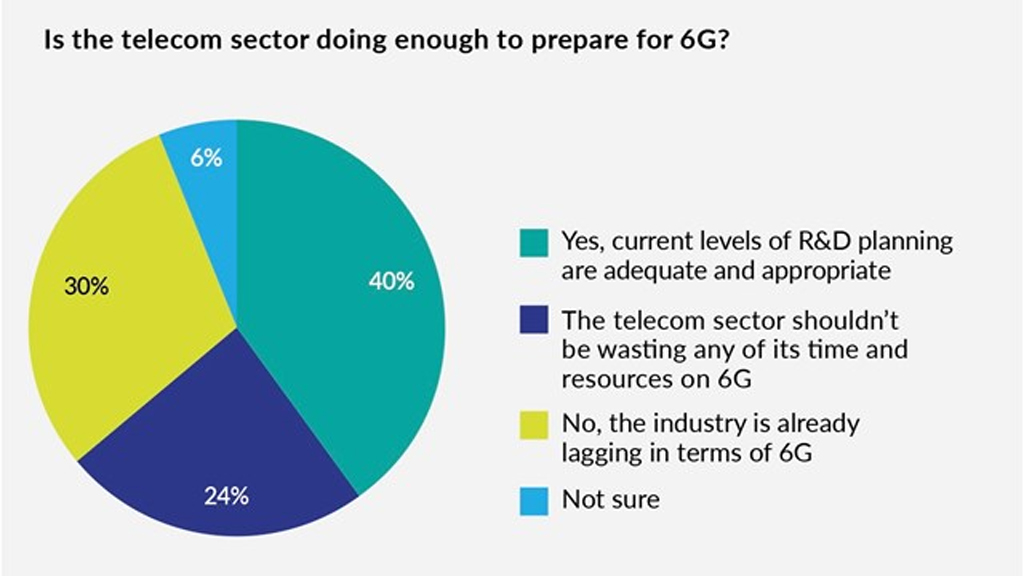
- 40% of respondents believe the telecom industry’s current R&D efforts are adequate, indicating a strong level of confidence in ongoing 6G preparation.
- A notable 30% say the industry is already lagging, highlighting significant concerns about whether telecom players are moving fast enough toward 6G readiness.
- Around 24% think resources shouldn’t be spent on 6G yet, suggesting skepticism about the timing or priority of 6G investments.
- Only 6% are unsure, showing that the majority of respondents have a clear opinion on the sector’s 6G preparedness.
- Overall sentiment is mixed but slightly optimistic, with 40% positive vs. 54% expressing concern or resistance, indicating a divided industry outlook on 6G readiness.
6G Connection Density and Capacity Statistics
- 6G networks will support up to 10 million devices per km², compared to 1 million in 5G.
- Network capacity is projected to increase by 1000x over 5G.
- Massive IoT deployments will connect tens of billions of devices globally by 2030.
- Smart city ecosystems will rely on ultra-dense sensor networks enabled by 6G.
- Device-to-device (D2D) communication will grow significantly, reducing network congestion by up to 25%.
- AI-based traffic management can improve network capacity utilization by over 35%.
- Network slicing will allow operators to allocate capacity dynamically across industries.
- Data traffic volumes are expected to increase by over 500% by 2030, driven by 6G applications.
Global 6G Patent Filings and R&D Investment Statistics
- Global 6G patent filings have increased by over 20% annually since 2022.
- China leads with over 40% of global 6G patent applications.
- The U.S., South Korea, and Japan collectively account for over 35% of filings.
- Telecom giants invest billions annually, with companies like Samsung and Huawei leading R&D efforts.
- The European Union has allocated €900 million+ for 6G research programs.
- Private sector investment contributes to over 60% of the total 6G R&D spending globally.
- Academic institutions worldwide are increasing 6G-related publications by over 25% annually.
- Collaborative research programs now involve 100+ countries and organizations.
Comparison of 6G with 4G and 5G Performance Statistics
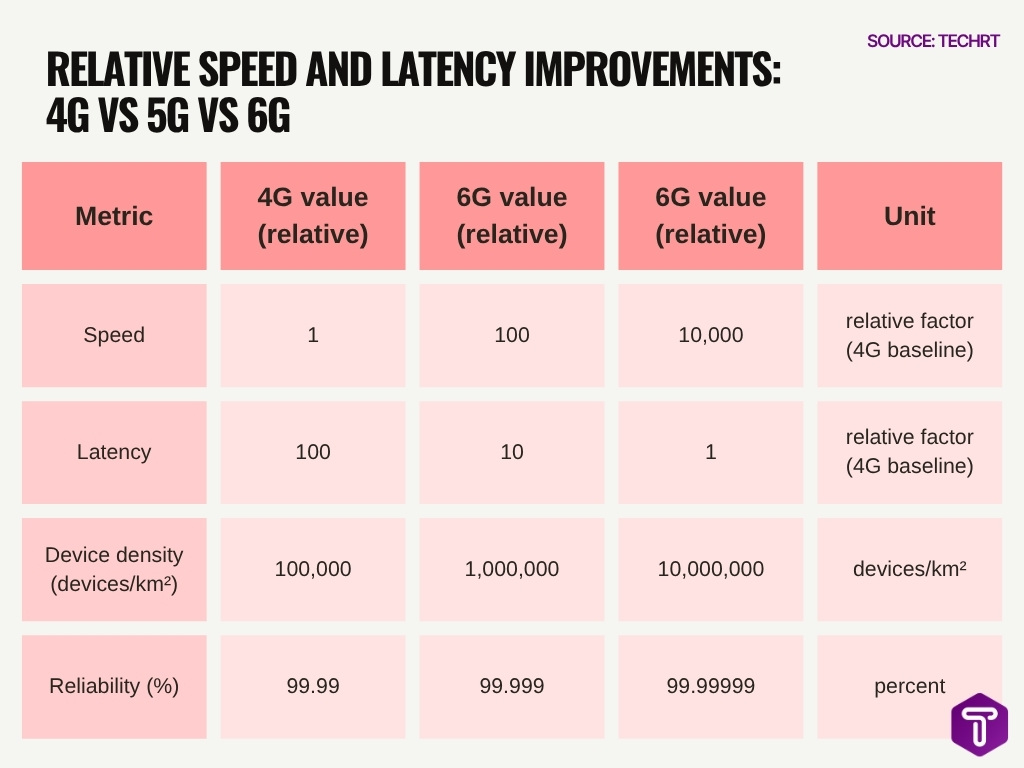
- 6G speeds (1 Tbps) are approximately 100x faster than 5G and 10,000x faster than 4G.
- Latency in 6G (0.1 ms) is 10x lower than 5G and 100x lower than 4G.
- Device density improves from 100,000/km² (4G) → 1 million (5G) → 10 million (6G).
- Energy efficiency per bit improves by up to 100x compared to 5G.
- Spectrum usage expands into THz bands in 6G, unlike sub-6 GHz and mmWave in 5G.
- AI-native architecture is unique to 6G, while 4G and 5G rely on human-managed networks.
- 6G enables holographic communication and digital twins, which are not feasible with 4G/5G at scale.
- Network reliability improves from 99.99% (4G) → 99.999% (5G) → 99.99999% (6G).
6G Trials, Pilots, and Testbed Deployment Statistics
- Over 50 major 6G testbeds are active worldwide as of 2026.
- China launched the world’s first 6G open co-creation testbed, interconnecting Beijing-Hong Kong and over 30 partners.
- China completed 6G prototype R&D and built the industry’s first field trial environment in 2025.
- US AT&T’s Dallas 6G testbed achieved over 1 Tbps using AI-driven spectrum optimization.
- Europe’s Hexa-X leads collaborative projects with Nokia Bell Labs and 12 TUM research chairs in 6G Future Lab Bavaria.
- Europe’s 6G-SANDBOX orchestrates large-scale NTN trials in H1 2026.
- South Korea allocated $220M government funding for 6G pilots targeting 2028 commercial use.
- South Korea plans full-scale pre-commercial 6G trials by 2026-2027.
- Japan leads with 9.9% of global 6G patents in the 2024 race.
- Ericsson-Qualcomm prototypes validated 6G physical layer with 400 MHz carrier at MWC 2026.
Frequently Asked Questions (FAQs)
What is the projected global 6G market size in 2026?
What CAGR is the 6G market expected to grow at?
How large could the 6G market become by 2036?
What is the value of AI-driven 6G testing platforms in 2026?
What is the expected CAGR of the 6G market between 2025 and 2035?
Conclusion
6G is no longer a distant concept; it is actively shaping the next phase of global connectivity through rapid research, investment, and early deployments. From terabit-level speeds to ultra-reliable, AI-driven networks, the technology promises to redefine industries such as healthcare, manufacturing, smart cities, and autonomous mobility. Moreover, the integration of satellite communication, edge computing, and intelligent automation will create a unified digital infrastructure capable of supporting entirely new applications that are not possible today.
As trials expand and standards mature, businesses and governments must prepare for a shift that goes beyond incremental upgrades and moves toward a fully immersive, data-driven world. The data clearly shows that 6G will not just enhance connectivity, it will fundamentally transform how digital systems interact, scale, and evolve in the years ahead.

Leave a comment
Have something to say about this article? Add your comment and start the discussion.