




AI governance has rapidly shifted from a niche technical concern to a core business priority as organizations scale artificial intelligence across industries. From healthcare systems using AI for diagnostics to financial institutions deploying models for fraud detection and credit scoring, the stakes have grown significantly. Poor governance can lead to biased decisions, regulatory penalties, and reputational damage, especially in highly regulated sectors like banking and insurance.
At the same time, the rise of generative AI and autonomous decision-making systems has introduced new layers of complexity. Companies now must manage risks related to data privacy, model transparency, and accountability while ensuring compliance with evolving global regulations. As adoption accelerates, organizations that fail to establish strong governance frameworks risk falling behind both competitively and ethically.
In this article, we break down the most important AI governance statistics, helping you understand where organizations stand today and where the biggest opportunities and risks lie.
Editor’s Choice
- 78% of organizations used AI in 2024, up from 55% in 2023, signaling rapid adoption that demands governance frameworks.
- 75% of companies report having AI governance processes, but only 12% consider them mature.
- The global AI governance market reached $308.3 million in 2025 and is growing rapidly.
- AI governance platform spending is expected to hit $492 million in 2026.
- 77% of organizations are actively building AI governance programs, rising to nearly 90% among AI users.
- Only 5% of organizations rate their governance maturity as excellent, showing a large readiness gap.
- 80% of executives believe their firms would fail an AI governance audit, highlighting compliance risks.
Recent Developments
- Global private AI investment reached $109.1 billion in the U.S. in 2024, intensifying the need for governance.
- Generative AI alone attracted $33.9 billion in 2024, accelerating governance challenges.
- Governments across 195 countries are now assessed for AI readiness, reflecting global governance focus.
- Around 70% of governments use AI internally, but only 33% apply it to policymaking, showing governance gaps.
- The EU AI Act and similar regulations are driving enterprise governance investments globally.
- AI adoption reached 16.3% of the global population in 2025, increasing governance complexity.
- Nearly 43% of large firms lack structured AI risk frameworks, despite widespread deployment.
- 56% of companies fail to generate value from AI, often due to weak governance foundations.
- AI governance is increasingly treated as a core enterprise metric, not just compliance.
AI Governance Market Statistics
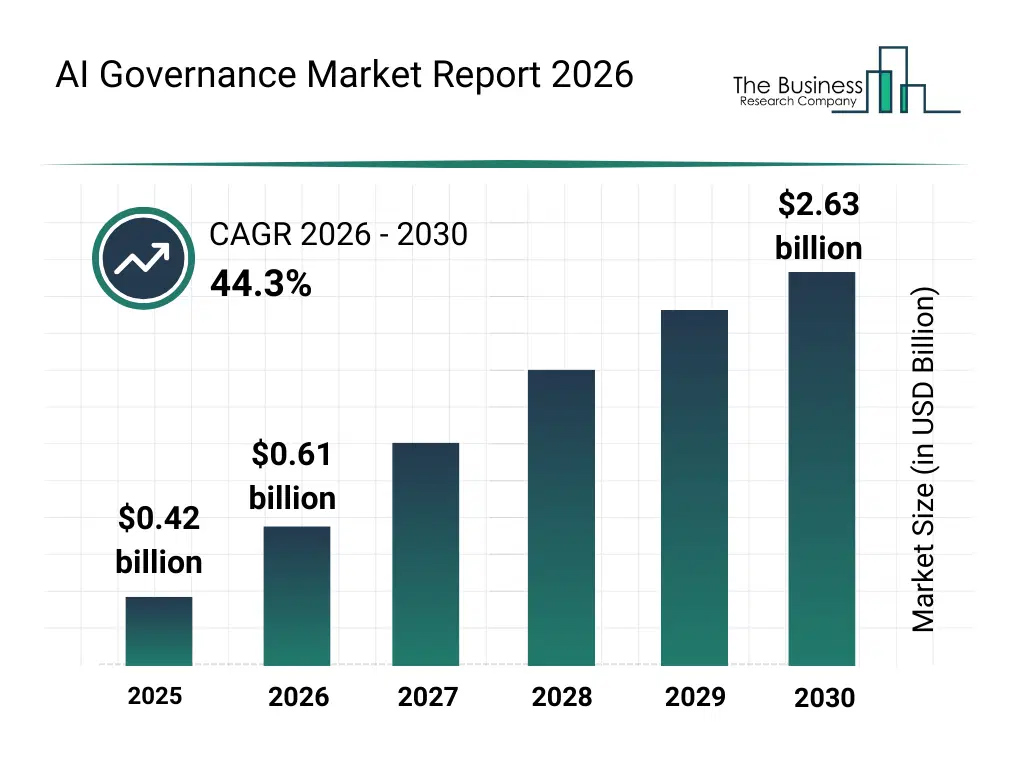
- The global AI governance market is projected to grow from $0.42 billion in 2025 to $2.63 billion by 2030, indicating rapid expansion.
- The market is expected to register a strong CAGR of 44.3% (2026–2030), highlighting accelerated adoption across industries.
- In 2026, the market reaches $0.61 billion, reflecting early-stage but fast-growing enterprise investment.
- The market nearly doubles between 2026 and 2028, rising from $0.61 billion to approximately $1.20 billion, signaling increased regulatory and compliance focus.
- By 2029, the market is estimated to reach around $1.80 billion, driven by the widespread implementation of AI governance frameworks.
- The sharp increase to $2.63 billion by 2030 demonstrates growing demand for risk management, transparency, and ethical AI systems.
- Overall, the market is expected to grow by more than 6× from 2025 to 2030, underscoring its emergence as a critical component of enterprise AI strategies.
AI Governance Maturity Statistics
- Only 12% of organizations consider their governance mature.
- Just 5% rate their governance maturity as excellent, indicating early-stage development.
- Fewer than 10% of enterprises integrate governance into development pipelines.
- Only 7% of organizations have fully embedded governance frameworks.
- Around 4% feel prepared to support AI at scale, highlighting maturity gaps.
- 18% of organizations use KPIs for AI governance monitoring, limiting visibility.
- Many firms lack audit trails and version control for AI systems, reducing maturity.
- 45% of organizations prioritize speed over governance, slowing maturity progress.
- 34% cite budget constraints as a barrier to governance maturity.
- 33% report a lack of internal expertise, impacting governance development.
AI Governance Framework Statistics
- 62% of organizations rely on internal AI governance frameworks, rather than external standards.
- Only 28% align their frameworks with global standards such as OECD or NIST AI Risk Management Framework.
- 41% of enterprises have partially implemented governance frameworks, but lack full lifecycle coverage.
- About 35% of organizations integrate governance into AI model development pipelines, reflecting gradual maturity.
- 48% of companies lack standardized documentation practices for AI systems, limiting traceability.
- 52% of enterprises use risk-based frameworks to prioritize AI governance controls.
- Only 22% of organizations conduct regular framework audits, indicating weak enforcement.
- 39% of companies have defined ethical AI principles, but fewer operationalize them.
- 31% of firms incorporate explainability requirements into governance frameworks.
AI Governance Adoption Statistics
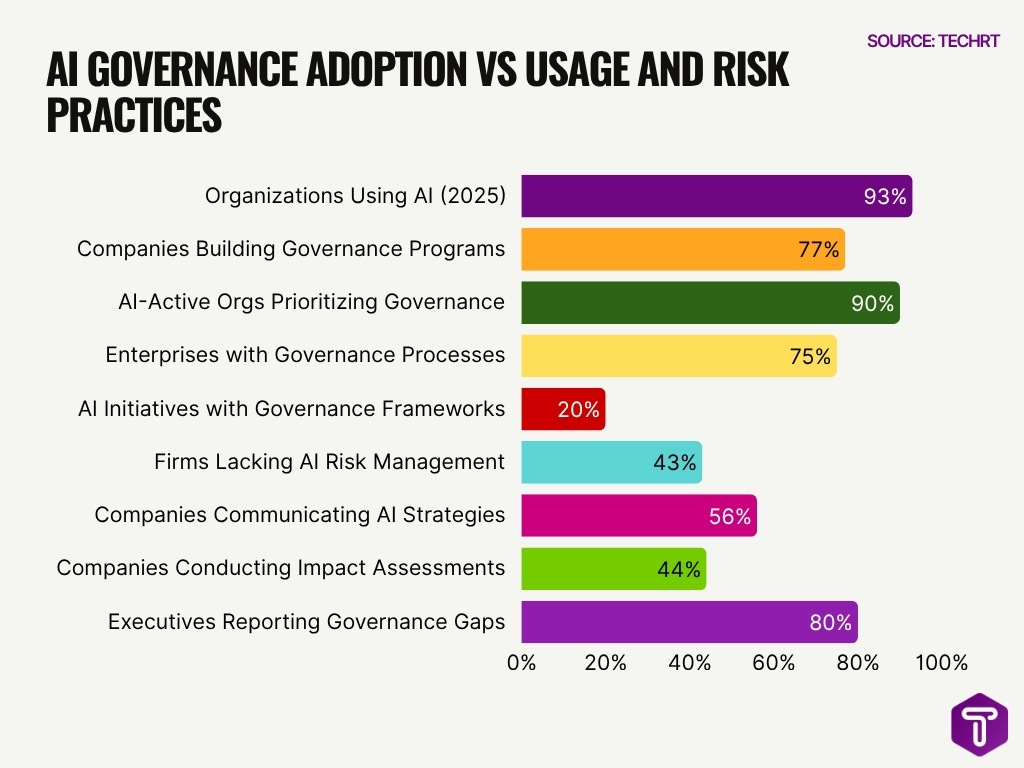
- 78% of organizations used AI in 2024, driving governance adoption.
- 77% of companies are building governance programs, reflecting widespread adoption.
- Nearly 90% of AI-active organizations prioritize governance initiatives.
- 75% of enterprises report having governance processes in place.
- Only 20% of AI initiatives include governance frameworks, indicating adoption gaps.
- 93% of organizations use AI, but governance integration remains limited.
- 43% of firms lack formal AI risk management frameworks, despite active use.
- 56% of companies have communicated AI strategies internally, but fewer implement governance controls.
- 44% conduct AI impact assessments, showing partial governance adoption.
- 80% of executives admit governance readiness gaps, reinforcing adoption challenges.
AI Governance Budget and Investment Statistics
- Global spending on AI governance tools is projected to exceed $492 million in 2026.
- 62% of enterprises increased AI governance budgets in 2025, reflecting urgency.
- 48% of organizations allocate less than 10% of their AI budgets to governance, indicating an imbalance.
- 35% of firms plan to double governance investments by 2027.
- 41% of companies cite ROI uncertainty as a barrier to governance spending.
- 29% of organizations invest in third-party governance platforms, rather than building in-house.
- 53% of large enterprises dedicate separate budgets for AI compliance and governance.
- 38% of firms prioritize governance investments after incidents or failures, showing reactive behavior.
- 44% of organizations expect governance costs to rise significantly with new regulations.
AI Governance Oversight and Ownership Statistics
- 55% of organizations assign AI governance to IT or data teams, rather than dedicated governance units.
- Only 21% have a centralized AI governance function, indicating fragmented ownership.
- 44% of enterprises involve legal or compliance teams in AI oversight.
- 38% of organizations lack clear ownership of AI governance, leading to accountability issues.
- 27% have established cross-functional AI governance committees.
- 49% of firms rely on informal oversight structures, rather than formal governance bodies.
- Only 19% appoint a Chief AI Officer or equivalent role, reflecting early-stage leadership.
- 35% of companies involve board-level stakeholders in AI governance decisions.
- 42% of organizations report governance conflicts between business and technical teams.
Trust in AI Governance Across Institutions
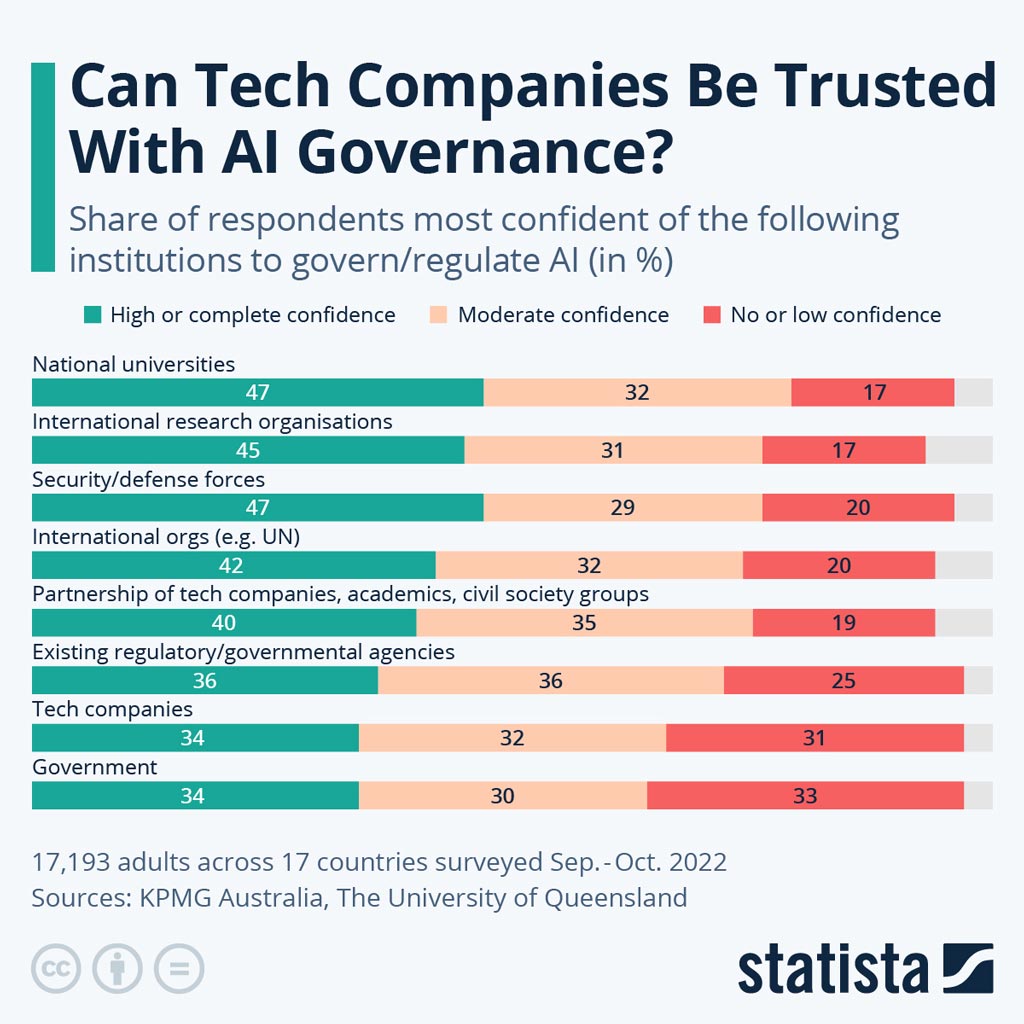
- Academic institutions lead in trust:
National universities (47%) and international research organizations (45%) receive the highest high/complete confidence, making them the most trusted entities for AI governance. - Defense and global bodies show strong credibility:
Security/defense forces (47%) and international organizations (42%) also rank high, indicating strong public confidence in structured and globally coordinated oversight. - Collaborative governance models are gaining traction:
A multi-stakeholder approach, including tech firms, academia, and civil society, earns 40% high confidence and 35% moderate confidence, highlighting support for balanced governance frameworks. - Regulators face mixed perception:
Existing regulatory/government agencies show an even split with 36% high confidence and 36% moderate confidence, but also a notable 25% low confidence, signaling uncertainty in current regulatory effectiveness. - Tech companies face a trust deficit:
Only 34% express high confidence in tech companies, while a significant 31% report low or no confidence, suggesting skepticism about self-regulation in AI. - Governments rank lowest in trust:
Government institutions show the highest low-confidence level (33%), nearly equal to their 34% high confidence, reflecting polarized public opinion. - Clear preference for independent oversight:
The data shows a strong tilt toward independent, research-driven institutions over corporate or political bodies for AI governance. - Trust declines as control becomes more centralized:
Institutions perceived as centralized or politically influenced (governments, tech firms) experience higher distrust levels, compared to academia and research-led entities. - Moderate confidence remains consistently high across all groups:
Most institutions maintain ~30–36% moderate confidence, indicating a large portion of respondents are undecided or cautiously optimistic.
AI Governance Board and Leadership Statistics
- 32% of boards actively oversee AI governance initiatives.
- Only 14% of boards have formal AI committees, showing limited governance maturity.
- 47% of executives believe leadership lacks AI governance expertise.
- 39% of organizations provide AI governance training to leadership, improving awareness.
- 28% of CEOs directly sponsor AI governance programs, indicating growing importance.
- 41% of companies include AI risks in enterprise risk management reports.
- Only 23% of boards review AI audit reports regularly, limiting oversight.
- 36% of firms link AI governance to ESG strategies, aligning with sustainability goals.
- 30% of executives prioritize governance in AI investment decisions, reflecting strategic alignment.
AI Governance Risk Management Statistics
- 43% of large firms lack formal AI risk frameworks, exposing operational risks.
- 61% of organizations identify bias as a top AI risk, especially in finance and hiring.
- 57% of companies cite data quality risks as a major governance concern.
- 49% report model drift as a significant challenge, affecting accuracy over time.
- 52% of enterprises perform risk assessments before AI deployment, but not continuously.
- Only 26% implement continuous risk monitoring systems for AI models.
- 38% of firms lack incident response plans for AI-related failures.
- 45% of organizations report cybersecurity risks linked to AI systems.
- 34% of companies quantify AI risks financially, limiting strategic decision-making.
AI Governance Hiring Trends by Company Size
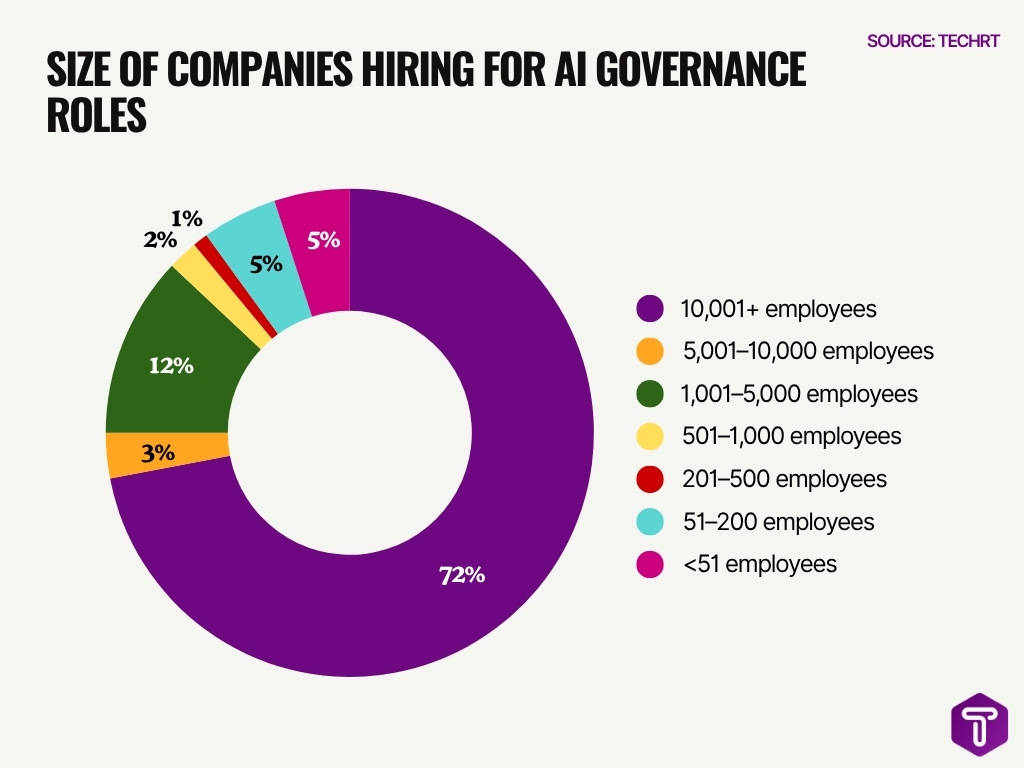
- Large enterprises dominate hiring, with 72% of AI governance roles coming from companies with 10,001+ employees, indicating strong adoption at scale.
- Mid-to-large organizations (1,001–5,000 employees) contribute a notable 12%, showing growing investment beyond the largest firms.
- Upper mid-market companies (5,001–10,000 employees) account for only 3%, suggesting a gap or slower adoption in this segment.
- Small-to-mid-sized businesses (51–200 employees) represent 5%, signaling early but emerging interest in AI governance practices.
- Very small companies (<51 employees) also hold 5%, indicating that even startups are beginning to prioritize governance frameworks.
- Lower mid-sized firms (501–1,000 employees) contribute just 2%, reflecting limited resources or delayed implementation.
- Companies with 201–500 employees show minimal participation at 1%, highlighting one of the lowest adoption segments.
- Overall, AI governance hiring is heavily concentrated in large enterprises, while SMEs and mid-sized firms lag behind, revealing a significant opportunity for future growth in these segments.
AI Governance Compliance Statistics
- 51% of organizations align AI governance with regulatory requirements.
- Only 29% feel fully prepared for the upcoming AI regulations, including the EU AI Act.
- 46% of firms conduct regular compliance audits for AI systems.
- 37% of organizations lack the documentation required for compliance audits.
- 42% of enterprises struggle with cross-border AI compliance due to varying regulations.
- 33% of companies report compliance costs as a barrier to AI governance.
- 48% of organizations use automated compliance tools, improving efficiency.
- Only 25% of firms track compliance metrics consistently, limiting visibility.
- 39% of organizations face delays in AI deployment due to compliance issues.
AI Governance Security Statistics
- 45% of organizations report AI-related cybersecurity risks, including adversarial attacks.
- 38% of enterprises lack robust AI security controls, exposing vulnerabilities.
- 52% of firms integrate AI security into broader cybersecurity strategies.
- 29% of organizations conduct adversarial testing on AI models, highlighting gaps.
- 41% of companies report data poisoning as a major threat.
- Only 24% implement secure AI development lifecycles, limiting resilience.
- 36% of firms use AI-driven security monitoring tools, improving detection capabilities.
- 47% of organizations cite third-party AI risks as a major security concern.
- 31% of enterprises conduct regular AI security audits, showing partial adoption.
AI Data Governance Policy Adoption Trends
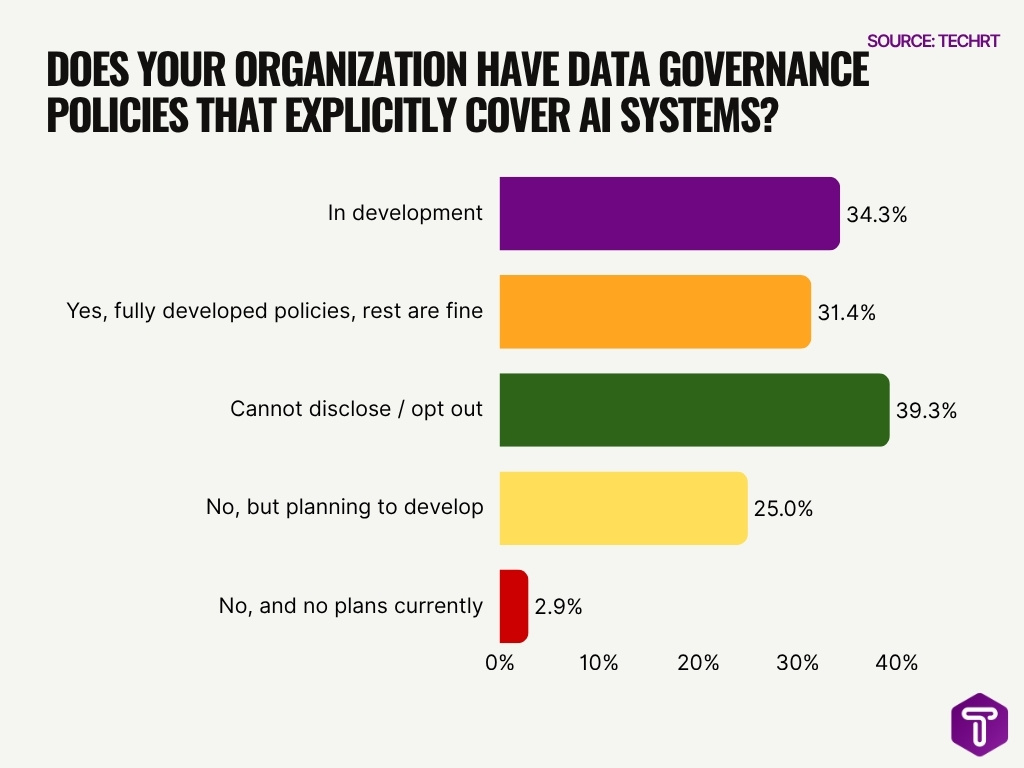
- A significant 34.3% of organizations report that their AI data governance policies are currently in development, indicating strong ongoing efforts toward structured AI oversight.
- About 31.4% of organizations have fully developed AI governance policies, suggesting that nearly one-third have already achieved mature governance frameworks.
- Notably, the largest segment, 39.3%, chose to “cannot disclose/opt out”, highlighting potential sensitivity, uncertainty, or lack of transparency around AI governance practices.
- A quarter of organizations (25.0%) stated they do not currently have policies but are planning to develop them, reflecting a growing awareness and future intent toward AI governance adoption.
- Only a small fraction, 2.9%, reported no plans to implement AI governance policies, indicating that very few organizations are ignoring AI governance altogether.
- Overall, combining “in development” (34.3%) and “planning to develop” (25.0%), nearly 59.3% of organizations are actively moving toward AI governance, signaling a rapid shift toward responsible AI practices.
AI Governance Data Privacy Statistics
- 71% of organizations cite data privacy as a top AI governance concern in 2025.
- 65% of consumers worry about how AI uses their personal data, influencing governance priorities.
- Only 38% of companies have fully implemented AI-specific data privacy controls.
- 54% of enterprises conduct data privacy impact assessments for AI systems.
- 47% of organizations struggle with anonymization of AI training data, increasing risk.
- 42% of firms report gaps in consent management for AI-driven data use.
- 36% of companies integrate privacy-by-design principles into AI development.
- Only 29% of organizations audit AI data pipelines regularly, limiting visibility.
- 58% of enterprises face challenges complying with global data privacy laws such as GDPR and CCPA.
AI Governance Audit and Monitoring Statistics
- 46% of organizations conduct regular AI audits, reflecting growing oversight.
- Only 27% of firms use automated AI monitoring tools, limiting scalability.
- 41% of enterprises lack real-time monitoring capabilities for AI systems.
- 33% of organizations audit AI models only after deployment, rather than continuously.
- 49% of companies track model performance metrics, but not governance indicators.
- 28% of firms maintain comprehensive audit trails for AI decisions.
- 37% of organizations report difficulty detecting model drift, impacting reliability.
- 45% of enterprises use dashboards for AI monitoring, improving transparency.
- Only 22% integrate audit results into governance improvements, limiting feedback loops.
AI Governance Challenges Statistics
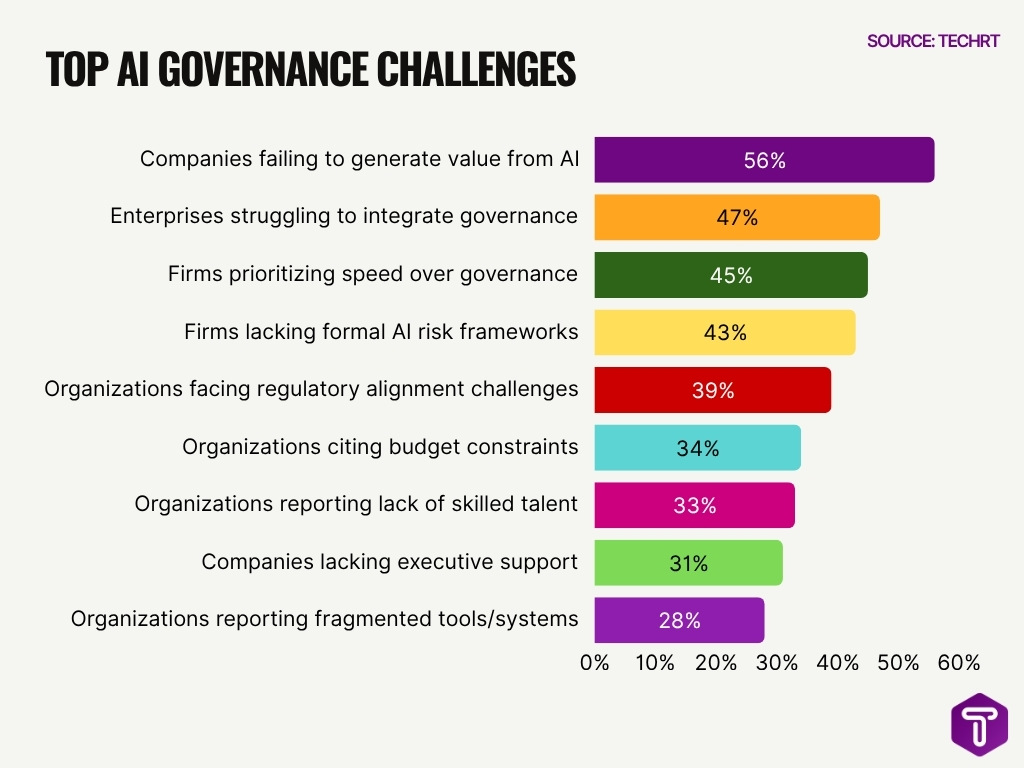
- 56% of companies fail to generate value from AI, often due to governance gaps.
- 43% of firms lack formal AI risk frameworks, creating operational challenges.
- 34% of organizations cite budget constraints as a key governance barrier.
- 33% report a lack of skilled talent in AI governance roles.
- 47% of enterprises struggle with integrating governance into workflows.
- 39% of organizations face challenges aligning AI with regulatory requirements.
- 45% of firms prioritize speed over governance, leading to higher risks.
- 31% of companies lack executive support for governance initiatives.
- 28% of organizations report fragmented governance tools and systems, reducing efficiency.
AI Governance and GenAI Statistics
- Generative AI investment reached $33.9 billion in 2024, accelerating governance needs.
- 72% of organizations are testing or deploying GenAI, increasing governance complexity.
- Only 26% of companies have GenAI-specific governance policies.
- 61% of executives cite misinformation risks as a key GenAI governance concern.
- 48% of firms report intellectual property risks from GenAI outputs.
- 37% of organizations monitor GenAI outputs for bias and hallucinations.
- 29% of enterprises restrict employee use of GenAI tools, reflecting governance caution.
- 42% of companies integrate GenAI governance into broader AI frameworks.
- 35% of firms conduct risk assessments specifically for GenAI applications.
AI Governance Incident and Breach Statistics
- 45% of organizations experienced AI-related security incidents in the past year.
- 38% of firms report data breaches linked to AI systems, highlighting vulnerabilities.
- 41% of enterprises cite data poisoning attacks as a growing threat.
- Only 27% of organizations have incident response plans for AI failures.
- 36% of companies report financial losses due to AI-related incidents.
- 33% of firms detect AI incidents late, increasing impact severity.
- 49% of organizations improve governance after incidents, showing reactive patterns.
- 28% of enterprises face reputational damage from AI failures.
- 31% of firms report regulatory penalties linked to AI misuse or non-compliance.
Frequently Asked Questions (FAQs)
What percentage of organizations have AI governance processes in place?
How many companies are actively building AI governance programs?
What is the projected spending on AI governance platforms in 2026?
What share of organizations lack formal AI risk management frameworks?
What is the projected CAGR of the AI governance market through 2035?
Conclusion
AI governance reflects a clear imbalance: while AI adoption continues to surge, governance maturity still lags behind. Organizations are investing in frameworks, policies, and compliance tools, yet many struggle with execution, leadership alignment, and continuous monitoring. This gap creates real exposure, from compliance failures to operational risks that can directly impact business performance.
Looking ahead, governance will no longer function as a reactive compliance layer. Instead, it will become a strategic foundation that enables responsible innovation. Companies that embed governance into their AI lifecycle, from design to deployment and monitoring, will not only reduce risks but also build stronger trust with customers, regulators, and stakeholders.
Ultimately, the organizations that treat AI governance as a long-term capability, not a checkbox requirement, will be best positioned to scale AI safely, unlock measurable value, and maintain a competitive edge in an increasingly regulated and AI-driven world.

Leave a comment
Have something to say about this article? Add your comment and start the discussion.