




Decentralized AI combines blockchain infrastructure with artificial intelligence to create systems that operate without centralized control, enabling greater transparency, security, and data ownership. This approach is already transforming industries, from fraud detection and automated trading in DeFi platforms to privacy-preserving analytics in healthcare, where sensitive patient data remains securely distributed. At the same time, enterprises use decentralized AI to improve compliance, reduce data risks, and unlock new collaborative models for innovation. As adoption accelerates across Web3 ecosystems and traditional industries alike, understanding the latest statistics becomes essential, so let’s explore the key data shaping decentralized AI.
Editor’s Choice
- The global AI market reached $390.91 billion in 2025 and is projected to hit $539.45 billion in 2026.
- The blockchain AI market size grew to approximately $704 million in 2025, showing strong early-stage adoption.
- The decentralized AI ecosystem is valued at roughly $12 billion as of 2024–2025, signaling rapid expansion.
- AI startups raised $202.3 billion in funding in 2025, up 75% year-over-year.
- AI accounted for nearly 50% of global venture capital funding in 2025.
- The blockchain technology market is expected to grow from $41.14 billion in 2025 to $62.91 billion in 2026.
- AI infrastructure spending is projected to increase from $158.3 billion in 2025 to $418.8 billion by 2030.
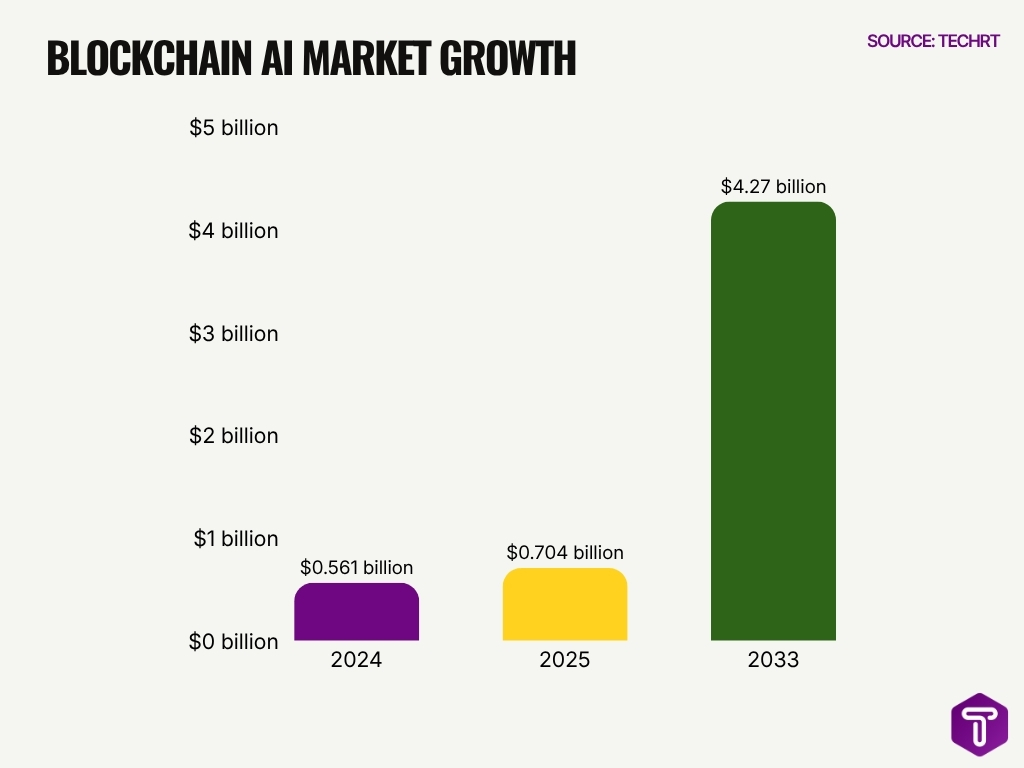
- The blockchain AI market could exceed $4.27 billion by 2033, growing at over 25% CAGR.
Recent Developments
- Over 100 new AI unicorns emerged in 2025, bringing the global total close to 1,300 companies.
- AI startups raised $73.1 billion in a single quarter in 2025, representing 58% of VC funding.
- Around 40% of enterprise applications are expected to include AI agents by 2026.
- Stablecoin transactions reached $772 billion in monthly volume in 2025, reflecting blockchain adoption.
- AI-enabled crypto scams accounted for 2.7% of total crypto liquidity in 2025, highlighting risks.
- Institutional crypto adoption accelerated sharply in 2025, with renewed VC inflows.
- Real-world asset tokenization and AI integration emerged as top trends heading into 2026.
- Enterprises increasingly integrate blockchain + AI for data integrity and automated compliance systems.
Global Decentralized AI Market Overview
- The decentralized AI market is estimated at around $12 billion globally in 2025.
- The broader AI market surpassed $390 billion in 2025, creating strong spillover demand.
- The AI market is expected to grow at a 30.6% CAGR through 2033.
- AI crypto and decentralized AI segments are projected to reach $46.9 billion by 2034.
- Blockchain adoption is accelerating, with enterprise usage increasing by 40% by 2025.
- The cryptocurrency market size reached $7.08 billion in 2026, supporting decentralized ecosystems.
- AI infrastructure investments are scaling rapidly, supporting decentralized compute layers.
- Decentralized AI is increasingly used in finance, healthcare, gaming, and supply chains.
Blockchain AI Market Size and Growth
- The blockchain AI market reached approximately $704 million in 2025, up from $561 million in 2024.
- The market is projected to grow to $4.27 billion by 2033.
- CAGR for blockchain AI stands at around 25.3% from 2026 to 2033.
- Another estimate places the market at $735 million in 2025, expected to reach $4.03 billion by 2033.
- The AI for the blockchain segment was valued at $657 million in 2025.
- It is projected to reach $3.46 billion by 2034, growing at 27.1% CAGR.
- Earlier forecasts estimated growth from $228 million in 2020 to $703 million in 2025.
- The U.S. blockchain AI market alone is expected to exceed $1.09 billion by 2033.
- Some projections estimate explosive growth from $6 billion in 2024 to $50 billion by 2030.
Investment Trends in Decentralized AI
- AI investments reached $202.3 billion in 2025, marking historic funding levels.
- Venture capital allocation to AI increased to 50% of global VC funding in 2025.
- AI startups raised $73.1 billion in a single quarter, showing strong investor confidence.
- The AI crypto market is expected to grow from $5.1 billion in 2025 to $55.2 billion by 2035.
- Blockchain AI market growth is fueled by increasing venture capital and enterprise demand.
- Institutional capital in crypto and AI surged again in 2025 after a slowdown.
- Large tech firms are investing tens of billions into AI infrastructure and ecosystems.
- Tokenization and decentralized compute marketplaces are attracting early-stage funding.
Regional Decentralized AI Market Breakdown
- North America holds a 42%+ share in AI-crypto and decentralized AI, driven by strong infrastructure and early adoption.
- The U.S. AI market reached $132.68 billion in 2025, keeping it the global innovation leader.
- Europe’s AI market was valued at $86.24 billion in 2025, supported by steady enterprise adoption.
- Asia-Pacific AI platforms grew 67% in 2024 to over $2.2 billion, signaling rapid expansion.
- North America led blockchain AI adoption with a $286 million market size in 2024.
- Venture funding into decentralized AI jumped ~200% in 2024, totaling $436 million.
- The Middle East saw AI investment surge 5x over the last year, backed by sovereign wealth funds.
- Saudi Arabia’s PIF managed $913 billion in assets in 2024, strengthening regional AI funding power.
- China remains a major AI market, with $24 billion in projected AI revenue in 2025.
- Developing regions are using decentralized AI for financial inclusion and identity systems as compute access expands.
Decentralized AI Companies Distribution by Country
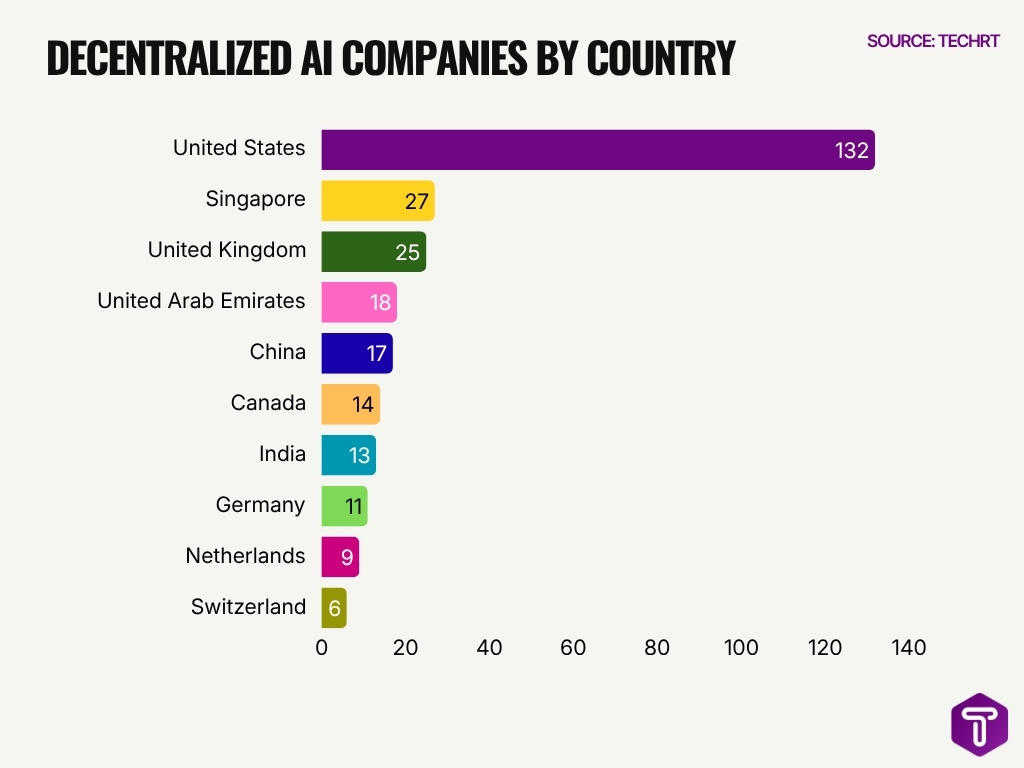
- The United States leads the global decentralized AI landscape with 132 companies, accounting for the largest share by a wide margin.
- Singapore ranks second with 27 companies, highlighting its position as a major Web3 and AI innovation hub in Asia.
- The United Kingdom follows closely with 25 companies, showing strong European participation in decentralized AI.
- The United Arab Emirates has 18 companies, reflecting its rapid emergence as a blockchain and AI-friendly ecosystem.
- China contributes 17 companies, indicating growing but more regulated adoption in decentralized AI.
- Canada hosts 14 companies, supported by its robust AI research and startup ecosystem.
- India accounts for 13 companies, showcasing steady growth in decentralized AI innovation.
- Germany has 11 companies, reinforcing its role as a key European tech and AI market.
- The Netherlands contributes 9 companies, reflecting increasing adoption in smaller but tech-forward economies.
- Switzerland, with 6 companies, remains notable due to its strong blockchain ecosystem (e.g., Crypto Valley).
- Overall, the top 3 countries (the United States, Singapore, United Kingdom) together account for 184 companies, representing a significant concentration of global decentralized AI activity.
- The data indicates a clear dominance of North America and Asia, while Europe maintains steady but fragmented growth across multiple countries.
Adoption of Decentralized AI by Enterprises
- Around 42% of large enterprises have already explored or implemented blockchain-based AI solutions as of 2025.
- Nearly 35% of U.S. enterprises report using AI in combination with distributed systems for data security and compliance.
- Enterprise adoption of AI overall reached 55% in 2025, up from 50% in 2024.
- About 28% of enterprises are actively piloting decentralized AI for data-sharing use cases.
- Financial institutions lead adoption, with over 60% exploring AI-blockchain integration.
- Enterprises report 30% reduction in data breach risks when using decentralized architectures.
- More than 70% of CIOs consider decentralized AI critical for long-term digital strategy.
- Around 25% of Fortune 500 companies are investing in decentralized compute infrastructure.
Adoption of Decentralized AI by Startups and Developers
- Over 60% of Web3 developers are actively building AI-integrated blockchain applications in 2025.
- The global developer community exceeded 27 million developers in 2025, with AI and blockchain among top focus areas.
- Startups working on decentralized AI raised over $18 billion in funding in 2025.
- Nearly 40% of AI startups are exploring decentralized or federated approaches.
- Open-source AI repositories grew by 45% year-over-year, driven by decentralized contributions.
- About 1 in 3 blockchain startups now include AI capabilities in their core offerings.
- Developer participation in Web3 ecosystems increased by 20% in 2025.
- Hackathons focused on decentralized AI grew by 35% globally in 2025.
Decentralized AI Funding by Stage
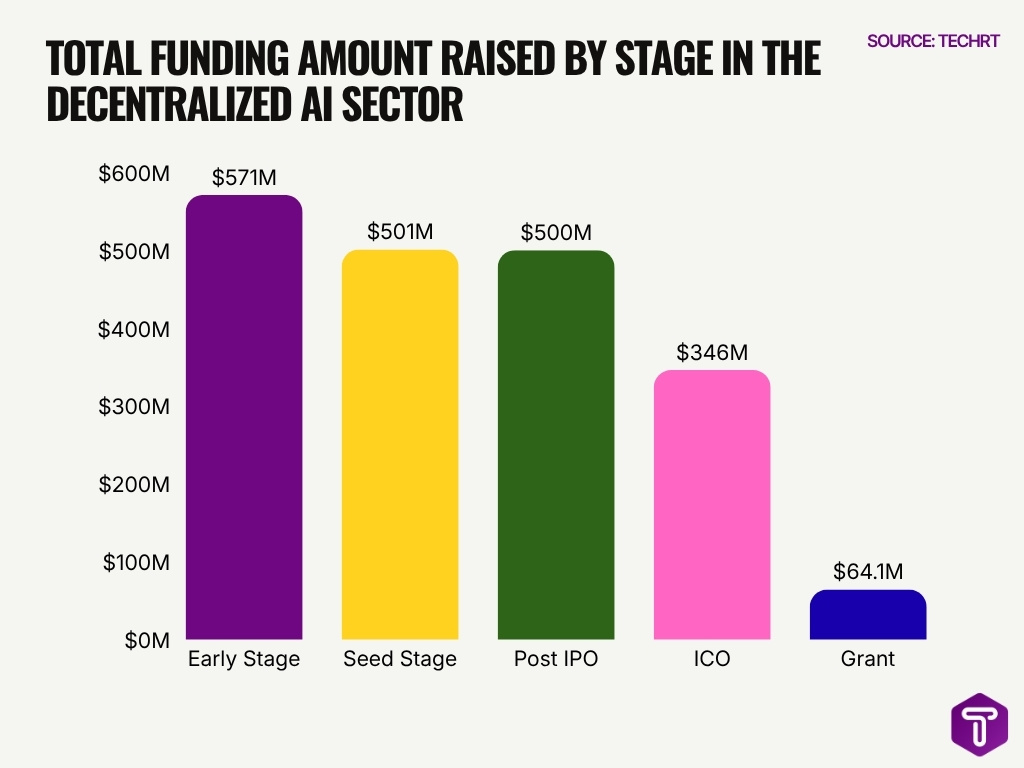
- Early Stage dominates funding, raising the highest amount at $571M, indicating strong investor confidence in early traction projects.
- Seed Stage follows closely with $501M, highlighting a robust pipeline of new startups entering the decentralized AI ecosystem.
- Post IPO funding remains significant at $500M, showing that even mature, publicly listed companies continue to attract substantial capital.
- ICO funding stands at $346M, reflecting the continued relevance of token-based fundraising models in decentralized AI, though lower than traditional funding routes.
- Grant funding is comparatively minimal at $64.1M, suggesting that institutional and non-dilutive funding plays a smaller role in this sector.
- The top three stages (Early, Seed, Post IPO) together account for over $1.5B, indicating that both early innovation and mature growth phases are heavily funded.
- There is a balanced distribution between Seed and Late-stage funding, signaling a healthy lifecycle of startups progressing through funding stages.
Web3 AI Agents and On-Chain Intelligence Growth
- Over 10,000 AI agents are estimated to be operating across blockchain ecosystems in 2025.
- On-chain AI agent transactions grew by 70% year-over-year.
- AI agents are now involved in automated trading, governance voting, and data validation.
- Around 25% of DeFi platforms are integrating AI-driven automation layers.
- Smart contract execution enhanced by AI has reduced errors by up to 30%.
- Web3 AI agents contribute to real-time decision-making across decentralized networks.
- AI-powered DAO governance participation increased by 50% in 2025.
- The number of autonomous AI wallets interacting with blockchain grew significantly in 2025.
Number of Active AI Agents on Blockchain Networks
- The number of active AI agents surpassed 10,000 across major chains in 2025.
- Ethereum-based AI agents account for nearly 45% of total deployments.
- Solana and Polygon ecosystems saw over 2,500 AI agent deployments combined.
- Monthly active AI agents grew by 65% between 2024 and 2025.
- AI-driven bots account for 20% of on-chain transaction activity in some DeFi ecosystems.
- Autonomous trading agents process billions in transaction volume monthly.
- AI agents are increasingly used in NFT pricing, arbitrage, and yield optimization.
- Cross-chain AI agents grew by 40% in 2025, enabling interoperability.
Decentralized AI Use Cases and Industry Verticals
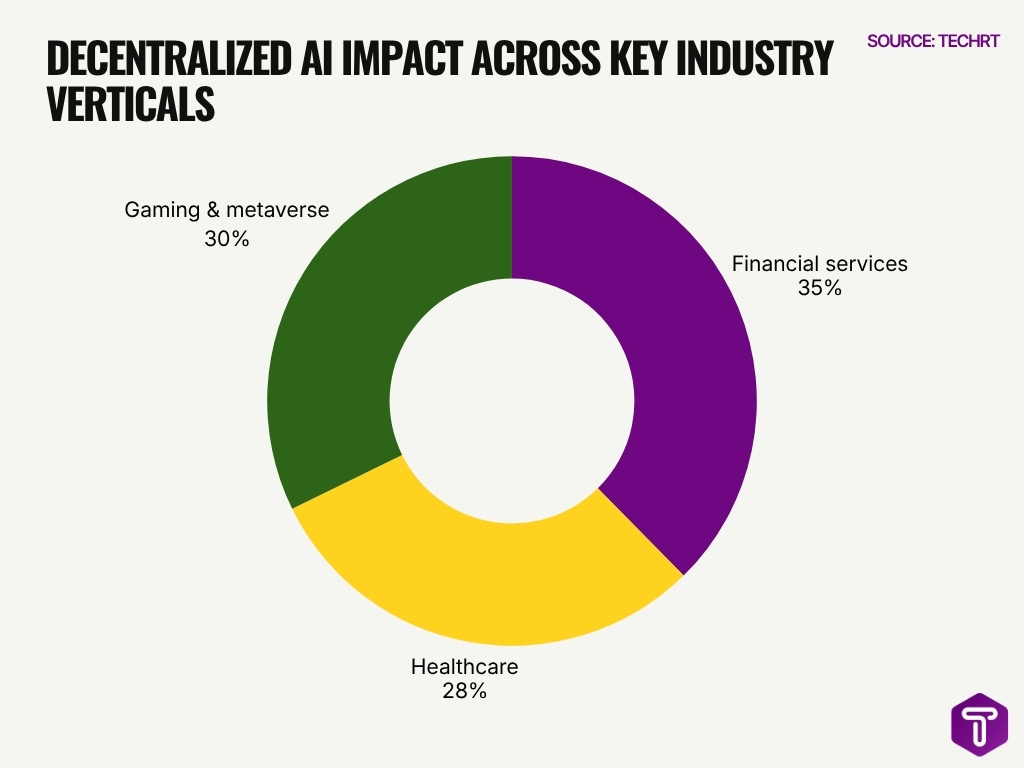
- Financial services account for over 35% of decentralized AI use cases.
- Healthcare adoption of decentralized AI grew by 28% in 2025.
- Supply chain applications using AI-blockchain increased efficiency by up to 25%.
- Gaming and metaverse platforms saw 30% adoption growth of decentralized AI tools.
- Identity verification systems using decentralized AI improved fraud detection by 40%.
- Retail personalization powered by decentralized AI improved conversion rates by 20%.
- Energy sector applications increased grid efficiency by 15% using AI + blockchain.
- Government adoption of decentralized AI grew steadily for digital identity and records.
Decentralized AI in Finance and DeFi
- DeFi total value locked (TVL) exceeded $100 billion in 2025, supporting AI integrations.
- AI-driven trading bots execute over 25% of DeFi transactions on major platforms.
- Fraud detection using decentralized AI reduced financial crime losses by 30%.
- Stablecoin transaction volume reached $772 billion monthly in 2025.
- AI-powered risk assessment models improved lending accuracy by 35%.
- Decentralized AI enables real-time credit scoring without centralized data storage.
- Yield optimization strategies powered by AI increased returns by 10–20%.
- DAO treasuries increasingly rely on AI agents for asset allocation decisions.
Decentralized AI in Gaming and Metaverse
- The global gaming market surpassed $221 billion in 2025, with AI and blockchain integration accelerating.
- Around 30% of Web3 games now use AI for NPC behavior and dynamic environments.
- Metaverse-related spending is expected to exceed $100 billion annually by 2026.
- AI-driven asset creation reduced game development costs by 20–30%.
- NFT-based gaming ecosystems saw 25% growth in active users in 2025.
- Decentralized AI enables player-owned economies and dynamic pricing models.
- AI moderation tools reduced toxic behavior incidents by 35% in online gaming.
- Over 50% of metaverse platforms are experimenting with AI-generated content.
Federated Learning and Privacy-Preserving AI Statistics
- The federated learning market is projected to reach $210 million by 2026, growing steadily.
- Over 35% of enterprises are exploring federated learning for privacy-focused AI.
- Federated AI reduces data transfer costs by up to 40%.
- Privacy-preserving AI adoption increased by 28% year-over-year in 2025.
- Around 60% of healthcare AI projects now include federated learning components.
- Differential privacy tools improved compliance rates by 50% in regulated industries.
- Federated models reduce centralized data breaches by over 50%.
- Edge AI combined with federated learning is expected to grow at >20% CAGR through 2030.
Decentralized AI in Healthcare and Life Sciences
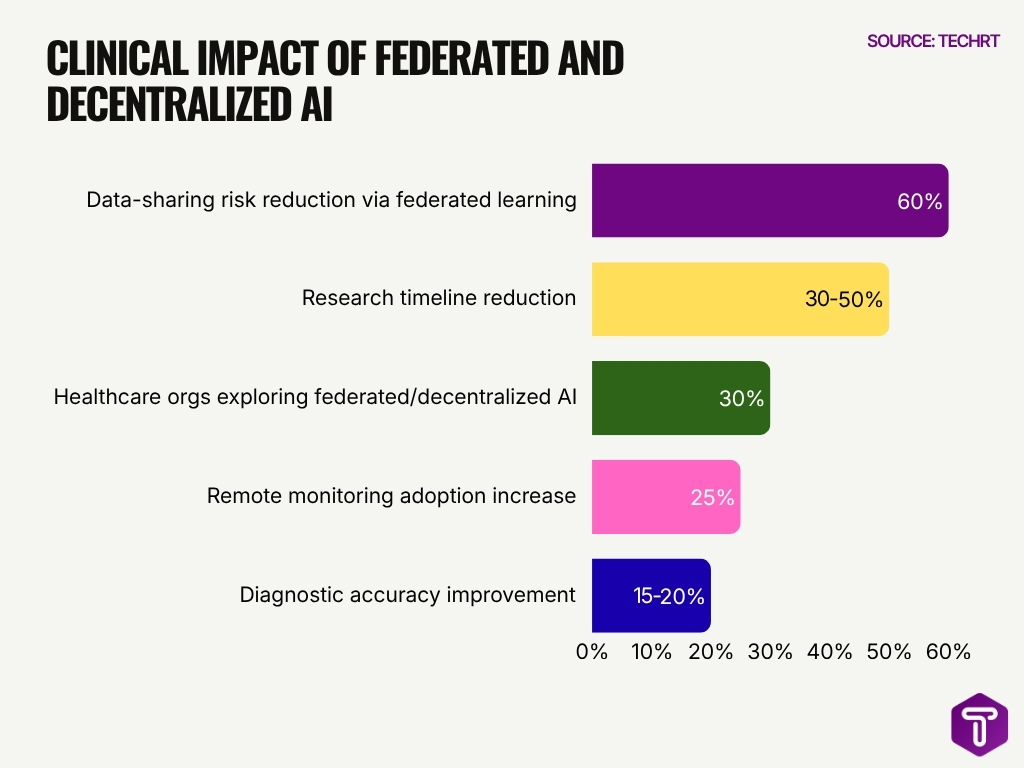
- The healthcare AI market reached $38.7 billion in 2025, with decentralized models gaining traction.
- Around 30% of healthcare organizations are exploring federated or decentralized AI.
- Federated learning reduced data-sharing risks by up to 60% in clinical studies.
- Decentralized AI improved diagnostic accuracy by 15–20% in pilot programs.
- AI-driven drug discovery reduced research timelines by 30–50%.
- Blockchain ensures secure patient data sharing across institutions.
- Remote patient monitoring systems using decentralized AI increased adoption by 25% in 2025.
- Privacy-preserving AI models comply better with regulations like HIPAA and GDPR.
Tokenization and Incentive Models in Decentralized AI
- Tokenized AI ecosystems grew to a market size of over $5 billion in 2025.
- Over 70% of decentralized AI platforms use token incentives for compute and data sharing.
- AI-related crypto tokens saw trading volumes increase by 60% in 2025.
- Token rewards improved user participation rates by up to 45%.
- Decentralized compute networks allow users to monetize idle GPU power.
- Data marketplaces using tokens enable secure and permissioned data exchange.
- AI DAO governance tokens are used for decision-making and protocol upgrades.
- Incentive-based AI training models improved dataset diversity by 30%.
Performance and Latency of On-Chain vs Centralized AI
- On-chain AI systems experience latency that is 10–100x higher than centralized AI systems.
- Layer-2 scaling solutions reduced blockchain latency by up to 70%.
- Hybrid AI architectures (off-chain + on-chain) improve performance by 50%.
- Decentralized compute networks reduced inference costs by 30–60%.
- Edge AI processing reduces response time by 20–40%.
- Blockchain throughput improved significantly, with some networks exceeding 65,000 TPS.
- Gas fees remain a constraint, impacting AI model execution on-chain.
- Zero-knowledge proofs are improving privacy and efficiency in decentralized AI systems.
Enterprise Benefits of Decentralized AI
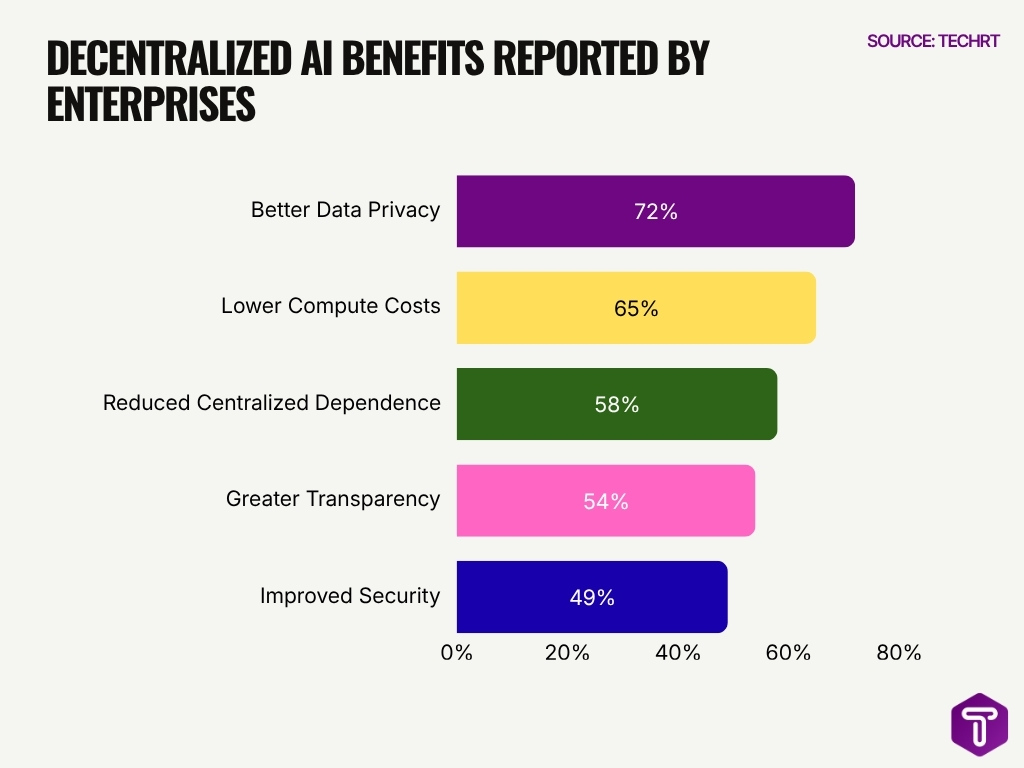
- Better Data Privacy leads adoption, with 72% of organizations citing it as the top benefit, highlighting strong demand for privacy-preserving AI systems.
- Lower Compute Costs (65%) emerges as the second most significant advantage, indicating that decentralized infrastructure can meaningfully reduce operational expenses.
- 58% of enterprises value reduced dependence on centralized systems, reflecting a shift toward distributed architectures and greater control over data and models.
- Greater Transparency is recognized by 54%, showing that organizations increasingly prioritize explainability and auditability in AI workflows.
- Nearly half of organizations (49%) report improved security, suggesting decentralized AI is perceived as more resilient against single points of failure and cyber threats.
- Overall, the data indicates that privacy, cost efficiency, and decentralization are the primary drivers behind enterprise adoption of decentralized AI.
Regulatory Landscape for Decentralized AI and Web3
- Over 60 countries introduced AI-related regulations by 2025.
- The EU AI Act is expected to impact over 450 million users across Europe.
- The U.S. released multiple AI executive orders focused on safety and transparency in 2025.
- Around 70% of enterprises cite regulatory uncertainty as a key barrier to decentralized AI adoption.
- GDPR compliance influences global AI data governance practices.
- Blockchain-based identity systems are being explored by governments worldwide.
- Regulatory sandboxes for AI and blockchain are expanding in Asia and the Middle East.
- Data sovereignty laws are shaping decentralized AI architectures globally.
Forecasts and Future Growth Projections for Decentralized AI
- The decentralized AI market is projected to exceed $50 billion by 2030.
- The AI market overall is expected to reach $1.8 trillion by 2030.
- The blockchain market could surpass $1.4 trillion by 2030, supporting decentralized ecosystems.
- AI infrastructure spending is forecast to grow at over 20% CAGR through 2030.
- Web3 AI agents are expected to grow 10x in number by 2028.
- Enterprise adoption of decentralized AI could reach 40% by 2030.
- Tokenized AI ecosystems are expected to dominate decentralized compute markets.
- AI-driven automation will impact over 300 million jobs globally by 2030.
Frequently Asked Questions (FAQs)
What is the market size of decentralized AI in 2025?
How fast is the blockchain AI market growing?
What percentage of enterprises are adopting decentralized AI solutions?
How much funding did AI startups receive recently?
5. How many AI agents are active on blockchain networks?
Conclusion
Decentralized AI is rapidly evolving from a niche concept into a critical component of modern digital infrastructure, supported by strong investment, growing enterprise adoption, and expanding real-world use cases. Across industries such as finance, healthcare, gaming, and supply chains, organizations are leveraging decentralized intelligence to improve efficiency, enhance security, and maintain greater control over data. At the same time, advancements in federated learning, tokenized incentive models, and AI agents are pushing the boundaries of what distributed systems can achieve.
While challenges like regulation, scalability, and latency still exist, ongoing innovation continues to close these gaps. Looking ahead, decentralized AI is positioned to play a central role in the future of technology, making it a key area for businesses, developers, and investors to watch closely.

Leave a comment
Have something to say about this article? Add your comment and start the discussion.