


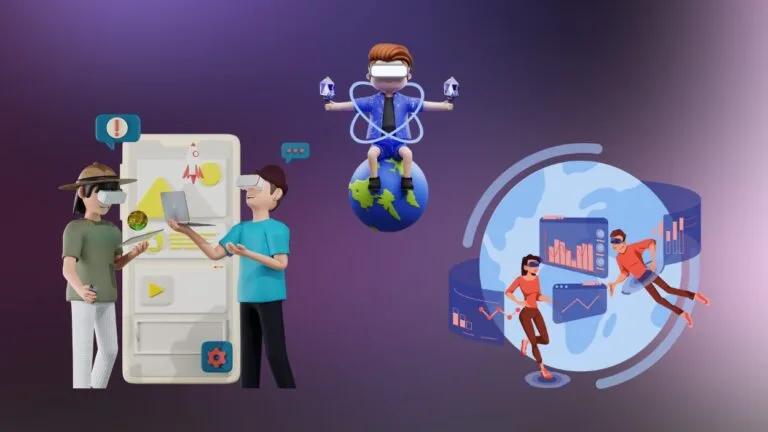

Spatial computing blends the physical and digital worlds using technologies like AR, VR, and AI-driven 3D mapping. It allows digital objects to interact with real environments in real time, creating immersive and data-rich experiences that go far beyond traditional screens. Today, businesses use spatial computing to build digital twins in manufacturing, enabling engineers to simulate production lines before deployment, and to deliver immersive training in healthcare, where surgeons and medical staff can practice procedures in safe, virtual environments.
Moreover, industries such as retail, construction, and logistics are leveraging spatial computing to improve decision-making, reduce costs, and enhance customer engagement through interactive visualization tools. As hardware becomes more accessible and AI integration deepens, spatial computing is quickly shifting from experimental innovation to a practical, scalable solution across sectors. With adoption accelerating worldwide, the following statistics offer a clear view of how this technology is shaping the future of work and everyday experiences.
Editor’s Choice
- The global spatial computing market reached $185.21 billion in 2025, signaling strong enterprise demand.
- It is projected to grow to $225.59 billion in 2026, reflecting rapid year-over-year expansion.
- Another estimate shows growth toward $1.09 trillion by 2034, highlighting long-term scalability.
- The spatial computing platform market alone is valued at $164 billion in 2025 globally.
- The U.S. spatial computing platform segment stands at $68.3 billion in 2025, showing strong domestic leadership.
- AR/VR technologies reached over 81 million active devices globally in 2024, demonstrating growing adoption.
- The extended reality market is expected to surpass $1.06 trillion by 2030, driven by enterprise and consumer demand.
Recent Developments
- Apple and other tech leaders are accelerating mixed-reality device launches, with new consumer hardware expected by 2026.
- Over 40% of Global 2000 manufacturers now use digital twins powered by spatial computing.
- Companies report 10–15% reductions in downtime using spatial simulations.
- Product development cycles improve by up to 30% with spatial computing tools.
- 5G and edge computing reduce latency to below 20 milliseconds, enabling real-time immersive experiences.
- Mixed-reality headsets are dropping below $1,000, making them accessible to broader markets.
- Enterprise spatial computing projects typically cost between $50,000 and $500,000, reflecting high initial investment.
- AI-driven spatial computing capabilities are growing at a 43%+ CAGR, accelerating innovation.
Spatial Computing Market Growth
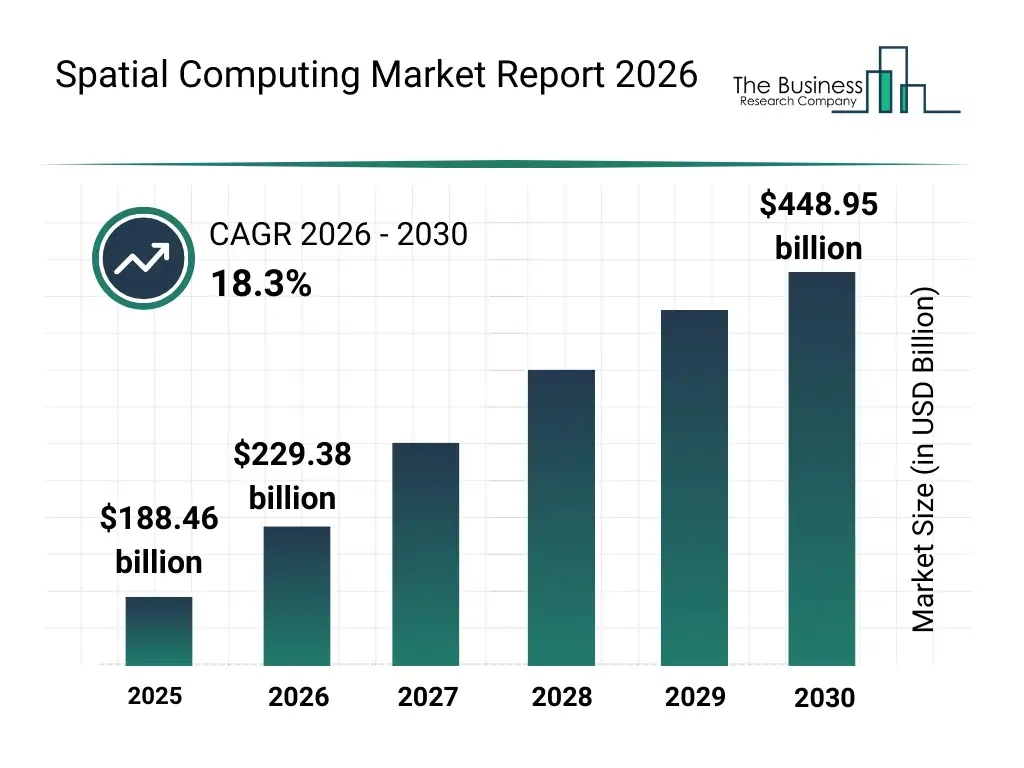
- The global spatial computing market is projected to grow strongly, rising from $188.46 billion in 2025 to $448.95 billion by 2030.
- In 2026, the market size is expected to reach $229.38 billion, showing a major jump from the previous year.
- The market is forecast to expand at a CAGR of 18.3% from 2026 to 2030, indicating rapid adoption across industries.
- Between 2025 and 2030, the spatial computing market is expected to add around $260.49 billion in value.
- The data suggests that spatial computing will more than double in market size between 2025 and 2030.
- Growth is likely being driven by increasing use of AR, VR, mixed reality, digital twins, AI, and immersive enterprise applications.
- The steady rise from 2026 through 2030 highlights growing investment in spatial computing hardware, software, and services.
- By 2030, spatial computing is expected to become a nearly $449 billion global market, making it a major technology growth segment.
Spatial Computing Revenue Forecast by Year
- Global market revenue is expected to grow from $185.21 billion in 2025 to $225.59 billion in 2026.
- Revenue could surpass $1.09 trillion by 2034, indicating exponential scaling.
- Another forecast shows $229.38 billion in 2026, aligning with steady growth trends.
- The spatial computing platform market could reach $164 billion in 2025 and grow steadily through 2035.
- XR market revenue is projected to hit $1.06 trillion by 2030, supporting cross-industry adoption.
- AR/VR revenue is expected to grow from $30.26 billion in 2025 to $40.76 billion in 2026.
- The combined AR/VR market could reach $441.51 billion by 2034, showing long-term growth.
- Some forecasts estimate the AR/VR market expansion to $451.5 billion by 2030, indicating strong mid-term revenue growth.
Spatial Computing Adoption by Region
- North America commands roughly 32% of the global spatial computing market share, making it the leading region.
- Asia‑Pacific is projected to expand at a CAGR of about 22%, the highest among all regions.
- The U.S. spatial computing platform market is estimated at over $45 billion in 2025, reflecting 75% of North America’s total.
- Europe holds around 18–20% of the global spatial computing market, with strong uptake in automotive and manufacturing.
- Asia‑Pacific generated around $43 billion in spatial computing revenue in 2023, with China contributing over 30% of that total.
- Canada’s spatial computing market accounts for roughly 15% of North America’s value, driven by AI and R&D spending.
- India’s spatial computing market is forecast to grow at a CAGR above 22%, one of the fastest rates worldwide.
- Latin America contributes about 6–8% of global spatial computing revenue, with Mexico’s manufacturing sector adopting AR for production‑line optimization.
- Mobile AR‑based spatial computing usage in emerging markets has surged by over 35% in the last three years, lowering entry barriers.
- The Rest of the World (the Middle East, Africa, and others) represents nearly 12% of the global spatial computing market share.
Spatial Computing Market Share by Region
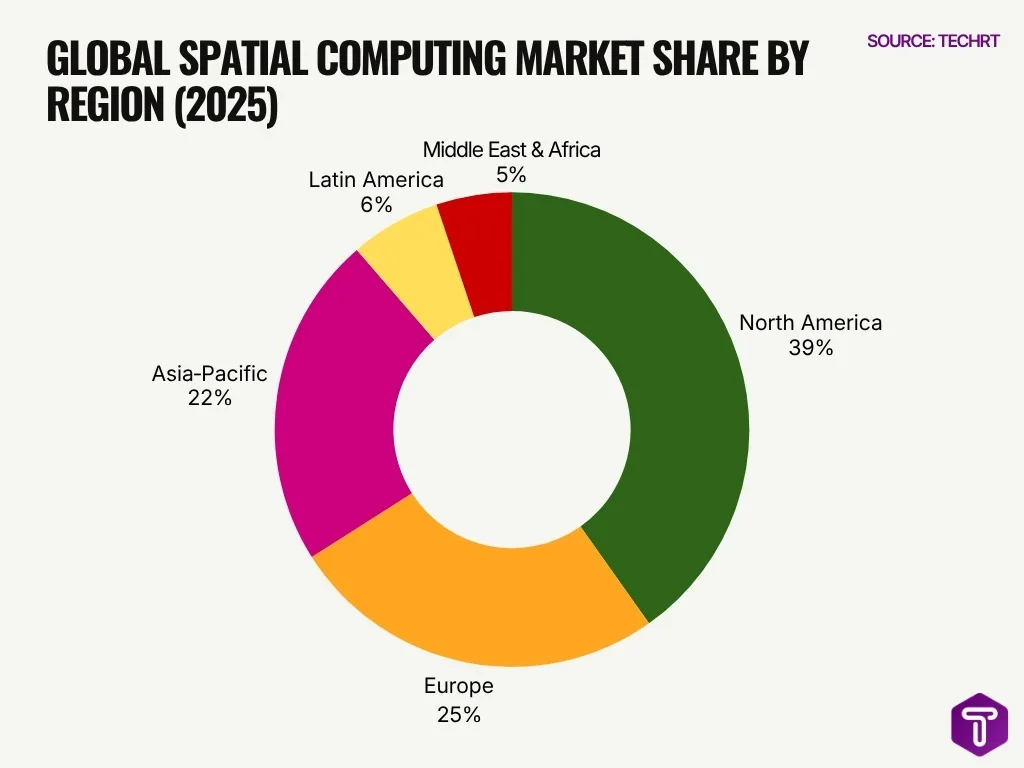
- North America accounts for over 39% of the global spatial computing market share, led by strong enterprise adoption.
- The United States alone contributes nearly 70% of North America’s regional revenue, driven by tech giants and defense investments.
- Europe holds approximately 25% of the global market share, supported by automotive and industrial applications.
- Germany, France, and the UK represent over 60% of Europe’s spatial computing revenue, reflecting concentrated industrial adoption.
- Asia-Pacific contributes around 22% of the global share in 2025, with rapid growth expected.
- China leads Asia-Pacific adoption with over 45% regional market share, driven by smart city and manufacturing initiatives.
- Japan and South Korea jointly account for 20%+ of Asia-Pacific spatial computing revenue, especially in robotics and electronics.
- Latin America represents a smaller share of around 6%, but shows steady growth in the retail and education sectors.
- The Middle East and Africa collectively hold less than 5% share, with adoption driven by smart infrastructure projects.
Spatial Computing Adoption by Industry Vertical
- Manufacturing leads adoption with over 30% share, driven by digital twins and predictive maintenance.
- Healthcare accounts for 18% of spatial computing use, particularly in surgical simulation and training.
- Retail contributes approximately 12% of adoption, leveraging AR for virtual try-ons and store navigation.
- The automotive industry uses spatial computing in over 40% of design workflows, improving prototyping efficiency.
- Aerospace and defense sectors account for 10%+ of adoption, especially for simulation and mission planning.
- Educational institutions report 25% increased engagement using immersive learning tools.
- Real estate companies use spatial computing in over 35% of property showcases, enabling virtual tours.
- Construction firms report up to 20% cost savings through AR-assisted project planning.
- Energy sector adoption is growing at over 28% CAGR, particularly for remote asset monitoring.
Spatial Computing Investments and Funding Trends
- Global investment in spatial computing startups exceeded $12 billion in 2024, reflecting strong VC interest.
- AR/VR startups attracted over $4.1 billion in funding in 2023, with continued growth into 2025.
- Big tech companies account for over 50% of total spatial computing investments, led by hardware and platform development.
- The U.S. receives more than 60% of global venture capital funding in spatial computing.
- Enterprise investment budgets for immersive tech increased by 22% year-over-year in 2025.
- Government funding for XR and spatial technologies grew by 18% globally, supporting defense and education sectors.
- Corporate M&A activity in spatial computing rose by 15% in 2024, signaling consolidation trends.
- Asia-Pacific venture funding grew at over 25% CAGR, driven by China and India ecosystems.
- Early-stage spatial computing startups now receive average seed rounds of $3–5 million, indicating maturing investor confidence.
Spatial Computing Funding by Country
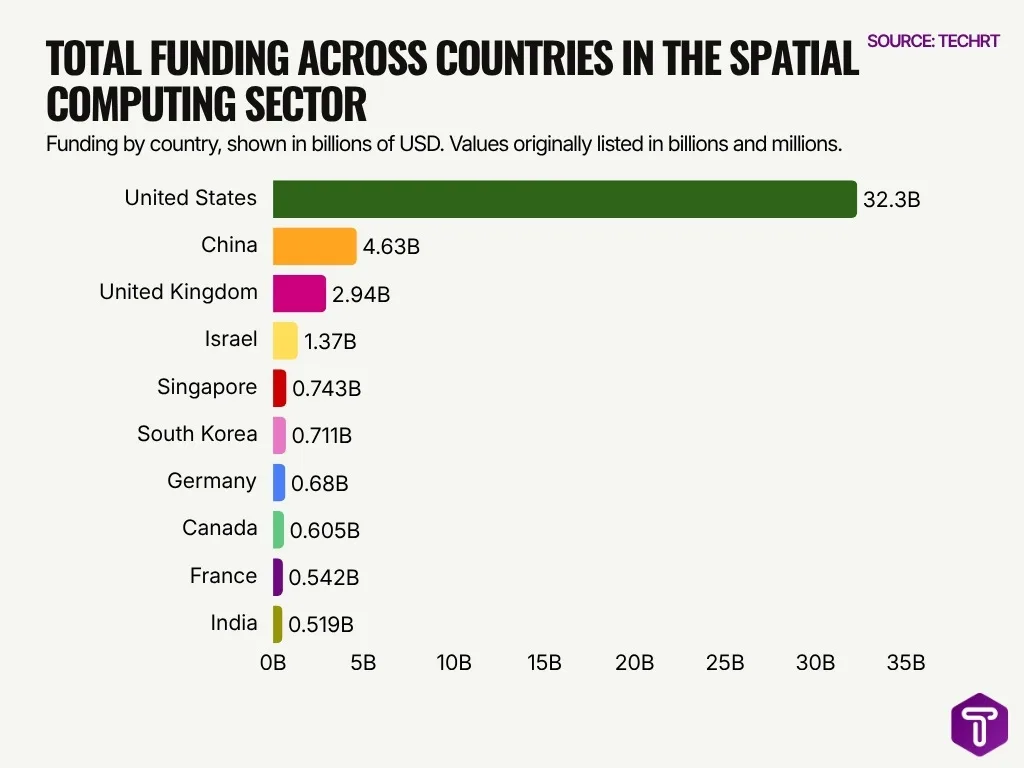
- The United States dominates Spatial Computing funding with $32.3B, far ahead of every other country in the dataset.
- China ranks second with $4.63B, but its funding is still only about 14% of the United States’ total.
- The United Kingdom holds the third position with $2.94B, making it the leading European country in Spatial Computing funding.
- Israel has attracted $1.37B, showing its strong position as a technology and innovation hub despite its smaller market size.
- The remaining six countries each recorded less than $1B in total funding, including Singapore ($743M), South Korea ($711M), Germany ($680M), Canada ($605M), France ($542M), and India ($519M).
- Singapore leads among Southeast Asian countries with $743M, highlighting its role as a regional technology and investment hub.
- South Korea and Germany show similar funding levels, with $711M and $680M, respectively.
- India appears in the top 10 with $519M, indicating growing investor interest in its Spatial Computing ecosystem.
- The data shows a highly concentrated funding landscape, with the United States alone accounting for the majority of funding among the listed countries.
- Overall, Spatial Computing investment is led by major innovation economies, especially the United States, China, and the United Kingdom.
Spatial Computing Hardware Market Statistics
- Hardware accounts for over 64% of total spatial computing revenue, making it the largest segment.
- Global AR/VR headset shipments reached approximately 10 million units in 2024.
- The average selling price of VR headsets dropped below $500 in 2025, improving accessibility.
- Enterprise-grade headsets can cost $3,000 or more, depending on features and performance.
- Smart glasses shipments are projected to grow at over 35% CAGR through 2030.
- Apple’s spatial computing device category is expected to drive double-digit growth in premium hardware segments.
- Sensors and cameras account for over 25% of hardware costs, highlighting component importance.
- Haptic devices and wearables are emerging, with adoption growing at over 30% CAGR.
- Gaming still drives over 45% of consumer hardware demand, especially for VR devices.
Spatial Computing Software Market Statistics
- Software accounts for roughly 36% of the spatial computing market, with rapid growth expected.
- The spatial computing software segment is projected to grow at over 40% CAGR, outpacing hardware.
- Cloud-based spatial computing platforms are used by over 55% of enterprises, enabling scalability.
- 3D content creation tools represent 20% of software revenue, driven by the design and gaming industries.
- AI-powered spatial analytics tools improve decision-making speed by up to 35%.
- Open-source spatial computing frameworks are used by over 40% of developers, accelerating innovation.
- Subscription-based pricing models dominate, accounting for over 60% of software revenue.
- Enterprise collaboration platforms using spatial computing grew by 28% year-over-year in 2025.
- Digital twin software platforms are expected to exceed a $73 billion market size by 2027, supporting industrial adoption.
Spatial Computing Adoption by Use Case
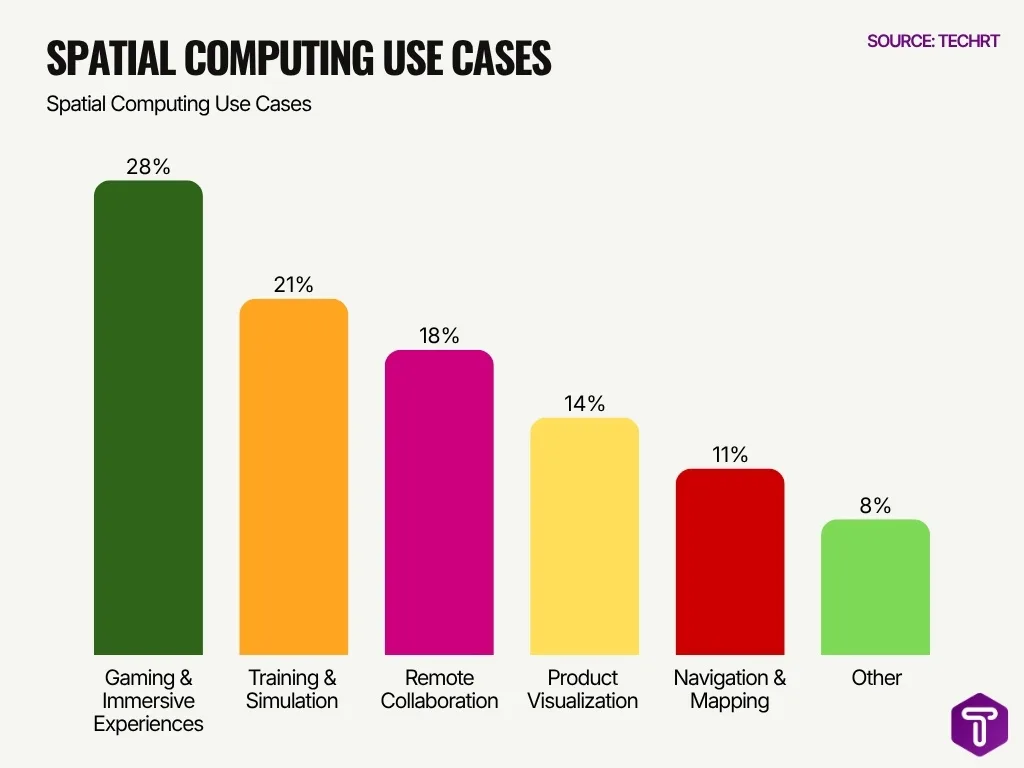
- Gaming & Immersive Experiences is the leading use case, accounting for 28% of spatial computing applications.
- Training & Simulation ranks second with 21%, showing strong adoption in areas such as workforce training, education, defense, and industrial simulations.
- Remote Collaboration represents 18%, reflecting the growing use of spatial computing for virtual meetings, shared 3D workspaces, and distributed teamwork.
- Product Visualization makes up 14%, highlighting its value in retail, design, architecture, and product demonstrations.
- Navigation & Mapping accounts for 11%, showing practical use in location-based services, indoor navigation, logistics, and augmented reality guidance.
- Other use cases contribute 8%, indicating that spatial computing is also being explored across smaller or emerging application areas.
- Overall, the data suggests that spatial computing is currently driven most strongly by immersive entertainment, while enterprise-focused uses such as training, collaboration, and visualization are also gaining significant traction.
Spatial Computing by Technology Segment (AR, VR, MR, XR)
- Augmented reality accounts for over 45% of spatial computing usage, driven by mobile applications.
- Virtual Reality holds approximately 35% market share, led by gaming and training applications.
- Mixed reality is growing fastest with over 40% CAGR, especially in enterprise use.
- The extended reality market size is projected to reach $1.06 trillion by 2030.
- Mobile AR users exceeded 1.4 billion globally in 2024, reflecting widespread adoption.
- VR training improves retention rates by 75% compared to traditional methods.
- MR devices enable up to 30% productivity improvements in industrial workflows.
- XR adoption in healthcare is growing at over 31% CAGR, particularly in diagnostics and therapy.
- AR advertising revenue is expected to exceed $8 billion by 2026, reflecting new monetization channels.
Spatial Computing and AI Integration Statistics
- Over 65% of spatial computing platforms now integrate AI capabilities, enhancing real-time data processing.
- AI-driven spatial analytics improve operational efficiency by up to 35% in industrial environments.
- Computer vision is expected to grow at over 19% CAGR through 2030, supporting spatial computing use cases.
- Around 58% of enterprises using spatial computing also deploy AI for automation and predictive insights.
- AI-powered digital twins reduce system failures by up to 25%, improving asset reliability.
- Machine learning models improve object recognition accuracy in AR systems to above 95%.
- AI-based spatial mapping tools reduce data processing time by 40% or more.
- Natural language interfaces in spatial computing applications have increased user adoption rates by 20%.
- Autonomous systems using spatial AI are projected to grow at over 30% CAGR, particularly in robotics and logistics.
Key Benefits of Spatial Computing in Enterprises
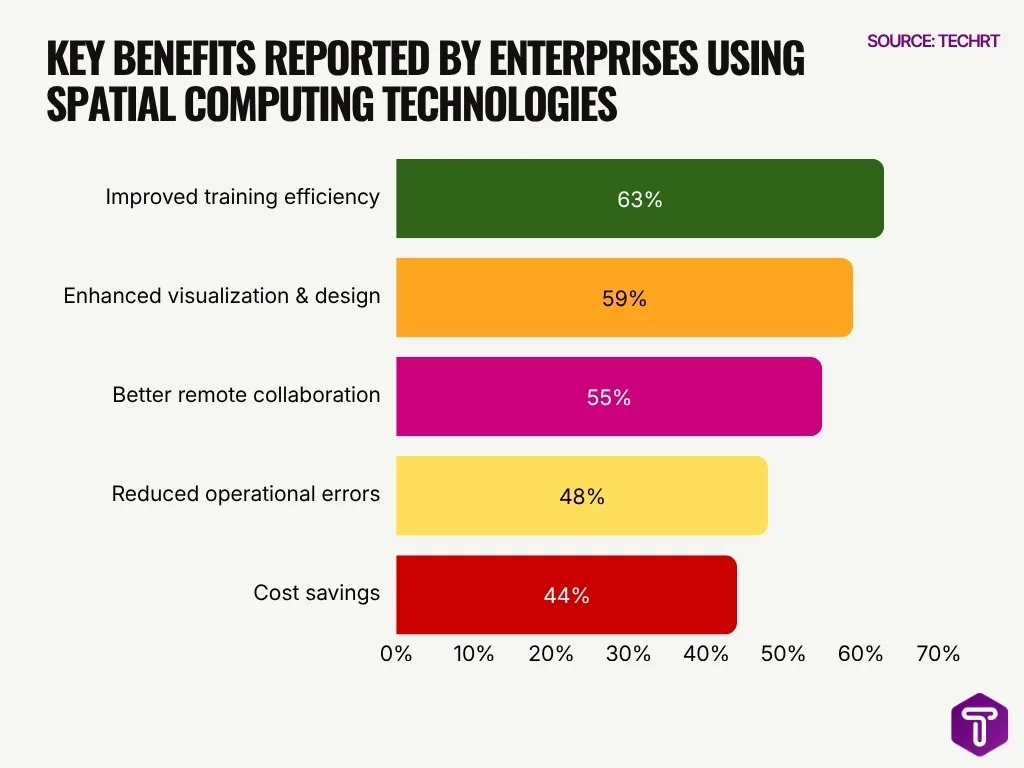
- Improved training efficiency is the most reported benefit, cited by 63% of companies. This suggests that spatial computing is especially valuable for immersive learning, simulations, and hands-on employee training.
- Enhanced visualization and design is reported by 59% of companies, showing that enterprises use spatial computing to improve product design, prototyping, planning, and complex data visualization.
- Better remote collaboration is identified by 55% of companies, indicating that spatial computing helps teams work together in shared virtual or mixed-reality environments, even when they are geographically separated.
- Reduced operational errors are reported by 48% of companies, suggesting that spatial computing can support more accurate workflows, real-time guidance, and better decision-making in operational settings.
- Cost savings are noted by 44% of companies, making it a significant but slightly less common benefit compared with efficiency, visualization, and collaboration improvements.
- Overall, the data shows that the strongest enterprise value of spatial computing lies in training, visualization, and collaboration, with each benefit reported by more than half of the surveyed companies.
Consumer Adoption of Spatial Computing Devices
- Global AR/VR user numbers surpassed 1.4 billion users in 2024, driven largely by mobile AR.
- Consumer VR headset shipments reached over 10 million units in 2024, reflecting steady growth.
- Approximately 32% of U.S. consumers have tried AR experiences, especially in retail and gaming.
- Gaming accounts for over 45% of consumer spatial computing usage, making it the leading segment.
- Social and entertainment platforms contribute to over 30% of AR engagement, especially among Gen Z users.
- Smart glasses adoption is expected to grow at over 35% CAGR through 2030, driven by lifestyle and productivity use.
- Around 60% of consumers prefer AR shopping experiences, citing improved product visualization.
- Mobile-based AR applications account for over 70% of consumer interactions, highlighting accessibility.
- Consumer spending on AR/VR content is projected to exceed $75 billion by 2026, reflecting strong demand.
Spatial Computing Device Shipments and Installed Base
- Global AR/VR headset shipments reached 10.3 million units in 2024, showing steady hardware growth.
- The installed base of AR-enabled smartphones exceeded 1.5 billion devices worldwide, expanding reach.
- Smart glasses shipments are expected to surpass 25 million units annually by 2030.
- Enterprise device deployments grew by 18% year-over-year in 2025, reflecting workplace adoption.
- North America accounts for over 35% of total device installations, driven by enterprise demand.
- Asia-Pacific device shipments are growing at over 25% CAGR, supported by the manufacturing and telecom sectors.
- VR gaming devices make up over 45% of total shipments, highlighting consumer demand.
- High-end enterprise headsets represent 20% of total shipments but over 40% of revenue, due to premium pricing.
- The installed base of spatial computing devices is projected to exceed 2.5 billion units by 2030, driven by mobile AR.
Challenges and Barriers to Spatial Computing Adoption
- High hardware costs remain a barrier, with enterprise devices priced at $3,000+, limiting adoption.
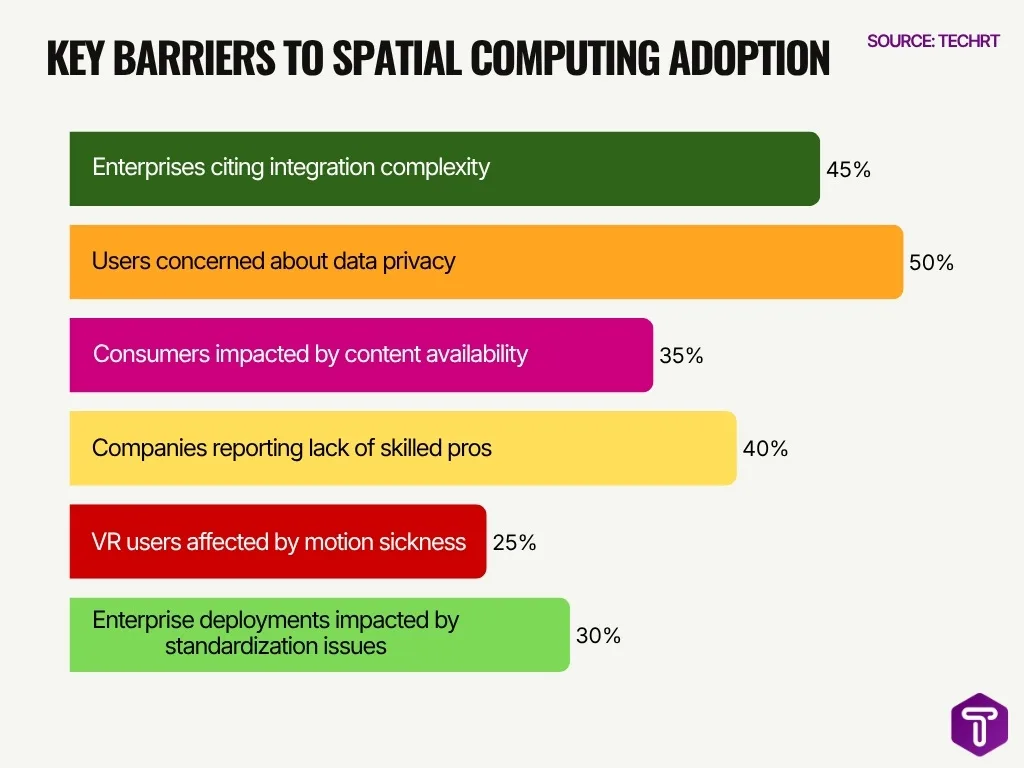
- Around 45% of enterprises cite integration complexity as a major challenge.
- Data privacy concerns affect over 50% of users, especially with AR-enabled tracking.
- Limited content availability impacts 35% of consumer adoption decisions, slowing growth.
- Battery life constraints reduce usability, with most devices offering 2–4 hours of active use.
- Lack of skilled professionals is reported by 40% of companies, hindering implementation.
- Motion sickness and user discomfort affect 25% of VR users, reducing engagement.
- Network limitations in some regions restrict real-time performance, especially without 5G.
- Standardization issues across platforms impact 30% of enterprise deployments, creating interoperability challenges.
Future Outlook and Growth Projections for Spatial Computing
- The spatial computing market is projected to exceed $1.09 trillion by 2034, reflecting long-term expansion.
- XR technologies are expected to reach $1.06 trillion by 2030, supporting ecosystem growth.
- AI integration will drive over 40% of new spatial computing applications by 2028, accelerating innovation.
- Enterprise adoption rates are projected to surpass 75% by 2030, driven by ROI-focused deployments.
- Smart city applications using spatial computing are expected to grow at over 27% CAGR, supporting urban planning.
- Consumer device adoption is forecast to exceed 2.5 billion active devices by 2030, largely driven by mobile AR.
- Digital twin technology is projected to become a $73+ billion market by 2027, driving growth in industrial applications.
- Spatial computing in healthcare is expected to grow at over 31% CAGR, driven by diagnostics and training.
- Global investment in spatial computing could exceed $20 billion annually by 2027, reflecting sustained investor confidence.
Frequently Asked Questions (FAQs)
What is the global spatial computing market size in 2025 and its future projection?
What is the CAGR of the spatial computing market forecast?
How fast is the emerging spatial computing segment growing?
How many AR and VR devices are currently in use globally?
What is the projected size of the AR/VR market by 2034?
Conclusion
Spatial computing is steadily evolving from a niche concept into a foundational technology that supports modern digital transformation. Across industries, organizations are using it to bridge the gap between physical operations and digital intelligence, whether through manufacturing digital twins, real-time remote collaboration, or immersive retail and customer experiences. These applications are not only improving efficiency but also enabling entirely new ways to interact with data and environments.
At the same time, advancements in AI, cloud computing, and 5G connectivity are amplifying the value of spatial computing, making solutions faster, smarter, and more scalable. While challenges such as cost, integration complexity, and user adoption remain, the overall trajectory points toward sustained growth and deeper integration into enterprise and consumer ecosystems. As the data throughout this article shows, spatial computing is set to become a central pillar of innovation, reshaping how businesses operate and how people engage with the digital world in the years ahead.

Leave a comment
Have something to say about this article? Add your comment and start the discussion.