




Zero-trust security has moved from a niche cybersecurity framework to a core business strategy across enterprises, governments, healthcare systems, and financial institutions. Organizations now use zero trust models to secure remote employees, protect cloud applications, reduce ransomware exposure, and manage identity-based threats across distributed environments. As cyberattacks grow more sophisticated and AI-driven threats expand, companies continue shifting away from perimeter-based defenses toward continuous verification models.
This article explores the latest zero trust security statistics, including market growth, enterprise adoption, investment trends, and implementation maturity across industries worldwide.
Editor’s Choice
- The global zero trust security market is expected to reach $54.31 billion in 2026, up from $44.71 billion in 2025.
- Around 81% of organizations have already implemented or started deploying a zero-trust framework in 2026.
- North America accounted for nearly 35% of global zero trust revenue in 2025, maintaining its lead entering 2026.
- The zero trust security industry is forecast to surpass $102 billion by 2031 at a CAGR above 16%.
- Large enterprises represented nearly 60% to 76% of total zero trust spending globally in 2025.
- Healthcare is projected to become the fastest-growing vertical for zero trust adoption through 2031.
- More than 78% of cybersecurity leaders now consider zero trust a top strategic security priority.
- Cloud-based zero trust deployments are growing at nearly 19.7% CAGR through 2031.
- About 65% of organizations experienced breaches linked to weak access controls before adopting zero trust strategies.
- Federal zero trust mandates in the US continue accelerating adoption across public-sector agencies and critical infrastructure operators.
Recent Developments
- In 2026, organizations assessing AI tool security before deployment increased to 64%, compared to 37% in 2025.
- The US government continued expanding zero-trust implementation under Executive Order 14028 and related federal cybersecurity mandates.
- The European Telecommunications Standards Institute published new zero-trust methodology guidance in late 2025 to standardize implementation practices.
- Multi-factor authentication deployments within zero trust frameworks are expected to grow at nearly 19.8% CAGR through 2031.
- Security vendors increasingly integrated identity protection, endpoint security, and microsegmentation into unified zero-trust platforms during 2025 and 2026.
- Cloud-native zero trust solutions emerged as the fastest-growing deployment segment due to hybrid work and SaaS expansion.
- Asia-Pacific became the fastest-growing regional market, with projected growth above 18% CAGR through 2031.
- Cybersecurity leaders increasingly adopted microsegmentation and continuous authentication to counter ransomware and insider threats in 2026.
- More organizations shifted from traditional VPNs toward Zero Trust Network Access platforms as remote work stabilized globally.
- Healthcare providers accelerated zero-trust deployments due to growing telehealth usage and escalating attacks on patient data systems.
Global Zero Trust Security Overview Statistics
- The global zero trust security market reached approximately $48.43 billion in 2026.
- Several forecasts estimate the market could exceed $117 billion by 2030.
- Analysts project annual market growth between 16% and 21% CAGR throughout the next decade.
- Around 70% of cybersecurity professionals now classify zero trust as critical to enterprise security planning.
- Approximately 60% of enterprises plan to adopt zero trust architecture within the next 12 to 18 months.
- Nearly 87% of organizations adopting zero trust reported a measurable decline in security incidents.
- Large enterprises continue dominating adoption due to higher cybersecurity budgets and complex hybrid environments.
- Financial services, healthcare, telecom, and government sectors remain the largest zero-trust adopters worldwide.
- North America remains the largest market, while Asia-Pacific records the fastest adoption growth globally.
- Research published in 2025 identified identity verification, least-privilege access, and continuous trust evaluation as the most common zero-trust implementation pillars.
Zero Trust Security Market Growth
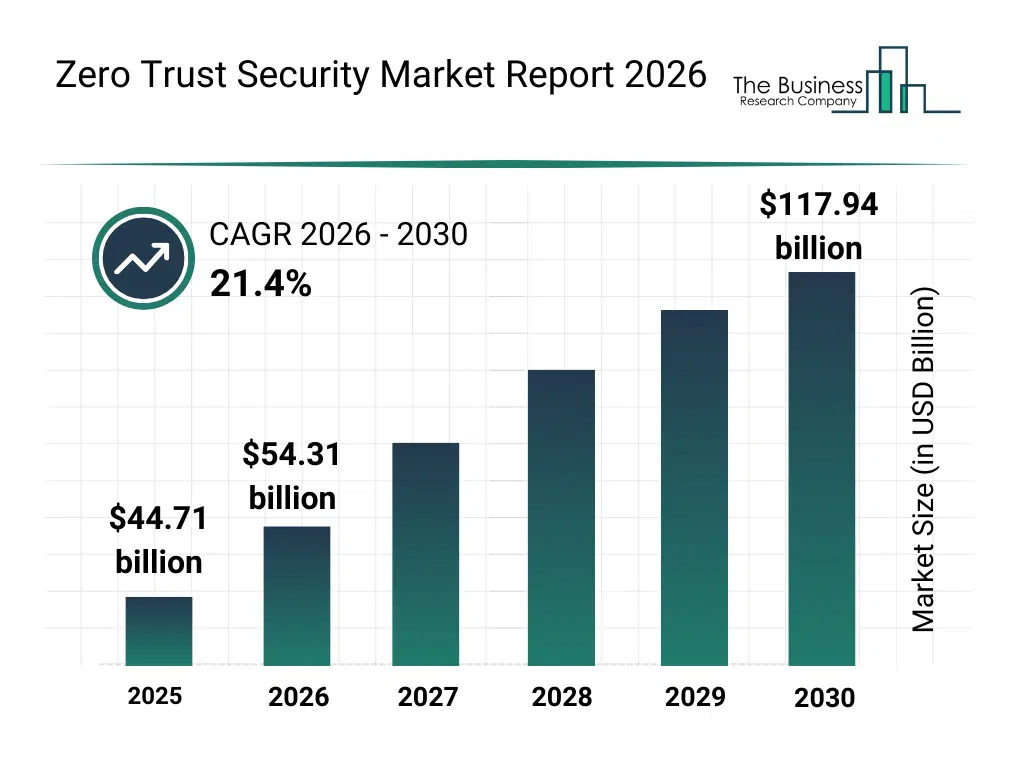
- The Zero Trust Security market is projected to grow strongly from $44.71 billion in 2025 to $117.4 billion by 2030.
- In 2026, the market size is expected to reach $54.31 billion, showing a major increase from the previous year.
- The market is forecast to expand at a 21.4% CAGR from 2026 to 2030, indicating rapid enterprise adoption of Zero Trust frameworks.
- By 2030, the Zero Trust Security market could become more than 2.6 times larger than its 2025 market size.
- The sharp growth reflects rising demand for identity-based security, cloud protection, remote work security, and continuous access verification.
- The data suggests that businesses are moving away from traditional perimeter-based security and investing more in Zero Trust architecture.
- The strongest growth period appears between 2028 and 2030, as adoption scales across enterprises, government agencies, and regulated industries.
- Overall, Zero Trust Security is becoming a major cybersecurity investment area, with the market expected to add around $72.69 billion in value between 2025 and 2030.
Zero Trust Adoption and Deployment Statistics Worldwide
- About 81% of organizations globally have adopted or started implementing zero-trust security models.
- Only 25% of enterprises believe their current infrastructure fully aligns with zero trust principles.
- Around 65% to 70% of organizations are expected to make zero trust a core cybersecurity strategy by 2026.
- Large enterprises accounted for roughly 76% of total zero trust spending in recent market assessments.
- Nearly 35% of organizations identify legacy infrastructure complexity as a major deployment challenge.
- Healthcare organizations accelerated adoption due to ransomware targeting patient systems and connected medical devices.
- Government agencies worldwide increased adoption following stricter cybersecurity mandates and national infrastructure protection efforts.
- Financial institutions expanded zero-trust deployments to secure digital banking, mobile access, and third-party integrations.
- Organizations with mature zero trust programs reported faster incident response times and stronger breach containment capabilities.
- Enterprises increasingly prioritized identity-first security frameworks over traditional perimeter-focused security architectures in 2025 and 2026.
Zero Trust Implementation Maturity and Roadmap Statistics
- Only 17% of organizations have fully implemented zero trust, even though 82% say it is essential to their security strategy.
- Around 60% of enterprises plan to expand zero-trust programs within the next 18 months, signaling continued investment.
- Zero-trust roadmaps increasingly start with identity management and privileged access controls before moving to broader enforcement.
- More than 40% of organizations now run periodic AI security assessments before deploying internal AI tools.
- By 2026, 70% of enterprises are expected to adopt some form of zero trust, showing the shift to a long-term operating model.
- Mature zero-trust deployments report up to 56% effectiveness in eliminating lateral movement between users and servers.
- Zero-trust adopters can see 68% fewer cloud misconfiguration incidents, helped by tighter controls across cloud-first environments.
- 67% of enterprises say legacy environments lack the flexibility needed for zero-trust implementation, creating visibility gaps.
- Continuous identity verification, policy-based access control, and microsegmentation are major roadmap trends in 2025–2026.
- Organizations increasingly treat zero trust as a strategic roadmap rather than a one-time product purchase, with phased deployment and ongoing optimization.
Industry-Specific Zero Trust Adoption Insights
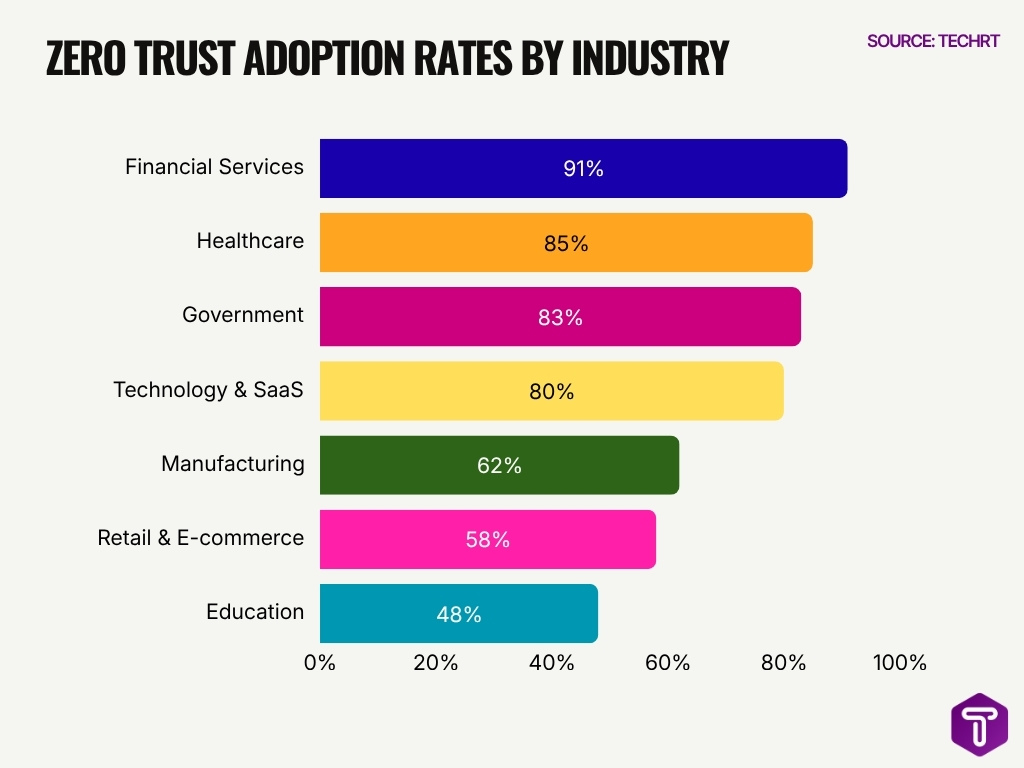
- Financial Services leads Zero Trust adoption at 91%, driven by strict compliance needs such as PCI-DSS, SOX, and growing pressure to prevent fraud.
- Healthcare ranks second with 85% adoption, mainly because hospitals, insurers, and health-tech firms must protect sensitive patient data and meet HIPAA-related security requirements.
- Government agencies show 83% adoption, supported by cybersecurity mandates such as CISA guidance and Executive Order 14028.
- Technology & SaaS companies record 80% adoption, reflecting their reliance on cloud-native infrastructure, distributed teams, and the need to protect intellectual property.
- Manufacturing adoption stands at 62%, as companies increasingly secure OT/ICS environments and reduce risks from supply chain attacks.
- Retail & E-commerce adoption is 58%, largely due to payment security needs, customer PII protection, and fraud prevention.
- Education has the lowest adoption rate at 48%, mainly because of budget limitations, legacy systems, and decentralized campus IT environments.
- The data shows that industries handling highly sensitive data or facing stronger compliance pressure, such as financial services, healthcare, and government, are adopting Zero Trust faster than sectors with tighter budgets or complex legacy infrastructure.
Zero Trust Adoption Statistics by Organization Size
- Around 76% of large enterprises worldwide actively invested in zero trust initiatives during 2025 and 2026.
- Enterprises with over 10,000 employees were nearly 2.5 times more likely to deploy advanced zero-trust architectures than mid-sized businesses.
- Small and medium-sized businesses are projected to increase zero trust spending at a CAGR above 18% through 2030.
- Nearly 61% of mid-market companies adopted multi-factor authentication as their first zero-trust implementation step.
- About 42% of SMBs cited ransomware concerns as the primary driver for adopting zero trust policies.
- Large enterprises allocated an average of 18% to 22% of cybersecurity budgets toward identity and zero trust initiatives in 2025.
- Around 54% of SMB security leaders reported difficulty integrating legacy systems into zero-trust frameworks.
- Organizations with more than 5,000 employees were significantly more likely to deploy microsegmentation and Zero Trust Network Access platforms.
- Approximately 70% of enterprise IT teams now prioritize identity-centric security over traditional perimeter controls.
- SMB adoption accelerated in 2026 due to the availability of cloud-native zero trust platforms with lower deployment costs.
Zero Trust Security Statistics by Region and Country
- North America held 34.72% of global zero trust revenue in 2025 and remained the largest region entering 2026.
- The U.S. zero trust security market was valued at $10.64 billion in 2025 and is projected to reach $49.74 billion by 2035.
- Asia-Pacific is the fastest-growing region, with a 18.63% CAGR through 2031.
- Japan’s zero-trust security market generated $1,733.2 million in 2024 and is expected to reach $4,862.0 million by 2030.
- Europe is being pushed by stricter rules like NIS2 and DORA, which strengthen continuous risk management and access control requirements.
- The EU’s GDPR-related cybersecurity obligations helped prevent an estimated €585 million to €1.4 billion in cyber damages in identity theft cases.
- India’s telecom security reforms for 2026 include a 50% fee reduction for startups, MSEs, and women-owned enterprises, supporting broader zero trust adoption.
- Australia updated its PSPF 2025 to mandate zero-trust adoption for government entities, making it a required security standard.
- The Middle East zero-trust security market is projected to grow at 17.14% CAGR and reach $7.4 billion by 2030.
- Canada is advancing zero trust through its Cyber Security Services Roadmap, built on continuous verification and a single secure digital identity.
Zero Trust Browser Adoption Drivers
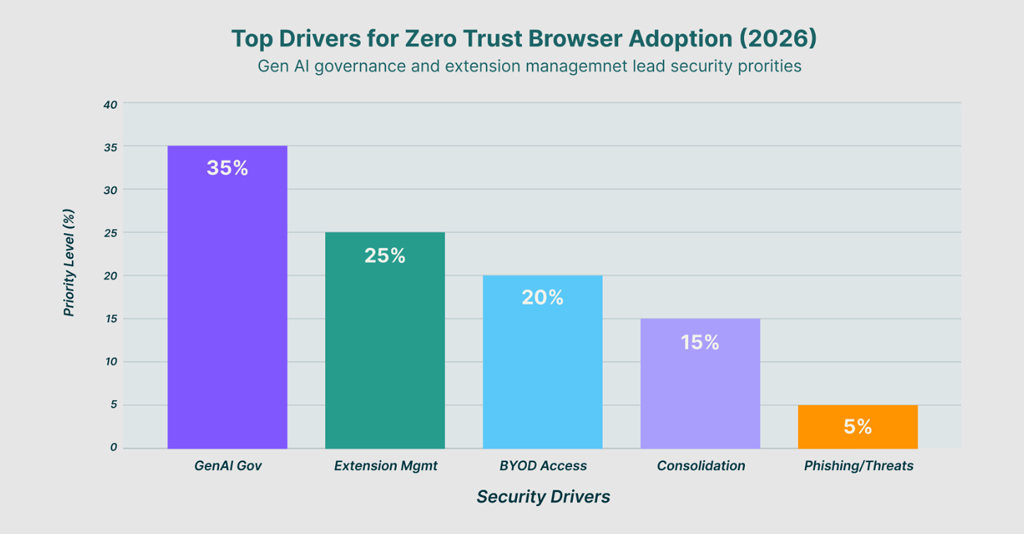
- GenAI governance is the top driver for Zero Trust browser adoption in 2026, accounting for 35% of priority levels.
- The data shows that organizations are increasingly focused on managing risks linked to AI usage, data exposure, and governance controls inside browsers.
- Extension management ranks second with 25%, highlighting the growing need to control browser extensions that may create security gaps.
- BYOD access is the third major driver at 20%, showing that companies are prioritizing secure access for employees using personal devices.
- Consolidation represents 15% of the priority level, suggesting that businesses want to reduce tool sprawl and manage browser security through fewer platforms.
- Phishing and threats account for only 5%, indicating that while threat prevention remains important, organizations are now placing greater emphasis on governance, access control, and operational efficiency.
- Together, GenAI governance and extension management make up 60% of total priority levels, making them the dominant focus areas for Zero Trust browser strategies.
- The chart suggests that Zero Trust browser adoption is shifting beyond traditional threat defense toward AI governance, device flexibility, and centralized security management.
Key Drivers of Zero Trust Adoption and Investment Statistics
- Around 65% of organizations reported breaches due to inadequate access controls before adopting zero trust.
- 81% of organizations have implemented or are adopting zero-trust security models globally.
- 78% of cybersecurity leaders identify zero trust as a top strategic priority in 2026.
- 65% of organizations plan to replace VPNs with zero-trust solutions amid remote work growth.
- Organizations with zero trust report 62% fewer ransomware incidents and limited lateral movement.
- 63% of enterprises adopt zero trust primarily for enhanced cloud security during migrations.
- Over 80% of businesses cite regulatory compliance as a major driver for zero trust adoption.
- 72% of cloud breaches occur without zero trust, pushing AI-driven continuous authentication.
- Mature zero-trust programs achieve 50% faster incident response and stronger cyber resilience.
- 82% of organizations use unmanaged BYOD devices, driving broader zero trust investments.
Remote and Hybrid Work Zero Trust Security Statistics
- 83% of organizations with Zero Trust reported better visibility and control over remote users, cloud apps, and BYOD devices in 2025.
- 74% of organizations had adopted MFA, making it a mainstream access requirement for distributed workforces.
- 71% of organizations used identity and access management tools as part of their Zero Trust approach for hybrid work.
- Zero Trust deployments were linked to 42% fewer security incidents than environments without Zero Trust.
- 65% of Zero Trust users reported faster incident response times, which matters more in remote-access-heavy environments.
- 82% of organizations cited insufficient VPN logging as a factor in failed compliance assessments, reinforcing the shift toward identity-centric controls.
- The ZTNA market is projected to grow from $41.28 billion in 2024 to $52.18 billion in 2025, showing rising demand driven by remote work.
- Another forecast puts the ZTNA market at $4.18 billion by 2030, with remote workforce access expected to hold the largest share.
- Companies with Zero Trust saved an average of $1.5 million per breach, while remote work increased breach cost pressure by about $1 million.
Most Adopted Zero Trust Technologies
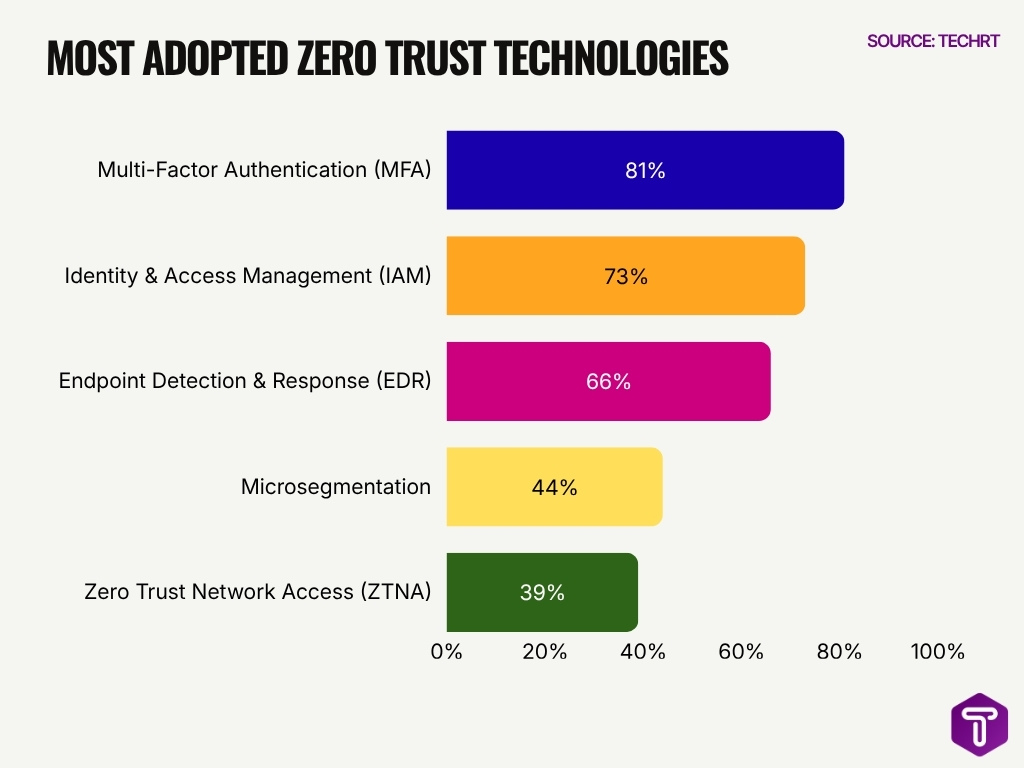
- Multi-Factor Authentication (MFA) is the most widely adopted Zero Trust technology, with an adoption rate of 81%.
- Identity & Access Management (IAM) follows closely at 73%, showing that identity verification is a major priority in Zero Trust strategies.
- Endpoint Detection & Response (EDR) has a strong adoption rate of 66%, highlighting the importance of endpoint-level threat detection.
- Microsegmentation is used by 44% of organizations, indicating growing interest in limiting lateral movement across networks.
- Zero Trust Network Access (ZTNA) records the lowest adoption among the listed technologies at 39%, suggesting that many organizations are still transitioning from traditional VPN-based access models.
- The gap between MFA and ZTNA adoption is 42 percentage points, showing that foundational identity controls are much more mature than advanced network-access modernization.
- Overall, the data suggests that Zero Trust adoption is currently strongest in identity security, while technologies like Microsegmentation and ZTNA still have room for wider implementation.
Cloud and SaaS Zero Trust Security Statistics
- Cloud-based zero trust deployments are projected to grow at approximately 19.7% CAGR through 2031.
- Around 85% of enterprises now rely on SaaS applications for critical business operations, increasing the need for zero-trust controls.
- Organizations increasingly adopted identity-first security frameworks to secure multi-cloud and SaaS environments.
- Nearly 62% of organizations identified cloud misconfigurations as a major cybersecurity concern in 2025 and 2026.
- SaaS application sprawl pushed enterprises to implement stricter continuous authentication and least-privilege access policies.
- Enterprises increasingly use microsegmentation to isolate workloads and limit lateral movement inside cloud environments.
- Cloud-native zero trust solutions became popular among SMBs because they reduced infrastructure management costs.
- Organizations deploying zero-trust cloud security reported improved visibility into user activity and SaaS access behavior.
- Security leaders are increasingly integrating CASB, endpoint protection, and identity governance into unified cloud zero trust strategies.
- AI-driven cloud workloads and generative AI adoption further accelerated investment in adaptive zero-trust cloud security controls.
Zero Trust Identity, Authentication, and Access Management Statistics
- Multi‑factor authentication adoption within zero trust environments is projected to grow at a 19.8% CAGR through 2031.
- Approximately 61% of breaches still involve compromised credentials, reinforcing the need for identity‑centric security.
- Organizations implementing adaptive authentication saw up to 60% fewer successful phishing and account takeover attempts compared with static policies.
- Nearly 70% of enterprises now list identity and access management modernization as a top priority inside their cybersecurity programs.
- Roughly 89% of enterprises enforce MFA for all users, a core requirement for zero-trust identity models.
- Around 41% of organizations have deployed passwordless authentication via biometrics, FIDO2, or mobile push by 2025–2026.
- Privileged access management (PAM) tools are now used by about 76% of enterprises to secure admin and privileged accounts.
- Security teams integrating behavioral analytics and AI into identity threat detection report up to 50% faster anomaly identification.
- Organizations with mature identity governance strategies experienced as much as 30% lower breach costs and stronger compliance outcomes.
- Cloud‑first enterprises applying least‑privilege and continuous verification in zero trust reported 63% fewer over‑privileged identities and misused credentials.
Enterprise Zero Trust Spending Is Led by IAM and Endpoint Security
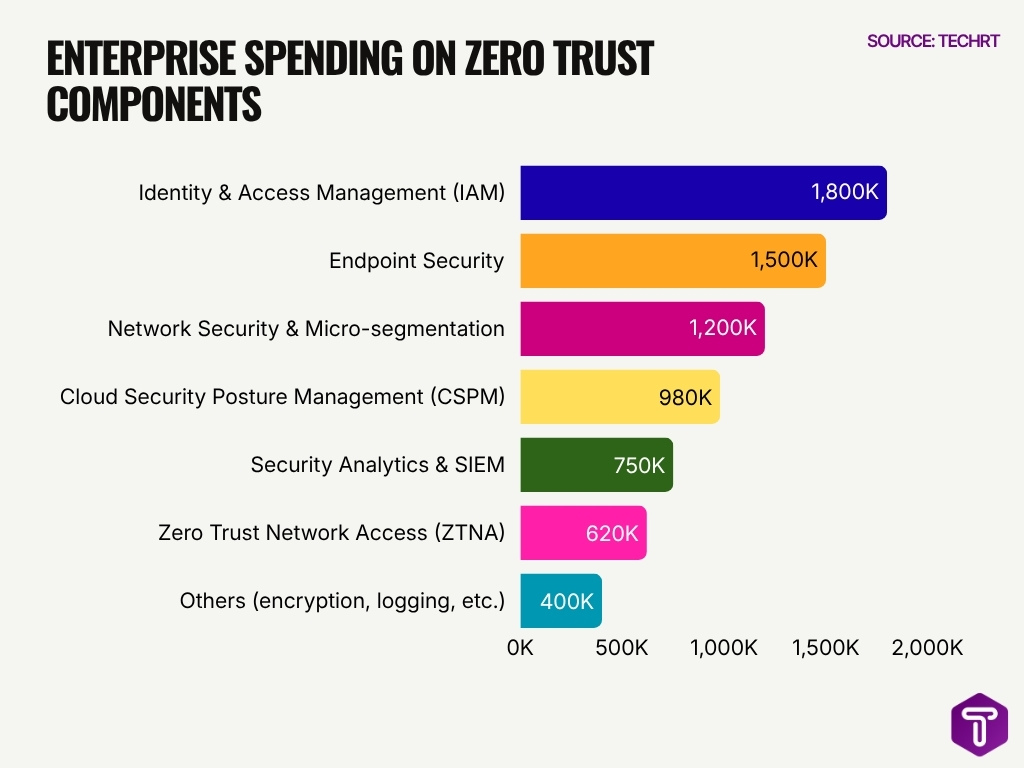
- Identity & Access Management (IAM) receives the highest average annual spend at $1.8 million per organization, accounting for 28% of the total security budget.
- Endpoint Security is the second-largest spending area, with organizations investing around $1.5 million annually, representing 23% of the security budget.
- Network Security & Micro-segmentation ranks third, with an average spend of $1.2 million and a 19% budget share, showing a strong enterprise focus on limiting lateral movement.
- Cloud Security Posture Management (CSPM) accounts for $980K in annual spending, making up 15% of the total security budget as cloud environments become central to Zero Trust strategies.
- Security Analytics & SIEM attracts an average investment of $750K, equal to 12% of the security budget, highlighting the importance of monitoring, detection, and response.
- Zero Trust Network Access (ZTNA) receives $620K annually, representing 10% of the security budget, reflecting growing demand for secure remote and hybrid access.
- Other Zero Trust tools, including encryption, logging, and related controls, receive the lowest average spend at $400K, making up 6% of the total security budget.
- Overall, the data shows that enterprises are prioritizing identity-first security, endpoint protection, and network segmentation as the core pillars of Zero Trust investment.
Zero Trust Network Access (ZTNA) and VPN Replacement Statistics
- The global ZTNA market is projected to surpass $12 billion by 2030 as organizations replace legacy VPN infrastructure.
- Around 72% of enterprises planned to reduce dependence on traditional VPNs by the end of 2026.
- More than 60% of remote-access deployments in large enterprises now include ZTNA capabilities.
- Organizations implementing ZTNA reported lower attack surfaces because applications remain hidden from the public internet.
- Around 58% of security leaders identified VPN-related vulnerabilities as a major reason for adopting zero-trust remote access.
- ZTNA deployments accelerated after hybrid work expanded the number of unmanaged endpoints connecting to enterprise systems.
- Enterprises increasingly integrate ZTNA with identity providers and endpoint detection platforms to enable adaptive access controls.
- Cloud-delivered ZTNA services recorded stronger adoption among SMBs because they reduced infrastructure complexity and maintenance costs.
- Organizations using ZTNA reported stronger visibility into user sessions, device posture, and application-level access behavior.
- Analysts expect ZTNA adoption to continue rising as enterprises modernize secure access strategies across distributed environments.
Device, Endpoint, and IoT Protection Statistics Under Zero Trust
- More than 70% of organizations increased endpoint security spending after adopting zero trust frameworks.
- Over 30 billion connected IoT devices are projected to be online worldwide by 2030, driving demand for device‑centric zero trust controls.
- Around 67% of enterprises named unmanaged devices as a major security risk in hybrid work environments.
- Roughly 65% of organizations now perform device posture checks before granting access to cloud apps and internal systems.
- Nearly 59% of security teams expanded endpoint detection and response (EDR/XDR) deployments during 2025 and 2026.
- The manufacturing and healthcare sectors increased IoT‑focused zero-trust deployments to secure operational technology (OT) devices.
- Zero trust microsegmentation reduced lateral movement between endpoints and IoT systems by up to 70–90% in mature implementations.
- Enterprises combined endpoint telemetry with AI‑driven behavioral analytics to cut dwell time for suspicious device activity by about 50%.
- About 52% of organizations reported stronger incident detection after integrating endpoint security with their zero-trust architecture.
- Security teams prioritized continuous endpoint verification instead of one‑time device authentication, leading to 40% fewer post‑compromise pivoting events.
Challenges and Barriers in Zero Trust Implementation Statistics
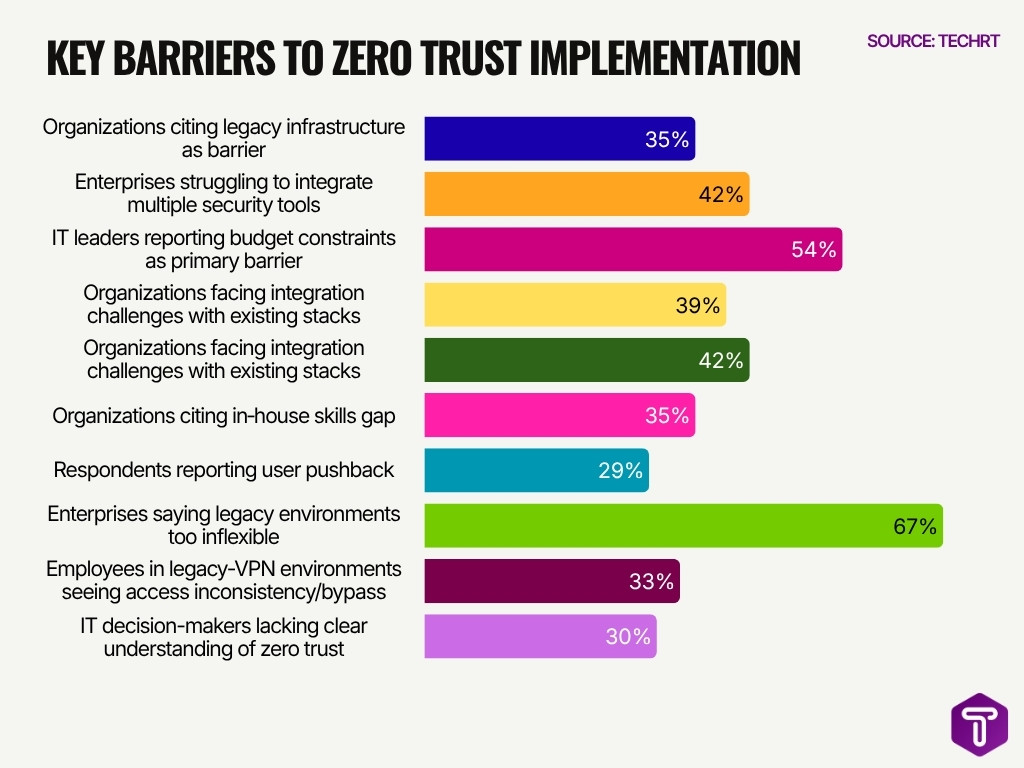
- About 35% of organizations name legacy infrastructure complexity as a major barrier to zero trust implementation.
- Roughly 42% of enterprises struggle to integrate multiple security tools into a unified zero-trust architecture.
- Nearly 54% of IT leaders report budget constraints as a primary barrier to full zero trust rollout.
- Around 39% of organizations face integration challenges when retrofitting zero trust into existing security stacks.
- About 42% of security teams lack complete visibility into users, devices, and workloads across hybrid and multi‑cloud environments.
- Nearly 35% of organizations cite a skills gap in-house as a key limitation for designing and maintaining zero-trust architectures.
- Around 29% of respondents report user pushback due to frequent re‑authentication and perceived productivity slowdowns.
- Approximately 67% of enterprises say their legacy environments are too inflexible for proper zero trust controls.
- About 33% of employees in legacy‑VPN environments report higher access inconsistency and bypass behavior, undermining zero-trust goals.
- Roughly 30% of IT decision‑makers admit they lack a clear understanding of what zero trust actually entails, slowing deployment.
Zero Trust Impact on Data Breaches and Ransomware Statistics
- Organizations with mature zero trust programs reduced average breach costs by $1.76 million (42.3% savings).
- Zero trust strategies cut breach-related costs by up to 30%, from an average of $4.45 million.
- ZTNA users (part of zero trust) reported 58% fewer successful phishing attacks.
- Organizations using zero trust frameworks are 3.2x less likely to pay ransomware ransoms.
- Zero-trust environments reduced ransomware dwell time from 18 days to 6.2 days.
- AI-driven zero trust cuts mean-time-to-respond by 55% and incident likelihood by 60%.
- 78% of security breaches could be prevented with full zero trust adoption.
- Zero-trust architectures lower breach costs by about $1 million on average.
- Only 6% of healthcare organizations deployed microsegmentation across >80% of critical systems.
- Identity misuse featured in over 80% of ransomware operations, lacking strong verification.
Zero Trust Cost of Breach Reduction and ROI Statistics
- Organizations deploying mature zero trust frameworks saved an average of $1.76 million in breach costs compared to those without.
- Zero trust implementations achieved an average 246% ROI over three years with payback in under six months.
- 59% of organizations reported improved security efficiency after consolidating controls into zero-trust platforms.
- Zero trust adopters reduced breach costs by up to 30%, averaging $4.45 million in savings potential.
- Organizations with mature zero trust saw 42% fewer security incidents and 50% faster incident response.
- Microsegmentation in zero trust achieved 90% reduction in potential breach impact during ransomware attacks.
- 72% of organizations reported a stronger security posture and lower compliance costs with zero trust adoption.
- Identity automation in zero trust resulted in 75% reduction in manual provisioning time and SOC workloads.
- 44% of zero trust organizations saw security incidents drop by over 90%, improving operational savings.
Frequently Asked Questions (FAQs)
What is the projected size of the zero-trust security market in 2026?
What CAGR is the zero-trust security market expected to grow at?
What share of zero-trust spending comes from large enterprises?
How many organizations have adopted zero-trust security models?
How much can organizations save in breach costs with mature zero trust deployments?
Conclusion
Zero-trust security continues to evolve from a cybersecurity trend into a foundational enterprise security model. Organizations across finance, healthcare, government, manufacturing, and technology sectors increasingly rely on identity verification, microsegmentation, adaptive authentication, and continuous monitoring to secure cloud environments, remote workers, SaaS applications, and connected devices.
The statistics show strong momentum in global adoption, market expansion, and enterprise investment. At the same time, organizations still face challenges tied to legacy infrastructure, integration complexity, visibility gaps, and workforce readiness. As AI-driven cyber threats and ransomware campaigns continue growing, zero trust strategies will likely remain central to modern cybersecurity planning for the rest of the decade.

Leave a comment
Have something to say about this article? Add your comment and start the discussion.