




Contactless payments now shape how consumers pay for groceries, ride public transit, order coffee, and shop online. Retailers, restaurants, healthcare providers, and transportation systems continue to expand tap-to-pay infrastructure as digital wallets and NFC-enabled cards become standard across the U.S. and global markets. At the same time, banks and fintech firms push faster and more secure checkout experiences to reduce friction and increase transaction speed. Explore the latest contactless payment statistics, market trends, and adoption figures shaping the industry.
Editor’s Choice
- The global contactless payment market reached $56.11 billion in 2025 and is projected to grow to $65.09 billion in 2026.
- The contactless payment industry could surpass $240 billion by 2035, reflecting continued consumer demand for cashless transactions.
- Asia-Pacific accounted for 26.2% of the global contactless payment market in 2025, making it the largest regional contributor.
- Europe represented more than 42% of global contactless payment revenue in 2025, driven by strong card penetration and digital banking adoption.
- The global mobile payment transaction market reached $10.16 trillion in 2025.
- Mobile wallet users worldwide are expected to exceed 5.3 billion by 2026.
- The global NFC market was valued at $29.9 billion in 2024 and continues to expand across payments, healthcare, and transportation sectors.
- Smartphones and wearables generated over 60% of the contactless payment market revenue in 2025.
- Retail applications contributed more than 60% of global contactless payment revenue in 2025.
Recent Developments
- Financial institutions increased support for NFC-enabled digital wallets during 2025 to improve checkout speed and fraud prevention.
- Several major mobile wallet providers introduced expanded NFC partnerships in 2025 to improve cross-platform payment compatibility.
- Wearable payment adoption continued to rise as smartwatches and fitness bands integrated tap-to-pay features.
- Transportation systems across Asia and Europe accelerated contactless ticketing deployments in metro and rail systems during 2025.
- U.S. retailers expanded soft POS and tap-on-phone solutions to reduce hardware costs for merchants.
- Government-backed digital payment initiatives in India and the UAE increased NFC payment adoption across public services.
- Cross-border contactless payments gained momentum in the Asia-Pacific due to wallet interoperability agreements.
- Contactless-enabled ATMs and transit kiosks expanded in urban markets throughout 2025.
- Banks increasingly adopted tokenization and one-time authentication codes to improve payment security for contactless users.
Global Overview of Contactless Payments
- Contactless payments rely on NFC and RFID technologies to enable tap-based transactions without physical card insertion.
- Millions of merchants worldwide now accept tap-to-pay transactions across retail, dining, healthcare, and transportation industries.
- Contactless payment systems support cards, smartphones, smartwatches, wearables, and mobile wallets.
- Europe remains one of the strongest contactless payment regions because of widespread card acceptance infrastructure.
- Asia-Pacific leads global growth due to smartphone penetration and government support for digital payment ecosystems.
- Contactless payments became mainstream in the U.S. after major retailers upgraded POS terminals during the last five years.
- Public transit systems increasingly prefer contactless ticketing because it shortens boarding times and lowers operational friction.
- NFC-enabled payments continue to expand beyond retail into healthcare, hospitality, and smart city infrastructure.
- Global consumers increasingly prefer contactless checkout because it reduces transaction time compared with chip-and-PIN methods.
Contactless Payment Revenue Growth Trends
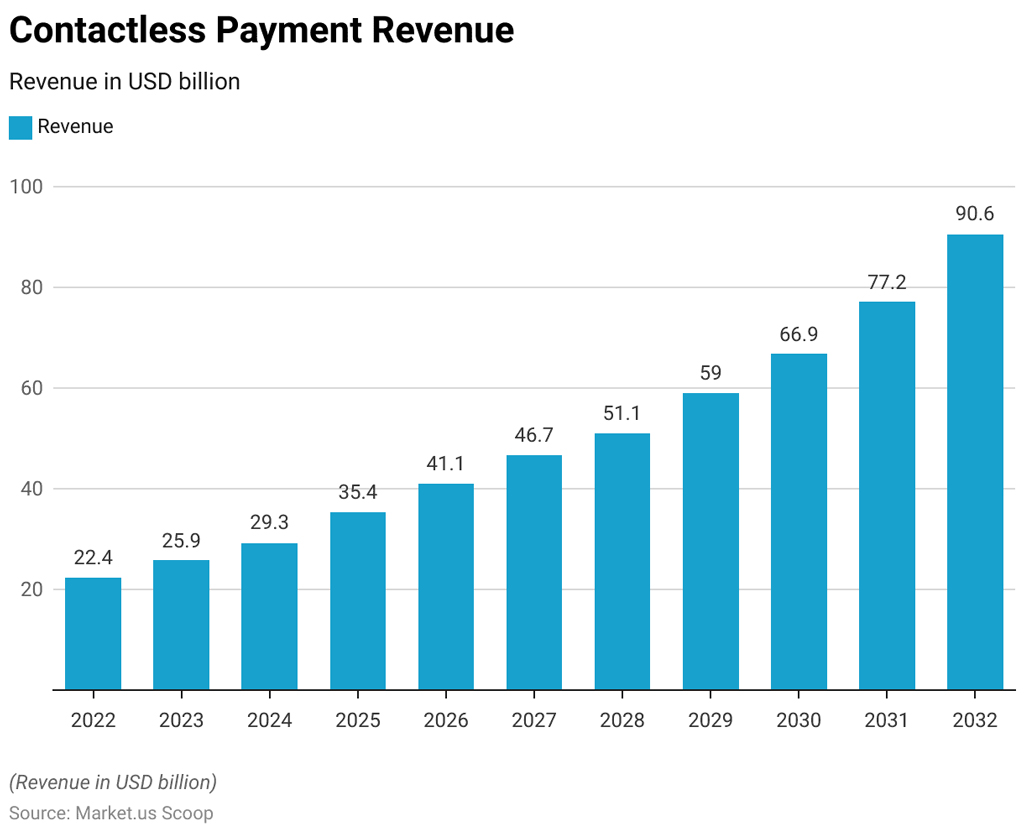
- The global contactless payment revenue is projected to grow from $22.4 billion in 2022 to $90.6 billion by 2032.
- Between 2022 and 2032, the market revenue is expected to increase by $68.2 billion, showing strong long-term growth.
- Revenue is forecast to more than quadruple over the 10-year period, rising by around 304% from 2022 levels.
- The market shows steady year-over-year growth, with revenue increasing from $25.9 billion in 2023 to $29.3 billion in 2024.
- By 2026, contactless payment revenue is expected to reach $41.1 billion, nearly double the 2022 value.
- The revenue is projected to cross the $50 billion mark in 2028, reaching $51.1 billion.
- A major growth phase appears after 2029, when revenue rises from $59.0 billion to $66.9 billion in 2030.
- The highest year-over-year increase occurs between 2031 and 2032, when revenue grows from $77.2 billion to $90.6 billion.
- By 2032, contactless payments are expected to generate $90.6 billion, highlighting the rising adoption of tap-to-pay cards, mobile wallets, and NFC-based payments.
- The data suggests that contactless payments are becoming a major part of the global digital payment ecosystem, supported by faster checkout experiences and growing consumer preference for cashless transactions.
Growth of the Contactless Payment Market
- The contactless payment market is forecast to grow at a 15.65% CAGR from 2026 to 2035.
- Another industry forecast projects the market will expand from $50.79 billion in 2026 to $128.35 billion by 2034.
- The NFC payments market could reach $59.5 billion by 2033, nearly doubling from 2023 levels.
- Global NFC payment revenue is expected to rise from $38.2 billion in 2025 to $71.16 billion by 2035.
- Analysts estimate the broader NFC mobile payment market will grow at a 16.9% CAGR through 2034.
- The global near-field communication market could surpass $101.8 billion by 2034.
- Growth in smartphone ownership remains one of the largest drivers of contactless payment expansion worldwide.
- Governments in emerging markets continue promoting cashless ecosystems to improve tax transparency and financial inclusion.
- Retailers increasingly invest in tap-to-pay infrastructure because faster checkout improves customer throughput during peak hours.
Contactless Payment Transaction Volume
- China processed 576.3 billion non-cash payment transactions during 2024, highlighting the scale of digital payment activity.
- Mobile wallet users globally are projected to surpass 5.3 billion by 2026, increasing overall contactless transaction frequency.
- Southeast Asia could see mobile wallet usage grow by 311% between 2020 and 2025.
- Retail remains the largest contributor to contactless transaction volume because of frequent low-value purchases.
- Public transportation systems increasingly process millions of tap-based transactions daily in major metro areas worldwide.
- Smartphones and wearable devices now account for most new contactless transaction growth globally.
- Soft POS adoption among small merchants continues to increase transaction counts in developing markets.
- Contactless card payments remain dominant for low-value in-store purchases in Europe and North America.
- Fast-food restaurants, vending machines, transit stations, and pharmacies continue to drive high-frequency tap-to-pay usage.
Contactless Payment Transaction Value
- Global mobile payment transaction value reached $10.16 trillion in 2025.
- Analysts expect the mobile payment transaction market to climb to $47.37 trillion by 2032.
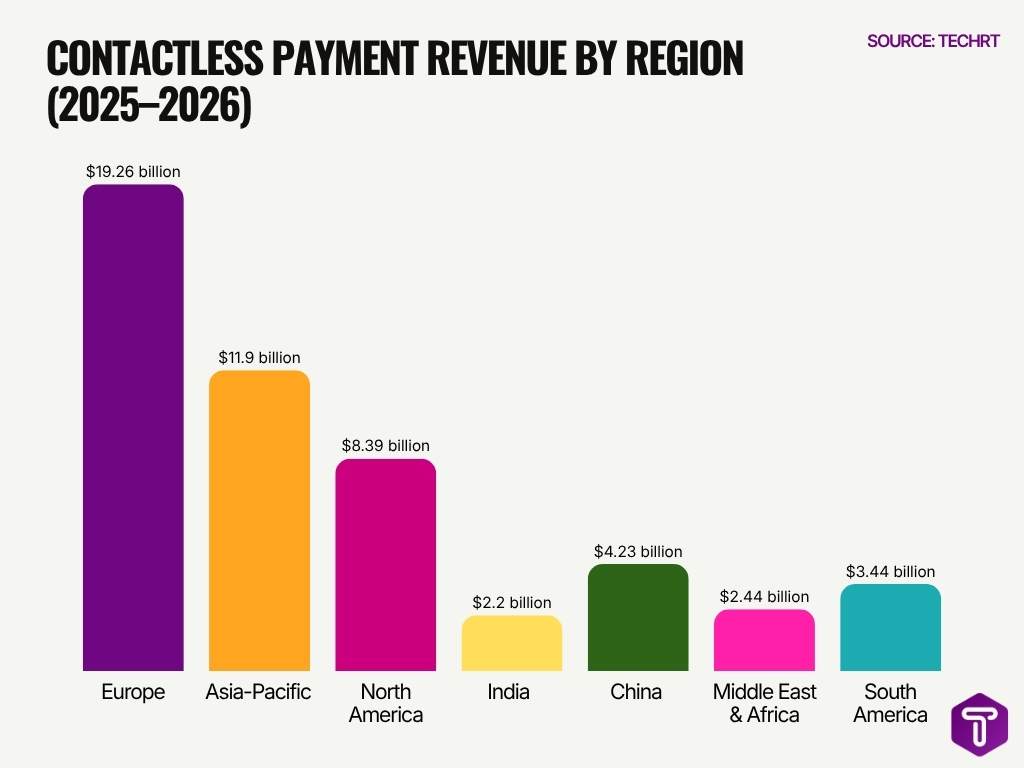
- Europe generated $19.26 billion in contactless payment market revenue during 2025.
- Asia-Pacific contactless payment revenue reached $11.9 billion in 2025.
- North America contributed $8.39 billion in 2025 to the global contactless payment market.
- India’s contactless payment market revenue is expected to hit $2.2 billion in 2026.
- China’s contactless payment market revenue could exceed $4.23 billion in 2026.
- The Middle East and Africa contactless market generated $2.44 billion in 2025.
- South America’s contactless payment sector produced $3.44 billion in 2025.
Adoption Rate of Contactless Payments
- More than 90% of smartphone users in several developed markets now use at least one form of contactless payment annually.
- In the U.S., contactless card penetration surpassed 72% of active payment cards in 2025.
- Over 67% of consumers globally used contactless payments at least once per week during 2025.
- The UK maintained one of the highest adoption rates worldwide, with contactless accounting for nearly 38% of all payments in 2025.
- Australia reported contactless usage rates above 95% for in-person card transactions in 2025.
- India experienced rapid adoption growth after UPI-enabled NFC and tap-to-pay services expanded across urban merchants.
- Younger consumers between the ages of 18 and 34 represented the highest contactless payment adoption group globally.
- Public transit systems helped accelerate adoption by integrating tap-to-pay access into buses, metros, and rail systems.
- Contactless payment adoption among small businesses in North America rose by more than 30% year over year in 2025.
Consumer Usage of Contactless Payments
- Consumers cited speed and convenience as the top reasons for choosing contactless payments in 2025.
- More than 74% of Gen Z consumers used mobile wallets or contactless cards weekly during 2025.
- Around 58% of U.S. shoppers preferred tap-to-pay over cash for purchases under $25 in 2025.
- Consumers completed contactless transactions up to 10 times faster than cash purchases at checkout counters.
- Digital wallet usage among U.S. consumers increased by over 20% between 2024 and 2025.
- Nearly half of consumers globally said they now carry less physical cash because of contactless payments.
- Grocery stores, pharmacies, and quick-service restaurants ranked among the most common locations for tap-to-pay usage.
- Wearable payment usage grew sharply among fitness-focused consumers using smartwatches for daily purchases.
- Consumers using contactless checkout reported shorter wait times and smoother retail experiences compared with traditional card entry methods.
Contactless Payment Usage by Payment Type
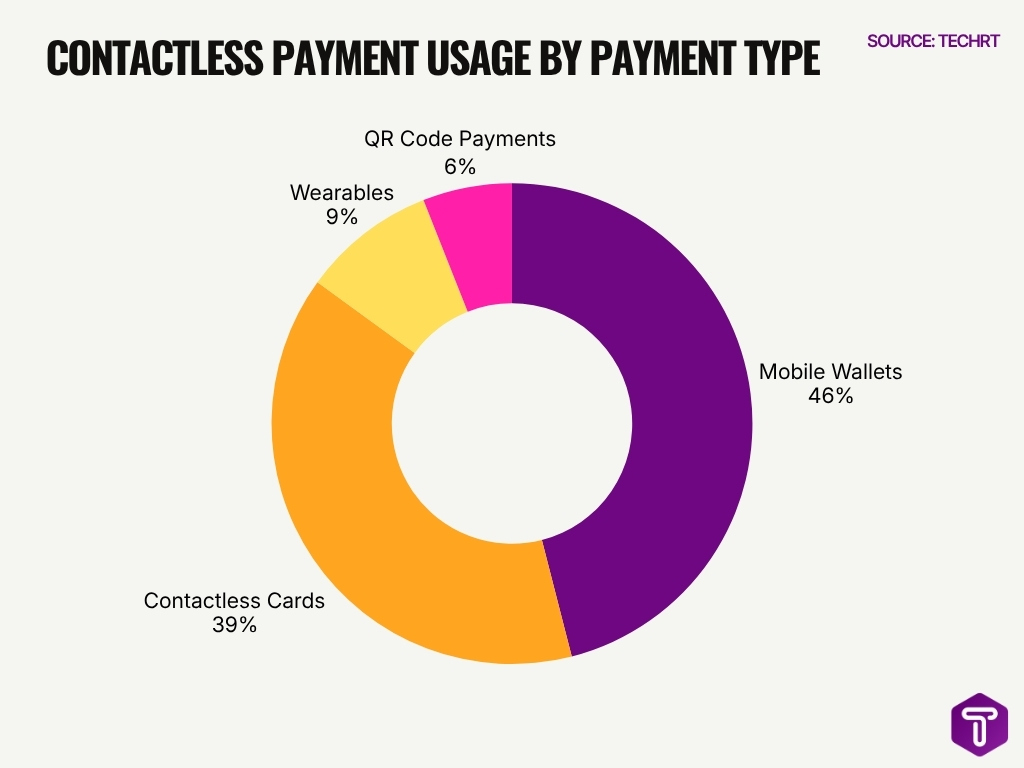
- Mobile Wallets account for the largest share of contactless payments at 46%, making them the most widely used payment type in the chart.
- Contactless Cards are the second most popular option, representing 39% of total usage.
- Together, Mobile Wallets and Contactless Cards make up 85% of contactless payment usage, showing that these two methods dominate the market.
- Wearables have a smaller but notable share at 9%, indicating growing adoption of smartwatches and other wearable payment devices.
- QR Code Payments represent the lowest share at 6%, suggesting they are less commonly used compared with card- and wallet-based contactless payments.
- The data shows a clear preference for convenient, device-based payment methods, especially mobile wallets and tap-to-pay cards.
Contactless Card Payment Statistics
- >70% of payment card shipments globally were contactless-enabled in 2025.
- Visa processed billions of tap-to-pay transactions worldwide during 2025.
- Mastercard reported that contactless became the preferred in-store payment in several mature markets by 2025.
- Contactless card taps reduced average checkout time by several seconds compared with chip insertions.
- North American banks issued millions of NFC-enabled replacement cards in accelerated rollout programs in 2025.
- Europe recorded about 71% contactless transaction share in 2024–2025, among the world’s highest rates.
- Contactless card usage among older consumers grew by around 38% over two years as cards stayed popular versus mobile wallets.
- Financial institutions expanded tokenization and biometric features, with widespread rollout of tokenized contactless solutions in 2025.
- Low-value retail purchases (everyday items) continued to account for the majority of contactless transaction frequency worldwide.
Mobile Wallet and NFC Payment Statistics
- Global mobile wallet users are expected to exceed 5.3 billion by 2026.
- Apple Pay, Google Pay, and Samsung Wallet remained the leading NFC wallet ecosystems in North America during 2025.
- NFC payment adoption grew rapidly in developing markets because smartphones became more affordable.
- The NFC market could exceed $101 billion globally by 2034.
- Smartphone-based payments accounted for more than 60% of contactless payment revenue in 2025.
- Digital wallet transactions increased significantly in transit systems and vending machine environments during 2025.
- Wearable devices emerged as one of the fastest-growing NFC payment categories globally.
- More merchants adopted QR-to-NFC hybrid payment experiences during 2025 to support broader payment flexibility.
- Consumers are increasingly linking loyalty rewards and coupon systems directly to mobile wallet applications.
Business Adoption of Contactless Payments
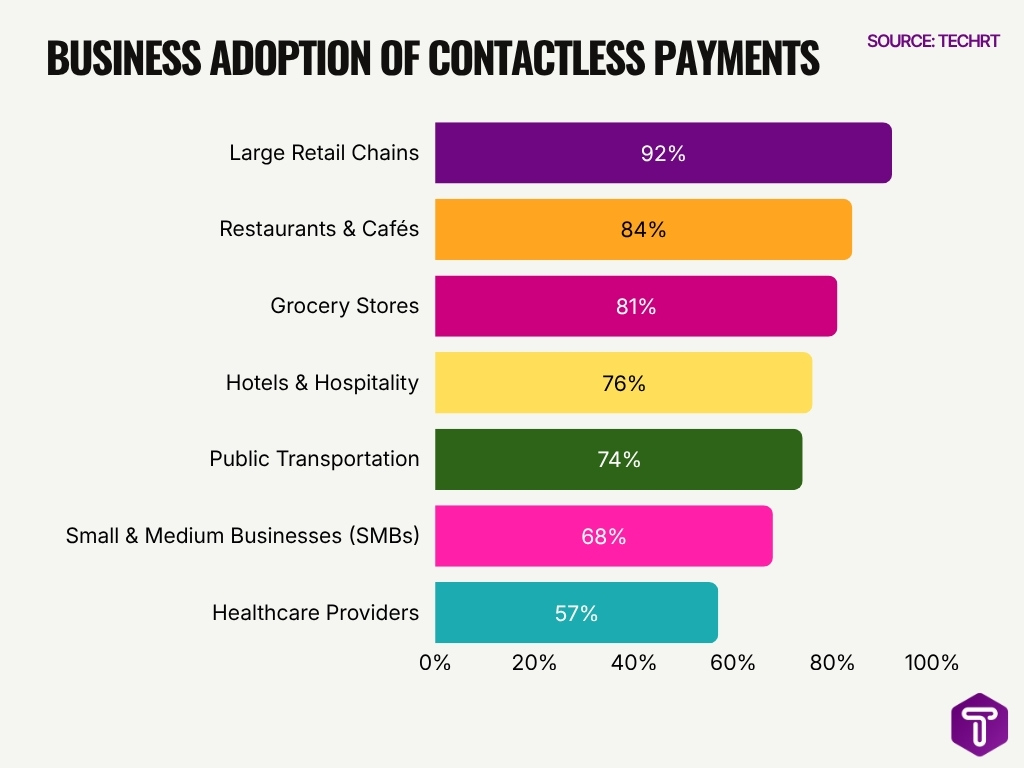
- Large retail chains lead contactless payment adoption, with an impressive 92% adoption rate, showing that major retailers have made tap-to-pay systems a standard checkout option.
- Restaurants and cafés rank second, with 84% adoption, highlighting strong demand for faster, low-friction payments in food service environments.
- Grocery stores show high adoption at 81%, reflecting the importance of quick checkout, high transaction volume, and convenience for everyday purchases.
- Hotels and hospitality businesses have a 76% adoption rate, indicating that contactless payments are increasingly used for bookings, check-ins, dining, and guest services.
- Public transportation records 74% adoption, showing that tap-to-pay cards and mobile wallets are becoming common for faster fare collection and commuter convenience.
- Small and medium businesses (SMBs) have adopted contactless payments at 68%, suggesting strong but still developing uptake among smaller merchants.
- Healthcare providers have the lowest adoption rate at 57%, indicating slower implementation compared with retail, hospitality, and transportation sectors.
- Overall, the data shows that contactless payment adoption is strongest in high-volume, consumer-facing sectors, especially large retail chains, restaurants, cafés, and grocery stores.
- The adoption gap between large retail chains at 92% and healthcare providers at 57% is 35 percentage points, showing clear differences in payment modernization across industries.
Tap to Pay Usage Statistics
- >50% of Americans used tap-to-pay regularly during 2025.
- Contactless transactions made up >75% of Mastercard network purchases in 2025.
- Visa’s Tap-to-Phone adoption grew 200% year‑over‑year in 2025.
- Tap-to-Phone reported ~30% of sellers were new small businesses adopting contactless POS.
- Transit tap usage jumped 37% year‑over‑year as riders used cards to board in 2025.
- Over 50% of U.S. consumers said they prefer contactless for in‑store payments in 2025.
- Tap-to-pay card tapping was preferred by 36% of consumers vs 14% for mobile wallets.
- Nearly 30% of Tap-to-Phone users were small or independent merchants in early 2025.
- Sports venues increased tap-only concessions and ticketing deployment throughout 2025, boosting contactless spend per fan by double‑digit percentages.
- Contactless smartphone payments are processed noticeably faster than magnetic-stripe transactions, reducing average checkout time per transaction.
In-Store vs Online Contactless Payments
- 75%+ of network transactions were contactless in 2025, showing tap-to-pay has become mainstream.
- 60%+ of all in-store transactions in the U.S. were contactless in 2025, reinforcing physical retail dominance.
- 87.9% of POS card payments in H1 2025 were contactless, and 62% of contactless payments used mobile wallets.
- 1.6 billion contactless POS payments were made in the 12 months to June 2025, worth €28.3 billion.
- 1.9% of global e-commerce visits converted to purchases in Q4 2025, highlighting the lower conversion baseline online.
- Offering Apple Pay lifted conversion by 22.3% on eligible checkouts, while revenue rose 22.5%.
- 66% of users prefer mobile wallets like Apple Pay or Google Pay, underscoring wallet demand in online checkout.
- Nearly 70% of American restaurants offered QR code payment options in 2025, reflecting faster dine-in contactless flows.
Contactless Payments by Region
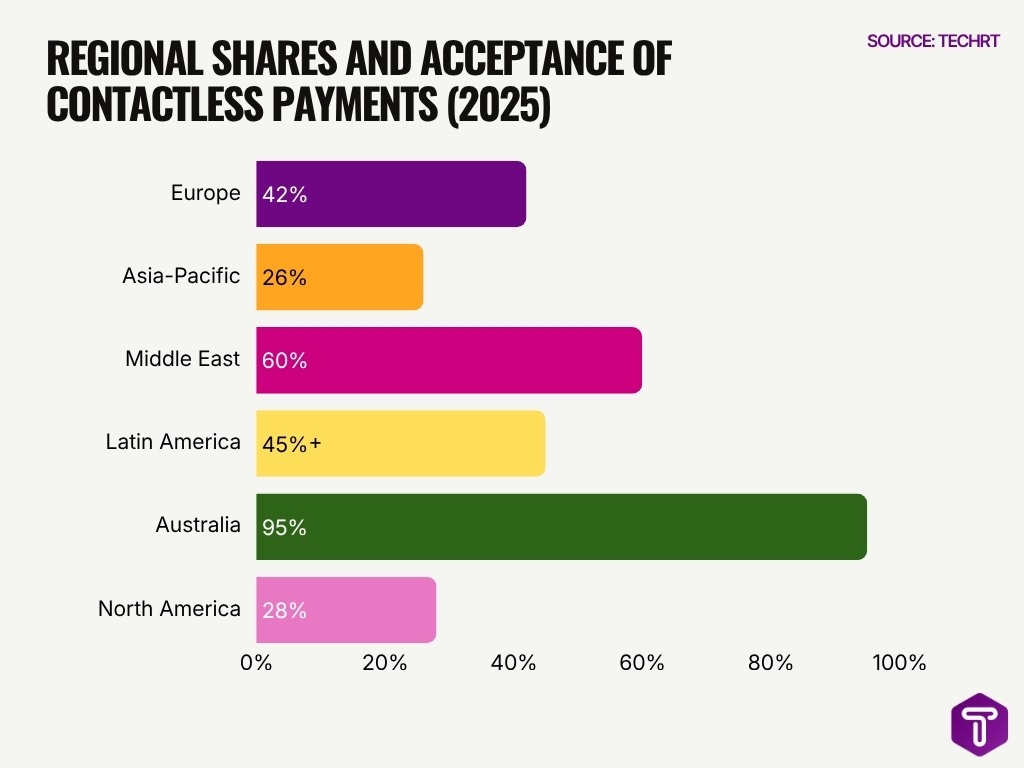
- Europe generated over 42% of global contactless payment revenue in 2025.
- The Asia‑Pacific region captured 26% of the global contactless payment market share in 2025 while posting the highest CAGR of around 20%.
- China’s contactless payment transactions exceeded 400 billion annually, underpinning its dominance in non‑cash payments.
- The United States saw contactless payment transactions surpass 1.5 trillion dollars in 2025, reflecting rapid POS terminal upgrades and cashless adoption.
- India’s UPI‑linked contactless transactions grew by over 70% year‑on‑year in 2025, driven by NFC and QR tap‑to‑pay rollouts.
- Australia recorded that more than 95% of face‑to‑face card payments were conducted via contactless or tap‑to‑pay methods in 2025.
- The Middle East achieved a contactless acceptance rate of roughly 60% across retail and transit merchants by 2025.
- Latin America registered that over 45% of active banked adults used mobile‑based contactless wallets at least once per month in 2025.
- Africa processed more than 1.2 billion mobile‑first contactless transactions in 2025, boosted by NFC‑enabled banking apps and telco‑led wallets.
- North America commanded the largest regional share at around 28% of global contactless payment value in 2025.
Industry-Wise Contactless Payment Statistics
- Retail generated more than 60% of global contactless payment revenue in 2025, making it the largest industry segment.
- Quick-service restaurants saw contactless payments help cut checkout friction, with fast-food spend up 20.7% between 2023 and 2025 in one regional market.
- Public transportation is one of the fastest-growing uses, with NFC ticketing projected to rise from 11.2 billion transactions in 2025 to 44.8 billion by 2030.
- Transit contactless journeys on London public transport grew at a 39.6% CAGR from 2015 to 2024, showing how quickly tap-to-pay can scale in mass transit.
- Healthcare saw contactless usage rise by 82% in 2025 as providers leaned into safer billing and registration workflows.
- Hospitality is expanding fast, with the segment expected to post the highest CAGR of 24.3% in one market view because of mobile check-ins and digital payments.
- Stadiums and entertainment venues are moving toward cashless operations, with the sports-venue cashless payments market valued at $18.6 billion in 2025.
- Vending machines are adopting NFC quickly, with contactless-enabled vending machines increasing by 38% globally in 2025.
- E-commerce is tied closely to wallets and digital checkout, with contactless payments projected to surpass $10 trillion by 2027.
- Fuel stations and convenience stores are benefiting from high-frequency tap usage, as the broader contactless market is projected to grow from $69.7 billion in 2025 to $84.2 billion in 2026.
Demographics of Contactless Payment Users
- 73% of millennials and 66% of Gen Z consistently used contactless payments, making younger adults the strongest user base.
- Consumers aged 18 to 24 reported 45% weekly contactless use, while the 25 to 34 group was close behind at 44%.
- In the United States, about 80% of people aged 25 to 34 regularly use NFC payments for in-store shopping.
- Among consumers aged 34 and below, 37% said mobile wallets were their main payment method.
- For consumers aged 35 and over, 54% reached for contactless debit or credit cards first, while only 13% used mobile phones as their primary payment method.
- Consumers with annual incomes above $75,000 were projected to make up 46.5% of all contactless payment users in the U.S. by 2025.
- More than 70% of NFC payment users were millennials and Gen Z, showing strong adoption among students and younger professionals.
- Women accounted for 53% of NFC payment users worldwide, with men at 47%.
- In urban and rural comparisons, digital payment adoption reached 84.6% in urban areas versus 46.8% in rural areas.
- Urban users recorded 56.4% digital payment adoption compared with 43.6% for rural users, reflecting stronger POS access in cities.
Top Drivers of Contactless Payment Adoption
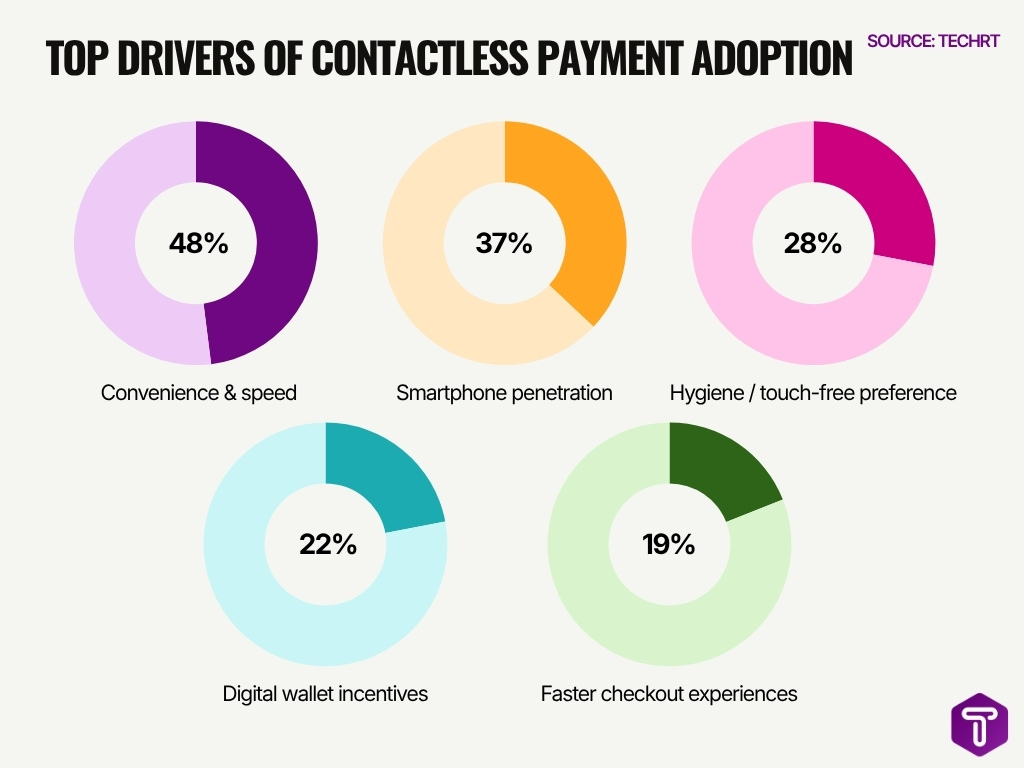
- Convenience & speed is the leading driver of contactless payment adoption, with 48% of respondents identifying it as a key factor.
- Smartphone penetration ranks second at 37%, showing that wider access to smartphones is strongly supporting the shift toward contactless payments.
- Hygiene and touch-free preference accounts for 28%, indicating that many consumers value contactless payments for reducing physical contact during transactions.
- Digital wallet incentives influence 22% of adoption, suggesting that cashback, discounts, and rewards continue to encourage users to choose contactless payment methods.
- Faster checkout experiences are cited by 19%, highlighting the importance of shorter queues and smoother payment processes for consumers.
- Overall, the data shows that contactless payment adoption is mainly driven by practical benefits, especially speed, ease of use, smartphone access, and touch-free convenience.
Security and Fraud Statistics in Contactless Payments
- 85% of senior payment professionals said fraud detection is the top AI use case, showing why banks pushed AI-based fraud tools in 2025.
- Tokenization secured 89% of NFC-based payments globally, and 60% of merchants used it in 2025 to protect payment data.
- Contactless fraud stayed low at 0.0005% per transaction, while card-not-present fraud remained far higher at about 0.93% of turnover.
- 95% of major wallets used two-factor authentication, supporting stronger consumer protection across mobile payment ecosystems.
- 84% of consumers used biometric authentication, while 85% said security is a top concern when choosing a wallet.
- In 2025, 72% of mobile authentication platforms adopted AI-driven multimodal biometrics, lifting fraud detection accuracy by 40%.
- The SEPA Instant Payments Regulation required EU banks to receive instant payments from 9 January 2025 and send them by October 2025.
- Verification of Payee checks were introduced to help reduce authorized push-payment fraud in Europe, with the rule tied to the 2025 instant-payments rollout.
- Contactless card fraud remained below overall card fraud, with physical card presence cutting losses to around 0.06% versus 0.93% for card-not-present transactions.
Merchant Acceptance and POS Terminal Statistics
- 89% of global POS terminals now accept contactless payments, nearing universal adoption by 2030.
- 86% of global consumers use contactless payment methods in 2025, driving merchant acceptance.
- 68% of U.S. card transactions are contactless-enabled, up 10% year-over-year.
- Nearly 180 million EFTPOS terminals were installed globally at the end of 2024, growing 11% annually.
- Soft POS merchants will exceed 34.5 million globally by 2027, up 475% from 2022.
- The mobile POS market reached $27.51 billion in 2025, projected to hit $68.68 billion by 2033.
- 83% of small businesses adopting contactless tech reported higher customer satisfaction in 2025.
- 71% of transactions in Europe were contactless in 2024, leading global regions.
Future Trends and Forecasts
- The global contactless payment market is projected to reach $240.12 billion by 2035 at a 15.65% CAGR.
- Digital wallet users are expected to pass 6 billion by 2030, equal to more than three-quarters of the global population.
- Mobile wallets accounted for roughly half of global e-commerce payment transactions in 2024 and are projected to grow at an 18.1% CAGR through 2030.
- The wearable payment devices market is forecast to rise from $69.95 billion in 2025 to $82.16 billion in 2026.
- The biometric payment market is projected to grow from $13.72 billion in 2026 to $25.7 billion by 2030.
- The AI fraud detection market is expected to expand from $7.5 billion in 2024 at 25% CAGR, showing strong demand for real-time security.
- The embedded finance market is projected to be $155.96 billion in 2026 and is growing at a 23.84% CAGR toward 2031.
- The digital identity in the government sector market is forecast to reach $16.56 billion by 2035, with an 18.32% CAGR.
- The Asia-Pacific cross-border payments market is projected to hit $24 trillion by 2033, up from $13.5 trillion in 2025.
- Contactless payment systems are expanding across retail, transportation, healthcare, and smart city services, with transit adoption already above 80 cities using account-based ticketing.
Frequently Asked Questions (FAQs)
What is the projected size of the global contactless payment market by 2035?
How many people are expected to use mobile wallets worldwide by 2026?
What share of the contactless payment market did Asia-Pacific hold in 2025?
How much could global contactless payment transactions be worth by 2030?
What percentage of Canadian in-store transactions were contactless in 2024?
Conclusion
Contactless payments continue transforming how consumers and businesses handle transactions across retail, transportation, hospitality, healthcare, and e-commerce sectors. Strong smartphone adoption, expanding NFC infrastructure, rising digital wallet usage, and growing merchant acceptance continue pushing the market toward sustained long-term growth. At the same time, advancements in biometric security, tokenization, and AI-driven fraud prevention are helping financial institutions strengthen consumer trust in tap-based transactions.
The U.S. market remains one of the fastest-growing contactless ecosystems, while Asia-Pacific and Europe continue setting global adoption benchmarks. As mobile wallets, wearable devices, and soft POS technologies mature, contactless payments will likely become the default payment experience across both physical and digital commerce environments over the next decade.

Leave a comment
Have something to say about this article? Add your comment and start the discussion.