



Retail media networks have become one of the fastest-growing segments in digital advertising. Major retailers now monetize shopper data, website traffic, and in-store screens to create high-margin advertising businesses that compete with search engines and social platforms. Brands use these networks to target consumers closer to purchase, while retailers generate new revenue streams beyond product sales.
The impact stretches across industries. Grocery chains now use retail media to promote consumer packaged goods in real time, while ecommerce marketplaces rely on sponsored listings to increase conversion rates and supplier spending. As privacy regulations reshape digital advertising, first-party retail data has become even more valuable. Explore the latest Retail Media Network Statistics to understand where the market is growing, which platforms lead the industry, and how advertisers are shifting budgets.
Editor’s Choice
- Global retail media ad spending reached $184 billion in 2025 and could surpass $312 billion by 2030, reflecting an 11% CAGR.
- US advertisers are projected to spend $71.09 billion on retail media in 2026, up from $60.32 billion in 2025.
- More than 80% of worldwide retail media spending in 2025 came from the US and China combined.
- Retail media spending in the US is expected to grow 20% in 2025, compared to just 4.3% growth for the broader ad market.
- Amazon generated approximately $68.6 billion in advertising revenue during 2025, maintaining its position as the world’s largest retail media company.
- Walmart’s advertising business produced $6.4 billion in revenue in 2025, representing a 37% to 46% annual growth rate depending on market segment.
- Retail media is forecast to account for more than 20% of all digital ad spending by 2029.
- Retail media ad spending worldwide exceeded $145 billion in 2025, fueled by ecommerce expansion and first-party data adoption.
- Global advertising revenue is projected to surpass $1 trillion in 2026, creating stronger competition among performance-driven channels like retail media.
Recent Developments
- Walmart Connect reported 44% growth in US advertising revenue during early 2026, driven by ecommerce and streaming integrations.
- Walmart’s global advertising business increased 37% year over year in 2025, highlighting rapid retailer monetization trends.
- Amazon’s advertising business grew 22% in 2025, reaching nearly $69 billion in annual revenue.
- Retail media growth rates have slowed slightly compared to 2023 highs, but the channel still outpaces most digital advertising segments.
- In-store retail media ad spending is expected to surpass $1 billion by 2029, supported by connected displays and smart shelf technology.
- Australia’s retail media market saw 62% of businesses actively using retail media networks in 2025.
- Around 39% of Australian advertisers planned to increase retail media spending in 2026.
- Ecommerce expansion continues to drive RMN growth, with Walmart ecommerce sales climbing 24% year over year.
- Retail media now represents a core diversification strategy for retailers as margins on advertising exceed traditional retail profits.
Retail Media Networks Market Growth
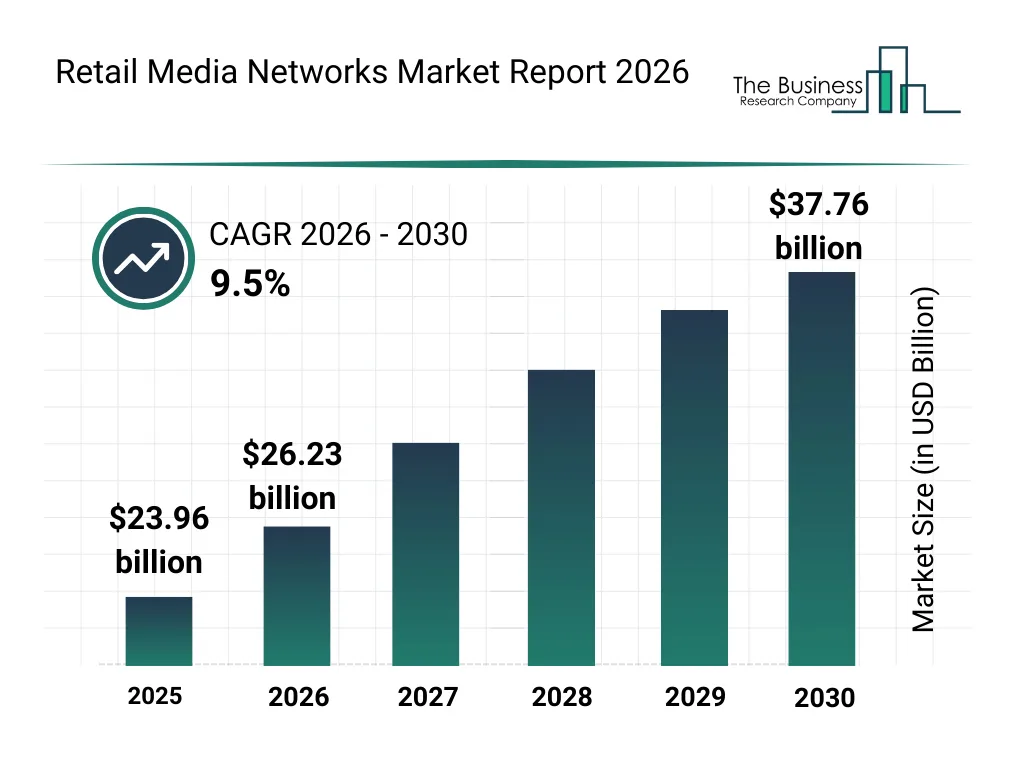
- The retail media networks market is projected to grow strongly, rising from $23.96 billion in 2025 to $37.76 billion by 2030.
- In 2026, the market size is expected to reach $26.23 billion, showing a clear increase from $23.96 billion in 2025.
- The market is forecast to expand at a CAGR of 9.5% from 2026 to 2030, indicating steady year-over-year growth.
- Between 2025 and 2030, the market is expected to add around $13.80 billion in value.
- By 2030, the retail media networks market is projected to be nearly 1.6 times larger than its 2025 size.
- The consistent upward trend suggests that brands and retailers are increasingly investing in retail media advertising, driven by stronger use of first-party data, e-commerce growth, and digital ad monetization.
- The sharp rise toward $37.76 billion by 2030 highlights retail media networks as one of the fastest-growing areas within the broader digital advertising ecosystem.
Regional Retail Media Market Performance
- The U.S. remains the largest retail media market, while China holds one of the biggest global spending shares, together accounting for 80.9% of worldwide retail media ad spend in 2025.
- North America dominated with 44.2% of global retail media revenues in 2025, reflecting its advanced ecommerce and ad-tech infrastructure.
- Europe’s retail media spend is projected to reach $43 billion by 2030, more than doubling from 2025 levels.
- Asia-Pacific excluding China is forecast to hit $26 billion in retail media spending by 2030.
- Latin America is expected to surpass $5 billion in retail media spending by 2030.
- Australia’s retail media market reached $2.6 billion, with 55% of businesses already investing and 25% planning to enter within 12 months.
- In Australia, seven in ten advertisers and agencies increased retail media spend in the past year, and 77% now work with three or more retail media networks.
- In Europe, 87% of buyers cite access to retailer first-party data as the top investment driver, showing how privacy rules are accelerating adoption.
- North American retail media continues to lead on profitability because of mature ecommerce, stronger data capabilities, and larger-scale retail ad ecosystems.
Retail Media vs Other Advertising Channels
- US retail media ad spending is projected to rise 17.2% in 2026, while social media ad growth is expected to stay below 11%.
- Retail media now captures more digital ad budgets than traditional linear TV in several major consumer categories.
- Around 69% of advertisers increased retail media budgets in 2025, compared with 54% for social advertising.
- Search advertising remains the largest digital channel globally, while retail media is the fastest-growing performance segment.
- Retail media click-through rates can be 2 to 3 times higher than standard display ads because of stronger purchase intent targeting.
- Connected TV retail media campaigns delivered stronger conversion rates than standard streaming campaigns in 2025.
- Retail media networks now account for nearly one-fifth of US digital ad spending.
- More brands shifted budgets from open-web display advertising to retailer-owned media inventory during 2025.
- Performance marketers increasingly favor retail media because campaigns connect directly to sales attribution rather than impressions alone.
Global Retail Media Ad Spend Growth
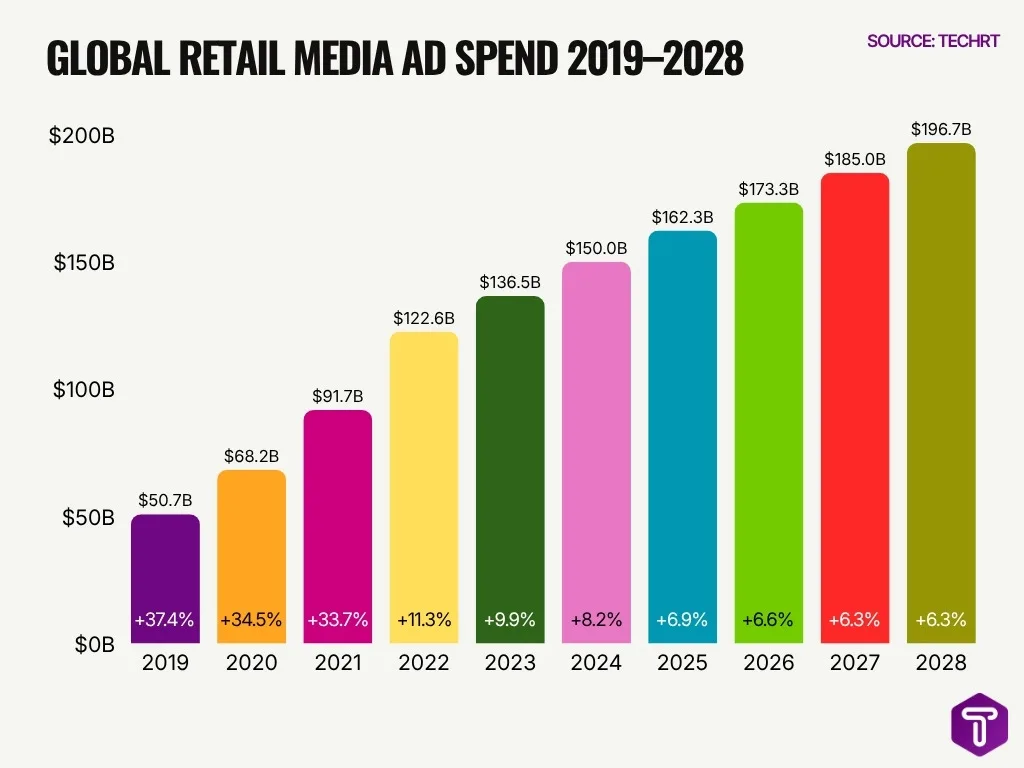
- Global retail media ad spend is projected to reach $196.7 billion by 2028, up from $50.7 billion in 2019, showing massive long-term market expansion.
- The market is expected to grow by nearly 3.9x between 2019 and 2028, highlighting retail media as one of the fastest-growing digital advertising channels.
- The strongest annual growth appeared in the early years, with ad spend rising +37.4% in 2019, +34.5% in 2020, and +33.7% in 2021.
- Retail media ad spend crossed the $100 billion milestone in 2022, reaching $122.6 billion.
- Growth slowed after 2022, but the market continued expanding steadily, increasing from $136.5 billion in 2023 to $150 billion in 2024.
- By 2025, global retail media ad spend is estimated to hit $162.3 billion, reflecting a +6.9% annual increase.
- The market is forecast to maintain consistent growth from 2026 to 2028, with annual growth rates between +6.3% and +6.6%.
- In absolute terms, global retail media ad spend is expected to add $46.7 billion between 2024 and 2028.
- The data suggests retail media is moving from a high-growth emerging channel to a more mature advertising segment with stable single-digit growth.
- The continued rise in spending shows that brands are increasingly investing in retailer-owned media platforms, driven by access to first-party shopper data, purchase intent signals, and measurable ad performance.
On-Site vs Off-Site Retail Media Advertising
- On-site retail media ads continue to generate the majority of retail media revenue globally.
- Sponsored product listings remain the most widely used on-site retail media format in ecommerce marketplaces.
- Off-site retail media spending increased by more than 30% year over year in 2025 as retailers expanded programmatic capabilities.
- Retailers increasingly use first-party shopper data to power off-site display campaigns across the open web.
- Advertisers reported stronger conversion rates from on-site ads because consumers are closer to purchase decisions.
- Off-site retail media campaigns help brands extend reach beyond retailer websites while maintaining audience targeting accuracy.
- Retailers increasingly bundle on-site sponsored listings with off-site video and connected TV inventory.
- More than 60% of advertisers used both on-site and off-site retail media campaigns in 2025.
- Off-site retail media inventory growth accelerated after third-party cookie restrictions reduced targeting precision elsewhere.
In-Store Retail Media Growth and Opportunities
- 74% of shoppers noticed in-store digital advertising during recent retail visits, showing strong visibility at the point of purchase.
- 58% of shoppers actively notice in-store displays, and nearly half say they influence purchase decisions.
- Checkout areas lead engagement, with 54% of shoppers noticing displays there, ahead of store entrances at 44% and shelf/aisle displays at 42%.
- Digital signage increased the likelihood of purchasing featured products by 8.1%, with the effect stronger when screens were placed close to the product.
- Digital proximity 6-sheet displays delivered 20.8% SKU sales lift versus 13.2% for static versions, while brand sales lift was 9.8% versus 5.2%.
- Digital gondola ends produced 11.9% SKU sales lift and 9.1% brand sales lift, beating static gondola ends at 10.0% and 5.1%.
- Across 38 in-store ad formats, the digital endcap ranked No. 8 for brand ROI at £3.08 and No. 10 for sales uplift per store at £388.
- U.S. retail media spending is expected to reach $60 billion in 2025 and $100 billion by 2028, with growth of 20% in 2025.
- In-store retail media ad spending in the U.S. was forecast to grow 32% in 2024, with a 31% CAGR from 2024 to 2028.
- Grocery retailers represent a major opportunity, with a $8.5 billion U.S. grocery retail media opportunity in 2024 and 97% of grocery chains planning white-label or third-party retail media solutions.
Amazon and Walmart Dominate US Retail Media Revenue Growth
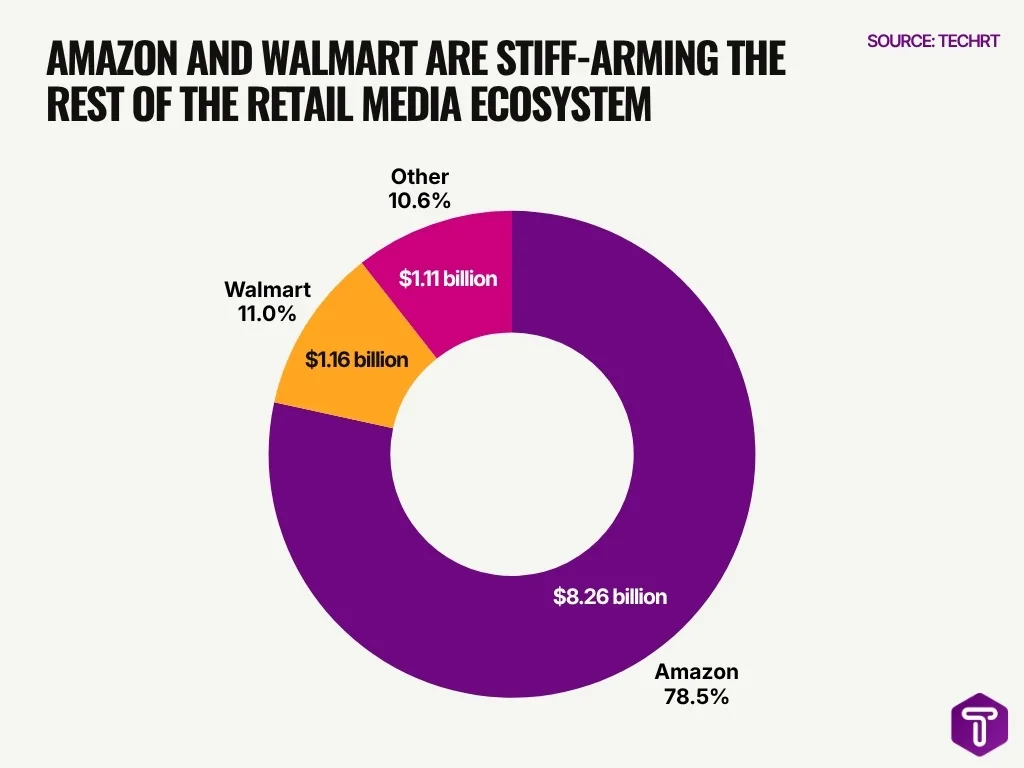
- Amazon is expected to capture 78.5% of US incremental retail media ad revenues in 2026, making it the clear leader in the market.
- In dollar terms, Amazon’s incremental retail media ad revenue is projected to reach $8.26 billion, far ahead of every other player.
- Walmart ranks second with an estimated 11.0% share, equal to around $1.16 billion in incremental retail media ad revenue.
- Together, Amazon and Walmart are expected to control 89.4% of incremental US retail media ad revenues in 2026.
- Their combined incremental revenue is projected at $9.42 billion, showing how concentrated the retail media market remains among the top two players.
- Other retail media companies are expected to account for only 10.6% of the market, or about $1.11 billion.
- The total US incremental retail media ad revenue opportunity is forecast at $10.53 billion in 2026.
- The data suggests that smaller retail media networks may face strong competitive pressure as Amazon and Walmart continue to dominate advertiser spending.
- Amazon’s share is more than 7 times larger than Walmart’s, highlighting the scale advantage of its retail media ecosystem.
- The chart shows that retail media growth is not evenly distributed, with most new revenue flowing to the largest platforms.
Retail Media Network Adoption by Retailers
- More than 200 retail media networks now operate worldwide, showing how quickly the channel has scaled.
- 76% of large retailers planned to expand retail media investments during 2025, signaling continued budget growth.
- Retail media ad spending was expected to exceed $100 billion in 2025, making it a major digital ad channel.
- Retail media spend in the U.S. was forecast to reach $71.09 billion in 2026, underscoring strong advertiser demand.
- Australia’s retail media networks market generated $708.9 million in 2024 and was projected to reach $1,526.8 million by 2030.
- Seven in ten advertisers and agencies in Australia increased retail media spend in the past 12 months, showing momentum in the market.
- 77% of Australian advertisers and agencies now work with three or more retail media networks, up from 58% last year.
- Retail media spending was projected to account for more than $1 in every $5 spent on digital media by 2029, reflecting a rising share.
- 65% of global marketers said retail media networks would play a bigger part in their media mix in the next 12 months.
Advertiser Investment and Budget Allocation
- More than 75% of US advertisers plan to increase retail media budgets in 2026.
- US retail media spending will reach $71.09 billion in 2026, up 17.8% year-over-year.
- CPG brands allocate budget to 2+ retail media networks, with 34% sourced from trade marketing.
- Advertisers shifted $60.32 billion from traditional display to retailer-owned ecosystems in 2025.
- Approximately 45% of marketers ranked retail media among their top three advertising priorities for 2026.
- Brands allocate retail media across onsite search, display, video, and CTV, with ROAS holding at $6.00.
- 80% of digital advertisers allocated a retail media budget, with most planning to increase spend.
- Retail media delivered a stronger return-on-ad-spend than social media, with spend up 27% and clicks up 38%.
- Amazon and Walmart capture 89% of incremental retail media spending, consolidating enterprise budgets.
Consumer Response to Retail Media Ads
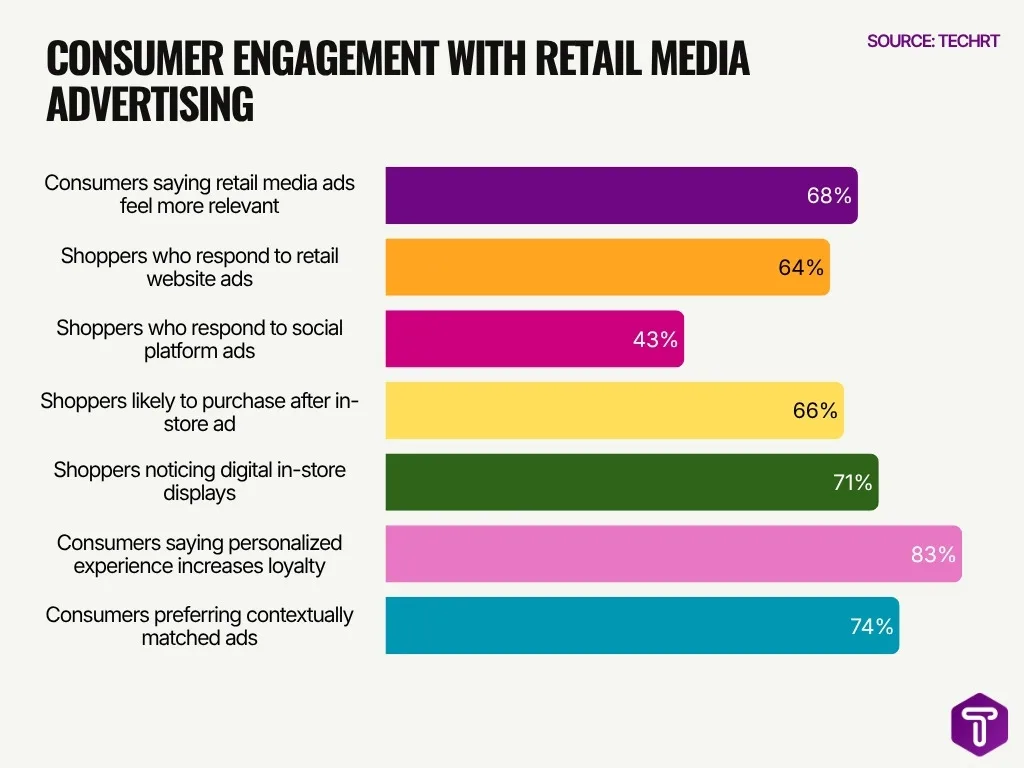
- Around 68% of consumers say retail media ads feel more relevant than generic digital ads.
- 64% of shoppers respond to retail website ads compared with 43% for social platforms.
- 66% of shoppers say they’re likely to purchase after seeing an in‑store ad.
- 71% of shoppers reported noticing digital in‑store displays during recent visits.
- 83% of consumers say a personalized experience increases brand loyalty.
- Retail media tied to discounts or loyalty offers can increase engagement by up to 50% versus non‑incentivized ads.
- Sponsored product placements influence purchase intent in categories like grocery and electronics for roughly 30–45% of shoppers.
- Younger consumers (Gen Z and younger millennials) are about 20–30% more likely to engage with retail media integrated into e‑commerce than older groups.
- 74% of consumers prefer ads that match the content or shopping context they’re viewing.
- Consumers are more willing to share shopping data with retailers than with social platforms, by a margin of about 20 percentage points.
Retail Media ROI and Performance Metrics
- Retail media campaigns deliver 3x to 5x return on ad spend, depending on category and placement.
- Sponsored product ads achieve 10%–15% ecommerce conversion rates, among the highest in digital advertising.
- 67% of marketers cite measurable ROI as the main reason for increasing retail media investments.
- Retail media offers 20%–30% stronger closed-loop attribution than traditional display advertising.
- On-site retail media ad conversion rates exceed standard ecommerce display ads by 2x due to purchase intent signals.
- 78% of retail media reporting dashboards now include real-time sales attribution and audience insights.
- Brands demanding standardized measurement across retail media networks grew 45% in 2025.
- Retailers with advanced analytics platforms reported 35% stronger advertiser retention rates during 2025.
First-Party Data Advantages in Retail Media
- 74% of marketers said first‑party data became more valuable after cookie restrictions expanded.
- >60% of advertisers ranked retailer‑owned audience data as a top factor when choosing retail‑media partners in 2025.
- Retailers with large loyalty ecosystems drive deterministic purchase signals that increase advertiser demand by double‑digit percentages.
- Consumers trust retailers more than social platforms for data sharing and personalization, boosting willingness to share purchase data by majorities in recent surveys.
- First‑party data lets retailers build audience segments from actual purchase behavior rather than inferred interests, improving targeting precision by notable margins.
- Combining online and offline purchase histories improves ad targeting accuracy, with retailers reporting measurable lifts in conversion when linking POS and ecommerce data.
- Loyalty‑based targeting in retail media produced higher conversion rates than broad demographic targeting across multiple campaign studies.
- Privacy regulations (GDPR/CCPA) have made first‑party retail data strategically essential, prompting most retailers to prioritize first‑party collection efforts.
Retail Media Measurement Effectiveness
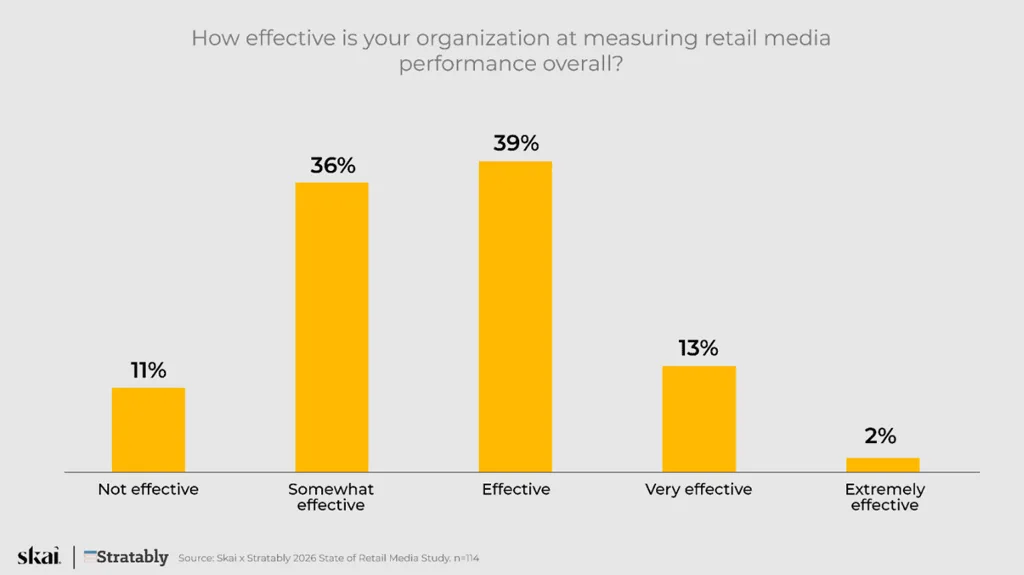
- 39% of organizations said they are effective at measuring retail media performance, making it the largest response group in the chart.
- 36% of respondents rated their organization as only somewhat effective, showing that many businesses still have room to improve their retail media measurement systems.
- Only 13% of organizations considered themselves very effective at measuring retail media performance.
- Just 2% of respondents said they are extremely effective, suggesting that advanced retail media measurement maturity is still rare.
- 11% of organizations reported being not effective, meaning a small but notable share still struggles with basic performance tracking.
- Combined, 75% of organizations fall into the somewhat effective or effective range, indicating that most companies have some measurement capabilities but may not yet be highly advanced.
- Only 15% of organizations are in the very effective or extremely effective categories, highlighting a clear opportunity for better attribution, reporting, and performance analytics in retail media.
- The data suggests that while retail media adoption is growing, measurement maturity remains a major challenge for brands, retailers, and advertisers.
Programmatic Retail Media Trends
- Global programmatic retail media spending grew by over 30% in 2025.
- Retailers generating more than 15% of total digital ad revenue from retail media accelerated programmatic integrations.
- Nearly 60% of major retailers now connect their retail media inventory to demand‑side platforms for programmatic buying.
- Off-site programmatic retail media inventory grew by more than 25% globally in 2025.
- Around 58% of marketers reported increasing programmatic retail media budgets in 2025.
- Retailers using AI‑driven bidding systems saw over 20% improvement in campaign ROI from programmatic retail media in 2025.
- Connected TV programmatic retail inventory grew by over 40% year‑on‑year in 2025.
- More than 50 self‑service programmatic retail portals were live across major retailers by mid‑2025.
- Programmatic retail media now accounts for more than 10% of total global display and video programmatic spend.
- Brands using programmatic retail media achieved an average click‑through rate uplift of around 35% versus traditional retail ads in 2025.
CPG Brand Spending on Retail Media
- Around 70% of CPG marketers increased retail media investments in 2025.
- CPG companies typically allocate 20% of their total media budget to retail media.
- Retail media spend grew 17.6% YoY, reaching 15.4% of global digital ad spend in 2025.
- US retail media off-site ad spend is expected to grow 42.1% in 2025, more than twice the rate of on-site spend.
- 65% of global marketers said retail media networks will play a bigger part in their media mix in 2025.
- Retail media now represents over 20% of all global digital ad spending, up from less than 15% just two years prior.
- Sponsored product ads on Instacart deliver 18-25% conversion rates for CPG brands.
- Grocery and CPG categories show higher in-store lift from retail media campaigns due to frequent purchase cycles.
- Global retail media ad spend is projected to surge from $184 billion in 2025 to $312 billion by 2030.
- 80% of worldwide retail media ad spending happens in China and the U.S. in 2025.
AI Search Is the Biggest Disruption for RMN Leaders
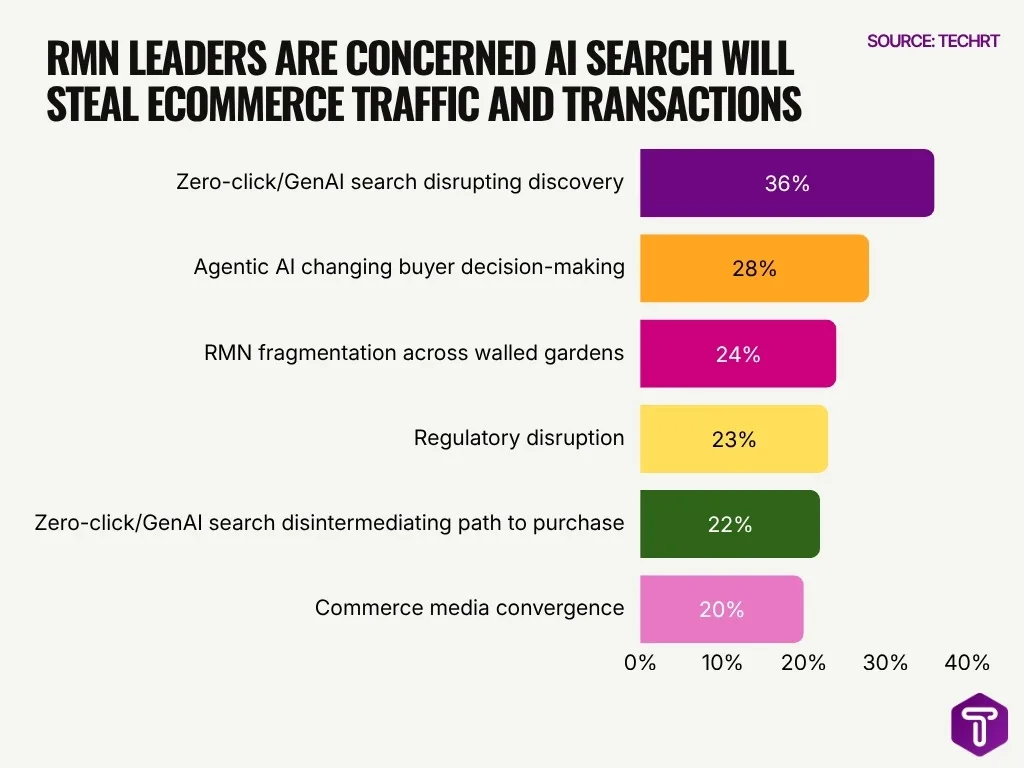
- Zero-click/GenAI search disrupting discovery is the top concern for RMN leaders, with 36% identifying it as the most disruptive force.
- Agentic AI changing buyer decision-making ranks second at 28%, showing that AI-driven shopping assistants may increasingly influence how consumers choose products.
- RMN fragmentation across walled gardens is a major industry challenge, cited by 24% of leaders, highlighting concerns around disconnected retail media ecosystems.
- Regulatory disruption follows closely at 23%, suggesting that privacy rules, data governance, and advertising regulations remain important risks for retail media networks.
- Zero-click/GenAI search disintermediating the path to purchase was selected by 22% of RMN leaders, reinforcing fears that AI search could reduce direct ecommerce traffic.
- Commerce media convergence is seen as disruptive by 20%, indicating that the lines between retail media, commerce media, and broader digital advertising are becoming less clear.
- Overall, the data shows that AI search-related concerns dominate the disruption landscape, appearing in two separate categories with 36% and 22% shares.
- The findings suggest RMN leaders are increasingly worried that AI-powered search experiences may capture product discovery, decision-making, and transactions before shoppers reach retailer websites.
Frequently Asked Questions (FAQs)
How large is the global retail media market expected to become by 2030?
How much will US advertisers spend on retail media in 2026?
What share of global retail media spending comes from the US and China?
What is the expected CAGR of the retail media networks market from 2025 to 2029?
How fast is retail media advertising growing in the US in 2025?
Conclusion
Retail media networks continue to reshape the global advertising landscape as retailers transform shopper data and ecommerce traffic into high-growth media businesses. Stronger first-party data capabilities, closed-loop attribution, and measurable performance metrics have pushed brands to increase investment across onsite, offsite, and in-store advertising channels.
The market’s momentum also reflects broader changes in digital advertising. Privacy regulations, AI-driven targeting, and connected commerce experiences continue accelerating retail media adoption among retailers, advertisers, and technology providers. As competition intensifies, networks with stronger measurement systems, scalable audience data, and omnichannel advertising capabilities will likely capture the largest share of future ad spending.

Leave a comment
Have something to say about this article? Add your comment and start the discussion.