




Artificial intelligence is transforming how people find and consume information online. AI-generated summaries, often called AI Overviews, are reshaping search behavior, reducing traditional clicks, and redefining digital visibility across industries. From improving efficiency in customer support to reshaping SEO strategy for marketers, the impact of these summaries is both broad and measurable. Below, we begin our deep look at key data and trends driving the evolution of AI Overviews in search and digital ecosystems.
Editor’s Choice
These are standout statistics reflecting the scope and influence of AI Overviews in 2026.
- ~2 billion users engage with Google AI Overviews globally each month.
- Organic click-through rates (CTR) can drop by up to 61% when AI Overviews appear.
- 93% zero click rates have been observed in AI Mode search sessions.
- AI-driven referrals convert at roughly 23× higher rates than traditional organic search traffic.
- 60% of all searches now result in no outbound click in AI-heavy interfaces.
- AI Overviews appear in approximately 25% of all Google searches in 2026, up significantly year over year.
- Roughly 30% of keywords trigger AI Overviews in U.S. search engine results pages.
- When cited in an AI Overview, a source’s CTR can increase from 0.6% to ~1.08%.
Recent Developments
AI Overviews continue evolving, with new features, integrations, and industry responses shaping user experience and safety.
- Google recently updated the AI Mode source displays, improving link clarity for fact-checking.
- Safety concerns persist, including reported misleading health advice in AI summaries.
- Scammers can sometimes insert fraudulent information into AI Overviews, prompting warnings from security experts.
- Critics argue AI Overviews may underemphasize critical disclaimers, especially in health-related queries.
- AI summarization continues to be refined with enhanced desktop and mobile UI updates for transparency.
- Partnerships between AI platforms and publishers are emerging to expand citation quality.
- The debate continues about AI Overviews’ impact on publisher revenue and traffic models.
- Advances in generative AI frameworks are driving deeper integration with voice and mobile search interfaces.
What are AI Overviews?
AI Overviews are AI-generated summaries that appear at the top of search engine results pages, designed to give users quick, concise answers without clicking through to individual websites.
- Introduced in 2023 as part of Google’s Search Generative Experience, AI Overviews summarize multiple sources into one cohesive response.
- By May 2025, AI Overviews were available in over 200 countries and territories.
- Early deployment showed that when featured alongside traditional snippets, AI Overviews could occupy up to ~75% of the visible mobile screen.
- They synthesize data across multiple domains, often citing 3–8 sources per summary.
- Instead of ranking links by keywords, they generate narrative answers based on intent and query structure.
- Overviews vary by language, region, and device type, affecting visibility and format.
- AI Overviews can appear not just for informational queries but also in instructional and comparison searches.
- Critics note potential accuracy issues for sensitive topics like health or legal content.
Key AI Overviews: Adoption Statistics
Adoption of AI Overviews and AI-assisted search behavior shows rapid growth across platforms and audiences.
- AI Overviews appear on roughly 25.11% of Google queries in 2026, up from ~13.1% in early 2025.
- In U.S. SERPs, about 30% of keywords now trigger AI Overviews.
- Global AI search usage has surged, with some studies suggesting AI referrals account for ~1.08% of all site traffic, steadily rising month over month.
- The overall AI search traffic growth year over year has exceeded 500% in recent analyses.
- Many organizations report that AI adoption in business functions now exceeds 50%, especially in the IT and telecom sectors.
- Daily active usage of generative AI tools ranges from 115M to 180M globally as of early 2025, indicating rising engagement.
- ChatGPT and similar platforms process billions of prompts monthly, boosting the broader AI search ecosystem.
- Nearly 40% of Americans use an AI chatbot at least once a month for information searches.
USA State-wise AI Overviews: Appearance Rates
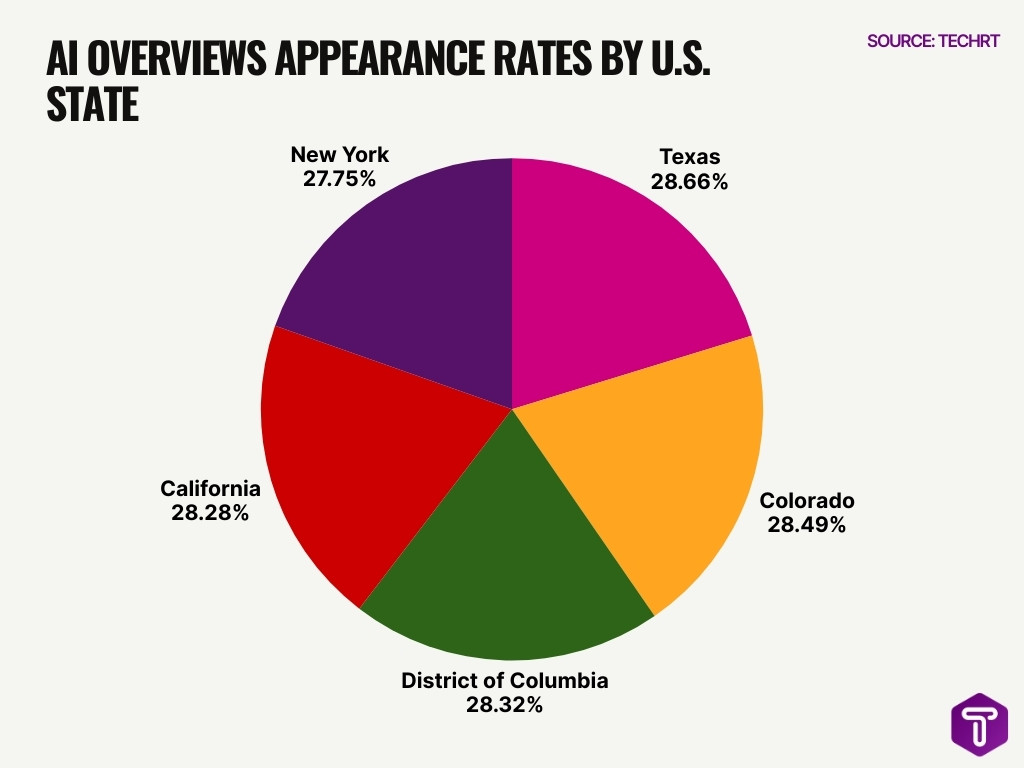
- Texas leads nationwide with the highest AI Overviews appearance rate at 28.66%, indicating strong adoption and frequent triggering of AI-generated summaries in search queries.
- Colorado ranks second at 28.49%, showing nearly identical engagement levels with AI Overviews as Texas.
- Washington, DC, follows closely with 28.32%, reflecting high usage despite its smaller population size.
- California records a strong rate of 28.28%, highlighting widespread exposure to AI Overviews in one of the largest digital markets.
- New York maintains a solid performance at 27.75%, remaining competitive among top-tier states.
- All top five locations fall within a narrow range of 27.75% to 28.66%, suggesting consistent AI Overview visibility across major U.S. regions.
- The overall variation between the highest and lowest states is only 0.91 percentage points, showing minimal regional disparity.
- States with major technology, research, and business hubs tend to show higher AI Overview activation rates.
- Higher appearance rates indicate that users in these regions frequently search for complex, informational, and exploratory queries.
- The data suggests that urbanized and digitally mature regions are more likely to trigger AI-powered search summaries.
AI Overviews: Penetration by Country and Region
AI Overviews have expanded rapidly across markets, but penetration varies by geography due to regulatory, language, and infrastructure differences.
- As of 2026, Google AI Overviews are available in 200+ countries and territories, following a phased global rollout from 2024 to 2025.
- In the United States, AI Overviews appear in roughly 30% of tracked keywords, making it the most mature AI Overview market.
- U.K. SERPs show AI Overviews in approximately 18 to 22% of informational queries, lower than U.S. penetration due to staggered deployment.
- Canada reports AI Overview presence in about 24% of desktop searches, with stronger visibility in health and finance verticals.
- In Australia, AI Overviews trigger in roughly 20% of non-branded queries, reflecting similar patterns to other English-speaking markets.
- India saw rapid growth in 2025, with AI Overview’s presence expanding to 15%+ of English language queries within months of release.
- EU rollout initially excluded some regions due to regulatory reviews under the Digital Markets Act, delaying deployment by 6 to 12 months compared to the U.S.
- Latin American markets show lower visibility rates, averaging 10 to 14% of informational searches, reflecting staged expansion.
- Mobile-first markets, including Southeast Asia, report faster adoption where AI search features integrate with Android ecosystems.
AI Overviews Availability by Language
Language support plays a critical role in AI Overview accuracy and adoption.
- AI Overviews initially launched in English only in 2023 before expanding to multilingual support.
- By late 2025, Google confirmed support for more than 40 languages, including Spanish, Portuguese, Hindi, and Japanese.
- Spanish language AI Overviews now account for roughly 8 to 12% of visible SERP features in Spain and Latin America.
- Hindi language AI search adoption grew significantly after mobile rollout, contributing to India’s 500M+ internet user base engagement.
- Japanese AI Overview queries demonstrate higher precision rates, with internal Google benchmarks showing improved summarization quality scores year over year.
- German language SERPs show lower trigger rates at approximately 15 to 18%, partly due to stricter compliance standards.
- Bilingual queries, for example, Spanish-English, show higher variability in citation sources, often pulling from both language domains.
- Emerging language support in Arabic and Korean expanded in 2026, targeting high-growth digital markets.
- Multilingual AI models have reduced translation latency by 30%+ compared to 2024 benchmarks, improving real-time answer generation.
AI Overviews Word Count Distribution Insights
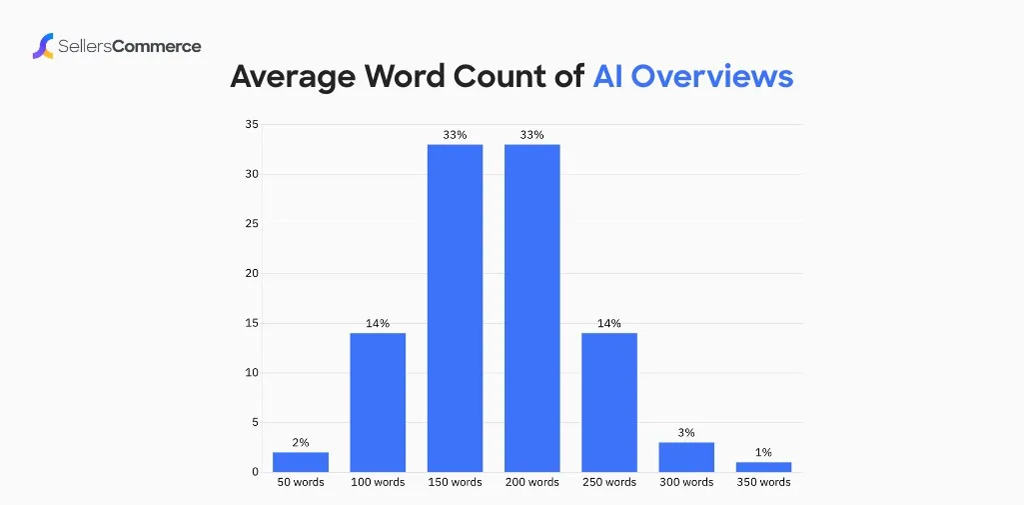
- The majority of AI Overviews fall between 150–200 words, with both ranges accounting for 33% each, showing that Google favors medium-length summaries.
- Around 66% of all AI Overviews are concentrated in the 150–200 word range, making this the dominant content length.
- Short AI Overviews of about 100 words represent 14%, indicating moderate use for quick-answer queries.
- Very summaries of 50 words appear in only 2% of cases, highlighting their limited adoption.
- Longer AI Overviews with 250 words also account for 14%, suggesting occasional in-depth responses.
- Extended summaries of 300 words make up just 3%, showing that lengthy AI explanations are uncommon.
- Ultra-long AI Overviews of around 350 words are extremely rare at only 1%, reinforcing Google’s preference for concise content.
- Overall, nearly 80%+ of AI Overviews stay below 250 words, emphasizing a strong focus on clarity and fast readability.
- The data suggests that content optimized for 150–200 words has the highest chance of being reflected in AI Overviews.
- Publishers targeting AI visibility should prioritize creating concise, structured, and mid-length content to align with this dominant pattern.
AI Overviews Usage by Device and Platform
Device behavior strongly influences AI Overview visibility and engagement.
- AI Overviews occupy up to 70%+ of the visible screen space on mobile, reducing traditional organic visibility.
- Mobile accounts for approximately 63% of global search traffic, amplifying AI Overview exposure on smartphones.
- Desktop AI Overview: CTR impact appears slightly lower than on mobile, with studies showing 45 to 55% organic CTR drops on desktop compared to steeper declines on mobile.
- Android integration has accelerated AI Overview adoption in mobile-first regions, where Android holds 70%+ global OS market share.
- Voice search integration with AI Overviews continues expanding, aligning with the 8.4 billion digital voice assistants projected globally.
- AI Mode in Google Search Labs increased user engagement time per query by measurable margins in 2025 pilot testing.
- Chrome browser integration improved citation visibility and inline expansion features in late 2025 updates.
- Tablet usage shows lower AI Overview interaction compared to smartphones, representing less than 5% of search device share globally.
- Cross-device behavior indicates users frequently complete transactional queries on desktop after starting informational searches on mobile.
AI Overviews Frequency by Query Type and Intent
Intent plays a defining role in whether AI Overviews appear.
- Informational queries show the highest trigger rate, with AI Overviews appearing in 40%+ of complex informational searches.
- How to queries frequently generate AI summaries, especially multi-step instructional searches.
- Comparison queries, for example, X vs Y, trigger AI Overviews in approximately 30% of cases.
- Branded navigational searches show significantly lower AI Overview presence, often under 10%.
- Transactional queries demonstrate moderate appearance rates, typically between 15 to 20%, depending on industry.
- Long tail queries, five or more words, are more likely to generate AI summaries than short head terms.
- Multi-part questions increase trigger likelihood due to the generative model’s strengths in synthesis.
- Zero-click informational queries correlate strongly with AI Overview visibility, reinforcing user reliance on summaries.
- Question-based searches starting with what, how, or why show the highest AI Overview saturation across U.S. SERPs.
AI Overviews: Adoption by Industry and Vertical
Adoption rates vary by sector, depending on query complexity and regulatory sensitivity.
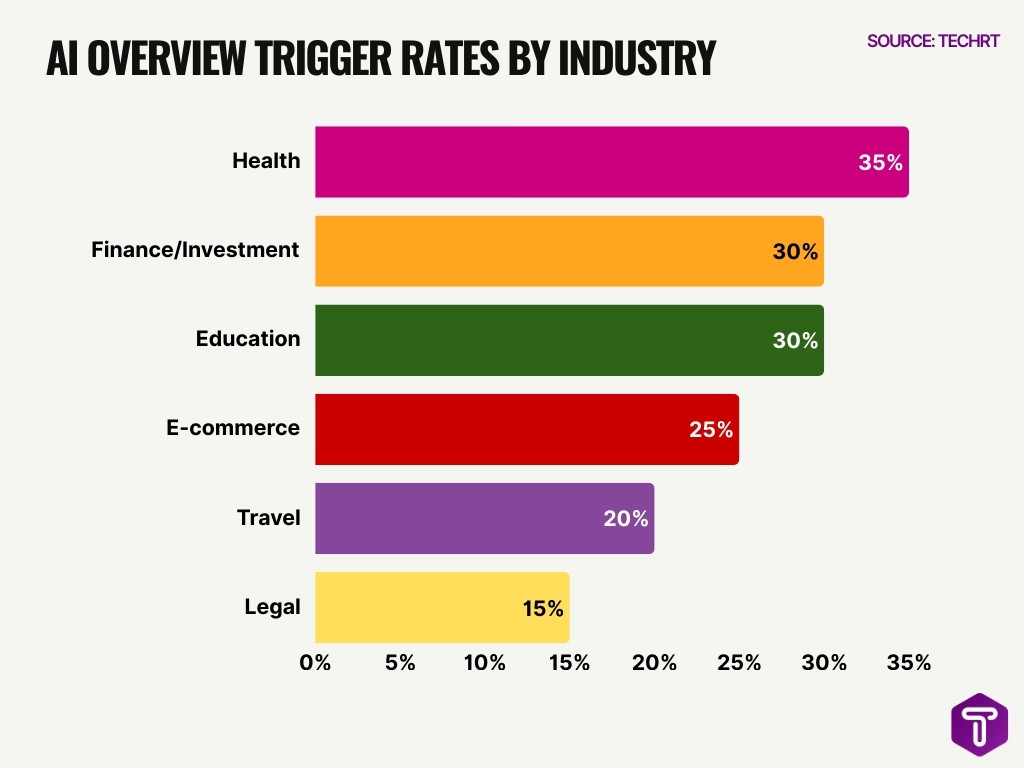
- Health-related queries show some of the highest AI Overview trigger rates, often exceeding 35% of informational searches.
- Finance and investment queries see AI Overviews in roughly 28 to 32% of tracked keywords, reflecting strong demand for summary answers.
- E-commerce product comparisons increasingly trigger AI Overviews in 25%+ of comparison searches.
- Education-related queries demonstrate strong visibility, with AI summaries appearing in about 30% of how-to academic searches.
- Travel queries show moderate adoption, around 18 to 22%, often supplemented with Google’s travel modules.
- B2B technology searches increasingly surface AI Overviews, particularly in SaaS comparisons and software definitions.
- Legal-related queries trigger fewer AI Overviews, averaging below 15%, due to higher accuracy risk thresholds.
- Local service queries, for example, plumbers and dentists, rely more heavily on local packs than AI Overviews, limiting penetration in transactional intent searches.
- News-related queries display lower AI Overview persistence due to freshness algorithms prioritizing live updates.
Share of Branded vs Non-Branded Queries with AI Overviews
AI Overviews appear more frequently in non-branded contexts, impacting discovery strategies.
- Non-branded queries trigger AI Overviews at 24.9% vs 13.1% for branded.
- 76.3% of all AI Overviews appear on non-branded keywords.
- AI Overviews are 1.9x more likely for non-branded than branded searches.
- Only 4.9% of branded terms trigger AI Overviews in the analyzed data.
- Non-branded searches are 2x more likely to show AI Overviews than branded.
- Branded queries with AI Overviews see +18% CTR boost.
- AI Overviews appear on 46% of 7+ word long-tail queries.
- Informational queries make up 99.9% of AI Overview triggers.
- About 70% of AI Overview citations change in 2-3 months, causing volatility.
Impact of Site Frequency on AI Overview Visibility
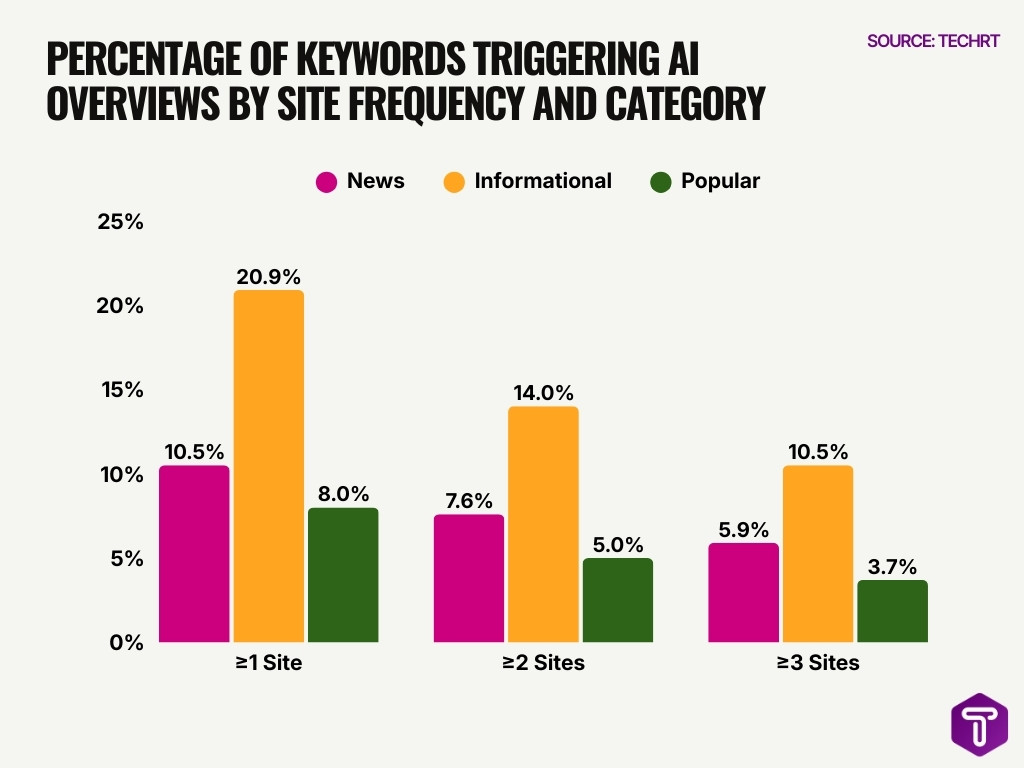
- Informational keywords dominate AI Overviews, with the highest presence at 20.9% when appearing on ≥1 site, making them the most favored content type.
- As site frequency increases, AI Overview visibility declines across all categories, indicating stronger filtering for multi-site queries.
- News-related keywords trigger AI Overviews at 10.5% for ≥1 site, but drop to 5.9% at ≥3 sites, showing reduced exposure in competitive spaces.
- Popular keywords show the lowest visibility overall, starting at 8.0% (≥1 site) and falling to just 3.7% (≥3 sites).
- When keywords appear on two or more sites, Informational content still leads at 14.0%, outperforming News (7.6%) and Popular (5.0%) categories.
- Queries found on three or more sites experience a major visibility drop, with Informational falling to 10.5%, highlighting stricter ranking thresholds.
- Single-site or low-competition keywords have a significantly higher chance of being featured in AI Overviews across all content types.
- The data suggests Google prioritizes high-quality informational intent over trending or news-driven topics in AI-generated summaries.
- Content creators targeting AI Overviews should focus on unique, well-structured informational pages to maximize visibility.
- Overall, content type and site competition play a critical role in determining AI Overview inclusion and prominence.
AI Overviews Impact on Organic Click Through Rate, CTR
AI Overviews significantly influence organic click behavior, especially for informational queries.
- Multiple SEO tracking studies show organic CTR drops between 18% and 64% when AI Overviews appear on informational queries.
- A 2025 study found that pages ranking number one experienced an average 31% CTR decline when an AI Overview was present.
- Mobile SERPs show a stronger impact, with some publishers reporting CTR declines of up to 50%+ compared to desktop.
- Informational queries see the steepest drop, while transactional queries show more moderate decreases, averaging 10 to 20%.
- Pages cited inside AI Overviews can see partial CTR recovery, with citation links earning 1.5 to 2× higher CTR compared to non-cited results on the same page.
- Zero ranking organic results, positions 2 to 5, show the sharpest visibility loss when AI Overviews occupy above the fold screen space.
- News publishers reported traffic declines of 20 to 40% on certain evergreen informational topics after the AI Overview rollout in 2025.
- CTR volatility increased year over year from 2024 to 2025, with higher fluctuation in health, finance, and education verticals.
- Despite declines, branded queries remain relatively stable, with CTR impact often below 10% when AI summaries appear.
Zero-Click Searches with AI Overviews
AI Overviews accelerate the growth of zero-click search behavior.
- Before AI Overviews, 57% of Google searches ended in zero clicks.
- AI Overviews boosted news query zero-click rates from 56% to 69% (May 2024–2025).
- Queries with AI Overviews show an 83% zero-click rate vs. 60% for traditional ones.
- Informational queries in AI mode have 92–94% zero-click rates, especially “what is” types.
- Mobile zero-click rate hits 77%, compared to 46.5% on desktop.
- AI Overviews trigger on 13.14% of US desktop queries (March 2025).
- 68.8% of top publisher searches with AI Overviews result in zero clicks.
- Only 360 of 1,000 US Google searches click to the open web.
- Longer queries see AI Overviews doubled in frequency post-launch.
Traffic and Revenue Impact of AI Overviews on Websites
Traffic shifts tied to AI Overviews directly influence publisher and business revenue models.
- Digital publishers reported traffic declines of 20-60% on informational content after the AI Overviews expansion in 2025.
- AI Overviews cut click-through rates by 34.5% for top-ranking pages across 300,000+ keywords.
- Affiliate sites experienced 20-40% revenue drops from reduced traffic to reviews and buyers’ guides.
- Organic CTR dropped 61% on AI Overviews queries, from 1.76% to 0.61%.
- Cited brands in AI Overviews gained 35% higher organic CTR than non-cited ones.
- 65% of B2B SaaS firms saw 20-35% organic traffic drops, but conversions rose 18-22%.
- Publishers face 33% global organic traffic decline from AI Overviews by late 2025.
- Smaller publishers reported up to 70% traffic drops since the AI Overviews rollout.
- AI search could shift billions in ad revenue by 2026-2027 as behaviors stabilize.
SERP Features That Appear with AI Overviews
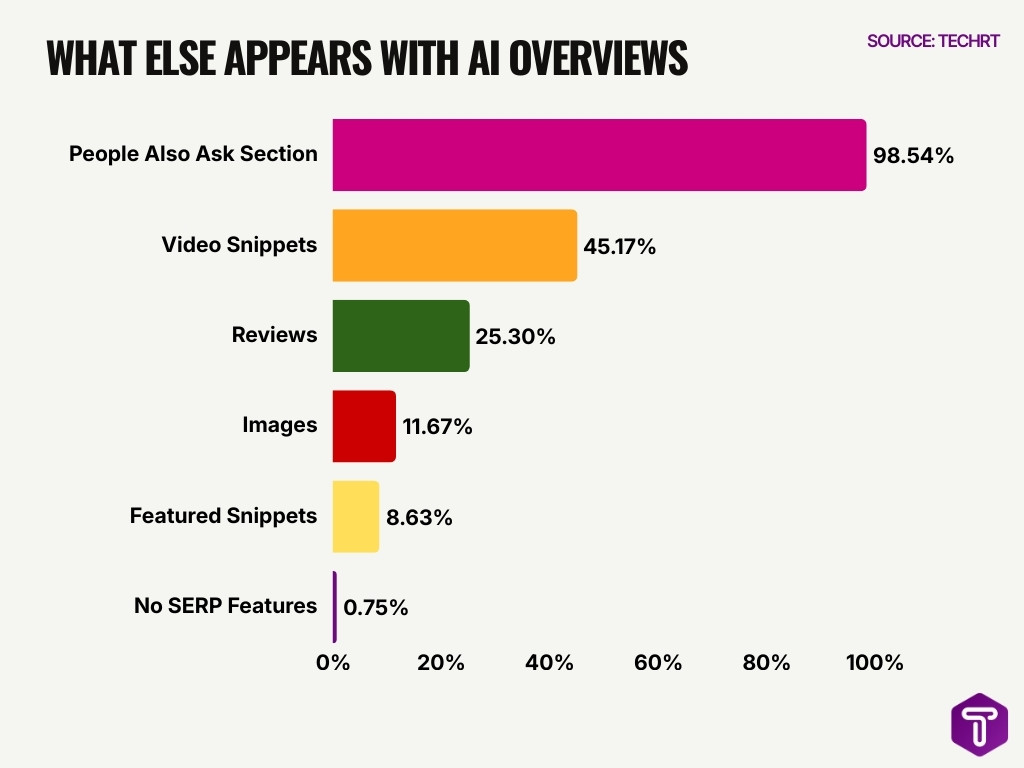
- People Also Ask dominates AI Overview results, appearing in 98.54% of search pages, showing that follow-up questions are almost always present.
- Video snippets accompany AI Overviews in 45.17% of cases, highlighting the growing importance of visual and multimedia content in search.
- Reviews are displayed alongside AI Overviews 25.30% of the time, indicating strong integration of user-generated and trust signals.
- Images appear with AI Overviews in 11.67% of results, suggesting moderate visual support for informational queries.
- Featured snippets coexist with AI Overviews in only 8.63% of searches, showing reduced overlap between traditional snippet formats and AI summaries.
- Searches with no additional SERP features are extremely rare at just 0.75%, proving that AI Overviews almost always appear with supporting elements.
- Overall, the data shows that AI Overviews rarely operate in isolation, instead functioning within a rich, multi-feature SERP ecosystem.
User Behavior Changes with AI Overviews
AI Overviews reshape how users interact with search engines.
- AI Overviews appear in 13% of global searches, cutting top-ranking page clicks by 34.5%.
- Organic CTR drops 61% when AI Overviews dominate SERPs.
- Users click traditional links in just 8% of AI summary encounters.
- Gen Z trusts AI answers over Google search at 76%.
- 42% of consumers trust AI summaries without website visits.
- 80% of AI Mode sessions skip external websites entirely.
- AI Overviews trigger 56% more for top-funnel awareness queries.
- 93% of Gen Z use two+ AI tools weekly for conversational search.
- Voice search satisfaction hits 80% with concise AI summaries.
- Desktop AI Overviews appear 39% more than on mobile.
How AI Overviews Select and Cite Sources
Understanding citation mechanics helps explain visibility shifts.
- AI Overviews cite 76% of sources from Google’s top 10 organic rankings.
- 86% of citations come from pages in the top 100 SERPs.
- Average AI Overview includes 13.34 links, up from 6.82 in 2024.
- 85% of cited sources show at least 3 strong E-E-A-T signals.
- Content with the FAQ schema has the highest citation probability among schema types.
- Cited content averages 1,282 words, above the organic average of 1,188.
- Pages updated within 60 days are 1.9x more likely to be cited.
- 96% of citations from sources with strong E-E-A-T signals.
- Sites with over 24K referring domains average 6.8 citations vs 2.5 for fewer.
- Structured data boosts AI citations by 44% with FAQ blocks.
AI Overviews vs AI Mode: Response Similarity Insights
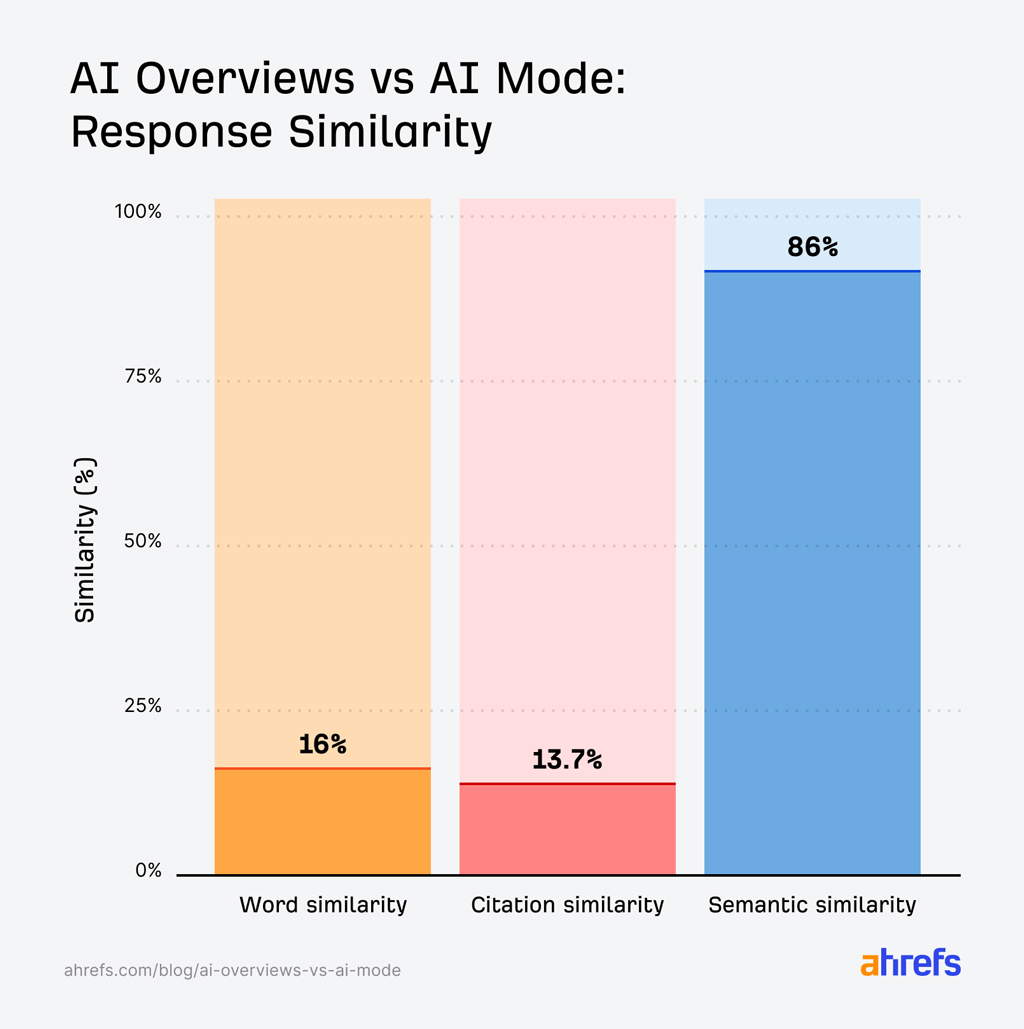
- Semantic similarity is extremely high at 86%, showing that AI Overviews and AI Mode deliver nearly the same meaning and intent in their responses.
- Despite strong semantic alignment, word similarity remains low at only 16%, indicating that both systems use different phrasing and sentence structures to convey similar information.
- Citation similarity stands at just 13.7%, suggesting that AI Overviews and AI Mode rely on different sources and references, even when answering the same queries.
- The large gap between semantic similarity (86%) and word similarity (16%) highlights how AI-generated responses prioritize meaning over exact wording.
- Low citation overlap (13.7%) implies that content creators and publishers may see varied attribution patterns, depending on which AI interface users engage with.
- With over 80%+ semantic alignment, users are likely to receive consistent and reliable answers, regardless of whether they use AI Overviews or AI Mode.
- However, the limited textual and citation overlap shows that AI systems are designed to minimize duplication, helping reduce content redundancy.
- For SEO and digital publishers, the high semantic similarity combined with low wording overlap means that AI-generated summaries may compete conceptually without copying directly.
- Overall, the data confirms that AI Overviews and AI Mode are functionally similar in meaning, but structurally and referentially different in execution.
Domain Types and Categories Most Cited in AI Overviews
Citation distribution highlights content authority trends.
- Nearly 20% of AI Overviews reference .gov domains in public policy summaries.
- Over 25% of AI-generated content cites .edu or academic resources.
- Major media like Forbes secure 804 citations across multiple niches.
- Healthline garners 113,728 mentions in medical AI summaries.
- NIH.gov dominates health queries with ~39% citation share.
- Amazon appears in 431,080 product comparison citations.
- Top 20 domains capture 66% of all AI Overview citations.
- Wikipedia leads with 11.22% of total citations at 1.1M mentions.
- Reddit holds 21% share despite forum quality thresholds.
SEO Strategy Shifts Driven by AI Overviews
AI Overviews are forcing strategic adjustments across SEO programs.
- AI Overviews trigger in 65% of long-tail queries, driving expanded targeting for complex searches.
- Structured data adoption rose to 41% for JSON-LD among sites in 2024, boosting AI citation chances.
- Organic CTR drops 61% when AI Overviews appear, shifting focus to citation optimization.
- Branded queries show +18.68% CTR gains with AI Overviews, enhancing brand resilience.
- Publishers saw 10% YoY organic traffic decline in 2025, accelerating diversification to email and social.
- AI search traffic surged 527% YoY in 2025, necessitating new visibility metrics tracking.
- Schema markup pages are 40% more likely to appear in AI summaries, increasing enterprise adoption.
- Top-10 results capture over 50% of AI Overview citations, prioritizing ranking for summaries.
Future Predictions and Forecasts for AI Overviews
Industry forecasts point toward deeper integration and continued evolution.
- Analysts forecast AI Overviews in >40% of informational queries by 2027.
- Global AI market projected to reach $347bn in 2026, fueling search integration.
- Generative AI revenue expected to hit $55.51bn in 2026 from search applications.
- Voice assistants forecasted at 8.4bn globally by 2025, boosting multimodal search.
- AI search traffic up 527% year-over-year, surpassing traditional by 2028.
- Traditional search volume is expected to drop 25% by 2026 due to AI adoption.
- Generative AI is growing at 36% CAGR through 2030, outpacing traditional search.
- AI Overviews now in 60% of U.S. searches, rising further by 2027.
- Asia-Pacific AI search at 19.3% market share in 2025, the fastest growth region.
Frequently Asked Questions (FAQs)
What percentage of Google searches now include AI Overviews in the United States, and how has that changed?
About 50% of Google searches in the U.S. now trigger AI Overviews responses, up substantially from earlier rollout phases.
By how much can organic click-through rate (CTR) drop when AI Overviews are present on a search results page?
Organic CTR can drop by up to approximately 61% for queries featuring AI Overviews compared to traditional search results.
What share of searches in AI Mode result in zero clicks according to recent behavior tracking?
Around 93% of searches conducted in AI Mode end in zero clicks, with no outbound link clicks recorded.
How much has AI search traffic growth increased year over year based on large-scale SEO analysis?
AI search traffic increased by about 527% year-over-year in 2025, indicating explosive adoption of AI-driven discovery.
What percentage of zero-click searches occur when AI Overviews are shown, compared to traditional search?
43% of searches with AI Overviews result in zero clicks, versus 34% for traditional search behavior without AI summaries.
Conclusion
AI Overviews have moved from experimental feature to core search interface in just a few years. They influence click behavior, traffic distribution, citation visibility, and user expectations across industries. Informational queries experience the greatest disruption, while branded and transactional searches remain more stable.
For U.S. businesses and global publishers alike, the path forward requires adapting SEO strategy, strengthening domain authority, and optimizing for citation visibility rather than rankings alone. As AI Overviews expand toward broader query coverage, the brands that invest in structured, trustworthy, and in-depth content will be best positioned to thrive in the next phase of AI-driven search.

Leave a comment
Have something to say about this article? Add your comment and start the discussion.