


AI is reshaping how companies find, evaluate, and hire talent at scale. By automating repetitive tasks like resume screening, interview scheduling, and candidate communication, AI allows recruiters to focus on strategic decision-making and relationship building. In industries such as healthcare and retail, AI helps manage high-volume hiring with speed and consistency, while in tech and finance, it improves precision in identifying specialized skills.
At the same time, AI-powered analytics enable organizations to predict hiring outcomes, reduce bias, and optimize workforce planning. As competition for talent intensifies and hiring timelines shrink, AI recruitment tools are becoming a core part of modern HR strategies. Let’s explore the latest data and uncover what’s driving this transformation.
Editor’s Choice
- Over 65% of recruiters have implemented AI in hiring processes as of 2026.
- 87% of companies now use AI in some part of recruitment workflows.
- AI adoption in HR rose from 26% in 2024 to 43% in 2025, signaling rapid growth.
- AI can reduce hiring time from 44 days to 11 days, improving efficiency.
- Companies report up to 30% reduction in cost-per-hire using AI.
- 72% of candidates report positive experiences with AI-powered applications.
- 93% of recruiters plan to increase AI usage in hiring in 2026.
Recent Developments
- AI adoption among businesses reached 63% in 2026, up from 45% in 2025.
- Recruitment activity increased 15% YoY in 2025, driven by AI-led hiring.
- AI-related job postings surged 130% since 2020, reflecting rising demand.
- Around 1 in 25 job postings now mention AI skills.
- 81% of companies planned to invest in AI recruitment tools in 2025.
- AI-driven platforms have handled 189 million+ candidate interactions globally.
- Nearly 98% of companies report improved hiring efficiency with AI tools.
- About 43% of organizations used AI in recruiting tasks in 2025, up sharply from 26% in 2024.
- Only 1 in 20 companies currently post AI-related roles, showing uneven adoption.
Global AI Recruitment Market Size Statistics
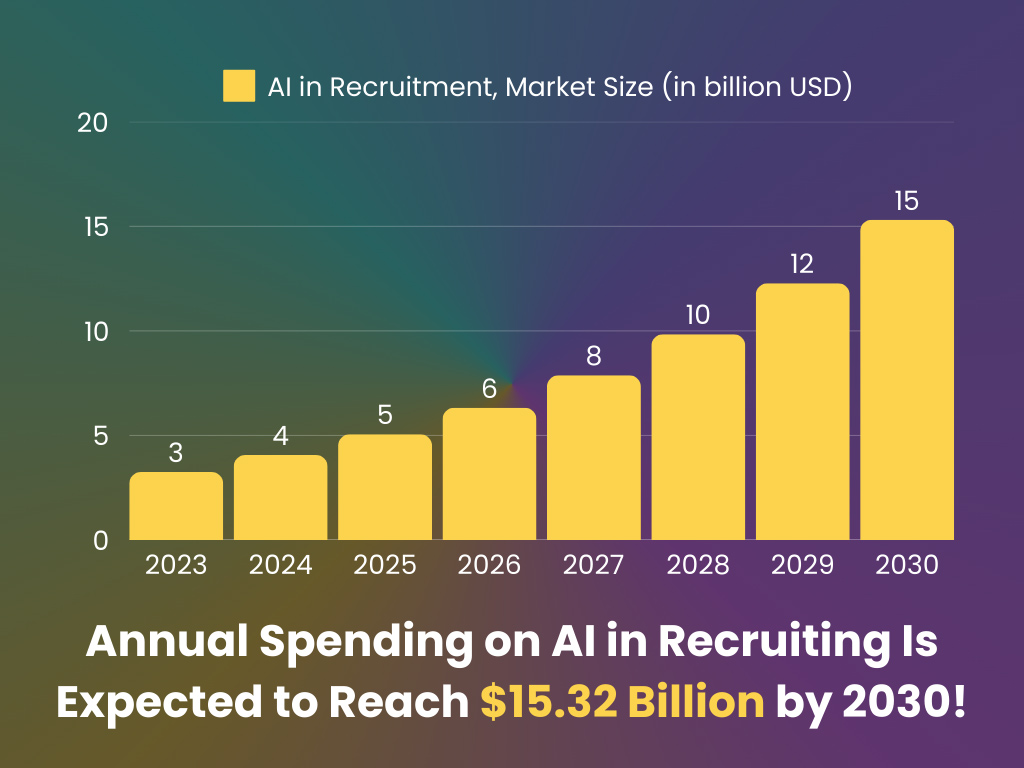
- The AI recruitment market is projected to grow from $3 billion in 2023 to $15 billion by 2030, reflecting a 5x increase within seven years.
- The market shows consistent year-over-year growth, increasing by approximately $1–2 billion annually.
- Between 2023 and 2026, the market expands steadily from $3B to $6B, indicating early-stage adoption and gradual scaling.
- A sharper acceleration begins post-2026, with the market rising from $6B in 2026 to $10B by 2028, highlighting rapid enterprise adoption.
- By 2027, the market will reach $8 billion, signaling a transition into mainstream usage across industries.
- The period from 2028 to 2030 shows strong momentum, growing from $10B to $15B, driven by automation and generative AI integration.
- The projected value of $15.32 billion by 2030 indicates sustained investment and long-term confidence in AI-driven hiring solutions.
- Overall, the data suggests a high-growth trajectory (strong CAGR) fueled by increasing demand for automation, efficiency, and data-driven recruitment.
Global Adoption of AI in Recruitment
- 99% of hiring managers use AI in some capacity in the hiring process.
- 98% saw significant improvements in hiring efficiency using AI.
- 93% of Fortune 500 CHROs confirmed their organization uses AI tools to improve business practices.
- 88% of companies use AI for initial candidate screening.
- 67% of hiring leaders cite time savings as AI‘s primary benefit in recruitment.
- AI recruitment reduces hiring costs by 30%.
- Recruitment effectiveness improves by 67% after integrating AI.
- 95% of hiring managers anticipate increased investment in AI for recruitment.
- 73% of hiring managers say AI helps match candidates to other roles.
AI Recruitment Adoption by Company Size
- Large enterprises account for nearly 90% of AI-related job postings.
- Only 1% of companies drive most AI hiring demand, indicating concentration.
- Smaller firms lag due to budget and infrastructure constraints.
- 81% of companies planned AI recruitment investments in 2025, led by enterprises.
- Startups increasingly adopt AI to compete for global talent pools.
- 63% of businesses globally now use AI tools, including SMEs.
- Enterprises report higher ROI and efficiency gains from AI hiring.
- Mid-sized companies focus on AI for cost reduction and faster hiring cycles.
- Adoption gaps persist due to skills shortages and implementation complexity.
AI Recruitment Adoption by Industry and Sector
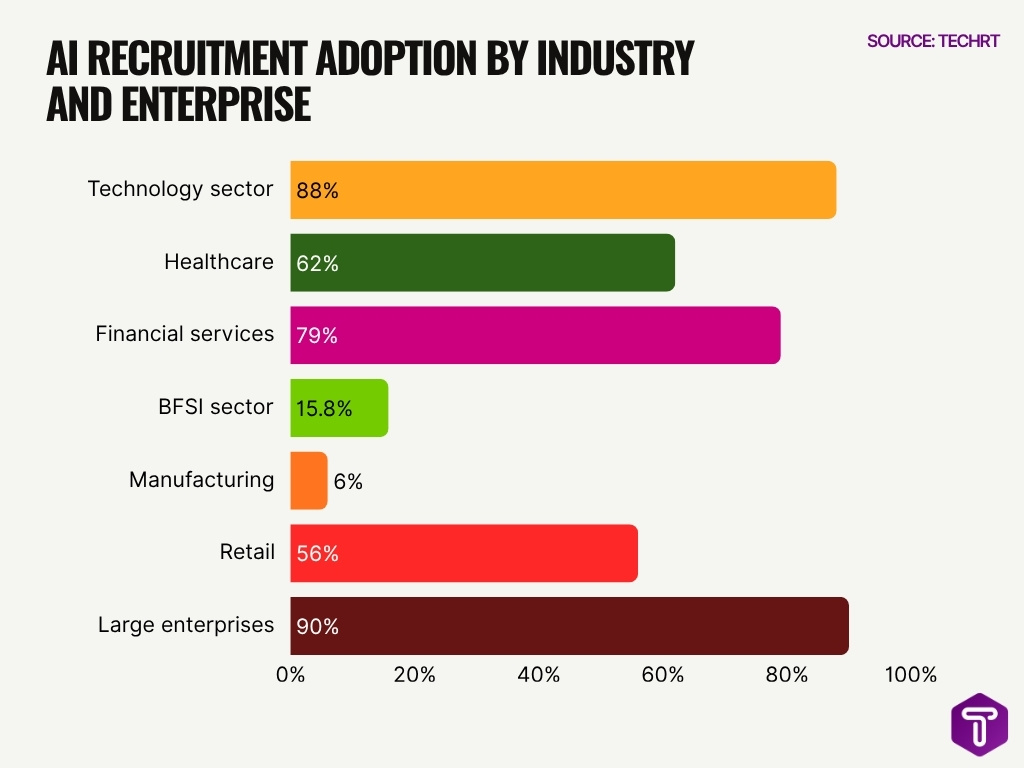
- The technology sector leads with 88% AI adoption in recruitment processes.
- Healthcare shows 62% AI adoption rate for hiring tools.
- Financial services at 79% for AI in recruitment functions.
- The BFSI sector claims 15.8% share of total AI job postings.
- Manufacturing AI hiring share stands at 6% of postings.
- Retail AI adoption reaches 56% overall in recruitment.
- North America hits 43% AI utilization in hiring.
- Large enterprises exceed 90% AI recruitment adoption.
AI Tools Used Across the Recruitment Funnel
- About 87% of companies now use AI in recruitment, making it a core tool across the hiring funnel.
- Nearly 89% of HR professionals whose organizations use AI for recruiting say it saves them time or boosts efficiency.
- In one survey, about 88% of recruiters reported using AI for candidate sourcing, making it the top HR tech use case.
- Around 79% of organizations have integrated AI or automation into their ATS, and 64% use it to filter out unqualified candidates.
- Roughly 72% of recruiters say AI is most useful for sourcing and screening qualified candidates faster than manual methods.
- About 64% of companies using AI rely on it to evaluate candidate assignments and tests during later interview stages.
- Around 40% of companies already use AI tools to communicate with applicants, automating routine candidate engagement.
- AI-driven recruitment analytics have delivered up to a 38% increase in quality of hire for organizations adopting these tools.
- By 2025, about 60% of organizations are expected to use AI for end-to-end recruitment, from sourcing through onboarding.
- Some employers report time-to-hire reductions of up to 70% after adopting AI for sourcing, screening, and scheduling.
AI in Candidate Sourcing and Talent Discovery
- AI-supported sourcing cuts time-to-fill by up to 30%, helping recruiters fill roles faster.
- Organizations using AI recruiting tools see a 30–40% drop in cost-per-hire, freeing budget for strategic hiring initiatives.
- Automation in AI sourcing workflows delivers a 41% boost in recruiter productivity by reducing manual search and outreach.
- 69% of talent acquisition professionals report higher-quality candidates when using AI-powered sourcing and matching tools.
- 72% of recruiters say AI is particularly helpful for candidate sourcing, making it one of AI’s top use cases in hiring.
- 40% of companies already use AI to source and engage talent for their hiring pipelines, embedding it into everyday recruiting.
- AI recruitment tools increase overall employee retention by 20% by helping teams hire better-fit candidates from the start.
- Hiring companies can run over 3x more interviews using AI-driven recruitment chatbots compared with manual scheduling and screening.
- AI in talent platforms reduces costs of sourcing by 30–35% while improving candidate shortlisting accuracy to around 80%.
- AI-enabled sourcing platforms improve diversity hiring effectiveness by up to 48%, broadening and balancing talent pools.
Key Insights: Benefits of AI in Recruitment
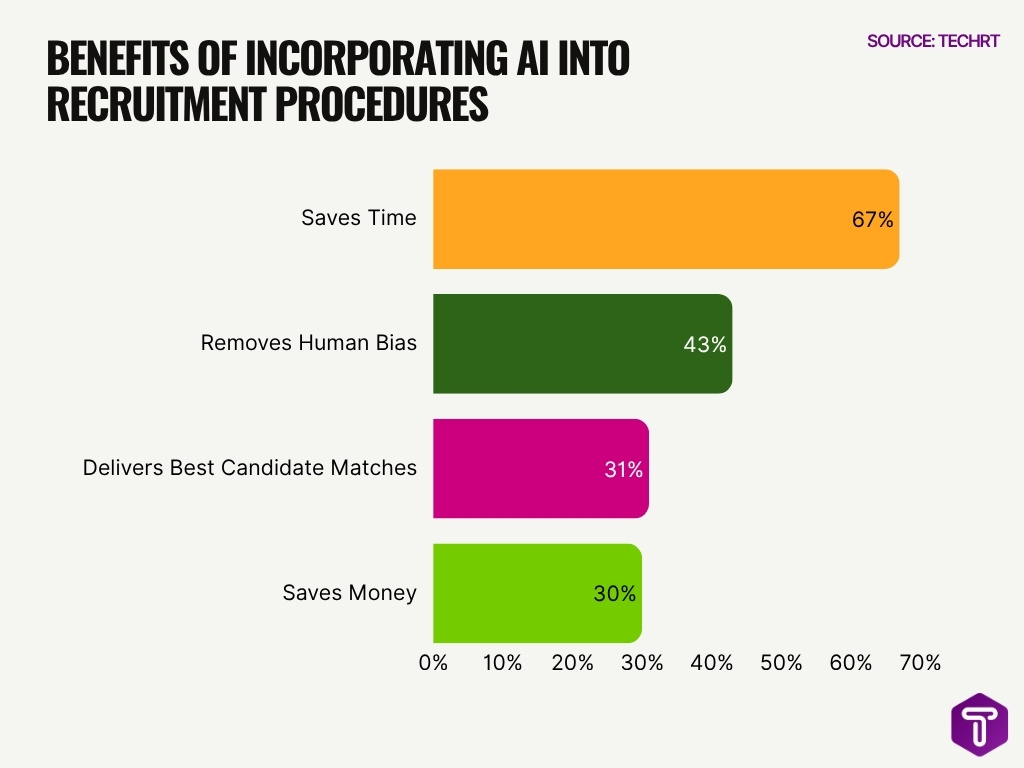
- Time efficiency dominates as the top benefit, with 67% of respondents stating that AI helps save time, making it the most impactful advantage in recruitment workflows.
- Bias reduction is a major driver, with 43% of respondents highlighting that AI helps remove human bias, supporting more fair and objective hiring decisions.
- Nearly 1 in 3 respondents (31%) believe AI improves candidate-job matching, indicating its growing role in enhancing the quality of hires.
- Cost savings are also significant, with 30% of respondents reporting that AI helps reduce recruitment expenses, improving overall ROI.
- The data suggests that efficiency (time + cost) and fairness (bias reduction) are the two primary pillars driving AI adoption in recruitment.
- While advanced matching capabilities (31%) are valued, organizations still prioritize operational gains like speed and cost reduction when implementing AI tools.
AI in Resume Screening and Shortlisting
- AI systems can screen over 1,000 resumes per minute, dramatically reducing manual effort.
- 75% of resumes are filtered by AI before reaching recruiters.
- AI reduces screening time by up to 70%.
- 68% of recruiters say AI improves candidate shortlisting accuracy.
- AI tools reduce unconscious bias in screening by 30–40%.
- Automated screening increases recruiter productivity by 3x.
- Companies using AI screening report a 35% improvement in hiring quality.
- AI shortlisting tools cut candidate rejection errors by up to 25%.
- 90% of large companies now use AI for resume screening.
AI in Interview Scheduling and Coordination
- AI tools reduce interview scheduling time by over 60%.
- 78% of recruiters use automation tools for scheduling interviews.
- AI scheduling assistants can handle 24/7 candidate coordination, improving responsiveness.
- Companies report a 40% decrease in candidate drop-off rates with automated scheduling.
- AI coordination tools reduce administrative workload by up to 55%.
- 62% of hiring teams use AI to streamline interview logistics.
- AI scheduling reduces time-to-interview by 50% or more.
- Automated reminders powered by AI reduce no-show rates by up to 30%.
- AI-driven coordination improves candidate satisfaction scores by 25%.
AI’s Growing Role in Transforming the Hiring Process
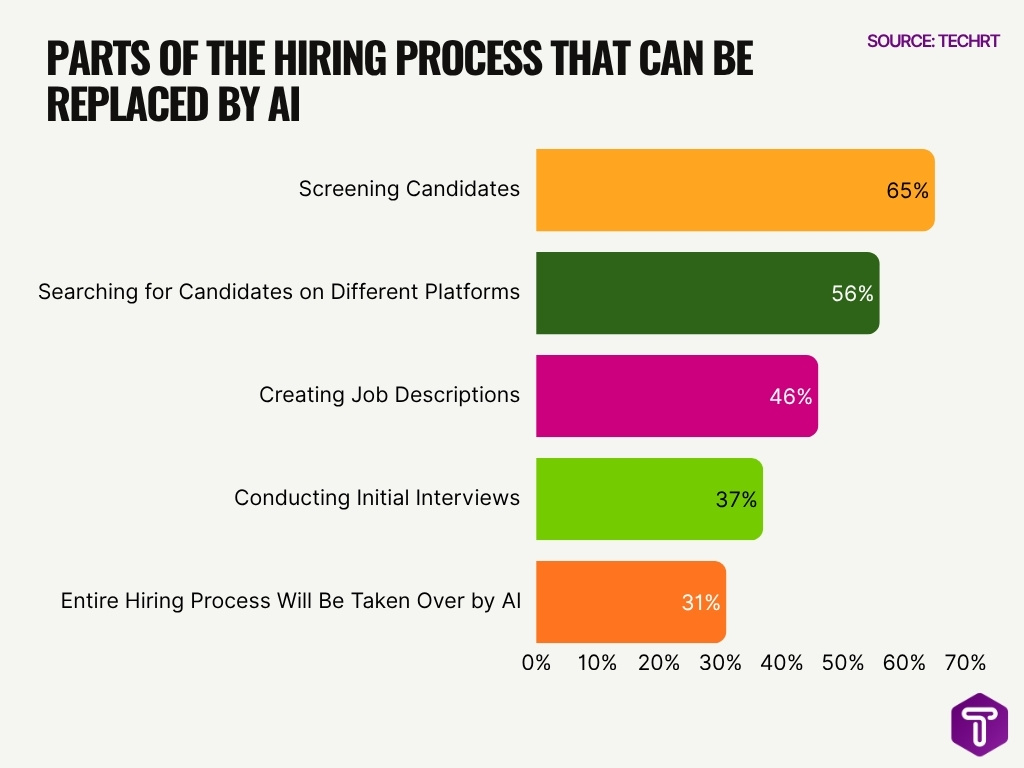
- Candidate screening leads automation adoption, with 65% of respondents believing AI can replace this stage, making it the most automatable part of recruitment.
- Talent sourcing is rapidly shifting to AI, as 56% say searching for candidates across platforms can be automated, highlighting AI’s strength in data aggregation and matching.
- Nearly 46% of respondents see AI replacing job description creation, indicating a strong move toward generative AI tools in content drafting.
- Initial interviews are increasingly automated, with 37% supporting AI-led screening interviews, especially via chatbots and video analysis tools.
- A notable 31% believe AI could take over the entire hiring process, reflecting growing trust in end-to-end recruitment automation.
- Overall, the data shows that early-stage hiring tasks (screening, sourcing) are more likely to be automated than later, human-centric stages.
- The trend highlights a clear shift toward efficiency, scalability, and reduced manual workload in recruitment through AI adoption.
AI-Powered Assessments and Skills Testing
- 60% of companies now use AI-based assessments in hiring.
- AI-driven assessments improve candidate-job fit by up to 50%.
- 74% of recruiters say AI assessments provide a more objective evaluation.
- AI-based testing reduces hiring bias by 35%.
- Companies using AI assessments see a 20% increase in employee retention.
- AI tools can evaluate technical and soft skills simultaneously, improving screening depth.
- 65% of hiring managers trust AI-based assessment results.
- AI assessments reduce time spent on candidate evaluation by 50%.
- Predictive analytics in assessments improves hiring success rates by 30%.
AI Chatbots and Virtual Recruiting Assistants
- 41% of companies now use recruitment chatbots in at least part of their hiring process.
- AI chatbots now handle 67% of initial candidate inquiries without human intervention.
- 40% of companies use AI chatbots to communicate with candidates throughout the hiring process.
- Organizations using recruitment chatbots report 41% higher candidate engagement compared with those that do not.
- Career sites that deploy chatbots see 95% more applicants converted into leads.
- The same sites experience about 40% more completed job applications after adding chatbots.
- Companies leveraging conversational hiring tools cut time-to-hire by up to 30%.
- A Statista-based survey found 70% of CHROs are implementing, piloting, or scaling HR chatbots.
- Chipotle’s AI assistant “Ava Cado” shrank its hiring cycle from 12 days to 4 days, roughly a 67% time reduction.
- General Motors’ chatbot “Ev-e” saved about $2M in hiring costs while scheduling 500,000+ interviews and cutting average scheduling time to 27 minutes.
Impact of AI Recruiting Tools on Time-to-Fill
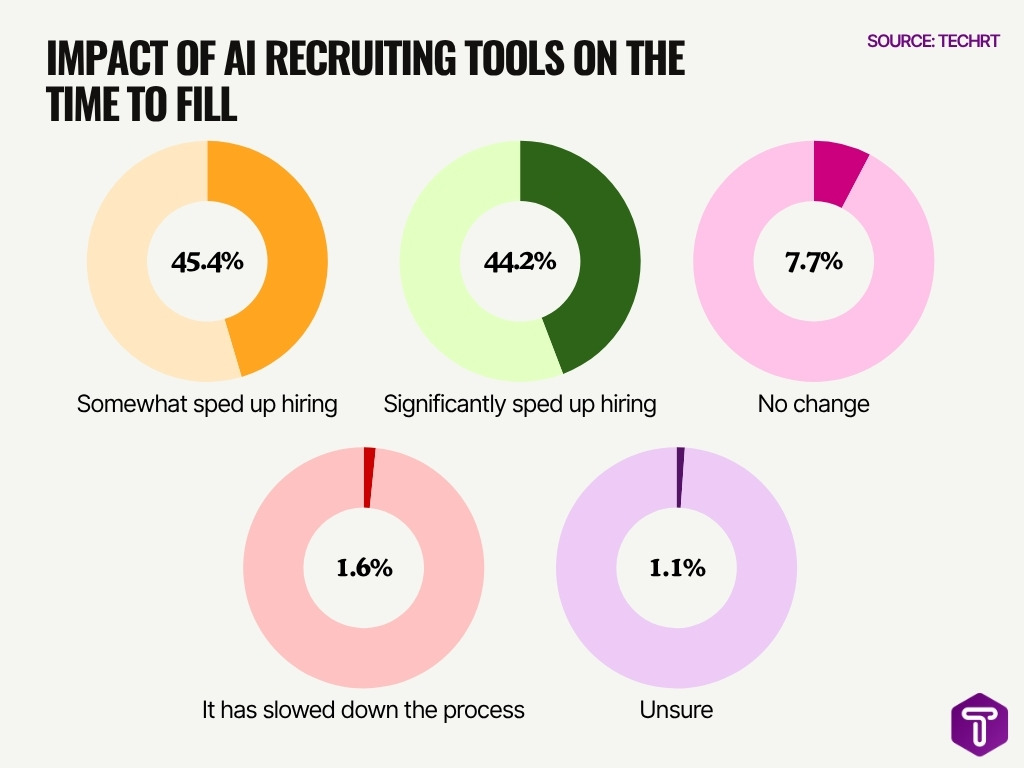
- A combined 89.6% of respondents report that AI has sped up hiring, highlighting its strong efficiency impact.
- Nearly half (45.4%) say AI has somewhat sped up hiring, indicating widespread moderate improvements.
- Another significant 44.2% state that AI has significantly accelerated the hiring process, showing substantial time-saving benefits.
- Only 7.7% of respondents observed no change, suggesting minimal neutral impact.
- A very small proportion (1.6%) believe AI has slowed down the process, indicating rare negative outcomes.
- Just 1.1% remain unsure, reflecting a high level of clarity and experience among respondents regarding AI’s impact.
Impact of AI on Cost-per-Hire and ROI
- Companies using AI in recruitment report up to 30% reduction in cost-per-hire.
- AI automation reduces administrative hiring costs by 40% on average.
- Organizations leveraging AI see a 3x return on investment (ROI) in recruitment processes.
- AI-driven hiring reduces dependency on external agencies, saving 20–35% in recruitment fees.
- 67% of HR leaders report measurable cost savings after implementing AI tools.
- AI tools reduce overtime and recruiter workload costs by over 25%.
- Companies that automate sourcing and screening report a 25% increase in hiring efficiency per dollar spent.
- AI helps reduce bad hires, saving companies up to $14,900 per bad hire on average.
- Recruitment teams using AI report higher budget optimization and resource allocation efficiency.
AI and Candidate Job-Match Accuracy
- AI-driven matching algorithms improve job-fit accuracy by up to 40%.
- Companies using AI report a 35% increase in quality-of-hire metrics.
- Predictive analytics in hiring improves candidate success rates by 30%.
- AI tools analyze hundreds of data points per candidate, improving match precision.
- 72% of recruiters say AI improves candidate-job alignment.
- AI reduces mismatched hires by up to 25%, lowering turnover rates.
- Companies using AI see a 20% improvement in employee retention due to better matching.
- AI-powered recommendation engines enhance internal mobility by 15–20%.
- Data-driven hiring improves long-term performance outcomes by up to 25%.
- Organizations using AI-based assessment tools experience a 25% faster hiring cycle with higher match accuracy.
AI Recruitment Market Share by Region
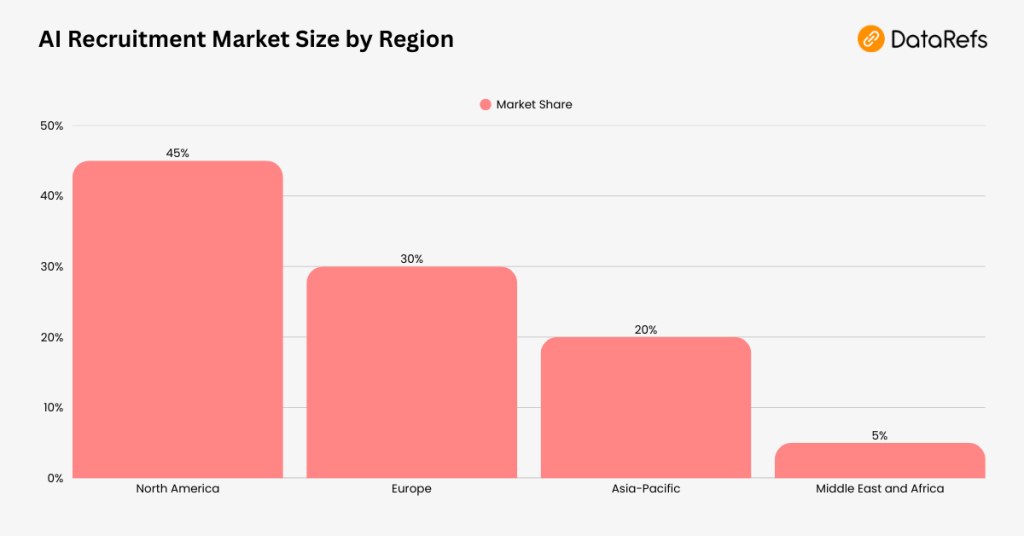
- North America dominates the AI recruitment market with a 45% share, making it the clear global leader due to advanced tech adoption and strong HR tech ecosystems.
- Europe holds the second position with 30%, reflecting steady growth driven by increasing investment in AI-driven hiring solutions and regulatory support.
- The Asia-Pacific region captures 20%, indicating rapid expansion potential as emerging economies accelerate digital transformation and workforce automation.
- The Middle East and Africa account for just 5%, showing the market is still in an early adoption phase with significant room for future growth.
- The top two regions (North America + Europe) together contribute a massive 75% of the total market, highlighting strong concentration in developed markets.
- There is a clear regional disparity, with developed regions leading adoption while emerging regions are catching up gradually.
- Overall, the data suggests a high-growth opportunity in underpenetrated regions like Asia-Pacific and the Middle East & Africa for future AI recruitment expansion.
AI Recruitment and Diversity, Equity, and Inclusion
- AI reduces unconscious bias in hiring by 30–40% when properly implemented.
- Companies using AI report a 20% increase in diverse candidate hiring.
- AI-driven sourcing tools expand talent pools by up to 30%, improving inclusivity.
- 67% of organizations believe AI helps improve diversity outcomes.
- Blind screening powered by AI reduces gender bias in hiring decisions by 25%.
- AI helps identify overlooked candidates, increasing representation from underrepresented groups.
- 44% of HR professionals worry about bias in AI algorithms.
- Ethical AI frameworks are now adopted by over 50% of enterprises to ensure fair hiring.
- Organizations that audit AI systems regularly report better DEI outcomes and compliance.
Candidate Attitudes Toward AI in Hiring
- 72% of candidates are comfortable interacting with AI during the hiring process.
- 67% of job seekers prefer faster responses enabled by AI tools.
- However, 40% of candidates express concerns about the lack of human interaction.
- 58% of applicants believe AI improves fairness in hiring decisions.
- Around 35% of candidates distrust AI decision-making due to transparency issues.
- 70% of Gen Z candidates expect AI-driven hiring experiences.
- Candidates using AI-assisted applications report higher satisfaction rates by 25%.
- AI chatbots improve communication satisfaction for over 60% of applicants.
- Transparency in AI decisions increases candidate trust by up to 30%.
Barriers and Challenges in Adopting AI Recruitment Tools
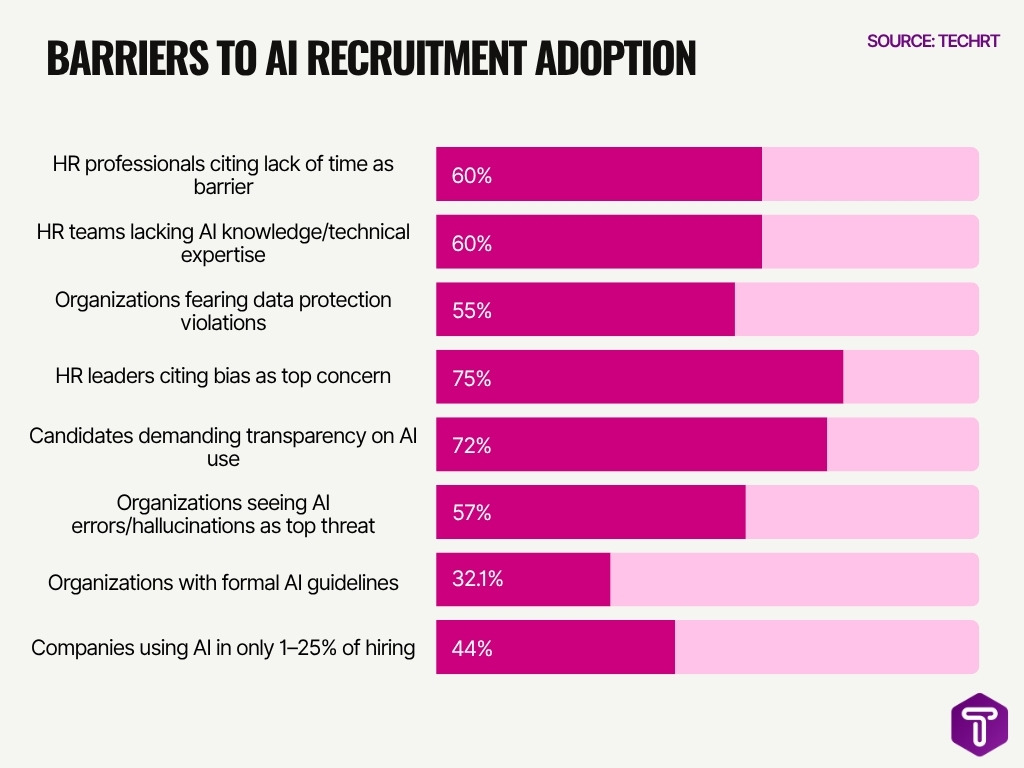
- 60% of HR professionals cite lack of time as a major barrier to AI adoption in recruitment.
- 60% of HR teams lack the necessary AI knowledge and technical expertise.
- Lack of transparency is the #1 barrier to human-centered AI adoption in hiring.
- 55% of organizations fear data protection violations with AI recruitment tools.
- 75% of HR leaders cite bias as their top concern for AI hiring tools.
- 72% of candidates demand transparency on AI use in the hiring process.
- 57% identify AI errors and hallucinations as the top threat to recruitment adoption.
- Only 32.1% of organizations have formal AI guidelines, hindering compliance.
- 44% of companies use AI in just 1-25% of hiring due to integration challenges with legacy systems.
Future Trends and Predictions for AI in Recruitment
- By 2027, over 90% of companies are projected to embed AI-driven tools into core recruitment workflows, up from roughly 30–40% experimenting today.
- AI is expected to automate nearly 80–90% of sourcing and initial candidate outreach, as sourcing automation alone is forecast to reach 90% by 2027.
- Organizations using predictive workforce analytics report up to 60% faster time-to-hire and a projected workforce analytics market size of $11.2 billion by 2035.
- AI-powered platforms that match internal talent to open roles already help 73% of recruiters re-route candidates to other jobs, pointing to 20–30% higher internal mobility potential.
- Early adopters integrating generative AI into hiring save about 20% of their weekly work time, equivalent to roughly one full workday freed for higher-value tasks.
- Around 97% of HR leaders believe AI will be embedded in everyday workflows within the next two years, with 20–40% of work already AI-augmented in tech organizations.
- Organizations implementing predictive analytics in talent management see a 23% increase in retention, 41% lower turnover costs, and 24% productivity improvement in the first year.
- Nearly 90% of employers already use automated systems to filter or rank applications, and 85% say automation or AI directly saves time and boosts efficiency in hiring.
- About 74% of talent acquisition professionals say AI can assist human interviewers by assessing skills–role fit, signaling a shift to standardized, compliance-ready AI evaluation frameworks.
Frequently Asked Questions (FAQs)
What percentage of companies use AI in recruitment?
Around 87% of companies now use AI in their recruitment processes.
How much can AI reduce time-to-hire in recruitment?
AI can reduce time-to-hire from 44 days to about 11 days, a drop of nearly 75%.
What share of companies use AI for candidate screening?
Approximately 88% of companies use AI for initial candidate screening.
What is the current size of the AI recruitment market?
The AI recruitment market is valued at around $661.56 million globally.
What percentage of organizations use AI in hiring overall?
Up to 99% of hiring teams report using AI in some capacity during recruitment.
Conclusion
AI continues to redefine recruitment by making hiring faster, more accurate, and cost-efficient. Organizations now rely on AI to streamline every stage of the hiring funnel, from sourcing candidates to predicting long-term job performance. These tools not only reduce operational costs but also improve hiring quality, candidate experience, and workforce diversity when implemented responsibly. However, challenges such as algorithmic bias, transparency, and data privacy remain critical considerations that companies must address.
Looking ahead, AI will play an even larger role in shaping workforce strategies, especially as predictive analytics and generative AI become more advanced. Companies that combine AI capabilities with human judgment and ethical oversight will be best positioned to build resilient, future-ready hiring systems.

Leave a comment
Have something to say about this article? Add your comment and start the discussion.