


AI now shapes how people search, discover, and make decisions online, redefining the fundamentals of SEO. Search engines no longer simply rank pages; they generate answers, summarize content, and guide users without requiring clicks. Features like AI Overviews and conversational search tools now sit at the center of the user journey, influencing everything from product research to local business discovery.
For example, ecommerce brands increasingly optimize content to be cited in AI-generated responses rather than just ranking on page one, while publishers and media companies adjust strategies to counter declining click-through rates. At the same time, marketers rely on AI tools to streamline keyword research, automate content production, and uncover deeper search intent patterns. As these shifts accelerate, understanding the data behind AI-driven SEO becomes essential for staying competitive. Let’s explore the latest statistics shaping AI SEO.
Editor’s Choice
- AI search traffic increased by 527% year over year (2024–2025), signaling rapid adoption of AI-driven discovery.
- Around 60% of Google searches now end without a click, largely due to AI-generated answers.
- AI Overviews reach over 2 billion monthly users globally.
- Nearly 70% of businesses report higher ROI after adopting AI in SEO workflows.
- About 35% of Gen Z users in the U.S. use AI chatbots for search.
- Organic CTR drops by 34.5% on average when AI Overviews appear.
- AI-driven search could surpass traditional search traffic by 2028.
Recent Developments
- AI Overviews expanded globally from 7 countries in 2024 to 229 countries in 2025, showing rapid rollout.
- Exposure to AI-generated answers in certain queries increased by over 5,600% year over year.
- Google’s search market share dropped to 70% in the U.S. when alternative platforms are included, reflecting fragmentation.
- AI-powered search engines now influence discovery, decision-making, and transactions, not just queries.
- AI assistants increasingly act as intermediaries, summarizing content instead of sending traffic directly.
- AI-generated responses now prioritize trusted third-party sources over brand-owned content.
- The SEO industry is shifting toward Generative Engine Optimization (GEO) to improve AI visibility.
- AI summaries reduce reliance on traditional rankings, pushing brands to optimize for authority and structured data.
SEO Professional AI Strategies Survey
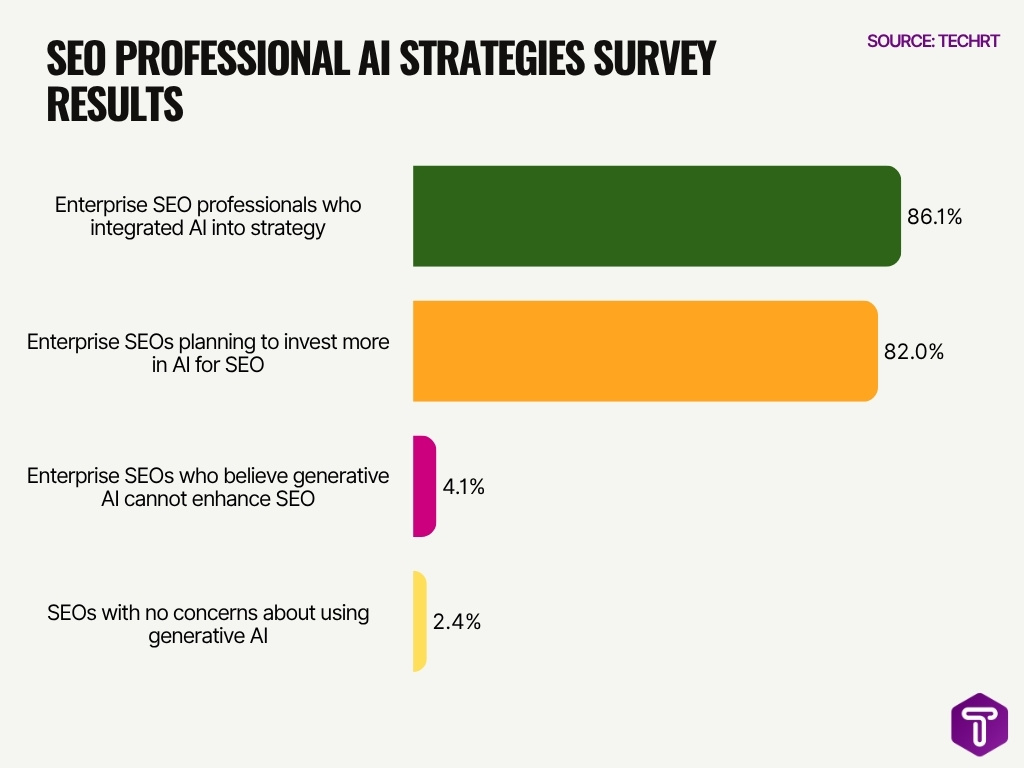
- AI adoption is already mainstream among enterprise SEO teams, with 86.1% of professionals actively integrating AI into their strategy.
- A strong future investment trend is evident, as 82.0% of enterprise SEOs plan to increase spending on AI for SEO, signaling sustained growth in AI-driven optimization.
- There is minimal skepticism around AI’s effectiveness, with only 4.1% believing that generative AI cannot enhance SEO.
- Concerns about AI usage are surprisingly low, with just 2.4% of SEOs reporting no concerns, indicating that most professionals are still cautiously evaluating risks.
- The data highlights a clear industry shift toward AI-first SEO strategies, where adoption and investment significantly outweigh resistance.
- Overall, the survey suggests that AI is no longer experimental but operational, becoming a core component of enterprise SEO workflows.
AI Adoption by Industry and Business Size
- Large enterprises show 91% AI adoption rates, over 2x higher than small businesses at 41%.
- Financial services lead with 82% AI adoption, followed by healthcare at 71%.
- Retail/ecommerce achieves 68% AI adoption with 24% growth year-over-year.
- Small businesses average $497/month on SEO services, constraining AI tool access.
- Firms spending over $500/month on SEO are 53.3% more likely to report extreme satisfaction.
- 58% of SaaS/marketing leaders use generative AI, boosting content by 47%.
- Media publishers face up to 38% Google traffic drops from AI Overviews.
- Ecommerce AI personalization lifts conversion rates by 26% on average.
- Healthcare adoption hits 22% in 2025, a 7x jump from 2024 levels.
AI Usage in Content Creation and SEO Workflows
- AI-generated content tools are used by over 60% of marketers for drafting and optimization.
- Content teams report up to 50% faster publishing cycles with AI assistance.
- AI helps improve content relevance by analyzing search intent patterns at scale.
- Around half of online content now includes some level of AI assistance.
- AI tools enable automated internal linking, keyword clustering, and SERP analysis.
- Businesses using AI content tools report higher engagement metrics like time on page.
- AI-assisted SEO strategies focus more on topic authority rather than keyword density.
- Retrieval systems risk content homogenization when AI-generated content dominates, affecting diversity.
AI Adoption Among SEOs
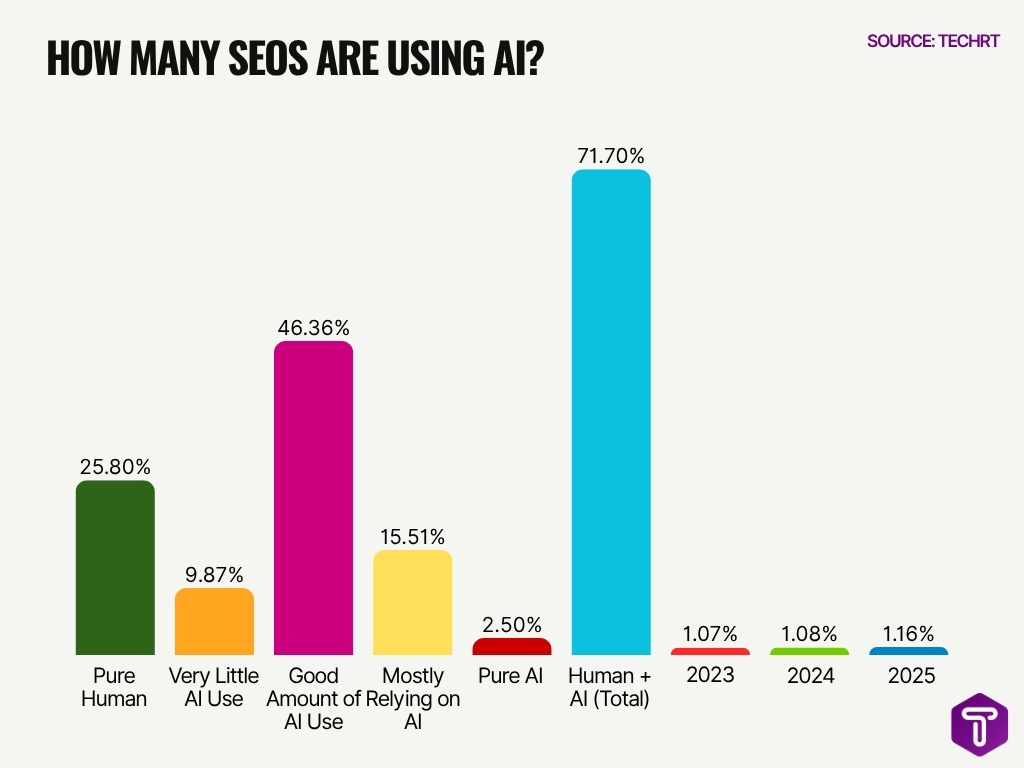
- 71.70% of SEOs use AI (Human + AI combined), showing that AI has become a mainstream tool in SEO workflows rather than a niche experiment.
- The largest segment, 46.36%, reports using a good amount of AI, indicating that balanced human + AI collaboration is the dominant approach.
- 25.80% of SEOs still rely purely on human effort, highlighting that a significant minority remains cautious about AI adoption.
- Only 2.50% of SEOs operate with pure AI, confirming that fully automated SEO is still rare and likely not yet trusted for end-to-end execution.
- 15.51% of professionals mostly rely on AI, suggesting a growing shift toward AI-heavy workflows, especially for content and data tasks.
- A smaller group, 9.87%, uses very little AI, indicating early-stage adoption or testing behavior among some SEOs.
- Year-over-year growth appears gradual, with adoption metrics at 1.07% (2023), 1.08% (2024), and 1.16% (2025), showing steady but incremental increases in AI reliance.
- The data clearly signals a hybrid SEO future, where human expertise + AI efficiency is the winning combination rather than full automation.
- Overall, the trend reflects a transition phase, where AI is widely adopted but not fully dominant, reinforcing the importance of human oversight and strategic input.
AI’s Impact on Search Traffic and Click-Through Rates
- Organic CTR drops 61% for queries with AI Overviews, from 1.76% to 0.61%.
- Paid CTR falls 68% on AI Overview queries, from 19.7% to 6.34%.
- AI Overviews reduce position one CTR by 58% as of December 2025.
- Top organic result CTR declines 32%, from 28% to 19% post-AI rollout.
- Users click links in 8% of AI summary searches vs. 15% without.
- Organic CTR for non-cited brands in AI Overviews drops 65.2% year-over-year.
- Gartner predicts 25% drop in traditional search traffic by 2026 due to AI.
- Zero-click rate hits 60% of queries, with AI Overviews in 13.14% of searches.
- Cited brands gain 35% more organic clicks in AI Overviews.
Zero-Click Searches and AI Overviews Statistics
- Around 60% of Google searches now end without a click, driven largely by AI-generated answers.
- Zero-click searches accounted for over 65% of mobile queries in 2025, up from 57% in 2023.
- AI Overviews appear in roughly 30% to 45% of informational queries.
- Informational searches trigger AI summaries more than 70% of the time, compared to commercial queries.
- Pages cited in AI Overviews receive significantly fewer direct clicks but higher brand exposure.
- AI Overviews reduce organic traffic by 15% to 25% for publishers, especially news and blogs.
- Featured snippets and AI Overviews together dominate over 50% of the above-the-fold SERP space.
- Nearly 1 in 3 users rely solely on AI summaries without scrolling further.
AI Content Ranking Timeline
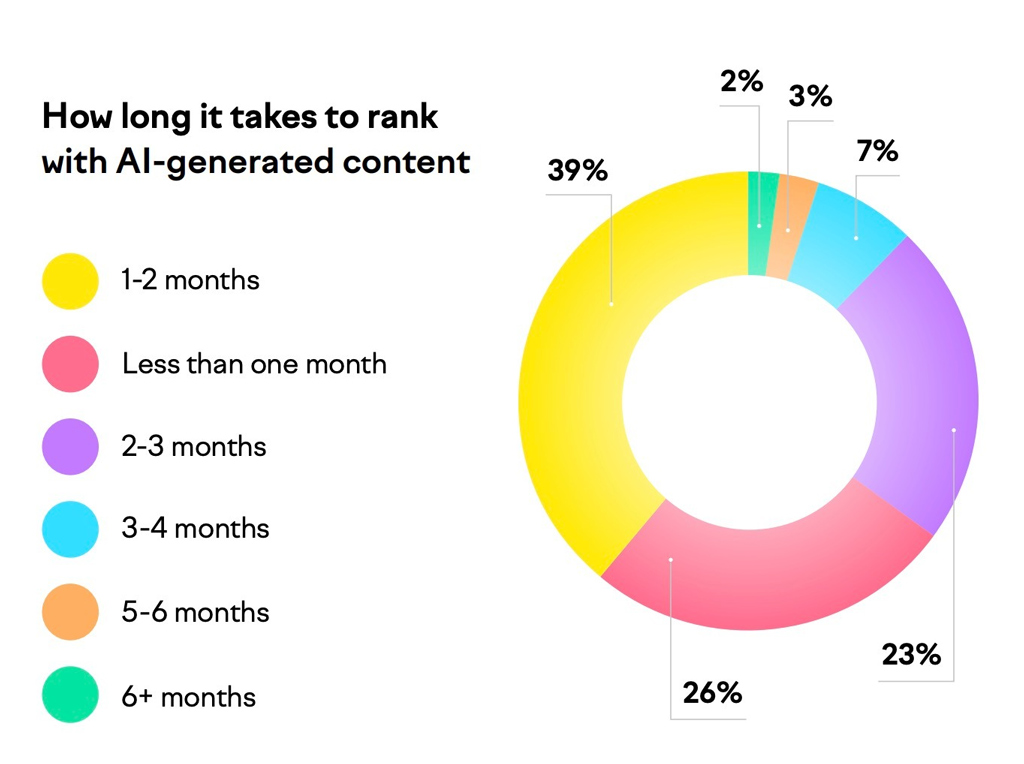
- Fast ranking is common: A combined 65% of content ranks within 1–2 months, showing that AI-generated content can achieve quick visibility in search results.
- Immediate impact potential: Around 26% rank in less than one month, indicating that high-quality AI content can deliver rapid SEO results when optimized well.
- The majority rank within 3 months: Nearly 88% of content ranks within 3 months, reinforcing that AI-driven SEO is efficient and scalable.
- Performance drops after 3 months: Only 12% take more than 3 months, suggesting that delayed ranking is relatively uncommon.
- Diminishing returns over time: Just 5% take 5+ months, highlighting that if content doesn’t rank early, it may require optimization or stronger backlinks.
- Sweet spot for ranking: The most common timeframe is 1–2 months (39%), making it the benchmark window for SEO performance expectations.
- Strategic takeaway: To maximize results, focus on content quality, keyword targeting, and authority signals early, as most rankings happen within the first 90 days.
AI Search Traffic vs Traditional Organic Traffic
- AI-driven search traffic grew by over 500% between 2024 and 2025, while traditional organic growth slowed.
- Traditional organic traffic growth dropped to single-digit percentages in 2025, compared to double digits earlier.
- AI platforms like chatbots contribute up to 10% of total referral traffic for early adopters.
- Websites optimized for AI visibility report 20% to 30% higher engagement rates than traditional SEO-only pages.
- Organic traffic share from Google declined as users increasingly rely on AI assistants and alternative discovery platforms.
- AI-driven sessions show longer dwell time but fewer page visits per session.
- Early data suggests AI traffic converts higher for high-intent queries, especially in SaaS and ecommerce.
- By 2026, AI search will contribute to a growing share of top-of-funnel discovery, particularly for research queries.
AI Chatbots and Conversational Search Adoption
- Over 35% of U.S. users now use AI chatbots for search-related queries.
- Global chatbot adoption reached over 1 billion users by 2025, driven by tools like ChatGPT and Gemini.
- Around 40% of users prefer conversational answers over traditional search results.
- Businesses integrating chatbot search report up to 25% improvement in customer engagement.
- Conversational queries are 3x longer on average than traditional keyword searches.
- AI chatbots handle over 70% of customer queries in some industries, including ecommerce and fintech.
- Younger users (Gen Z and Millennials) drive the majority of chatbot-based search usage.
- Voice and chatbot search overlap significantly, with over 50% of voice queries processed through AI assistants.
AI Usage Growth Trends Across Generations
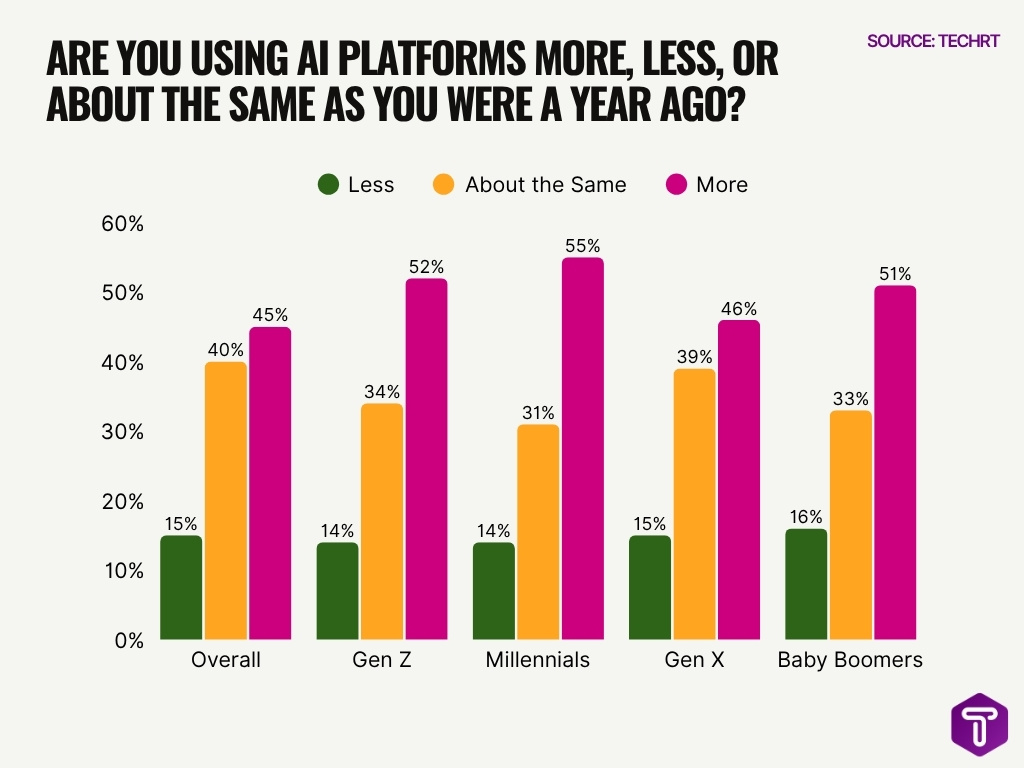
- AI adoption is accelerating, with 45% of overall users reporting they have been using AI platforms for more than a year, compared to only 15% using them less.
- A significant 40% of users report “no change”, indicating AI has already reached a stable, habitual usage level for many.
- Millennials lead AI growth, with a striking 55% using AI more, making them the most engaged demographic.
- Gen Z follows closely, with 52% increasing usage, showing strong adoption among younger, digital-native users.
- Surprisingly, Baby Boomers show strong growth too, with 51% using AI more, highlighting mainstream adoption beyond younger audiences.
- Gen X demonstrates balanced growth, with 46% using AI more and 39% reporting no change, suggesting steady but less aggressive adoption.
- Across all generations, the share of users using AI less remains low (14%–16%), indicating minimal drop-off or disengagement.
- The data signals a clear trend: AI usage is not just growing, it’s becoming universal across age groups, with over half of some demographics increasing usage year-over-year.
AI Overviews: Appearance in Google Results
- AI Overviews appear in 50-60% of U.S. searches, up from 6.49% in January 2025.
- Informational queries trigger AI Overviews in 99.9% of cases.
- Organic CTR drops 61% (from 1.76% to 0.61%) when AI Overviews appear.
- Health queries show AI Overviews in 82% of searches.
- Finance educational queries trigger AI Overviews at 67% rate.
- AI Overviews surged 58% across 9 industries in 12 months.
- Question queries generate AI Overviews 57.9% of the time.
- Commercial queries see AI Overviews rise from 8.15% to 18.57%.
- AI Overviews rolled out to 200 countries by mid-2025.
- Brands cited in AI Overviews earn 35% more clicks.
AI Citation Patterns and Source Behavior
- AI‑cited sources are dominated by the top 20 domains, which together account for about 66–67% of all citations, highlighting extreme citation concentration.
- Over 52% of AI Overview citations originate from pages that rank in Google’s top 10, reinforcing a strong overlap between SEO rankings and AI citations.
- Around 90% of AI‑cited pages fall within the top 30 organic search results, while only about 10% come from lower‑ranking positions.
- Wikipedia appears as one of the most cited sources, representing roughly 7–8% of all AI citations and demonstrating a clear preference for neutral, encyclopedic content.
- Content that includes specific statistics and data is cited up to 40% more frequently than purely qualitative material, making numerical evidence a critical citation signal.
- Domains with 32,000+ referring domains are approximately 3.5 times more likely to be cited by AI systems, underscoring the role of high backlink authority in citation behavior.
- Pages with schema markup experience about 47% higher citation rates, indicating that structured, machine‑readable formatting strongly boosts AI visibility.
- Smaller or emerging sites receive less than 10% share of total AI‑cited domains, with a handful of giants capturing well over half of all citations.
- AI‑cited content often comes from top‑tier publishers such as Reuters, AP, and major news outlets, which together can constitute over 60% of news‑related citations.
- Around 38% of first‑page content has at least a 38% chance of being cited, while the probability plummets sharply below the top‑10 and top‑30 bands.
AI-Generated Content Presence in Search Results
- Over 50% of web content now includes some level of AI assistance, up from 30% in 2023.
- AI-generated pages appear in up to 40% of top-ranking results for certain informational queries.
- Google reports that quality, not authorship (AI vs human), determines rankings, reinforcing E-E-A-T signals.
- Sites using AI-assisted content strategies report 20% to 30% faster ranking improvements.
- However, large-scale AI content publishing increases the risk of duplicate or low-value content penalties.
- AI-generated content dominates long-tail keyword coverage, especially for informational blogs.
- Around 35% of marketers express concerns about AI content accuracy and originality.
- Studies show that AI-heavy SERPs may reduce content diversity by up to 25%, affecting the discovery of niche sources.
Top Websites Dominating AI Assistant Mentions
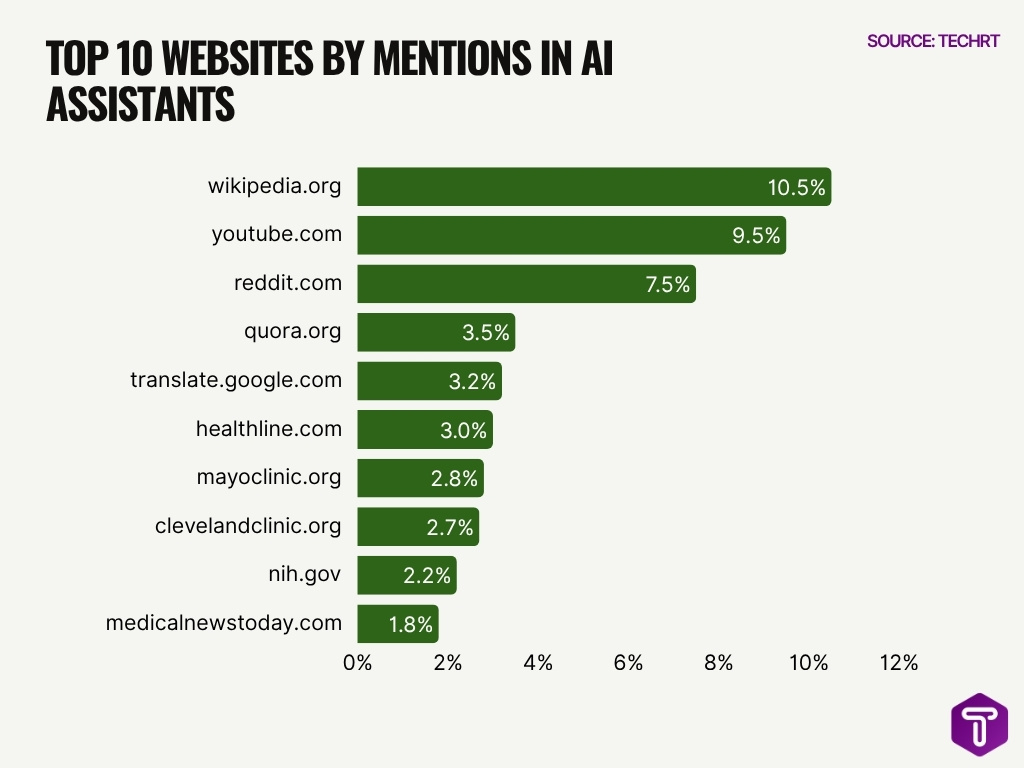
- Wikipedia leads overwhelmingly with a 10.5% mention share, making it the most trusted and cited source across AI overviews.
- YouTube ranks second at 9.5%, highlighting the growing importance of video content in AI-generated answers.
- Reddit secures third place with 7.5%, showing that community-driven discussions are heavily referenced by AI systems.
- There is a sharp drop after the top 3, with the next platform, Quora (3.5%), receiving less than half of Reddit’s share.
- Google-owned property (translate.google.com) appears in the top 5 with 3.2%, indicating AI reliance on internal ecosystem data.
- Health-focused websites dominate mid-tier rankings, including: Healthline (3.0%), Mayo Clinic (2.8%), and Cleveland Clinic (2.7%).
- This reflects high trust in authoritative medical sources.
- Government and research sources like NIH still contribute with 2.2%, reinforcing credibility signals in AI outputs.
- Medical News Today ranks last among the top 10 with 1.8%, showing long-tail authority sites still matter, but with lower visibility.
- The top 3 websites alone account for 27.5% of total mentions, indicating a high concentration of authority sources in AI responses.
- Overall trend: AI assistants prioritize high-authority, informational, and user-generated platforms, combining trust (Wikipedia, NIH) with engagement (YouTube, Reddit).
AI SEO ROI and Business Impact
- Businesses using AI in SEO report up to 70% improvement in ROI compared to traditional strategies.
- AI-driven personalization increases conversion rates by 20% to 35% in ecommerce environments.
- Companies leveraging AI SEO tools reduce operational costs by 30% to 40% on average.
- AI-powered content strategies generate higher engagement metrics, including longer dwell time and lower bounce rates.
- Organizations investing in AI SEO see faster time-to-market for content campaigns, often by weeks.
- AI-driven insights improve keyword targeting accuracy and user intent matching.
- Businesses report better attribution tracking with AI-enhanced analytics tools.
- Early adopters of AI SEO strategies gain a competitive advantage in emerging search ecosystems.
AI SEO Budget and Investment Trends
- Global AI marketing spend is projected to exceed $107 billion by 2028, with SEO as a major component.
- Around 68% of companies increased their AI SEO budgets in 2025.
- Enterprises allocate 20% to 30% of digital marketing budgets to AI tools and automation.
- Small businesses still spend an average of $497/month on SEO services, limiting advanced AI adoption.
- Companies spending over $1,000/month on SEO are significantly more likely to integrate AI tools.
- Investment in AI content tools grew by over 45% year over year (2024–2025).
- Marketing leaders rank AI SEO among the top 3 priorities for digital transformation.
- Agencies increasingly bundle AI capabilities into SEO packages, driving higher pricing tiers and service differentiation.
AI Marketing Use Cases
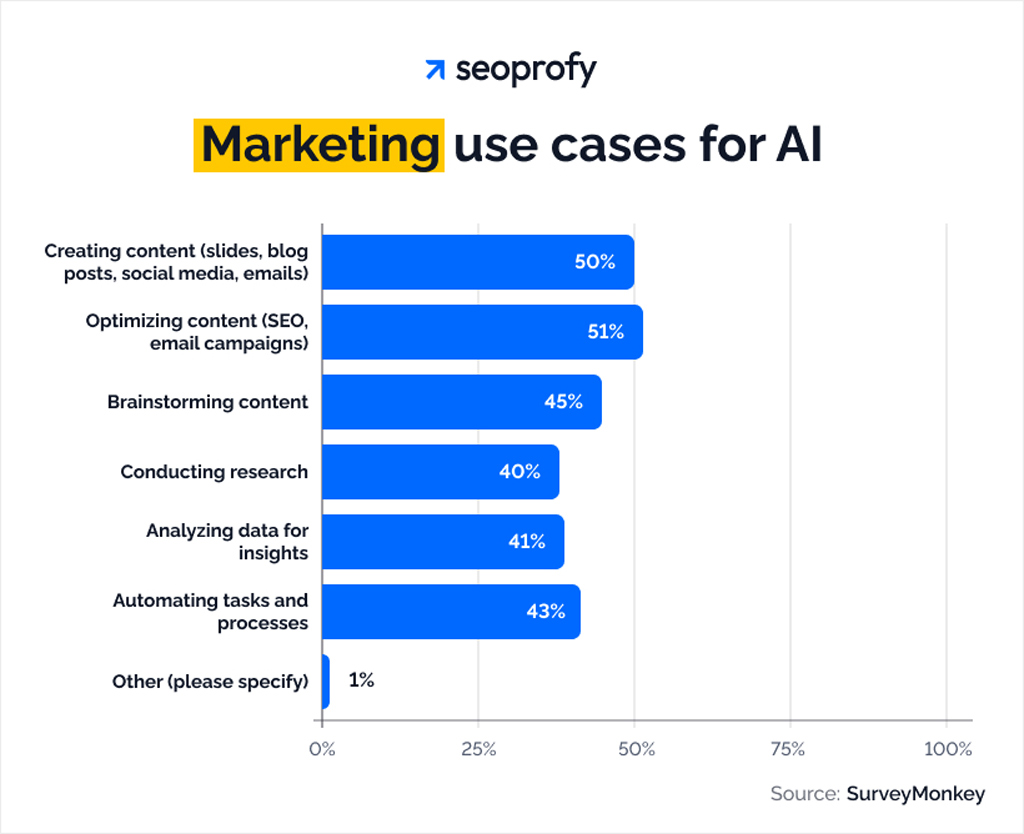
- Content optimization leads adoption (51%), making it the top use case for AI in marketing, highlighting its critical role in SEO and email performance improvement.
- Content creation is nearly as dominant (50%), showing that half of marketers rely on AI for producing blogs, social media, emails, and presentations.
- Brainstorming support is widely adopted (45%), indicating AI’s growing importance in idea generation and creative workflows.
- Task automation (43%) is a major efficiency driver, helping marketers streamline repetitive processes and operational workloads.
- Data analysis for insights (41%) reflects AI’s role in enabling data-driven decision-making and performance tracking.
- Research usage stands at 40%, proving AI is a key tool for market research, competitor analysis, and content validation.
- A very small share falls under “Other” (1%), suggesting that most AI use cases in marketing are already well-defined and standardized.
- Overall, 4 out of the top 5 use cases exceed 40% adoption, signaling that AI is deeply integrated into core marketing functions, not just experimental usage.
Voice Search and AI-Powered Discovery
- Over 50% of all searches are now voice-assisted or AI-powered across devices.
- Voice search queries are 3x longer than typed queries, reflecting conversational behavior.
- Around 58% of consumers use voice search to find local businesses.
- AI assistants power over 90% of voice search responses, integrating generative AI capabilities.
- Smart speaker adoption reached over 400 million devices globally.
- Voice search contributes significantly to mobile and on-the-go discovery, especially for navigation and local queries.
- Businesses optimizing for voice search report higher visibility in featured answers and AI summaries.
- Conversational AI integrates voice, chat, and search into a unified discovery experience.
AI Trust, Accuracy, and User Perception
- Around 62% of users express concerns about AI-generated misinformation.
- Only 40% of users fully trust AI-generated search results, highlighting credibility challenges.
- Users are more likely to trust AI answers that cite recognizable sources and brands.
- Transparency and disclosure increase trust levels by up to 30%.
- Younger users (18–34) show higher trust in AI compared to older demographics.
- Around 45% of users cross-check AI answers with traditional search results.
- Businesses prioritize accuracy and fact-checking mechanisms in AI-driven content strategies.
- Trust signals such as author expertise, citations, and brand reputation play a critical role in AI visibility and adoption.
Frequently Asked Questions (FAQs)
How much has AI search traffic grown recently?
AI search traffic increased by 527% year over year between 2024 and 2025.
What percentage of searches now end without a click?
Approximately 58.5% to 60% of searches now result in zero clicks, with some AI-driven queries reaching up to 80%–93%.
How much do AI Overviews reduce organic click-through rates?
AI Overviews reduce organic CTR by 34.5% on average, with some cases showing drops of up to 61% or more.
What share of top search results now includes AI-generated content?
AI-generated content appears in about 17.3% of Google’s top 20 search results.
How many users are reached by AI search features like AI Overviews?
AI Overviews reach over 2 billion monthly users globally.
Conclusion
AI has transformed SEO from a ranking-focused discipline into a broader visibility strategy that spans search engines, AI assistants, and conversational platforms. The data highlights a clear shift, fewer clicks, more zero-click experiences, and a growing reliance on AI-generated summaries to deliver information instantly. This change forces businesses to rethink how they measure success, moving beyond rankings to focus on brand presence, authority, and inclusion in AI-generated responses.
At the same time, companies that invest in AI tools, structured content, and credibility signals are seeing measurable gains in efficiency, engagement, and ROI. However, challenges around trust, accuracy, and content saturation remain critical factors that can influence long-term performance. As AI continues to evolve, the future of SEO will depend on how effectively brands adapt to these systems, ensuring their content not only ranks but also gets selected, cited, and trusted by AI-driven platforms.

Leave a comment
Have something to say about this article? Add your comment and start the discussion.