




The debate over AI‑generated vs human‑created content isn’t just academic; it’s reshaping how companies produce, distribute, and measure digital content. With AI tools dramatically increasing content output and human expertise still driving engagement and trust, content strategy has become a balancing act between speed and depth. In sectors like SEO, marketing, and social media, organizations use AI to scale drafts and humans to refine context and credibility. This article unpacks the latest data to help you understand where each approach wins, where it struggles, and how they coexist.
Editor’s Choice
- 67% of marketers now rely on AI for content marketing or SEO tasks.
- AI appears in over 50% of search results through Google AI Overviews by 2025.
- Human content still dominates visibility even where AI volume is high.
- 92% of users believe AI boosts productivity, despite cleanup requirements.
- Human content tends to draw higher quality engagement (comments/hashtags).
- Hybrid workflows outperform AI‑only or human‑only in some SEO tasks.
- Experts predict human involvement in content creation will remain essential for decades.
Recent Developments
- AI investment surges, 84% of companies plan to increase generative AI spending in 2026.
- Content cleanup burden, 58% of users spend over 3 hours weekly revising AI content.
- Only 2% of AI outputs require no revision.
- Platforms are introducing user controls to moderate exposure to AI content.
- AI moderation has reduced harmful content seen by human moderators by 76%.
- Artists and creators are campaigning against unchecked AI use in creative work.
- Studies show the balance of AI vs human content online is more equal than previously thought.
- Detection and labeling improvements shape future regulation of AI content.
Human vs AI Articles: Reader Perception Statistics
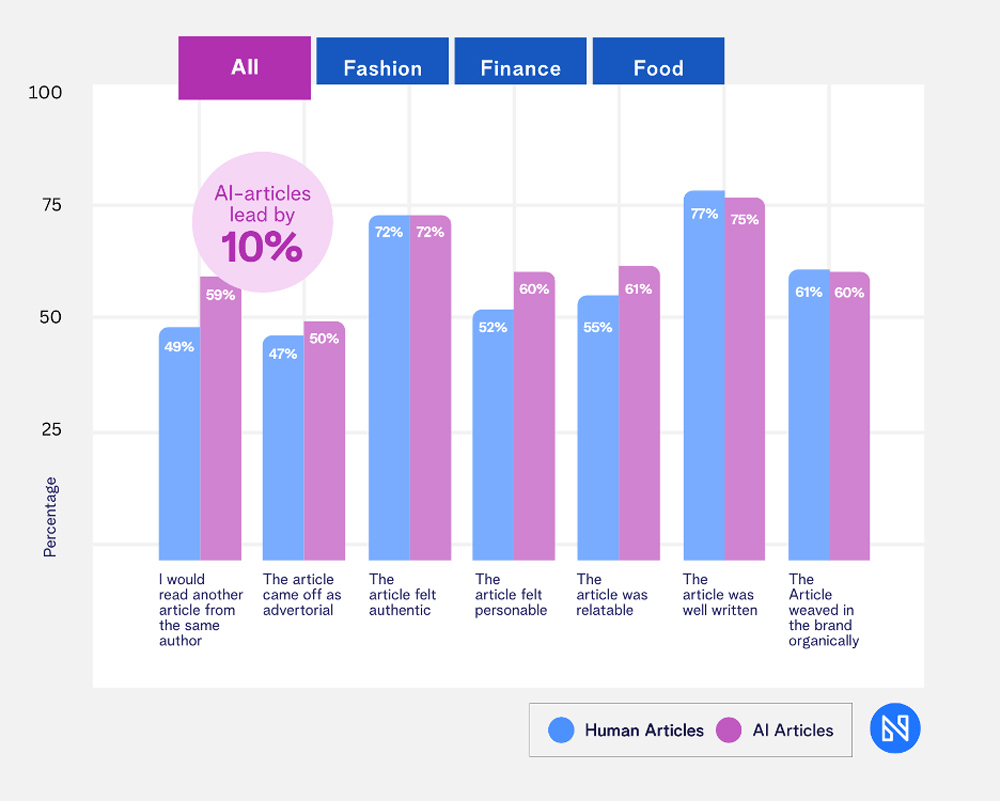
- AI-written articles outperform human-written content by 10% overall, highlighting stronger aggregate reader preference across key engagement metrics.
- 59% of readers say they would read another article from the same author when the content is AI-written, compared to 49% for human-written articles.
- 50% of AI articles are perceived as advertorial, slightly higher than 47% for human articles, indicating comparable brand-promotion perception.
- Authenticity perception is identical at 72% for both AI and human articles, showing no trust disadvantage for AI-generated content.
- 60% of readers find AI-written articles personable, outperforming 52% for human-written content.
- AI articles score 61% for relatability, exceeding 55% for human articles and suggesting stronger emotional resonance.
- 77% of readers rate human-written articles as well written, narrowly surpassing 75% for AI-written articles.
- 60% of AI articles are seen as organically weaving in brand messaging, nearly matching 61% for human-written content.
Key Definitions and Differences
- AI‑Generated Content, produced by algorithms synthesizing patterns, facts, and priors from large datasets.
- Human‑Created Content, Authored by people with lived experience, context, and subjective insight.
- Hybrid Content, Drafts generated by AI and refined by humans to maximize impact.
- AI content scales rapidly but often lacks deep context and narrative nuance.
- Human content takes longer but typically scores higher on trust signals and deep engagement.
- AI outputs may need substantial revisions for accuracy and relevance.
- Humans excel at brand voice consistency across campaigns.
Engagement Metrics Breakdown
- Humanized content (AI drafted + human edited) can attract 4× more traffic on average than AI‑only content.
- Engagement (comments, shares) historically remains higher on human‑authored posts, reflecting deeper user interaction.
- Search content that includes real quotes or human perspectives sees longer dwell times than generic responses.
- The AI-only headlines can drive higher CTR on SERPs in some tests, with up to ~59% uplift vs human headlines.
- Users often trust articles authored by identifiable humans more than generic AI drafts.
- Content with human context and examples reduces bounce rates, particularly on informational pages.
- Social engagement statistics tend to favor human storytelling formats over plain AI summaries.
- Personalization elements added by human editors correlate with higher repeat engagement.
Average Traffic per Post: AI vs Human-Generated Content
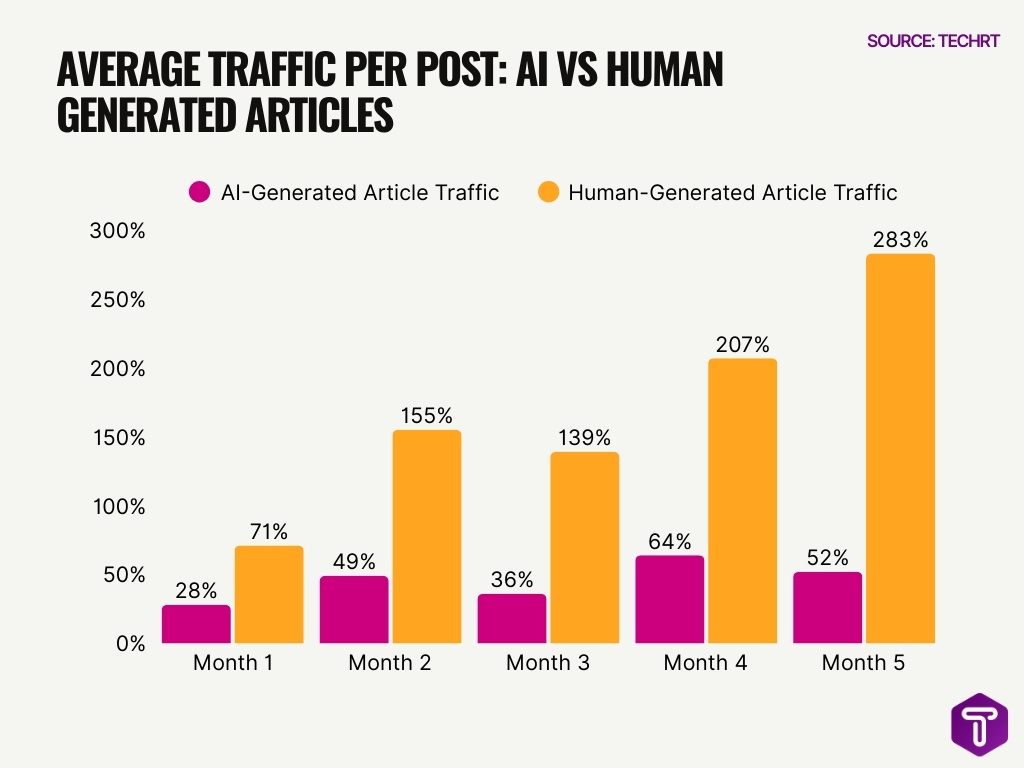
- Human-generated articles consistently outperform AI-generated content, starting at 71 visits in Month 1 compared to 28 visits for AI content.
- In Month 2, human-written posts reach 155 average visits, more than 3× higher than AI articles at 49 visits.
- Month 3 shows a similar trend, with human content at 139 visits versus 36 visits for AI-generated articles.
- The performance gap widens further in Month 4, where human-written articles attract 207 visits, compared to 64 visits for AI content.
- By Month 5, human-generated articles peak at 283 average visits, while AI articles trail behind at 52 visits.
- Across all five months, human content delivers significantly higher organic traffic, highlighting stronger engagement, authority, and search visibility.
- The data suggests that while AI content provides scalability, human-written articles drive superior traffic growth over time.
SEO Ranking Data
- As of 2025, AI‑generated pages appeared in ~17.3% of top search results.
- Human‑updated content accounts for roughly 70% of top‑ranking pages, even as AI use rises.
- A hybrid approach (AI draft + human edit) is increasingly effective at retaining rankings.
- Google’s 2026 ranking emphasis prioritizes trust, experience, and clarity over mere keyword‑rich text.
- Pages optimized for structured data and human context tend to outperform AI auto‑generated ones in rankings.
- AI can generate well‑structured content, but human quality signals often boost SERP authority.
- Organic ranking stability for AI content varies widely by niche and editorial quality.
- AI summary features often shift SERP real estate, making traditional rankings less visible.
Conversion Rate Insights
- AI‑sourced traffic can produce higher conversion rates than traditional search referrals due to intent alignment.
- Across some testing pools, AI‑attributed visitors were 4.4× more likely to convert than non‑AI referral traffic.
- Conversion improvements often hinge on human editing of AI drafts to clarify calls‑to‑action.
- Story‑led, human‑infused content tends to convert at a higher rate than generic AI text.
- Personalization layering by humans increases purchase intent signals and lowers abandonment.
- Pure AI text without human oversight risks lower conversion due to a lack of resonance.
- Combining AI analytics with human creativity improves conversion outcomes substantially.
- A/B testing remains essential to compare human and AI‑draft performance in real‑world settings.
Volume of AI‑Generated Content vs Human Content Online
- AI-generated articles reached nearly 50% of newly published English web articles by late 2022, surging to 52% by mid-2025.
- 74% of new webpages in April 2025 contained some AI-generated content, with 71.7% as mixed AI-human.
- Over 47% of recent Medium posts were likely AI-generated in a 2024 analysis of 274k posts.
- 90% of online content was predicted to be AI-generated by 2025, but the actual share stabilized near 50%.
- Human content receives 4x more traffic than pure AI content and 5.44x more for blogs.
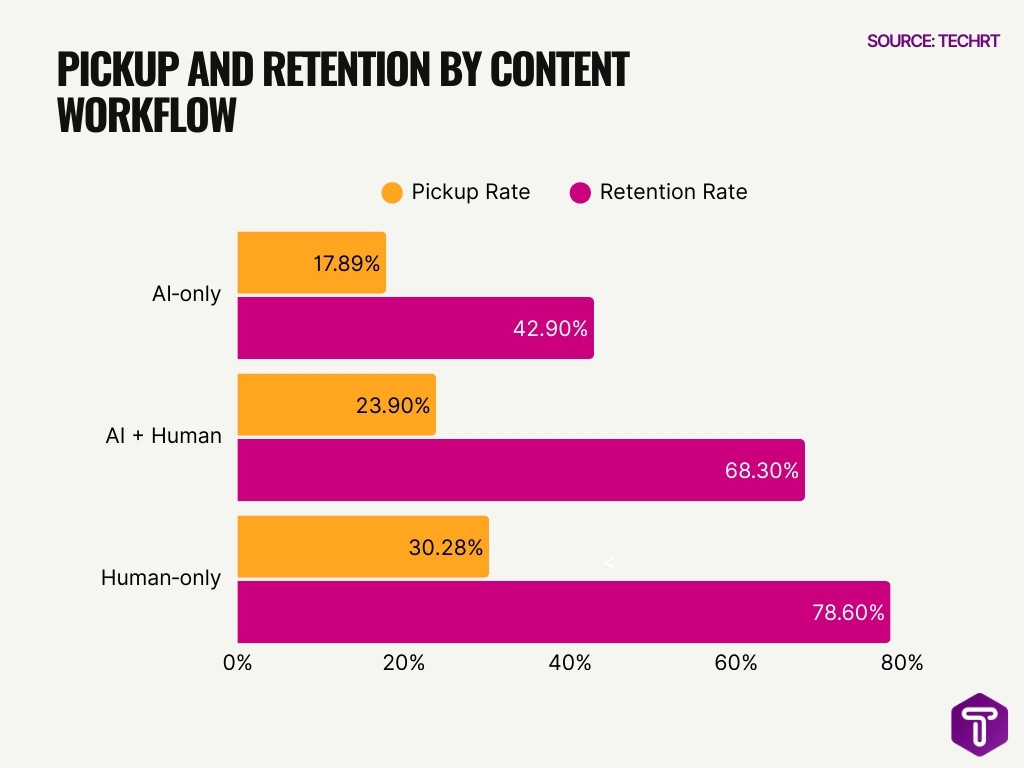
- AI + human hybrid content shows 23.9% pickup rate and 68.3% retention, vs AI-only 17.89% and 42.9%.
- Pure human pages had 30.28% pickup and 78.6% retention, outperforming AI-only equivalents.
- 87% of content marketers use AI for creation, mainly blog posts, boosting their online volume.
- Human-written content drives 4.10 visitors per minute, vs AI’s 3.25.
- Content farms like Demand Media published 1 million items monthly pre-AI boom, now amplified by tools.
Readability Scores Comparison
- Human text averages 55.4 Flesch Reading Ease score vs 28.4 for AI text.
- AI text shows median perplexity 7.2 vs human’s 15.0.
- Human editing boosts Flesch scores by an average of 11 points.
- Readers exhibit +13.7 pp pro-human bias in blind tests.
- Humans detect AI text with only 19% accuracy overall.
- High readability pages gain 17% more featured snippets.
- AI text takes 26.8s estimated read time vs human 22.5s.
- Expert readers prefer human text 6-8 times for quality.
- Optimal SEO readability targets a grade 6-9 level.
User Experience Metrics
- AI + Human content achieves a 78.6% retention rate on pages, far exceeding AI-only’s 44.7%.
- Humanized content draws 4x more traffic than pure AI-generated material.
- Personalized CTAs outperform basic ones by 202% in conversions.
- Hybrid content boosts pickup rate to 30.28% from AI’s 21.7%.
- UGC boosts conversions by 161% on product pages versus branded content.
- Consistent brand voice lifts trust, with 81% of consumers needing it to buy.
- Personalized recommendations increase retention by 30% through relevance.
- Authentic stories rate higher, as 92% trust peer content over ads.
- Human-AI hybrid UX nearly matches human-only in time on page metrics.
- Conversational human voice boosts retention by 18% and trust scores.
Perception of AI-Written Content Quality vs Human Writing
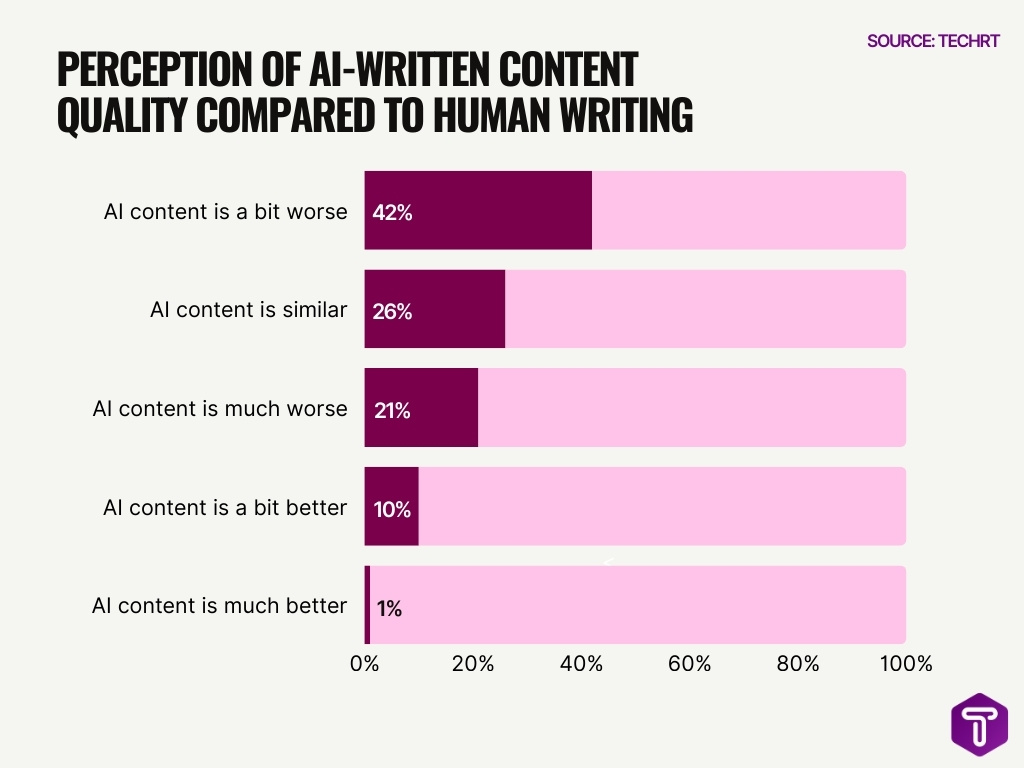
- 42% of respondents believe AI-written content is a bit worse than content written by humans, indicating ongoing quality concerns.
- 26% say AI content is similar to human-written content, suggesting parity in certain use cases.
- 21% feel AI-generated content is much worse, highlighting a significant trust and quality gap.
- Only 10% think AI content is a bit better, showing a limited positive perception.
- Just 1% believe AI-written content is much better, confirming that strong confidence in AI content quality remains rare.
E‑E‑A‑T Compliance Scores
- Content that demonstrates E‑E‑A‑T continues to rank higher on average in search results in 2026.
- Search engines increasingly penalize pages with weak trust or shallow context, even if AI‑generated.
- Human‑written content tends to score higher on experience and authoritativeness due to lived insights.
- AI tools can suggest facts and structural signals, but require human review to meet E‑E‑A‑T standards.
- Low‑quality AI pages are more likely to fall short in E‑E‑A‑T, risking de‑indexing or ranking decline.
- Brand‑specific signals (author bios, citations, original data) reinforce trustworthiness and are more prevalent in human content.
- E‑E‑A‑T scores now directly influence visibility in answer engines and AI summaries beyond traditional ranking factors.
- Sites prioritizing expert authorship and editorial review are far more likely to serve as sources for AI‑generated snippets.
Cost Efficiency Analysis
- AI-generated content costs $131 per blog post, 4.7x cheaper than $611 for human-written content.
- 85% of B2B marketers use generative AI tools for content workflows.
- Hybrid AI-human teams produce content 40% faster while maintaining quality.
- Marketing teams with AI achieve an average 300% ROI from implementations.
- 38% of AI adopters save money on writers, averaging $188 monthly on tools.
- 68% of marketing leaders report positive ROI from AI investments.
- 87% of AI users spend $0–$100 per blog post versus 39% of non-users.
- AI cuts content creation time by 30–50%, boosting output efficiency.
- 10–20% ROI boost seen in organizations using AI for marketing and sales.
- 51% of AI companies plan to increase spending on content generation.
Human-Like Perception of ChatGPT Content
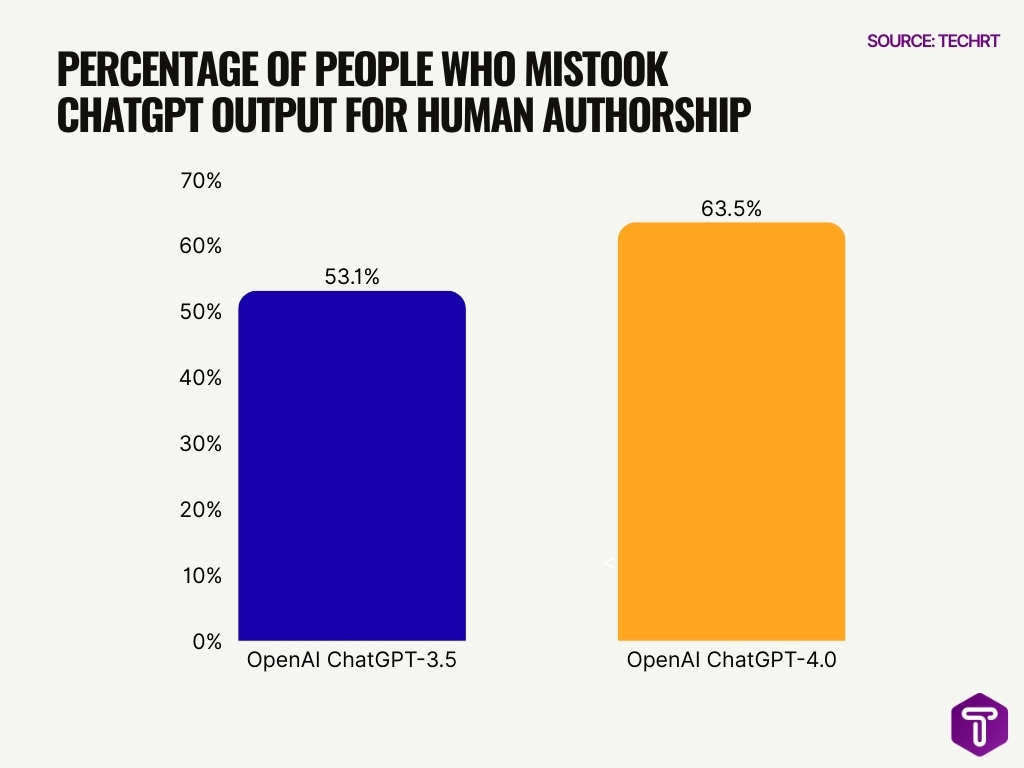
- 53.1% of people mistakenly believed content generated by ChatGPT-3.5 was written by a human author, indicating that even earlier AI models can convincingly mimic human writing styles.
- 63.5% of respondents misidentified ChatGPT-4.0 output as human-authored, showing a significant improvement in human-like text generation compared to previous versions.
- The 10.4 percentage-point increase from ChatGPT-3.5 to ChatGPT-4.0 highlights rapid advancements in AI language realism and coherence.
- A clear majority of users struggled to distinguish AI-generated content from human writing, underscoring growing challenges in content authenticity and detection.
Strengths of AI Content
- AI generates first drafts 10x faster, scaling content pipelines by 300%.
- Generative AI slashes writing time by 40-60% across domains.
- AI processes millions of data points in minutes for SEO paths.
- AI SEO tools boost organic traffic by up to 45% universally.
- AI automates technical SEO, used by 60% of top sites.
- AI multilingual content yields 327% higher AI search visibility.
- AI accelerates keyword research by 80%, enabling gap analysis.
- AI outlines jumpstart workflows, increasing output 66%.
- AI analyzes engagement, improving updates by 25% responsiveness.
- AI scorecards deliver 70% better ROI for systematic refinement.
Strengths of Human Content
- Human-generated content outperforms AI in user engagement by roughly 47%.
- Human content pages achieve average session durations 40% longer than AI equivalents.
- Bounce rates drop by 15% for human-written content due to deeper interactions.
- Human content attracts 25% more backlinks than pure AI-generated pieces.
- AI content low on E-E-A-T sees 40% lower rankings in YMYL queries.
- Human-written content yields originality scores 50% higher in plagiarism checks.
- Reader retention for human content exceeds 70% through page end.
- Human content delivers 35% higher conversion rates and 22% more revenue.
- Hybrid human refinement of AI drafts boosts engagement by 73% and cuts bounce by 61%.
AI vs Human Content Writing Time Comparison
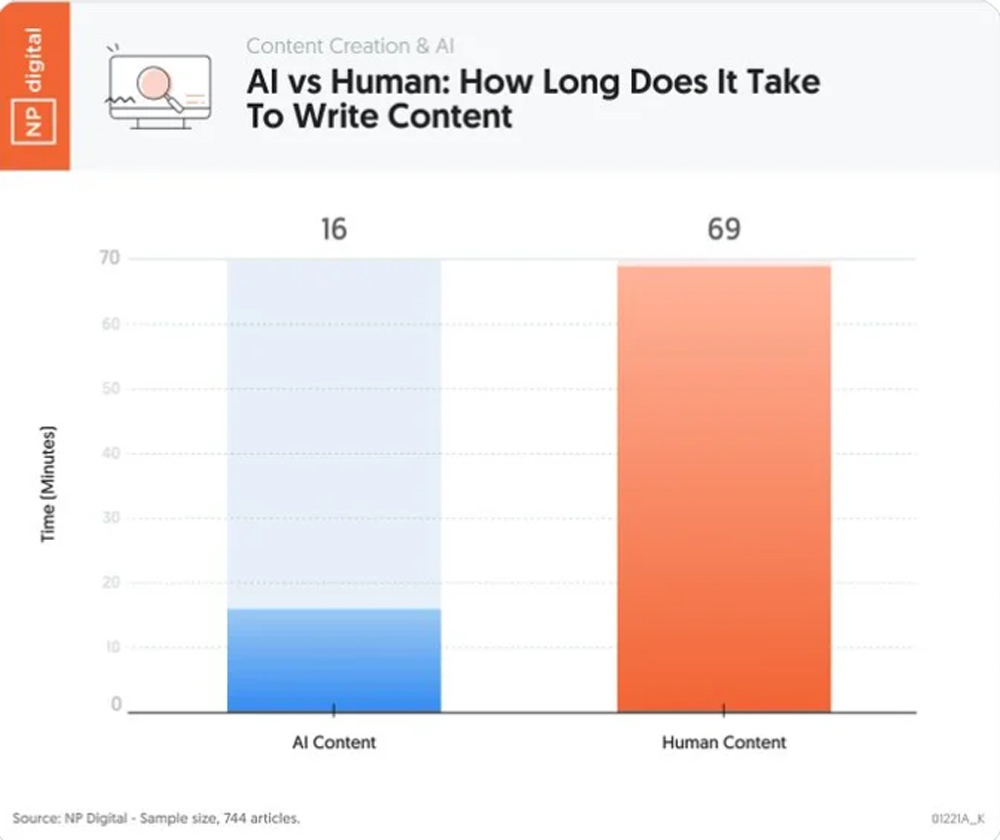
- AI-generated content takes just 16 minutes on average, highlighting its speed and efficiency in modern content creation.
- Human-written content requires around 69 minutes per article, showing the time-intensive nature of manual writing.
- AI writing is approximately 77% faster than human writing, delivering substantial time savings for publishers and marketers.
- The average time gap is 53 minutes per article, underscoring the productivity advantage of AI tools.
- Human writers spend about 4.3× more time than AI to produce similar content volumes.
- The comparison is based on 744 analyzed articles, ensuring the data reflects real-world publishing behavior.
- Time is measured in minutes, making the efficiency difference easy to quantify and compare for editorial planning.
Hybrid Approach Benefits
- Organizations using AI drafts with human editing achieve 40% faster content production while maintaining brand voice.
- Hybrid content ranks 67% better in performance metrics and meets E-E-A-T standards effectively.
- Teams blending AI analytics with editorial strategy produce content 3-5 times faster through optimized iteration cycles.
- AI keyword tools boost suggestion accuracy when humans refine for brand relevance, improving SEO by up to 90% efficiency.
- Human validation in hybrid workflows reduces AI hallucinations by 15-27%, minimizing misinformation risks.
- Hybrid approaches deliver 156% stronger ROI than pure AI or human-only content strategies.
- AI visualization dashboards enable analysts to make strategic decisions5x faster with real-time insights.
- AI-human collaboration enhances creative output, with co-creation scoring 3.2/5 originality vs. humans at 2.6/5.
Frequently Asked Questions (FAQs)
What share of newly created web pages in 2025 include AI‑generated content?
About 74.2% of newly created web pages in April 2025 contained AI‑generated content.
What percentage of online articles were primarily AI‑generated as of mid‑2025?
By May 2025, over 50% of all online articles were classified as AI‑generated.
How much has AI‑powered SEO traffic grown year‑over‑year in recent data?
AI search traffic increased by 527% year‑over‑year in 2025.
What proportion of content marketers planned to use AI for content marketing in 2025?
An estimated 90% of content marketers planned to use AI to support content marketing in 2025.
What percent of U.S. respondents say AI‑powered search results were more specific to queries?
25% of U.S. respondents reported that AI‑powered search results were more specific to their queries.
Conclusion
The content landscape has matured beyond the simplistic “AI vs human” battle. Instead, collaboration between technology and human expertise defines success. AI brings efficiency, scalability, and analytical power, while human creators contribute trust, insight, creativity, and high-trust signals essential for long‑term SEO and audience engagement. Hybrid teams deliver measurable cost efficiencies, maintain strong E‑E‑A‑T compliance, and optimize workflows that drive both visibility and conversions. As search engines evolve to prioritize value over volume, organizations that balance machine assistance with human judgment will lead the next era of content performance.

Leave a comment
Have something to say about this article? Add your comment and start the discussion.