



Android accessibility features help millions of people with diverse needs use their smartphones independently. These capabilities make everyday tasks, from reading messages to controlling apps, easier for people with visual, hearing, motor, or cognitive challenges. In enterprise settings, accessibility tools such as screen readers and voice access improve job performance and compliance. In education and healthcare, these features support inclusive learning and patient engagement. Explore the latest statistics and trends shaping Android accessibility.
Editor’s Choice
- ~29% of screen reader users rely on Google’s TalkBack on Android devices.
- Nearly 75% of Android users surveyed have one or more accessibility settings enabled.
- Android 14 allows font size scaling up to 200%, expanding comfort for users with low vision.
- TalkBack is part of the Android Accessibility Suite, downloaded over 5 billion times globally.
- Dark mode remains a widely used visual accessibility setting with known benefits for eye strain and battery savings.
- Custom accessibility shortcuts can enable features like Select‑to‑Speak instantly via the Accessibility button.
- High‑contrast text and color correction help users with color blindness or contrast sensitivity.
Recent Developments
- AI‑enhanced TalkBack now offers AI‑generated image descriptions and follow‑up questions for visually impaired users.
- Expressive captions are expanding beyond standard text to capture vocal nuances on Android.
- Android extends Expressive Captions on more apps, improving inclusivity for videos and media.
- Support for Bluetooth LE hearing aids was introduced in 2025 and is expanding across more devices in 2026.
- Chrome on Android now includes customizable page zoom without disrupting layout, easing readability.
- AI‑powered notification summaries are rolling out across Android OEMs, aiding users who struggle with long message threads.
- Dark mode is further refined to auto‑apply in more apps, improving accessibility consistently.
- Android Accessibility Suite continues to receive frequent updates to support broader language and gesture options.
Android Accessibility Overview
- Android integrates accessibility into core OS settings, not as optional add‑ons.
- TalkBack provides spoken feedback and gesture‑based navigation for visually impaired users.
- Display settings include font size, display size, and dark theme to improve readability.
- Magnification tools let users temporarily zoom in on any part of the screen.
- Contrast tools cover color correction, inversion, and high‑contrast text for visibility.
- Select‑to‑Speak reads screen elements aloud on demand.
- Accessibility services also include tools like Lookout for object and text identification.
Usage Statistics
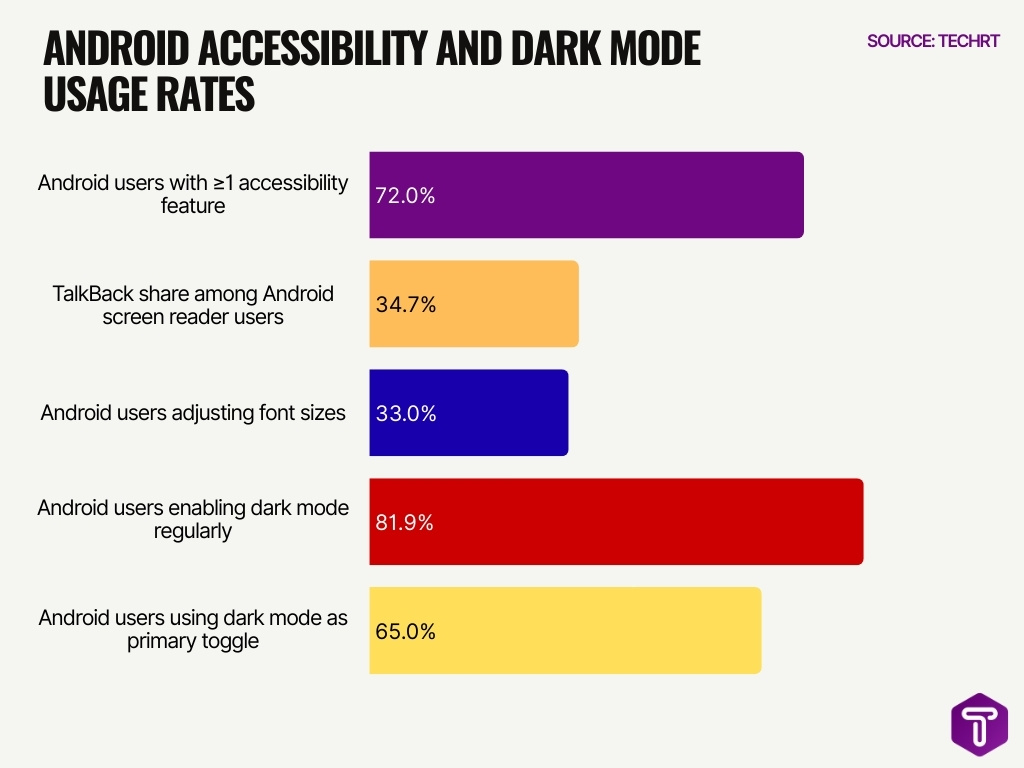
- Nearly 72% of Android users have at least one accessibility feature enabled.
- A large segment of Android users activates two or more accessibility features simultaneously.
- TalkBack holds a 34.7% share among Android screen reader users worldwide.
- Android Accessibility Suite comes pre-installed on over 3.9 billion active Android devices.
- 33% of Android users adjust font sizes for visual accessibility, with most opting for larger.
- High-contrast and color correction features support users with vision impairments in steady adoption.
- 81.9% of Android users enable dark mode regularly across phones and apps.
- 65% of Android users actively use dark mode as a primary accessibility toggle.
- AI-driven accessibility tools show year-over-year growth in user engagement rates.
TalkBack Usage
- TalkBack commands 76.4% usage among Android screen reader users.
- 34.7% of mobile screen reader users prefer TalkBack globally.
- Over 3 billion Android devices ship with TalkBack pre-installed.
- 29.5% market share for TalkBack in the latest WebAIM surveys.
- 91% of blind Android users actively use TalkBack daily.
- Screen reader market grows at 10.91% CAGR, led by TalkBack.
- TalkBack usage surged 66% from 2019-2024, per surveys.
- 1.3 billion visually impaired people drive TalkBack adoption.
- Enterprise apps report 85% TalkBack compatibility testing.
Visual Settings Adoption
- 72% of Android users rely on accessibility features, including visual settings.
- 33% of mobile users adjust font scaling for better readability.
- Low vision users commonly enable font scaling up to 200% on Android 14.
- Magnification gestures allow zooming up to 8x for UI parts.
- 83.6% of websites fail high-contrast text requirements, driving mode adoption.
- Color correction modes like deuteranomaly aid 8% with color deficiencies.
- Color inversion simplifies parsing for users with light sensitivity.
- Bold text is enabled by over 500,000 Dutch users for thicker strokes.
- 81.9% of Android users adopt dark mode for eye comfort.
Dark Mode Statistics
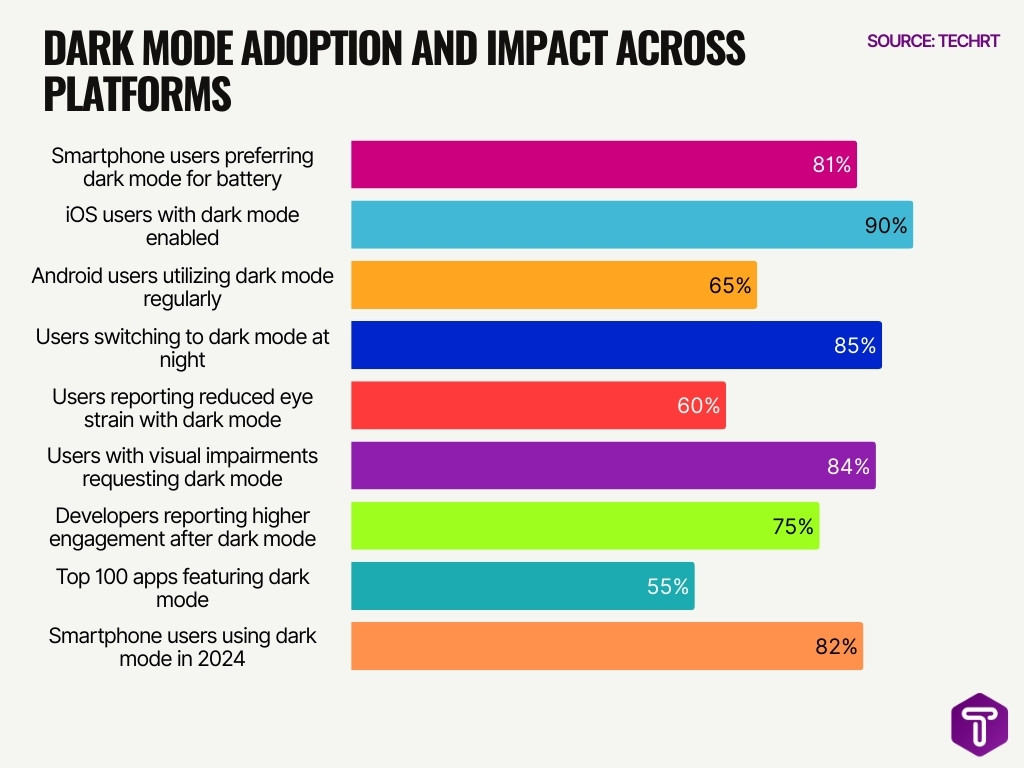
- 81% of global smartphone users prefer dark mode for battery saving.
- 90% of iOS users have enabled dark mode on their devices.
- 65% of Android users utilize dark mode regularly.
- 85% of users switch to dark mode during night hours.
- Dark mode reduces OLED power consumption by up to 67% at maximum brightness.
- 60% of users report that dark mode reduces eye strain during prolonged use.
- 84% of users with visual impairments request dark mode as a standard accessibility feature.
- 75% of app developers report increased user engagement after implementing dark mode.
- 55% of the top 100 App Store apps feature a dark mode option.
- 82% of smartphone users used dark mode in 2024.
Font Size Adjustments
- Android 14 boosts font scaling to 200% from 130% in prior versions, enhancing accessibility for vision-impaired users.
- Over 70% of Dutch Android users enable at least one accessibility feature, frequently including font scaling.
- More than 20% of Android users increase text size beyond the default for better readability.
- 33% of mobile users adjust font size, with 20% opting for larger text primarily.
- Android 14 introduces non-linear scaling up to 200%, preserving UI hierarchy.
- Nearly 75% of surveyed Android users activate multiple accessibility settings, such as font adjustments.
- Samsung devices support 200% font scaling even on older Android versions.
- 11sp is the minimum recommended font size in Android for accessibility compliance.
- Over 3 million Dutch mobile users extrapolate to larger font preferences globally.
- 16sp serves as the standard body text size in Material Design guidelines.
Magnification Usage
- 47% of low vision users rely on screen magnifier software.
- 45% use OS magnification settings for enlarged viewing.
- 72% prefer letter-size magnification over reduced viewing distance.
- 16,787 active users employed a smartphone magnifier app over 30 days.
- 78% of low vision mobile users enable accessibility settings, including magnification.
- 25% require 400% or larger magnification levels regularly.
- 69% combine magnification with other tools like screen readers.
- 82% access magnification via gestures or shortcuts on iOS devices.
- Android Magnification Gestures support up to 8x zoom for on-demand enlargement.
Color Correction Stats
- Approximately 8% of males and 0.5% of females worldwide have color vision deficiency (CVD).
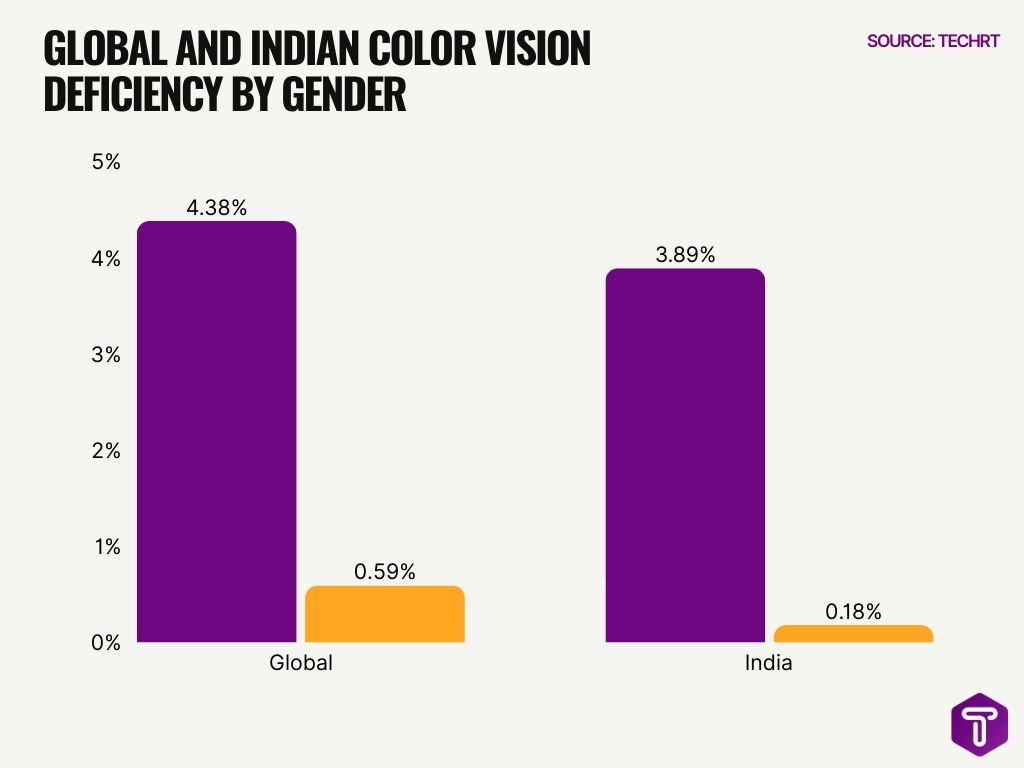
- Global CVD prevalence stands at 2.59%, higher in males at 4.38% than in females at 0.59%.
- Android provides four color correction modes: deuteranomaly, protanomaly, tritanomaly, and grayscale for CVD users.
- Red-green deficiencies account for 98% of color blindness cases globally.
- 86% of dichromats (severe CVD) report daily color distinction difficulties, versus 66% of anomalous trichromats.
- In India, CVD prevalence is 3.89% in males and 0.18% in females.
- Android 15 adds intensity sliders (low, medium, high) to fine-tune color correction filters.
- Adaptive color correction boosts usability by up to 40% for tritanomaly users on mobile devices.
- Among Android users with CVD, adoption of accessibility filters has shown steady growth since the 2019 introduction.
High Contrast Text
- WCAG mandates a 4.5:1 minimum contrast ratio for normal text legibility.
- 51.4% of low vision users activate high contrast mode daily.
- 71.2% prefer light text on dark backgrounds for optimal readability.
- 46% of low vision adults favor reversed-contrast text configurations.
- 30.6% in surveys use high contrast settings regularly.
- 85% of one million homepages fail WCAG contrast compliance.
- 7:1 contrast ratio meets AAA standards for severe vision impairment.
- Android 16 introduces outline text, replacing traditional high contrast.
- 72% combine text size increase with high contrast features.
Audio Features Usage
- Sound Amplifier has achieved over 370 million downloads on Android devices.
- Voice Access recorded 500k downloads in the last month in India alone.
- 67.6% of users with asymmetrical hearing loss regularly use mono audio features.
- 52% of smartphone owners utilize voice assistants like Voice Access for hands-free control.
- 43.1% success rate in hearing aid usage with Android Bluetooth pairing support.
- Android Sound Amplifier ranks #114 in Communication apps in the United States.
- Live Caption enables real-time on-device captions for media, available on Pixel devices since 2019.
- Notification Sounds apps, akin to Sound Notifications, have 17 million downloads.
- The YuWA dataset includes 76,000+ audio clips for audio descriptions in videos.
Closed Captions Data
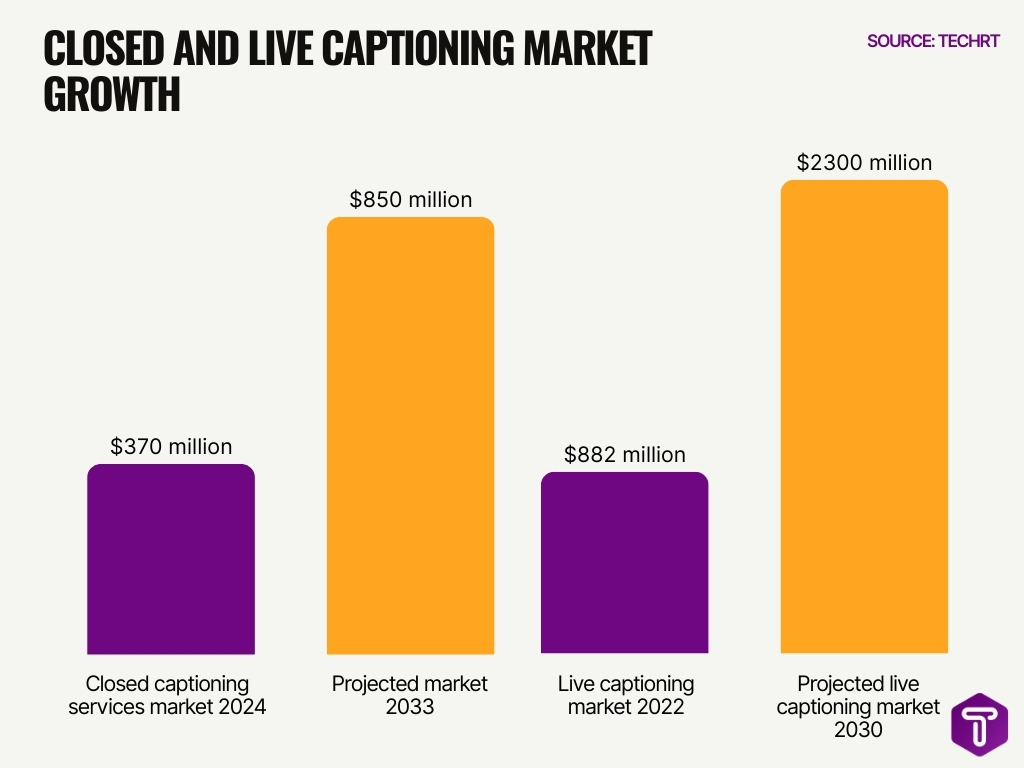
- The global closed captioning services market reached $370 million in 2024, projected to hit $850 million by 2033 at 9.7% CAGR.
- 85% of Facebook videos are watched muted, boosting captioned video views by 40% on YouTube.
- 80% of caption users have no hearing impairment, with 54% students using them for comprehension.
- 12% increase in average watch time for captioned videos on Facebook, 80% viewers finish them.
- 38% Americans prefer subtitles, rising to 63% among adults under 30.
- Closed captions improve speech understanding by 52% (from 23% to 75%) for the hearing-impaired elderly.
- The live captioning market was valued at $882 million in 2022, expected to reach $2.3 billion by 2030 at 12.7% CAGR.
- 90% students find closed captions moderately helpful for learning, even without disabilities.
Speech Features Stats
- Android’s Text-to-Speech reaches nearly 75% of users with one or more accessibility settings activated.
- Voice Access app garnered 500k downloads last month, aiding hands-free control.
- Over 52% of Android smartphone owners utilize built-in voice assistants monthly.
- AI-enhanced speech recognition achieves up to 99% understanding rate on Android platforms.
- Select-to-Speak supports on-demand reading since Android 5, widely used for audio cues.
- Speech tools boost motor-impaired users’ independence, with 90.3% motor analysis accuracy.
- Physical disability users report 63% face moderate to extreme daily activity challenges eased by voice features.
- Nearly 75% of surveyed Android users enable multiple accessibility features, including speech services.
Select to Speak
- Android Accessibility Suite has surpassed 10 billion installs on Google Play.
- Over 3.9 billion active Android users worldwide can access Select to Speak in 2025.
- 72.77% global smartphone market share for Android supports widespread Select to Speak availability.
- 95%+ of active Android devices run Android 9 or newer, enabling default Select to Speak support.
- 15-20% of the population has dyslexia, benefiting from Select to Speak’s text-reading features.
- 80% of students with learning disabilities have dyslexia aided by Select to Speak literacy tools.
- 54% increase in course completion rates reported with text-to-speech like Select to Speak.
- 4.04 average rating from 4.2 million reviews highlights the Select to Speak suite’s popularity.
- Android 9+ compatibility ensures Select to Speak reaches nearly all modern devices.
- Text-to-speech boosts reading comprehension for dyslexia users in education settings.
Voice Access Adoption
- Over 8 billion voice assistants were projected to be in global use by 2024.
- Up to 75% of app interactions worldwide were predicted to involve voice by 2025.
- The Voice Access app has achieved 1 billion+ downloads on Google Play.
- 44 million downloads of Voice Access recorded in the last 30 days.
- 153.5 million US adults used voice assistants in 2025.
- 96.5% of smartphone owners have used a voice assistant at least once.
- 90% of smartphones shipped in 2025 include voice assistants.
- 52% of smartphone owners regularly use voice assistants.
- 22% of new apps feature multimodal voice interfaces.
Regional Usage Differences
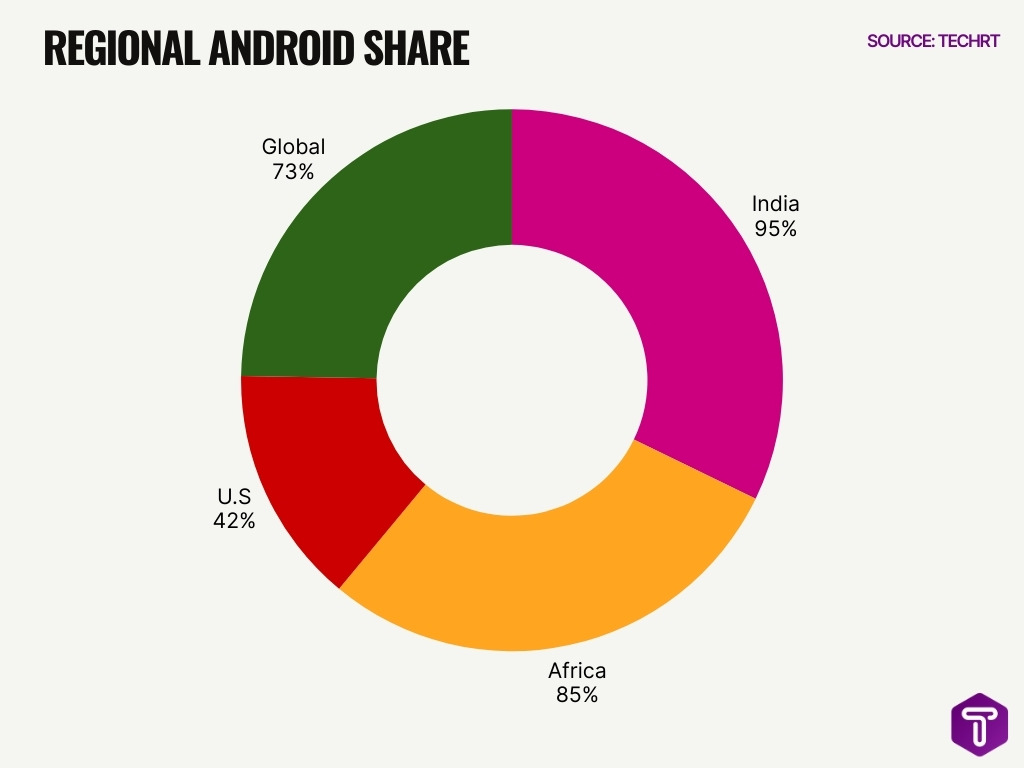
- Android commands ~95% market share in India and ~85% in Africa, driving higher TalkBack usage.
- US Android penetration stands at ~42%, contrasting the global ~73% average, lowering feature adoption.
- Asia-Pacific Android dominance reaches ~82%, boosting necessity-driven accessibility tools.
- Latin America reports ~91% Android share, heightening reliance on budget devices.
- TalkBack holds ~35% of global mobile screen reader usage in high-Android regions.
- Nearly 75% Android users activate accessibility settings vs 50% iOS users in surveyed markets.
- Asia-Pacific screen reader market grows fastest at ~11% CAGR, outpacing North America’s ~7%.
- Digital accessibility adoption surges ~10% annually in the Asia-Pacific due to regulations.
- Emerging markets show ~30-75% abandonment of traditional aids for smartphone features.
Multiple Features Usage
- 72% of Android users enable at least one accessibility feature, with a large group using two or more simultaneously.
- A significant portion of Android users activate multiple accessibility features like dark mode and larger fonts together.
- Android natively supports running Select to Speak and TalkBack at the same time for multi-sensory access.
- Nearly 20% of users with accessibility settings enabled use multiple features concurrently on mobile devices.
- Combining accessibility aids correlates with up to 36% higher app retention and better user engagement.
- 45% of employees with disabilities rate workplace software accessibility as only fair or poor, boosting multi-feature demand.
- Visual settings like font size increase and magnification are most commonly combined on Android.
- Speech features such as Voice Access pair frequently with visual aids for full input/output accessibility.
- Multi-feature use is prevalent in education and enterprise, where diverse tasks require interoperability.
Trends Over Time
- Accessibility feature visibility in Android onboarding has risen, with nearly 75% of Android users activating at least one feature.
- TalkBack integration of Gemini AI enhances image descriptions, boosting annual improvements in screen reader feedback.
- Voice User Interface market grows at a 20-25% CAGR, reaching over $20 billion by 2028 from $16.5 billion in 2023.
- The speech and voice recognition market expands from $19.09 billion in 2025 to $81.59 billion by 2032.
- The screen reader market, valued at $1.3 billion in 2023, is projected to hit $2.8 billion by 2032 at 8.2% CAGR.
- Android TalkBack is used by 34.7% of mobile screen reader users, second to VoiceOver.
- Apps prioritizing accessibility expand customer base by 15-20%, per industry analysis.
- Over 50% of iOS and 75% of Android users enable multiple accessibility settings.
- VUI adoption in apps drives 4x real-time growth in voice AI processing year-over-year.
Most Challenging Mobile Accessibility Barriers
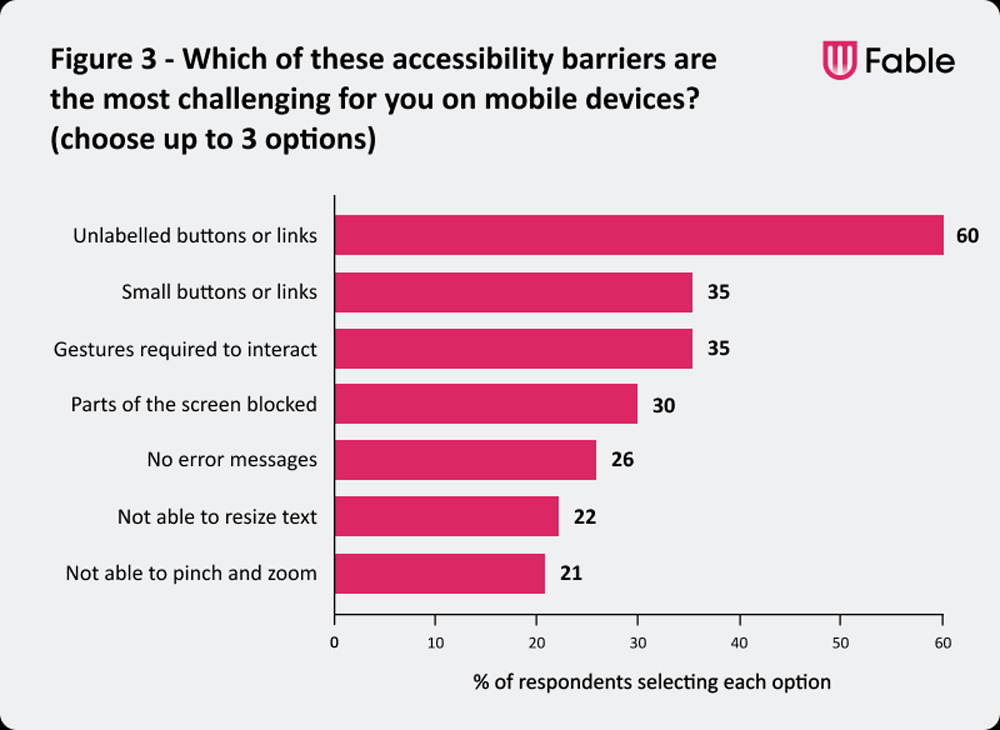
- Unlabelled buttons or links are the biggest accessibility barrier, affecting 60% of respondents, making navigation and interaction extremely difficult on mobile devices.
- Small buttons or links create usability challenges for 35% of users, increasing errors and frustration due to poor touch accuracy.
- Gesture-based interactions are problematic for 35% of respondents, indicating that swipe- or motion-dependent controls remain inaccessible for many users.
- Blocked screen areas impact 30% of users, often hiding critical content or interactive elements on mobile interfaces.
- Missing error messages affect 26% of respondents, leaving users without guidance when actions fail or inputs are incorrect.
- Inability to resize text is reported by 22% of users, limiting readability and customization for users with visual impairments.
- Lack of pinch-to-zoom support affects 21% of respondents, preventing users from enlarging content for better visibility and control.
Developer Adoption Stats
- 79% of developers build accessibility into design plans at the earliest stages.
- 87% of accessibility teams employ inclusive design principles.
- 71.8% of practitioners are very familiar with WCAG guidelines.
- 52.6% report very proficient knowledge of web accessibility.
- Only 19% have adequate internal resources for ongoing accessibility testing.
- 29.1% of accessibility practitioners report having a disability.
- 36.6% cite lack of skills/knowledge as a key reason for inaccessibility.
- Automated tools detect only 20-30% of accessibility issues, according to practitioners.
- 44% strongly agree accessibility is a higher priority than last year.
Frequently Asked Questions (FAQs)
What percentage of Android users have at least one accessibility feature enabled?
Almost 72% of Android users surveyed have at least one accessibility setting enabled on their phone.
What share of mobile user journeys face accessibility barriers?
Around 72% of mobile user journeys experience accessibility barriers due to common UX and design issues.
What percentage of respondents use mobile screen readers?
About 47% of survey respondents reported using screen readers on their mobile devices.
What is Android’s global market share among mobile operating systems?
Android holds approximately 72–73% of the global mobile OS market share as of 2025.
How many active Android OS users are there worldwide?
There are about 3.9 billion Android OS users globally.
Conclusion
Android’s accessibility landscape reflects strong adoption, continual innovation, and growing developer commitment. Across visual, audio, and voice features, users report higher engagement and easier interaction with everyday tasks. Voice‑based interfaces and AI integrations are shaping the future where spoken and multi‑sensory access becomes standard.
Regional variations highlight the need for localized approaches, and developer trends show ever‑improving adherence to inclusive design. With vast market opportunities and rising accessibility expectations, Android remains central to digital inclusion globally.

Leave a comment
Have something to say about this article? Add your comment and start the discussion.