




Big data refers to the massive volumes of structured and unstructured information generated every second from digital platforms, connected devices, financial transactions, and enterprise systems. Traditional databases cannot efficiently process this scale, which is why organizations rely on advanced analytics, cloud computing, and AI-driven platforms to extract actionable insights.
In healthcare, big data powers predictive diagnostics and personalized treatment planning. In retail and e-commerce, companies use behavioral analytics to optimize pricing, inventory, and customer targeting in real time. Financial institutions depend on large-scale data processing to detect fraud within milliseconds and manage risk exposure.
As global data creation accelerates toward hundreds of zettabytes annually, businesses that invest in scalable analytics infrastructure gain measurable advantages in efficiency, customer experience, and revenue growth. Explore the full breakdown of Big Data Statistics below to understand how this transformation is unfolding across industries and regions.
Editor’s Choice
- 181 zettabytes of data are projected worldwide by the end of 2025.
- The global big data analytics market is expected to be above $495 billion in 2025.
- Big data technology market poised to reach $521 billion in 2026.
- Market size projected to top $1 trillion+ by 2034 per analytics forecasts.
- CAGR of approximately 13.3% across big data markets through 2029.
- Data analytics spending is expected to exceed $104 billion in 2026.
- North America holds roughly 27% to 32% market share in data analytics adoption.
Recent Developments
- Major tech companies boosted infrastructure spending with over $400 billion in capex in 2025, largely on AI and data technologies.
- Tech bond sales forecasts in 2026 rose to around $360 billion, driven by AI and cloud investment.
- Global investment in data centers hit a record $61 billion in 2025, underscoring infrastructure demand.
- Semiconductor industry revenues are expected to cross $1 trillion in 2026, supporting data infrastructure.
- The server market saw 61% year-over-year revenue growth in Q3 2025, led by demand for accelerated compute.
- AI, cloud, and advertising revenue trends continue to accelerate data monetization.
- Data center and cloud spending indicate businesses are prioritizing scalable data platforms.
- Increasing adoption of edge and hybrid cloud architectures is enabling distributed data insight workflows.
Global Big Data Overview Statistics
- The global volume of data is projected to reach 181 zettabytes by 2025, driven by IoT, mobile, and enterprise data streams.
- By 2028, total data created and consumed worldwide may hit 394 zettabytes.
- The U.S. big data industry is projected to reach $248.89 billion by 2032.
- North America continues to dominate global analytics with about 32% market share as of 2025.
- Global cloud adoption accelerates big data usage across sectors.
- Data volumes from connected devices are outpacing traditional enterprise data growth.
- Enterprises in EMEA and Asia-Pacific regions are significantly increasing AI-driven analytics use.
- By 2026, data ecosystem expansion is expected to influence regulatory frameworks globally.
Big Data and Analytics Services Market Growth Insights
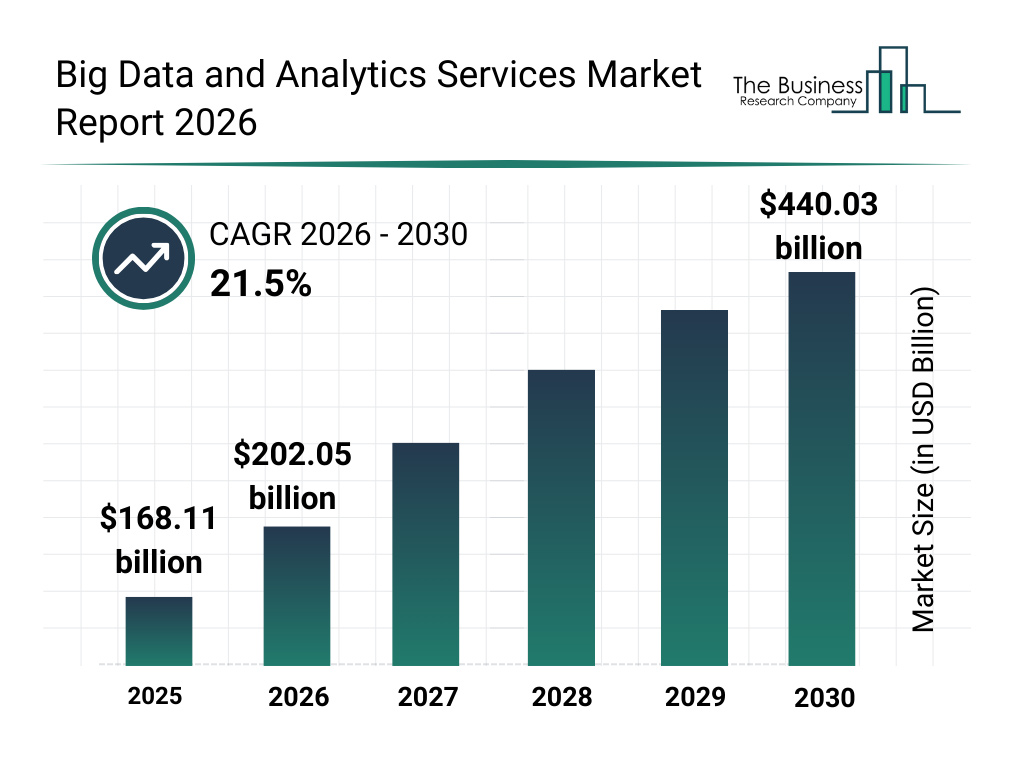
- The global big data and analytics services market was valued at $168.11 billion in 2025, highlighting its strong early-stage expansion.
- In 2026, the market increased to $202.05 billion, reflecting rising enterprise adoption of data-driven technologies.
- From 2026 to 2030, the market is projected to grow at a robust CAGR of 21.5%, indicating sustained long-term momentum.
- By 2030, the industry is expected to reach $440.03 billion, showing more than 2.1x growth compared to 2026 levels.
- The rapid growth is driven by increasing investments in AI, cloud computing, and advanced analytics platforms.
- Large enterprises and SMEs are accelerating spending on data management, predictive analytics, and real-time insights.
- Expanding use cases in finance, healthcare, retail, and manufacturing are contributing significantly to market expansion.
- The strong upward trend from 2025 to 2030 reflects growing demand for scalable, secure, and intelligent data solutions.
- Technology providers are focusing on automation, AI-powered analytics, and big data infrastructure to capture market share.
- The consistent growth trajectory positions big data and analytics as a core pillar of digital transformation strategies worldwide.
Global Data Creation and Growth Statistics
- Projected global data volume by 2025: 181 zettabytes.
- Expected data volume by 2028: 394 zettabytes.
- Year-over-year data creation growth continues at double-digit rates.
- IoT devices globally are projected to exceed tens of billions, fueling data generation.
- Digital transformation across enterprises increases digital footprint and storage needs.
- Streaming, e-commerce, and video content are major drivers of data growth.
- Data generated per person annually continues to climb into multiple terabytes.
- Enterprise sensor data and machine logs now rival human-generated data amounts.
Big Data Market Size and Revenue Statistics
- The global big data analytics market is valued at around $495.18 billion in 2025.
- Forecasts put the analytics market at $961.89 billion by 2032.
- The big data technology market is estimated at $454.00 billion in 2025.
- Expected growth to about $521.09 billion in 2026.
- Long-term projections show the market exceeding $1.4 trillion by 2034.
- Big data contributes to significant revenue pools in analytics, storage, and BI tools.
- North America holds a leading share of total big data revenue.
- Global spending on big data is rising with enterprise digital transformation budgets.
Big Data Adoption by Organizational Size
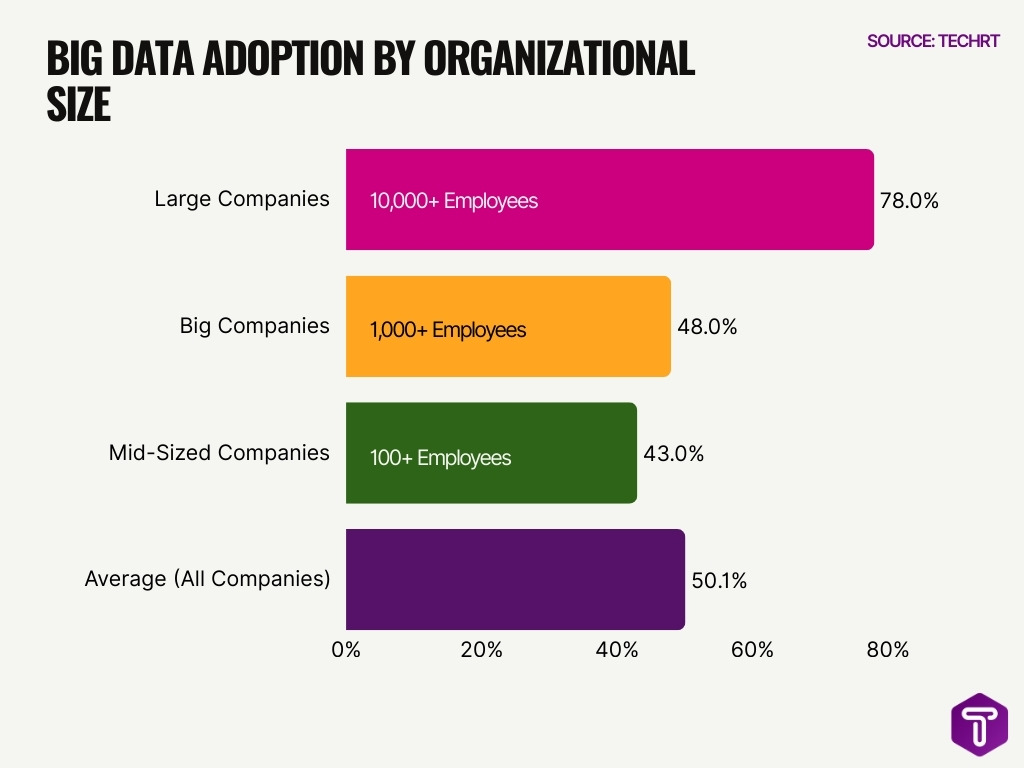
- Large companies (10,000+ employees) lead big data usage, with an adoption rate of 78%, showing strong investment in advanced analytics and infrastructure.
- Big companies (1,000+ employees) report 48% adoption, indicating moderate integration of big data into business operations.
- Mid-sized companies (100+ employees) show 43% adoption, reflecting slower digital transformation compared to larger enterprises.
- The overall industry average stands at 50.1%, highlighting that only about half of organizations currently use big data solutions.
- There is a 35 percentage point gap between large companies (78%) and mid-sized firms (43%), demonstrating a significant size-based digital divide.
- Companies with larger workforces and higher budgets are more likely to adopt big data tools for decision-making, automation, and forecasting.
- Smaller and mid-sized businesses face cost, skill, and infrastructure barriers, which continue to limit adoption below 50%.
- As cloud analytics and AI tools become more affordable, mid-sized and big companies are expected to push adoption beyond the current 43%–48% range.
Big Data Adoption and Usage Statistics
- The healthcare sector shows 89% big data adoption rate for improved patient care.
- Financial services lead with 91% adoption rate in big data analytics.
- 70% of SMBs plan to increase analytics investments by 2024.
- 82% of enterprises prioritize real-time analytics for IoT data.
- 75% of apps will embed analytics by 2025, boosting revenue by 30%.
- 60% of large organizations have adopted big data analytics.
- The global big data market is projected to reach $1,194.35 billion by 2032.
- 97.2% of companies use big data for innovation, boosting revenue by 8%.
- 54% adoption of cloud computing for scalable big data processing.
Big Data by Region and Country Statistics
- North America accounts for approximately 32% of the global big data analytics market share in 2025.
- The U.S. big data market is projected to exceed $248 billion by 2032.
- Asia-Pacific is forecast to grow at the fastest CAGR, exceeding 14% through 2030.
- Europe holds nearly 25% of global analytics revenue, with Germany, the U.K., and France leading adoption.
- China’s big data industry surpassed $220 billion in 2024, fueled by AI integration and smart city programs.
- India’s analytics market is expected to grow at over 15% CAGR.
- Middle East investments in AI and big data reached over $20 billion in 2024.
- Latin America’s big data market is expanding at roughly 12% annual growth.
- Government-backed digital transformation programs across OECD nations are accelerating national data infrastructure projects.
Big Data and Analytics Adoption Across Industries
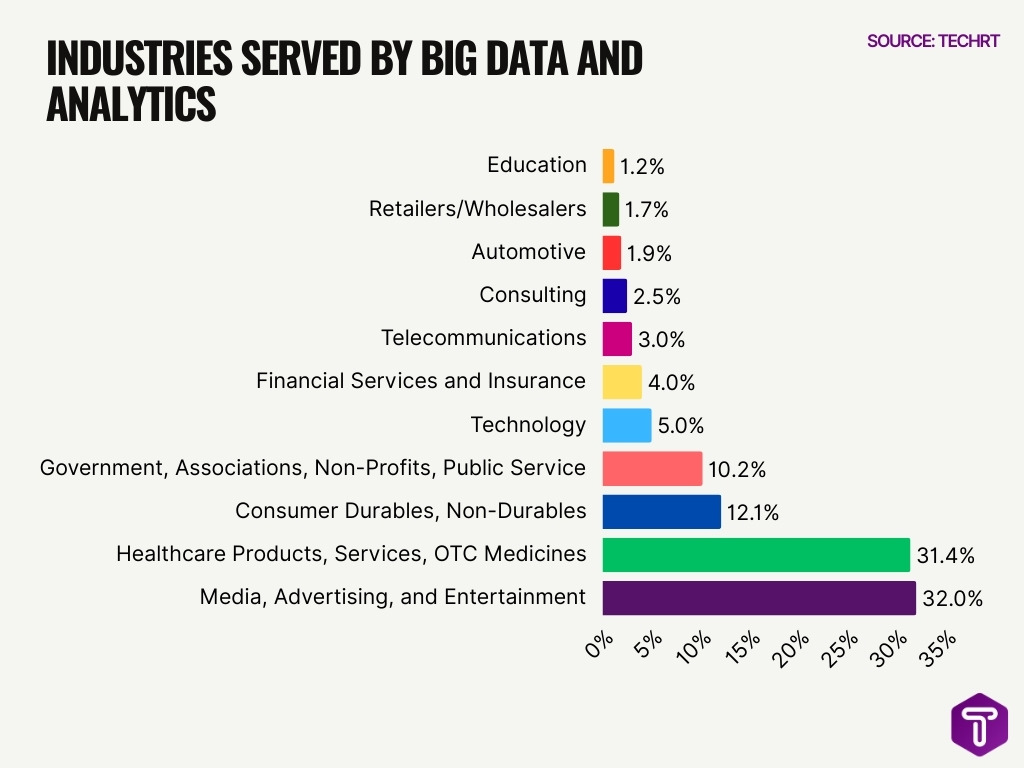
- Media, Advertising, and Entertainment lead big data adoption with the highest share at 32.0%, highlighting its strong reliance on audience analytics, content optimization, and ad targeting.
- Healthcare Products, Services, and OTC Medicines follow closely at 31.4%, reflecting heavy use of big data for patient insights, drug research, and operational efficiency.
- Consumer Durables and Non-Durables account for 12.1%, showing significant adoption in supply chain management, demand forecasting, and customer behavior analysis.
- Government, Associations, Non-Profits, and Public Service represent 10.2%, indicating growing use of analytics for policy planning, public services, and resource allocation.
- The Technology sector holds a 5.0% share, using big data extensively for product development, AI training, and performance monitoring.
- Financial Services and Insurance contributes 4.0%, leveraging analytics for risk assessment, fraud detection, and personalized financial products.
- Telecommunications records 3.0%, driven by network optimization and customer churn analysis.
- Consulting firms account for 2.5%, supporting data-driven decision-making and enterprise transformation projects.
- The Automotive industry stands at 1.9%, reflecting early-stage adoption in connected vehicles and predictive maintenance.
- Retailers and Wholesalers capture 1.7%, mainly using big data for inventory optimization and pricing strategies.
- Education shows the lowest adoption at 1.2%, indicating limited but emerging use of analytics in student performance tracking and digital learning systems.
Big Data in Healthcare, BFSI, Retail, Manufacturing, Telecom, Government, and Media Statistics
- Healthcare providers using predictive analytics reduce hospital readmissions by up to 25%.
- The global healthcare analytics market is projected to exceed $130 billion by 2030.
- BFSI institutions use AI-driven analytics to detect fraud in real time, reducing losses by up to 40%.
- Retailers leveraging big data personalization see revenue growth increases of 5% to 15%.
- Smart manufacturing analytics adoption improves production output by 10% to 20%.
- Telecom companies analyze petabytes of subscriber data daily to optimize network performance.
- Governments investing in big data platforms report operational savings of 10% or more in digital service delivery.
- Media companies using advanced analytics increase advertising ROI by 20% to 30%.
- Public health surveillance systems rely on real-time data streams to monitor disease outbreaks globally.
Big Data and Internet of Things, IoT, Statistics
- The number of IoT devices worldwide is projected to exceed 29 billion by 2030, up from around 15 billion in 2023.
- IoT devices generate nearly 80 zettabytes of data annually.
- Industrial IoT spending surpassed $260 billion in 2024.
- Smart city initiatives globally account for over $200 billion in annual IoT-related investments.
- 75% of enterprise data is expected to be processed outside traditional data centers by 2026 due to edge computing growth.
- IoT-enabled predictive maintenance reduces equipment breakdowns by 30%.
- Connected healthcare devices are projected to grow at over 18% CAGR through 2028.
- Automotive IoT data traffic is expanding at double-digit growth as vehicles become more connected.
- Over 60% of enterprises report integrating IoT data into centralized analytics platforms.
Data Created Online Every 60 Seconds
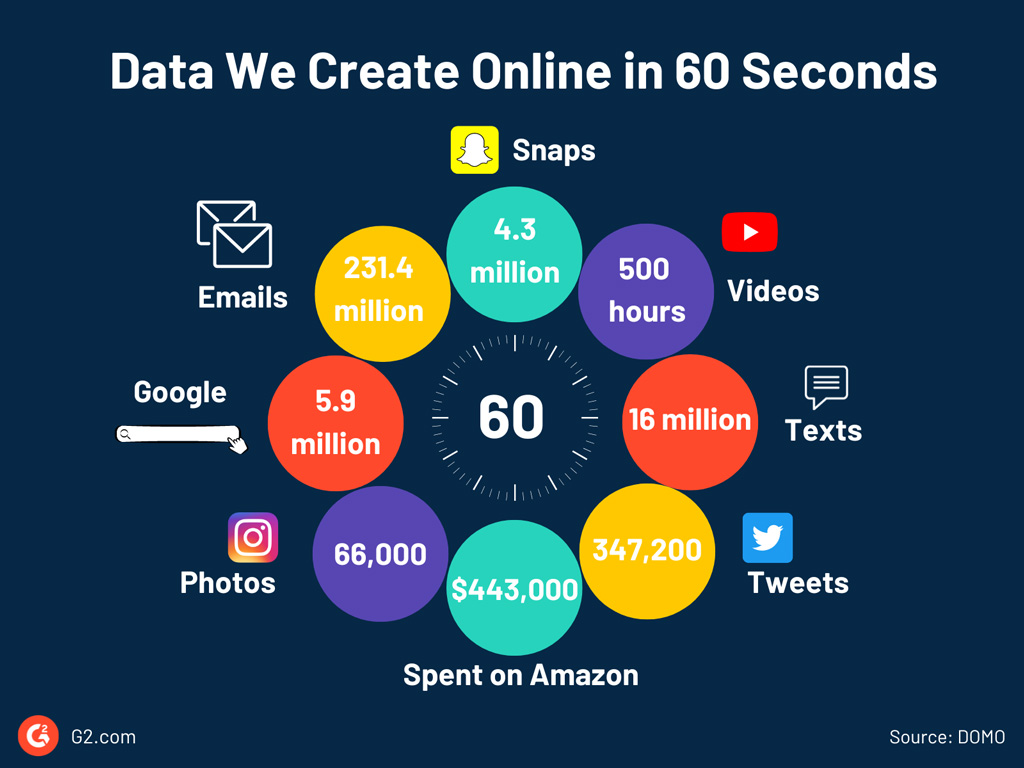
- In just 60 seconds, users send a staggering 231.4 million emails, highlighting the continued dominance of email communication worldwide.
- Snapchat users generate 4.3 million snaps per minute, showcasing the massive scale of real-time visual sharing.
- YouTube creators upload approximately 500 hours of video content every minute, reflecting explosive growth in long-form and short-form video consumption.
- Consumers send around 16 million text messages per minute, proving that SMS remains a core communication channel globally.
- Google processes about 5.9 million searches every 60 seconds, underlining its central role in information discovery.
- Instagram users upload roughly 66,000 photos per minute, reinforcing the platform’s strong visual engagement.
- Shoppers spend an estimated $443,000 on Amazon every minute, demonstrating the immense scale of global eCommerce activity.
- Twitter (X) users publish approximately 347,200 tweets per minute, indicating constant real-time conversations happening worldwide.
Structured vs Unstructured Data Volume Statistics
- Approximately 80% to 90% of enterprise data is unstructured, including emails, video, and social content.
- Structured data accounts for less than 20% of total enterprise information volumes.
- Global unstructured data volumes are growing at over 55% annually.
- Video content represents the largest share of unstructured data generation worldwide.
- Social media platforms generate billions of unstructured posts daily.
- Enterprises report that analyzing unstructured data improves decision accuracy by 15% to 25%.
- AI-powered natural language processing tools are now used by more than 50% of large enterprises to analyze text data.
- Data lake adoption rates increased by over 20% in 2024 to better manage unstructured content.
- Organizations storing unstructured data in the cloud grew by nearly 30% year over year.
Cloud Big Data and Data Lake Adoption Statistics
- Public cloud services spending is projected to reach $678.8 billion in 2024, up from $563.6 billion in 2023.
- By 2026, more than 75% of organizations are expected to adopt a digital transformation model centered on cloud platforms.
- Over 60% of enterprise data is now stored in the cloud.
- Data lake adoption among large enterprises exceeds 70%.
- Hybrid cloud adoption reached 85% of organizations in 2024.
- Cloud-based analytics deployments reduce infrastructure costs by 20% to 30%.
- More than 50% of data and analytics leaders report migrating mission-critical workloads to cloud-native data platforms.
- The global data lake market is projected to surpass $45 billion by 2030.
- Edge-cloud integration is expected to process 75% of enterprise-generated data outside centralized data centers by 2026.
Big Data Tools, Platforms, and BI Adoption Statistics
- The global business intelligence market is projected to reach $54 billion by 2026.
- Over 90% of enterprises report using BI tools for operational reporting and dashboards.
- Self-service analytics usage increased by over 25% year over year in 2024.
- More than 65% of analytics tasks will be automated or augmented by AI by 2026.
- Open-source big data tools remain core components in over 50% of enterprise data stacks.
- Embedded analytics integration within SaaS applications grew by 30% in 2024.
- Data visualization platform adoption among mid-sized companies increased by 20% in the past year.
- Data catalog adoption rose to over 60% among Fortune 1000 firms.
- Organizations using advanced analytics platforms report decision-making speed improvements of up to 5x faster.
Big Data and AI Professionals’ Salary Insights
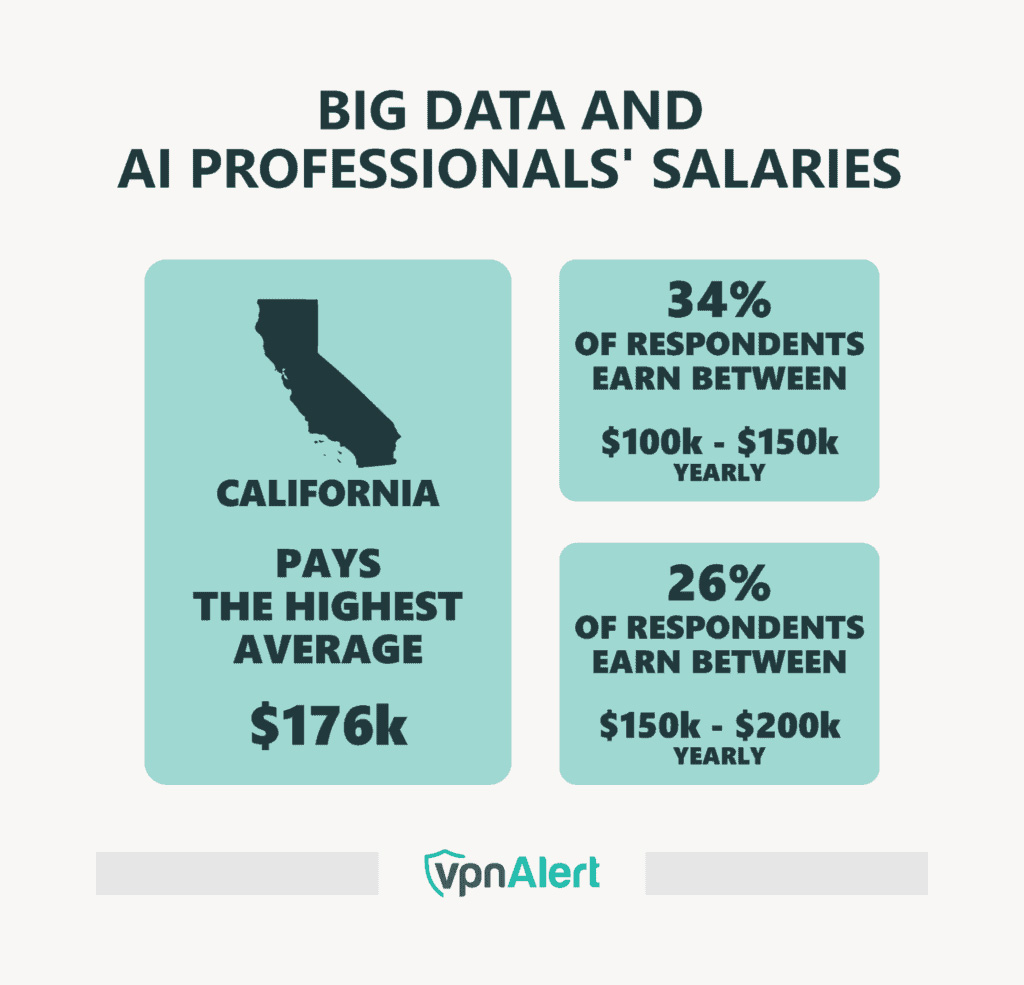
- California leads the market by offering the highest average salary of $176,000 per year for Big Data and AI professionals.
- A significant 34% of respondents earn between $100,000 and $150,000 annually, showing strong mid-level income potential.
- Around 26% of professionals report salaries in the $150,000 to $200,000 range, reflecting high demand for advanced skills.
- More than 60% of respondents earn above $100,000 per year, highlighting the premium value of data and AI expertise.
- The concentration of top-paying roles in California underscores its position as a global hub for AI and big data innovation.
Data Privacy, Security, Governance, and Compliance Statistics
- The average global cost of a data breach reached $4.45 million in 2023.
- In the U.S., average breach costs exceed $9.4 million.
- Over 75% of countries now enforce national data protection or privacy laws.
- 63% of organizations report increasing cybersecurity budgets in 2024.
- Compliance-related spending on data governance solutions grew by over 20% year over year.
- 80% of enterprises cite data governance as critical for AI success.
- Insider threats account for nearly 20% of data breaches.
- Multi-cloud security adoption rose to 60% of enterprises in 2024.
- Data encryption adoption in cloud environments exceeds 85% among large enterprises.
Big Data ROI, Business Value, and Implementation Cost Statistics
- Organizations using advanced analytics report operating margin improvements of 15% to 20%.
- Data-driven companies are 23 times more likely to acquire customers.
- 91% of businesses state that data investments have delivered measurable value.
- The average enterprise spends over $10 million annually on data and analytics infrastructure.
- Analytics-led personalization increases marketing ROI by 10% to 30%.
- Companies that scale AI effectively generate up to 3x higher ROI than peers.
- Poor data quality costs organizations an average of $12.9 million annually.
- Predictive analytics reduces supply chain forecasting errors by 20% to 50%.
- 60% of organizations report faster strategic decision-making after implementing big data platforms.
Future Trends and Forecasts in Big Data Statistics
- Global data volume is projected to reach 394 zettabytes by 2028.
- The big data analytics market is forecast to exceed $1.17 trillion by 2034.
- Edge analytics adoption is expected to grow at over 15% CAGR through 2030.
- By 2026, 80% of enterprises will use multiple data hubs to manage distributed architectures.
- Quantum computing integration with big data platforms is projected to accelerate post-2027.
- Sustainable data center investments are rising, with green infrastructure spending growing by over 20% annually.
- Data literacy programs expanded across 70% of large enterprises in 2024.
- Real-time analytics adoption is expected to surpass 65% of enterprises by 2026.
- AI-augmented analytics will become the default model for business intelligence platforms within the next five years.
Frequently Asked Questions (FAQs)
How many zettabytes of data are expected to be generated worldwide in 2026?
Around 221 zettabytes of data is expected to be generated globally in 2026.
What was the global big data analytics market size in 2025 and its projected value by 2034?
The global big data analytics market was valued at $394.70 billion in 2025 and is projected to reach about $1,176.57 billion by 2034 at a 12.8% CAGR.
What is the projected growth of the big data and analytics market from 2025 to 2026?
The big data and analytics market is projected to grow from $134.64 billion in 2025 to $151.89 billion in 2026 at a 12.8% CAGR.
How many connected IoT devices are expected by the end of 2025?
The number of connected IoT devices is projected to reach about 21.1 billion by the end of 2025, with around 14% annual growth.
What is the expected market size growth of the Big Data as a Service (BDaaS) market by 2035?
The global Big Data as a Service market is projected to grow from $47.21 billion in 2026 to approximately $226.81 billion by 2035 at a 19.11% CAGR.
Conclusion
Big data stands at the center of digital transformation across industries. Cloud migration, AI integration, and IoT expansion continue to push global data volumes toward unprecedented levels. At the same time, privacy regulations and governance frameworks are reshaping how organizations manage information responsibly.
Enterprises that invest strategically in analytics, AI, and secure data infrastructure report measurable gains in revenue, efficiency, and competitive positioning. As global data creation moves toward 394 zettabytes by 2028 and market valuations approach trillion-dollar levels, big data will remain a core pillar of enterprise strategy.

Leave a comment
Have something to say about this article? Add your comment and start the discussion.