



Business blogging continues to shape how brands attract, educate, and convert audiences. It plays a central role in inbound marketing strategies, helping companies generate organic traffic, build authority, and nurture leads over time. For example, SaaS companies rely on blogs to explain complex products and drive trial sign-ups, while eCommerce brands use blog content to rank for product-related searches and guide purchase decisions.
At the same time, the landscape is evolving quickly. AI-powered search, changing user behavior, and content saturation are forcing businesses to rethink how they create and distribute blog content. As a result, data-driven blogging strategies are no longer optional; they are essential for staying competitive. Let’s explore the latest statistics that define business blogging today.
Editor’s Choice
- 80% of businesses use blogging as part of their marketing strategy in 2026.
- Companies that blog generate 67% more leads than those that don’t.
- Blogging can increase website traffic by 55% on average.
- Blog posts rank among the top 5 highest-ROI content formats in 2025–2026.
- There are over 600 million blogs worldwide, highlighting massive competition and opportunity.
- Businesses that prioritize blogging are 13x more likely to achieve positive ROI.
- 90% of leads generated monthly come from older blog posts, proving long-term value.
Recent Developments
- Around 94% of marketers plan to use AI in content creation, including blog writing, in 2026.
- Nearly 30% of marketers report declining search traffic due to AI tools changing user behavior.
- Zero-click search experiences are expected to dominate in 2026, reducing direct blog traffic.
- Over 50% of marketers plan to increase content marketing budgets, signaling continued investment.
- 62.8% of content marketers reported traffic growth year-over-year despite market shifts.
- AI adoption in blogging workflows now touches 44% of content drafting processes.
- Organic search traffic to blogs has declined consistently over the past 5 years, especially with AI summaries.
- Content marketing revenue is projected to exceed $100 billion globally by 2026.
Overview of Business Blogging
- There are more than 600 million blogs globally, with millions of new posts published daily.
- WordPress alone publishes 70 million blog posts per month, showing massive content volume.
- About 77% of internet users read blogs, indicating widespread consumption.
- The US has over 31 million active bloggers, making it one of the largest markets.
- Blogging ranks as the third most popular content format among marketers in 2025–2026.
- 76% of content marketers rely on blogs for content distribution.
- Around 29% of users read blogs monthly, while 18% read them daily.
- Blogging remains a top inbound marketing channel, outperforming many outbound tactics.
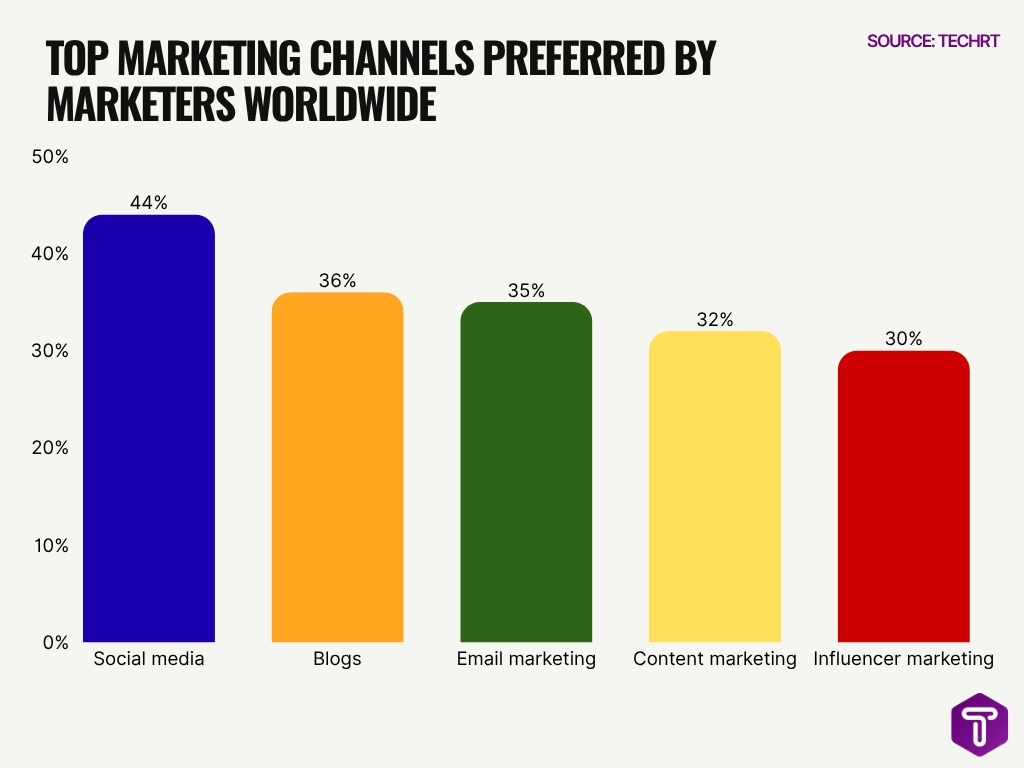
Top Marketing Channels Used by Marketers
- Social media leads the landscape, with 44% of marketers identifying it as their top marketing channel, making it the most dominant platform for audience engagement and brand visibility.
- Blogs remain highly influential, with 36% of marketers relying on them, highlighting the continued importance of long-form, SEO-driven content strategies.
- Email marketing stays strong, cited by 35% of marketers, proving its effectiveness in direct communication, lead nurturing, and conversion optimization.
- Content marketing as a whole is still critical, with 32% adoption, indicating that value-driven content continues to fuel brand authority and customer trust.
- Influencer marketing is rapidly gaining traction, with 30% of marketers leveraging it, showing a growing shift toward creator-led and social proof-based strategies.
- The gap between social media (44%) and blogs (36%) suggests that while short-form, real-time content dominates, owned content platforms still play a crucial role.
- A relatively close distribution between channels (30%–44% range) indicates that marketers are diversifying their strategies rather than relying on a single channel.
- The combined strength of content-related channels (blogs + content marketing = 68%) highlights how content remains the backbone of modern marketing.
- Channels like email and blogs outperform newer trends like influencer marketing, emphasizing that proven, ROI-driven channels still hold significant value.
- Overall, the data reflects a multi-channel marketing approach, where businesses integrate social, content, and direct communication channels to maximize reach and performance.
Business Blogging and Lead Generation
- Businesses with blogs generate 67% more leads monthly than those without.
- Companies that publish 16+ blog posts per month get 3.5x more leads than those publishing fewer than four.
- Blogging contributes to over 40% of total inbound leads for content-focused companies.
- Marketers report that blog content generates 2x more leads than paid ads in some industries.
- About 60% of marketers say blogging produces their highest-quality leads.
- Businesses that blog convert visitors into leads at a 6x higher rate than non-blogging websites.
- Including CTAs in blog posts can increase lead conversions by up to 121%.
- 90% of marketers use blogs to support lead generation funnels.
- Evergreen blog content continues to generate leads for years after publication, often contributing 70%+ of total leads.
Business Blogging Adoption and Usage
- Around 4 in 5 companies (80%) maintain a blog as part of their marketing strategy.
- 38% of marketers actively publish blog content, ranking it among the top formats.
- Nearly 29% of marketers actively use content marketing strategies centered on blogs.
- 76% of marketers use blogs to distribute content and reach audiences.
- About 50% of marketers plan to increase content investment, including blogs.
- 67% of marketers use AI tools to assist with blogging and SEO.
- Nearly 80% of marketers write content in-house, showing internal reliance on blogging.
- Only 20–26% of bloggers report strong results, indicating room for optimization.
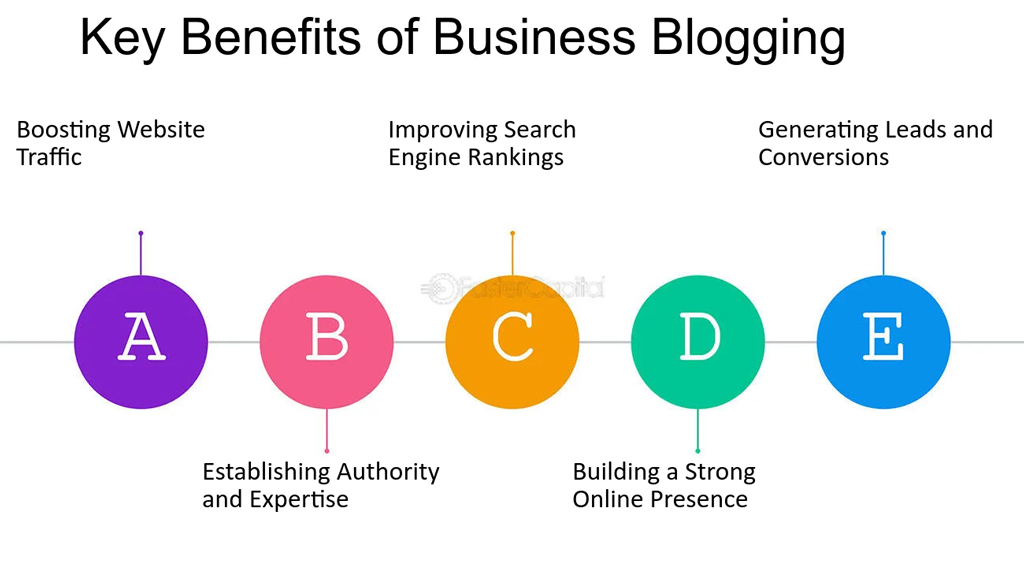
Key Benefits of Business Blogging
- Business blogging significantly boosts website traffic, making it one of the most effective strategies for increasing organic visitors and improving overall site visibility.
- Companies that blog consistently are better positioned to improve search engine rankings, helping them appear higher in Google search results and attract more qualified traffic.
- Blogging helps in establishing authority and expertise, allowing businesses to build trust and credibility within their industry over time.
- A well-maintained blog contributes to building a strong online presence, ensuring that brands remain visible, relevant, and competitive in the digital space.
- One of the most impactful benefits is generating leads and conversions, as blogs can guide readers through the sales funnel and turn visitors into customers.
- By combining all five benefits, blogging becomes a multi-functional marketing asset that supports traffic growth, SEO performance, brand authority, and revenue generation.
- Businesses leveraging blogging effectively gain a competitive advantage, as they consistently produce valuable content that engages and converts their target audience.
Business Blogging and SEO Performance
- Blogs are responsible for over 55% of search-driven traffic for many businesses.
- Companies that blog earn 97% more backlinks, a key ranking factor.
- Content marketing (including blogging) costs 62% less than traditional marketing while delivering higher SEO returns.
- 72% of marketers say relevant content creation is the most effective SEO tactic.
- Blog posts that include internal links can improve SEO rankings by up to 40%.
- Updating blog content improves rankings for over 70% of marketers.
- Featured snippets often pull from blog content, capturing over 8% of search clicks.
- Blogs that include images get 94% more views, improving dwell time and SEO signals.
- 61% of marketers prioritize SEO as their top inbound marketing strategy, with blogs as a core component.
Business Blogging ROI and Revenue Impact
- Businesses that blog are 13x more likely to achieve positive ROI.
- Content marketing generates 3x more leads per dollar spent than traditional advertising.
- Blogging reduces customer acquisition costs by up to 60%.
- Companies investing in blogs report higher lifetime customer value (LTV) due to nurturing content.
- Businesses with active blogs see up to 67% higher sales conversion rates.
- Content marketing contributes to over 20% of total marketing ROI for many organizations.
- Blogs influence 47% of buyer decisions before purchase.
- Companies that prioritize blogging experience 2x revenue growth compared to those that don’t.
- High-performing blogs can generate passive revenue streams for years, especially in SaaS and affiliate models.
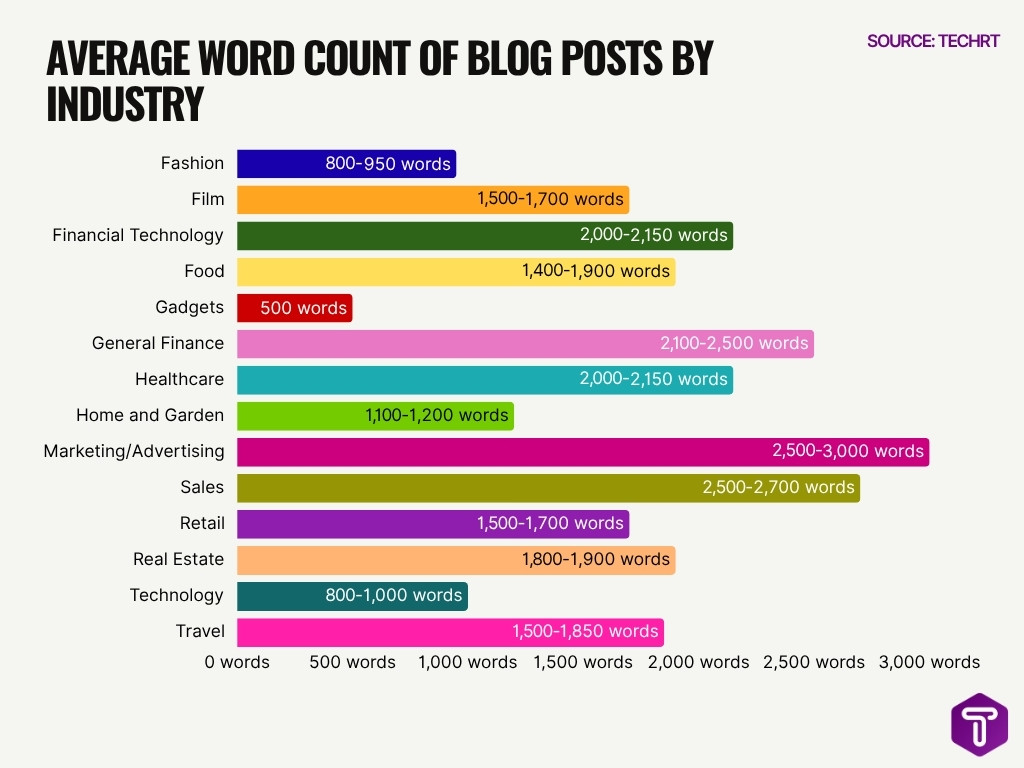
Blog Word Count Trends Across Industries
- Marketing/Advertising blogs dominate in length, averaging 2,500–3,000 words, highlighting the need for deep, research-driven content.
- Sales-related content closely follows, with 2,500–2,700 words, emphasizing detailed funnels, strategies, and conversion tactics.
- Finance and FinTech blogs require substantial depth, typically around 2,000–2,500 words, due to complex concepts and trust-building requirements.
- Healthcare content aligns with long-form trends, averaging 2,000–2,150 words, reflecting the importance of accuracy and comprehensive explanations.
- Real estate blogs fall in the mid-to-high range, at 1,800–1,900 words, balancing market insights and property details.
- Travel blogs average between 1,500–1,850 words, combining storytelling with practical guidance for readers.
- Food and retail content typically range from 1,400–1,900 words, supporting SEO-friendly recipes, reviews, and buying guides.
- Film-related blogs average 1,500–1,700 words, allowing room for analysis, reviews, and commentary.
- Home and garden blogs are moderately sized, at 1,100–1,200 words, focusing on how-to guides and tips.
- Technology blogs are relatively concise, averaging 800–1,000 words, often delivering quick updates and insights.
- Fashion blogs remain short-form, with 800–950 words, aligning with visual-first and trend-driven consumption.
- Gadget blogs are the shortest, at just 300–500 words, reflecting quick reviews and product-focused content.
- Overall, industries requiring expertise and trust (finance, healthcare, marketing) favor long-form content, while visual or product-driven niches (fashion, gadgets) lean toward shorter blogs.
Business Blogging and Brand Authority
- 61% of consumers trust brands more after reading blog content.
- Businesses that blog consistently are seen as industry leaders by 70% of consumers.
- Blogging helps increase brand awareness for over 60% of marketers.
- Companies publishing thought leadership blogs see 3x higher engagement rates.
- Educational blog content influences 80% of B2B purchase decisions.
- Brands with active blogs receive 55% more brand mentions online.
- Blog-driven brands are 2.5x more likely to be perceived as trustworthy.
- Content-rich websites build higher domain authority scores, improving long-term visibility.
- Businesses using blogs for storytelling see higher emotional engagement and retention.
Blogging Frequency and Consistency for Businesses
- Companies that blog 16+ times per month generate significantly more traffic and leads.
- Publishing blogs weekly results in 2x better performance than monthly publishing.
- Only 30% of bloggers publish consistently, despite proven benefits.
- Consistent bloggers are 2–3x more likely to report strong results.
- Businesses that publish at least 11 posts per month see higher engagement rates.
- Content consistency improves SEO rankings for over 70% of websites.
- Inconsistent blogging leads to reduced traffic growth in 65% of cases.
- Marketers who follow editorial calendars are 60% more likely to succeed.
- Businesses that maintain a blog for 12+ months see exponential growth compared to short-term efforts.
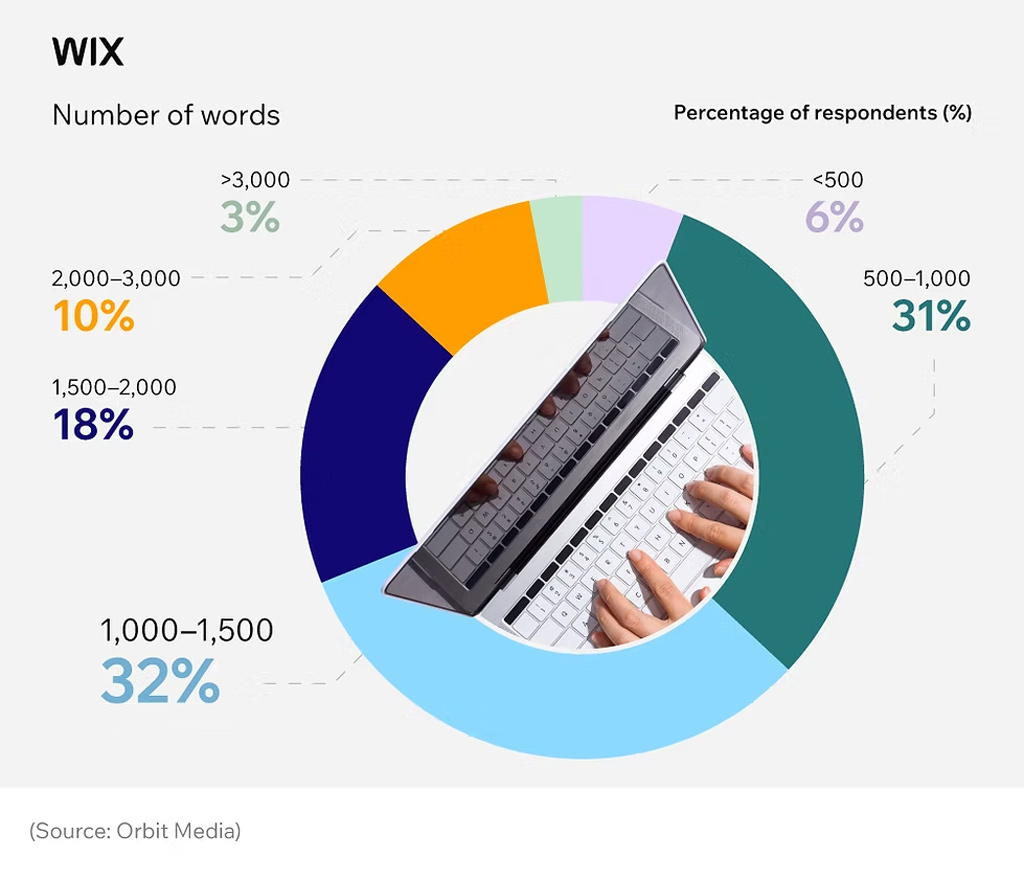
Key Insights on Blog Post Length Distribution
- The most common blog length is 1,000–1,500 words, preferred by 32% of respondents, making it the dominant content size.
- Close behind, 31% of marketers publish posts between 500–1,000 words, showing strong adoption of shorter, digestible content.
- Mid-length content (1,500–2,000 words) is used by 18%, indicating a balanced approach between depth and readability.
- Only 10% of respondents create longer-form content in the 2,000–3,000-word range.
- Very long-form blogs (over 3,000 words) are rare, used by just 3%, suggesting limited adoption despite SEO benefits.
- Short-form content (under 500 words) is also uncommon, accounting for only 6%, indicating a shift away from thin content.
- Overall, 63% of bloggers focus on posts between 500–1,500 words, highlighting this range as the industry standard.
- The data shows a clear preference for moderate-length content, balancing SEO performance and user engagement.
- There is a noticeable decline in usage as content length exceeds 2,000 words, reflecting higher effort and resource requirements.
- The trend suggests that quality and optimal length (500–1,500 words) matter more than simply producing extremely long or very short posts.
B2B Business Blogging Statistics
- 73% of B2B marketers use blogging as a core content marketing strategy.
- Blogs influence 80% of B2B buying decisions during the research phase.
- 65% of B2B buyers say they rely on blog content before engaging with a sales team.
- B2B companies that blog generate 67% more leads than those that don’t.
- 76% of B2B marketers say blogs help nurture prospects through the funnel.
- Blog-driven B2B strategies contribute to over 40% of inbound leads.
- Long-form B2B blog content generates 3x more engagement than shorter content.
- 70% of B2B marketers say blogging improves brand awareness.
- B2B companies with blogs see higher deal conversion rates, especially in SaaS industries.
B2C Business Blogging Statistics
- 77% of internet users read blogs, with strong engagement in B2C sectors.
- B2C companies that blog see 88% higher website traffic growth.
- 60% of consumers feel more positive about brands after reading blog content.
- Blogs influence 61% of online purchasing decisions in B2C markets.
- Lifestyle and product blogs generate 2x higher social shares than other formats.
- 45% of B2C marketers say blogs are their most important content type.
- Visual blog content increases engagement by over 70% in B2C campaigns.
- Blogs contribute to over 30% of eCommerce traffic for content-driven brands.
- B2C brands using storytelling blogs see higher customer retention rates.
Top CMS Platforms by Number of Blogs
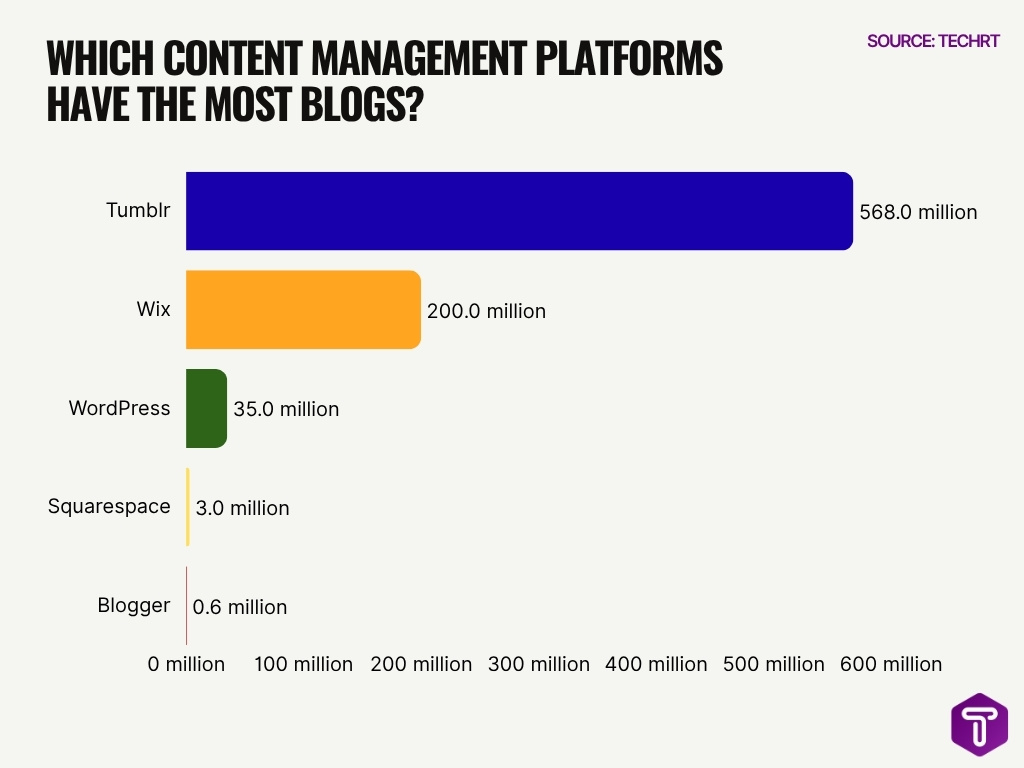
- Tumblr leads significantly with a massive 568 million blogs, making it the most dominant platform in terms of blog volume.
- Wix ranks second, boasting 200 million users, indicating strong adoption even though the metric differs from blog count.
- WordPress powers 35 million sites, reinforcing its reputation as one of the most widely used CMS platforms globally.
- Squarespace hosts around 3 million sites, showing a smaller but still notable presence among premium website builders.
- Blogger trails behind with 619,000 blogs, highlighting a sharp drop compared to other platforms in the ranking.
- The gap between Tumblr and Wix alone exceeds 300 million, illustrating Tumblr’s overwhelming scale advantage.
- There is a steep decline after the top three, with WordPress (35 million) to Squarespace (3 million) showing a 10x drop.
- Platforms vary in metrics (blogs, users, sites), suggesting differences in how each ecosystem measures scale and engagement.
- The data reflects a mix of legacy blogging platforms (Blogger, Tumblr) and modern CMS builders (Wix, Squarespace) competing in the same space.
- Overall, Tumblr and WordPress dominate blogging culture, while Wix and Squarespace focus more on website creation beyond blogs.
Social Media and Business Blog Amplification
- 90% of bloggers actively promote posts on social platforms to drive traffic.
- 94% of B2B marketers use organic social media as the top blog distribution channel.
- Blogs with active social promotion generate 13x more leads than those without.
- 76% of professionals report that social media drives relevant blog traffic.
- Social sharing buttons boost email click-through rates by up to 55%.
- Guest blog posts shared on social media get 23% more shares than standard posts.
- LinkedIn generates 80% of B2B leads through social channels like blogs.
- Visual content improves blog retention by up to 80% via social shares.
- Consistent social posting improves blog reader retention by 23%.
- B2B companies with blogs see 67% more leads from social amplification.
Challenges Businesses Face with Blogging
- 60% of marketers struggle to create consistent content.
- 65% cite lack of time and resources as the biggest blogging challenge.
- Only 20% of bloggers report strong results, indicating execution gaps.
- 52% of marketers find it difficult to produce engaging content regularly.
- Measuring ROI remains a challenge for over 40% of content marketers.
- 50% of businesses lack a documented content strategy, reducing effectiveness.
- SEO algorithm changes impact blog rankings for over 60% of websites annually.
- Content saturation makes it harder to stand out, with millions of blog posts published daily.
- Teams without analytics tools are 2x more likely to underperform.
Future Trends in Business Blogging
- AI-generated content is expected to power over 50% of blog content creation by 2027.
- Voice search optimization will influence blog structure and keyword strategy.
- Interactive content adoption is projected to grow by over 60% in blogging strategies.
- Video-integrated blogs will dominate, with 80% of content including video elements.
- Personalization in blog content will increase engagement by over 70%.
- AI tools will assist 70% of marketers in blog creation and optimization.
- Search engines will prioritize experience-driven content (E-E-A-T) in blog rankings.
- Content refresh strategies will become essential, with over 65% of marketers updating old posts regularly.
- Blogs will increasingly integrate with multi-channel ecosystems, including email, social, and video.
Frequently Asked Questions (FAQs)
What percentage of businesses use blogging as a marketing strategy?
Around 80% of businesses use blogging as part of their marketing strategy.
How much more traffic do companies get from blogging?
Businesses that blog see about a 55% increase in website traffic.
How many blogs exist worldwide in 2026?
There are over 600 million blogs globally, publishing around 7.5 million posts daily.
How much more likely are bloggers to achieve ROI?
Marketers who prioritize blogging are 13x more likely to achieve positive ROI.
How much more lead generation do blogging businesses achieve?
Companies with blogs generate 67% more leads, and small businesses can see up to 126% higher lead growth.
Conclusion
Business blogging remains a high-impact, cost-effective strategy for driving traffic, generating leads, and building long-term brand authority. The data clearly shows that companies investing in consistent blogging benefit from stronger SEO performance, higher lead conversion rates, and improved customer trust. Whether in B2B or B2C environments, blogs continue to influence buying decisions at every stage of the customer journey.
However, the landscape is becoming more complex. AI-generated content, zero-click searches, and increasing competition require businesses to focus on quality, relevance, and user intent rather than just volume. Successful brands are those that combine blogging with SEO, social media, and data analytics to create a cohesive content ecosystem.
In the years ahead, blogging will not disappear; it will evolve. Businesses that adapt to new trends while maintaining consistency and value-driven content will continue to see measurable growth and sustained ROI from their blogging efforts.

Leave a comment
Have something to say about this article? Add your comment and start the discussion.