




ChatGPT will have become a defining force in how millions of people, both individuals and professionals, interact with artificial intelligence daily. Its conversational capabilities have reshaped workflows in education, customer service, and creative industries. From automating routine tasks to accelerating research insights, ChatGPT’s adoption shows a clear shift toward AI‑assisted work and life. Dive into ChatGPT Statistics to see how usage, growth, and engagement are shaping the future of AI interaction.
Editor’s Choice
- 878 million total ChatGPT users online in January 2026 across platforms (ChatGPT standalone + integrations).
- ChatGPT’s market share in the AI search/chat market remained around 74% at the start of 2026.
- 800+ million weekly active users interact with the platform globally.
- ChatGPT was responsible for over 5.8 billion monthly visits as of late 2025.
- Daily prompt volume exceeded 2 billion interactions across use cases.
- The platform processes more than 7 million visits per hour globally.
- ChatGPT Plus had around 10 million paying subscribers.
Recent Developments
- ChatGPT was briefly offline in early February 2026, with 13,000+ users reporting issues during peak outage reports.
- AI web traffic trends show bots like ChatGPT now contribute a growing share of online hits, with one AI bot visit for every 31 human visits by late 2025.
- Competition from other AI platforms, such as Google’s Gemini, grew in 2025, with Gemini reaching 750 million MAUs by late 2025.
- Safety enhancements were introduced in late 2025 following concerns over sensitive or harmful AI responses, with compliance improvements to 91% according to OpenAI.
- Enterprise adoption hit a key mark with 1 million business customers actively using ChatGPT in late 2025.
- OpenAI raised major funding in 2025, boosting infrastructure and model development.
- New features like autonomous research tools (e.g., Deep Research) were added during 2025.
- Partnerships with governments and larger organizations expanded, cementing ChatGPT’s role in public services.
Overview of Statistics Related to ChatGPT
- ChatGPT’s total unique users across services reached 878 million by January 2026.
- Monthly traffic on ChatGPT platforms exceeded 5.8 billion visits in late 2025.
- Weekly active usage surpassed 800 million users globally.
- Daily active users are estimated to be around 200–300 million, accounting for web, mobile, and integrated AI tools.
- ChatGPT holds a roughly 74% share in the AI chatbot market.
- The platform handles billions of requests each day, estimated at 2+ billion prompts daily.
- ChatGPT continues to lead ahead of many competitors in user count and engagement metrics.
- ChatGPT app consistently ranks among the top-visited AI platforms globally.
Growth Timeline and Key Milestones for ChatGPT
- Released in November 2022, ChatGPT hit 100 million users in under 3 months.
- By early 2025, weekly users grew to 400 million from around 300 million in late 2024.
- Mid‑2025 saw weekly users reach 700–800 million, indicating rapid mainstream adoption.
- Monthly visits climbed to 5.8+ billion in late 2025.
- Enterprise adoption exceeded 1 million business accounts by late 2025.
- Paid subscriber count grew to 10 million+ by late 2025.
- OpenAI’s revenue from ChatGPT reached double‑digit billions annually by mid‑2025.
- Continued platform enhancements like autonomous research and deeper integrations marked important product milestones in 2025.
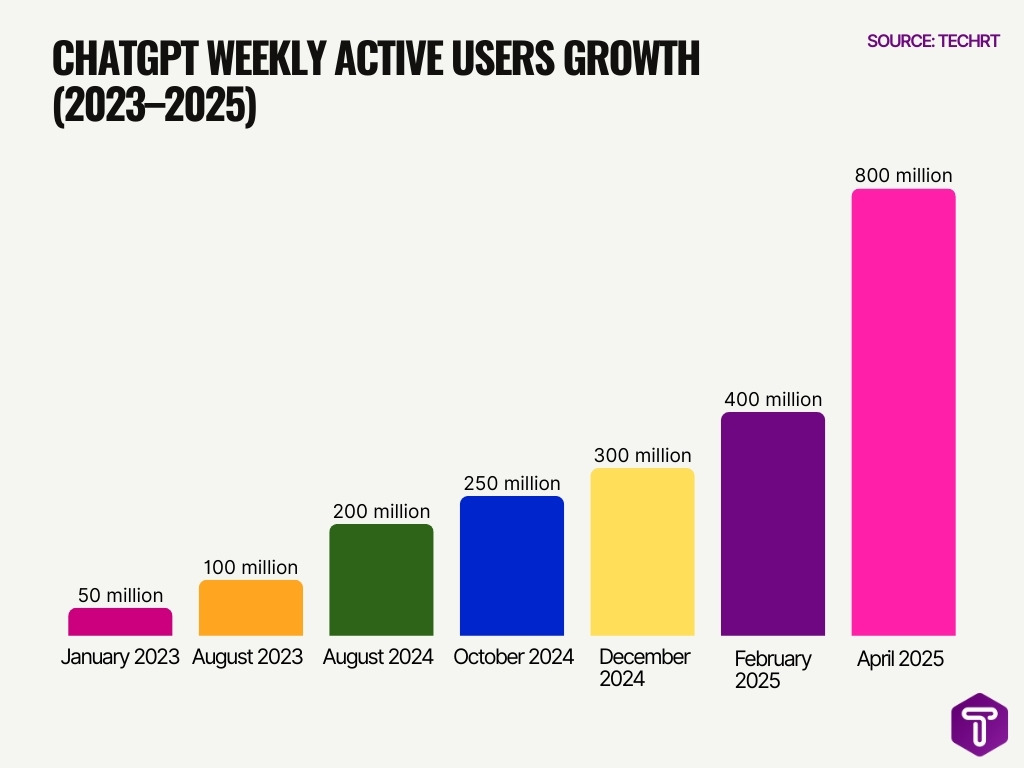
ChatGPT Weekly Active Users Growth
- January 2023: ChatGPT recorded around 50 million weekly active users, marking its early-stage adoption phase.
- August 2023: User base doubled to 100 million, showing strong global interest within just 7 months.
- August 2024: Weekly users reached 200 million, reflecting a 100% year-over-year growth from August 2023.
- October 2024: Active users climbed to 250 million, indicating accelerated adoption in late 2024.
- December 2024: Usage expanded further to 300 million, driven by enterprise and professional adoption.
- February 2025: Weekly users surged to 400 million, representing a 33% increase in just two months.
- April 2025: ChatGPT hit a major milestone with 800 million weekly active users, showing a 100% jump from February 2025 and highlighting mass-market penetration.
- Overall Growth (2023–2025): ChatGPT expanded from 50 million to 800 million users, achieving a massive 1,500% growth in just over two years.
Monthly Active Users Using ChatGPT
- ChatGPT’s monthly visits reached 5.8+ billion by late 2025, marking top ranked web traffic among AI platforms.
- The platform ranked within the top 15 most visited websites worldwide by monthly visits.
- Unique monthly active users are estimated to be up to 2.8 billion by January 2026.
- U.S. accounts for around 67.7 million monthly users.
- India and other global markets showed strong month‑on‑month growth in 2025.
- Monthly unique device identities across platforms exceed 500 million.
- The steady monthly increases reflect broad demographic adoption.
- ChatGPT’s MAU spike aligns with broader AI interest trends in late 2025.
Daily Active Users on ChatGPT Platforms
- Daily active users are estimated to be between 200-300 million early in 2026.
- ChatGPT processes over 2 billion user prompts per day.
- Daily visit volumes translate into roughly 7.9 million visits per hour.
- Peak daily usage far outpaces many legacy online tools.
- Daily engagement spikes during global business hours.
- Global distribution shows consistent daily use across regions.
- Daily metrics have grown significantly since 2025.
- Daily prompt activity remains a strong signal of AI adoption in workflows.
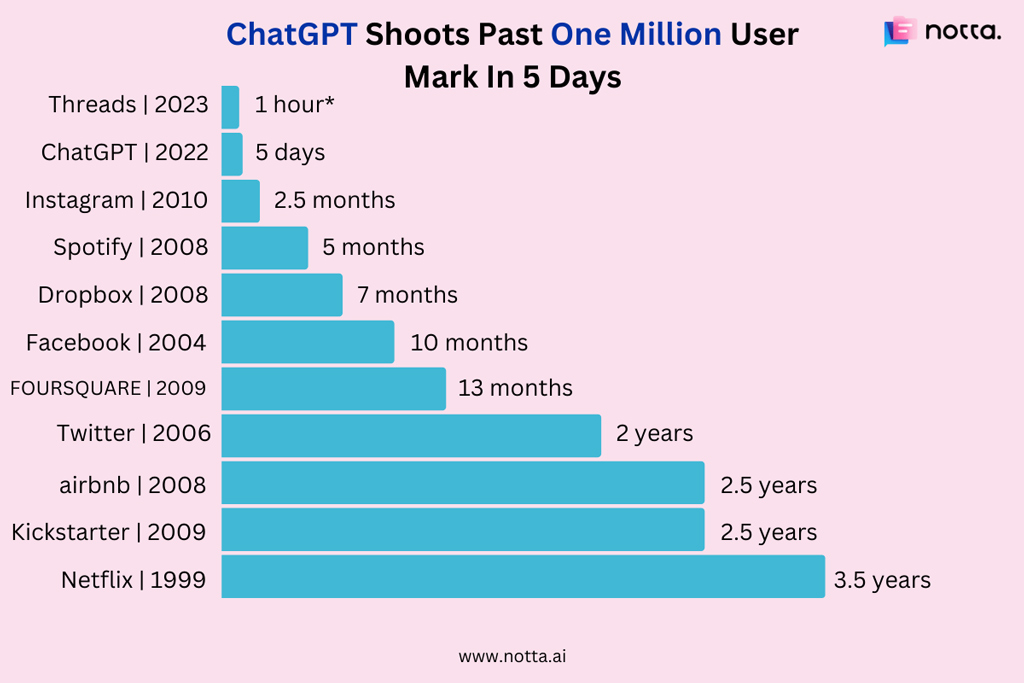
How Fast Major Platforms Reached 1 Million Users
- Threads (2023) became the fastest platform on record by reaching 1 million users in just 1 hour, setting a new benchmark for viral adoption.
- ChatGPT (2022) achieved massive early traction by crossing 1 million users in only 5 days, highlighting the explosive demand for AI tools.
- Instagram (2010) reached the milestone in 2.5 months, demonstrating strong early social media engagement.
- Spotify (2008) attracted 1 million users in 5 months, reflecting rapid growth in music streaming adoption.
- Dropbox (2008) hit 1 million users in 7 months, driven by strong word-of-mouth and referral marketing.
- Facebook (2004) took 10 months to reach 1 million users, despite later becoming a global social media giant.
- Foursquare (2009) achieved the milestone in 13 months, fueled by location-based social networking trends.
- Twitter (2006) required 2 years to cross 1 million users, showing slower early adoption compared to newer platforms.
- Airbnb (2008) reached 1 million users in 2.5 years, reflecting gradual trust-building in the sharing economy.
- Kickstarter (2009) also took 2.5 years to achieve 1 million users, growing steadily through creator-driven campaigns.
- Netflix (1999) was the slowest among these platforms, taking 3.5 years to reach 1 million users in its early streaming phase.
Website Traffic and Visit Volume for ChatGPT
- ChatGPT recorded over 5.8 billion monthly visits across platforms by late 2025.
- This volume made ChatGPT one of the top 15 most‑visited websites globally in the AI category.
- Monthly visits showed a 7.6% month‑on‑month increase in late 2025.
- Website traffic from the United States accounted for ~19.5% of global traffic.
- India contributed approximately 9.06% of traffic among the top country markets.
- Brazil and Japan followed with 5% and 4.11% share, respectively.
- Overall, “Other” countries made up around 59% of visits in late 2025.
- VisualCapitalist data indicated the U.S. held about 15.1% of ChatGPT’s web traffic in mid‑2025.
- Daily traffic patterns varied with significant peaks during global business hours.
Session Duration and User Engagement on ChatGPT
- Average user sessions hovered around 10–15 minutes per visit.
- High engagement was driven by repeat interactions, as individuals input follow‑up queries in the same session.
- Users often engaged in multi‑task sessions, science research, work assistance, and creative writing, in single visits.
- Interaction rates increased in educational and professional clusters during weekdays.
- Engagement analytics show information seeking and writing support as top activities.
- Daily prompt volume (~2.5 billion) supports the high engagement per session.
- Users typically return within 24 hours, indicating strong session retention.
- Retention rates for paid tiers were higher (~59–88% annually, depending on plan).
- Engagement metrics indicate mobile users tend to have slightly shorter session durations but more frequent visits.
User Demographics by Age Group for ChatGPT
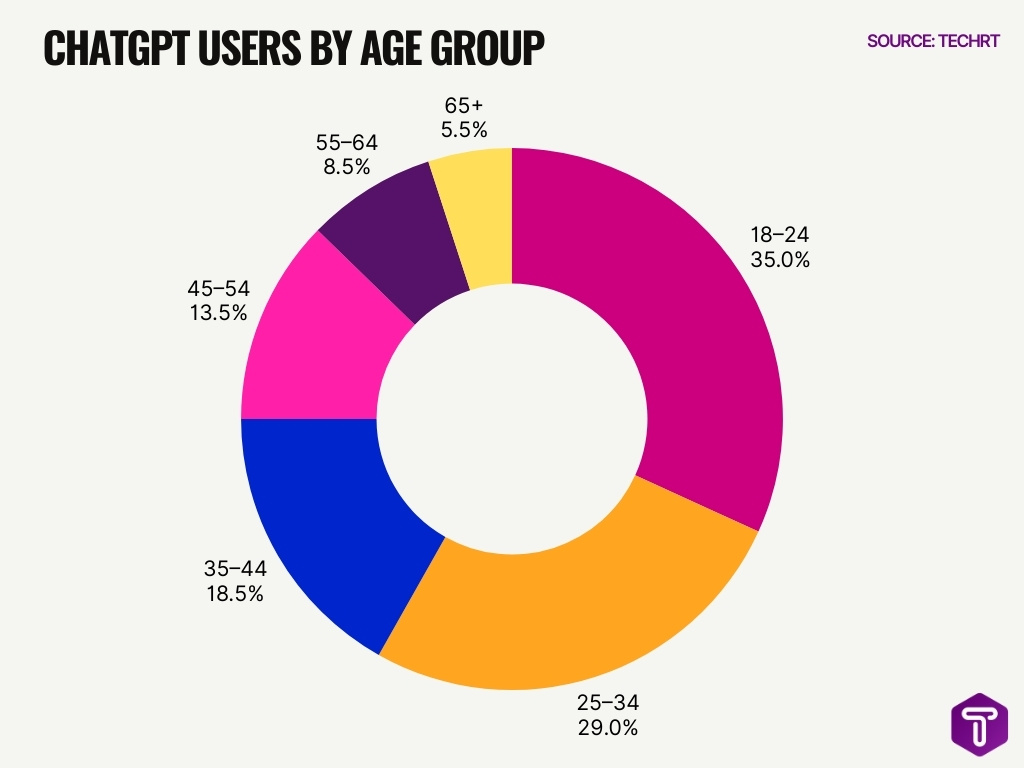
- Individuals aged 18–34 make up the majority of users (~55–60%).
- The 18–24 age segment alone accounts for roughly 23–46% of interactions in some surveys.
- Users between 25–34 years are the largest subgroup (often ~28–30%).
- Ages 35–44 account for ~18–19% of users.
- Individuals in the 45–54 bracket represented ~13–14%.
- Ages 55–64 are around ~8–9% of the user base.
- Users aged 65+ are the smallest share (~5–6%) of overall ChatGPT use.
- Demographic studies indicate adoption continues expanding beyond younger cohorts.
- Some analyses found mid‑career and older adults increasingly using AI for practical tasks.
User Demographics by Gender for ChatGPT
- Gender distribution has grown more balanced over time.
- Estimates show approximately 54.7% male to 45.3% female usage globally.
- Earlier snapshots showed male user dominance (~64%), but that narrowed in 2025.
- Shifts in usage reflect increased adoption among women for communication and writing tasks.
- Usage among non‑binary or unspecified gender groups is rising in segmented platform stats.
- Some research found women now constitute a slight majority in certain segments (~52%).
- Demographic trends show younger cohorts are more evenly split by gender.
- Professional use patterns vary, and technical topics tend to engage more male users.
- Gender statistics are evolving as AI literacy expands across populations.
Users by Country and Region on ChatGPT
- The United States accounts for 19.51% of ChatGPT traffic share.
- India holds 9.06% of global ChatGPT visits.
- Brazil contributes 5% to ChatGPT’s visitor share.
- Japan represents 4.11% of total ChatGPT traffic.
- The United Kingdom makes up 3.29% of ChatGPT usage.
- Other countries collectively account for 59.03% of visits.
- In February 2026, India reached 16.5% visitor share, surpassing the U.S. at 17.1%.
- Canada holds 5.4%, France 4.3%, and Mexico 3.6% of ChatGPT visitors.
- VisualCapitalist reported the U.S. at 15.1% and India at 9.3% in August 2025.
- The top 5 countries represent under 50%, with “others” exceeding 50% of usage.
Usage by Profession and Job Role With ChatGPT
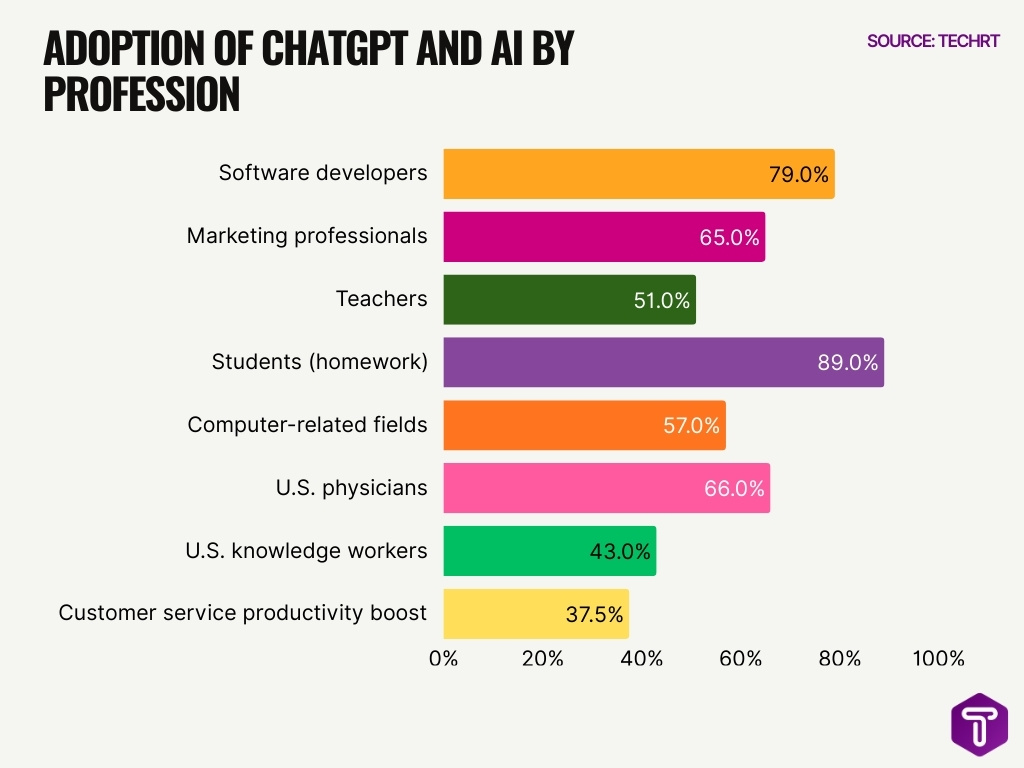
- 79% of software developers have used ChatGPT.
- 65% of marketing professionals utilize ChatGPT.
- 51% of teachers reported using ChatGPT, with 40% weekly.
- 89% of students use ChatGPT for homework.
- ChatGPT boosts customer service productivity by 30-45%.
- 57% in computer-related fields adopt ChatGPT at work.
- 66% of U.S. physicians used AI like ChatGPT in 2024.
- 43% of U.S. knowledge workers now use AI tools.
Usage by Device and Platform for ChatGPT
- Mobile devices account for ~65% of all ChatGPT sessions.
- Desktop/laptop usage comprises ~35% of total ChatGPT traffic.
- 48% of mobile users favor the app experience over browser access.
- Desktop sessions peak during traditional work hours (9 AM–5 PM).
- App usage shows 2x higher daily frequency than browser sessions.
- iOS and Android reflect global mobile OS trends with 55% Android dominance.
- Integrations in other platforms account for 15–20%, with a rising usage share.
- Desktop remains key for coding (40%) and enterprise workflows.
- Cross-platform sync boosts session continuity across devices by 30%.
Personal vs Work-Related Usage of ChatGPT
- Around 73% of ChatGPT use is non‑professional, meaning personal tasks like hobbies, study help, or casual interaction dominate overall use.
- About 83% of AI users report using ChatGPT at home, while roughly 70.8% use it in business contexts.
- Professional or workplace use has grown steadily as productivity features improve.
- In work environments, more than half of AI users save 3+ hours per week thanks to ChatGPT automation.
- Knowledge workers using AI produce roughly 40% higher quality outputs, according to academic research.
- Daily professional use of ChatGPT has doubled in recent reports, especially among younger employees.
- Workers aged 18–29 are over twice as likely to use ChatGPT at work compared to those 50+.
- Use cases at work include writing, research, programming, and data analysis across departments.
- Personal use still leads in sheer frequency, but work‑related activity shows stronger growth year‑on‑year.
Use Cases and Activity Types Involving ChatGPT
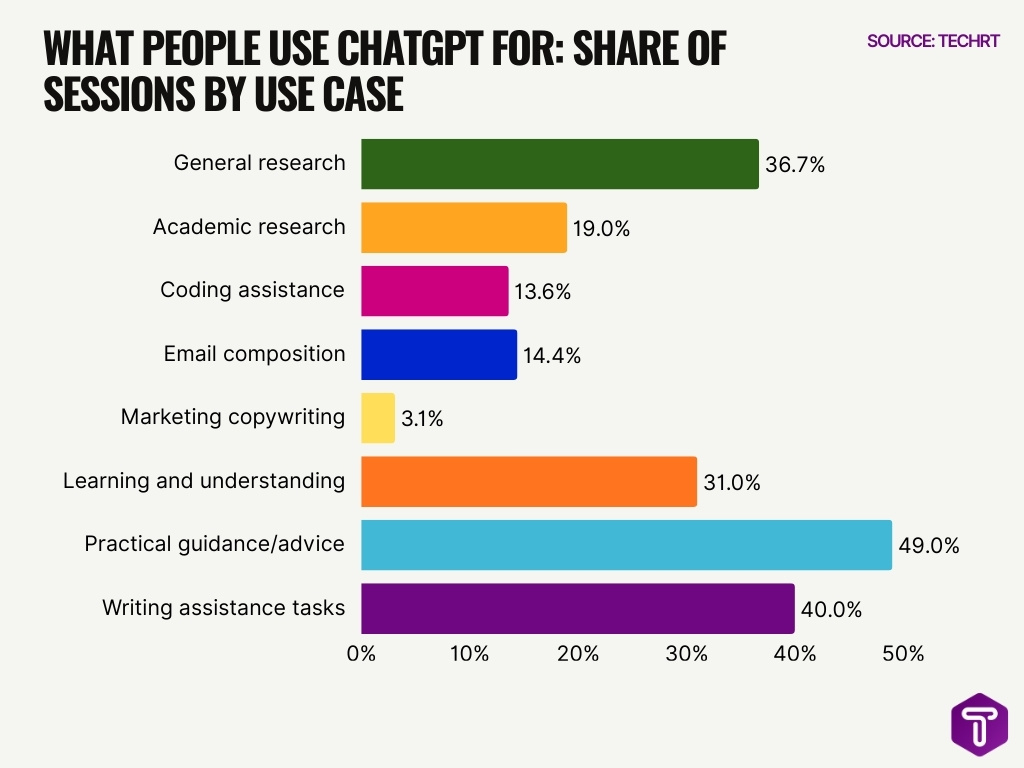
- ChatGPT users conduct general research in 36.7% of sessions, making it the top use case.
- Academic research accounts for 19% of ChatGPT activities among users.
- Coding assistance represents 13.6% of usage in early 2026.
- Email composition comprises 14.4% of ChatGPT interactions.
- Marketing copywriting makes up 3.1% of use cases recently.
- Learning and understanding dominate 31% of conversations.
- Practical guidance and advice-seeking cover 49% of user queries.
- Writing assistance, mostly editing, forms a key portion of 40% content tasks.
- Image generation via DALL-E sees ChatGPT mobile users creating over 12 million images weekly.
- 89% of students use ChatGPT for homework and outlining.
Adoption in Businesses and Enterprises of ChatGPT
- Businesses spent $37 billion on generative AI in 2025, up 3.2x from $11.5 billion in 2024.
- OpenAI business adoption reached 36.8% of US companies in December 2025, up 2 points month-over-month.
- 46.6% of US companies invested in AI products in December 2025, rising 1.6 points from November.
- OpenAI reported 1 million business customers as of November 2025.
- ChatGPT message volume in enterprises grew 8x year-over-year in 2025.
- ChatGPT Enterprise seats increased 9x in one year by late 2025.
- Over 92% of Fortune 500 companies used ChatGPT by mid-2025.
- Workers using ChatGPT Enterprise saved 40-60 minutes daily on tasks.
- 75% of workers reported improved speed or quality from AI tools like ChatGPT.
API Usage and Developer Integration With ChatGPT
- Over 4 million developers have built applications using OpenAI’s ChatGPT APIs.
- 92% of Fortune 500 companies integrate ChatGPT APIs into their enterprise workflows.
- 79% of developers rely on ChatGPT APIs for coding and technical tasks.
- 63% of software developers use ChatGPT APIs for debugging and code generation.
- 2 million developers actively utilize OpenAI APIs for third-party app integrations.
- 73% of developers report productivity gains from ChatGPT API acceleration in workflows.
- API platform processes 6 billion tokens per minute, supporting developer integrations.
- Over 80% of Fortune 500 firms adopted ChatGPT APIs within nine months of launch.
Downsides of Using ChatGPT: Key User Concerns
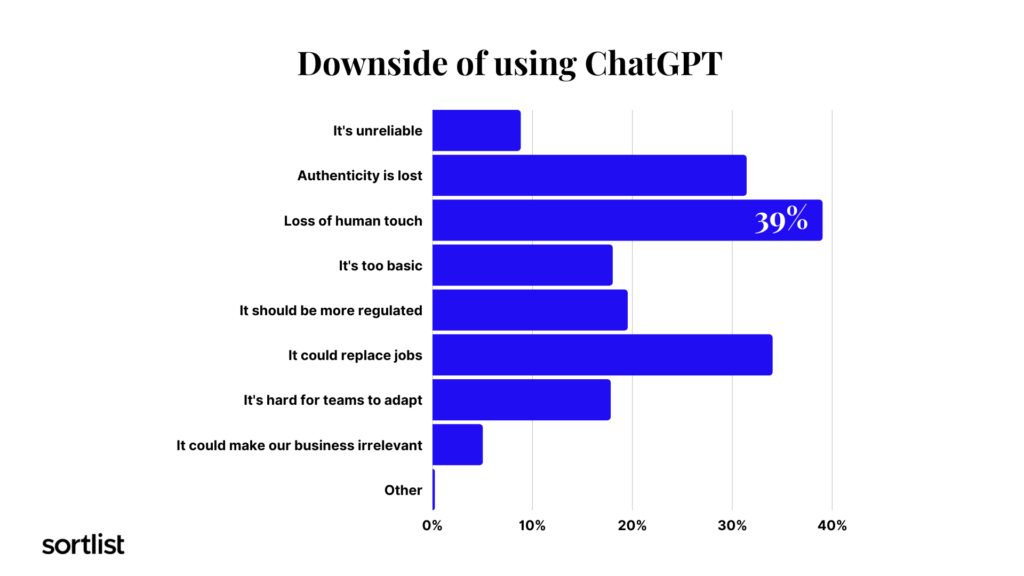
- Loss of human touch is the biggest concern, cited by 39% of users, showing worries about reduced personal interaction and emotional connection.
- Job replacement fears remain strong, with 34% believing ChatGPT could replace human jobs in multiple industries.
- Authenticity issues affect 31% of users, who feel that AI-generated content lacks originality and a genuine human voice.
- Regulation demands are growing, as 20% of respondents say ChatGPT should be more regulated to ensure ethical and responsible use.
- Basic or limited responses frustrate users, with 18% reporting that ChatGPT is too basic for complex or specialized tasks.
- Team adaptation challenges impact 17% of users, highlighting difficulties in integrating AI tools into existing workflows.
- Reliability concerns persist, as 9% say ChatGPT is unreliable, especially for critical or fact-based tasks.
- Business relevance fears affect 5% of users, who worry that AI could make their business models obsolete.
- Only 1% selected “Other”, indicating that most concerns are already captured in common AI-related issues.
Plus Subscribers and Paid User Base of ChatGPT
- As of mid‑2025, ChatGPT reached 20 million paid subscribers across Plus and other tiers.
- Paid subscription counts grew sharply year‑on‑year from 15.5 million at the end of 2024.
- Plus subscriptions offer faster access and priority features for active users.
- Early 2026 estimates suggest paid subscriber growth continues despite free usage dominance.
- OpenAI projects 220 million paying users by 2030 across global markets.
- Paid user share remains a small fraction of total active users but represents a growing revenue stream.
- Subscription monetization expands to include newer freemium tools and features.
- Paid tiers enable access to advanced capabilities like Deep Research.
- Professional and enterprise plans are expanding beyond individual subscriptions.
Revenue, Costs, and Profitability Driven by ChatGPT
- OpenAI’s annualized revenue run‑rate reached about $12 billion by mid‑2025.
- Revenue more than tripled from 2024’s approximately $3.7 billion.
- ChatGPT was a key revenue driver, with around $2.7 billion in revenue in 2024.
- Operating losses remain significant due to high computing and R&D costs.
- OpenAI’s valuation soared with a $40 billion funding round at a $300 billion post‑money valuation.
- Profitability targets are set for around 2029, according to long‑term guidance.
- New monetization avenues, including advertising and shopping assistant features, are being explored.
- API services and enterprise contracts contribute to diversified revenue streams.
- Subscription revenue growth remains a priority despite strong free usage.
Future Outlook and Forecasts for ChatGPT Usage
- The generative AI chatbot market is projected to grow dramatically, with annual growth rates exceeding 30%+ annually through 2033.
- Analysts forecast broader adoption across sectors, not traditionally early tech adopters.
- By 2030, OpenAI expects about 220 million paid subscribers from its user base.
- AI tools like ChatGPT are expected to automate many routine text and information tasks.
- Continued API expansion will likely embed conversational AI deeper into business systems.
- Innovations such as autonomous AI agents will broaden capabilities and use cases.
- Competitive dynamics with other AI platforms will shape user growth and monetization strategies.
- Regional adoption patterns (e.g., India’s rapid growth) indicate global diffusion of usage.
- Forecasts suggest that ChatGPT may reach 1 billion regular users by late 2026.
Frequently Asked Questions (FAQs)
How many users does ChatGPT have as of early 2026?
ChatGPT has around 883 million total users, including 815 million standalone users and 103 million Copilot users as of February 2026.
What monthly traffic does ChatGPT generate?
ChatGPT recorded approximately 6.2 billion total monthly visits (5.7 billion on ChatGPT alone and 1.1 billion via Copilot) in early 2026.
What share of the AI chatbot market does ChatGPT hold?
ChatGPT dominates the AI chatbot landscape with an estimated market share of about 79.8% globally.
How many weekly active users does ChatGPT have?
Around 900 million users engage with ChatGPT on a weekly basis as of January 2026.
How many daily prompts does ChatGPT process?
ChatGPT processes roughly 2.5 billion requests per day in 2026.
Conclusion
ChatGPT has firmly entrenched itself as a core AI platform across personal and professional spheres. Usage remains high in both casual and work contexts, with enterprises increasingly integrating AI into workflows and paying for advanced features. Revenue streams are expanding, and long‑range projections anticipate continued growth in subscribers, developer integrations, and automation capabilities.
As the generative AI market matures, ChatGPT’s footprint is expected to expand further, reflecting both broader adoption and deeper functional integration across industries and global regions.

Leave a comment
Have something to say about this article? Add your comment and start the discussion.