



Customer retention measures how well a business keeps its existing customers over time. In competitive markets, retaining loyal customers often proves more profitable than constantly acquiring new ones. For example, SaaS platforms rely on retention to grow recurring revenue, while ecommerce brands depend on repeat buyers to sustain long-term profitability. Understanding customer retention statistics helps companies optimize loyalty programs, improve customer experience, and reduce churn. The statistics below reveal how retention trends are shaping businesses, and what organizations can do to stay competitive.
Editor’s Choice
- Acquiring a new customer can cost five times more than retaining an existing one, making retention strategies significantly more cost-effective for most businesses.
- The average customer retention rate across industries is about 75%, although performance varies widely depending on the sector.
- Increasing retention by just 5% can boost profits by 25% to 95%, demonstrating the financial impact of customer loyalty.
- Returning customers spend around 67% more than first-time buyers, highlighting the value of repeat purchasers.
- U.S. companies lose about $168 billion annually due to customer churn, underscoring the scale of the retention challenge.
- About 61% of small businesses generate more than half of their revenue from repeat customers, proving retention is a primary revenue driver.
- Businesses typically lose 10% to 25% of their customers each year, depending on industry dynamics and competition.
Recent Developments
- 44.1% of subscription businesses reported a decline in voluntary churn in the past year, showing improvements in retention strategies across SaaS and subscription models.
- Mobile commerce reached $4.5 trillion in global sales in 2024, yet mobile apps retain only about 5.6% of users after 30 days.
- Around 71% of consumers expect personalized interactions, which increasingly influences repeat purchases.
- 60% of customers say personalized experiences motivate them to buy again, making personalization a core retention driver.
- Nearly 90% of consumers say the customer experience matters as much as the product itself when deciding to remain loyal to a brand.
- 50% of customers will switch brands after just one negative experience, demonstrating how fragile loyalty can be.
- 84% of companies that improve customer experience report revenue growth, reinforcing the link between CX and retention.
- Nearly three-quarters of consumers say they feel loyalty toward at least one brand, reflecting strong emotional connections in modern markets.
- Around 55% of consumers remain loyal to brands primarily because they love the product, emphasizing product quality as a retention factor.
Overall Customer Retention Benchmarks
- The global average retention rate is approximately 75%, though strong companies often exceed 80%.
- Retention rates can range from 35% to 84%, depending on industry and customer relationship length.
- Businesses that lead in loyalty metrics can grow 2.5 times faster than competitors with weaker retention.
- The probability of selling to an existing customer ranges between 60% and 70%, compared with 5% to 20% for new prospects.
- Approximately 44% of companies still do not track their retention rate, limiting their ability to improve customer loyalty.
- Around 40% of companies say they prioritize retention and acquisition equally, showing a balanced marketing approach.
- Repeat customers generate a disproportionate share of revenue, with the top 5% of customers contributing about 35% of ecommerce revenue.
- Businesses that improve customer retention by just a few percentage points often experience significant lifetime value growth.
Average Customer Retention Rates by Industry
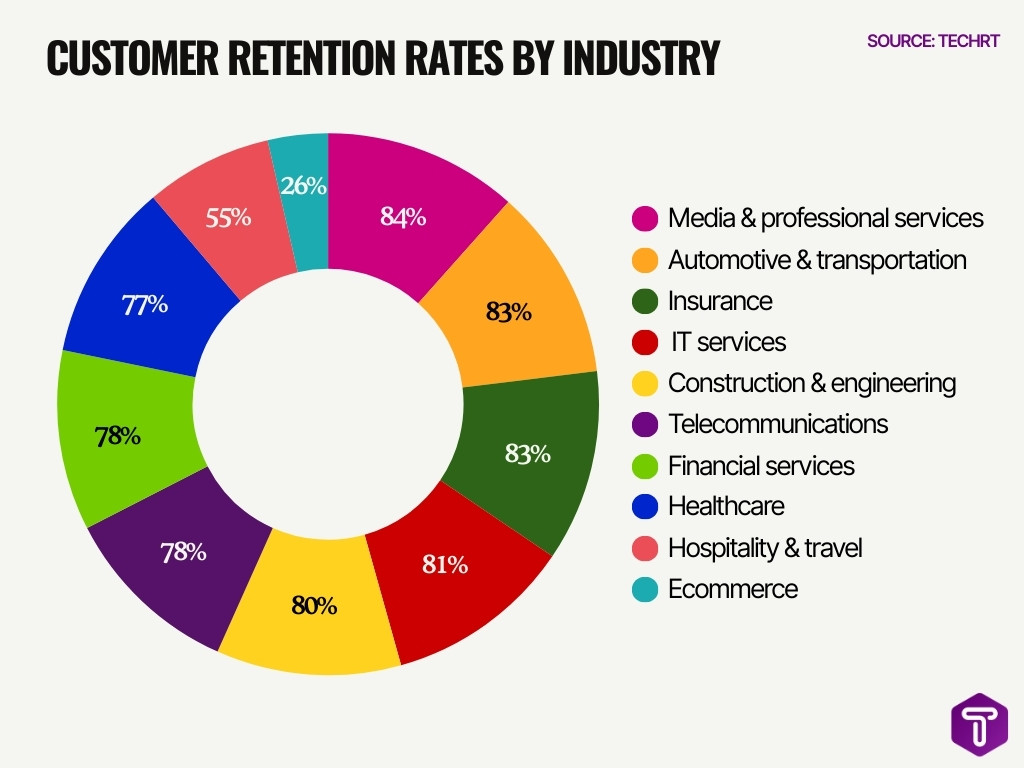
- The media and professional services sectors lead retention rankings at around 84%.
- Automotive and transportation companies maintain roughly 83% retention rates.
- Insurance businesses retain about 83% of customers annually, supported by long-term policy contracts.
- IT services companies achieve about 81% retention on average.
- The construction and engineering sectors maintain around 80% customer retention.
- Telecommunications companies typically see about 78% retention rates.
- Financial services firms report roughly 78% retention on average.
- Healthcare organizations average around 77% retention rates.
- Hospitality and travel industries record much lower retention levels, around 55%.
- Ecommerce businesses retain only about 26% of customers on average, due to high competition and price sensitivity.
Customer Retention vs Customer Acquisition Statistics
- Acquiring a new customer costs five to seven times more than retaining an existing one.
- Customer acquisition costs in ecommerce increased from $9 in 2013 to $29 by 2022, showing rising acquisition expenses.
- Existing customers are 50% more likely to try new products than first-time buyers.
- Loyal customers are 31% more likely to spend more compared with new customers.
- The probability of selling to a new prospect ranges from 5% to 20%, far lower than existing customer conversion rates.
- Retention programs can deliver higher ROI than most acquisition campaigns, especially in subscription businesses.
- Companies that focus on retention can save billions annually in lost revenue from churn.
- Many organizations now invest heavily in CRM platforms and customer success teams to improve retention instead of increasing marketing spend on acquisition.
Customer Churn and Retention Rates
- Financial services firms report about 81% retention and 19% churn rates, indicating strong customer loyalty.
- Businesses typically lose 10% to 25% of customers each year due to churn.
- SaaS companies maintain around 74% annual retention on average, with top performers exceeding this benchmark.
- In mobile apps, average 30-day retention is roughly 28%, highlighting high early churn rates.
- By 90 days, mobile app retention drops to about 12%, showing how quickly users disengage.
- Ecommerce stores retain only about 26% of customers, one of the lowest retention levels among major industries.
- Streaming services demonstrate strong loyalty, with many platforms maintaining churn rates below 10%.
- Improving onboarding and customer success processes can reduce churn significantly in SaaS businesses.
Customer Retention and Customer Lifetime Value (CLV)
- Increasing customer retention by 5% can raise profits by 25% to 95%, largely because long-term customers generate higher lifetime value.
- The average customer lifetime value in ecommerce ranges between $150 and $300, depending on purchase frequency and product category.
- Returning customers typically spend 67% more than new customers, which significantly increases CLV over time.
- Companies that prioritize retention strategies report 30% higher lifetime value per customer compared with those focusing mostly on acquisition.
- Subscription-based businesses often achieve CLV-to-CAC ratios above 3:1, indicating sustainable growth when retention is strong.
- In SaaS, the average customer lifetime ranges from 3 to 5 years, depending on churn and product adoption levels.
- Approximately 80% of a company’s future profits often come from just 20% of existing customers, reinforcing the impact of loyal customers on CLV.
- Ecommerce brands with loyalty programs can increase customer lifetime value by up to 30%, especially when personalized offers drive repeat purchases.
- Businesses that actively track CLV are 2.5 times more likely to improve retention outcomes.
Customer Retention Trends Across App Categories
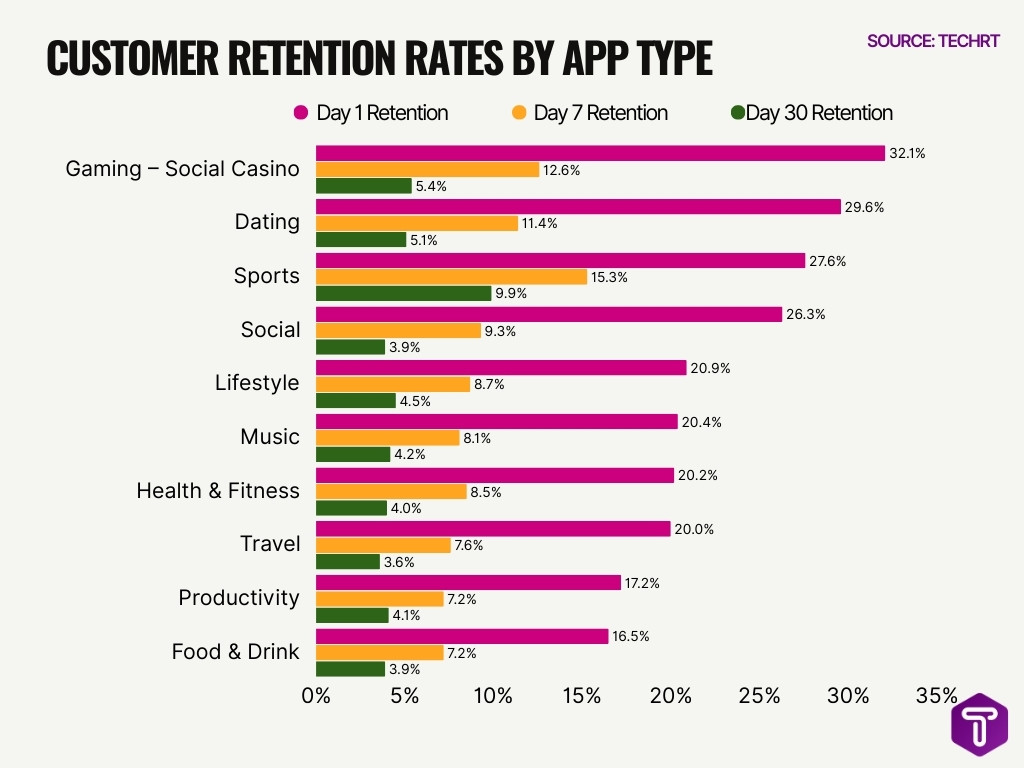
- Gaming – Social Casino apps lead Day 1 retention, with 32.1% of users returning on the first day, the highest among all categories. However, retention drops sharply to 5.4% by Day 30, resulting in a 26.7% drop-off.
- Dating apps show the second-highest early engagement, achieving 29.6% Day 1 retention. But long-term retention declines to 5.1% by Day 30, reflecting a 24.5% decrease over the first month.
- Sports apps demonstrate the strongest long-term retention, with 15.3% Day 7 retention and 9.9% Day 30 retention, the highest Day 30 rate among all categories, indicating stronger sustained user interest.
- Social apps start strong with 26.3% Day 1 retention, but engagement falls rapidly to 3.9% by Day 30, representing a 22.4% drop-off, one of the steepest declines.
- Lifestyle apps retain 20.9% of users on Day 1, decreasing to 8.7% by Day 7 and 4.5% by Day 30, showing a 16.4% decline over the first month.
- Music apps follow a similar pattern, with 20.4% Day 1 retention, 8.1% Day 7 retention, and 4.2% Day 30 retention, marking a 16.2% drop-off.
- Health & Fitness apps record 20.2% Day 1 retention, dropping to 8.5% by Day 7 and 4.0% by Day 30, indicating a 16.2% retention loss within 30 days.
- Travel apps start with 20% Day 1 retention, but only 3.6% of users remain active after 30 days, reflecting a 16.4% drop-off, likely influenced by seasonal or situational usage patterns.
- Productivity apps show relatively stable retention decline, starting at 17.2% Day 1 retention and ending at 4.1% by Day 30, resulting in a 13.1% drop-off, one of the smaller declines.
- Food & Drink apps have the lowest Day 1 retention at 16.5%, with 7.2% Day 7 retention and 3.9% Day 30 retention, but the drop-off of 12.6% is the smallest among all categories.
Net Revenue Retention and Gross Revenue Retention
- SaaS companies with strong growth typically maintain Net Revenue Retention above 110%, indicating expansion revenue from existing customers.
- The median NRR among top-performing SaaS companies reached 118% in 2024, driven by upsells and product expansion.
- Companies with NRR above 120% grow nearly three times faster than those below 100%.
- The average Gross Revenue Retention across SaaS companies ranges from 85% to 95%, depending on customer churn and downgrades.
- Public SaaS firms reported a median GRR of 91% in 2024, demonstrating relatively stable subscription revenue.
- High-growth startups often achieve NRR above 130%, indicating strong expansion revenue from existing customers.
- Around 60% of SaaS companies consider NRR their most important retention metric for measuring revenue health.
- Enterprise SaaS products often show higher NRR because large customers expand usage over time.
- Businesses with an NRR below 100% typically struggle to sustain long-term growth without constant acquisition.
Repeat Purchase and Reorder Rates
- The average ecommerce repeat purchase rate is around 28%, meaning nearly one-third of customers return to buy again.
- Approximately 65% of a company’s business often comes from existing customers, emphasizing the importance of repeat purchases.
- Consumers who purchase once have a 27% chance of returning, while those who buy twice have a 49% chance of purchasing again.
- Customers who purchase three times have a 62% probability of buying again, showing how loyalty grows after multiple transactions.
- Brands with subscription reorder models can reach repeat purchase rates above 50%.
- In grocery ecommerce, repeat purchase rates exceed 40% due to frequent replenishment cycles.
- Retailers that send post-purchase email campaigns see repeat purchase rates increase by 15% to 25%.
- Mobile shopping apps generate higher reorder frequency compared with desktop users, particularly in fast-moving consumer goods.
- Companies that implement personalized product recommendations see up to 31% higher repeat purchase rates.
Key Factors That Drive Consumer Brand Loyalty
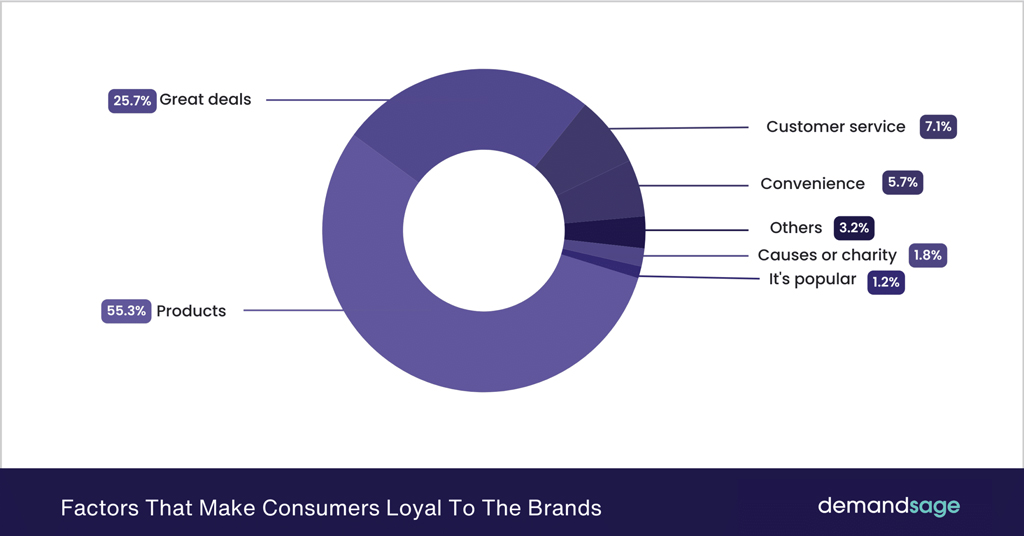
- Products are the biggest driver of brand loyalty, with 55.3% of consumers saying product quality and performance keep them loyal to a brand.
- Great deals and discounts influence 25.7% of consumers, making promotional offers the second-largest factor behind customer loyalty.
- Customer service impacts 7.1% of consumers, showing that responsive support and positive service experiences still play a meaningful role in retaining customers.
- Convenience affects 5.7% of consumers, indicating that easy purchasing processes, fast delivery, and smooth shopping experiences contribute to loyalty.
- 3.2% of consumers cite other factors beyond the major categories when deciding to remain loyal to a brand.
- 1.8% of consumers stay loyal because of causes or charity initiatives, highlighting a smaller but notable segment that values corporate social responsibility.
- Only 1.2% of consumers remain loyal because a brand is popular, suggesting that product value and deals matter far more than brand hype.
Retention by Customer Segment and Persona
- B2B companies often maintain customer retention rates above 90% due to longer contracts and deeper relationships.
- In contrast, B2C ecommerce businesses average retention rates below 30%, reflecting high competition and price sensitivity.
- Enterprise SaaS customers show 20% higher retention than small business customers because of larger switching costs.
- High-value customer segments can generate up to 70% of total revenue, even though they represent a smaller portion of the customer base.
- Millennials show higher brand loyalty than Gen Z, particularly when companies deliver personalized experiences.
- Premium subscription customers maintain retention rates 15% to 20% higher than free tier users.
- Businesses that segment customers using behavioral data can improve retention rates by 10% to 15%.
- Personalized messaging increases engagement among high-value segments by over 25%.
- Companies that analyze persona-based retention data are more likely to increase customer lifetime value.
Cohort-Based Retention Over Time
- SaaS first-year cohort retention averages 70-85% for top performers.
- B2B SaaS month-1 retention hits 46.9%, with PLG models at 48.4%.
- Strong onboarding lifts first-year retention by up to 25% in SaaS.
- Software cohort retention stands at 39% after one month.
- Mobile apps retain 25% of users after day 1.
- Ecommerce cohorts retain 30% on average across brands.
- Ecommerce sees under 40% return within six months post-purchase.
- Cohort analysis boosts retention by 15% via product insights.
- SaaS cohorts with 70%+ feature adoption double retention rates.
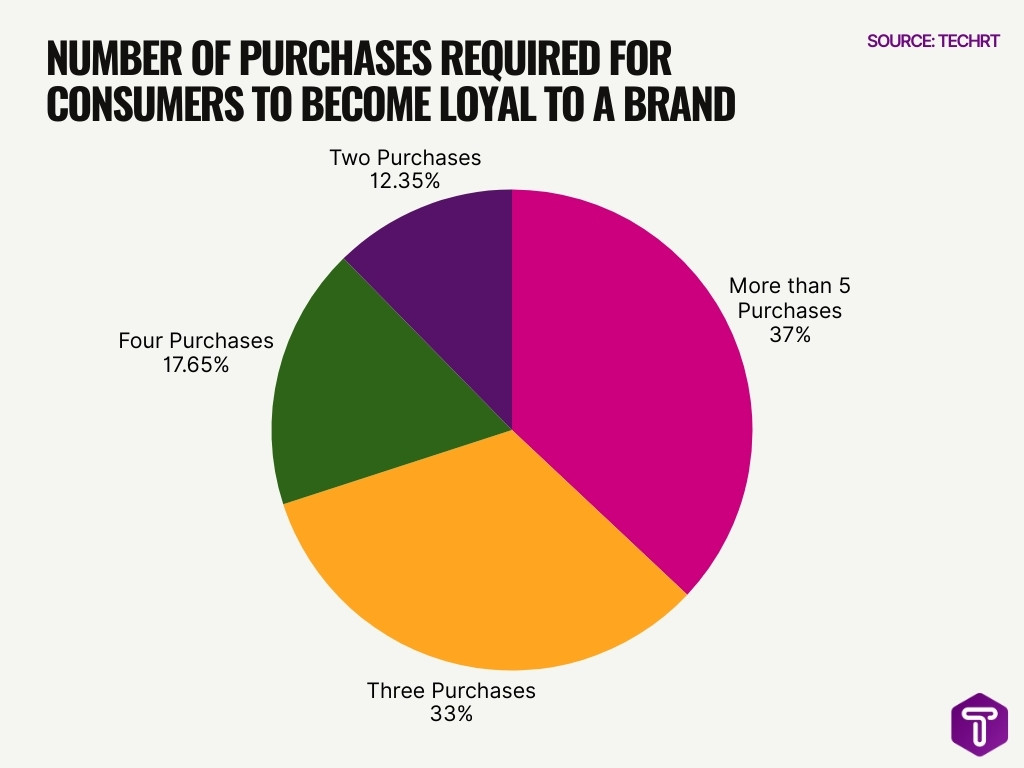
How Many Purchases Does It Take for Consumers to Become Loyal to a Brand?
- A significant 37% of consumers need more than 5 purchases before they consider themselves loyal to a brand, indicating that loyalty often develops through long-term engagement and repeated positive experiences.
- Around 33% of consumers say it takes three purchases to become loyal, showing that consistent product quality and customer experience early on can quickly build trust.
- Approximately 17.65% of consumers report becoming loyal after four purchases, suggesting that mid-cycle engagement strategies such as personalized offers or loyalty rewards can strengthen retention.
- Only 12.35% of consumers become loyal after two purchases, highlighting that instant loyalty is relatively rare and most brands must nurture relationships over multiple buying cycles.
- Overall, the data indicates that most consumers require at least three or more purchases before forming true brand loyalty, emphasizing the importance of customer retention strategies and repeat purchase incentives.
Customer Satisfaction and Retention
- Around 73% of customers say a positive experience strongly influences brand loyalty.
- Customers who rate satisfaction as very high are six times more likely to repurchase.
- Companies that lead in customer satisfaction generate 5.7 times more revenue than competitors with poor satisfaction scores.
- Approximately 86% of customers are willing to pay more for a better customer experience.
- Nearly 32% of customers stop doing business with a brand they love after just one bad experience.
- Businesses that actively measure customer satisfaction using Net Promoter Score report higher retention rates.
- Improving satisfaction scores by one point on the NPS scale can increase retention by about 3%.
- Companies with strong customer satisfaction programs achieve 20% higher repeat purchase rates.
- Brands with consistent service quality maintain significantly lower churn compared with industry averages.
Key Customer Service Statistics and Consumer Reactions
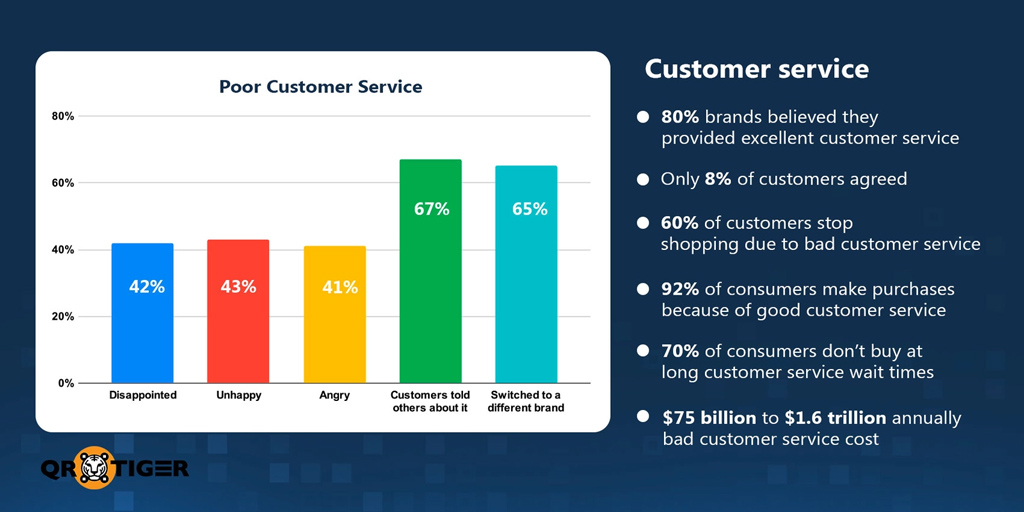
- 80% of brands believe they provide excellent customer service, but only 8% of customers actually agree, revealing a significant gap between brand perception and customer reality.
- Poor customer service has a direct impact on customer emotions. Around 43% of customers feel unhappy, 42% feel disappointed, and 41% feel angry after experiencing bad service.
- Negative experiences spread quickly through word of mouth. About 67% of customers tell others about a poor customer service experience, potentially damaging a brand’s reputation.
- Poor service can drive customers away permanently. Nearly 65% of customers switch to a different brand after encountering bad customer service.
- Customer experience strongly influences purchasing behavior. A massive 92% of consumers say they make purchases because of good customer service.
- On the flip side, 60% of customers stop shopping with a brand after experiencing poor customer service.
- Long response or wait times are another major issue. Around 70% of consumers avoid buying from companies that have long customer service wait times.
- The financial impact of poor service is enormous. Businesses lose an estimated $75 billion to $1.6 trillion every year due to bad customer service experiences.
Impact of Personalization on Retention
- Around 71% of consumers expect companies to deliver personalized interactions across marketing and support channels.
- 76% of customers feel frustrated when companies fail to personalize experiences, which can negatively affect retention.
- Businesses that implement advanced personalization generate 40% more revenue from those activities compared with slower adopters.
- Nearly 60% of consumers say personalization influences their decision to become repeat buyers.
- Personalized product recommendations can increase average order value by about 20%.
- Retailers using personalization technologies often see 10% to 15% higher customer retention rates.
- Email campaigns with personalized content achieve 29% higher open rates and 41% higher click-through rates.
- Approximately 80% of consumers are more likely to purchase from brands offering personalized experiences.
- Companies that leverage behavioral data for personalization experience higher engagement and repeat purchase rates.
Loyalty Programs and Customer Retention
- More than 80% of consumers say loyalty programs make them more likely to continue doing business with a brand.
- Members of loyalty programs generate 12% to 18% more revenue annually than non-members.
- Approximately 70% of consumers say loyalty programs influence their purchasing decisions.
- Retailers with loyalty programs can increase customer lifetime value by up to 30%.
- The average consumer participates in about 14 loyalty programs, but actively uses fewer than half of them.
- Brands that provide rewards and incentives see higher repeat purchase frequency among members.
- Loyalty members spend 67% more on average compared with new customers.
- Approximately 79% of consumers say loyalty programs increase the likelihood of recommending a brand.
- Businesses that offer tiered loyalty programs often achieve higher engagement and retention among high-value customers.
Top Customer Retention Strategies Businesses Use
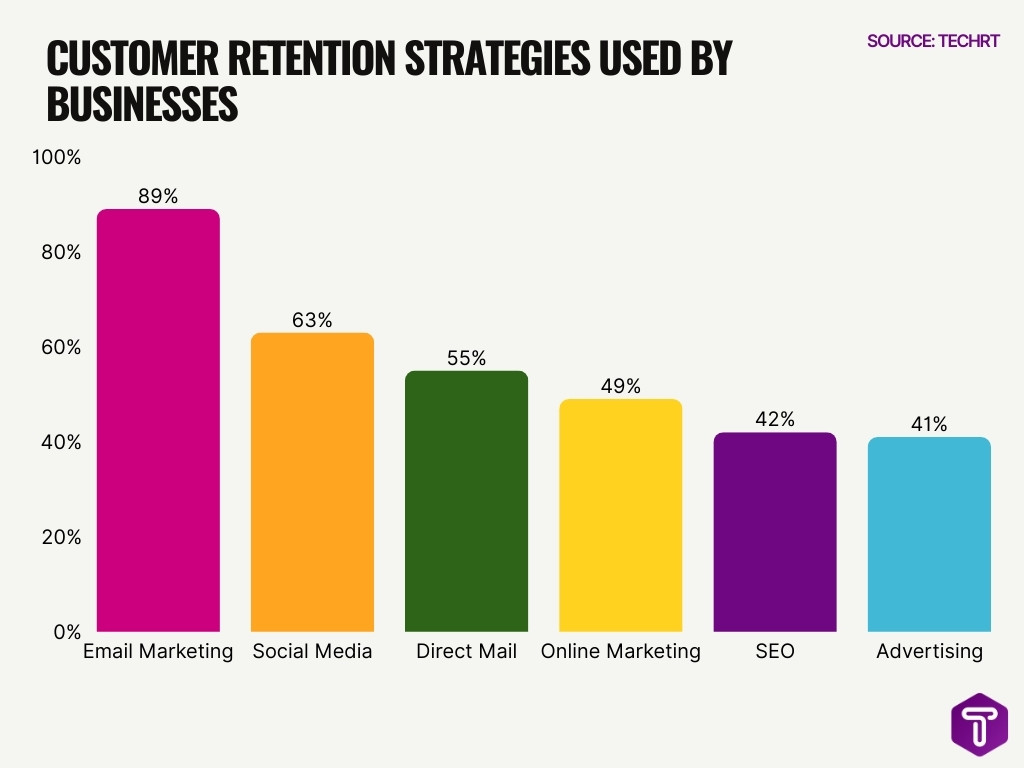
- Email marketing is the most effective customer retention strategy, with 89% of businesses using it to maintain relationships and encourage repeat purchases.
- Social media ranks second, as 63% of businesses leverage platforms like Facebook, Instagram, and LinkedIn to keep customers engaged and connected with their brand.
- Direct mail remains a powerful traditional retention channel, with 55% of companies still using physical mail campaigns to maintain customer loyalty.
- Nearly 49% of businesses rely on online marketing strategies, such as targeted campaigns, remarketing, and personalized content, to retain existing customers.
- SEO plays a key role in retention for 42% of businesses, helping brands stay visible in search results and encouraging customers to return organically.
- Advertising is used by 41% of businesses as a retention strategy, often through retargeting ads and personalized promotional campaigns.
- The data clearly shows that digital channels dominate customer retention, with email marketing and social media leading the strategies used by businesses to keep customers loyal and engaged.
Proactive Customer Success and Retention
- SaaS companies that implement proactive customer success programs reduce churn by up to 15%.
- Around 68% of customers leave a company because they feel the business does not care about them, emphasizing the need for proactive engagement.
- Organizations that actively track customer health scores can identify churn risks earlier and improve retention outcomes.
- Proactive onboarding programs can improve first-year retention by nearly 20%.
- Companies using customer success teams report higher Net Revenue Retention compared with companies that rely only on support teams.
- Businesses that implement automated engagement workflows achieve higher renewal rates among subscription customers.
- Proactive outreach through customer success managers increases product adoption and long-term retention.
- SaaS companies with mature customer success operations report NRR above 110% on average.
- Companies that regularly collect feedback through surveys and analytics improve customer satisfaction and loyalty metrics over time.
Common Customer Retention Metrics Tracked by Companies
- Across industries, the average Customer Retention Rate ranges between 70–80%, with IT & software retaining about 77–81% of customers.
- Retail and ecommerce often lag, with average retention rates around 63% for retail and as low as 30% for ecommerce businesses.
- Many B2B SaaS firms target an annual Customer Churn Rate below 10%, while B2B SaaS churn typically averages 3–5% per month.
- For B2C SaaS, normal monthly churn rates are higher, commonly in the 6–8% per month range due to weaker loyalty and fewer contracts.
- High-value SaaS segments show Net Revenue Retention (NRR) benchmarks of 110–130%, indicating significant expansion of revenue from existing customers.
- Subscription businesses often aim for Gross Revenue Retention (GRR) of 90–95%, with anything below 85% signaling elevated revenue loss risk.
- In many industries, strong brands achieve Customer Lifetime Value (CLV) to CAC ratios of 3:1 or higher, a common benchmark for sustainable growth.
- Average Net Promoter Score (NPS) in SaaS/tech hovers around 38–42, while top performers in the same space exceed 60+.
- E‑commerce and retail brands typically see average NPS in the 32–36 range, with leading players reaching 55+.
- Many companies consider a Customer Satisfaction (CSAT) score of 80–85%+ as healthy, with best‑in‑class teams maintaining 90% or higher satisfaction after key interactions.
Frequently Asked Questions (FAQs)
How much cheaper is retaining an existing customer compared to acquiring a new one?
Retaining customers typically costs about 5× less than acquiring new customers, and in some industries acquisition can be 5–25× more expensive.
How much can profits increase if customer retention improves by 5%?
A 5% increase in customer retention can boost profits by 25% to 95%, according to industry research.
What is the average customer retention rate across industries?
The average customer retention rate across industries is about 75%, though benchmarks range from 35% to 84% depending on the industry.
How much more do returning customers spend compared with new customers?
Returning customers spend about 67% more on average than first-time buyers.
What is the average ecommerce customer retention rate?
The average ecommerce retention rate is roughly 30%, while top-performing brands can reach around 62% retention.
Conclusion
Customer retention has become one of the most important performance indicators for modern businesses. The data shows that loyal customers spend more, purchase more frequently, and drive stronger long-term profitability than newly acquired customers. At the same time, rising competition and digital alternatives make it easier for customers to switch brands if expectations are not met.
Companies that prioritize customer experience, personalization, loyalty programs, and proactive engagement consistently achieve higher retention rates and customer lifetime value. As businesses move, data-driven retention strategies, supported by analytics, customer success teams, and omnichannel experiences, will play a central role in sustainable growth. Organizations that actively measure and optimize retention metrics will be better positioned to build lasting relationships with their customers.

Leave a comment
Have something to say about this article? Add your comment and start the discussion.