




Cyber Monday has evolved into one of the most significant online shopping holidays in the U.S. and around the world, trailing closely behind Black Friday in sales volume each year. Originally coined in 2005 to encourage ecommerce shopping after Thanksgiving, the day now drives tens of billions in online revenue and influences marketing, logistics, and consumer behavior throughout the holiday season.
Its impact extends vividly into retail strategy and consumer tech adoption, from early access deals on large retail platforms to AI-powered price comparisons that shape how shoppers find deals. As spending forecasts climb for Cyber Monday, this article explores the latest statistics and trends shaping the landscape of online holiday commerce.
Editor’s Choice
- $14.25 billion in online sales were recorded on Cyber Monday 2025, setting a new peak for the holiday online shopping day.
- Adobe Analytics estimates Cyber Monday 2025 sales will be up about 7.1% year over year.
- Over 75.9 million U.S. consumers shopped online on Cyber Monday 2025.
- Global Cyber Monday online sales reached $17.3 billion through midday report.
- Peak online spending often occurs between 8 p.m. and 10 p.m. EST, with consumers spending millions per minute.
- Mobile devices now contribute over 57% of US Cyber Monday online sales.
- BNPL, Buy Now, Pay Later, usage is growing, projected to exceed $1 billion in Cyber Monday 2025 BNPL transactions.
Recent Developments
- Retailers are expanding Cyber Monday deals across Cyber Week, extending promotions before and after the official date to capture more sales.
- Adobe Analytics projected Cyber Monday 2025 sales are up around 6.3% from 2024, indicating resilience amid economic uncertainty.
- AI-driven shopping features and price comparisons dramatically scaled consumer engagement, with platforms reporting steep growth in AI-assisted purchases during the holiday week.
- Salesforce data shows global online sales on Cyber Monday moved toward $52.7 billion overall during the weekend.
- Mobile commerce continued its acceleration, reflecting shifts in shopping behavior during the season.
- Independent merchants on platforms such as Shopify reported record BFCM weekend sales of $14.6 billion, highlighting the role of smaller brands.
- Emphasis on data security and consumer privacy concerns rose as retailers sent billions of targeted promotional emails during Black Friday and Cyber Monday.
- Buy Now, Pay Later options continued gaining traction as a payment method among online shoppers.
Overview of Key Cyber Monday Statistics
- Cyber Monday remains the largest online shopping day of the year in the U.S., surpassing Black Friday in total digital revenue.
- Total online sales were estimated at $14.25 billion in 2025.
- Peak spending moments can exceed $15.8 million per minute at the height of shopping hours.
- Approximately 75.9 million U.S. consumers participated in Cyber Monday 2025.
- Cyber Monday contributed nearly 32.4% of Cyber Week’s total online sales last cycle.
- Mobile accounted for more than 57% of online sales in the U.S. in 2024.
- Projections for Cyber Monday 2026 show anticipated spending reaching about $15.2 billion.
- Year over year online sales growth has averaged around 6–8% over recent years.
Cyber Monday Sales Growth Trends
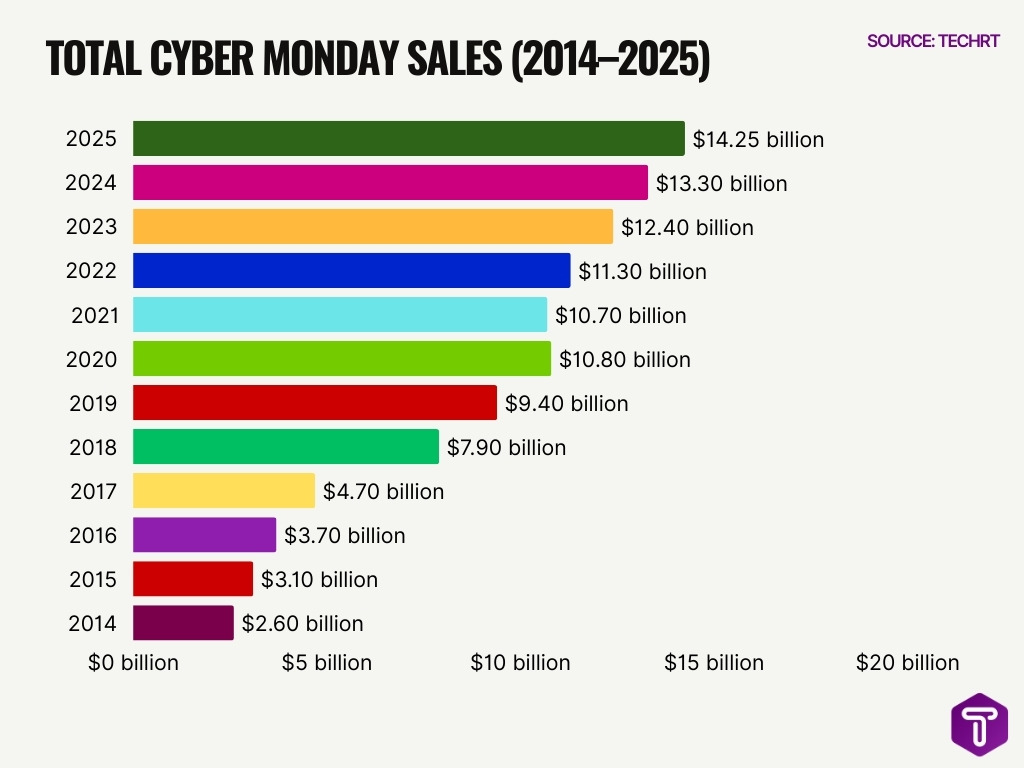
- Total Cyber Monday sales increased from $2.60 billion in 2014 to $14.25 billion in 2025, reflecting a strong long-term expansion of the online shopping market.
- Between 2014 and 2018, sales more than tripled from $2.60 billion to $7.90 billion, highlighting rapid early-stage e-commerce adoption.
- In 2019, Cyber Monday revenue reached $9.40 billion, marking the first time sales crossed the $9 billion threshold.
- The pandemic-driven shopping surge in 2020 pushed sales to $10.80 billion, accelerating digital retail dependence.
- Despite pandemic disruptions, 2021 maintained a strong performance at $10.70 billion, showing sustained consumer confidence in online purchases.
- Sales continued climbing in 2022 and 2023, rising from $11.30 billion to $12.40 billion, driven by mobile commerce and digital promotions.
- In 2024, Cyber Monday spending grew further to $13.30 billion, supported by expanded omnichannel strategies.
- The highest recorded sales occurred in 2025 at $14.25 billion, representing a new all-time peak for Cyber Monday.
- From 2020 to 2025, revenue increased by nearly $3.45 billion, underlining the long-term resilience of online retail.
- Overall, Cyber Monday sales grew by more than 448% from 2014 to 2025, confirming its status as one of the most important global e-commerce events.
U.S. Market Insights in Cyber Monday Statistics
- The U.S. market accounts for the lion’s share of Cyber Monday online spending.
- Online U.S. sales hit an estimated $14.25 billion in 2025.
- Sales growth was roughly up 7.1% year over year.
- Mobile commerce dominance continues with over half of sales originating from smartphones.
- An expected 58% of online purchases were projected to happen on mobile devices.
- Consumers shopped aggressively during peak evening hours.
- Buy Now, Pay Later options contributed significantly to total cart values.
- Adobe reported strong penetration of Cyber Monday into overall holiday ecommerce revenue.
U.K. Market Insights in Cyber Monday Statistics
- Online retail sales in the U.K. reached £3.4 billion during Cyber Week 2025, with Cyber Monday contributing a significant share.
- Online sales on Cyber Monday 2024 grew by over 5% year over year, reflecting steady ecommerce expansion.
- Mobile devices accounted for nearly 60% of U.K. Cyber Monday traffic in 2024, highlighting strong smartphone adoption.
- The average online order value in the U.K. during Cyber Monday 2024 was approximately £155, slightly higher than Black Friday.
- More than 45% of U.K. consumers reported starting holiday shopping before Black Friday weekend, spreading Cyber Monday demand.
- Apparel and electronics remained the top two categories, together accounting for over 40% of Cyber Monday online purchases in the U.K.
- BNPL usage in the U.K. rose by nearly 20% year over year during the 2024 holiday season.
- Retailers such as Amazon UK and John Lewis experienced double-digit online growth during Cyber Monday promotions.
Key Marketing Channels Driving Black Friday & Cyber Monday Purchases
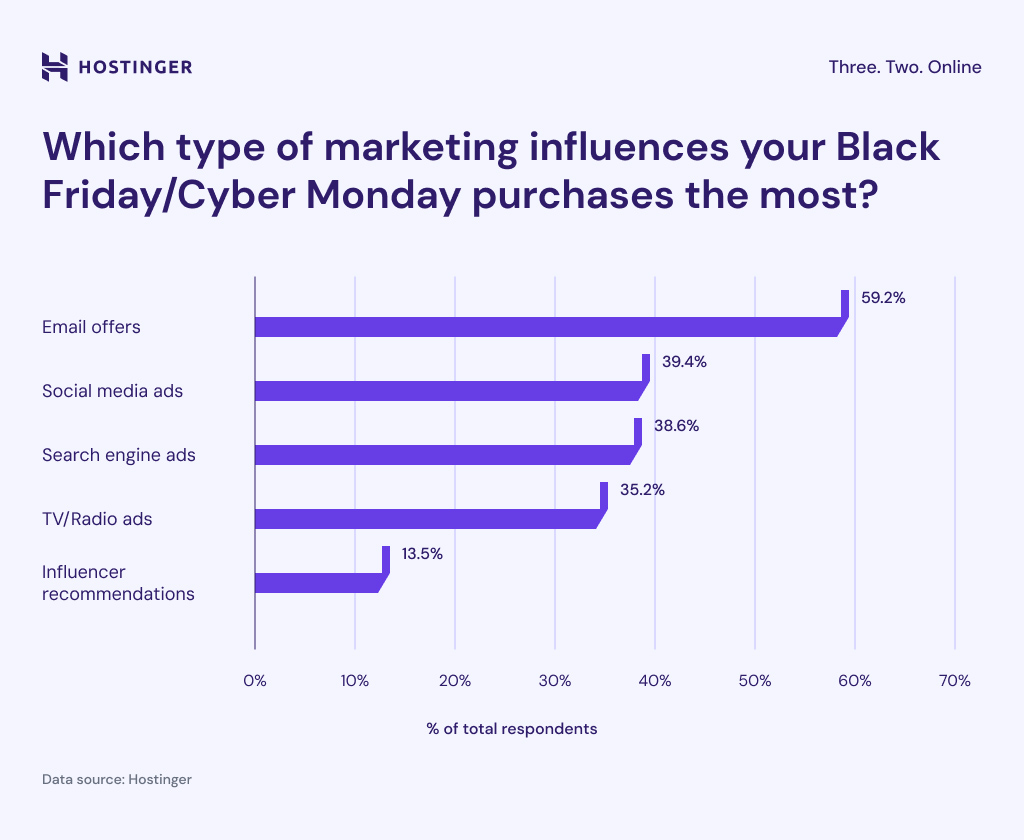
- Email offers dominate as the most influential channel, impacting 59.2% of respondents, making it the clear leader in holiday purchase decisions.
- Social media ads influence 39.4% of shoppers, highlighting the strong role of paid campaigns across platforms during peak shopping events.
- Search engine ads drive 38.6% of purchase decisions, showing that high-intent search traffic plays a critical role during Black Friday and Cyber Monday.
- Traditional advertising still matters, with TV and radio ads influencing 35.2% of respondents, proving offline media retains relevance.
- Influencer recommendations rank lowest at 13.5%, indicating that while creator marketing has an impact, it lags significantly behind direct and paid advertising channels.
- There is a substantial 19.8 percentage point gap between email marketing (59.2%) and the next highest channel (39.4% social media ads), underscoring email’s dominance in conversion-driven campaigns.
Global and Regional Performance in Cyber Monday Statistics
- Global Cyber Monday online sales surpassed $17 billion in 2025, reflecting continued international adoption.
- Global online sales across Cyber Week reached $52.7 billion, with Cyber Monday representing a major spike.
- Canada recorded approximately C$1.2 billion in Cyber Monday ecommerce sales in 2024.
- Australia saw online retail traffic jump by over 15% year over year during Cyber Monday 2024.
- In Germany, Cyber Monday online transactions increased by roughly 8% compared with 2023.
- Latin American markets, including Brazil and Mexico, reported ecommerce growth exceeding 10% during Cyber Week 2024.
- Cross-border ecommerce accounted for nearly 25% of Cyber Monday global sales, driven by international shipping and marketplace expansion.
- Asia-Pacific mobile commerce penetration exceeded 65% of online transactions during Cyber Monday 2024.
Retailer and Brand Performance in Cyber Monday Statistics
- Amazon consistently ranks as the top Cyber Monday retailer, capturing an estimated over 35% of U.S. online traffic share during the event.
- Walmart reported strong online growth during Cyber Monday 2025, with ecommerce sales up by double digits year over year.
- Shopify merchants generated a record $14.6 billion in sales across the BFCM weekend 2025, highlighting independent brand performance.
- Target experienced increased digital traffic and curbside pickup orders during Cyber Monday 2024.
- Electronics brands drove some of the highest average transaction values during Cyber Monday.
- Apparel brands saw conversion rates rise by nearly 12% compared with October averages.
- Small and mid-size retailers contributed roughly 30% of total Cyber Monday online revenue through marketplace channels.
- Loyalty programs influenced repeat purchases, with over 40% of Cyber Monday buyers returning to previously visited retailers.
Cyber Monday 2023 Shopping Preferences by Gender
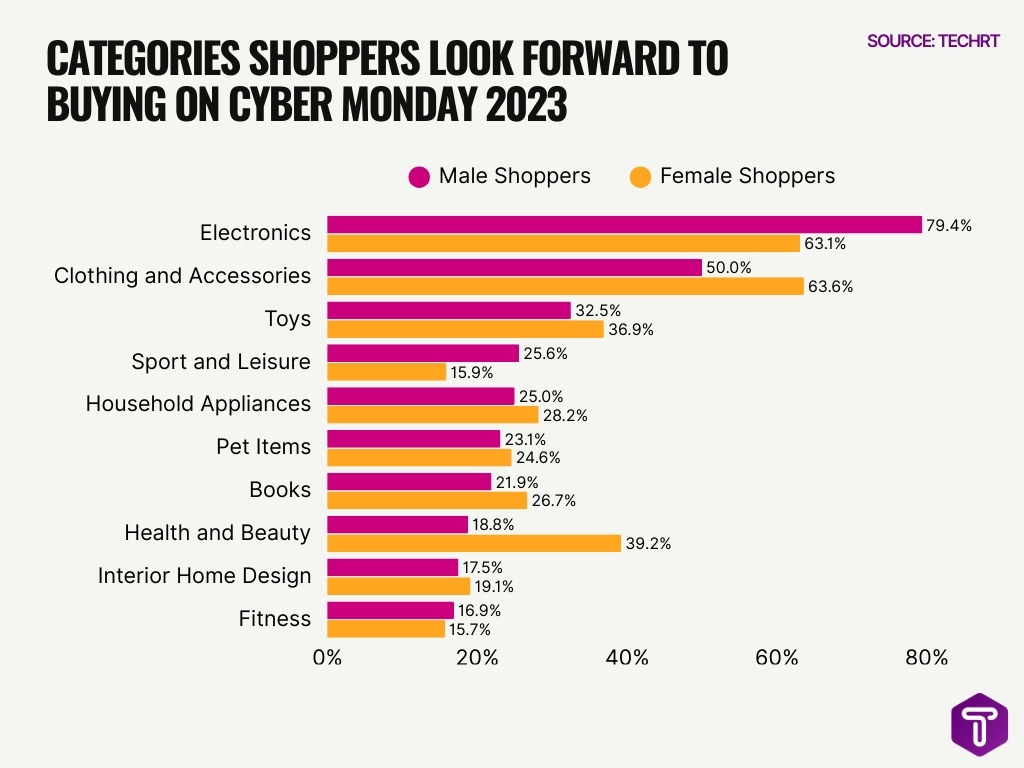
- Electronics dominated male shopping intent, with 79.4% of men planning to purchase tech products, compared to 63.1% of women.
- Clothing and accessories were more popular among women, attracting 63.6% of female shoppers, while 50% of men showed interest.
- Toys saw balanced demand, with 36.9% of women and 32.5% of men planning purchases.
- Sport and leisure items appealed more to men, with 25.6% of males interested versus 15.9% of females.
- Household appliances recorded similar interest, with 28.2% of women and 25% of men planning to buy.
- Pet items showed steady demand across genders, engaging 24.6% of women and 23.1% of men.
- Books were more popular among women, with 26.7% of female shoppers compared to 21.9% of male shoppers.
- Health and beauty products stood out among women, with a strong 39.2% interest rate, more than double the 18.8% among men.
- Interior home design products attracted moderate attention, with 19.1% of women and 17.5% of men showing interest.
- Fitness products recorded the lowest engagement, with 16.9% of men and 15.7% of women planning purchases.
Sales, Revenue, and Ecommerce Data in Cyber Monday Statistics
- U.S. Cyber Monday sales reached an estimated $14.25 billion in 2025, marking a record high.
- Cyber Monday 2024 generated approximately $12.4 billion in U.S. online sales.
- Average growth over the past five years has ranged between 6% and 9% annually.
- Peak online spending has exceeded $15 million per minute during evening hours.
- Ecommerce penetration during Cyber Monday now represents more than 20% of total holiday retail sales in the U.S.
- Over 75 million Americans participated in Cyber Monday online shopping in 2025.
- Online grocery purchases during Cyber Monday increased by nearly 9% year over year in 2024.
- Retailers offering free shipping thresholds experienced conversion rates up to 15% higher than those without.
Mobile vs Desktop Trends in Cyber Monday Statistics
- Mobile devices accounted for more than 57% of U.S. Cyber Monday sales in 2024, continuing an upward trajectory.
- Desktop conversion rates remain higher, averaging around 5–6%, compared with mobile’s roughly 3–4%.
- Mobile traffic represented nearly 70% of total site visits during Cyber Monday 2024.
- Average mobile order values lag desktop by approximately 10–15%, reflecting smaller basket sizes.
- Tablet traffic contributed about 5% of total Cyber Monday transactions.
- Retail apps drove nearly 25% of mobile purchases, emphasizing app-based engagement.
- One-click checkout features improved mobile conversion rates by up to 20% compared with traditional forms.
- Social commerce referrals increased mobile traffic by over 18% year over year.
Generational Shopping Preferences: Black Friday vs. Cyber Monday
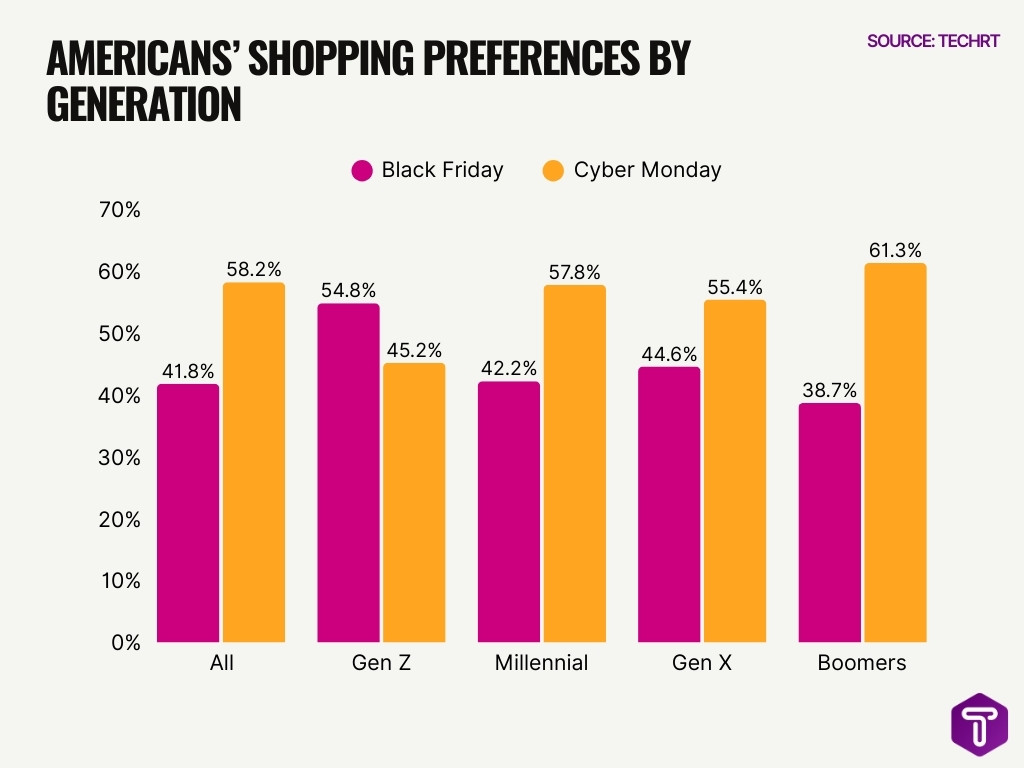
- Cyber Monday dominates overall, with 58.2% of shoppers preferring it compared to 41.8% favoring Black Friday.
- Gen Z is the only generation favoring Black Friday, with 54.8% choosing in-store deals over 45.2% opting for Cyber Monday.
- Millennials show a strong preference for online shopping, as 57.8% prefer Cyber Monday, while only 42.2% choose Black Friday.
- Gen X consumers lean toward digital discounts, with 55.4% favoring Cyber Monday versus 44.6% for Black Friday.
- Boomers are the most inclined toward Cyber Monday, recording the highest preference at 61.3%, compared to just 38.7% for Black Friday.
- Older generations increasingly favor online deals, indicating a shift from traditional in-store shopping to digital-first purchasing behavior.
- Younger shoppers remain more attached to physical retail experiences, especially during major sales events like Black Friday.
Traffic, Conversion, and Checkout Trends in Cyber Monday Statistics
- Cyber Monday traffic typically peaks between 8 p.m. and 10 p.m. EST, when shoppers spend millions per minute.
- Overall ecommerce conversion rates during Cyber Monday average around 4–5%, above standard monthly averages.
- Cart abandonment rates remain high at roughly 70%, despite promotional incentives.
- Sites offering guest checkout options see conversion lifts of up to 15%.
- Email marketing drives nearly 20% of Cyber Monday ecommerce revenue.
- Paid search advertising accounts for approximately 30% of referral traffic on Cyber Monday.
- Page load speed improvements of just one second can increase conversions by 7% or more.
- AI-powered personalization engines improved average session durations by over 10% during Cyber Week 2024.
Average Order Value and Spending Patterns in Cyber Monday Statistics
- The average U.S. Cyber Monday order value in 2024 was approximately $128, slightly higher than Black Friday.
- Consumers spent an average of $321 across the five-day Cyber Week period in 2025.
- Electronics purchases often exceed $300 per transaction, making it the highest AOV category.
- Apparel AOV typically ranges between $75 and $110 during Cyber Monday.
- Shoppers using BNPL options often record basket sizes that are 10–20% higher than those of credit card users.
- Repeat buyers tend to spend nearly 25% more than first-time customers.
- Free shipping thresholds encourage upselling, increasing average basket size by approximately $12–$18.
- Subscription add-ons and warranty extensions contributed incremental revenue growth of around 8% during Cyber Monday 2024.
Cyber Monday Discount Trends by Category
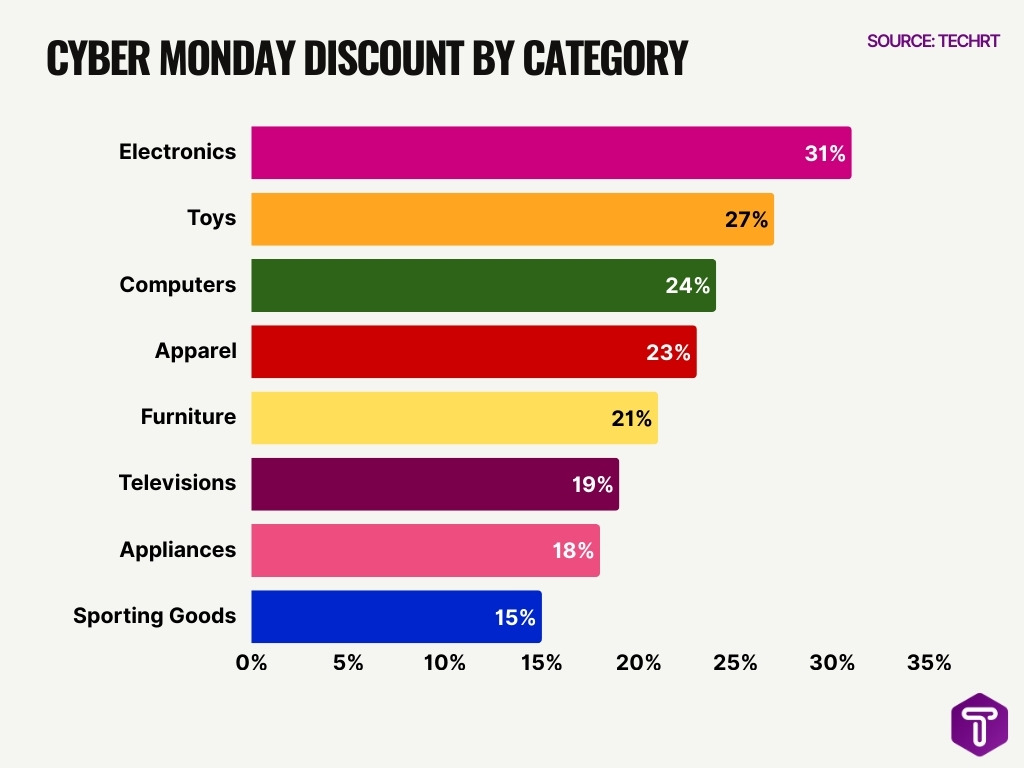
- Electronics recorded the highest discount at 31%, making it the most attractive category for bargain hunters during Cyber Monday.
- Toys followed closely with a 27% discount, reflecting strong promotional activity in the children’s and gifting segment.
- Computers secured the third position with an average discount of 24%, appealing to students and professionals seeking tech upgrades.
- Apparel offered competitive deals with a 23% price reduction, highlighting aggressive fashion retail promotions.
- Furniture saw substantial markdowns of 21%, encouraging big-ticket home purchases during the sale period.
- Televisions featured solid discounts of 19%, supporting high demand in the home entertainment category.
- Appliances provided notable savings at 18%, benefiting consumers looking for essential household upgrades.
- Sporting Goods recorded the lowest among major categories, yet still delivered strong value with 15% discounts.
Discount and Pricing Trends in Cyber Monday Statistics
- Average Cyber Monday discounts in 2025 reached approximately 27% across major retail categories.
- Electronics discounts frequently ranged between 25% and 35%, remaining the deepest among all categories.
- Apparel markdowns averaged roughly 20–25%, sustaining strong volume growth.
- Retailers that extended early access deals saw revenue increases of nearly 8% compared with single-day promotions.
- Dynamic pricing strategies powered by AI improved revenue optimization by approximately 10% during Cyber Week 2024.
- Free shipping incentives were offered by more than 70% of major online retailers during Cyber Monday.
- Price comparison tools recorded traffic increases exceeding 15% year over year during Cyber Monday 2025.
- Retailers offering price-match guarantees reported higher shopper trust and repeat purchase intent, contributing to a nearly 12% uplift in customer retention metrics.
Consumer Shopping Behavior in Cyber Monday Statistics
- Over 75 million U.S. consumers shopped online on Cyber Monday 2025.
- Approximately 60% of shoppers researched products in advance before making purchases.
- Evening hours between 8 p.m. and 10 p.m. EST generated peak spending, with millions spent per minute.
- Nearly 45% of shoppers used mobile apps rather than mobile browsers during Cyber Monday 2024.
- Email marketing campaigns influenced about 20% of total online purchases during Cyber Week.
- Social media referrals contributed to roughly 18% of mobile traffic growth year over year.
- Cart abandonment rates hovered around 70%, emphasizing the importance of checkout optimization.
- Loyalty program members were nearly 30% more likely to complete repeat purchases on Cyber Monday.
Key Insights on Cyber Monday and Black Friday Shopping Dissatisfaction
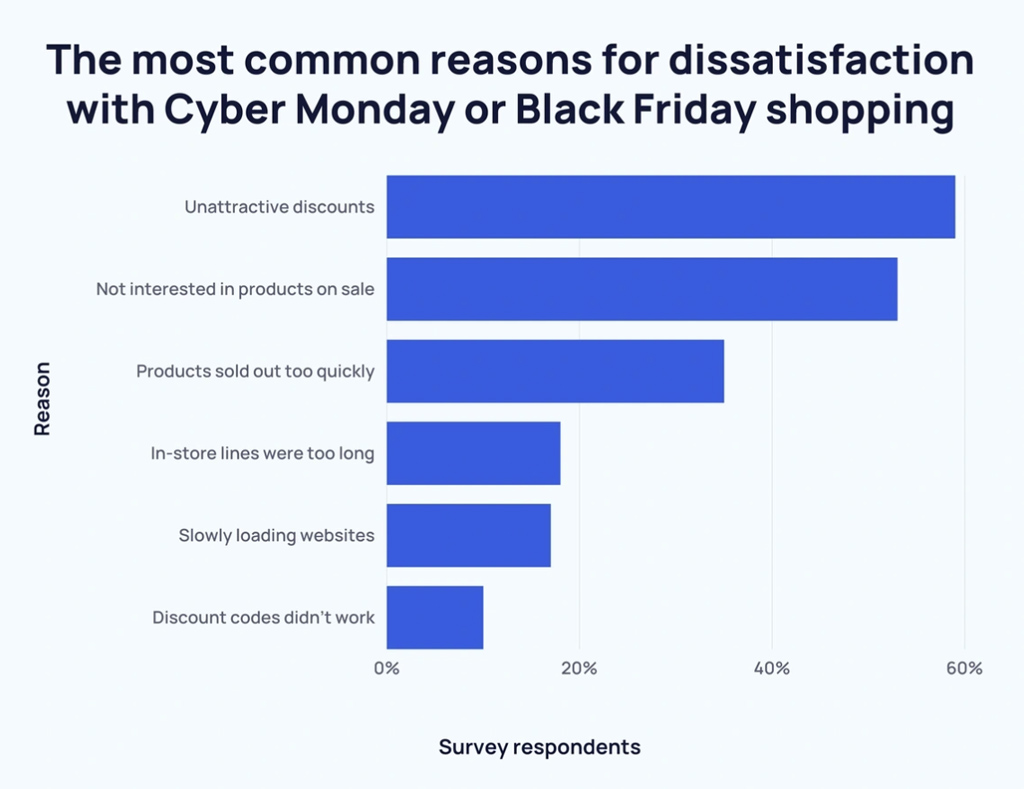
- Unattractive discounts are the leading cause of dissatisfaction, affecting 59% of shoppers, showing that many customers feel deals are not valuable enough.
- Lack of interest in discounted products frustrates 53% of respondents, indicating a mismatch between promotions and consumer preferences.
- Products selling out too quickly impacts 35% of shoppers, highlighting ongoing inventory and supply challenges during major sales events.
- Long in-store checkout lines disappoint 18% of consumers, proving that physical store congestion still affects the shopping experience.
- Slowly loading websites creates frustration for 17% of buyers, emphasizing the need for better website performance during peak traffic.
- Non-working discount codes affect 10% of shoppers, reflecting technical and operational issues that reduce trust in promotional campaigns.
Buy Now, Pay Later and Payment Methods in Cyber Monday Statistics
- BNPL transactions surpassed $1 billion in Cyber Monday 2025 sales, marking continued growth.
- BNPL usage during Cyber Week 2024 rose approximately 20% year over year.
- Shoppers using BNPL recorded average basket sizes that were 10–20% higher than those using traditional credit cards.
- Credit cards remained the dominant payment method, accounting for roughly 40–45% of total Cyber Monday transactions.
- Digital wallets contributed to nearly 30% of mobile checkout completions.
- Retailers integrating one-click checkout features improved payment completion rates by up to 20%.
- Fraud prevention investments increased by nearly 15% during the holiday ecommerce season, reflecting growing transaction volumes.
- Contactless and tokenized payments continued expanding adoption, particularly in cross-border ecommerce transactions.
Comparison of Black Friday and Cyber Monday Statistics
- Cyber Monday 2025 online sales hit $14.25 billion, surpassing Black Friday’s $10.5 billion in U.S. digital revenue.
- In-store sales drove Black Friday’s total revenue past $25 billion, making it the overall retail leader.
- Mobile purchases accounted for 57% of Cyber Monday sales versus 54% on Black Friday.
- Electronics discounts averaged 31% on Cyber Monday compared with 27% on Black Friday.
- Cyber Monday conversion rates averaged 7.2%, about 0.8 percentage points higher than Black Friday.
- Black Friday site traffic peaked at 9 a.m., while Cyber Monday traffic surged around 8–10 p.m.
- Buy Now, Pay Later (BNPL) use grew 18% year-over-year on Black Friday and 21% on Cyber Monday.
- Average order value for Cyber Monday was $155, roughly 6% higher than Black Friday’s average.
- Email-driven sales were 23% higher on Cyber Monday due to personalized promotions.
- Cyber Week 2025 campaigns extended average discount windows by 5–6 days, blurring distinctions between the two events.
Frequently Asked Questions (FAQs)
How much did U.S. consumers spend online on Cyber Monday 2025?
U.S. online sales reached about $14.25 billion, marking a 7.1% year-over-year increase in total ecommerce spending on Cyber Monday 2025.
What percentage increase in Cyber Monday spend was projected for 2025 compared to 2024?
Cyber Monday online spending was expected to grow by 6.3% to 7.1% compared with 2024, according to forecasts and final reported figures.
How many consumers shopped online on Cyber Monday 2025 in the U.S.?
Approximately 75.9 million U.S. consumers shopped online for Cyber Monday in 2025, up from 64.4 million in 2024.
What share of Cyber Monday ecommerce sales came from mobile devices in 2025?
Mobile devices accounted for about 57.5% of all online Cyber Monday sales, translating to roughly $8.2 billion in mobile spend.
How much did “buy now, pay later” (BNPL) contribute to Cyber Monday ecommerce in 2025?
Buy Now, Pay Later transactions on Cyber Monday 2025 exceeded $1.03 billion, representing a growth over the prior year.
Conclusion
Cyber Monday continues to break online sales records, with U.S. revenue reaching $14.25 billion in 2025 and projections pointing toward further growth. Mobile commerce now drives the majority of transactions, while AI-powered pricing, BNPL adoption, and extended Cyber Week promotions reshape how consumers shop.
For retailers, the data underscores the importance of optimizing checkout flows, leveraging personalization, and balancing discount depth with profitability. For consumers, Cyber Monday offers measurable savings across electronics, apparel, and emerging subscription services. As ecommerce infrastructure strengthens and global participation expands, Cyber Monday remains a defining moment in the digital retail calendar.

Leave a comment
Have something to say about this article? Add your comment and start the discussion.