



Digital marketing continues to reshape how brands connect with consumers, from AI-driven ad targeting to data-led customer journeys. Businesses across industries now depend on digital channels to acquire customers, drive ecommerce sales, and measure performance with precision. For example, retailers use personalized ads and email automation to increase conversions, while SaaS companies rely on SEO and content marketing to generate qualified leads at scale.
At the same time, the rapid growth of mobile usage, social media platforms, and AI-powered tools has changed how audiences discover and interact with brands. As marketing budgets increasingly shift away from traditional channels, staying updated with the latest statistics becomes essential for making informed, ROI-focused decisions. Let’s explore the key digital marketing statistics shaping and beyond.
Editor’s Choice
- Global digital ad spend is projected to reach $835.82 billion in 2026, accounting for 68.7% of total ad spend.
- Worldwide advertising spend is expected to surpass $1 trillion in 2026 for the first time.
- Digital ad spend grew from $485 billion in 2023 to $526 billion in 2024, showing consistent expansion.
- The global digital marketing market reached $456.7 billion in 2025 and continues to grow at a nearly 11% CAGR.
- In 2025, global ad spending hit $1.17 trillion, highlighting sustained investment growth.
- Mobile advertising accounts for over 70% of digital ad budgets globally.
- Nearly three-quarters of global ad spend is now digital, reflecting a structural shift in marketing strategies.
Recent Developments
- AI-powered advertising in the U.S. is expected to grow by 63% in 2026, reaching $57 billion.
- AI-driven ad budgets are projected to grow at a 29% CAGR through 2030, indicating long-term adoption.
- Influencer marketing spend reached $37 billion in the U.S. in 2025, growing 26% year-over-year.
- Digital formats accounted for 72% of global ad revenue in 2024 and are expected to exceed 80% by 2029.
- Programmatic advertising now represents over 80% of digital ad spend.
- Search advertising alone generated $132 billion in 2024, remaining a dominant channel.
- User-generated content is gaining traction and is expected to outperform traditional content formats in ad revenue share.
- Social platforms now connect with over 5 billion users globally, expanding marketing reach.
- Brands increasingly rely on automation tools for bidding, targeting, and optimization, reducing manual campaign management.
Global Digital Marketing Overview
- Global ad spend increased by 7.3% in 2024, adding $75 billion year-over-year.
- Digital advertising has contributed the majority of growth in global ad spend since 2019.
- Digital channels now account for over 68% of total advertising investment globally.
- The U.S. remains the largest ad market, with $466.34 billion spent in 2025.
- Asia-Pacific is the fastest-growing region, driven by markets like India and China.
- Social and video content dominate user attention, especially among younger demographics.
- Digital transformation continues to drive marketing investments across industries.
- North America holds around 35–40% market share in digital marketing spend.
- India’s digital media already accounts for 46% of its total ad market, reflecting rapid adoption.
Global Digital Marketing Market Growth Insights
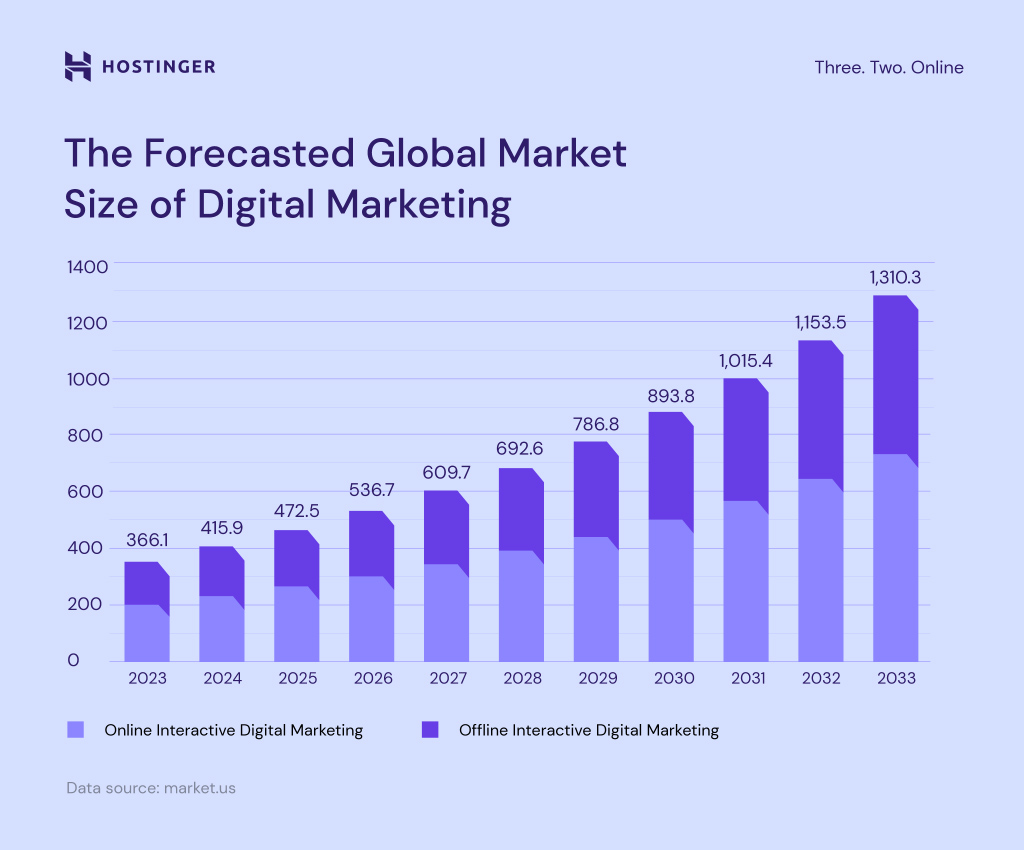
- The global digital marketing market is projected to grow from $366.1 billion in 2023 to $1,310.3 billion by 2033, reflecting massive industry expansion.
- The market is expected to add over $944.2 billion in value within a decade, highlighting strong long-term investment potential.
- Digital marketing spending is forecast to nearly 3.6× increase between 2023 and 2033, indicating rapid adoption across industries.
- The market crosses the $1 trillion milestone by 2031, reaching $1,015.4 billion, a key psychological and economic benchmark.
- Year-over-year growth remains consistent, with the market increasing by approximately $50B–$150B annually throughout the forecast period.
- By 2027, the market will surpass $600 billion, showing strong mid-term growth momentum.
- Between 2028 and 2030, the market expands from $692.6 billion to $893.8 billion, adding over $200 billion in just 2 years.
- The fastest absolute growth occurs in the later years, with an increase of nearly $295 billion from 2030 to 2033.
- The steady upward trajectory indicates increasing reliance on online interactive digital marketing, alongside continued investment in hybrid strategies.
- Overall, the data reflects a high-growth, scalable industry, driven by AI adoption, data-driven marketing, and digital transformation trends worldwide.
Digital vs Traditional Marketing Spend
- Digital advertising accounts for 68.7% of total global ad spend in 2026.
- Traditional print advertising continues to decline, with a -3% growth rate.
- TV advertising is growing slowly at around 2.4% annually.
- Digital formats already made up 72% of total ad revenue in 2024.
- By 2029, digital advertising is expected to exceed 80% of total ad revenue.
- Over 65% of ad budgets were digital by 2025, reflecting the ongoing transition.
- Out-of-home advertising is growing modestly at 4.1%, but still trails digital.
- Cinema advertising grows at 2.2%, showing limited recovery compared to digital channels.
- Digital channels drive most incremental ad growth globally, while traditional media stagnates.
Digital Marketing Budget Allocation
- Over 70% of digital ad budgets are allocated to mobile channels.
- Search advertising accounts for nearly 40% of total digital ad spend.
- Programmatic advertising handles 80%+ of digital media buying.
- AI-powered campaigns are capturing 12% of total ad spend in the U.S.
- Brands increasingly invest in video and social commerce formats to drive engagement.
- Creator-driven marketing budgets are expanding rapidly, with influencer spend growing faster than overall media.
- Companies are shifting budgets toward first-party data strategies due to privacy changes.
- Retail media and connected TV are emerging as high-growth budget categories.
- Businesses prioritize ROI-driven channels like search and paid social over awareness-only campaigns.
Digital Advertising Spend by Channel
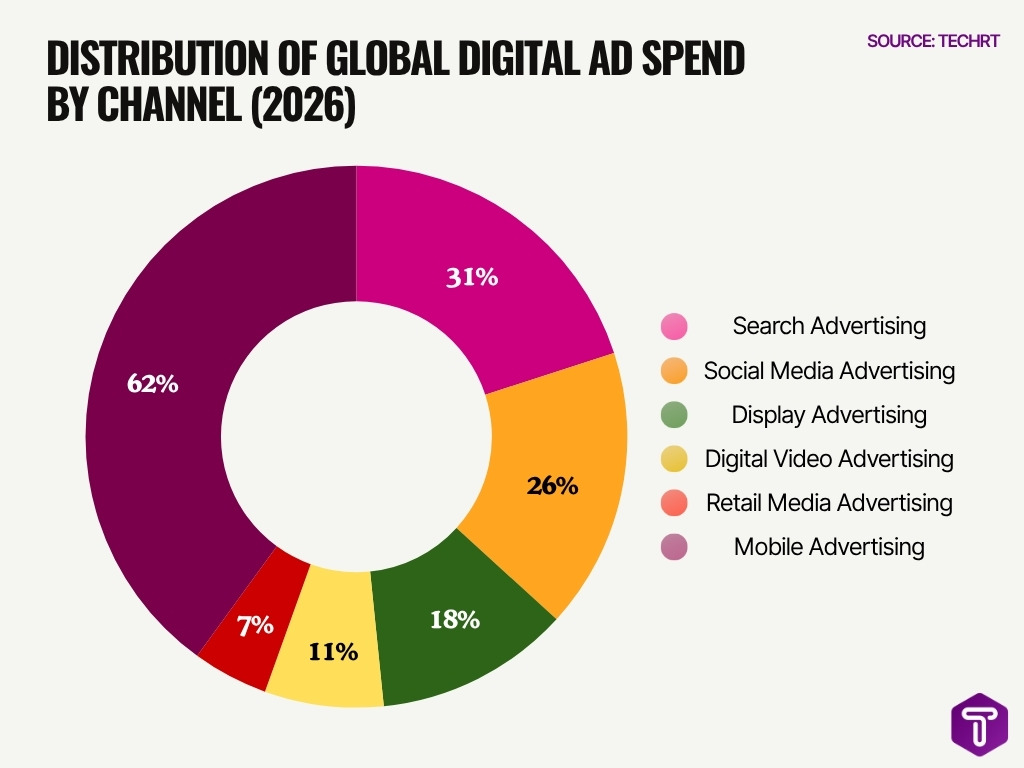
- Search advertising accounts for 31% of global digital ad spend in 2026, totaling $260 billion.
- Social media advertising represents 26% of digital ad spend at $220 billion globally in 2026.
- Display advertising comprises 18% of digital ad budgets, reaching $150 billion worldwide in 2026.
- Digital video advertising holds 11% share with $95 billion spent globally in 2026.
- Retail media advertising captures 7% of digital spend, amounting to $60 billion in 2026.
- Mobile advertising drives 62% of total digital ad spend globally.
- Connected TV (CTV) ad spend grows at 13.8% annually in the US for 2026.
- Digital audio advertising grows at a 12-15% CAGR through the next five years.
Search Engine Marketing and SEO Statistics
- Google holds over 91% of the global search engine market share, dominating search marketing.
- Organic search drives 53% of all website traffic, making SEO a core acquisition channel.
- 75% of users never scroll past the first page of search results.
- The top Google result gets an average 27.6% click-through rate.
- SEO leads have a 14.6% close rate, compared to 1.7% for outbound leads.
- Businesses spend an average of $497/month on SEO services, with higher spend linked to better satisfaction.
- 61% of marketers say improving SEO and organic presence is their top priority.
- Voice search usage continues to grow, with over 50% of adults using voice search daily.
- Featured snippets capture ~8% of all clicks, increasing zero-click searches.
Pay-Per-Click (PPC) and Search Ads Statistics
- Businesses earn an average of $2 for every $1 spent on Google Ads, highlighting strong ROI.
- The average Google Ads click-through rate across industries is 6.11% for search campaigns.
- The average cost per click in Google Ads is $2.69 for search and $0.63 for display.
- Search ads account for over 40% of total digital ad revenue globally.
- Paid search conversion rates average 3.75% across industries.
- 65% of high-intent searches result in an ad click, especially for transactional queries.
- Remarketing ads can increase conversion rates by up to 70%.
- Mobile PPC campaigns generate over 50% of paid search clicks.
- Automation and smart bidding are used in over 80% of Google Ads campaigns, improving efficiency.
Social Media Marketing Statistics
- There are over 5.04 billion social media users worldwide in 2025, representing more than 62% of the global population.
- The average user spends 2 hours and 23 minutes daily on social media platforms.
- Social media advertising spend is projected to reach $276 billion by 2026.
- 90% of marketers say social media increases brand exposure.
- Instagram engagement rates average 0.60% per post, higher than many other platforms.
- Facebook remains the largest platform with over 3 billion monthly active users.
- LinkedIn generates 80% of B2B social media leads, making it a key platform for professionals.
- TikTok users spend an average of 95 minutes per day on the app, driving high engagement.
- Social commerce sales are expected to exceed $1.2 trillion globally by 2025.
AI Adoption by Social Marketers in Regulated vs Loosely Regulated Industries
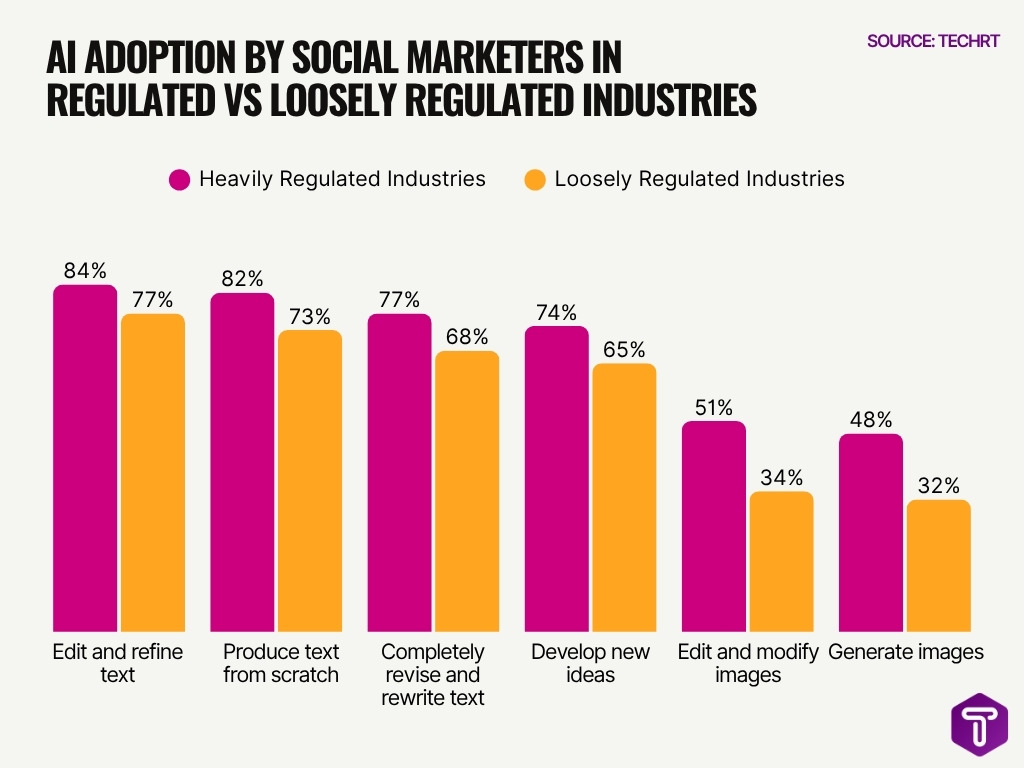
- AI usage is consistently higher in heavily regulated industries, with 84% using AI to edit and refine text, compared to 77% in loosely regulated sectors.
- Content creation sees strong AI adoption, as 82% of heavily regulated organizations use AI to produce text from scratch, versus 73% in less regulated industries.
- For advanced text editing tasks, 77% of heavily regulated industries rely on AI to completely revise and rewrite content, compared to 68% in loosely regulated sectors.
- AI-driven ideation is widely adopted, with 74% of heavily regulated industries using AI to develop new ideas, while 65% of loosely regulated industries do the same.
- A significant gap appears in visual content tasks, where only 51% of heavily regulated industries use AI to edit and modify images, compared to just 34% in loosely regulated industries.
- AI image generation remains the least adopted use case, with 48% adoption in heavily regulated industries and 32% in loosely regulated sectors.
- Overall, text-based AI applications dominate adoption, while image-related AI use cases lag across both industry types.
- The data highlights that heavily regulated industries are leading AI adoption across all activities, likely driven by the need for efficiency, compliance, and content accuracy.
Influencer Marketing Statistics
- The influencer marketing industry is valued at $24 billion globally in 2025, up from $21.1 billion in 2023.
- U.S. influencer marketing spend reached $37 billion in 2025, growing rapidly year-over-year.
- 89% of marketers say influencer marketing delivers ROI comparable to or better than other channels.
- Micro-influencers achieve higher engagement rates than mega influencers.
- 61% of consumers trust influencer recommendations, compared to 38% for brand-produced content.
- Instagram is used by over 80% of influencer campaigns, making it the dominant platform.
- TikTok influencer campaigns generate up to 2x higher engagement rates than Instagram.
- Brands earn an average of $5.20 for every $1 spent on influencer marketing.
- 67% of brands plan to increase influencer marketing budgets in 2026.
Content Marketing and Blogging Statistics
- 70% of marketers actively invest in content marketing, making it a core strategy.
- Content marketing generates 3x more leads than traditional marketing while costing 62% less.
- Companies with blogs generate 67% more leads per month than those without.
- Long-form blog posts get 77% more backlinks than shorter articles.
- 60% of marketers say content marketing increases engagement and retention.
- Updating old blog content can increase traffic by up to 106%.
- 82% of marketers actively use content marketing in 2025, up from 70% in 2023.
- Interactive content generates 2x more engagement than static content.
- SEO-driven blog posts remain the top-performing content type for organic traffic.
Key Content Marketing Goals Among B2B Marketers
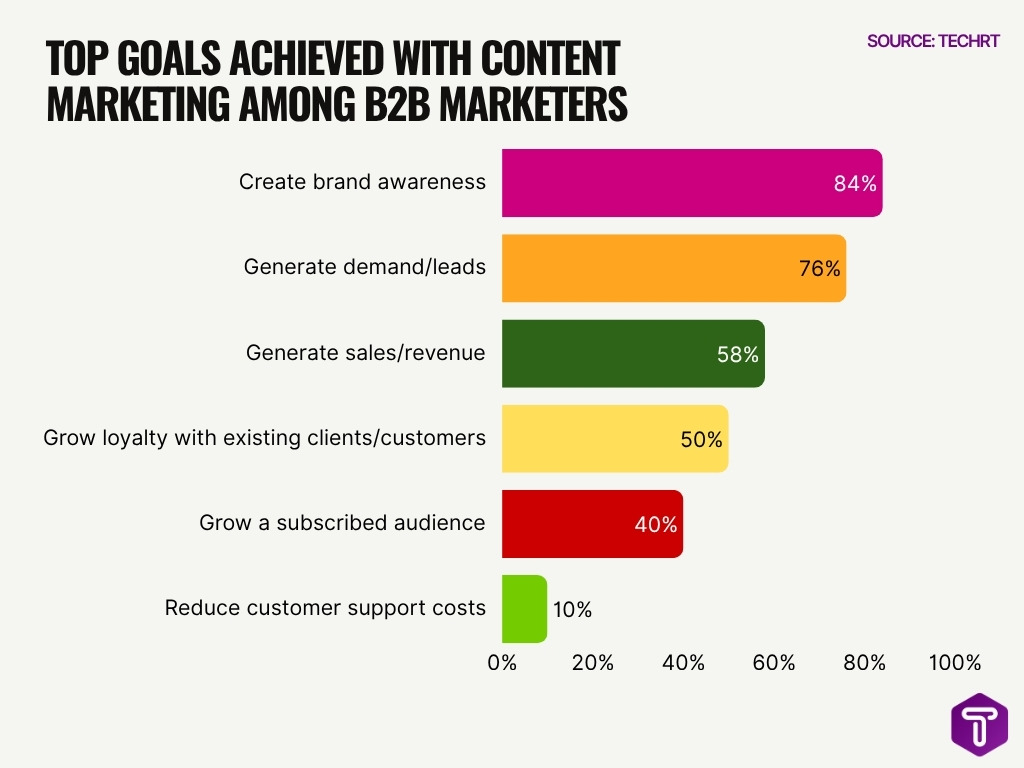
- Brand awareness dominates as the top priority, with 84% of B2B marketers leveraging content marketing to increase visibility and recognition.
- Lead generation remains a core objective, as 76% of marketers use content to generate demand and acquire qualified leads.
- Over half of marketers (58%) focus on driving sales and revenue, highlighting content marketing’s direct impact on bottom-line growth.
- Customer retention is equally important, with 50% of B2B marketers aiming to build loyalty among existing clients and customers.
- Around 40% of marketers use content to grow a subscribed audience, indicating a strong push toward owned media and long-term audience building.
- Only 10% prioritize reducing customer support costs, making it the least common goal despite content’s potential in self-service and support optimization.
Video Marketing Statistics
- 91% of businesses use video as a marketing tool in 2026.
- 82% of marketers say video marketing delivers a good ROI.
- Short-form videos are the #1 highest-ROI content format for 49% of marketers.
- YouTube Shorts averaged 200 billion daily views in 2026.
- Adding video to landing pages boosts conversions by 80%.
- 73% of consumers prefer short-form videos to learn about products.
- Live streaming global sales are expected to hit $500 billion in 2025.
- 70% of video consumption occurs on mobile devices.
- Digital video ad spend reaches $72 billion in 2025.
- 93% of marketers report positive ROI from video marketing.
Email Marketing Statistics
- Email marketing delivers an average ROI of $36 for every $1 spent.
- There are over 4.48 billion email users worldwide in 2025, expected to reach 4.73 billion by 2026.
- 64% of small businesses use email marketing to reach customers.
- The average email open rate is 21.5%, with click-through rates around 2.3%.
- Personalized campaigns improve click-through rates by 14% and conversions by 10%.
- Over 60% of email opens occur on mobile devices.
- Welcome emails generate 4x higher open rates and 5x more clicks than standard campaigns.
- Segmented campaigns can increase revenue by up to 760%.
- 87% of marketers use email to distribute content.
- Emails with interactive content can boost engagement rates by up to 300%.
Email Click-Through Rate Benchmarks by Industry
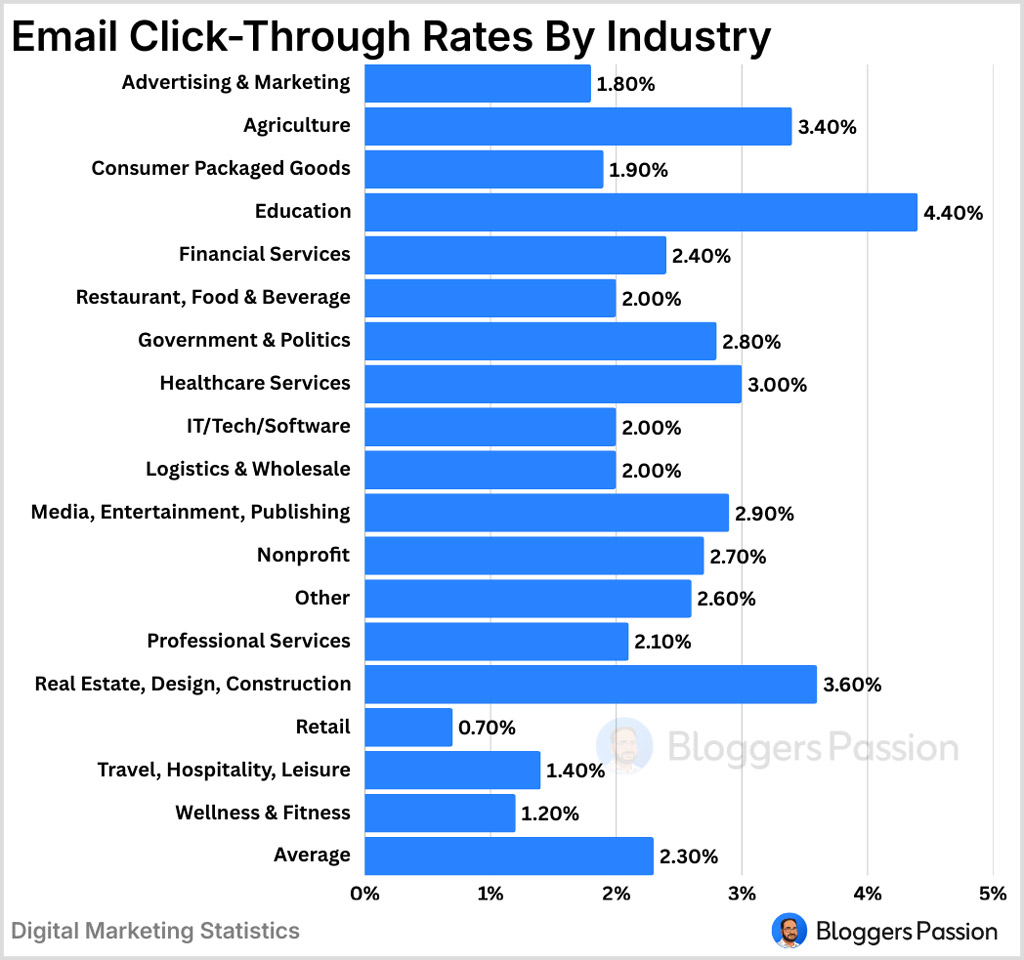
- The average email CTR across industries is 2.30%, serving as a key benchmark for performance comparison.
- Education leads all industries with a 4.40% CTR, indicating high engagement levels in academic and learning-related emails.
- Real Estate, Design, and Construction (3.60%) and Agriculture (3.40%) also show strong above-average performance, suggesting targeted audiences respond well to these sectors.
- Healthcare Services (3.00%) and Media, Entertainment, and Publishing (2.90%) maintain solid engagement rates, staying above the industry average.
- Government & Politics (2.80%) and Nonprofit (2.70%) sectors demonstrate moderately high CTRs, likely driven by purpose-driven messaging.
- Mid-performing industries include Other (2.60%), Financial Services (2.40%), and Professional Services (2.10%), hovering close to or slightly above the average.
- IT/Tech/Software, Logistics & Wholesale, and Food & Beverage each record a 2.00% CTR, reflecting average engagement levels.
- Lower-performing sectors include Consumer Packaged Goods (1.90%) and Advertising & Marketing (1.80%), slightly below the benchmark.
- Travel, Hospitality & Leisure (1.40%) and Wellness & Fitness (1.20%) show weaker engagement, possibly due to seasonality or promotional fatigue.
- Retail has the lowest CTR at just 0.70%, highlighting significant engagement challenges despite high email volume in the sector.
- Overall, industries with niche audiences or high-value content (Education, Real Estate, Agriculture) tend to outperform those with mass marketing approaches (Retail, Advertising).
Mobile Marketing and Smartphone Usage Statistics
- There are over 6.9 billion smartphone users globally in 2025, covering more than 85% of the population.
- Mobile devices generate over 58% of global website traffic.
- 92% of internet users access the web via mobile devices.
- Mobile advertising accounts for over 70% of total digital ad spend.
- Users spend an average of 4 hours and 30 minutes daily on mobile devices.
- 70% of ecommerce traffic comes from mobile devices, but conversion rates remain lower than on desktops.
- Mobile apps account for 88% of total mobile time spent.
- SMS marketing boasts a 98% open rate.
- Location-based marketing influences nearby purchase decisions for 76% of smartphone users.
Ecommerce and Online Shopping Statistics
- Global ecommerce sales reached $6.3 trillion in 2024 and are projected to exceed $7 trillion by 2026.
- Ecommerce accounts for over 22% of total global retail sales.
- 2.77 billion people shop online worldwide, representing one-third of the global population.
- Amazon accounts for over 37% of the U.S. ecommerce market share.
- Mobile commerce contributes over 60% of ecommerce sales globally.
- Average cart abandonment rates are around 70%.
- 49% of consumers start product searches on search engines.
- Personalized product recommendations can increase revenue by up to 31%.
- Same-day delivery influences 41% of consumers’ purchase decisions.
SEO Project Pricing Trends and Insights
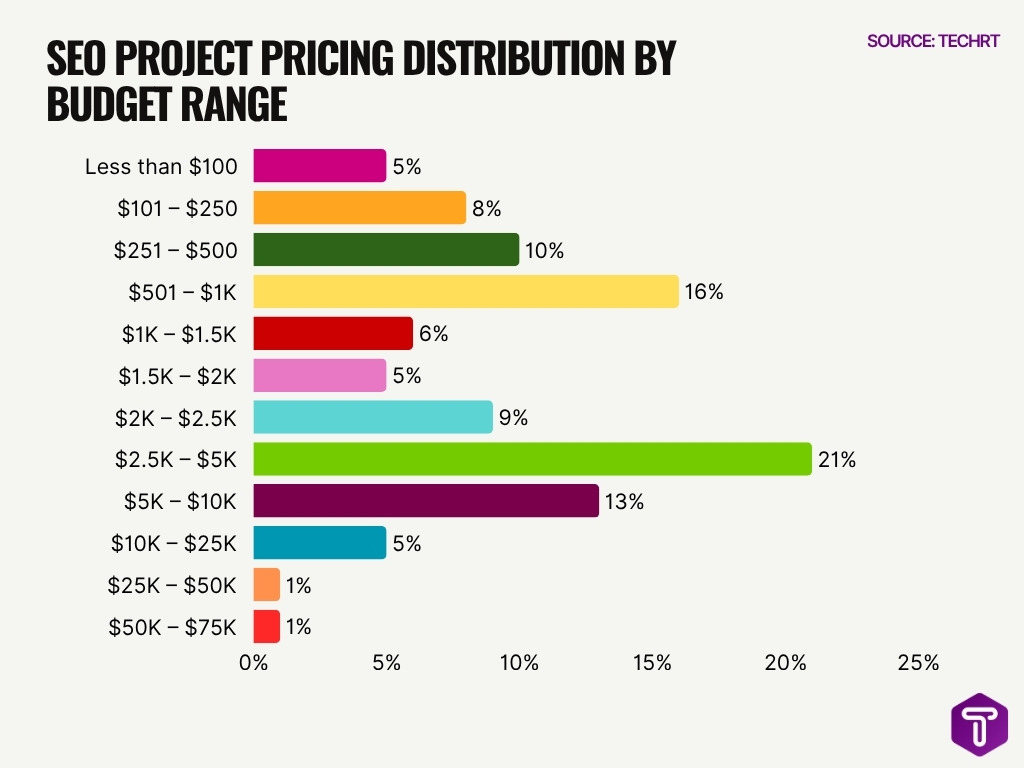
- The most common SEO project pricing range is $2.5K–$5K, accounting for the highest share at 21% of respondents, indicating a strong mid-market demand.
- A significant portion of SEO projects fall between $501–$1K (16%) and $5K–$10K (13%), showing a balanced distribution across mid-to-high budget segments.
- Entry-level SEO pricing remains accessible, with <$100 (5%) and $101–$250 (8%), suggesting availability of low-cost or basic SEO services.
- Around 10% of respondents charge $251–$500, highlighting this as a common starting range for small businesses.
- The $2K–$2.5K range (9%) also represents a notable share, reinforcing that mid-tier SEO packages are in high demand.
- Pricing between $1K–$1.5K (6%) and $1.5K–$2K (5%) shows a slight dip, indicating a pricing gap or transition zone in the market.
- High-ticket SEO projects are less common, with only 5% charging $10K–$25K, reflecting enterprise-level or highly specialized services.
- Premium SEO services above $25K are rare, with just 1% each for $25K–$50K and $50K–$75K, indicating a very niche, high-end market.
- Overall, the data suggests that over 60% of SEO projects fall within the $500–$5K range, making it the core pricing sweet spot for most businesses.
- The pricing distribution highlights a tiered SEO market, where budget, mid-range, and premium services coexist, catering to different business sizes and needs.
Conversion Rate and Lead Generation Statistics
- The average website conversion rate across industries is 2.35%, with top performers reaching 11%+.
- Landing pages with fewer than 10 form fields convert better.
- Companies that optimize landing pages see conversion increases of up to 300%.
- Personalized CTAs convert 202% better than generic ones.
- 61% of marketers say generating traffic and leads is their biggest challenge.
- Using video on landing pages can boost conversions by up to 80%.
- A 1-second delay in page load time can reduce conversions by 7%.
- Businesses using marketing automation see 451% more qualified leads.
- Retargeting campaigns can increase conversion rates by 150%.
AI and Machine Learning in Marketing Statistics
- 80% of marketers use AI tools in some form.
- AI-driven personalization can increase revenue by 10–15%.
- The global AI in marketing market is projected to reach $107 billion by 2028.
- 63% of marketers plan to increase AI budgets in 2026.
- AI-powered chatbots can handle up to 80% of customer interactions.
- Businesses using AI for marketing report up to 30% higher ROI on campaigns.
- Predictive analytics improves campaign performance by 20% or more.
- AI-generated content reduces production time by 50% or more.
- 75% of enterprises will shift from piloting to operationalizing AI by 2026.
Privacy, Cookies, and Data Compliance Statistics
- 81% of consumers say data privacy is a top concern.
- Over 60% of users reject cookies when a clear “Reject all” option is available.
- Chrome holds over 66% of the global browser market share amid third-party cookie debates.
- 73% of marketers rely more on first-party data post-privacy regulations.
- GDPR fines reached €7.1 billion cumulatively by the end of 2025.
- 92% of Americans worry about their online privacy.
- 48% of users stopped buying from companies over privacy concerns.
- 29.5% of global internet users employ ad blockers.
Frequently Asked Questions (FAQs)
What is the average ROI of email marketing in 2026?
Email marketing generates approximately $36 to $45 for every $1 spent, making it the highest ROI channel in digital marketing.
How much is the global digital marketing market value expected to reach by 2026?
The global digital marketing and advertising market is projected to reach around $786 billion by 2026.
What percentage of digital ad spend comes from social media?
Social media accounts for roughly 30% of total digital advertising spend worldwide, with continued annual growth.
What is the average conversion rate for ecommerce websites?
The average ecommerce conversion rate is under 2% globally, depending on industry and region.
What ROI do businesses typically get from Google Ads?
Businesses earn about 200% ROI, or $2 for every $1 spent, on Google Ads campaigns.
Conclusion
Digital marketing reflects a clear shift toward data-driven, AI-powered, and mobile-first strategies. Businesses now prioritize measurable performance, from search and social campaigns to personalized email and ecommerce experiences. At the same time, privacy regulations and changing user expectations push marketers to rethink data strategies and build trust.
As budgets continue to move toward digital channels, brands that adapt quickly, by leveraging automation, optimizing conversion paths, and embracing emerging platforms, will stay ahead. Use these statistics as a benchmark to refine your strategy and uncover new growth opportunities in an increasingly competitive landscape.

Leave a comment
Have something to say about this article? Add your comment and start the discussion.