



Fake news has become one of the most consequential information trends of the decade. False and misleading content continues to shape opinions, influence politics, and strain the relationship between citizens and institutions. From health myths circulating during global events to AI-generated media mimicking reality, misinformation increasingly blurs the line between fact and fiction. Two key real-world impacts include global elections swayed by viral misinformation and corporate reputational damage costing billions in lost trust and markets. Read on for verified statistics that reveal the scale and consequences of fake news.
Editor’s Choice
- Around 62% of online content is now considered false or misleading, according to a 2026 global assessment.
- Approximately 86% of adults worldwide report being exposed to misinformation online.
- Nearly 80% of U.S. adults say they have encountered fake news at least once.
- About 43% of U.S. adults regularly get news from Facebook, a major vector for misinformation.
- 55% of TikTok users in the U.S. say they use the platform for news, up significantly from previous years.
- Over 47% of crisis-related misinformation is generated by anonymous or bot accounts.
- A median of 72% of adults across 25 nations view the spread of misinformation as a major threat to their country.
Recent Developments
- Public concern over fabricated news has risen, with a median of >80% of adults in 35 countries calling it a big problem.
- Initiatives like global AI detection standards are emerging in response to the rise in synthetic media content.
- Governments and NGOs now view misinformation as one of the top global risks, ranked alongside climate and economic threats.
- Platforms globally are expanding fact-checking partnerships to reduce harmful content engagement.
- Crowd-flagging of misleading posts has been shown to reduce sharing and interaction significantly.
- Research shows that algorithms that reward engagement inadvertently amplify false stories over accurate reporting.
- Fear of misinformation erosion has pushed trusted news brands to play a bigger role in verification, especially among younger news consumers.
- An increasing number of social platforms are investing in digital verification systems to authenticate videos and images.
Global Fake News Prevalence
- About 86% of the global population reports exposure to misinformation online.
- A median of 72% of adults across 25 nations identify the spread of misinformation as a major national threat.
- Across 35 countries, more than 80% of adults say made-up news and disinformation are a problem in their country, with 59% calling it a big problem.
- In major democracies such as the U.S. and the UK, roughly half of adults consider fake news a serious problem.
- The United Nations’ 2024 risk report ranks misinformation among the top global hazards affecting society.
- Misinformation exposure correlates with lower trust in government and major institutions.
- Global campaigns to detect and counter deepfakes are underway to safeguard public discourse.
- In crises, nearly half of all misinformation comes from anonymous or bot accounts.
Fake News Exposure in the United States
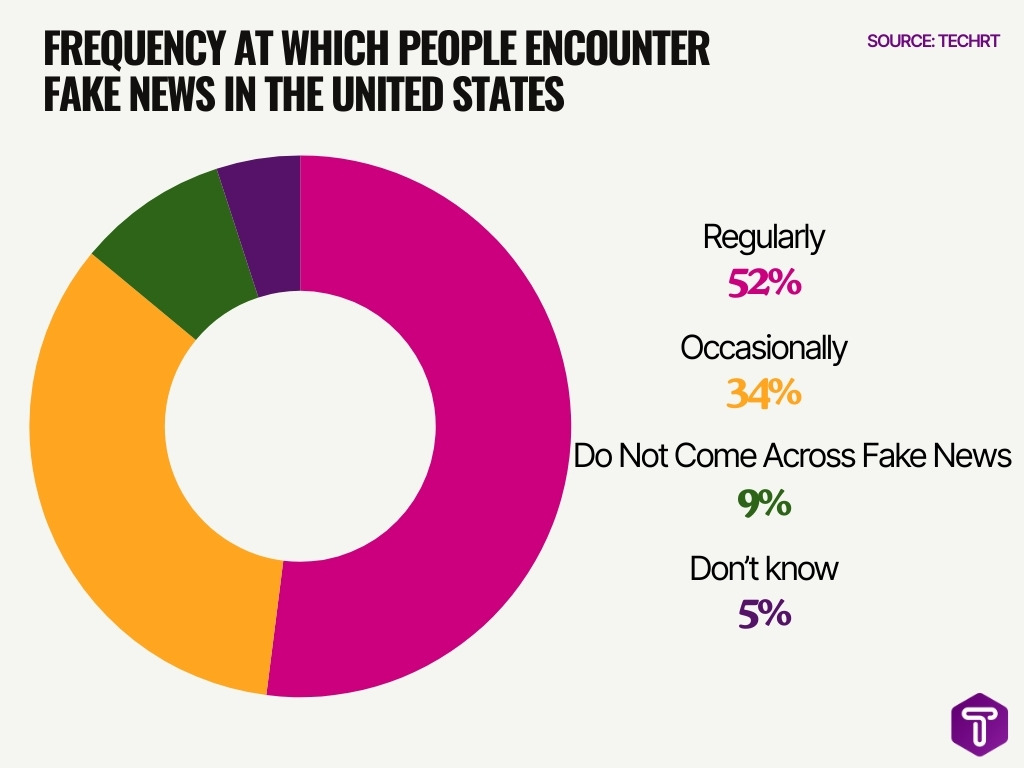
- 52% of Americans report encountering fake news regularly, showing that misinformation is a constant presence in daily news consumption.
- 34% of respondents say they come across fake news occasionally, indicating that over one-third of users face misinformation on a frequent basis.
- A combined 86% of people (52% regularly + 34% occasionally) encounter fake news at least sometimes, highlighting the widespread reach of false information.
- Only 9% of individuals claim they do not come across fake news, suggesting that avoiding misinformation is increasingly difficult.
- About 5% of respondents don’t know whether they encounter fake news, reflecting uncertainty in identifying misleading content.
US Fake News Statistics
- Close to 80% of U.S. adults report having consumed fake news at some point online.
- Roughly 23% of Americans admit they have shared a fake news story, knowingly or unknowingly.
- About 48% of U.S. adults think the government should restrict online false information, even at some cost to free expression.
- 43% of U.S. adults regularly get news from Facebook, with other platforms also gaining traction.
- YouTube news consumption sits at 35% of U.S. adults, illustrating how misinformation enters mainstream feeds.
- TikTok and Instagram have both surpassed older platforms for news among younger American adults.
- Platforms like X (Twitter) remain news sources for about 12% of U.S. adults, despite persistent misinformation challenges.
- Media literacy and trusted outlets remain vital as half of Americans verify stories via established news sources before sharing.
International Fake News Trends
- A median of 72% of adults across 25 nations consider online misinformation a major threat.
- In many countries, fake news ranks above terrorism or economic concerns in perceived risk.
- Concern over misinformation is widespread across demographic groups and political affiliations.
- In North America, about 51% of Americans and 43% of Canadians see fake news as a very serious issue.
- Latin American countries report higher-than-average concern over health and political misinformation.
- European democracies are introducing stricter laws to hold platforms accountable for the spread of false information.
- In Asia, misinformation around elections and religion has sparked social unrest and real-world violence.
- African nations increasingly cite digital literacy challenges as fueling fake news impact.
- Global elections continue to be vulnerable to fake narratives created domestically and abroad.
- Nations with higher press freedom tend to report greater concern about misinformation influence.
Global Exposure to Fake News by Country
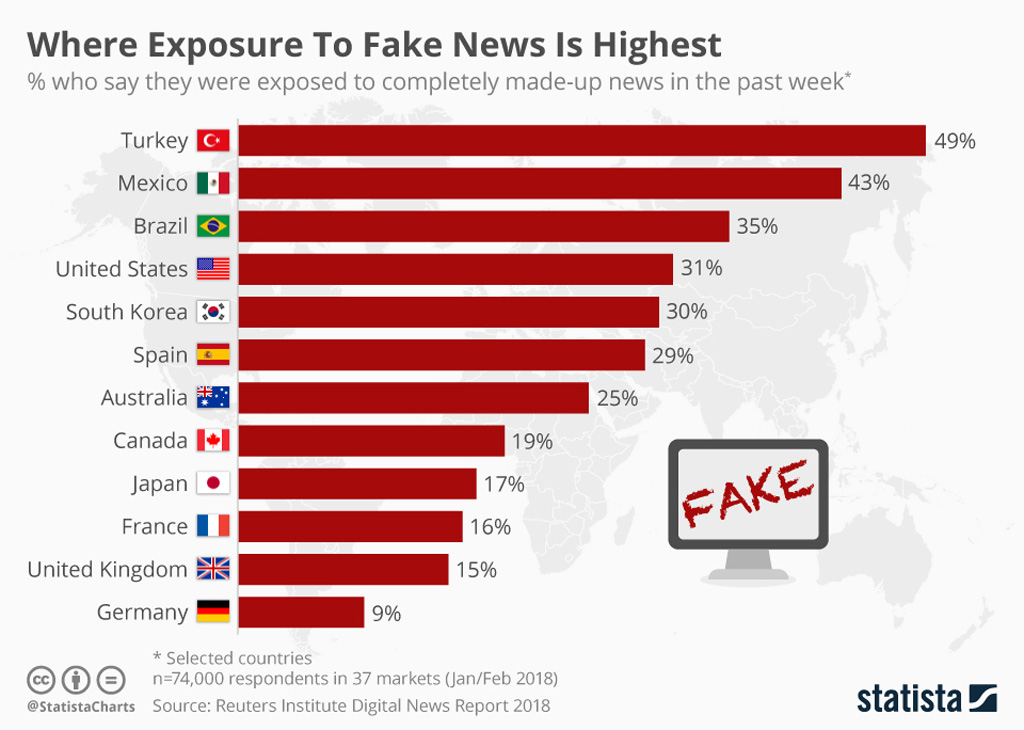
- Turkey leads globally in fake news exposure, with 49% of respondents reporting they encountered completely made-up news in the past week.
- Mexico ranks second, where 43% of users said they were exposed to fake news, highlighting widespread misinformation risks.
- Brazil holds third place, with 35% of people reporting recent exposure to fabricated news content.
- The United States reports significant exposure, as 31% of respondents encountered fake news within a single week.
- South Korea follows closely, with 30% of users experiencing misinformation on digital platforms.
- Spain records notable levels, with 29% of respondents stating they were exposed to fake news.
- Australia shows moderate exposure, where 25% of users reported seeing false information online.
- Canada reflects a lower impact, with only 19% of respondents encountering fake news recently.
- Japan maintains relatively strong media trust, with just 17% reporting exposure.
- France reports limited exposure, as 16% of users noticed fake news content.
- The United Kingdom remains comparatively resilient, with only 15% reporting misinformation exposure.
- Germany records the lowest rate, with just 9%, indicating stronger resistance to fake news spread.
Bot-Driven Fake News
- Social media bots automate the posting and amplification of fake news, making false narratives seem more popular than they truly are.
- Bot networks can mimic human account behavior, increasing the risk that misinformation will go viral.
- Coordinated bot activity has been observed to focus on political, health, and crisis-related disinformation topics.
- Disinformation-for-hire services now offer customizable bot networks to spread specific narratives at scale.
- Bots significantly erode institutional trust by presenting false information with the appearance of broad support or consensus.
- Detection efforts show that bots contribute to a noticeable portion of misinformation traffic across major platforms.
- Research reviews indicate that bot development and evasion techniques evolve rapidly, making detection harder for platforms and researchers.
- Human users are often less likely than bots to correct misinformation once it begins circulating.
Social Media Misinformation Spread
- Fake news is 70% more likely to be retweeted than true stories on Twitter.
- False news reaches 1,500 people 6 times faster than true stories on Twitter.
- 6% of Twitter accounts identified as bots spread 31% of low-credibility information.
- 62% of digital content creators do not fact-check before sharing on social media.
- 50% of the misinformation spread online is due to users not paying attention.
- 15% of habitual Facebook users are responsible for 37% of false headlines shared.
- Bots accounted for 22% of messages during COVID-19, amplifying misinformation.
- Only 0.1% of people can accurately detect AI-generated deepfakes on social media.
- Deepfake videos shared on social media are projected to reach 8 million by 2025.
Social Media Platforms and Trust in News
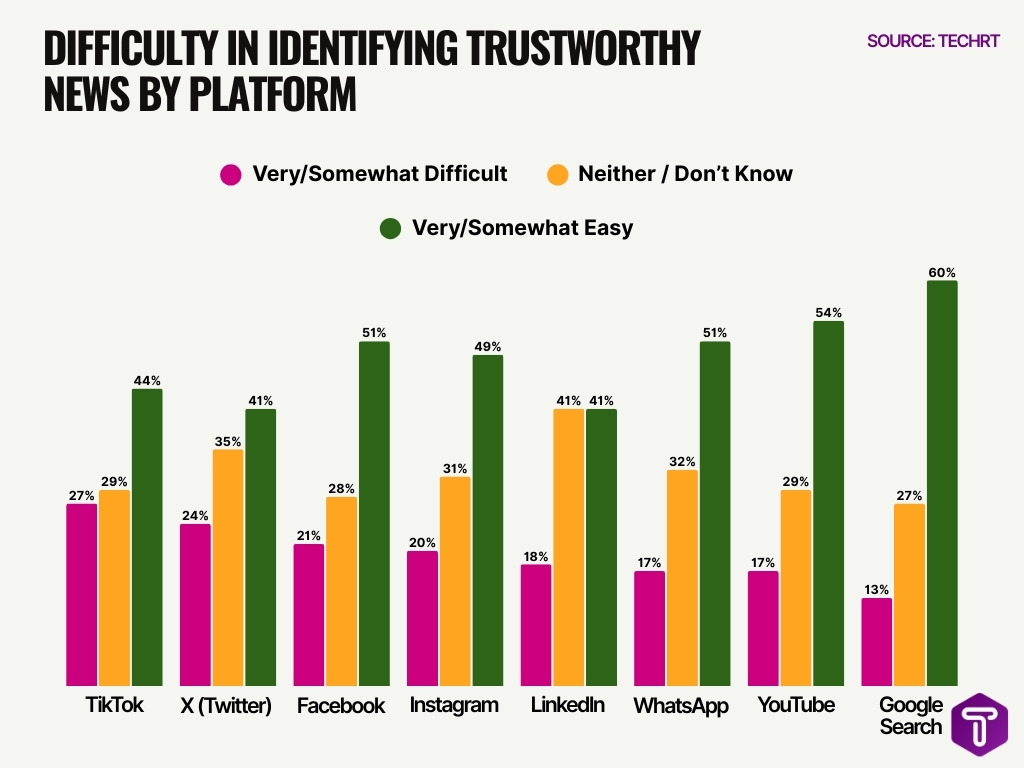
- Google Search is the most trusted source, with 60% of respondents saying it is very or somewhat easy to identify trustworthy news, while only 13% find it difficult.
- YouTube ranks second in credibility, as 54% of users report that it is easy to verify news, compared to just 17% who struggle to identify reliable information.
- Facebook and WhatsApp show similar trust levels, with 51% of respondents on each platform finding it easy to recognize credible news sources.
- Instagram maintains moderate reliability, where 49% of users find it easy to distinguish real news from fake content, while 20% report difficulties.
- TikTok emerges as the most challenging platform, with 27% of users finding it very or somewhat difficult to identify trustworthy news, the highest among all platforms.
- X (Twitter) also faces credibility concerns, as 24% of respondents struggle with misinformation, and only 41% find it easy to verify news.
- LinkedIn shows the highest uncertainty level, with 41% of users selecting “neither or don’t know,” indicating confusion about news credibility on the platform.
- Across platforms, neutral responses remain significant, ranging from 27% to 41%, highlighting widespread uncertainty in evaluating online information.
- Overall, search engines and video platforms outperform social networks in trust, with Google Search (60%) and YouTube (54%) leading in perceived reliability.
- The data reveals a clear trust gap, where short-form and algorithm-driven platforms like TikTok and X lag behind more established information channels.
Deepfakes and Visual Misinfo
- Prior exposure to deepfakes increases a user’s belief in misinformation, even if they can’t verify authenticity.
- Deepfake technology continues to advance, making manipulated content more convincing and harder to detect.
- AI-generated deepfakes have been identified in political campaigns and high-profile events, raising concerns about election interference.
- The United Nations has urged stronger measures to detect and prevent AI-driven deepfake content that can mislead the public.
- Deepfake creation tools are now more affordable and accessible, lowering the barrier for misuse by bad actors.
- Even amid growing concern, only a small percentage of the public can reliably distinguish a deepfake from authentic content.
- Public anxiety about deepfakes’ potential to manipulate political views and social outcomes remains high.
- Misleading or AI-altered visual content during crises or disasters has led to misperceptions about real events, amplifying panic and confusion.
Public Trust in Media
- 58% of people globally worry about distinguishing truth from lies online.
- 40% trust most news most of the time across 48 markets.
- 47% see influencers as a major source of misinformation.
- 57% in the US view politicians as a top disinformation threat.
- 32% identify news media as a major misinformation source.
- 44% of Americans ignore suspected election misinformation.
- 41% of adults feel confident verifying online information accuracy.
- 73% express concern over false election information spread.
Public Confidence in Identifying Real vs Fake News
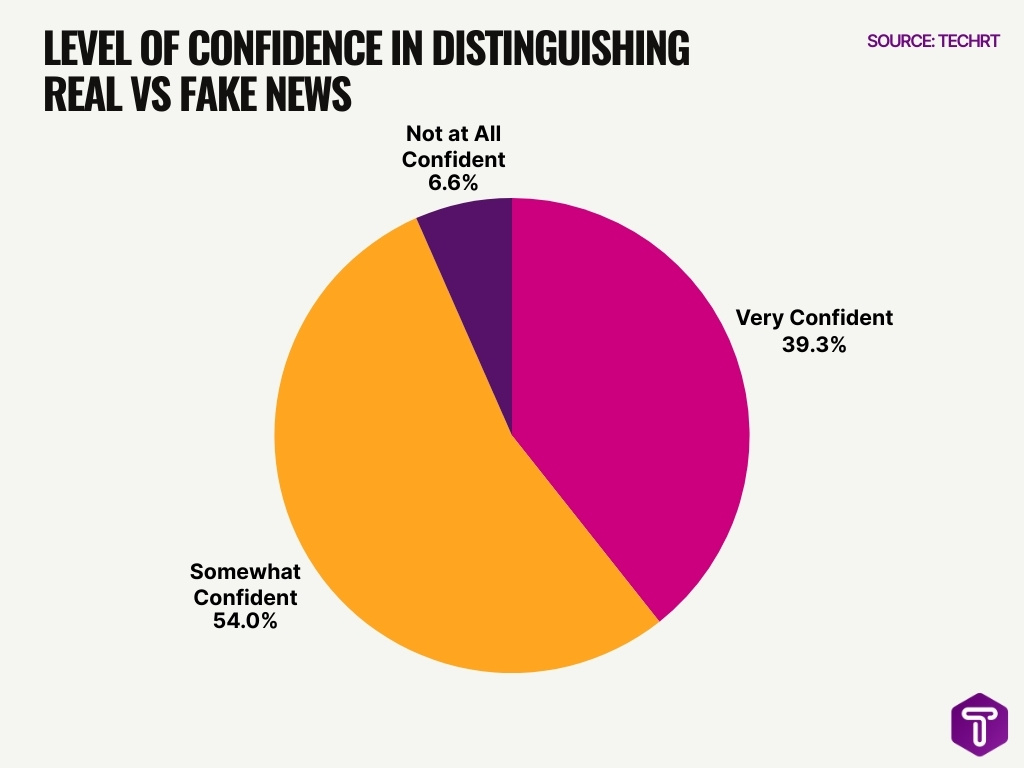
- 54.0% of U.S. adults say they are Somewhat Confident in their ability to distinguish between real news and fake news, making this the largest confidence group.
- Nearly 39.3% of respondents report being Very Confident, indicating that over one-third of adults strongly trust their own news judgment.
- Only 6.6% of people admit they are Not at All Confident, suggesting that a small minority struggle to identify misinformation.
- In total, more than 93% of adults show at least some level of confidence in recognizing fake news, highlighting a widespread belief in media literacy skills.
- The dominance of the “Somewhat Confident” (54.0%) category suggests that while most people feel capable, many remain uncertain about consistently spotting misinformation.
- The gap between Very Confident (39.3%) and Not at All Confident (6.6%) reflects a strong overall confidence trend, but also points to ongoing risks of misinformation exposure.
Unintentional Sharing Rates
- Many users share fake or misleading content unknowingly, contributing significantly to the spread.
- Surveys show a notable percentage of social media users admit to sharing false information accidentally.
- Unintentional sharing peaks during breaking news events, when people rush to post before verifying accuracy.
- Young adults are often more likely to share content without checking sources, especially on fast-moving platforms.
- A lack of digital literacy is linked with higher rates of accidental misinformation sharing.
- Research suggests repeated exposure to misinformation makes false content seem more credible and shareable.
- Users who frequently engage with news on social media are also more likely to forward unverified content.
- Efforts to insert friction (e.g., prompts to read original articles before sharing) have shown modest success in reducing unintentional spread.
Political Impact of Fake News
- Misinformation campaigns boosted Trump-favoring fake stories, shared 30 million times on Facebook vs. 8 million for Clinton in 2016.
- Fake news exposure caused a 5% drop in mainstream media trust around the 2018 elections.
- Far-right misinformation pages earned 65% more engagement per follower than other far-right sources on Facebook.
- Bots generated 19% of political tweets during the 2016 US election discussions.
- Robocall misinformation in the 2011 Canadian election ridings lowered voter turnout by 3 percentage points.
- AI-generated political fake news fooled over 50% of human evaluators in detection tests.
- Echo chambers in segregated networks increased false news spread over true news structurally.
- 57% of Americans reported seeing fake news during the 2018 midterm elections.
- Disinformation attacks in elections rose over 40% since 2022, per recent reports.
- Media literacy interventions reduced false headline endorsements by about 25%.
COVID-19 Misinformation Stats
- False and inaccurate COVID-19 content proliferated rapidly during the pandemic and continues to shape health beliefs years later.
- Much of the misinformation was reconfigurations of true information spun into misleading claims rather than completely fabricated stories.
- A Reuters Institute analysis found that the largest category of COVID-19 misinformation (about 39%) involved misleading claims about government or public health authority actions.
- Conspiracy theories, such as linking the virus to technology or nefarious actors, were widely shared early in the pandemic and still influence belief patterns today.
- Misinformation about COVID-19 vaccines contributed to vaccine hesitancy and distrust, complicating public health efforts globally.
- False claims about vaccine side effects and the legality of vaccination measures spread quickly on social platforms.
- Even though the acute phase of the pandemic has passed, legacy misinformation about COVID-19 still circulates in political and health discussions online.
- Health misinformation more broadly is recognized as a long-term challenge that predates and postdates the coronavirus outbreak.
Gen Z vs Millennials: Fake News Vulnerability Insights
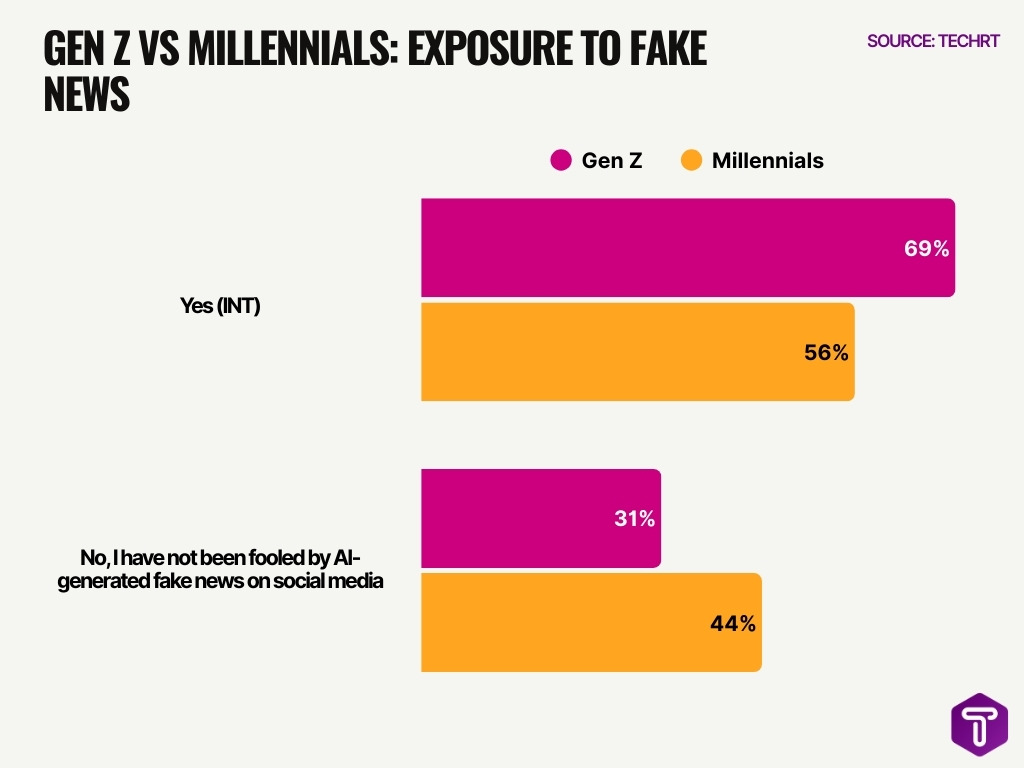
- Gen Z shows higher susceptibility, with 69% admitting they have been influenced by AI-generated fake news, compared to 56% of Millennials.
- Only 31% of Gen Z claim they have not been fooled by AI-driven misinformation on social media, highlighting stronger exposure risks.
- In contrast, 44% of Millennials report resisting fake news, indicating better digital skepticism and media awareness.
- The 13-point gap (69% vs 56%) reveals that younger users are significantly more vulnerable to deceptive online content.
- These figures emphasize the growing need for digital literacy programs, especially for Gen Z, to counter the spread of AI-powered misinformation.
Fake News Consumption Patterns Globally
- Globally, 86% of adults report exposure to fake news online.
- 58.5% of internet users worldwide express concern about misinformation.
- 72% of adults across 25 nations view false information as a major threat.
- False news is 70% more likely to be retweeted than true stories on Twitter.
- Older adults (65+) shared fake news 7 times more than 18-29 year olds on Facebook.
- 79% of respondents in 18 countries worried about distinguishing fake from real online.
- 67% of internet users in the Americas worry about online misinformation exposure.
- 74.2% in Latin America and the Caribbean see false news as a very big problem.
- Misinformation and disinformation rank as the top short-term global risk for 2025.
Children and Education Statistics on Misinformation
- 68% of primary school pupils accurately detected fake science news after media literacy intervention.
- 12.9% of adolescents encountered misinformation daily on social media.
- 44.2% of adolescents faced misinformation weekly via social media platforms.
- 41% of teenagers couldn’t distinguish true health messages from fake ones.
- 54% accuracy rate for adults detecting lies in children’s statements, near chance.
- News media literacy training boosted pupils’ fake news self-efficacy beliefs significantly.
- 67% of young people aged 15-24 get news primarily from social media.
- 90% of TikTok users saw misinformation in the first 35 minutes, according to a Newsguard study.
Prevalence on Social Media Platforms
- Over 64% of urban Indians identify social media feeds as the widest source of disinformation and fake news.
- 85% of citizens worry about the impact of online disinformation, with social media as the primary source for most.
- 78.9% of India’s first-time voters encountered fake news on platforms like WhatsApp (29.8%), Instagram (17.8%), and Facebook (15.8%).
- 82.2% of debunked misinformation images in India were shared on WhatsApp after fact-checking.
- 57% of respondents view TikTok as the most dangerous platform for false or misleading information.
- 47% identify online influencers as the biggest threat for spreading misinformation worldwide.
- 35.6% of social media users perceive a high amount of health misinformation on these platforms.
- 94% of UK adults have encountered misinformation on social media platforms.
Perceived Severity of Made-Up News: Journalists vs. Public
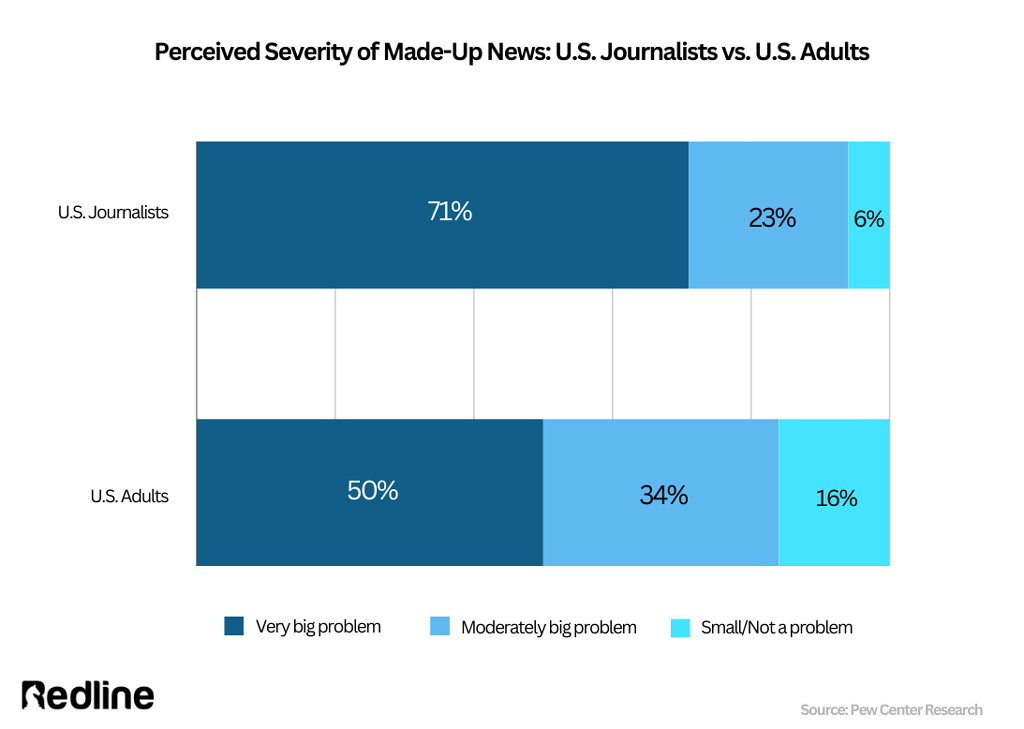
- 71% of U.S. journalists consider made-up news a very big problem, highlighting strong professional concern over misinformation.
- Only 50% of U.S. adults view fake news as a very big problem, showing a 21-point gap compared to journalists.
- About 23% of journalists believe misinformation is a moderately big problem, indicating limited tolerance for false reporting.
- In contrast, 34% of U.S. adults rate fake news as a moderately big problem, suggesting greater uncertainty or mixed concern.
- Just 6% of journalists think made-up news is a small or no problem, reflecting near-universal recognition of its risks.
- Meanwhile, 16% of adults see misinformation as small or not a problem, nearly three times higher than journalists.
- Overall, journalists are significantly more alarmed about fake news than the general public, emphasizing a clear perception gap in media credibility and trust.
Fact-Checking Behaviors
- Fact-checking initiatives are emerging globally to counter misinformation, but usage varies widely by audience.
- Services like BBC Verify show increasing engagement with verifiable source checks among some user groups.
- In one UK survey, 26% of adults had used a fact-checking tool at least once, and about 5% used one regularly.
- Independent fact-checkers and media literacy programs aim to improve public discernment, though adoption is still limited.
- Research suggests that formal media literacy training can enhance users’ ability to distinguish false from true information.
- Fact-checking tends to correct specific falsehoods but may not improve general detection skills without broader education.
- Platforms have implemented AI and human moderation to flag or remove misleading posts, but results vary.
- Public reliance on fact-checking correlates strongly with trust in traditional news sources.
Journalist Views on Fake News
- 81% of journalists view disinformation as a very serious problem for journalism today.
- 76% of journalists deal with disinformation regularly in their work.
- 40% categorize detecting disinformation as an urgent priority at their news outlet.
- More than 33% identify disinformation as the most serious issue affecting journalism.
- 89.88% believe AI will significantly increase disinformation risks.
- 62% worry most about disinformation spreading inaccurate, harmful information.
- 66% spend more time actively debunking disinformation in stories.
- 58% of journalists faced public hostility due to disinformation challenges.
- 11% of journalists have unknowingly reported disinformation themselves.
Frequently Asked Questions (FAQs)
What percentage of online content is estimated to be false or misleading in 2025–2026?
Approximately 62% of online content is estimated to be false or misleading.
What share of global adults report having been exposed to fake news online?
About 86% of global adults report exposure to misinformation or fake news online.
What percentage of U.S. adults regularly get news from Facebook, a platform often linked with the spread?
Approximately 43% of U.S. adults say they regularly get news from Facebook.
What proportion of adults across 25 countries see the spread of false information online as a major threat?
A median of 72% of adults across 25 nations view the spread of false information as a major threat.
What percentage of people express concern about distinguishing truth from falsehood in online news?
Around 58% of people worry that discerning real news from fake news online is becoming increasingly difficult.
Conclusion
The data show that misinformation remains a global and persistent challenge that touches public health, education, and civic trust. From the lingering effects of COVID-19 content to widespread fake news consumption across digital platforms, false information shapes how people see the world and behave online. Children and adults alike struggle to distinguish truth from falsehood, and while fact-checking tools and media literacy efforts are gaining traction, user confidence does not always translate into accurate discernment.
Journalists and educators are stepping up to counter misinformation, but perceived difficulty in spotting fake news highlights the need for ongoing public awareness and skills development. As media ecosystems evolve, understanding these statistics can help individuals and institutions navigate a landscape where truth and deception constantly compete.

Leave a comment
Have something to say about this article? Add your comment and start the discussion.