


Businesses rely on Google Ads to capture high-intent customers at the exact moment they search, making it one of the most performance-driven advertising platforms available today. From e-commerce brands scaling revenue through Shopping campaigns to local service providers generating qualified leads within hours, Google Ads plays a critical role in both customer acquisition and revenue growth.
Its ability to combine precise targeting, real-time bidding, and measurable outcomes allows marketers to optimize campaigns with clarity and speed. Moreover, as automation and AI reshape digital advertising, Google Ads continues to evolve into a more intelligent and efficient system. Let’s explore the latest data and uncover what these numbers reveal about performance, trends, and opportunities.
Editor’s Choice
- Google Ads delivers an average ROI of 200%, meaning businesses earn $2 for every $1 spent.
- Over 63% of users have clicked on a Google ad, highlighting strong engagement.
- Google Ads holds a 39.37% share of the global PPC market.
- The average CTR across industries reaches 6.66% in 2026, reflecting improved ad relevance.
- Businesses report conversion rates of around 4.4% on average.
- Google Ads contributes to over 60% of paid ad clicks globally.
- Paid search visitors are 50% more likely to convert than organic visitors.
Recent Developments
- Google introduced AI-driven tools like AI Max and Meridian to improve campaign performance in 2025.
- Automation now powers bidding, targeting, and creative optimization, reducing manual campaign management.
- AI-powered search ad spend is projected to grow from $1 billion in 2025 to $26 billion by 2029.
- Performance Max campaigns continue expanding, combining Search, Display, YouTube, and Shopping in one campaign.
- Mobile continues to dominate, with over 61.9% of Google ad clicks coming from mobile devices.
- Google enhanced measurement tools to track full-funnel performance from discovery to conversion.
- Advertisers increasingly rely on first-party data strategies due to privacy changes.
- Smart bidding adoption has grown as advertisers seek real-time optimization based on user intent signals.
Google Ads Key Statistics and Top Insights
- Businesses earn $2 for every $1 spent on Google Ads, reinforcing its profitability.
- The average conversion rate ranges between 3% and 6% across industries.
- Google Ads search campaigns achieve around 3.75% conversion rates, outperforming display ads.
- Display ads typically deliver lower CTRs (~0.46%) but broader reach.
- Google Display Network reaches over 90% of internet users worldwide.
- The top search ad position can achieve CTRs close to 7.94%.
- Google Ads contributes to significant brand awareness increases of up to 33%.
- Around 70% of advertisers identify Google Ads as their highest ROI channel.
Google Ads Revenue Growth
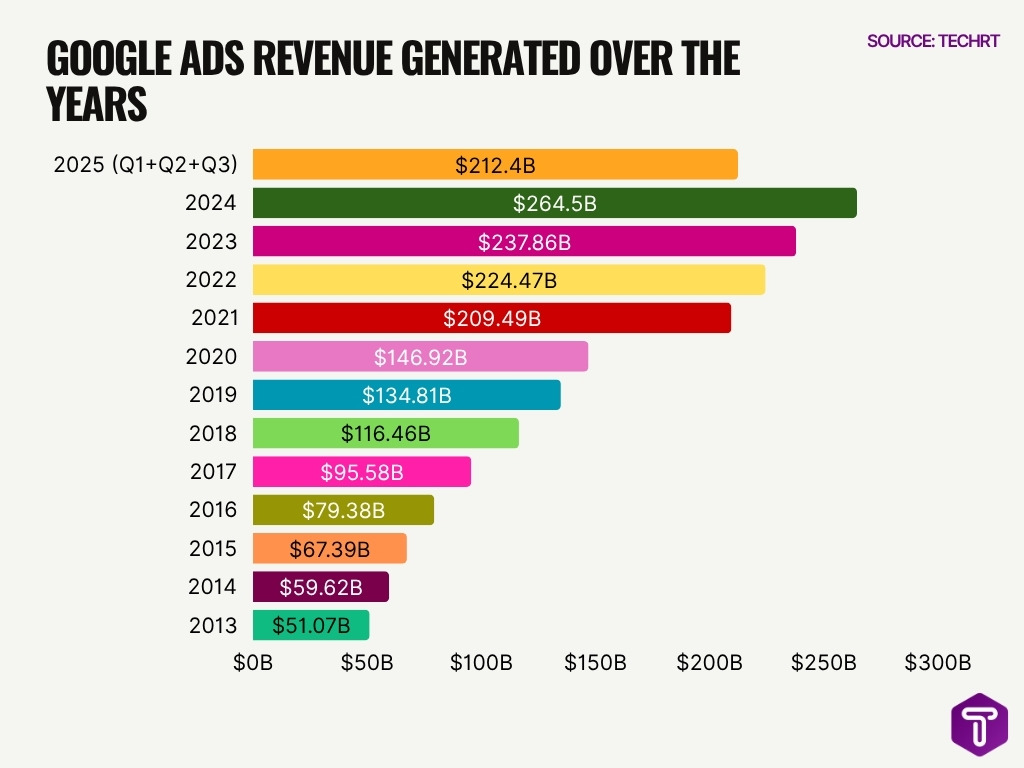
- Explosive long-term growth: Google Ads revenue surged from $51.07 billion (2013) to $264.5 billion (2024), a 5.1× increase in just over a decade.
- Strong upward trajectory: Revenue has consistently increased year-over-year, with no major declines, highlighting the platform’s dominance in digital advertising.
- Post-pandemic acceleration: After $146.92 billion in 2020, revenue jumped to $209.49 billion in 2021, a massive 42% YoY growth, driven by digital adoption.
- Sustained high revenue levels: From 2021 to 2024, revenue remained above $200 billion annually, indicating a mature yet still growing market demand.
- Peak revenue milestone: The highest recorded revenue is $264.5 billion in 2024, marking a record-breaking year for Google Ads.
- 2025 trend remains strong: With $212.4 billion already generated in Q1–Q3 2025, the platform is on track to approach or exceed 2024 levels.
- Mid-decade scaling phase: Between 2016 ($79.38B) and 2019 ($134.81B), revenue nearly doubled, showing rapid scaling of Google’s ad ecosystem.
- Early growth foundation: From 2013 to 2016, revenue grew from $51.07B to $79.38B, establishing the base for later exponential expansion.
- Compound growth strength: Over the entire period, Google Ads demonstrates a high CAGR, reinforcing its position as a core revenue engine for Google.
- Market leadership signal: The steady increase reflects Google Ads’ critical role in global digital ad spend, outperforming many competitors in scale and reach.
Google Ads Market Share and Growth Statistics
- Google holds a 90.01% share of the global search engine market as of February 2026.
- Google Ads commands 39.37% of the global PPC market share in 2025.
- The global search advertising market reached USD 168.94 billion in 2024.
- Google Ads revenue hit $264.5 billion in 2024, up from $237.86 billion in 2023.
- Google advertising generated $212.4 billion in the first three quarters of 2025 alone.
- 65% of businesses worldwide actively use Google Ads for PPC campaigns.
- 80-85% of global PPC budgets are allocated to Google Ads over competitors.
- U.S. search ad spending reached $123.6 billion in 2025.
- Google Ads generated $296.15 billion in projected revenue for 2025.
- Over 7 million advertisers run PPC campaigns on Google Ads.
Google Ads Usage and Adoption Statistics
- More than 65% of SMBs use Google Ads as their primary PPC platform.
- Google Ads drives over 60% of total paid clicks globally, showing strong adoption.
- Around 70% of marketers consider Google Ads their top ROI channel.
- Paid ads increase brand awareness by up to 33% for businesses.
- Mobile accounts for over 60% of ad interactions, emphasizing mobile-first strategies.
- Google Ads campaigns can reach billions of users through search and display networks.
- Businesses increasingly integrate Google Ads with SEO for combined visibility and conversions.
- Performance Max and automation tools are now widely adopted to simplify campaign management and scaling.
Impact of Google Ad Types on Brand Awareness
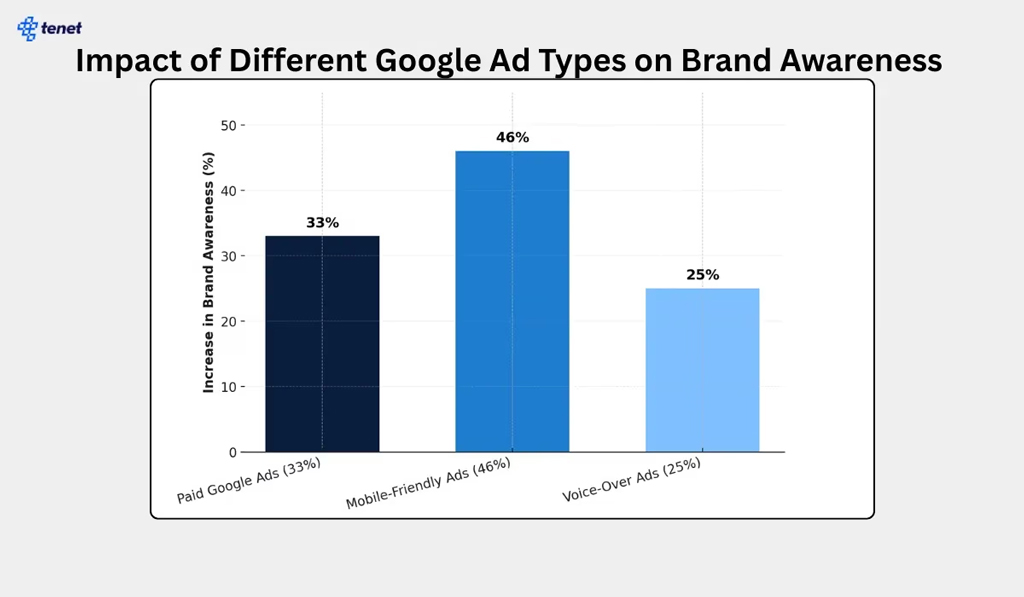
- Mobile-friendly ads lead performance with the highest increase in brand awareness at 46%, making them the most effective format among the three.
- Paid Google Ads deliver solid results, contributing to a 33% increase in brand awareness, showing their continued relevance in digital campaigns.
- Voice-over ads show the lowest impact, with a 25% increase, indicating comparatively weaker effectiveness for awareness-driven goals.
- There is a 21 percentage point gap between the top-performing (46%) and lowest-performing (25%) ad types, highlighting significant variation in effectiveness.
- Mobile optimization is critical, outperforming traditional paid ads by 13 percentage points (46% vs. 33%).
- The data suggests a clear shift toward mobile-first advertising strategies for maximizing brand awareness outcomes.
- All ad types contribute positively, with each format generating at least a 25% uplift in brand awareness.
Google Ads Reach and Search Engine Dominance
- Google dominates global search with over 89% market share, making it the primary paid search channel.
- The platform processes over 8.5 billion searches per day, creating massive ad inventory.
- Google Ads can reach over 90% of global internet users via Search and Display networks.
- Paid search ads account for approximately 45% of clicks on SERPs, reflecting strong commercial intent.
- Google Display Network spans over 2 million websites and apps, expanding reach beyond search.
- YouTube, part of Google Ads, reaches 2.7+ billion monthly users globally.
- Mobile devices generate more than 60% of all Google searches, shaping ad strategies.
- Google handles over 70% of U.S. desktop search traffic, maintaining domestic dominance.
- Voice and visual search growth is influencing ad formats and targeting capabilities.
Google Ads Cost-Per-Click (CPC) Statistics
- The average CPC for Google search ads is $2.69, varying by industry.
- Display ads have a significantly lower CPC of around $0.63, making them cost-effective for awareness.
- Legal and insurance keywords can exceed $50 per click, among the highest in digital advertising.
- E-commerce industries typically see CPCs between $1 and $2, depending on competition.
- Mobile CPC rates are often lower than desktop, due to bidding dynamics.
- Smart bidding strategies can reduce CPC by optimizing bids in real time.
- Long-tail keywords generally cost less per click while improving targeting precision.
- CPC costs increased slightly year-over-year due to higher competition and demand for paid traffic.
- Seasonal spikes can drive CPC increases of 20% to 50% in competitive niches.
Average CPC by Industry (Search vs Display)
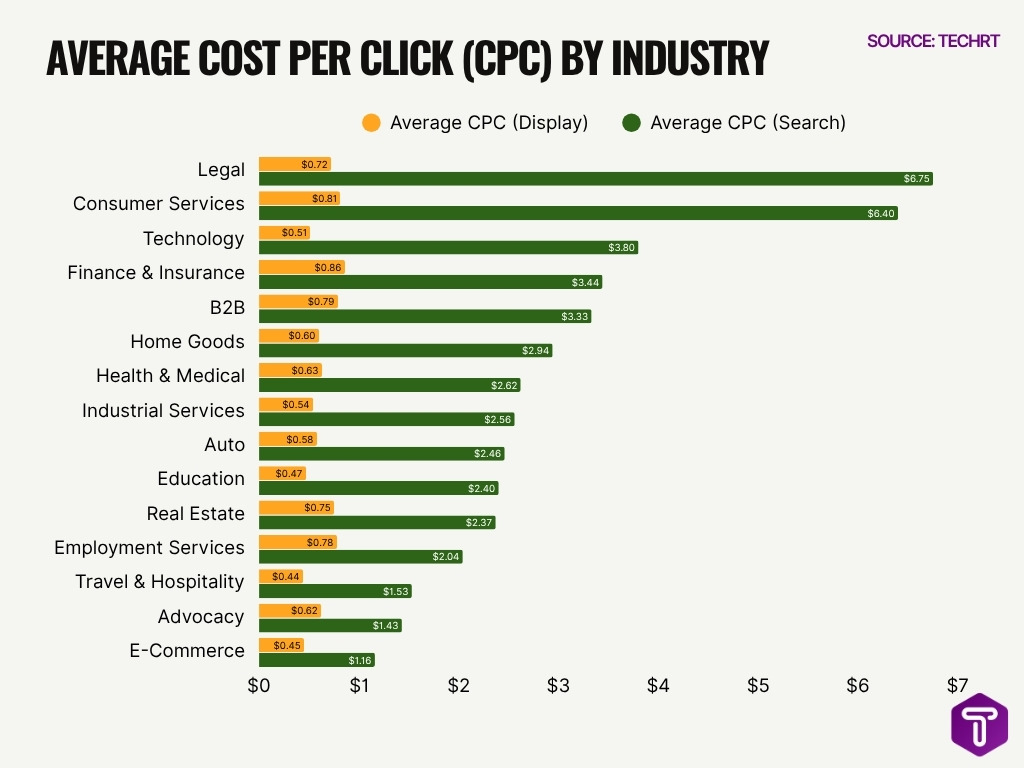
- The legal industry dominates CPC costs, with the highest Search CPC at $6.75, indicating extremely competitive, high-value keywords.
- Consumer Services follows closely with a $6.40 Search CPC, highlighting strong bidding competition for service-based queries.
- Technology and Finance sectors remain premium segments, with $3.80 and $3.44 Search CPC, respectively, reflecting high conversion value traffic.
- B2B advertising shows strong investment, with $3.33 Search CPC, driven by longer sales cycles and higher customer lifetime value.
- Mid-tier industries like Home Goods ($2.94) and Health & Medical ($2.62) maintain moderate CPCs, balancing competition and volume.
- Industrial Services ($2.56) and Auto ($2.46) indicate stable demand but slightly lower bidding pressure compared to top-tier sectors.
- Lower CPC industries include Travel & Hospitality ($1.53) and E-Commerce ($1.16), suggesting higher volume but lower cost per click efficiency.
- On the Display network, CPCs are significantly lower across all industries, typically ranging between $0.44 and $0.86.
- Finance & Insurance leads Display CPC at $0.86, indicating premium audience targeting even in display campaigns.
- Consumer Services ($0.81) and B2B ($0.79) also show strong display competition, reflecting demand for remarketing and awareness campaigns.
- Education ($0.47) and Technology ($0.51) offer relatively low-cost display opportunities, ideal for scalable brand visibility.
- Travel & Hospitality has the lowest Display CPC at $0.44, making it cost-effective for broad audience reach campaigns.
- The gap between Search and Display CPC is substantial, with Search often 3x to 8x higher, emphasizing intent-driven pricing in search ads.
- Overall, industries with high customer value and urgency (Legal, Finance, B2B) consistently command higher CPCs across both channels.
Google Ads Audience Reach and Demographics
- Google Ads can reach over 4.3 billion internet users worldwide, making it one of the largest ad ecosystems.
- Users aged 25 to 34 represent the largest segment of Google users globally.
- Around 63% of users have clicked a Google ad at least once, showing strong engagement.
- Mobile users are more likely to engage with ads compared to desktop users, especially in local searches.
- Local searches with ads lead to 76% of users visiting a business within a day.
- Over 50% of shoppers use Google to discover new brands, highlighting awareness potential.
- Google Ads allows targeting across demographics, interests, and in-market audiences, increasing personalization.
- Men and women show relatively balanced engagement, though purchase-driven clicks skew slightly toward males in certain sectors.
- Emerging markets contribute significantly to growth, with Asia-Pacific leading user expansion.
Google Ads Conversion Rate Statistics
- The average Google Ads conversion rate stands at 4.4% across industries.
- Search ads convert at around 3.75%, outperforming display campaigns.
- Top-performing industries achieve conversion rates above 10%, particularly in legal and finance.
- Landing page optimization can boost conversion rates by up to 200%.
- Mobile conversions now account for over 50% of total ad conversions, reflecting mobile-first behavior.
- Retargeting campaigns can increase conversion rates by 70% or more.
- Businesses using AI-driven bidding see higher conversion efficiency and reduced CPA.
- Video ads contribute to strong assisted conversions, especially in multi-touch journeys.
- Local service ads deliver high conversion intent due to proximity-based targeting.
Why People Click on Paid Ads
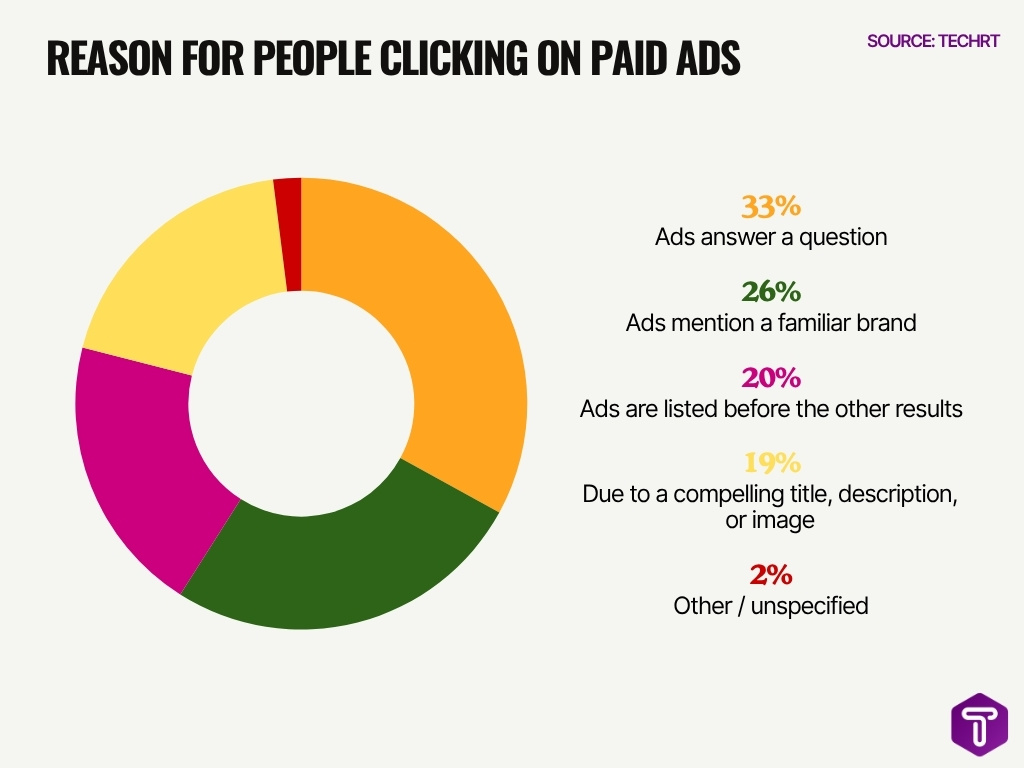
- 33% of users click ads because they directly answer a question, making relevance the top driver of ad engagement.
- 26% are influenced by familiar brands, showing that brand recognition significantly boosts trust and clicks.
- 20% of clicks happen because ads appear before organic results, highlighting the importance of top SERP positioning.
- 19% of users are attracted by compelling creatives, such as a strong headline, description, or image, emphasizing the role of ad copy and design.
- Only ~2% fall into other reasons, indicating that most click behavior is driven by clear, measurable factors like relevance, branding, placement, and creatives.
Google Ads Click-Through Rate (CTR) Statistics
- The average CTR for Google search ads is around 6.66% in 2026, up from ~6.11% in 2024.
- Display ads typically generate a CTR of 0.46%, reflecting lower intent traffic.
- The top ad position can achieve CTRs above 7.9%, significantly outperforming lower placements.
- Branded keywords often see CTRs exceeding 10% to 20%, due to high relevance.
- Mobile ads tend to produce higher CTRs than desktop, especially for local queries.
- Industries like dating and travel report CTR averages above 8%, while B2B sectors lag slightly.
- Ad extensions can improve CTR by 10% to 15%, enhancing visibility and engagement.
- Responsive search ads outperform traditional formats, increasing CTR through automated optimization.
- Video ads on YouTube can achieve CTR rates between 0.5% and 1.5%, depending on targeting.
Google Ads Cost-Per-Lead (CPL) and Cost-Per-Acquisition (CPA) Statistics
- The average cost per lead across industries is $40 to $100, depending on the sector.
- Legal and finance industries report CPLs exceeding $150 to $300, due to high-value customers.
- The average CPA for Google Ads ranges between $50 and $150 across most industries.
- Businesses using optimized landing pages can reduce CPA by up to 30%.
- Retargeting campaigns lower CPA by bringing back high-intent users.
- Automation and smart bidding can reduce CPA by 20% or more, improving efficiency.
- E-commerce brands often achieve lower CPA due to high purchase intent traffic.
- Poor keyword targeting can significantly increase CPA, reducing campaign profitability.
- Lead quality optimization plays a key role in improving overall acquisition efficiency.
Google Ads Budget and Monthly Spend Benchmarks
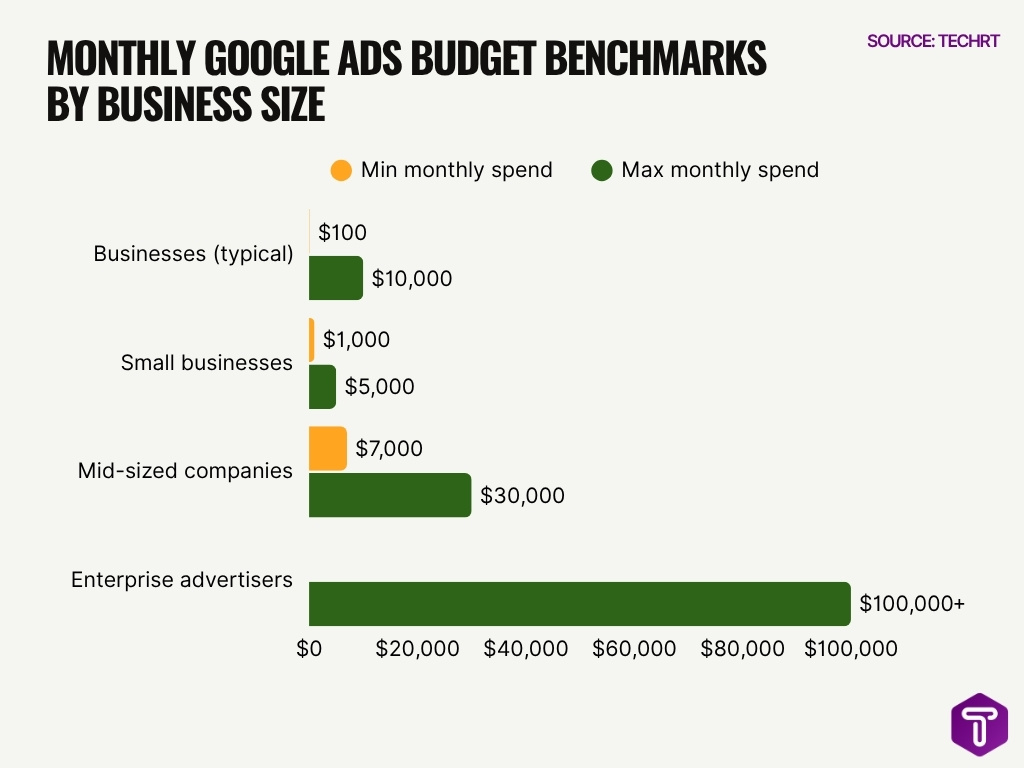
- Businesses typically spend between $100 and $10,000 per month on Google Ads.
- Small businesses allocate an average of $1,000 to $5,000 monthly for PPC campaigns.
- Mid-sized companies often invest $7,000 to $30,000 per month to scale acquisition.
- Enterprise advertisers can exceed $100,000+ monthly budgets, especially in competitive sectors.
- Around 72% of companies have not reviewed their Google Ads campaigns in over a month, leading to inefficiencies.
- Businesses typically dedicate 7% to 10% of total revenue to marketing, with a portion allocated to paid search.
- Seasonal industries increase budgets by 20% to 50% during peak periods, such as holidays.
- Startups often prioritize Google Ads for quick traction and lead generation, allocating higher early-stage budgets.
- Budget allocation increasingly shifts toward Performance Max campaigns for unified spending control.
Google Ads Return on Investment (ROI) and ROAS Statistics
- Businesses earn an average ROI of 200% on Google Ads, meaning $2 earned per $1 spent.
- Typical ROAS benchmarks range between 3:1 and 5:1, depending on industry.
- High-performing campaigns can achieve ROAS above 8:1, particularly in e-commerce.
- Paid search visitors are 50% more likely to convert than organic visitors.
- Companies that optimize ad creatives and targeting see higher ROI improvements over time.
- AI-driven bidding strategies improve ROI by analyzing real-time user signals.
- Businesses using remarketing achieve higher ROI due to repeat engagement.
- Google Ads contributes significantly to customer acquisition and revenue growth across industries.
- Multi-channel strategies combining Google Ads and SEO drive higher overall marketing ROI.
YouTube and Video Advertising Statistics via Google Ads
- YouTube has over 2.7 billion monthly active users, offering massive reach.
- Video ads can increase brand recall by up to 80%, improving awareness.
- YouTube ads reach over 90% of internet users globally, integrated with Google Ads.
- Skippable in-stream ads allow advertisers to pay only when users engage, improving efficiency.
- Video campaigns drive higher engagement compared to static display ads.
- Mobile accounts for over 70% of YouTube watch time, shaping ad strategies.
- YouTube Shorts is rapidly growing, with billions of daily views, opening new ad inventory.
- Video ads contribute significantly to upper-funnel marketing and brand discovery.
- Businesses using video ads report higher conversion lift when combined with search campaigns.
Google Ads CTR Benchmarks by Industry
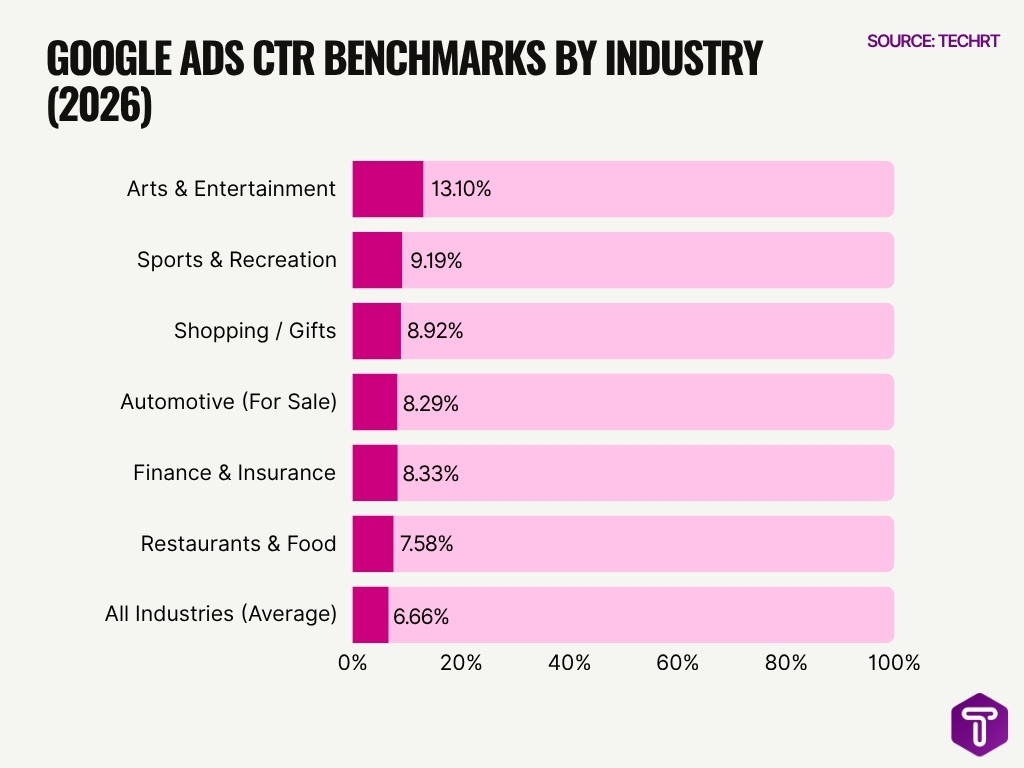
- Arts & Entertainment leads with the highest CTR at 13.10%, nearly 2x higher than the overall average, indicating strong user engagement in this segment.
- Sports & Recreation (9.19%) and Shopping / Gifts (8.92%) show above-average performance, highlighting high consumer intent and seasonal engagement patterns.
- Finance & Insurance (8.33%) and Automotive (8.29%) maintain solid CTRs above 8%, reflecting competitive yet high-value advertising niches.
- Restaurants & Food records 7.58% CTR, still above the industry average, suggesting strong local and mobile-driven ad interactions.
- The overall average CTR across industries is 6.66%, serving as a baseline benchmark for evaluating campaign performance.
- Top-performing industries like Arts & Entertainment outperform the average by +6.44 percentage points, indicating significant variance in user engagement across sectors.
- Even the lowest-performing listed category (Restaurants & Food at 7.58%) still exceeds the global average, suggesting generally strong CTR trends in 2026.
- The gap between the highest (13.10%) and average (6.66%) CTR is substantial, emphasizing the importance of industry-specific benchmarking rather than relying on generic averages.
- Industries tied to entertainment, hobbies, and consumer purchases tend to generate higher engagement, while more complex decision sectors show relatively moderate CTRs.
- These benchmarks highlight that CTR performance is highly industry-dependent, and advertisers should optimize campaigns based on vertical-specific expectations, not universal standards.
Google Ads Performance by Campaign Type (Search, Display, Shopping, Video)
- Google Search campaigns average a conversion rate of about 3.75%, making them the highest‑intent channel.
- Google Display campaigns average a CTR of roughly 0.46%, reflecting broad reach but lower engagement.
- Google Shopping ads generate up to 85.3% of retail search ad clicks in the U.S., despite around 76.4% of retail search ad spend.
- Performance Max campaigns drive an average 13% increase in incremental conversions at similar CPA versus older campaign types.
- Remarketing campaigns often achieve 2–3× higher conversion rates than cold‑traffic campaigns.
- Discovery campaigns can deliver up to 20% lower cost‑per‑action (CPA) compared with other Google Ads formats.
- Google Video campaigns on YouTube can increase brand awareness lift by up to 50% versus standard search‑only strategies.
- Shopping campaigns typically achieve 3–5× higher ROI for e‑commerce brands versus standard text‑only search ads.
- App campaigns have driven over 17 billion app installs from ads since their 2015 launch, showcasing massive scale.
- Across Google Ads, smart‑shopping / Performance‑led shopping formats achieve up to 5.5× higher ROI than manual‑optimized standard shopping campaigns.
Google Ads Automation, AI, and Smart Bidding Statistics
- Google’s AI evaluates over 1 billion signals in real time to adjust bids and improve campaign performance.
- Advertisers using Smart Bidding see up to 30% higher conversions versus manual bidding strategies.
- More than 80% of Google Ads advertisers now rely on automated bidding tools for campaign management.
- Performance Max campaigns account for over 60–70% of AI‑driven ad spend across Google’s inventory.
- Over 70% of active Google Ads campaigns are optimized by machine learning‑based automation.
- AI‑driven recommendations help marketers achieve around 20–25% better ad performance after implementation.
- Automation cuts routine tasks by roughly 10 hours per week, freeing marketers for strategy and creative work.
- Predictive targeting powered by machine learning improves CPA efficiency by about 20% on average.
- AI‑generated ad creatives can lift CTR by up to 32–55% and reduce CAC by nearly 20% in test campaigns.
- Privacy‑first changes are pushing over 60% of advertisers to combine first‑party data with AI‑driven targeting models.
Google Ads Trends and Future Outlook
- AI-powered ad buying scales from 8% ($35B) of U.S. ad revenue in 2025 to 26% ($142B) by 2030.
- Digital advertising market grows at 14.3% CAGR to reach $1,522B by 2030.
- Over 80% of Google advertisers use automated bidding for campaign optimization.
- Performance Max campaigns peaked at 82% of ad spend in 2024, holding strong in 2025.
- 70% of Google Ads impressions come from mobile devices in 2025.
- 63% of Google Ad clicks originate from mobile devices.
- Google Lens processes 12 billion visual searches monthly.
- Voice assistants will handle over 3.5 billion searches daily by 2025.
- YouTube generates 13.68% of Google’s total ad revenue ($36.15B).
- Full-funnel Google Ads strategies deliver up to $8 ROI per $1 spent.
Frequently Asked Questions (FAQs)
What is the average ROI for Google Ads?
Google Ads delivers an average ROI of 200% to 800%, meaning businesses can earn $2 to $8 for every $1 spent.
What is the average cost-per-click (CPC) for Google Ads?
The average Google Ads CPC is about $2.69 globally, but can reach $5.26+ in competitive industries.
What is the average click-through rate (CTR) for Google Ads?
Google Ads CTR typically ranges between 4% and 6%, with search ads averaging 3.17% and display ads around 0.46%.
What is the average conversion rate for Google Ads campaigns?
Google Ads conversion rates generally fall between 3% and 7%, depending on industry and campaign type.
How much do businesses spend monthly on Google Ads?
Most businesses spend between $100 and $10,000 per month, while agencies charge $501 to $3,000 monthly for management.
Conclusion
Google Ads remains one of the most effective and scalable digital advertising platforms, offering a powerful mix of reach, intent-driven targeting, and measurable performance. Businesses across industries, from startups to global enterprises, use it to generate leads, increase sales, and build brand visibility in competitive markets. As automation, AI-driven bidding, and privacy-focused strategies continue to evolve, advertisers must adapt their approach to stay efficient and competitive.
The data clearly shows that success with Google Ads depends on continuous optimization, smart budgeting, and a deep understanding of audience behavior. These statistics not only highlight current performance benchmarks but also point toward a future shaped by automation, video, and data-driven decision-making, giving marketers a clear roadmap for sustained growth.

Leave a comment
Have something to say about this article? Add your comment and start the discussion.