


Google Bard, now widely known as Google Gemini, has grown from a curious experiment into one of the most used generative AI chatbots in the world. Since its initial launch in March 2023, this tool has transformed how people search, create content, and interact with digital assistants, powered by Google’s cutting-edge large language models. In industries from customer support automation to product research, organizations use Bard and Gemini to streamline workflows, reduce response times, and augment decision-making processes. As generative AI becomes woven into everyday tools, people now rely on Bard for everything from code generation to summarizing complex documents. Scroll on to explore the latest statistical snapshot of Bard’s journey and performance.
Editor’s Choice
- As of early 2026, Bard, Google Gemini, surpassed 750 million monthly active users (MAUs), reflecting strong adoption.
- Bard’s monthly usage climbed from 142.6M in Feb 2024 to 650M by Nov 2025.
- Gemini AI services now reach 2 billion users monthly via AI Overviews.
- The platform operates in 239 countries and regions, supporting 46 languages.
- Google reports 13 million developers building with the Gemini ecosystem.
- Enterprise integrations include over 70% of Google Cloud customers using Bard’s capabilities.
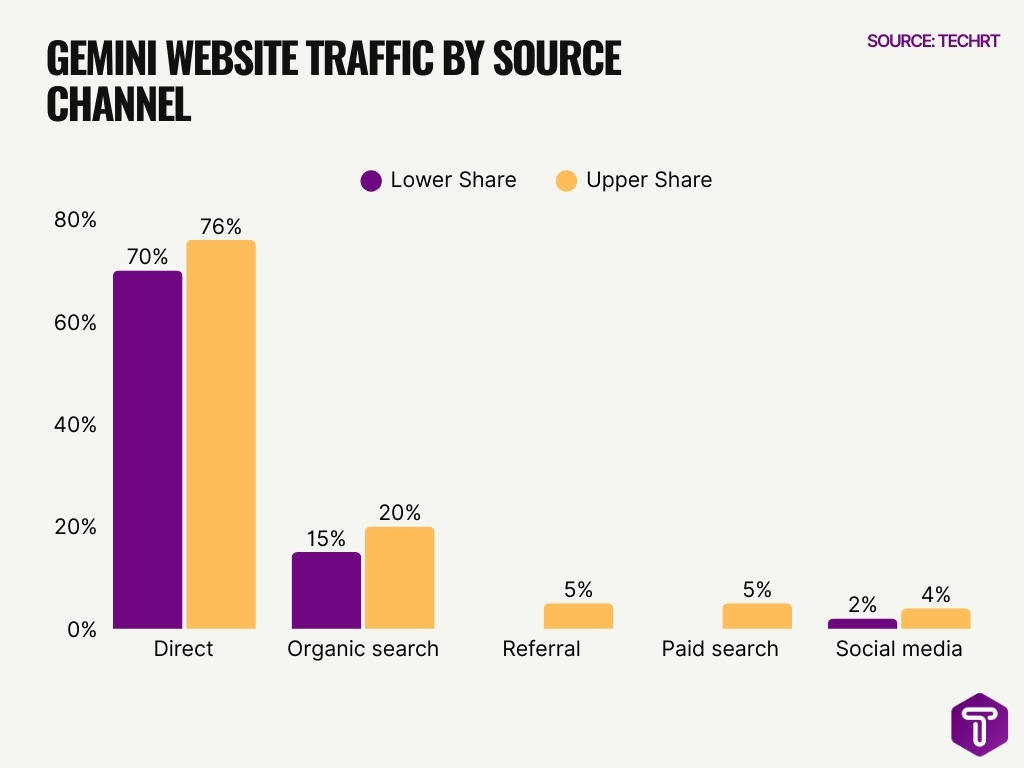
- Direct traffic accounts for ~76% of total platform visits, showing brand strength.
Recent Developments
- In February 2024, Bard was rebranded to Google Gemini, unifying multiple AI services.
- The launch of Gemini 3 in late 2025 drove significant boosts in user engagement and growth.
- AI Overviews, powered by Gemini tech, now serve 2 billion users monthly, a major increase in broad usage.
- Gemini Advanced features, including Ultra 1.0, were introduced as subscription options.
- Google announced partnerships to integrate Gemini’s generative AI into future versions of Siri and iOS, expanding reach.
- Improved multimodal capabilities now allow the model to handle text, image, and code inputs simultaneously.
- Developers gained access to enhanced APIs for embedding Gemini directly into apps and services.
- Integration of Gemini with Google Search and Android devices boosted baseline usage dramatically.
Google Bard Overview (Launch, Model & Availability)
- Bard debuted on March 21, 2023, as Google’s flagship conversational AI tool.
- The underlying model originally used LaMDA and later transitioned to the more powerful Gemini series.
- The official rebrand to Google Gemini occurred on February 8, 2024, consolidating Bard with other AI products.
- Bard and Gemini are available as a web app and mobile app on Android, iOS, and various platforms.
- Support spans 46 languages, making it accessible internationally.
- The service reaches 239 countries and regions, reflecting expansive global availability.
- Integration with Google Assistant and other native services expands its use cases.
- Bard’s availability on mobile and integrated OS layers increases casual and professional usage alike.
Key Google Gemini Statistics
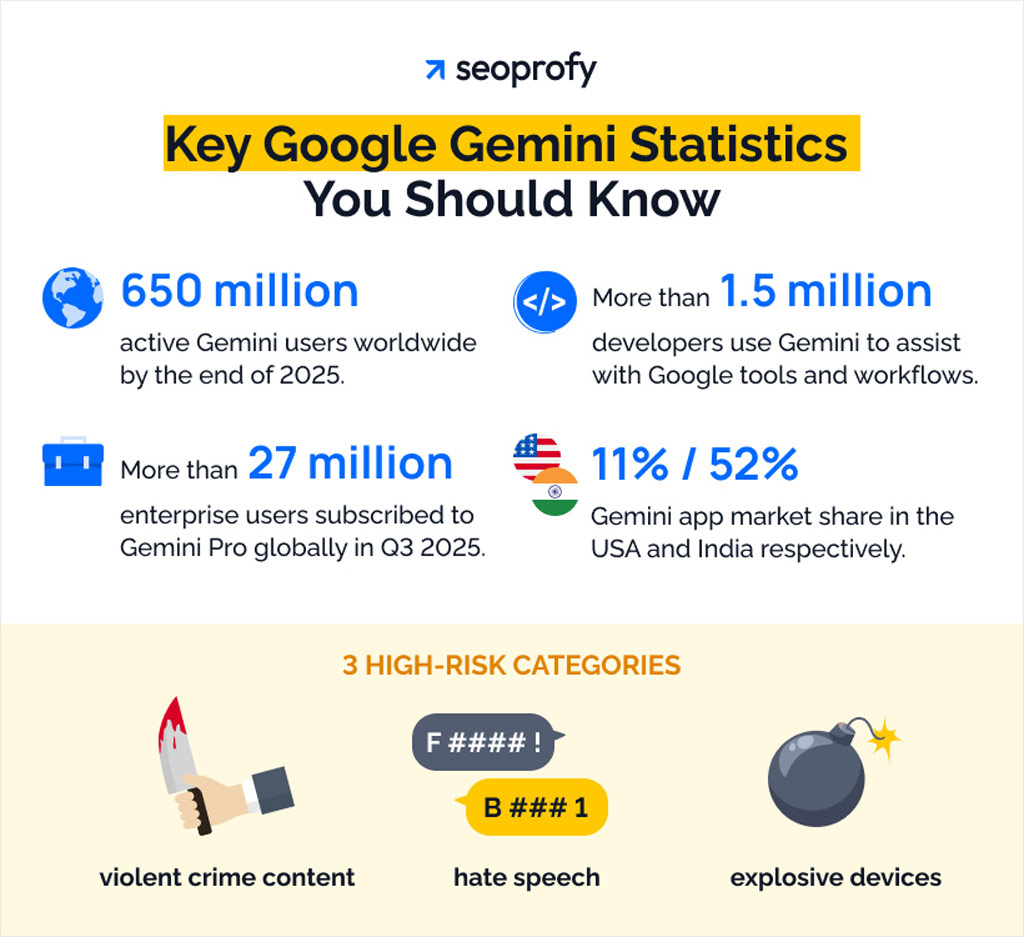
- Google Gemini reached approximately 650 million active users worldwide by the end of 2025, reflecting its rapid global adoption.
- More than 1.5 million developers actively use Gemini to support Google tools and workflows, highlighting strong developer ecosystem growth.
- Over 27 million enterprise users subscribed to Gemini Pro globally in Q3 2025, indicating rising demand for premium AI solutions.
- The Gemini app captured an estimated 11% market share in the USA, showing steady penetration in the North American market.
- In India, Gemini achieved a dominant 52% market share, making it one of the leading AI assistant platforms in the region.
- Google identifies three high-risk content categories for Gemini moderation: violent crime content, hate speech, and explosive devices, emphasizing its focus on AI safety.
- The presence of strict content moderation policies reflects Google’s commitment to responsible AI development and user protection.
- Strong growth across users, developers, and enterprises positions Gemini as a major competitor in the global AI ecosystem.
Google Bard Timeline and Major Updates
- Feb 6, 2023: Bard initially announced, powering early tests.
- Mar 21, 2023: Bard publicly launched with limited early access.
- May to Dec 2023: Expanded support and feature updates rolled out globally.
- Feb 8, 2024: Bard rebranded to Gemini.
- 2024 to 2025: Multiple iterations of Gemini, including 2.0 and 2.5, improved accuracy and multimodal abilities.
- Nov 2025: Gemini 3 release marked a major performance milestone.
- 2025 to 2026: Continued growth in adoption and integration with partner platforms.
- Ongoing updates continue to align Bard and Gemini with evolving AI use cases, from enterprise to creative content generation.
Google Gemini (Formerly Bard) Rebrand Overview and Key Stats
- The rebrand unified Bard with other generative services under the Gemini name.
- Gemini supports text, images, and multimodal inputs, enabling richer results.
- The shift reflected Google’s long-term AI strategy to compete more directly with peers like ChatGPT.
- As of late 2025, downloads of the Gemini mobile app exceeded 180 million.
- Market share in the global AI chatbot space sits around 13.5%, placing it third behind competitors.
- Enterprise adoption includes 70% of Google Cloud customers using Gemini-based tools.
- Direct traffic remains the dominant source of visits, highlighting strong brand loyalty.
- Gemini’s integration with AI Overviews results in 2 billion monthly touchpoints.
AI Chatbot Market Share in the U.S. (November 2025)
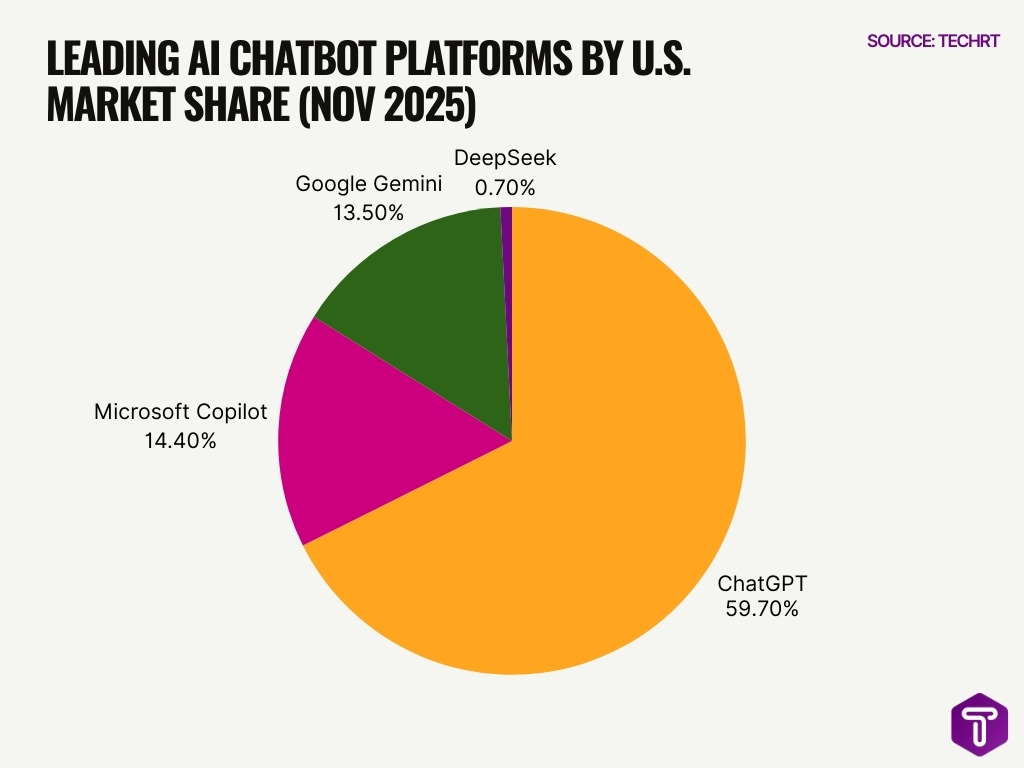
- ChatGPT dominates the U.S. AI chatbot market with a commanding 59.7% market share, controlling more than half of the total market.
- Microsoft Copilot holds the second position with 14.40%, capturing a significant but distant share compared to the market leader.
- Google Gemini follows closely with 13.50%, maintaining strong competition in the AI chatbot space.
- The gap between ChatGPT (59.7%) and its nearest competitor, Microsoft Copilot (14.40%), is a substantial 45.3 percentage points, highlighting clear market leadership.
- DeepSeek accounts for just 0.70%, indicating minimal penetration in the U.S. chatbot ecosystem.
- Combined, Microsoft Copilot and Google Gemini hold 27.9% of the market, which is still less than half of ChatGPT’s share alone.
- The top three platforms, ChatGPT, Microsoft Copilot, and Google Gemini, together control 87.6% of the total U.S. AI chatbot market.
- The data reflects a highly concentrated market, with one dominant player and two strong but significantly smaller competitors.
Google Bard User Count and Monthly Active Users
- As of early 2026, Google Gemini, formerly Bard, reports more than 750 million monthly active users (MAUs) globally, reflecting continued post-rebrand acceleration.
- Gemini’s MAUs grew from 142.6 million in February 2024 to approximately 650 million by November 2025, marking a more than 4× increase in under two years.
- Mid-2025 estimates placed Gemini’s MAUs between 350 million and 450 million, indicating sustained quarterly growth throughout 2025.
- Monthly visits to gemini.google.com exceeded 800 million visits in several months of 2025, highlighting strong web-based usage alongside app adoption.
- Daily active users (DAUs) have been estimated in the 35 to 45 million range during peak 2025 usage periods.
- Gemini downloads surpassed 180 million cumulative installs by late 2025, driven largely by Android distribution.
- Google’s AI Overviews, powered by Gemini, now reach 2 billion monthly users, indirectly expanding the model’s exposure far beyond standalone app metrics.
- Compared with early 2023 beta access, user scale has expanded by more than 100×, illustrating one of the fastest adoption curves in generative AI.
Google Bard Website Traffic Statistics
- Gemini’s website traffic surpassed 825 million total visits in the peak 2025 months.
- Direct traffic accounts for roughly 70% to 76% of total visits, indicating strong brand recognition and repeat usage.
- Organic search contributes approximately 15% to 20% of traffic, largely from informational and AI-related queries.
- Referral traffic remains under 5%, reflecting Gemini’s primarily direct and search-driven model.
- Average monthly web traffic increased more than 300% between early 2024 and late 2025.
- The United States generates the largest share of traffic at around 18% to 22% of total visits.
- India ranks among the top traffic contributors, accounting for roughly 10% to 14% of visits.
- Traffic spikes typically align with major model releases, including the Gemini 3 rollout in late 2025.
Google Bard Users by Country and Region
- The United States represents approximately 20% of total Gemini users, making it the largest single market.
- India consistently ranks second, contributing around 12% to 14% of global traffic.
- Brazil accounts for roughly 5% to 7% of total users, reflecting strong adoption in Latin America.
- The United Kingdom contributes approximately 4% to 6% of the traffic share.
- Gemini operates in 239 countries and territories, making it one of the most globally accessible AI chatbots.
- Support for 46+ languages enables broad regional penetration across Europe and Asia.
- Asia-Pacific collectively contributes over 30% of global user traffic, driven by India and Southeast Asia.
- North America remains the highest revenue-generating region for Gemini subscriptions.
Google Bard User Demographics Statistics
- Users aged 18-34 represent over 50% of Google Gemini’s audience, with 25-34 at 29.7-31.1% and 18-24 at 20.8-22.4%.
- Approximately 58-60% of Gemini users are male, while 40-42% are female, showing male dominance in early adoption.
- 25-34-year-olds form the largest group at 29.7-31.1% of Gemini’s user base in 2025.
- The United States accounts for 12-15% of Gemini traffic, followed by India at 7-10%.
- Desktop usage dominates at 73.7%, while mobile makes up 26.3% of Gemini engagement in 2025.
- Over 10 million downloads of the Gemini AI app on Google Play highlight strong mobile adoption in 2025.
- Gemini reached 400 million monthly active users worldwide as of 2025, ranking 2nd among AI platforms.
- 74% of Indian respondents believe AI like Gemini boosts student performance, driving education use.
- Small businesses represent 36% of active Gemini users, mainly for content creation in 2025.
Google Bard Training Dataset Breakdown
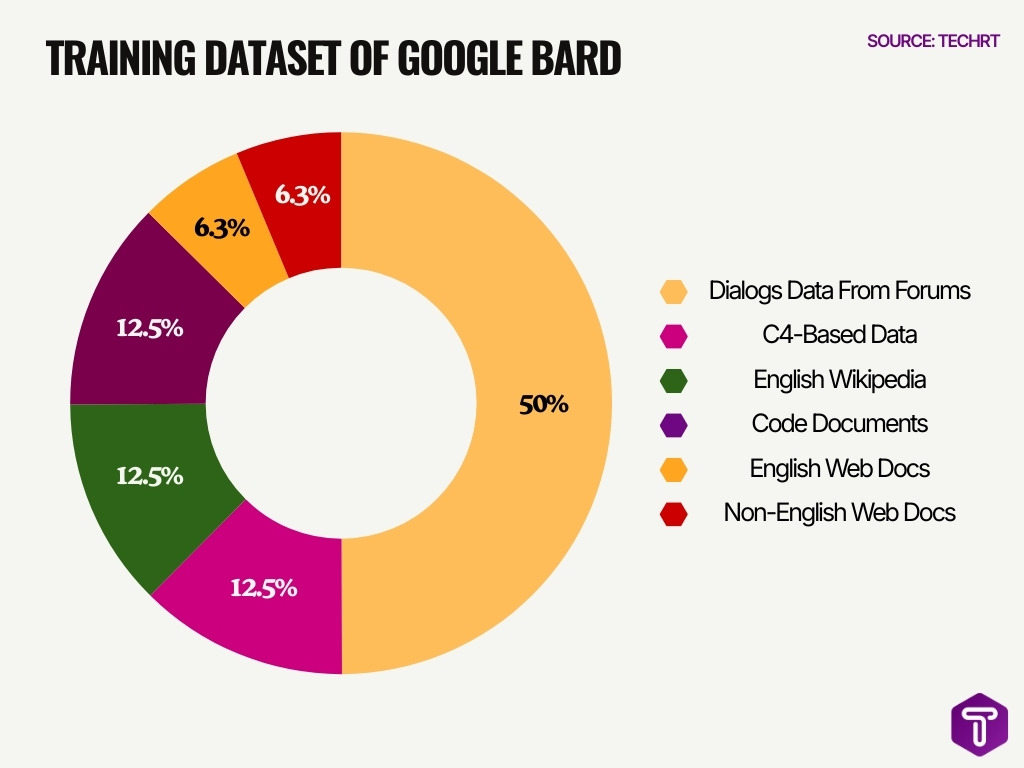
- 50.0% of Google Bard’s training data comes from dialog data from forums, indicating a strong focus on conversational understanding and human interaction patterns.
- 12.5% is sourced from C4-based data, contributing large-scale structured web content to enhance contextual comprehension.
- Another 12.5% originates from English Wikipedia, supporting factual accuracy and knowledge depth across diverse topics.
- 12.5% of the dataset consists of code documents, strengthening Bard’s capabilities in programming, debugging, and technical assistance.
- 6.3% is derived from English web documents, adding broader real-world web content for general knowledge enhancement.
- The remaining 6.3% comes from Non-English web documents, improving multilingual exposure and cross-language understanding.
- Overall, a combined 75%+ of the dataset is focused on conversational and structured knowledge sources, reinforcing Bard’s strength in dialogue-driven AI responses.
Google Bard Traffic by Device (Desktop vs Mobile)
- Desktop accounts for approximately 55% to 60% of web traffic, reflecting strong workplace use.
- Mobile web contributes roughly 40% to 45% of traffic, growing steadily in 2025.
- Android app downloads significantly outpace iOS due to native ecosystem integration.
- Mobile app installs exceeded 180 million cumulative downloads by late 2025.
- Enterprise and coding-related queries skew heavily toward desktop devices.
- Casual queries and personal productivity use cases dominate mobile sessions.
- Average session duration on desktop tends to exceed mobile by 20% to 30%, based on traffic analysis.
- App usage growth accelerated following deeper Android OS integration in 2025.
Google Bard Engagement Metrics (Visit Duration, Pages per Visit, Bounce Rate)
- Average visit duration ranges between 6 and 8 minutes, reflecting extended conversational sessions.
- Pages per visit typically range from 2.5 to 3.5 pages, depending on session depth.
- Bounce rate estimates fall between 35% and 45%, relatively low for AI chat interfaces.
- Engagement increased by more than 20% year over year following the Gemini Advanced release.
- Desktop sessions average longer durations compared with mobile sessions.
- Repeat visitor rate remains high due to Workspace and Android integration.
- Enterprise usage sessions often exceed 10 minutes per session, especially for coding and research tasks.
- Engagement spikes frequently follow major AI announcements or performance updates.
How People Use Google Bard (Use-Case Statistics)
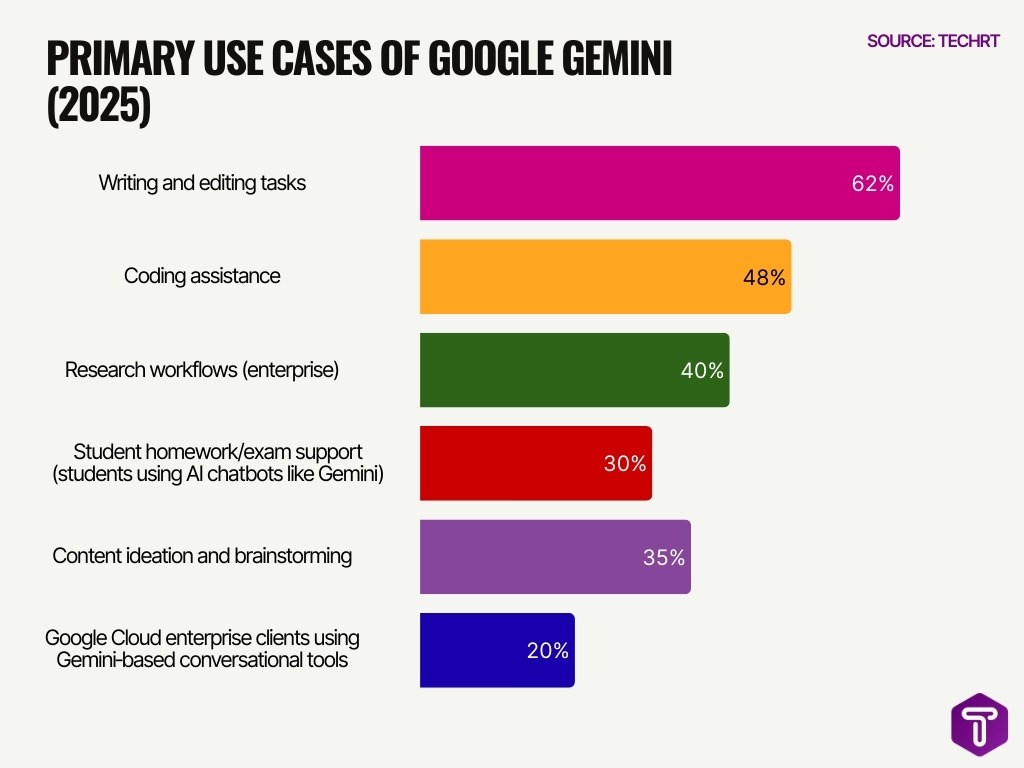
- A 2025 developer survey found that 62% of users rely on Gemini for writing and editing tasks, including emails, blog posts, and reports.
- Approximately 48% of users use Gemini for coding assistance, including debugging and code generation.
- Around 40% of enterprise users integrate Gemini into research workflows, especially for document summarization.
- More than 30% of students report using AI chatbots like Gemini for homework support and exam prep.
- Content ideation and brainstorming account for roughly 35% of daily prompts, particularly among marketers and creators.
- Multimodal queries, including image analysis and prompt-based image generation, increased by 25% year over year in 2025.
- Google Workspace integrations drive heavy professional usage, with millions of daily AI-assisted document edits across Docs and Gmail.
- Customer support automation represents a growing segment, with over 20% of Google Cloud enterprise clients deploying Gemini-based conversational tools.
Google Bard Languages, Countries, and Availability Statistics
- Gemini supports 46+ languages, including English, Spanish, Hindi, Japanese, and German.
- The service operates in 239 countries and territories, making it one of the most widely distributed AI tools globally.
- North America and Europe account for a combined 45% to 50% of total active users.
- India remains one of the fastest-growing markets, contributing over 12% of total traffic share.
- Android OS-level integration significantly increased adoption in emerging markets throughout 2025.
- Gemini Advanced subscription access expanded to more than 150 countries by late 2025.
- Regional language expansions in 2025 led to a 20% increase in non-English usage year over year.
- Accessibility improvements, including voice-based interaction support, improved engagement in multilingual regions.
Google Bard Training Dataset and Model Size Statistics
- LaMDA 2, original Bard base model, trained on 2.81 trillion tokens.
- PaLM 2 upgrade expanded the dataset to 3.6 trillion tokens with multilingual support.
- Gemini Ultra used up to 11 trillion tokens for multimodal text, image, and audio training.
- Gemini Ultra beat GPT-4 on 30 of 32 academic benchmarks upon launch.
- Gemini Ultra scored 90.0% on MMLU, exceeding GPT-4‘s 86.4%.
- Estimates peg Gemini Ultra at hundreds of billions of parameters.
- Gemini 3.0 Pro boosted factual accuracy by 36% over Gemini 2.5 on SimpleQA.
- Gemini 3 cut hallucination rates from 88% in 2025 toward 15% goal.
- TPU v5 delivered 11.5 petaflops for efficient Gemini training compute.
- Gemini 2.0 advanced MMMU score to 75.4% from the previous 70.7%.
Google Bard Market Share and Business Adoption Statistics
- As of late 2025, Gemini holds approximately 13% to 15% of the global AI chatbot market share.
- OpenAI’s ChatGPT continues to lead with over 60% market share, placing Gemini in third position globally.
- Over 70% of Google Cloud customers reportedly use Gemini-powered services in some capacity.
- Enterprise AI adoption increased by 35% year over year in 2025, with Gemini among the leading tools integrated into business workflows.
- Gemini integration into Google Workspace expanded AI usage across millions of enterprise accounts.
- Android device-level integration provides Gemini access to over 3 billion active Android devices worldwide.
- Subscription-based Gemini Advanced tiers contribute to recurring revenue growth in Google’s AI segment.
- U.S. businesses represent one of the largest segments of paid Gemini Advanced subscribers.
Where Users Go After Leaving Gemini – Key Insights
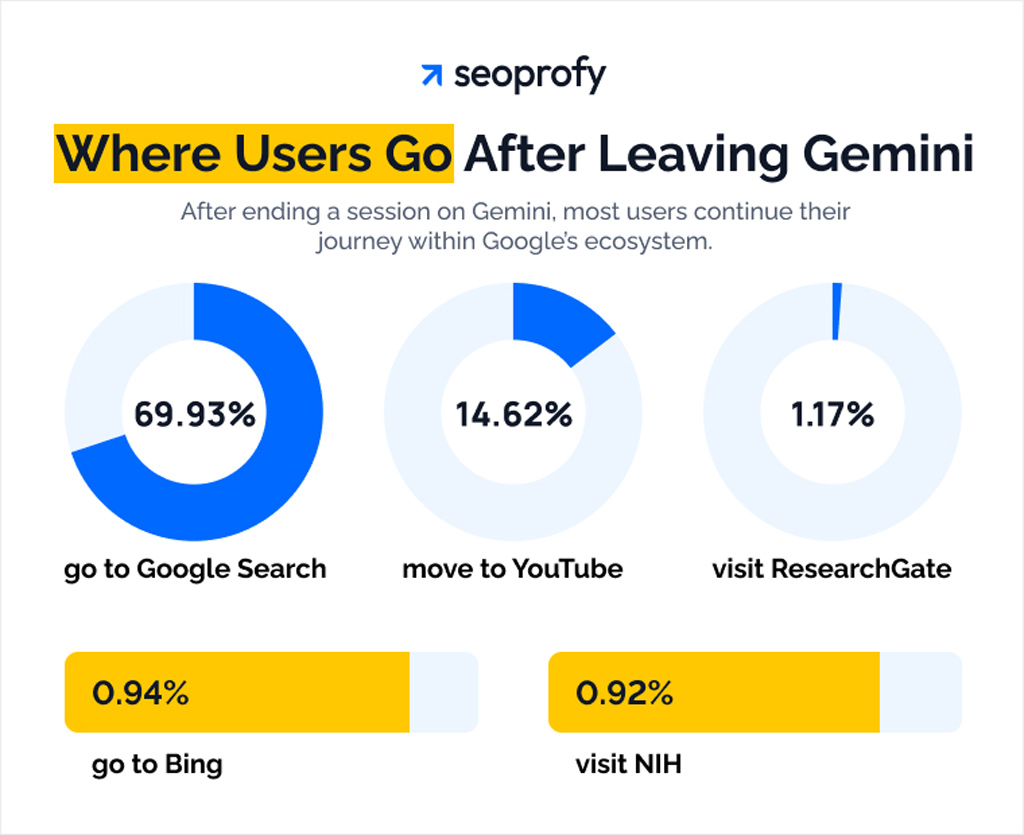
- Nearly 7 out of 10 users (69.93%) move directly to Google Search, showing Gemini’s strong integration with Google’s search ecosystem.
- YouTube attracts 14.62% of users, highlighting that many people continue their journey through video-based learning and tutorials after using Gemini.
- Only 1.17% of users visit ResearchGate, indicating limited academic or research-oriented migration from Gemini sessions.
- A very small share, just 0.94%, switches to Bing, reflecting minimal cross-search-engine movement among Gemini users.
- Similarly, only 0.92% proceed to the NIH website, suggesting low redirection to specialized medical or scientific resources.
- In total, over 84% of users (69.93% + 14.62%) remain within Google-owned platforms, reinforcing Google’s closed-loop ecosystem dominance.
- The sharp gap between Google Search (69.93%) and competitors like Bing (0.94%) demonstrates Gemini’s role in strengthening Google’s search monopoly.
- The data shows that Gemini primarily serves as a gateway to Google’s core products, rather than a bridge to external platforms.
- Educational, research, and alternative search platforms together account for less than 3% of total traffic, underlining their marginal role in post-Gemini user behavior.
- Overall, user behavior suggests that Gemini functions more as a traffic distributor within Google’s ecosystem than an independent discovery tool.
Google Bard vs ChatGPT Usage and Performance Statistics
- ChatGPT surpassed 180 million weekly active users in 2024, maintaining a lead over Gemini.
- Gemini reached 750 million MAUs by early 2026, narrowing the competitive gap.
- Gemini Ultra outperformed GPT-4 on 30 of 32 academic benchmarks, according to Google’s launch report.
- ChatGPT currently leads in global chatbot traffic share at approximately 60%+, while Gemini holds around 13% to 15%.
- Mobile app downloads for ChatGPT exceed 250 million, compared with Gemini’s approximately 180 million.
- Gemini benefits from native Google Search integration, offering exposure to 2 billion AI Overview users monthly.
- U.S. usage dominance remains strong for both platforms, accounting for roughly 20% of Gemini traffic and similar shares for ChatGPT.
- Both platforms show rising enterprise adoption, but ChatGPT currently leads in API-based developer integrations.
Google Bard Accuracy, Limitations, and Error Statistics
- Early Bard versions faced criticism for factual inaccuracies, including a well-publicized error during the February 2023 demo event.
- Internal benchmark updates in 2025 showed up to 20% improvement in reasoning accuracy compared with earlier Gemini versions.
- Independent AI benchmark tests place Gemini’s reasoning accuracy in the mid-to-high 80% range across selected datasets.
- Hallucination rates remain an industry-wide issue, with studies suggesting that large language models generate inaccurate outputs in 15% to 25% of complex queries.
- Google has implemented stricter safety filters, reducing unsafe content outputs by double-digit percentage improvements in the 2025 updates.
- Multimodal accuracy improved significantly in image reasoning benchmarks after Gemini 2.5 updates.
- Enterprise compliance and governance tools were expanded in 2025 to address data privacy concerns.
- Despite performance gains, experts continue to caution that AI-generated outputs require human verification for high-stakes use cases.
Frequently Asked Questions (FAQs)
How many monthly active users does Google Bard (Gemini) have in early 2026?
Google’s AI chatbot Gemini, formerly Bard, has surpassed 750 million monthly active users as of Q4 2025, reflecting strong global adoption.
What percentage of Gemini users are aged between 25 and 34?
Approximately 29.66% of Gemini visitors are aged 25 to 34, making this age group the largest user demographic.
What share of global AI chatbot web traffic does Google Gemini hold as of early 2026?
Google Gemini accounts for about 21.5% of global AI chatbot traffic, up substantially from prior periods.
By how much did Gemini’s monthly active users grow year-over-year by Nov 2025?
Gemini’s monthly active user base increased by approximately 170% year-over-year through November 2025.
What proportion of Gemini users are male versus female?
Around 58% of Google Gemini users are male, with roughly 42% female.
Conclusion
Google Bard, now operating under the Gemini brand, has evolved into one of the world’s largest generative AI platforms. With 750 million monthly active users, expansion into 239 countries, and integration across Google Search, Android, and Workspace, its influence extends well beyond a standalone chatbot. Moreover, enterprise adoption and multimodal advancements signal Google’s long-term commitment to AI leadership.
However, competition with ChatGPT remains intense, and accuracy limitations still require human oversight. As AI adoption accelerates across the U.S. and globally, Gemini’s trajectory will depend on performance improvements, ecosystem integration, and responsible deployment.
In short, the numbers show rapid growth, expanding reach, and strong enterprise traction, but also an evolving competitive landscape that will define the next phase of generative AI.

Leave a comment
Have something to say about this article? Add your comment and start the discussion.