



Infographics have moved from a design trend to a core communication tool in modern marketing. Brands use them to simplify complex datasets in annual reports, investor presentations, and data-driven blog content, while educators rely on them to improve learning retention and student engagement in classrooms and e-learning platforms. In addition, marketers use infographics to boost social media reach and explain product value in a way that drives faster decision-making.
As visual-first content continues to dominate digital channels and user attention spans shrink, understanding how infographics perform across industries becomes essential, so let’s explore the latest data shaping this space.
Editor’s Choice
- 65% of brands now use infographics in their content marketing strategy, reflecting widespread adoption.
- Businesses that use infographics generate 178% more inbound links than those that don’t.
- Infographics can drive up to a 12% increase in website traffic compared to text-only content.
- Visual content is processed up to 1,000x faster than text, making infographics highly effective for quick communication.
- Infographics are 30x more likely to be read than standard articles.
- Around 41.5% of user engagement with branded visuals comes from infographics alone.
- Over 84% of companies consider visual content like infographics essential to their strategy.
Recent Developments
- In 2025–2026, 75% of marketers use AI tools for creating visual content, including infographics.
- About 83.2% of content marketers planned to integrate AI into workflows in 2024, shaping infographic creation pipelines.
- Infographic search demand has grown by over 800% in just two years, indicating rising audience interest.
- Nearly 45.7% of marketers now allocate 20–50% of budgets to visual content creation.
- 22% of marketers reported visual content expansion as their most effective diversification strategy in 2025.
- New AI systems like text-to-infographic tools now automate layout and storytelling processes for marketers.
- Interactive infographics are gaining traction, with 93% of marketers calling them effective for education and engagement.
- Social media platforms increasingly prioritize visual-first content, pushing infographic adoption across campaigns.
Overview of Infographic Usage Statistics
- Over 65% of marketers rely on infographics as part of their content strategy.
- Around 56% of marketing professionals use infographics across multiple channels.
- Only 22% of bloggers create infographics, but they rank among the top-performing formats.
- Businesses using infographics are 28% more likely to find critical information efficiently.
- Visual content improves information discovery speed by 39% in documents.
- Infographics contribute to 650% higher engagement compared to text-only posts.
- Around 37% of readers click the first link embedded in an infographic.
- 61% of consumers say infographics help them retain information better.
Key Insights on How People Interact with Infographics
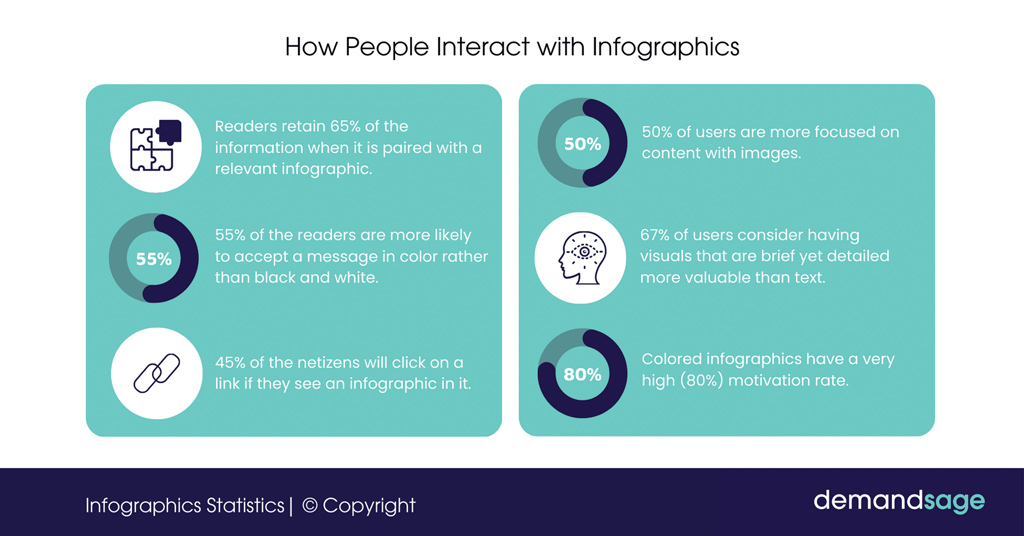
- 65% of readers retain information when it is paired with a relevant infographic, highlighting the strong impact of visual learning.
- Around 55% of readers are more likely to accept messages in color, showing that colored visuals outperform black-and-white content.
- Nearly 45% of internet users click on links when they include an infographic, indicating a significant boost in click-through rates (CTR).
- About 50% of users are more focused on content with images, reinforcing the importance of visual-first content strategies.
- A strong 67% of users prefer visuals that are brief yet detailed, considering them more valuable than plain text.
- Colored infographics drive an 80% motivation rate, demonstrating their ability to influence user behavior and engagement.
Growth of Infographics Over Time
- Infographic usage has grown alongside content marketing, with 82% of companies now using content marketing overall.
- The global content marketing industry is projected to reach $1.95 trillion by 2032, driving infographic demand.
- Visual search demand, including infographics, increased by 800%+ in two years.
- 65% of businesses now dedicate over 10% of marketing budgets to visual content.
- Nearly half of marketers (45.7%) invest heavily (20–50%) in visual content creation.
- Infographics have shifted from niche to mainstream, with two-thirds of brands adopting them.
- Content consumption trends show a 207% increase in usage during digital acceleration periods.
- Infographics continue to outperform traditional formats in engagement and readability metrics.
Infographics in Social Media Marketing
- Over 91% of consumers prefer visual content over plain text on social platforms.
- By 2026, 80%+ of social media posts are expected to include visual elements like infographics.
- Infographics generate 41.5% of total engagement across branded visual content.
- Social platforms like LinkedIn see 96% of B2B marketers distributing content, often using visuals.
- Infographics help content achieve 650% higher engagement than text-only posts.
- Visual posts are significantly more shareable, contributing to higher social reach and impressions.
- 75% of marketers use AI to create social visuals, accelerating infographic production.
- Infographics support cross-platform reuse, enabling a single asset to perform across blogs, email, and social feeds.
Social Media Platforms Dominating Marketing Strategies
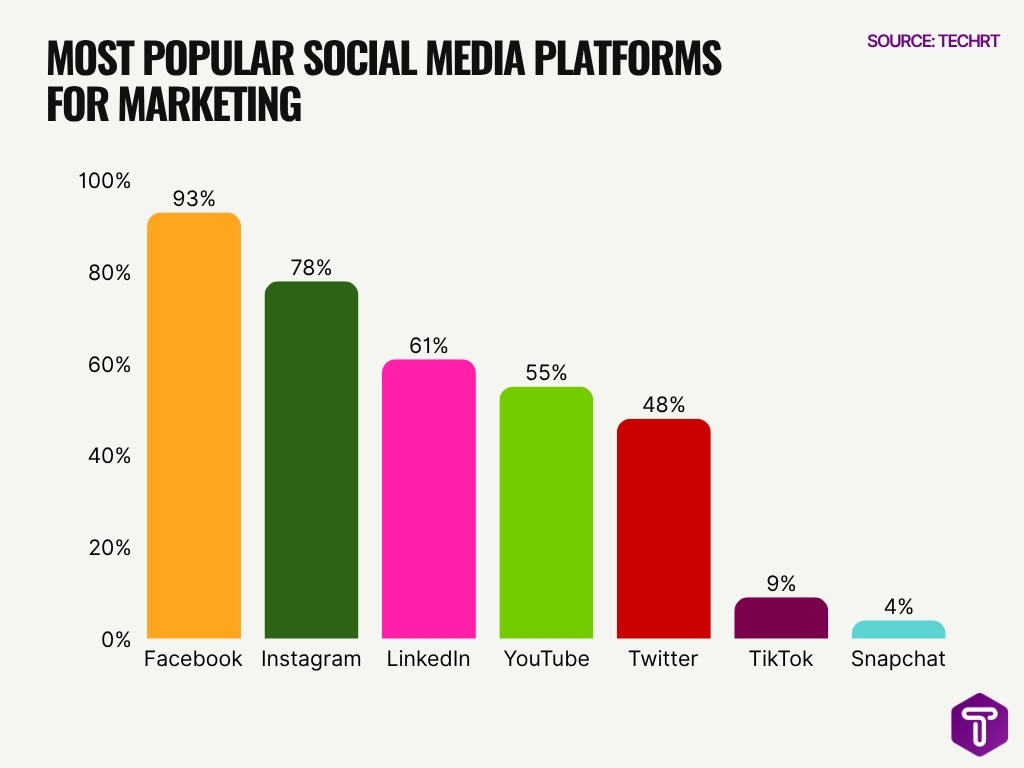
- Facebook leads the market with a massive 93% adoption rate, making it the most widely used platform for marketing globally.
- Instagram ranks second at 78%, highlighting its strong influence in visual content marketing and brand engagement.
- LinkedIn is used by 61% of marketers, showing its dominance in B2B marketing and professional networking.
- YouTube reaches 55% usage, proving the growing importance of video marketing and long-form content strategies.
- Twitter is utilized by 48% of marketers, mainly for real-time engagement, news, and customer interaction.
- TikTok adoption stands at 9%, indicating it is still an emerging platform but with high potential for short-form video marketing.
- Snapchat has the lowest usage at 4%, suggesting limited adoption in mainstream marketing strategies.
- The data shows a clear trend: established platforms dominate, while newer platforms like TikTok and Snapchat are still growing in marketing adoption.
- Visual and video-first platforms (Instagram, YouTube) collectively command a significant share, emphasizing the shift toward multimedia content marketing.
- Professional and social networking platforms (LinkedIn, Facebook) remain critical for both B2B and B2C strategies.
Infographics in Email and Lead Generation
- Emails that include infographics or visuals see a 42% higher click-through rate compared to text-only emails.
- Adding visual elements like infographics can improve email engagement by up to 300%.
- 65% of marketers say visual content improves lead generation results.
- Infographics embedded in lead magnets can increase conversion rates by up to 35%.
- 49% of B2B marketers rely on visual assets, including infographics, to nurture leads.
- Emails with visual storytelling elements generate 26% more opens than standard campaigns.
- Infographics help reduce bounce rates in email campaigns by making content easier to scan and digest.
- 73% of marketers say visuals, including infographics, play a key role in converting leads.
Infographics and SEO Performance
- Pages with infographics can boost organic traffic by up to 12%, enhancing overall SEO ranking.
- Websites featuring visuals receive 94% more views than those with plain text.
- Infographics can lift average dwell time by up to 15%, signaling higher user engagement.
- Sites with rich visuals report 37% lower bounce rates compared to text-heavy pages.
- Content containing infographics earns 3x more backlinks, improving domain authority.
- Posts with infographics are 30 times more likely to be read than text-only content.
- 61% of marketers cite SEO improvement, with visuals, as their top inbound priority.
- Sharing rates increase by up to 200% when posts include engaging infographics.
- Visual content helps achieve 41% higher click-through rates in Google Discover and search.
- Infographics enhance keyword visibility, boosting chances to rank in featured snippets and image results.
How to Create a Powerful Infographic That Attracts Backlinks
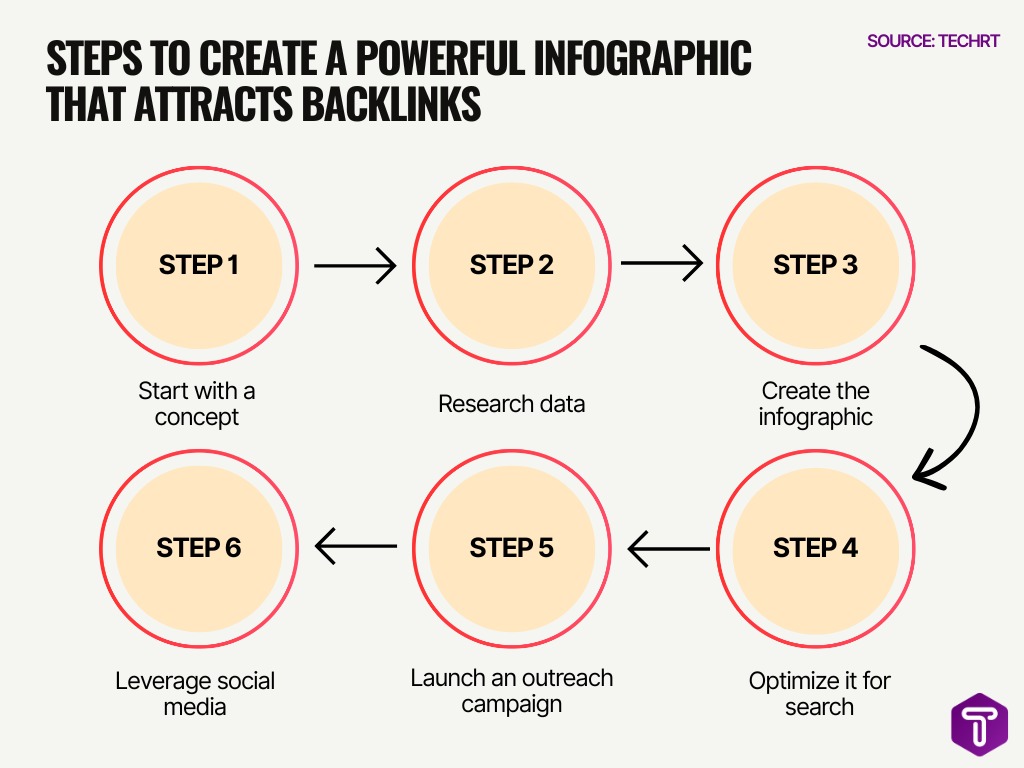
- The process of building a high-performing infographic involves a 6-step framework that combines strategy, design, SEO, and promotion.
- It begins with Step 1: Start with a concept, where defining a clear topic and objective is critical for relevance and audience targeting.
- Step 2: Research data emphasizes the importance of using credible, data-driven insights to enhance authority and trustworthiness.
- In Step 3: Create the infographic, the focus shifts to visual storytelling, ensuring the content is engaging, easy to understand, and visually appealing.
- Step 4: Optimize it for search highlights the role of SEO, including keywords, alt text, and metadata, to improve discoverability in search engines.
- Step 5: Launch an outreach campaign that underlines the need for link-building strategies, such as reaching out to publishers, bloggers, and media outlets.
- Finally, Step 6: Leverage social media focuses on distribution and amplification, using platforms like LinkedIn, Twitter, and Pinterest to maximize reach and engagement.
- Overall, combining content quality + SEO optimization + strategic promotion is key to generating high-quality backlinks and organic traffic.
Infographics and Conversion Rates
- Landing pages with infographics can improve conversions by up to 80%.
- Visual content increases user willingness to engage, leading to higher conversions.
- Infographics simplify decision-making, boosting purchase intent by 25%.
- 64% of consumers are more likely to buy after viewing visual content.
- Infographics help explain product benefits, reducing friction in the buyer journey.
- Visual storytelling improves conversion rates in email campaigns and landing pages alike.
- Infographics can increase CTA clicks by making content more engaging and actionable.
- Pages with visual content outperform text-heavy pages in lead-to-customer conversion rates.
Audience Engagement With Infographics
- Infographics are 30x more likely to be read than text-only articles.
- Infographics drive 41.5% of all user engagement with brand content.
- Visuals boost information retention from 10% to 65% after three days.
- Infographics are liked and shared 3x more than other visual content.
- Content with infographics gets 650% higher engagement than text-only.
- Interactive content drives 2x more engagement than static visuals.
- Visuals increase learning and retention by 78% over text alone.
- Articles with infographics see 12% higher website traffic.
- Color visuals cut data-finding time by 70% for users.
- Infographics generate 178% more inbound links to websites.
Top-Performing Design Trends Driving Engagement
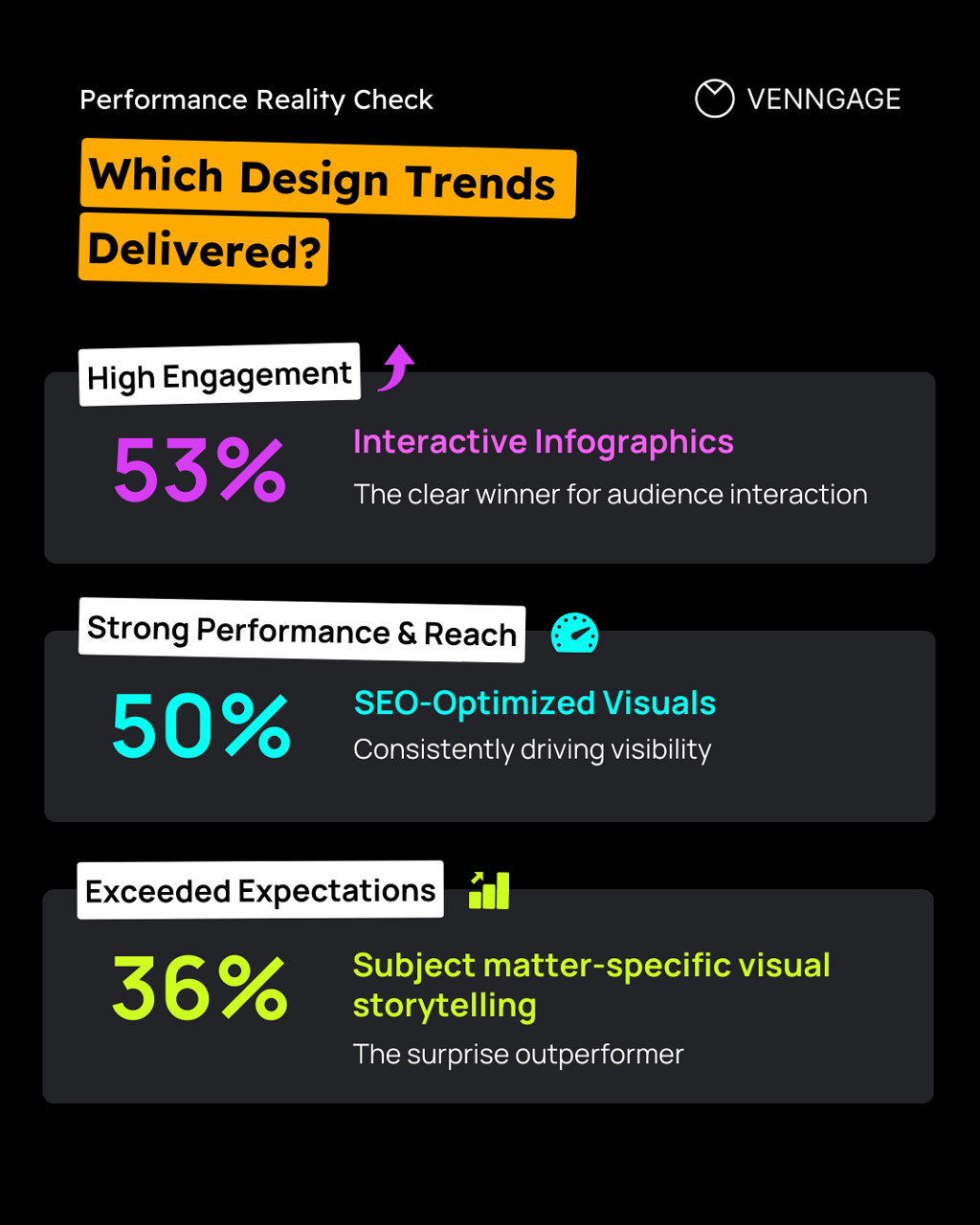
- Interactive infographics lead the way, with 53% performance, making them the most effective format for audience engagement and interaction.
- SEO-optimized visuals follow closely at 50%, highlighting their critical role in improving discoverability and organic reach across digital platforms.
- Subject matter-specific visual storytelling achieved 36%, proving that niche, tailored content can outperform expectations despite lower overall adoption.
- The narrow gap between interactive infographics (53%) and SEO visuals (50%) suggests that engagement and visibility are nearly equally important in modern content strategies.
- While interactive formats dominate engagement, SEO-focused visuals ensure long-term traffic sustainability, making them essential for content marketing ROI.
- The 36% performance of specialized storytelling visuals indicates a growing opportunity for brands to differentiate through targeted, context-rich design.
- Overall, the data shows a clear trend: combining interactivity, SEO optimization, and niche storytelling is key to maximizing both engagement and reach.
Infographics and Information Comprehension
- Visual content boosts comprehension by up to 400% compared to text.
- People retain 65% of visual information after three days, versus only 10% of text.
- Infographics help users process data 60,000x faster than traditional text.
- 61% of consumers prefer easy-to-understand visual content over lengthy articles.
- Infographics can improve learning effectiveness by 323% in educational settings.
- Businesses using infographics report a 12% higher information retention rate among employees.
- Visual content increases audience engagement by 94% compared to text-only posts.
- 67% of learners say visuals make complex data easier to understand.
- Presentations using infographics are 43% more persuasive than non-visual ones.
- Visual aids reduce cognitive effort by up to 30%, enhancing clarity and recall.
Infographics in Content Marketing
- 65% of brands actively use infographics in content marketing campaigns.
- 87% of B2B marketers say content marketing improves brand awareness, often supported by visuals.
- Infographics can increase inbound links by 178%, boosting overall content reach.
- Around 49% of US B2B marketers rank content marketing as their top revenue driver.
- 76% of marketers report that content marketing generates leads, with visuals enhancing conversion.
- Infographics rank among the top three highest-performing formats for bloggers who use them.
- Visual content is a priority, with 40% of marketers increasing investment in visuals and videos.
- 72% of marketers say content marketing improves engagement and traffic, often driven by visual formats.
Content Formats Bloggers Prefer: Key Insights
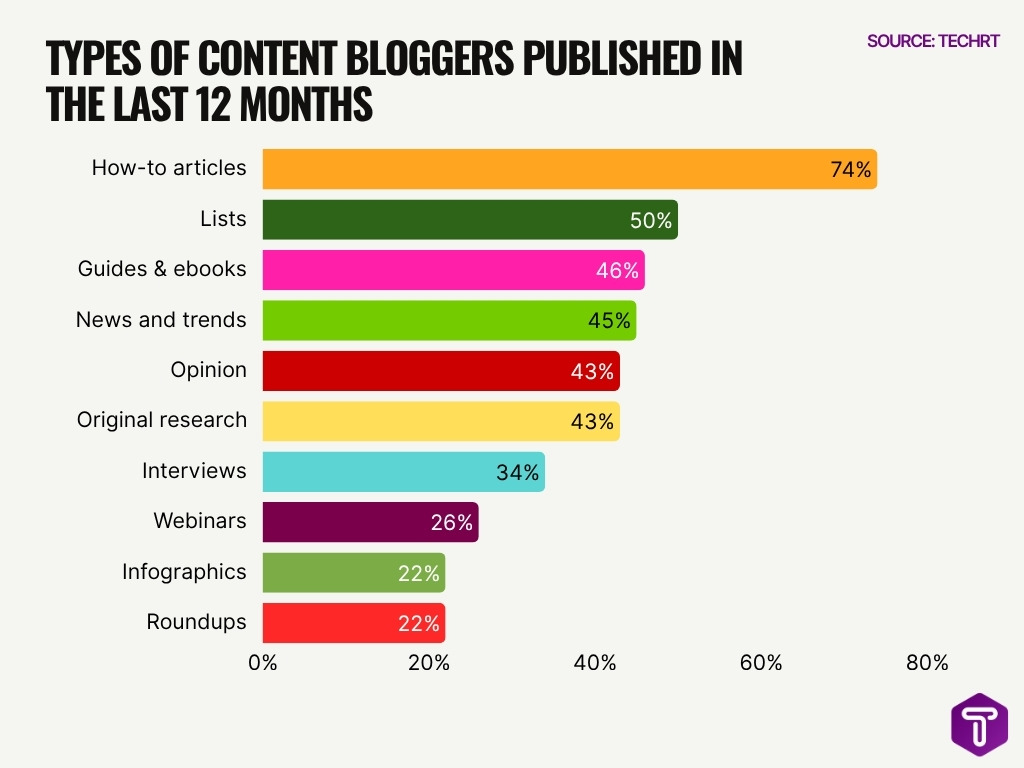
- How-to articles dominate content strategy, with 74% of bloggers publishing them—making it the most widely used format by a large margin.
- List-based content ranks second, with 50% adoption, highlighting its effectiveness for scannability and quick consumption.
- Guides & ebooks (46%) and news & trends (45%) show strong adoption, indicating bloggers focus on both evergreen authority content and timely updates.
- Opinion content and original research are equally popular, each at 43%, reflecting a growing emphasis on thought leadership and data-driven storytelling.
- Interviews are used by 34% of bloggers, suggesting moderate reliance on expert insights and collaborations.
- Webinars are less common, with only 26% adoption, likely due to higher production effort and resource requirements.
- Infographics (22%) and roundups (22%) are the least used formats, despite their potential for visual engagement and backlink generation.
- The gap between top (74%) and bottom (22%) formats is 52 percentage points, showing a significant concentration around a few high-performing content types.
- Overall, bloggers prioritize practical, value-driven, and easily digestible content formats over more resource-intensive or visual-heavy formats.
Infographics and Brand Awareness
- Infographics are shared 3x more on social media than any other type of content, massively extending brand reach.
- Content with relevant images gets 94% more views than content without visuals, boosting overall brand visibility.
- Using a signature brand colour can increase brand recognition by up to 80%, making visual identity far more memorable.
- Visual content is 40x more likely to be shared than text-only posts, helping brands spread awareness faster across social feeds.
- Social posts with images generate about 2.3x more engagement, giving branded visuals a major edge in crowded feeds.
- Visual content can drive 650% higher engagement than text-based content, turning more viewers into brand-aware audiences.
- 35% of marketers say visual imagery is the most important content type for their business, underscoring visuals’ role in brand building.
- Around 80% of marketers use visual assets in social media marketing to strengthen brand recognition and recall.
- Roughly 65% of B2B marketers have used infographics in their campaigns, reflecting their value for communicating brand stories.
Infographics in B2B Marketing
- 65% of B2B marketers use infographics as part of their content strategy.
- 73% of B2B marketers say visual content improves lead generation and engagement.
- Infographics rank among the top 3 most effective formats for B2B content marketing.
- 82% of B2B marketers report success using content marketing, often supported by visuals.
- Infographics help explain complex B2B solutions, improving understanding among decision-makers.
- 49% of B2B buyers rely on visual content during the decision-making process.
- B2B companies using visuals see higher engagement rates across LinkedIn and email campaigns.
- Infographics support account-based marketing by simplifying data-heavy insights.
Infographics in B2C Marketing
- 70% of consumers prefer learning about products through visual content like infographics.
- Infographics influence purchasing decisions, with 64% of consumers more likely to buy after viewing visuals.
- Visual content generates 2x higher engagement in B2C campaigns compared to text-only formats.
- Infographics help brands communicate product benefits quickly, reducing decision time.
- 55% of consumers pay more attention to visual content than text-based ads.
- Infographics improve mobile engagement, especially among younger audiences.
- B2C brands using visuals report higher retention and repeat engagement.
- Infographics are widely used in eCommerce to explain features, pricing, and comparisons.
Infographics by Industry and Sector
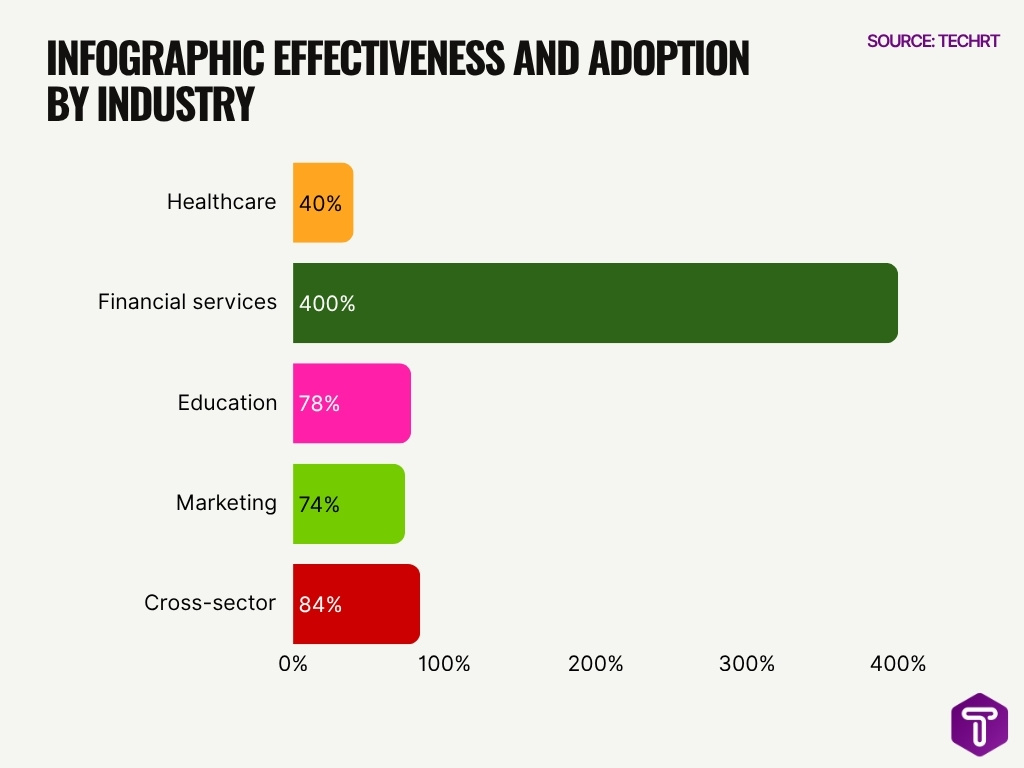
- Healthcare organizations use infographics to boost patient comprehension by up to 40%.
- Financial services firms leverage infographics for visuals, improving learning and retention by 400%.
- The education sector sees visual tools like infographics enhance information retention by 78%.
- Marketing leads with 74% of brands adopting infographics in content strategies.
- Technology companies rank high, with data leaders using infographics for innovation.
- Government agencies deploy infographics like the Census Bureau’s for public data visualization.
- Retail and eCommerce use infographics amid $6.42 trillion global sales in 2025.
- Nonprofits apply infographics in annual reports to highlight impact metrics effectively.
- 84% of companies across sectors use infographics primarily for marketing purposes.
Static vs Interactive Infographics
- Interactive infographics generate 2x more engagement than static versions.
- 93% of marketers say interactive content effectively educates audiences.
- Interactive content delivers 52.6% higher engagement levels than static.
- Users spend 13 minutes on interactive content vs. 8.5 minutes on static.
- Interactive infographics are shared 37% more than static ones.
- 66% of marketers report higher audience engagement with interactive content.
- 28% of marketers used interactive infographics in their campaigns.
- Interactive content generates 2x more conversions than static.
- Interactive infographics boost scrolling depth by 53%.
Distribution Channels for Infographics
- Around 90–94% of marketers distribute infographics via social media, making it the top channel for visual content reach.
- Roughly 30% of marketers create visual content like infographics specifically for their blogs and websites, using them as primary publishing hubs.
- Emails with visual content can see click‑through rates up to 2–3x higher than text‑only campaigns, driving frequent infographic inclusion.
- 96% of B2B content marketers use LinkedIn as an organic distribution channel, regularly sharing infographics and other visuals there.
- Repurposing a single infographic across email, social, web, and sales can effectively create content for 5 channels at once, significantly boosting ROI.
- Infographics are 3x more likely to be shared and liked on social media than other content types, amplifying reach on Pinterest, Instagram, Facebook, and X.
- Visual posts on platforms like Pinterest and Instagram can deliver 20%+ higher conversion rates compared with standard formats, making them strong venues for infographics.
- Only about 28% of B2B marketers avoid paid content distribution, meaning the majority use paid promotion to extend infographic reach across search and social.
- Infographics and other visuals in presentations and reports can improve information retention by around 10% and generate 3x more engagement, supporting their use in internal decks and whitepapers.
Future Outlook for Infographics
- Over 80% of marketers use visual content to boost engagement on social platforms.
- The visual content market is valued at $14.66 billion in 2026, growing to $58.45 billion by 2035 at 16.61% CAGR.
- 49% of marketers use AI daily for image and video generation.
- 28% of marketers used interactive infographics in campaigns, with 53% seeing strong engagement.
- 45.71% allocate 20-50% of the budget to visual content creation.
- 72% of B2B buyers prefer infographics early in the purchasing process.
- Articles with infographics get 178% more links and 72% more views.
- AR/VR market to reach $299.99 billion by 2035 at 18.9% CAGR, enabling immersive visuals.
- 56% of marketers include visuals or infographics in almost every content piece.
- Infographics achieve 2% CTR, 45% higher effectiveness than static content.
Frequently Asked Questions (FAQs)
What percentage of marketers use infographics in their strategy?
Over 65% of marketers actively use infographics as part of their content strategy.
How much higher engagement do infographics generate compared to text content?
Infographics can drive up to 650% higher engagement than text-only content.
By how much can infographics increase website traffic?
Websites using infographics can see up to a 12% to 72% increase in traffic, depending on implementation.
How much faster is visual content like infographics processed compared to text?
Visual content is processed up to 1,000x faster than plain text.
What percentage of people retain information better with infographics?
Around 61% of consumers say infographics help them retain information more effectively.
Conclusion
Infographics continue to shape how brands communicate, educate, and convert audiences. They play a measurable role in improving SEO performance, increasing engagement across social and email channels, and driving higher conversion rates on landing pages and campaigns. Businesses across the B2B and B2C sectors rely on infographics to simplify complex information, strengthen brand recall, and support multi-channel marketing strategies.
As AI-powered design tools, interactive formats, and immersive technologies evolve, infographics will become even more dynamic and personalized. For marketers, content creators, and organizations aiming to communicate clearly and drive action, investing in high-quality infographic content is no longer optional; it is a strategic advantage.

Leave a comment
Have something to say about this article? Add your comment and start the discussion.