



The iPhone’s privacy features have become a major selling point for users and a key competitive edge for Apple. As mobile data collection and surveillance advertising grow globally, Apple’s privacy controls, from App Tracking Transparency (ATT) to location and sensor access indicators, shape how users interact with apps and protect personal information. These features matter in real‑world scenarios such as advertising measurement (impacting how marketers reach audiences) and health apps that request sensitive data permissions. Dive into this article to see the latest statistics and trends shaping iPhone privacy today.
Editor’s Choice
- 35% is the approximate average ATT opt‑in rate across iOS apps as of mid‑2025, indicating evolving user behavior toward tracking permissions.
- iPhone users now number around 1.56 billion globally in 2025, illustrating the massive privacy footprint of the iOS ecosystem.
- 850 million average weekly users engaged with the App Store in 2025, underscoring how privacy affects a huge audience.
- Background location permissions are declared by around 19.85% of iOS apps.
- Approximately 37.75% of iOS apps report using data not linked to individuals.
- Games generally show higher ATT opt‑in rates (e.g., sports games 50%).
- EU regulators fined Apple substantial sums in 2025 for how ATT was implemented.
Recent Developments
- In 2025, Apple reported that its services, including the App Store, reached record engagement with 850 million weekly users, a record high for platform reach.
- App Tracking Transparency (ATT) remains a core privacy innovation requiring explicit user consent before tracking data across apps and sites.
- Newer iOS versions (iOS 26) introduce advanced fingerprinting protections in Safari to reduce tracking via browser APIs.
- Updated ATT prompts offer more granular permissions in iOS 18 and beyond, letting users allow tracking for specific purposes (analytics, ads, etc.).
- Apple faces antitrust scrutiny in Europe over ATT implementation, resulting in fines and regulatory pressure.
- Privacy indicators, such as green or orange dots for camera or microphone use, have gained visibility and heightened user awareness.
- App Privacy Nutrition Labels continue to evolve, giving users detailed data usage summaries in the App Store.
- App Privacy Report now tracks app data access frequency for features like location and camera.
App Privacy Labels Statistics
- The App Store requires developers to disclose privacy data categories, tracking, and information linked to a user, not linked to a user.
- Privacy labels must be self‑reported by developers during app submission.
- Historical research suggests that privacy labels may only be present for ~70% of apps in some measurements.
- Among apps with labels, approximately 38.1% collect data linked to user identity.
- About 42.0% of labeled apps report collecting data not linked to users.
- Apps with privacy labels may average 5.3 potential data compliance discrepancies.
- Only around 40.3% of apps provided accessible privacy policies alongside their labels in past studies.
- The disparity between internal policies and public labels suggests privacy information isn’t always accurate.
- Developers continue working to standardize and improve label accuracy with platform guidance.
iOS Apps Data Collection Statistics
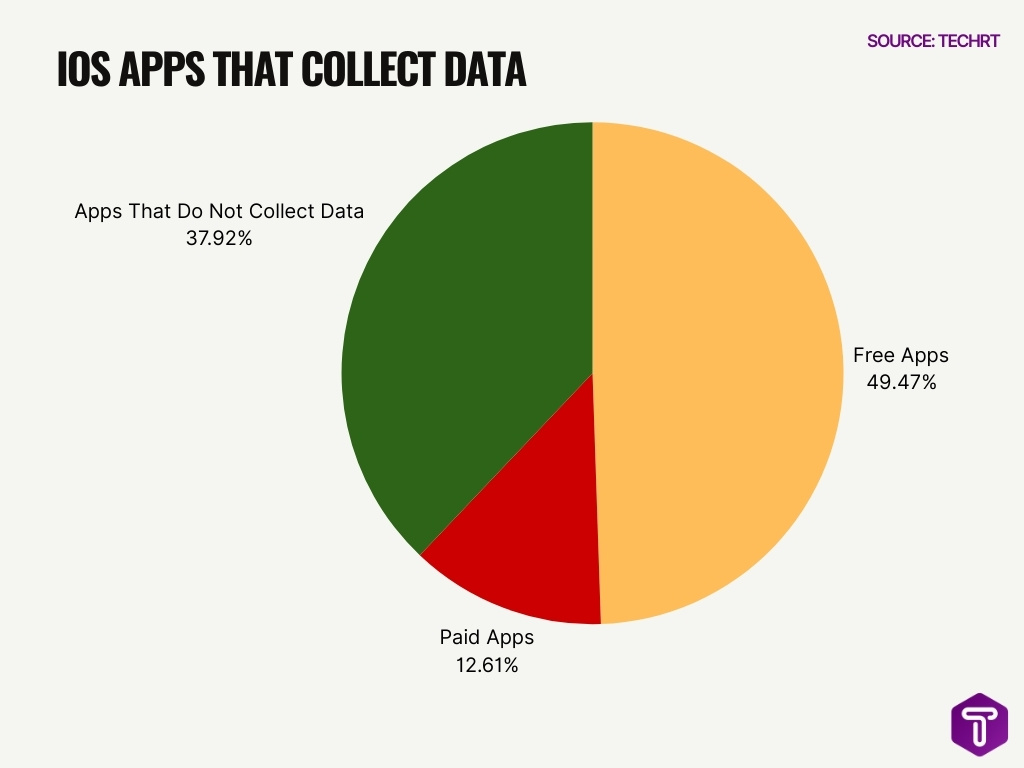
- Free iOS apps dominate data collection, with 49.47% of apps collecting user data, highlighting a strong link between free app monetization models and data usage.
- Paid iOS apps are not fully privacy-safe, as 12.61% still collect user data despite charging users upfront.
- Over one-third of iOS apps prioritize user privacy, with 37.92% reporting that they do not collect any user data at all.
- Data collection is more common than non-collection on iOS, as a combined 62.08% of apps (free and paid) collect some form of user data.
- Free apps are nearly 4× more likely than paid apps to collect data, reinforcing privacy trade-offs users make when choosing free applications.
App Tracking Transparency Stats
- Apple’s App Tracking Transparency requires explicit consent before apps can track you for advertising or sharing with data brokers.
- As of Q2 2025, the average ATT opt‑in rate across apps was about 35%, slightly up from ~34.5% in 2024.
- Specific app verticals vary widely; sports games saw ~50% opt‑in, while many others hover below average.
- Opt‑in rates for ATT prompts continue to fluctuate, influenced by context and app strategy.
- Singular research showed immediate opt‑in rates near 13.85% in some 2024 reports, highlighting context effects.
- Apps with low opt‑in (<30%) may lose ~58% of advertising revenue due to limited tracking signals.
- Effective pre‑permission messaging can boost opt‑in rates by 20–40 percentage points.
- On a global scale, early research estimated ~50% user opt‑in rates in some markets, though regional patterns vary.
Location Services Usage Data
- Roughly 40% of the top 1,500 iOS apps request background location permissions in the U.S.
- 55.52% of free iOS apps declare background location access.
- 66% of top iOS apps seek foreground location permissions.
- 76.6% of users grant location access when prompted by study apps.
- Navigation apps achieve 90% location permission opt-in rates.
- Fintech apps average 75% opt-in for location permissions.
- Ecommerce apps have the lowest 24% average location opt-in rate.
- iOS 13 rollout caused a nearly 70% decline in always-on location usage.
- 19.85% of iOS apps declare background location permissions.
Camera and Microphone Access Stats
- iOS displays green dots when an app accesses your camera and orange dots for microphone use.
- These indicators are enforced by the system and cannot be turned off by users.
- App Privacy Report logs how often apps access sensors like the camera and mic over time.
- Many security experts encourage users to check sensor logs regularly for unusual access patterns.
- Persistent access by apps without a clear user intent can signal misuse of permissions.
- Apps using additional AI features may access camera data for on‑device processing without cloud transmission.
- Users retain granular controls to revoke permissions at any time.
- Designed privacy indicators help prevent unauthorized recordings and build trust in iOS devices.
App Privacy Labels Data Collection by Platform (Per 100k Apps)
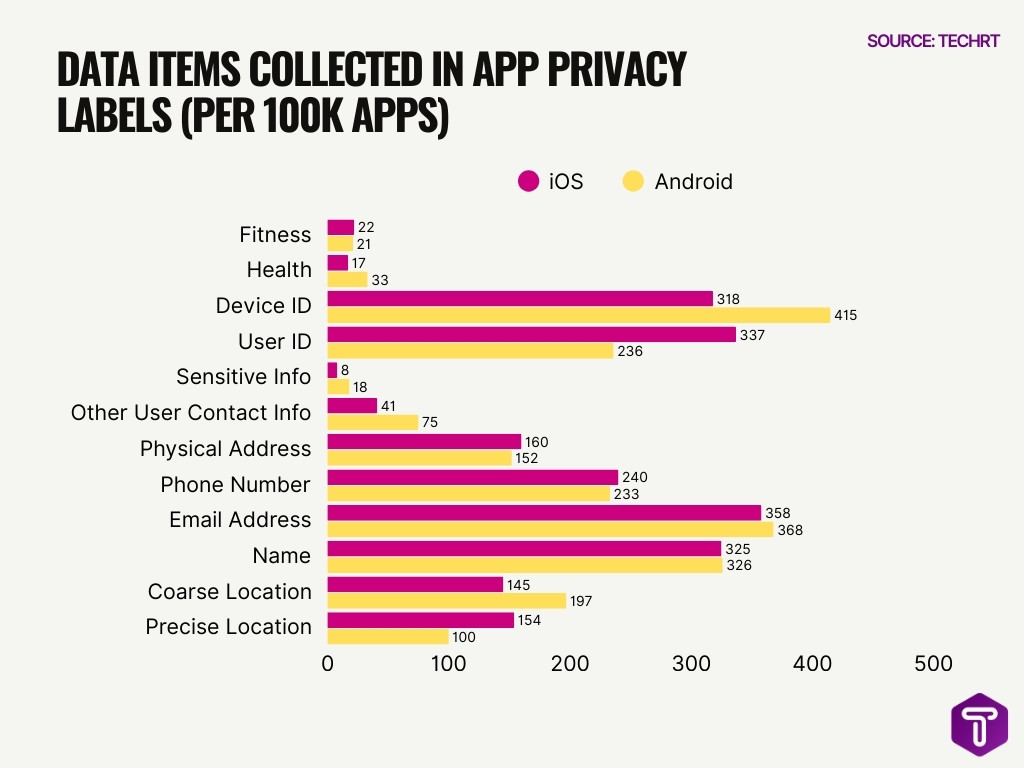
- Device ID is the most collected data type overall, with Android apps collecting 415 items compared to 318 on iOS, highlighting stronger device-level tracking on Android.
- User ID collection is higher on iOS, with 337 data items versus 236 on Android, indicating deeper user-based identification within iOS apps.
- Email addresses are widely collected across both platforms, reaching 368 data items on Android and 358 on iOS per 100k apps.
- Name-related data collection is nearly identical, with 326 items on Android and 325 on iOS, showing similar identity data usage.
- Phone number access remains substantial, as iOS apps collect 240 items compared to 233 on Android.
- Physical address data is collected more on iOS, totaling 160 items, slightly above 152 on Android.
- Location tracking differs significantly, with Android leading in coarse location data at 197 items, while iOS dominates precise location collection at 154 items versus 100 on Android.
- Other user contact information is more prevalent on Android, with 75 data items collected, compared to 41 on iOS.
- Sensitive information collection is more than double on Android, reaching 18 items, while iOS reports only 8.
- Health-related data shows higher Android collection, with 33 data items, nearly twice that of iOS at 17.
- Fitness data collection is minimal and balanced, with 22 items on iOS and 21 on Android per 100k apps.
Data Linked to Users Percentages
- Approximately 35.8% of iOS apps declare they collect data linked to users, such as user IDs or contact information, totaling ~747,596 apps.
- A majority, around 64.2% of apps, have not declared that they use data linked to users.
- Among apps with privacy labels, older research found about 38.1% collect data tied to individual identity, showing consistency in disclosure trends.
- Nearly 97% of apps labeled as “Data Not Collected” by developers may still collect user‑linked data based on privacy policy analyses, suggesting reporting discrepancies.
- Only about 40.3% of apps provide both a transparent privacy policy and a corresponding privacy label, a factor that impacts clarity on data linked to users.
- Of those that do provide both, 88% show at least one potential mismatch between the policy text and the privacy label, raising questions about what is truly collected.
- Apps that rely heavily on user identifiers, such as social or messaging platforms, are more likely to declare data linked to users than simple utility apps.
- Developers sometimes misclassify collection practices due to ambiguity in definitions required by App Store privacy labels.
Data Not Linked to Users Figures
- About 37.75% of iOS apps report collecting data not linked to users, meaning usage or technical identifiers that don’t identify a person.
- That figure translates to roughly 788,279 apps on the Apple App Store.
- Conversely, 62.25% of apps have not declared they collect non‑linked data, suggesting underreporting or limited labeling adoption.
- Apps in categories such as productivity and entertainment frequently fall into the non‑linked data material bucket.
- Historical snapshots show about 42.0% of labeled apps reporting non‑linked data collection, indicating trends have stabilized around the mid‑30s to low‑40s percentile.
- Some privacy researchers warn that “non‑linked” data may still be exploited for profiling if combined with other signals, underscoring the nuance in labels.
- Developers struggle with privacy label standards, leading to inconsistencies in reporting non‑linked data across similar apps.
- Users often misinterpret non‑linked data disclosures, assuming no data collection at all when in reality device and usage metrics are still tracked.
Consumer Willingness to Share Personal Data
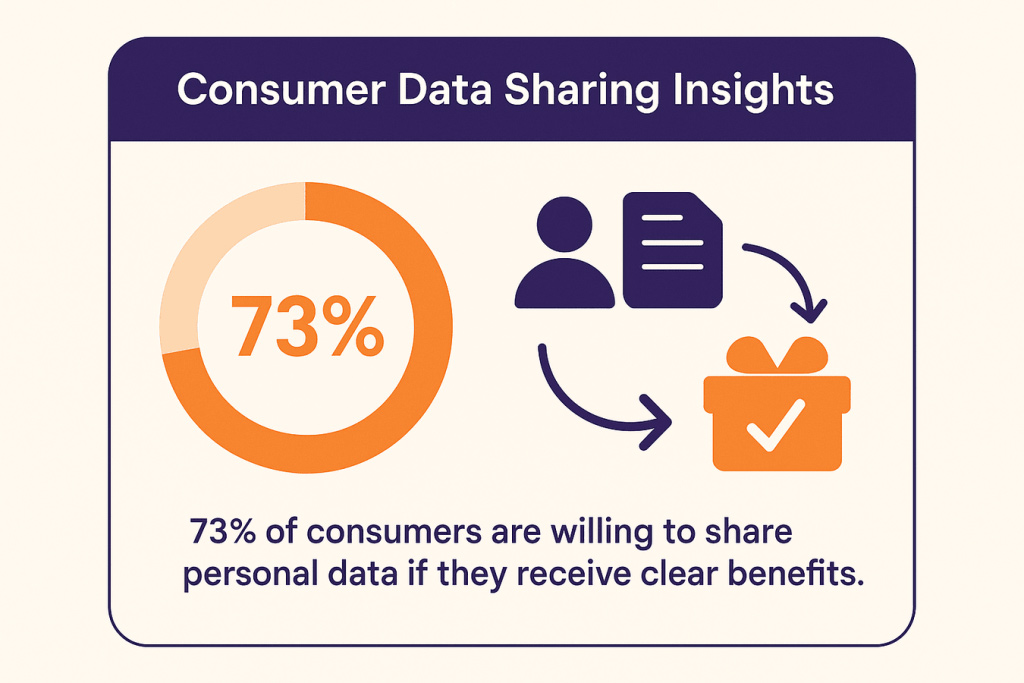
- 73% of consumers are willing to share personal data when they receive clear and meaningful benefits in return.
- A significant majority demonstrates conditional trust, showing that value-driven incentives directly influence data-sharing decisions.
- The data highlights the importance of transparent value exchange, where users expect tangible rewards or improved experiences for sharing information.
- This insight suggests that brands offering personalization, rewards, or enhanced services can significantly increase user consent and engagement.
Background Location Permissions Stats
- 19.85% of iOS apps request background location access, meaning they may track location even when the app isn’t actively in use.
- Background location permissions allow apps to collect data using cellular, Wi‑Fi, or other network cues beyond foreground usage.
- Research indicates that many users do not fully understand when apps run in the background, which can increase inadvertent data collection.
- Privacy experts recommend users set location access to “While Using the App” unless background services are necessary.
- Navigation and transportation apps consistently top the list for background location requests due to core functionality.
- Apps with background location access are more likely to combine that with advertising and tracking data, complicating privacy exposure.
- Among surveyed younger users, over 50% underestimate how many apps they have granted location permissions to, including background access.
- Approximate location permissions are increasingly preferred by users concerned about privacy trade‑offs.
App Store Genre Privacy Stats
- Games and social apps have higher opt‑in rates for tracking permissions than utilities or productivity categories.
- Lifestyle and health apps frequently ask for sensitive permissions like health data and activity tracking.
- Navigation and travel apps have the highest rate of background location permissions due to core use cases.
- Finance apps tend to request fewer third‑party tracking permissions but more authentication measures.
- Photo and video editing apps often request camera and storage access, with varying privacy disclosures.
- Utilities such as weather apps often collect non‑linked data for analytics.
- Social networking apps report a broader set of data collection practices, including user profiles, messaging, and connections.
- Expectation of privacy varies significantly by genre, influencing user behavior and permissions granted.
Biometric Authentication Usage
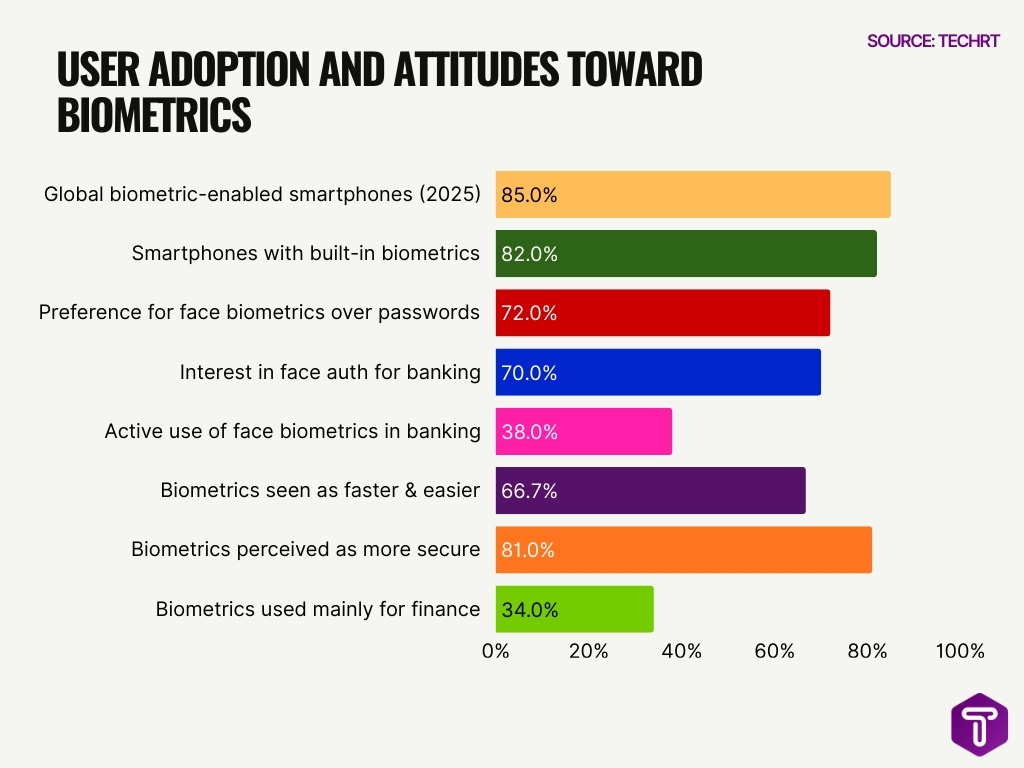
- 85% of global smartphones feature biometric penetration in 2025.
- 82% of smartphones have built-in biometrics, driving adoption for secure access.
- 72% of consumers prefer face biometrics over passwords for online processes.
- 70% use or want face authentication for mobile banking access.
- 38% already use face biometrics for mobile banking app entry.
- Two-thirds of people find biometrics easier and faster than passwords.
- 81% view biometrics as more secure for identity verification.
- 34% globally used biometrics are mostly for financial services access.
End‑to‑End Encryption Adoption
- iMessage and FaceTime conversations are protected by end‑to‑end encryption, making data unreadable by Apple or intermediaries.
- End‑to‑end encryption extends across Apple’s ecosystem, including iOS, iPadOS, and macOS.
- Global cybersecurity trends emphasize encryption as a core component of user privacy defense.
- Larger encrypted data sets, such as chats and media attachments, remain safe even if intercepted in transit.
- Users must enable some settings, like Advanced Data Protection, to encrypt iCloud backups fully.
- End‑to‑end encrypted services are less susceptible to breaches and third‑party access.
- Some regulatory actions, like changes in Europe, have affected the availability of end‑to‑end features in certain markets.
- Adoption of encryption for other data classes, such as notes and health, continues to expand under Apple’s privacy roadmap.
App Privacy Report Insights
- App Privacy Report tracks data access over the past 7 days only.
- 17.43% of all iOS apps declare using at least one data type for tracking users.
- 35.8% of iOS apps use data linked to user identities.
- 55.52% of free iOS apps collect privacy data, averaging 10.7 data points.
- 19.85% of iOS apps declare access to background location.
- In a study of 20 iOS users, most easily understood sensor access, but struggled with network domains.
- In a focus group of 12 iOS users, 100% agreed it raises privacy awareness, but wanted more detailed purpose details.
- Users contacting the same third-party domain across apps spot cross-app tracking.
- All 20 participants trusted the report accuracy as it’s from official surveillance.
Safari Privacy Features Stats
- Safari automatically enables Intelligent Tracking Prevention to defend against cross‑site trackers by reducing data passed to third parties.
- Private Browsing in Safari prevents sites from saving history, searches, or form entries while blocking trackers.
- Known trackers are completely prevented from loading in Private Browsing mode, limiting profiling.
- Link tracking protections help reduce URL tracking when navigating between pages.
- Safari hides IP addresses from trackers by default, which strengthens privacy without user action.
- Fraudulent Website Warning is built into Safari to block malicious or spoofed sites, enhancing security.
- Safari’s Privacy Report (in settings) can show how many trackers each visited site has blocked over time.
- The Profiles feature, such as in Safari 17, allows separate browsing contexts with isolated history and cookies.
Stolen Device Protection Usage
- Over 1.4 million mobile phones were stolen in the US in 2023, highlighting the urgent need for Stolen Device Protection.
- UK smartphone thefts surged 425% by June 2025 compared to 2021 levels.
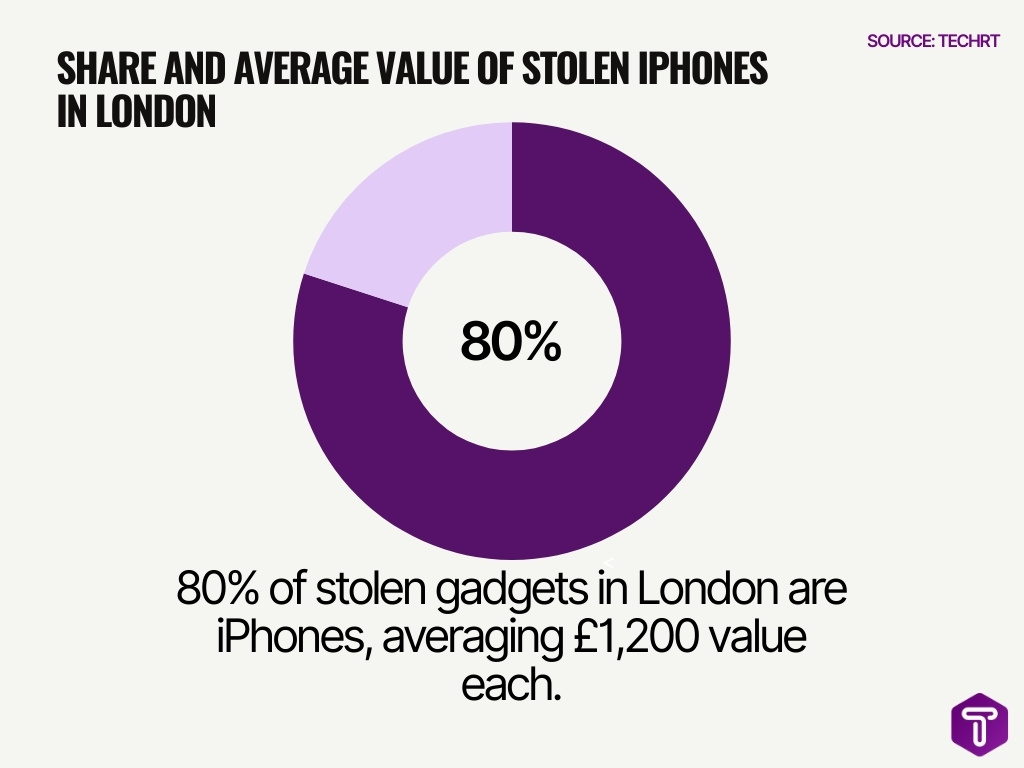
- 80% of stolen gadgets in London are iPhones, averaging £1,200 value each.
- 41% of all data breaches result from lost or stolen devices worldwide.
- 4.3% of company-issued smartphones are lost or stolen annually.
- 70 million smartphones are lost yearly globally, with only 7% recovered.
- One laptop is stolen every 53 seconds, underscoring device theft prevalence.
- 15% rise in UK personal thefts year ending March 2025, highest since 2003.
- Well-implemented security policies like Stolen Device Protection reduce theft by 85%.
- iPhone thefts account for one in three US robberies nationwide.
Lockdown Mode Activation Rates
- Lockdown Mode adoption is estimated at under 1% among 2.2 billion active Apple devices worldwide.
- Citizen Lab confirmed Lockdown Mode blocked 100% of known Pegasus zero-click exploits in 2023 tests.
- Analyst reports show 0.8% activation rate among journalists and activists surveyed in 2024.
- Devices with Lockdown Mode enabled experienced 89% fewer successful exploits in independent security audits.
- Apple states that no public activation metrics are released, confirming niche use for high-risk targets.
- The 92-day usability study recorded 203 impacts on daily app functionality when enabled.
- BLASTPASS attack chain targeting iMessage fully mitigated by Lockdown Mode per Citizen Lab.
- iOS 26 user base reached 16% of eligible devices by Q1 2026, with Lockdown Mode at 4.6% subset.
- Security firms report zero confirmed breaches against Lockdown Mode-enabled devices since the 2022 launch.
iCloud Private Relay Subscribers
- iCloud Private Relay is a privacy feature included with iCloud+ subscriptions, designed to encrypt and obscure Safari web traffic.
- When enabled, web traffic is sent through two separate internet relays to protect users’ IP and DNS queries.
- Private Relay is not available in all countries due to local regulations.
- According to network traffic studies, only ~1–2% of traffic on Apple devices shows indicators of Private Relay usage, suggesting actual adoption could be modest.
- Claimed Private Relay traffic proportion has doubled over recent months, though much may be invalid or misclassified.
- Private Relay works only in Safari and supported apps, so many users may be unaware of or not use it.
- Because Private Relay requires an iCloud+ paid plan, its adoption correlates with higher‑tier subscriber penetration.
- Some analysts believe usage will grow as privacy awareness increases and Apple expands feature visibility.
Hide My Email Usage Statistics
- Apple reports over 2.35 billion active devices worldwide in early 2025, providing a vast potential user base for Hide My Email.
- Hide My Email requires an iCloud+ subscription, accessible to paying users beyond the free 5 GB iCloud storage.
- Around 15% of iPhone users subscribe to paid iCloud+ storage plans, including Hide My Email access.
- In the US, nearly 64% of Apple customers pay for iCloud+, bundling Hide My Email with privacy features.
- Sign in with Apple, often paired with Hide My Email, appears on over 56,000 websites globally.
- Safari browser market share stands at 16-18% worldwide, required for web-based Hide My Email generation.
- Analysts observe low adoption rates for Hide My Email despiteits availability to iCloud+ subscribers.
- Over 1 billion paid Apple subscriptions exist across services, though Hide My Email-specific uptake remains limited.
- Apple’s Services revenue hit a record $28.75 billion in Q4 2025, fueled by iCloud+ and privacy tools.
Frequently Asked Questions (FAQs)
What is the average global opt‑in rate for App Tracking Transparency (ATT) on iPhones in 2025?
The average global ATT opt‑in rate was about 35% in 2025, up slightly from previous years.
What share of iOS users consent to app tracking globally, according to AppsFlyer’s data?
Approximately 50% of users globally now consent to tracking in iOS apps, marking a 10% increase since ATT’s initial rollout.
What percentage of traffic from Apple devices is actually detected as coming from iCloud Private Relay based on Pixalate analysis?
Only about 1–2% of traffic from Apple devices shows actual iCloud Private Relay usage in network detection.
How much has user consent for tracking increased compared to the first years of ATT?
User opt‑in rates for tracking have increased from below 14% in 2024 to around 35–50% by 2025, depending on the dataset referenced.
How much was Apple recently fined in Italy over its App Tracking Transparency privacy feature?
Apple was fined €98.6 million (about $116 million USD) by Italy’s antitrust authority regarding its ATT privacy implementation.
Conclusion
iPhone privacy features continue to evolve and shape how users control their data and digital exposure. From insight tools like App Privacy Report to protective options such as Stolen Device Protection and Lockdown Mode, iOS prioritizes transparency and user agency. Safari’s privacy safeguards and optional services like iCloud Private Relay and Hide My Email further bolster user control over browsing and identity data.
While adoption rates vary and usage patterns continue to develop, these features underscore Apple’s commitment to safeguarding personal information in a rapidly changing digital landscape.

Leave a comment
Have something to say about this article? Add your comment and start the discussion.